4.2.2: Inequality
 Call Kai
 Learn
Learn Practice Test
 Spaced Repetition
 Match
Match Flashcards
 Knowt Play
1/9

There's no tags or description
Looks like no tags are added yet.
Name | Mastery | Learn | Test | Matching | Spaced | Call with Kai |
|---|
No analytics yet
Send a link to your students to track their progress
10 Terms
Wealth and inequality
Income is a flow of earnings
Wealth is a stock of asset
Income inequality refers to the extent to which income is distributed in an uneven manner
Wealth is likely to be more unequally distributed because assets that make up wealth can be accumulated over time
People who are wealthy now can generate an income from their assets and as long as income exceeds expenditure, they are able to build up a stock of assets
This accumulation wealth can occur over successive generations via inheritance
Measures of inequality: The Lorenz curve
Shows the cumulative percentage of the population plotted against the cumulative percentage of income that people have
A perfectly equal society would have a straight line from corner to corner
The degree of the bend away from the straight line indicates the degree of inequality
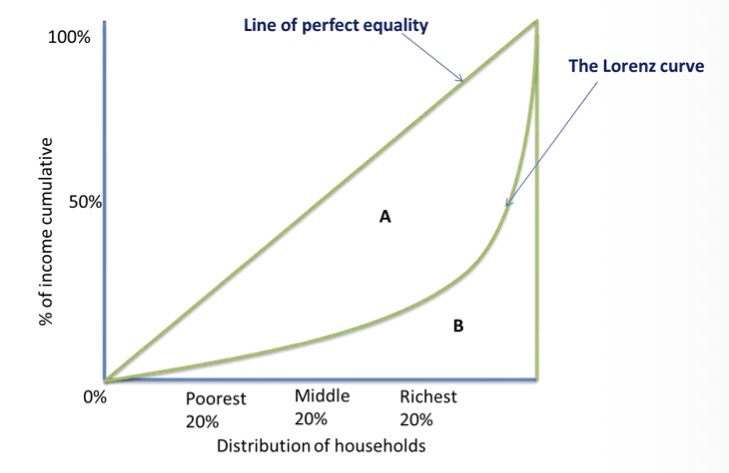
Measures of inequality: The Gini coefficient
The ratio of the area between the 45 degree line and Lorenz curve divided by the whole triangle under the 45 degree cruve
It is measure between 1 and 0
The larger the coefficient, the more unequal the country
Causes of wealth and income inequality: Wages
Some workers simply earn more than others- can be due to higher educational achievements, working longer hours, skills are more in demand
Those who aren’t in work will have a lower income than others e.g. pensioners, those on benefits
The higher the level of income, the more someone can save and thus the more wealth they can build up
Those on high incomes will be able to build up a stock of assets, whilst those on lower incomes may have to spend most of their money on everyday items like food
Causes of wealth and income inequality: Wealth levels
Someone who already has high levels of wealth is able to build up larger wealth than those on lower levels of wealth
E.g. they may undertake a risky investment which will give a higher rate of return
Those with lower levels of wealth are unable to do so
Inheritance often allows high levels of wealth
High levels of wealth mean people can earn rent or interest on their assets and therefore generate income from their assets
Causes of wealth and income inequality: Chance
Those who bought houses in the right area or bought the right assets will see a huge increase in the price of their assets and hence an increase in their wealth
They may have ben lucky to inherit wealth
Those who chose the right sort of job will have seen their income higher than other rates
Causes of wealth and income inequality: Age
Working adults at the peak of their career will earn a higher income than those who have just started
Those who are older will have had a chance to build up more assets, although some of this stock may have been used up to pay for retirement
Causes of wealth and income inequality between countries
Some countries have been held back by wars, colonialism, droughts, famines and earthquakes
Certain social groups may have been excluded and marginalised
Developed countries tend to favour each other when trading, negotiating etc
This helps them to develop more than countries who are not involved in the agreements
The Kuznets hypothesis
Says that as society develops and moves from agriculture to industry, inequality increases as the wages of industrial workers rises faster than farmers
Then wealth is redistributed through taxation and government spending and as a result inequality falls
However, Piketty discredited this theory by arguing inequality rises as the country develops as the rate of return on capital grows, so the rich get richer and inequality decreases
Significance of capitalism
A capitalist economy leads to income inequality because of wage differentials
Wages vary as they are based on demand and supply, and demand and supply vary for different jobs
Individuals also own resources and thus wealth differs based on the assets they own
Wealth can be passed on or gained through saving of incomes
It is argued that equality can never be achieved in a capitalist society where the possibility of having more is important to encourage hard work
Without the incentive to gain more, people will not try hard or take risks since they have no reason to and this means the economy won’t grow- inequality is essential for capitalism to work
A degree of inequality is necessary and desirable, but excessive inequality causes problems with efficiency and social justice