RAD 170 Final Exam
 Call Kai
 Learn
Learn Practice Test
 Spaced Repetition
 Match
Match Flashcards
 Knowt Play
1/104

There's no tags or description
Looks like no tags are added yet.
Name | Mastery | Learn | Test | Matching | Spaced | Call with Kai |
|---|
No analytics yet
Send a link to your students to track their progress
105 Terms
Resolution is improved when ______.
A. OID increases
B. OID Decreases
C. SID Decreases
D. None of the above
B. OID Decreases
Which of the following will influence the resolution in an image?
A. SID
B. OID
C. Focal Spot size
D. All of the above
D. All of the above
Which of the following groups of exposure factors would be MOST appropriate to control involuntary motion?
A. 400 mA, 0.03 sec
B. 200 mA, 0.06 sec
C. 600 mA, 0.02 sec
D. 100 mA, 0.12 sec
C. 600 mA, 0.02 sec
A lateral view of the cervical spine is requested. Which distance factor will give the least amount of recorded detail?
A. 36" SID
b. 40" SID
C. 48" SID
D. 72" SID
A. 36" SID
If the OID is decreased, unsharpness ______and recorded detail _______
Decreases, Increases
The following image is an example of what type of distortion?
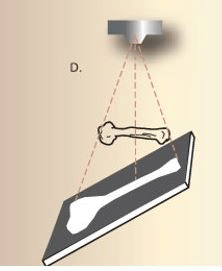
Elongation
You take an image using 80 kVp at 10 mAs and your EI # indicates that the image is overexposed. Using the 15% rule to decrease the exposure, what would your new technique be for your repeat image?
68 kVp @ 10 mAs
When an angle is used on the tube, SID should be adjusted by ______ inch(es) for every 5 degrees of CR angulation
1 inch
Write out the formula for the inverse square law.
old intensity/new intensity = new distance2/old distance2
True or False: It is OK to use AEC Center cell for a lateral CXR exposure.
True
Which quality factor allows visualization of the image?
A. Brightness
B. Contrast
C. Density
B. Contrast
All of the following affect spatial resolution, EXCEPT:
A. mA
B. focal spot size
C. SID
D. OID
A. mA
The largest contributing factor to magnification in an image is:
OID
____________ is the loss of some of the energy from the x-ray beam as it passes through the tissue being imaged.
Attenuation
Factors that affect the Visibility of detail in an image include all of the following EXCEPT:
A. Brightness
B. X-ray tube focal spot size
C. Image contrast
D. Use of radiographic grids
B. X-ray tube focal spot size
True or False: As beam restriction increases, receptor exposure decreases
True
Which set of technical factors will result in the best spatial resolution?
mAS kVp SID OID FSS
A. 25 70 40” 4” 0.6mm
B. 12 80 72” 4” 0.6mm
C. 15 70 72” 8” 0.6mm
D. 20 80 40” 8” 1.2mm
B.
Which type of technique would produce the least radiation dose to the patient?
A. High kVp technique
B. Low kVp technique
A. High kVp technique
The Anode Heel Effect results in less intensity at the _____ side of the tube
Anode
While performing an abdomen examination in the erect position using an AEC unit, You use 72 inches rather than 40 inches SID. The IR Exposure EI# / DI# of this radiograph will indicate that it was:
A. Underexposed
B. Overexposed
C. Acceptable
D. Mottled
C. Acceptable
The x-ray beam that leaves the patient is made up of scatter and primary radiation. This beam is referred to as:
Exit (remnant) radiation
If the x-ray tube is moved closer to the IR, the radiation intensity at the IR:
Increases
If the SID doubles and no other changes are made, the radiation intensity at the Image Receptor:
A. Doubles
B. Is cut in half
C. Quadruples
D. Is reduced by a factor of 4
D. Is reduced by a factor of 4
The 15% rule states that: an increase of 15% of the kVp will increase the IR exposure the same as:
Doubling the mAs
The negative effects of increased OID can be mitigated by:
A. Decreasing focal spot size
B. Decreasing SID
C. Increasing focal spot size
D. Increasing SID
D. Increasing SID
A positive beam limiting device is also known as:
Automatic collimator
True or False: An x-ray image can be distorted by both magnification and minification.
False
For a variable kVp chart, which factor is held constant?
mAs
A compensating filter is used for:
A. Improvement of image quality
B. High kVp exposure to reduce scatter
C. An area of equal or consistent tissue thickness
D. Reduction of patient dose
A. Improvement of image quality
If two anatomic parts received the same amount of radiation, which would display the greatest image receptor exposure?
A. The thinner anatomic part
B. The thicker anatomic part
A. The thinner anatomic part
True or False: When using an AEC, the radiographer must set the kilovoltage.
True
When using AEC for an exposure, if kVp is increased on a repeat exposure, the following will occur:
A. The exposure time increases
B. The exposure time decreases
C. None of the above is affected
B. The exposure time decreases
The tube current is the:
mA
If the AEC center detector is used instead of the two outside cells for a PA chest exposure the radiograph will:
A. Be underexposed
B. Show motion
C. Have too much contrast
D. Be overexposed
D. Be overexposed
The tissue interaction involving the photoelectric effect is associated with ________ .
A. Scattering of the primary photon
B. Exit radiation
C. Absorption of the primary photon
D. Transmission of the primary photon
C. Absorption of the primary photon
Which factor would most likely improve the spatial resolution in a radiographic image of the wrist?
A. Increasing the OID
B. Decreasing the FSS
C. Using a higher kVp
D. Setting a lower mAs
B. Decreasing the FSS
As the SID is increased, the recorded size of the object in the image will:
A. Increase
B. Decrease
C. Remain the same
B. Decrease
If a satisfactory IR Exposure (acceptable EI/DI#) is obtained with 70 kVp and 20 mAs at 40inch SID, what mAs is required to maintain the same IR Exposure at 72 in. SID?
65 mAs (Exposure Maintenance Formula)
When an x-ray tube is not centered along the center-line of a focused grid, it is termed:
A. Off focus
B. Lateral decentering
C. Off angle
B. Lateral decentering
What type of distortion is shown here?
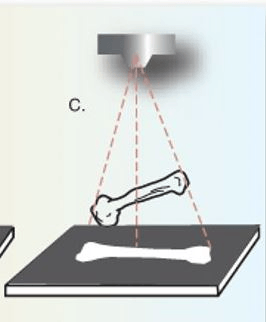
Foreshortening
The number of lead strips per inch in a grid is a measure of:
Grid frequency
A grid should be used when part thickness exceeds:
10 cm
Compton scattering occurs when an incident x-ray photon interacts with a _____ electron.
A. Loosely bound inner-shell
B. Tightly bound inner-shell
C. Loosely bound outer-shell
D. Tightly bound outer-shell
C. Loosely bound outer-shell
An object is placed at an angle to the image receptor. If the central ray is directed perpendicular to the image receptor through the center of the object, the image of the object will appear:
A. Spatially distorted
B. Foreshortened
C. Elongated
D. Blurred
B. Foreshortened
The total filtration in mm of Aluminum equivalent of a fixed radiographic unit operating above 70 kVp is required to be ______.
2.5 mm
A forearm radiograph is acquired using 2.5 mAs and 60 kVp. In order to double image receptor exposure without other technique changes, what new kVp is required?
69 kVp
True or False: For accurate representation of air fluid levels, the patient must be as upright as possible and the CR should be angled to match the angle of the patient.
False
Which formula is used when calculating intensity with a change in distance?
Inverse square law
The radiolucent strips in a grid: _____________ . (select all that apply)
A. Absorb scattered x-rays
B. Allow transmitted photons to pass through
C. Absorb transmitted electrons
D. Have a low atomic number
B. Allow transmitted photons to pass through
D. Have a low atomic number
The range of acceptable source-image distances that can be used on a focused grid is called the:
A. Grid maximum distance
B. Grid ratio
C. Focal range
D. Grid frequency
C. Focal range
Which of the following is not one of the four radiographic quality factors?
A. Receptor exposure/brightness
B. mAs
C. Spatial Resolution
D. Distortion
B. mAs
When performing an abdomen radiograph, which body habitus would result in the largest scatter production?
A. Asthenic body habitus
B. Sthenic body habitus
C. Hypersthenic body habitus
D. All body habitus will have the same amount of scatter
C. Hypersthenic body habitus
Which term describes absorption characteristics of the anatomic tissues radiographed?
A. Subject contrast
B. Recorded detail
C. Image contrast
D. Spatial resolution
A. Subject contrast
Compared to other anatomic tissues, _______ is considered a low attenuator and will produce _______densities on an image.
A. bone, lighter
B. bone, darker
C. air, darker
D. air, lighter
C. air, darker
With digital imaging, we receive visual feedback that tells us our technique is appropriate.
A. True
B. False
B. False
Scattered radiation that hits the IR produces:
A. decreased recorded detail and decreased IR exposure
B. increased distortion and lower contrast
C. increased IR exposure and lower contrast
D. higher contrast and decreased IR exposure
C. increased IR exposure and lower contrast
A radiograph with few gray tones, primarily exhibiting black and white, would be described as having what type of contrast? Select two:
1. Long scale
2. Short scale
3. Low
4. High
2 and 4, short scale, high contrast
Thinner body parts result in less ________ than a thicker body part.
A. Transmission
B. Brems
C. Attenuation
D. All of the above
C. Attenuation
The primary controlling factors for receptor exposure are:
A. kVp and mAs
B. SID and OID
C. mAs and SID
D. SID, OID, FSS
A. kVp and mAs
Spatial Resolution in digital radiography is defined as the:
A. Total number of brightness levels in the radiograph
B. Structural sharpness recorded in the radiograph
C. Amount of geometric distortion displayed in the radiograph
D. Total number of photons absorbed by the IR.
B. Structural sharpness recorded in the radiograph
Attenuation decreases with increasing beam quality.
A. True
B. False
A. True
Which factor does NOT affect radiographic contrast?
A. kVp
B. computer processing
C. Focal spot size
D. Use of a grid
C. Focal spot size
Receptor exposure is defined as the:
A. Amount of radiation striking the image receptor
B. Amount of radiation absorbed by the patient
C. Visible difference in brightness levels in the image
D. Amount of magnification in the digital image
A. Amount of radiation striking the image receptor
A technologist can identify an image produced with excessively high mAs based on which of the following?
A. The appearance of quantum mottle
B. The appearance of excessive image contrast
C. The appearance of vertical streaks in the image
D. An exposure indicator outside of the acceptable range
D. An exposure indicator outside of the acceptable range
What is the primary factor controlling subject contrast?
A. The absorption characteristics of the tissues and structures being exposed
B. The intensity of the incident x-ray beam
C. The dynamic range of the image receptor used for the exposure
D. The geometric factors used for the exposure
A. The absorption characteristics of the tissues and structures being exposed
Which of the following is NOT one of the visibility factors of image quality?
A. Receptor exposure
B. Brightness
C. Spatial resolution
D. Contrast
C. Spatial resolution
Producing an acceptable radiograph requires consideration of:
A. technical factor selection
B. pathology
C. image processing
D. all of the above
D. all of the above
If the same amount of radiation is sent through two tissues of the same makeup, but are different thicknesses, the most radiation would emerge from:
A. Thicker tissue
B. Thinner tissue
C. Neither-it would be the same
B. Thinner tissue
Which quality factor allows visualization of the image?
A. Brightness
B. Contrast
C. Density
B. Contrast
Which of these pathologies is considered additive?
A. Pneumothorax
B. Bowel obstruction
C. Atelectasis
D. Emphysema
C. Atelectasis
Which of the following would influence tissue thickness and opacity?
Patient build or physique
Patient age
Patient pathology
All of the above
All of the above
Destructive disease processes typically require a(n) ________ in radiographic technique in order to compensate and maintain IR exposure level to the digital image receptor.
A. increase
B. decrease
C. No change
B. decrease
If a radiograph is determined to have high contrast, which of the following statements is also generally true?
A. It also has many shades of gray
B. It also has short scale contrast
C. It also has a long scale contrast
D. It's overexposed
B. It also has short scale contrast
Which of the following can impact the remnant signal? Select all that apply.
A. Tissue density
B. Pathology
C. Beam restriction
D. All of the above
D. All of the above
Which of the following body habitus is the term for a very slender person?
A. Hypersthenic
B. Sthenic
C. Asthenic
D. Lowsthenic
C. Asthenic
Practices that enable the radiographer to reduce the exposure time required for a particular image include:
1. use of a higher milliamperage
2. use of a higher kilovoltage
3. use of a higher ratio grid
1 and 2
Which of the following represents an ideal DI number?
A. +3
B. 0
C. +1
D. -1
B. 0
A higher atomic number in tissue results in:
A. increased attenuation
B. decreased attenuation
C. increased scatter
D. increased transmission
A. increased attenuation
What is the effect of thicker body parts on radiation exposure to the IR?
A. Increased exposure
B. Decreased exposure
C. No effect
D. Uniform exposure
B. Decreased exposure
A radiopaque structure can be defined as:
A. made of low attenuation material, allowing more x-rays to pass through the IR
B. made of high attenuation material, blocking x-rays from reaching the IR
C. a structure that is magnified in the radiograph
D. a structure that is distorted in the radiograph
B. made of high attenuation material, blocking x-rays from reaching the IR
What is the primary factor affecting size distortion?
Object-to-image distance (OID)
Source-to-image distance (SID)
Focal spot size
Object-to-image distance (OID)
Which scenario produces the least magnification on a radiograph?
Short OID and short SID
Long OID and long SID
Long OID and short SID
Short OID and long SID
Short OID and long SID
Distortion in radiography refers to the misrepresentation of:
Only size
Only shape
Both size and shape
Image contrast
Both size and shape
In radiographic imaging, size distortion is also known as:
Foreshortening
Elongation
Magnification
Minification
Magnification
When size distortion decreases, how does image unsharpness change?
It increases
It decreases
It remains unchanged
It decreases
Which exam inherently has the smallest OID?
Lateral cervical spine
AP lumbar spine
Lateral chest
RAO ribs
AP lumbar spine
Which setup results in the least amount of shape distortion?
CR perpendicular to both the object and IR
Object parallel to the IR but CR angled
IR perpendicular to the CR but angled to the object
Object tilted but IR perpendicular
CR perpendicular to both the object and IR
Which of the following describes geometric aspects of radiographic imaging?
Visibility
Photographic properties
Image sharpness, size, and shape
Exposure
Image sharpness, size, and shape
Which factors control magnification?
CR angle and SID
OID and focal spot size
Focal spot size and CR angulation
SID and OID
SID and OID
If an object is placed at an angle but the CR is perpendicular to the IR, the image will appear:
Foreshortened
Elongated
Distorted
Blurred
Foreshortened
Spatial resolution is affected by OID in what way?
Directly proportional
Inversely proportional
Unaffected
Randomly
Inversely proportional
For accurate air-fluid level demonstration, the CR must be:
Perpendicular to the IR
Angled 15 degrees
Parallel to the floor
None of the above
Parallel to the floor
If the image of an object appears 25% larger than its actual size, what is the magnification factor?
0.75
1.00
1.25
1.50
1.25
A satisfactory image is made using a minimal amount of object to image distance. A second image is made with a 4” OID as a result the following will occur: (assume that all other factors are constant and no compensations occurred).
visibility is unchanged, sharpness is increased
visibility is increased, sharpness is decreased
visibility is unchanged, sharpness is decreased
visibility is unchanged, sharpness is unchanged
visibility is unchanged, sharpness is decreased
If the large focal spot is used instead of the small focal spot:
contrast will decrease
unsharpness will increase
exposure will increase
spatial resolution will increase
unsharpness will increase
What are the requirements of a good breathing technique?
high mA, short exposure time
low mA, long exposure time
long exposure time, increased kVp
none of the above are correct
low mA, long exposure time
When anatomical structures overlap in an image, they are said to be:
Foreshortened
Elongated
Superimposed
Superimposed
A linear structure positioned at an angle to the IR, with the CR perpendicular to the IR, will appear:
Spatially distorted
Foreshortened
Elongated
Magnified
Foreshortened
A technologist is performing an AP projection of the lumbar spine. If the central ray is angled 15° cephalad instead of perpendicular to the image receptor, which type of distortion is most likely to occur?
Foreshortening
Elongation
Magnification
No distortion will occur
Elongation
If a radiograph shows an object appearing significantly shorter than its actual size, which of the following errors most likely occurred?
The central ray was angled incorrectly
The object was placed too close to the image receptor
The object was not parallel to the image receptor
The SID was too high
The object was not parallel to the image receptor