Chapter 20, and 21: Development of Evolution
 Call Kai
 Learn
Learn Practice Test
 Spaced Repetition
 Match
Match Flashcards
 Knowt Play
1/46

There's no tags or description
Looks like no tags are added yet.
Name | Mastery | Learn | Test | Matching | Spaced | Call with Kai |
|---|
No analytics yet
Send a link to your students to track their progress
47 Terms
Why does evolution matter?
In 1858 Charles Darwin and Alfred Russel Wallace each presented papers to the Linnaean Society of London describing a mechanism for biological evolution
In 1859 Darwin published his book, On the Origin of Species by Means of Natural Selection, which proposed that natural mechanisms produced the diversity of life on Earth
Darwin’s concept of evolution forms the unifying paradigm within which all biological research is undertaken
Biological evolution occurs in populations when?
Specific processes cause the genomes of organisms to differ from those of their ancestors
What are the products of evolution?
The genetic changes, and the phenotypic modifications they cause
By studying the products of evolution, biologist are able to learn?
About the processes that cause evolutionary change
Natural History is a branch of biology that?
Examines the form and variety of organisms in their natural environment
What did Aristotle propose/make?
A ladder-like classification of nature, known as the Great Chain of Being
Aristotle’s Great Chain of Being, is the idea in which?
Each specieis if formed individually with its own purpose and place in nature and where no species evolves into a new species
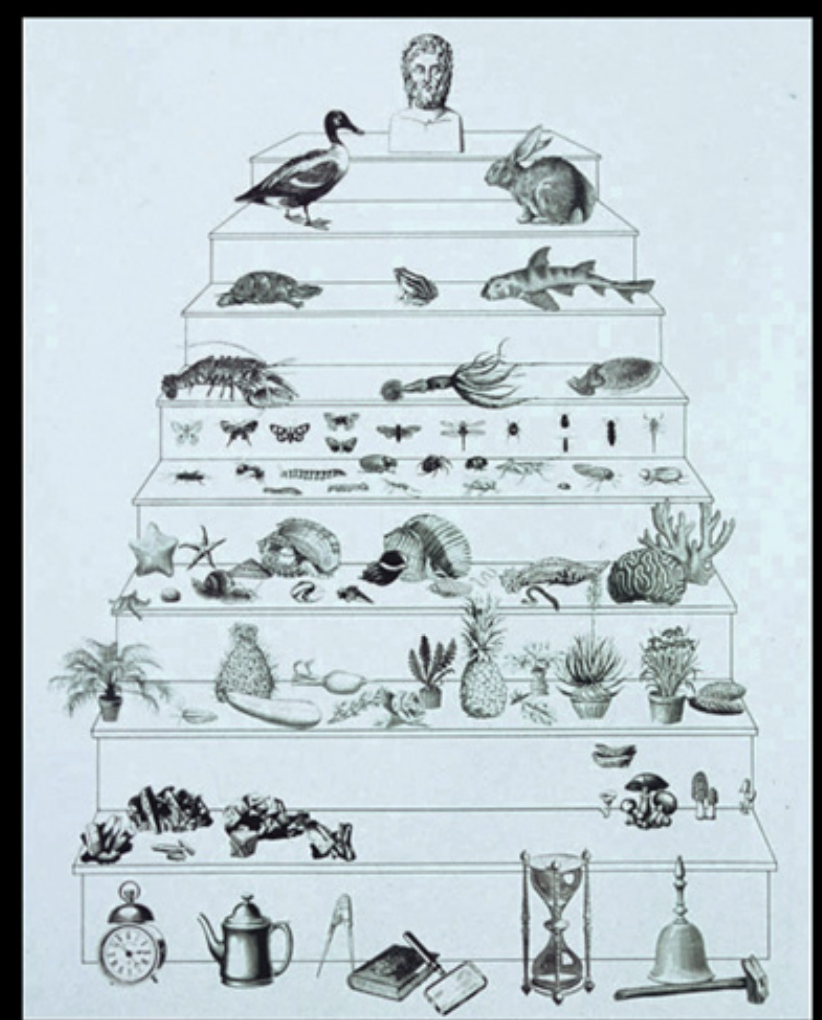
By the fourteenth century, Europeans had formed Natural Theology by?
Merging Artistotles’s calssification system with bibical creations
What are some points of Natural Theology?
-Each organism had been independently created by god
-New species could not arise from other species
-Extinction was initially resisted by some natural theologians because it conflicted with the idea of a perfect, complete creation
Three new disciplines promoted a growing awareness of change
Biogeography
Comparative Morphology
Paleobiology
What is Biogeography?
Studies of the world distribution of plants and animals
Global explorations provided naturalists with?
Thousands of unknown plants and animals
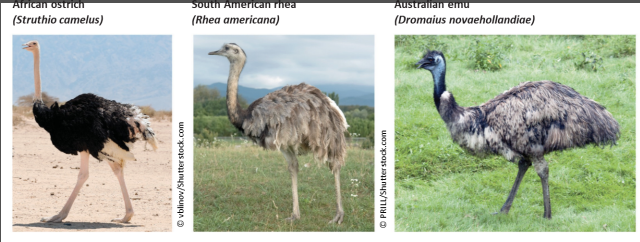
What does this diagram show?
Some species found in similar habitats in different areas resembled each other
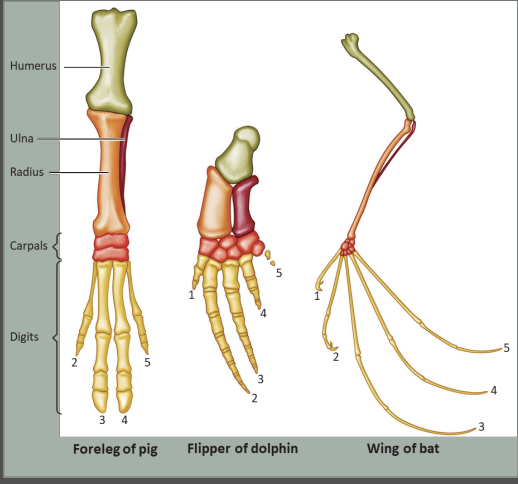
When biologist began to compare the morphology (_________) of organisms, they discovered?
Morphology (Anatomical structure)
Discovered interesting similarities and differences
Examples: Front legs of pigs, flippers of dolphins, and wings of bats have similar locations; all are constructed of similar tissues; and all develop similarly in embryos
Buffon proposed vestigal structures, which are?
Body parts that have lost most or all of their original function in modern organisms but were fully functional in their ancestors.
By the mid-18th century, geologists observed different
Fossils in younger and older layers of sedimentary rocks
Georges Cuvier (1769–1832), a founder of paleobiology, realized that?
Layers of fossils represented organisms that had lived at successive times in the past
This idea would develop the theory of catastrophism, the idea that?
Each layer of fossils had died in a local catastrophe
Taxonomy is related to?
Swedish botanist Karl von Linné (Carolus Linnaeus)
Karl created 180 books filled with?
Precise descriptions of nature, but he did little analysis or interpretation.
What was Karl von Linne most important contribution to science?
His logical classification system for all living things which he proposed in his book Systema Naturae
What did Karl use?
A binomial nomeclature: genus and species
Jean Baptise de Lamarck proposed a theory of biological evolution based on?
Specific mechanisms (principle of use and disuse and inheritance of acquired characteristics
Lamarck had four important ideas that were used by Darwin, being?
-All species change through time
-New characteristics are passed from one generation to the next
-Organisms change in response to environments
-Specific mechanisms caused evolutionary change
According to Lamarck, what did he state about herons?
Short-legged ancestors of herons stretched their legs to stay dry while feeding in shallow water
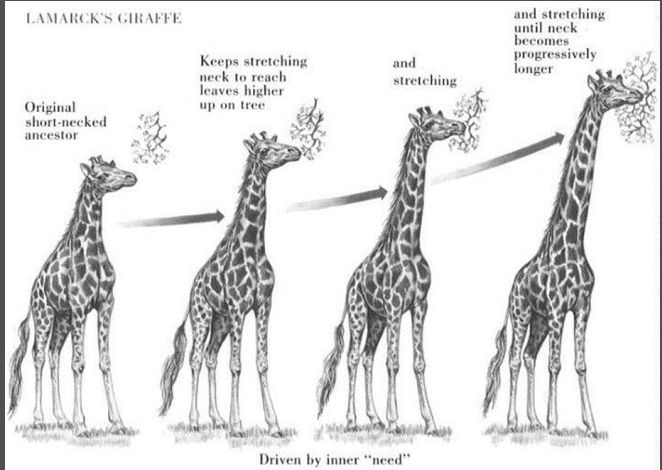
Explain the image of Larmick’s Theory
In the slide:
Giraffes start with short necks
They stretch their necks to reach higher leaves
Over generations, the neck supposedly becomes longer
This change is driven by an internal “need” rather than natural selection
Body parts grow in proportion to how much they are used
Why was the theory flawed?
Because structural changes acquired during an organisms lifetime are not inherited by the next generation
James Hutton (1726-1797) will have the idea of Gradualism in which?
He proposed that slow, continuous physical processes, acting over long period of time, produced Earth’s geological features
Charles Lyell (1797-1875) will have the idea of Uniformitarianism in which?
He proposed that the geological processes that sculpted Earth’s surface over long periods of time (Earthquakes, erosion, etc) are exactly the same as the processes observed today
In 1831, Charles Darwin will do what?
Embark on a voyage around the world on the naval surveying ship H.M.S Beagle
What did Darwin noticed in Finches?
The great variability in bill shapes among 13 species of finches
What two questions did he focus on?
-Why were the finches on a particular island slightly different from those on nearby
-How did these different species arise
What was Darwins Observations? (Hint: Their are 2)
-Individuals within populations vary in size, form, color, behavior, and other characteristics
-Many of these variations are hereditary
What was Darwin’s Inference? (Hint: Their are 2)
-If certain hereditary traits enabled some individuals to survive and reproduce more than others, then those traits would become more common in next generation
-This process is called Natural Selection
Natural Selection will favor?
Adaptive traits - genetically based characteristics that make organisms more likely to survive and reproduce
By favoring individuals that are well adapted to the environments in which they live?
Natural Selection causes species to change through time
Darwin realized that Natural Selection could cause what?
Populations to become more different over time (evolutionary divergence) and produce new species
Observe (Hint: Their are 5)
Most organisms produce more than one or two offspring
Populations do not increase in size indefinitely
Food and other resources are limited for most populations
Individuals within populations vary in many characteristics
Many variations appear to be inherited by subsequent generations
Hypothesis (Hint: Their are 2)
Individuals within a population compete for resources
Hereditary characteristics may allow some individuals to survive longer and reproduce more than others
Predict
A population’s characteristics will change over the generations as advantageous, heritable characteristics become more common
Darwin argued that all organisms that ever lived arose through?
Descent with modification, the evolutionary alteration and diversification of ancestral species
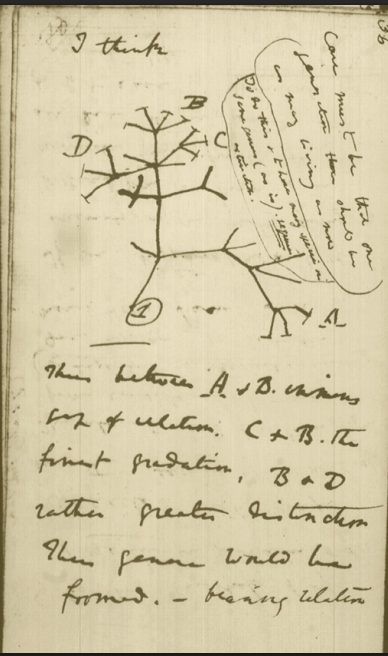
What do we take from this image?
Darwin envisioned this pattern of descent as a tree (Tree of life) growing through time, with each limb representing a body plan suitable for a particular way of live
-Proposed natural selection as the mechanisms that drives evolutionary change
What are the Four Characteristics of Darwin’s Theory
The origins of biological diversity can be explained by purely physical processes
Evolutionary change occurs in groups of organisms, rather than in individuals
Evolution is a multistage process occurring over generations
Evolution occurs because some organisms function better than others in a particular environment
What is the basis of evolution?
Genetic Variation
What links the ideas of Mendel and Darwin?
The study of population genetics
Microevolution represents? (Hint: Two concepts)
Describes small-scale genetic changes in populations
Respond to shifting environmental circumstances
Example: A shift in bill size of a finch species
Macroevolution represents? (Hint: Two concepts)
Describes larger-scale evolutionary changes in species and more inclusive groups
Results from gradual accumulation of microevolutionary changes