M6: Microbiology, Parasitology, and Public Health - Virology - Part 1 - Introduction
 Call Kai
 Learn
Learn Practice Test
 Spaced Repetition
 Match
Match Flashcards
 Knowt Play
1/49

There's no tags or description
Looks like no tags are added yet.
Name | Mastery | Learn | Test | Matching | Spaced | Call with Kai |
|---|
No analytics yet
Send a link to your students to track their progress
50 Terms
True about virus except:
a. Small infections units
b. Requires electron microscopy to be visialized
c. Obligate intracellular parasite
d. Cannot make energy or proteins independently of the host.
e. None
e. None
Mature viral particle which is the infective form.
a. Prion
b. Virion
c. Capsid
d. Enveloped
e. Plasmid
b. Virion
Viral component:
a. Nucleic acid genome
b. Capsid
c. Envelope
d. a and b
e. b and c
f. All
f. All
True about viral nucleic acid genome except:
a. Can be DNA or RNA
b. Single or double stranded
c. RNA positive sense mimics mRNA
d. RNA negative sense is converted first to mRNA and carry own polymerase
e. None
e. None
Viral RNA that mimics mRNA.
a. Positive sense
b. Negative sense
a. Positive sense
Viral RNA that is converted first to mRNA and carry own polymerase.
a. Positive sense
b. Negative sense
b. Negative sense
Protective protein coat.
a. Nucleic acid genome
b. Capsid
c. Envelope
d. a and b
e. b and c
f. All
b. Capsid
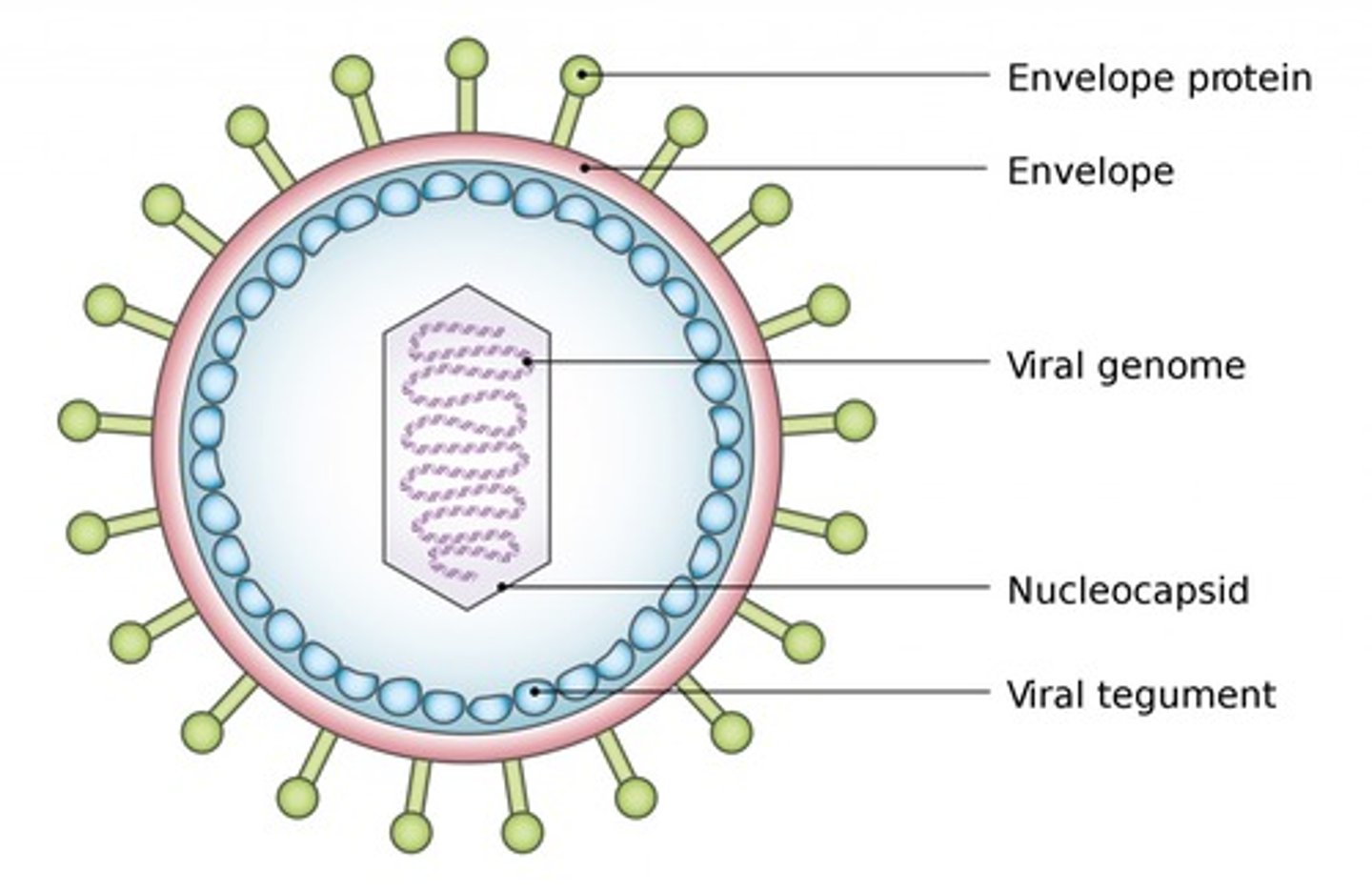
Subunit of capsid.
a. Viriod
b. Virion
c. Capsomere
d. Chromosome
c. Capsomere
Nucleocapsid is composed of:
a. Nucleic acid genome
b. Capsid
c. Envelope
d. a and b
e. b and c
f. All
d. a and b
Nucleic acid genome
Capsid
Nucleocapsid that is 20 equilateral triangles.
a. Icosahedral
b. Helical
c. Complex
a. Icosahedral
Nucleocapsid that is spiral shaped.
a. Icosahedral
b. Helical
c. Complex
b. Helical
Nucleocapsid of a bacteriophage.
a. Icosahedral
b. Helical
c. Complex
c. Complex
Viral phospholipid bilayer which is obtained from host cell membrane as result from budding.
a. Nucleic acid genome
b. Capsid
c. Envelope
d. a and b
e. b and c
f. All
c. Envelope
Viral multiplication cycle:
1- Biosynthesis
2- Assembly
3- Release
4- Attachment
5- Penetration
6- Uncoating
a. 456123
b. 465123
c. 456213
d. 465123
a. 456123
1- Attachment
2- Penetration
3- Uncoating
4- Biosynthesis
5- Assembly
6- Release
Attachment to the target epithelial cell.
a. Attachment
b. Penetration
c. Uncoating
d. Biosynthesis
e. Assembly
f. Release
a. Attachment
Engulfment of the virus.
a. Attachment
b. Penetration
c. Uncoating
d. Biosynthesis
e. Assembly
f. Release
b. Penetration
Penetration is through endocytosis.
a. Naked virus
b. Enveloped virus
a. Naked virus
Penetration is through fusion of envelope to host membrane.
a. Naked virus
b. Enveloped virus
b. Enveloped virus
Viral content release inside the cell.
a. Attachment
b. Penetration
c. Uncoating
d. Biosynthesis
e. Assembly
f. Release
c. Uncoating
Viral RNA entry to the nucleus and replication through RNA polymerase.
a. Attachment
b. Penetration
c. Uncoating
d. Biosynthesis
e. Assembly
f. Release
d. Biosynthesis
Phage particles are assembled.
a. Attachment
b. Penetration
c. Uncoating
d. Biosynthesis
e. Assembly
f. Release
e. Assembly
Viral particles release to the extracellular fluid.
a. Attachment
b. Penetration
c. Uncoating
d. Biosynthesis
e. Assembly
f. Release
f. Release
Release is through cell lysis.
a. Naked virus
b. Enveloped virus
a. Naked virus
Release is through budding.
a. Naked virus
b. Enveloped virus
b. Enveloped virus
Blocked by:
Amantadine
Rimantadine
a. Uncoating
b. Viral protein synthesis
c. Nucleic acid synthesis
d. Packaging and assembly
e. Integration
f. Penetration
a. Uncoating
Blocked by:
NRTI
NNRTI
Nucleoside/Nucleotide analogues
a. Uncoating
b. Viral protein synthesis
c. Nucleic acid synthesis
d. Packaging and assembly
e. Integration
f. Penetration
c. Nucleic acid synthesis
Blocked by "-gravirs".
a. Uncoating
b. Viral protein synthesis
c. Nucleic acid synthesis
d. Packaging and assembly
e. Integration
f. Penetration
e. Integration - Integrase inhibitors
Blocked by "-navirs".
a. Uncoating
b. Viral protein synthesis
c. Nucleic acid synthesis
d. Packaging and assembly
e. Integration
f. Penetration
b. Viral protein synthesis - Protease inhibitors
Blocked by "-mivirs".
a. Uncoating
b. Viral protein synthesis
c. Nucleic acid synthesis
d. Viral release
e. Integration
f. Penetration
d. Viral release - Neuraminidase inhibitors
Blocked by interferon-alfa.
a. Uncoating
b. Viral protein synthesis
c. Nucleic acid synthesis
d. Viral release
e. Integration
f. Penetration
f. Penetration
Blocked by:
Enfuvirtide
Docosanol
Maraviroc
Palivizumab
a. Viral attachment and entry
b. Viral protein synthesis
c. Nucleic acid synthesis
d. Viral release
e. Integration
a. Viral attachment and entry
Smallest infective pathogen known.
a. Viriod
b. Virion
c. Capsid
d. Prion
a. Viriod
Circular ssRNA with composed of nucleic acid only and no protein coating that infects plants.
a. Viriod
b. Virion
c. Capsid
d. Prion
a. Viriod
Smallest human pathogen composed of protein only.
a. Viriod
b. Virion
c. Capsid
d. Prion
d. Prion
Common misfolded brain protein that infects other proteins upon contact.
a. Viriod
b. Virion
c. Capsid
d. Prion
d. Prion
Prion clinical presentation is transmissible spongiform encephalopathy which is degenerative CNS disease resulting to sponge-like brain. This may include the following except:
a. Creutzfeldt-Jakob disease (CJD)
b. Mad cow disease
c. Kuru
d. Scrapie
e. None
e. None
Characteristic of DNA virus.
a. Double stranded
b. Icosahedral
c. Replication site is nucleus
d. a and b
e. b and c
f. All
f. All
The only single stranded DNA virus.
a. Parvovirus
b. Poxviridae
c. Rhabdoviridae
d. Reoviridae
a. Parvovirus
The only complex DNA virus.
a. Parvovirus
b. Poxviridae
c. Rhabdoviridae
d. Reoviridae
b. Poxviridae
The only DNA virus replicated in the cytoplasm.
a. Parvovirus
b. Poxviridae
c. Rhabdoviridae
d. Reoviridae
b. Poxviridae
DNA Virus:
I. Parvoviridae
II. Papillomaviridae
III. Polyomaviridae
IV. Adenoviridae
V. Herpesviridae
VI. Hepadnaviridae
VII. Poxviridae
a. I, II, III, IV, V, VI, VII
b. I, II, III, IV
c. V, VI, VII
d. I, II, III
e. IV, V, VI, VII
a. I, II, III, IV, V, VI, VII
"Pardon PaPa As He Has Pox"
Naked DNA Virus:
I. Parvoviridae
II. Papillomaviridae
III. Polyomaviridae
IV. Adenoviridae
V. Herpesviridae
VI. Hepadnaviridae
VII. Poxviridae
a. I, II, III, IV, V, VI, VII
b. I, II, III, IV
c. V, VI, VII
d. I, II, III
e. IV, V, VI, VII
b. I, II, III, IV
Naked DNA Virus:
• Parvoviridae
• Papillomaviridae
• Polyomaviridae
• Adenoviridae
Enveloped DNA Virus:
I. Parvoviridae
II. Papillomaviridae
III. Polyomaviridae
IV. Adenoviridae
V. Herpesviridae
VI. Hepadnaviridae
VII. Poxviridae
a. I, II, III, IV, V, VI, VII
b. I, II, III, IV
c. V, VI, VII
d. I, II, III
e. IV, V, VI, VII
c. V, VI, VII
Enveloped DNA Virus:
• Herpesviridae
• Hepadnaviridae
• Poxviridae
RNA virus general characteristics except:
a. Helical
b. Enveloped
c. Cytoplasmic replication
d. Single stranded
e. None
e. None
Only bullet shaped RNA virus.
a. Rhabdoviridae
b. Picornaviridae
c. Retroviridae
d. Reoviridae
a. Rhabdoviridae
Only double stranded RNA virus.
a. Rhabdoviridae
b. Picornaviridae
c. Retroviridae
d. Reoviridae
d. Reoviridae
Only naked RNA virus.
a. Picornavirus
b. Reovirus
c. Calicivirus
d. a and b
e. b and c
f. All
f. All
Naghubad sa "PRC" - Naked RNA Virus:
• Picornavirus
• Reovirus
• Calicivirus
Only RNA virus replicated in the nucleus.
a. Retrovirus
b. Orthomyxovirus
c. Influenza virus
d. a and b
e. b and c
f. All
f. All
Nucleus replicated virus:
• Reovirus
• Orthomyxovirus
• Influenza virus
Positive sense RNA virus:
I. Picornavirus
II. Coronavirus
III. Togavirus
IV. Calicivirus
V. Flavivirus
VI. Retrovirus
VI. Reovirus
a. I, II, III, IV, V, VI, VII
b. I, II, III, IV, V, VI
c. I, II, III, IV, V
d. I, II, III
e. IV, V, VI, VII
a. I, II, III, IV, V, VI, VII
Positive sense RNA virus: "PiCoTCaFlaRe"
• Picornavirus
• Coronavirus
• Togavirus
• Calicivirus
• Flavivirus
• Retrovirus
• Reovirus
Negative sense RNA virus:
I. Paramyxovirus
II. Filovirus
III. Arenavirus
IV. Bunyavirus
V. Orthomyxovirus
VI. Rhabdovirus
a. I, II, III, IV, V, VI
b. I, II, III, IV, V
c. I, II, III, IV
d. I, II, III
e. IV, V, VI
a. I, II, III, IV, V, VI
Negative sense RNA virus: "ParFABOR"
• Paramyxovirus
• Filovirus
• Arenavirus
• Bunyavirus
• Orthomyxovirus
• Rhabdovirus