Physiological changes of ageing
 Call Kai
 Learn
Learn Practice Test
 Spaced Repetition
 Match
Match Flashcards
 Knowt Play
1/17

There's no tags or description
Looks like no tags are added yet.
Name | Mastery | Learn | Test | Matching | Spaced | Call with Kai |
|---|
No analytics yet
Send a link to your students to track their progress
18 Terms
Concepts of ageing
chronologic age and physiologic age are not the same
vary based on the complex interactions of genetics and the environment
individuals age at different rates
Effects of ageing on tissues
affects cells and extracellular matric produced by them
cells divide more slowly
injuries heal more slowly
rate of RBC synthesis declines
Extracellular matrix changes important
Collagen fibers become irregular – tendons and ligaments become less flexible and more fragile
Elastic fibers fragment and bind Ca2+ - making it less elastic
Irregular arrangement of fibers and loss of elasticity leads to increased wrinkling and increased risk of bones breaking
Walls of arteries becomes less elastic because of changes in collagen and elastic fibers
Dilation and constriction not as efficient
Integumentary system
Epidermis thins
Dermal collagen and elastic fibers decreases leading to wrinkling
Hypodermal fat decreases – sunken looking cheeks and eyes
Decrease in sweat gland activity and blood supply to dermis
Reduced ability to regulate body temperature
Drier skin
Melanocyte number generally decreases
Grey / white hair
Muscular System
Loss of muscle fibers: skeletal, smooth, cardiac
Surface area of neuromuscular junctions decreases (skeletal muscle)
Increased time required for contraction – reaction time and reflexes compromised
Decrease in motor neurons – less control of muscle – more prone to falling/imbalance
Decreased density of capillaries (skeletal muscle) therefore reduced blood flow
Longer recovery period after exercise
Nervous System
Decrease in size and weight of brain
Loss of motor neurons
Loss of cerebellar neurons
Reflexes slow
Action potential generation and conduction and synaptic functions slow
Structural changes in neurons – decreased function
Plasma membrane becomes rigid
ER becomes more irregular
Neurofibrillar tangles and amyloid plaques form
Decreased blood supply
Decreased Short term memory
General stress
Meissner and pacinian corpuscles decrease
Remaining corpuscles become distorted and less functional
Become less conscious of something touching, pressing on skin
Increased risk of skin injuries
Difficulty identifying object by touch due to loss of receptor functionality
Decreased proprioception – i.e. decreased awareness of limb and joint position
Affect balance and coordination
Special Senses
Taste
Loss of receptors – taste decreases
Hearing
Hair cells in cochlea decreases – hearing loss
Hair cells in other auditory structures decrease – imbalance, less sensitive to gravity, prone to falling
Smell
Smell perception decreases – cause unknown
Vision
Lenses of eyes lose flexibility – rigid (presbyopia)
Cataracts
Endocrine System
Gradual decrease in some endocrine glands
GH decreases
May account for decrease in bone and muscle mass and increase in adipose tissue
Greatest in those who do not exercise
Decrease may not occur in those who exercise
Decrease in
Melatonin
Reproductive hormones: testosterone, progesterone, estrogen
Aldosterone, renin
Thyroid hormones
Parathyroid hormone
Insulin
Cardiovascular System: Heart
Cardiac muscle cells
Size and number decrease
Heart valve become less flexible, thick and rigid
Changes in connective tissue
Calcium deposits
Conducting system becomes fibrosed and loss of cells
Arrhythmias
Cardiac output and maximum oxygen consumption reduced
Cardiovascular system: Blood Vessels
veins:
Patchy thickenings – narrowing in those regions
Weakening of connective tissue in walls – varicose veins, hemorrhoids
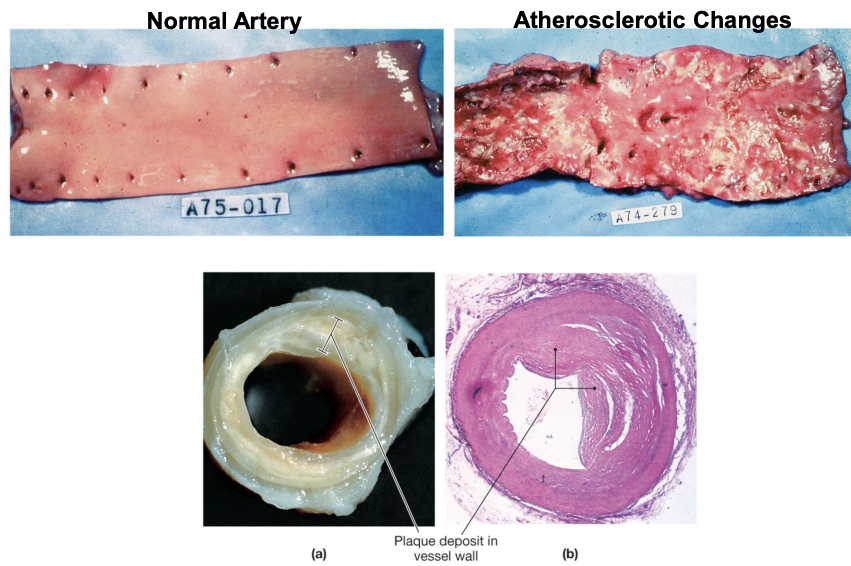
Arteries
Less elastic
Deposits of fatty substances, calcium, connective tissue
Arteriosclerosis
Arteries become less elastic
Risk of increased BP
Atherosclerosis
Deposition of material in walls – fatlike substance, connective tissue, calcium salts
Artery narrows – impairs blood flow
Immune system
T cells are less functional
Ability of helper T cells to proliferate in response to antigens decreases
Less stimulation of B cells and cytotoxic T cells
More antigen required to produce an immune response, response is slower
Ability to resist infections and develop immunity decreases
Autoimmune disease occurs
Immune responses destroy healthy tissue
Respiratory system
Pulmonary function decreases with age
Calcification of cartilages in the upper respiratory tract
Elastic fibers fragment and some calcification
Number and size of alveoli reduced and walls thicken – reducing gas exchange across respiratory membranes
Vital capacity decreases – reduced ability to fill and empty the lungs
Vital capacity = the volume of exhaled air after maximal inspiration.
Residual volume increases – alveolar ducts and larger bronchioles increase in diameter – decreasing air available for gas exchang
Residual volume = volume of air that remains in the lungs after maximum forceful expiration – i.e. it’s the volume of air that cannot be expelled from the lungs
Mucus is more viscous and fewer cilia on epithelium in lungs
Cilia cannot efficiently clear viscous mucus out of lungs and into throat. Increases probability of infection. Lung function compromised – viscous mucus reduced gas exchange in alveoli.
Digestive System
Connective tissue layers of GI tract thins
Blood supply to GI tract decreases
Decreased motility of GI tract
Smooth muscle cell number deceases in the muscle layers of GI tract
Loss of muscle tone and peristalsis – constipation
Goblet cells in mucosa produce less mucus
A major role of mucus – coats the interior surface of the GI tract, lubricates luminal contents and acts as a physical barrier to bacteria and other pathogens. First line of defense against infiltration of microorganisms, digestive enzymes and acids, digested food particles, microbial by-products, and food-associated toxins. These functions compromised by reduced mucus production
Gastric glands, liver, and pancreas secrete less
Reduced secretion of enzymes, buffers etc makes digestion and absorption less efficient
Tooth loss
Decrease in enamel thickness
Receding gingiva – exposing dentin
Renal system
Bladder
Loss of urinary sphincter muscle tone – urinary incontinence
Less elastic – volume decrease
Kidney
diminished capacity to regulate fluid and electrolyte balance
Atrophy of tissue
Decrease in nephron number
Reduced circulation to remaining nephrons
Women
Shorter urethra because of shrinkage – increased urinary tract infection risk
Men
Prostatic hyperplasia – compresses urethra – difficulty in micturition (urination)
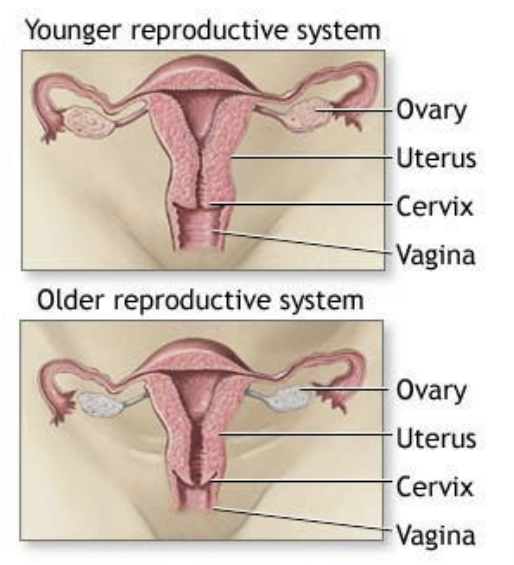
Reproductive System: Women
menopause most significant
Decreased estrogen and progesterone production
Uterus size decreases
Endometrium thickness decreases
Irregular menses, menstruation eventually stops
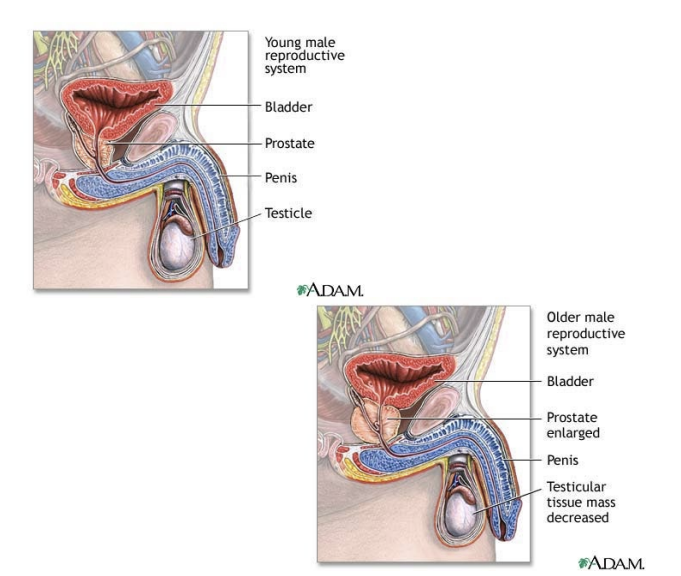
Reproductive System: Men
gradual decline
Decreased testosterone
Benign prostatic enlargement – blockage of prostatic urethra
Frequency of prostrate cancer increases
Erectile dysfunction
Skeletal system: Bone
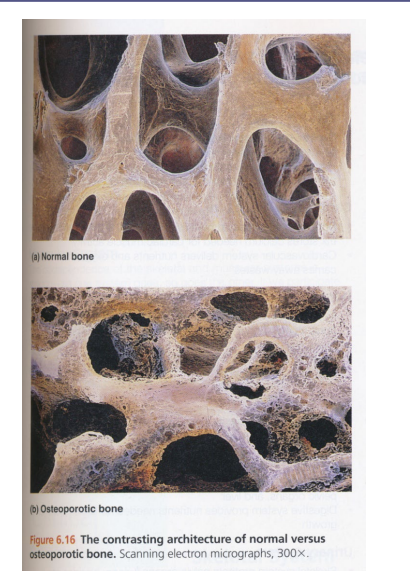
Amount of bone matrix decreases and matrix becomes more brittle (osteoporosis)
Decreased collagen production resulting in more mineral
Rate of matrix formation by osteoblasts slower than breakdown rate by osteoclasts
Bone loss from jaws
Tooth loss
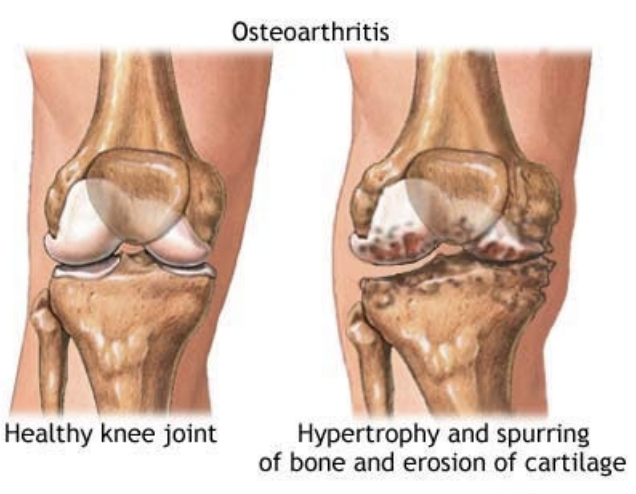
Skeletal System: Joints
Joints
Greatest effect in synovial joints
Wearing down of articular cartilage
Matrix replacement declines and matrix becomes more rigid
Synovial fluid production decreases
Ligaments and tendons around joints shorten and become less flexible
Arthritis – inflammatory degeneration of joints