4. Quality Control
 Call Kai
 Learn
Learn Practice Test
 Spaced Repetition
 Match
Match Flashcards
 Knowt Play
1/25

There's no tags or description
Looks like no tags are added yet.
Name | Mastery | Learn | Test | Matching | Spaced | Call with Kai |
|---|
No analytics yet
Send a link to your students to track their progress
26 Terms
Definition of food quality control
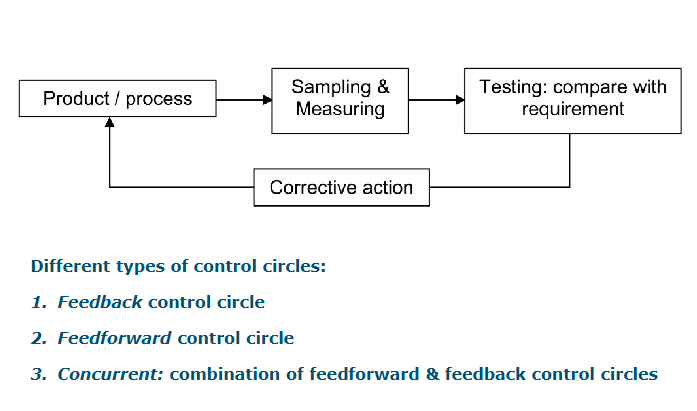
The core mechanism of quality control is to maintain desired quality by:
Measuring of product and process parameters
Comparing outcomes with standard requirements
Deciding if adjustment is needed
Taking corrective action(s) to ensure final quality will meet requirements.
Quality control steps
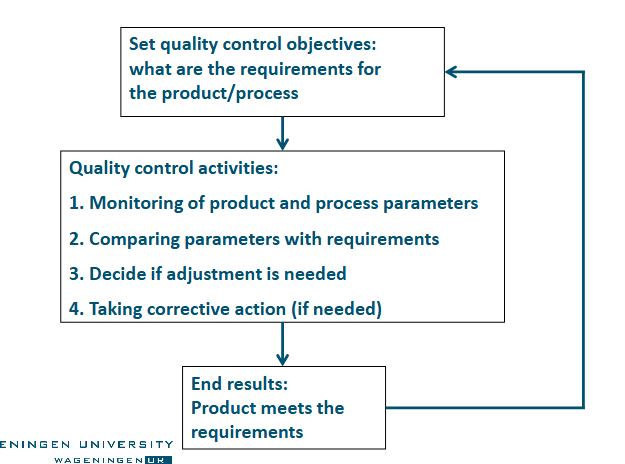
Four basis quality control activities.
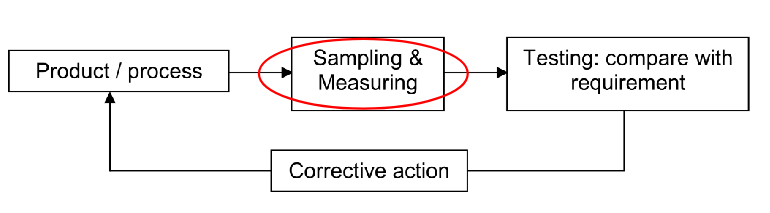
Measuring as a basis for quality control activites
Product measuring:
Taking representative sample and measure product parameter
Process measuring:
Checking the actual parameters
Types of measuring devices (Five total)
Off-line: Manual sampling, followed by transport (lab/test room) for actual measurment or analysis
At-line: Manual sampling followed by analysis or measurement at location
On-line: Automatic sampling followed by automatic analysis
In-line: Signal is observed by a sensor (thus no sampling) in the product stream and translated to an external signal.
Non-invasive: Measuring a signal in a product stream without physical contact with the product (portable ultrasonic flow meter)
Testing as a basis for quality control activities
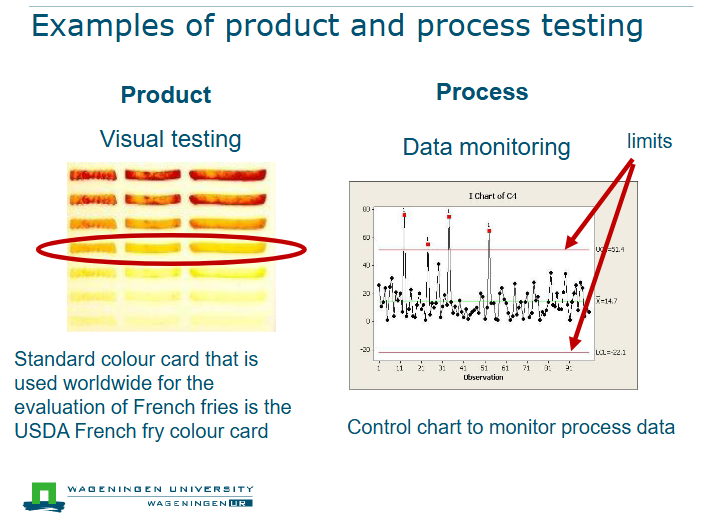
Testing: comparing outcome of the measurement with the target (norm) and tolerances (limits)
The outcome of measurement can be e.g. a number (e.g. CFU/ml of pathogen) or a visual result (e.g. color)
Testing can be done by people (e.g. for sensory test results) or be automated (e.g. weight measurements).
Steps in corrective actions
Regulating
Actual handling
Control circles
Corrective action: regulating
Regulating is the process of determining which corrective action is required: both the extent (large or small) and direction (positive or negative)
Corrective action: actual handling
Corrective action → actual handling to bring system back in control
Can be instrumental (e.g. temperature increase) or human handling (e.g. removal of the wrong products)
Depends on accuracy of handling and documentation of actual correction
Corrective action: control circles
Feedback:
The corrective action is taken after the trouble has occurred
This action adjusts the undesired situation based on measurements later in the process
Feedforward:
The corrective action is taken before the trouble occurs
This action anticipates the expected situation based on measurements earlier in the process.
Concurrent: combination fo feedforward & feedback control circles.
Why is food quality control being done?
Because of variation
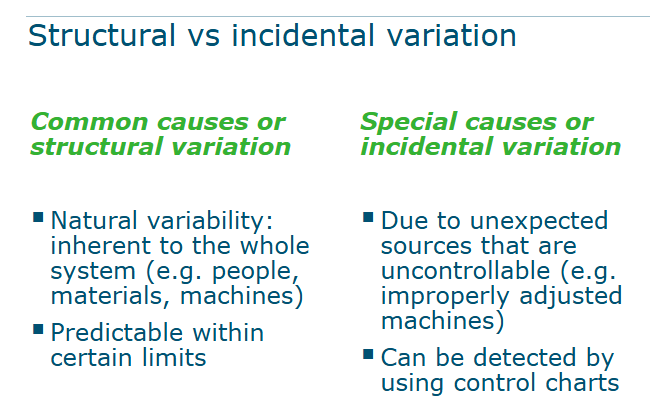
Food products are ‘living systems’ which cause variation
Quality is inversely related to variation; less variation → less scrap and reword, fewer line stoppages, happier customers
Variation is a natural phenomenon → but performance of reliable process can be predicted within limits
To regulate or improve a process we must understand causes of variation
structural vs. incidental variation
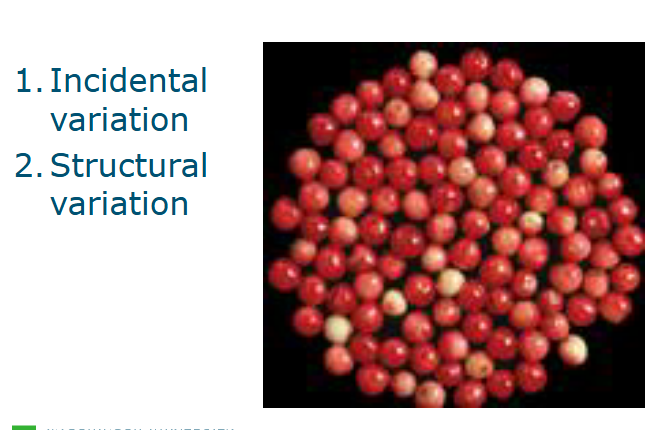
What kind of variation is this?
Structural variation
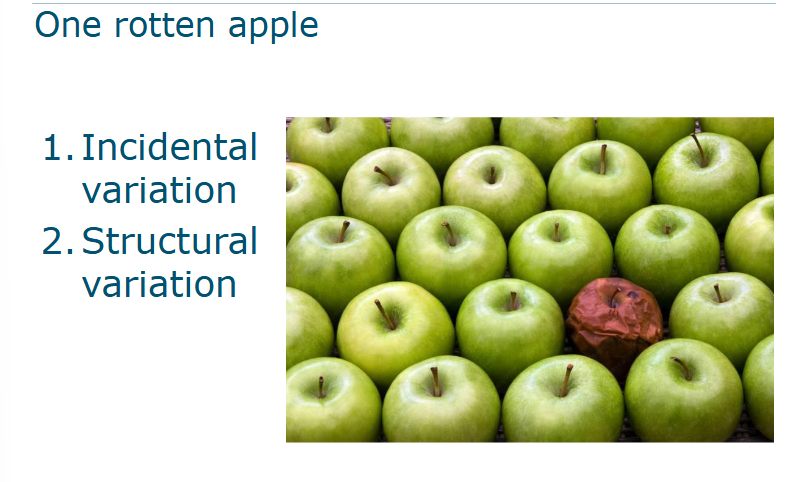
What kind of variation is this?
Incidental variation
Odd one out, not structurally happening.
Three types of sampling methods
Spot-check procedure
100% inspection
Acceptance sampling
Acceptance sampling method
Acceptance sampling is based on statistical principles
Provides judgement of the risk of a decision
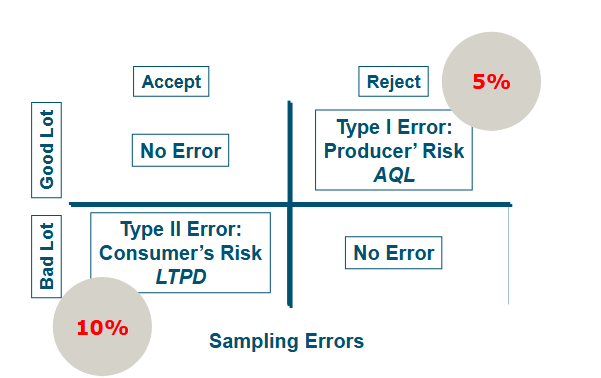
Producer’s risk probability that a batch is wrongly rejected
Consumer’s risk probability that the batch is wrongly accepted.
The principle is that you are not measuring the quality of the full batch, but you are to sentence the batch to either reject or accept it.
Steps in the acceptance sampling method steps
Sample n samples out of N (N = batch)
Determine the number of (non-) conforming items
Compare results with acceptance criteria
Decide on acceptance or rejection
Steps in the acceptance sampling method (Step 1)
Sampling plan aspects
Location (e.g. incoming materials or final inspection)
Which sampling plan (number of items from a batch)
Which items to take (e.g. on the top, randomly)
The type of data (e.g. the non-conforming or conforming, variable or attribute)
Steps in the acceptance sampling method (Step 2)
Determination of (non-) confomring items
What type of analysis:
Visual inspection
Sensory evaluation (e.g. color, taste, flavor, odor)
Physical evaluation
Microbial analysis
Compositional analysis (e.g. protein and flavor concentration)
Enzyme analysis (e.g. proteinases, lipases, pectic enzymes)
Steps in the acceptance sampling method (Step 3)
Compare with acceptance criteria
Steps in the acceptance sampling method (Step 4)
Sampling plans (step 1)
How to design the sampling plan?
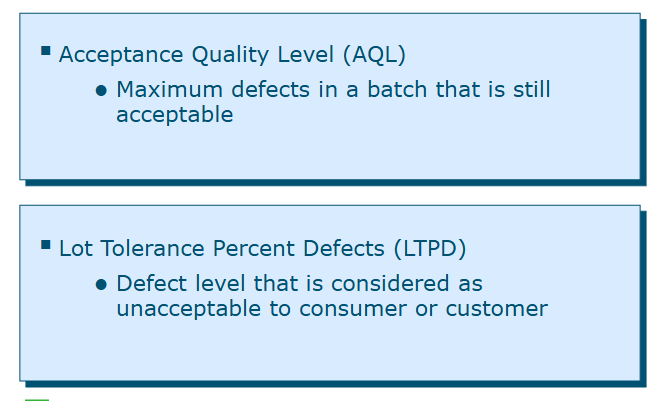
Set the desired quality level: AQL/LTPD
Usual errors chosen for sampling plan:
5% chance of rejecting a good lot (AQL)
10% chance of accepting a bad lot (LTPD)
Caculate the sampling plan:
How many units ‘n’ to sample
Maximum number of defective items ‘c’
How do you visualize effect of sampling plan?
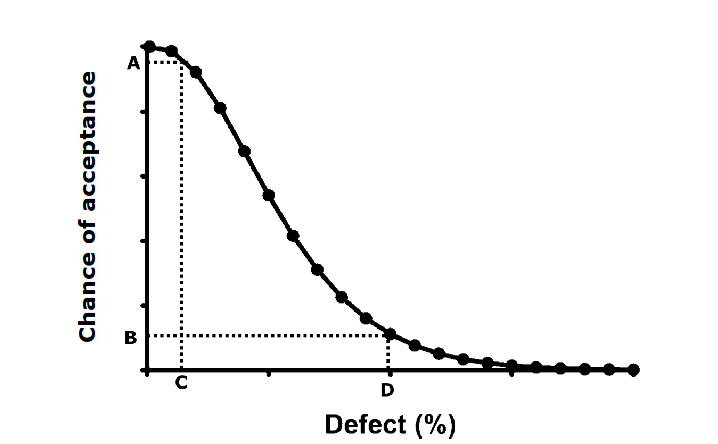
Operating characteristic curve (OC)
Shows probability of accepting lots of different quality levels
Assists management to discriminate criteria of good and bad lots
Exact shape and location of the curve is defined by the sample size (n) and acceptance level (c)
Double sampling plans
Multiple sampling plans
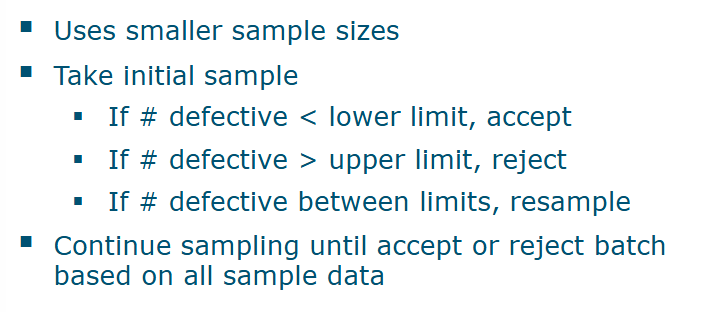
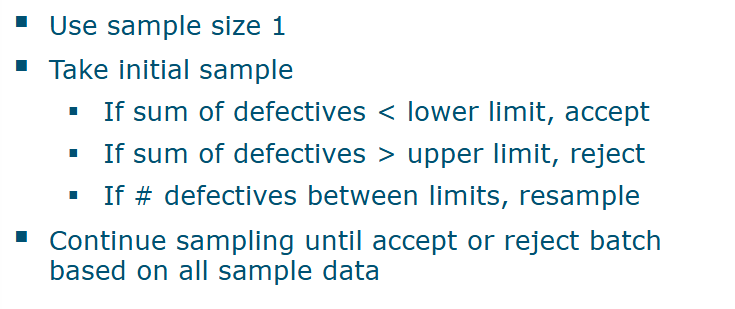
Sequential sampling