training effects + mechanisms behind WM
 Call Kai
 Learn
Learn Practice Test
 Spaced Repetition
 Match
Match Flashcards
 Knowt Play
1/42

There's no tags or description
Looks like no tags are added yet.
Name | Mastery | Learn | Test | Matching | Spaced | Call with Kai |
|---|
No analytics yet
Send a link to your students to track their progress
43 Terms
what is the concept of brain training + what methods have been proposed to boost it
believes WM capacity can be trained + improved on by engaging in training behaviour, similarly to strength training
online brain training programmes e.g. cogmed have been put forward + sold as effective
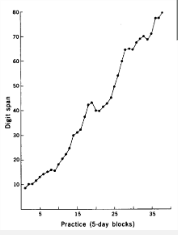
what did Ericsson et al. (1980)’s classic test of WM training find
found after over 230 hours of training, a subject was able to increase his memory span from 7 to 79 digits
suggests that with an appropriate mnemonic system + practice, there is seemingly no limit to memory performance
what is the concept of transfer
improvements in practiced tasks lead to improvements in unpracticed tasks
if we improve our brain by training WM, this may cause our abilities to exceed in other brain-dependent tasks e.g. cognitive inhibition
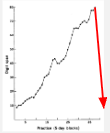
what was the major limitation with Ericsson et al. (1980)’s experiment + what does this suggest
when the task was switched from digits to letters of the alphabet after 3 months of practice, performance exhibited no transfer → memory span dropped to around 6 items
means there was no transfer → just because you have improved on a specific task, doesn’t mean these abilities extend to other WM tasks
what is strategy-based training + what is one example
the introduction + acquisition of strategies in order to improve WM capacity
e.g. remembering the order of planets → My Very Educated Mother Just Served Us Noodles
what is the issue with strategy-based training
although it’s effective for particular activities, they are material or task-specific → means that they are difficult to transfer to other contexts, e.g. other WM tasks
what is process-based training + how does this negate strategy-based training
the repeated practice of specific tasks targeting cognitive processes
it is assumed that repeated practice of WM tasks e.g. complex span tasks would train one’s general WM, meaning this would transfer to other WM tasks/abilities
practice for WM tasks negate strategy-based training due to being a cognitive process that automatically occurs → getting better with practice suggests the processes themselves are becoming stronger
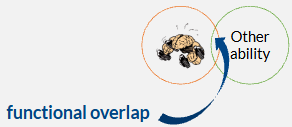
what is the concept of functional overlap + how does this apply to WM
the assumption of transfer occurring if underlying processes are shared between the practiced task and non-practiced ones of the same domain
because variation in WM is correlated with variation in many other abilities, by enhancing WM, we may be able to improve a wide range of related cognitive abilities due to functional overlap
what are the 3 levels of successful training transfer
practiced tasks → WM task practiced on e.g. the n-back task
near transfer = same cognitive function, but another cognitive task → untrained WM tasks e.g. complex-span task
far transfer = different but related cognitive function → e.g. reasoning (as WM supports it)
what 3-stage process do training + transfer studies usually take
performance at a pretest (baseline) assessment is compared to performance at a posttest after training, e.g.:
pretest → participants complete an n-back, complex span + reasoning task
training → practice n-back task daily for 3 weeks
posttest → participants complete n-back, complex span + reasoning task
if we are completing effective process-based training, we should observe near + far transfer through improvements at complex span + reasoning tasks
what is change evaluated relative to in training + transfer experiments, and what are two types
change is compared to a control group → participants not receiving WM training in order to assess whether intervention is effective. is either:
passive → no intervention
active → alternative intervention that doesn’t target WM (no functional overlap)
what are passive controls appropriate + not appropriate to control for
appropriate to control for test-retest effects → e.g. improved performance with familiarity between test 1 and 2
not appropriate for other factors that affected the period between test + retest, e.g. motivation
not appropriate to control for placebo effect → e.g. motivation to perform better
what are active controls appropriate for controlling for
test-retest effects
other factors that affected the period in between test + retest
placebo effect
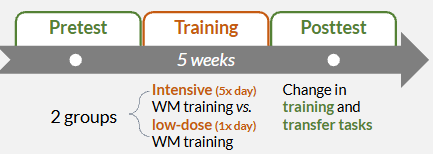
who was Klingberg et al. (2002)’s seminal training study aimed to improving the WM of and what was the structure of the experiment
wanted to assess whether intensive WM training could help children with attention deficits, e.g. ADHD
participants completed computerised training programme with a variety of WM tasks in order to see whether far transfer (to attention) would occur
tested improvements over 5 weeks in intensive WM training (5x day) relative to an active control (1x day) + measured possible change
what were the training + transfer tasks used in Klingberg et al. (2002)’s study
training task → visuospatial working memory task (encoded a series of positions of dots on a grid to be replicated)
transfer task → Raven’s progressive matrices (reasoning task → tests ability to reason what the next item in a sequence is + disengage from old rules)

what were Klingberg et al. (2002)’s results
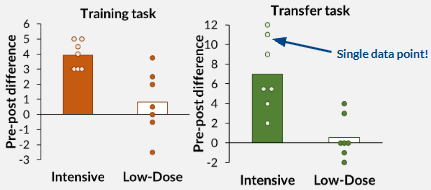
as predicted, there were marked improvements for those having undergone intensive training in both the training task + far transfer task
low dose group experienced minor improvement for training task (probably due to placebo), but overall indication that process-based training = effective
what was the main issue with Klingberg et al. (2002)’s study
sample was very small (N = 7); this means that:
study findings have little power, so may not be replicable/generalisable to a wider population
such a small sample means that there is high variability in results, e.g. some of the low-dose group outperformed the high-dose group → difficult to determine whether outcomes = solely due to training intensity
in what 3 ways did Klingberg et al. (2005)’s study differ from the previous one
performed an RCT using a larger sample (N = 53)
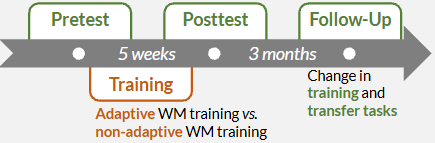
training procedure was either adaptive WM training (experimental; difficulty adapts to individual capacity) or non-adaptive WM training (control; stays at same difficulty level)
measured both training + transfer tasks at 3 months follow-up as well as a post test → allows to assess whether improvements are sustained
what were Klingberg et al. (2005)’s results for the training tasks
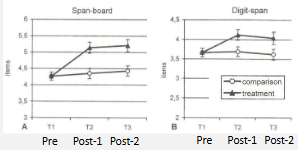
found larger benefits on visual WM + digit span tasks in adaptive WM group in comparison to the nonadaptive WM group
treatment group improved by 1 ½ items in comparison to minor improvements/no difference in control
what were Klingberg et al. (2005)’s results for the transfer tasks + what does this suggest
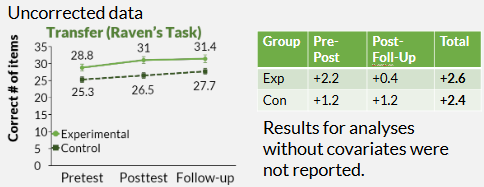
though they initially found larger benefits in adaptive relative to nonadaptive WM groups in inhibition + reasoning tasks, when assessing the uncorrected data, there was barely variability between experimental + control conditions
this is because experimental group performed better on average in the pre-test + results for analyses without covariates were not reported → unsystematic variance
this suggests that changes in score only very minorly due to training, so transfer may not be very effective
how was Jaeggi et al. (2008)’s seminal training study conducted
recruited non-ADHD participants to assess whether transfer effects for reasoning could result from WM tasks
experimental group received 8-19 sessions of training on the dual n-back task (have to keep track of what item appeared 2 items ago with both auditory + visual information
control group was passive (no intervention → could be possible drawback)
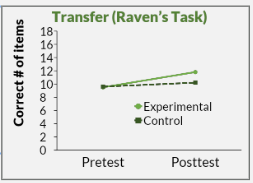
posttest assessed performance on dual n-back + Raven’s task
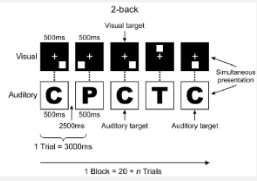
what were Jaeggi et al. (2008)’s findings
found that training resulted in better performance in both the dual n-back task + Raven’s task, implying that transfer did occur
however, only fractional improvements in reasoning task performance → small effects imply that transfer effect are not strong
how did Redick et al. (2013) conduct their seminal training study
well controlled experiment → consisted of
pretest → participants completed WM task, spatial/verbal WM tasks, and spatial/verbal reasoning tasks
10 sessions of WM training was compared to 10 sessions of visual search tasks (active control) and no intervention (passive control)
midtest consisting of all tasks was taking
another 10 sessions of training was undertaken
posttest assessed performance on all previous tasks to measure change in both training + near/far transfer
what were Redick et al. (2013)’s results
found:
no significant near transfer effects on spatial + verbal WM performance → no improvement on tasks relying on similar cognitive abilities
no significant far transfer effects on spatial + verbal reasoning → no improvement on tasks with related cognitive abilities
suggests that transfer does not occur after training
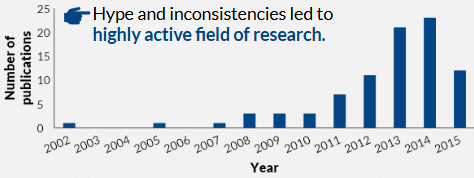
how has the scope of of WM training studies changed between 2002-2015
the hype + inconsistencies in findings surrounding WM training has lead to it being a highly active research field, causing increase in publications
publication bias also needs to be taken into account → data more likely to be published if significant, meaning is likely less evidence for WM training than what the field suggests
what are 3 suggested methodological issues explaining why there are inconsistencies in WM training findings (Shipstead et al., 2012)
lack of active controls can cause placebo effects
single tasks used for measuring cognitive abilities does not control for the task-impurity problem → WM tasks overlap with many other skills e.g. attention
small sample sizes due to expensive experiments → causes low statistical power = imprecise measurement
what are is the suggested theoretical issue explaining why there are inconsistencies in WM training findings (Von Bastian + Oberauer, 2014)
many studies lack theoretical framework for why training + transfer would occur → functional overlap = vague in concept
without theory explaining mechanisms of transfer (why we expect effects), we cannot predict when we should observe effects
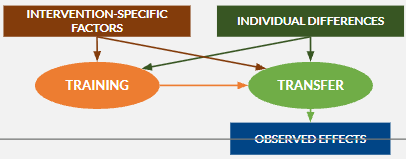
what is the multiple sources of variance framework for the mechanisms of WM skill transfer (von Bastian + Oberauer, 2014)
suggests that variance at each stage of the process between training, transfer + observed effects occurs due to:
intervention-specific factors depending on the training + transfer tasks
individual differences in the ability to transfer
understanding this variance will aid us in understanding what will occur in transfer
what are the two proposed mechanisms of transfer (von Bastian + Oberauer, 2014)
enhanced capacity → when progressively developing task ability, you are improving capacity (creating more slots of info to go in)
enhanced efficiency → can manipulate/make use of the info we have quickly
how does the multiple sources of variance framework predict that enhanced capacity affects transfer
training increases the number of info elements held in the WM (e.g. increasing one’s broad focus of attention), suggesting that training would lead to broader transfer effects (can be applied to more skills)
how does the multiple sources of variance framework predict that enhanced efficiency affects transfer
training supports a more efficient use of the existing capacity through strategies or faster processing, resulting in training leading to selective transfer effects
not quite as selective as strategy training, but better at building links with info within current processing
how did De Simoni + von Bastian (2018) test the multiple sources of variance framework
~200 young adult participants (bigger sample size) instructed to complete 20 sessions of either:
WM binding training (experimental)
WM updating training (experimental)
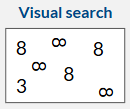
visual search (active control)
in a double-blind trial (good control used) → measured near + far transfer using 4 tasks per ability
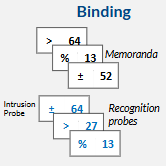
what did the binding condition measure + what task were they trained on
binding condition assessed efficiency:
presented with a list of memoranda that need to be bound to a specific context (symbol with number)
then given a recognition probe to see if they match → recognition task. intrusion probes were also shown as distractors
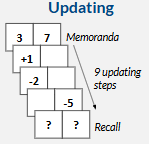
what did the updating condition measure + what task were they trained on
updating condition assesses capacity:
participants had to keep a running 2 running tallies of memoranda while updating previous number 9 times depending on the new presentation
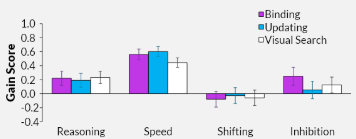
what effects were found for training, near + far transfer in De Simoni + von Bastian (2018)’s study, and what does this suggest
training task findings were overall effective
no evidence for near transfer → binding + updating training did not translate to visual search (somehow got worse)
no evidence for far transfer → no significant group differences on skills associated with WM e.g. reasoning + shifting
this suggests that in a methodologically-sound study, training improved neither WM capacity of efficiency
what is an example of large individual differences in training progress
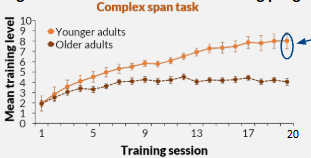
young adults have increasingly large individual differences in training progress as their level increases
however they benefit consistently more than older adults, and don’t hit the same ceiling from training that older adults do
what are 3 hypotheses as to who benefits from training more
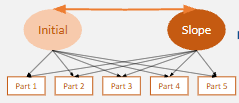
magnification → people with a higher ability to gain more (those with already good WM capacity gain more ability)
compensation → people with a lower ability to gain more (lower ability is trained in order to compensate for the absence)
no difference in who benefits more
what did Guye et al. (2017) find when studying how initial training performance + progress is related between younger + older participants
younger adults showed magnification of initial task performance → heightened capacity gets better over time (not ideal for patients interventions)
there was little effect in older adults → worse capacity cannot significantly changed
what did Melby-Lervag et al. (2016) find regarding whether effectiveness of training depends on the type of training task
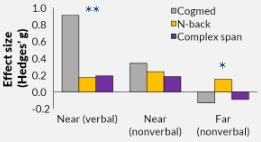
found on average, cogmed induces relatively larger verbal near transfer, but n-back yields relatively larger far transfer
findings were moderate but significant (largest effect size)
what did Melby-Lervag et al. (2016) find regarding whether effectiveness of training depends on training dose
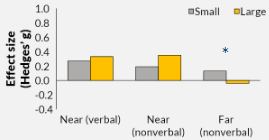
found training dose has little effect → only significant difference occurred for far transfer, but made training group significantly worse
what are 5 possible demographic/personal factors that could influence whether some gain more training than others
age
gender
personality
motivation
beliefs
what did Guye et al. (2017) find regarding whether demographics, personality, motivation + beliefs ar related to the slope in training progress
found limited evidence for individual differences predicting slope in training progress, but result may differ for samples with successful training + transfer
inconsistencies make it harder to examine overall
overall, what 4 factors have been investigated on training effects + how effective were they
individual differences in capacity + efficiency → no effects for near + far transfer
age → young adults experience magnification, whether older adults have little training effective
type of training task → cogmed = most effective near transfer, n-back most effective far transfer
training dose → has no significant effect (more = worse??)
overall, some evidence for multiple sources of variance framework