Freebody Diagrams and Newton's 2nd Law Problems
 Call Kai
 Learn
Learn Practice Test
 Spaced Repetition
 Match
Match Flashcards
 Knowt Play
1/44

There's no tags or description
Looks like no tags are added yet.
Name | Mastery | Learn | Test | Matching | Spaced | Call with Kai |
|---|
No analytics yet
Send a link to your students to track their progress
45 Terms
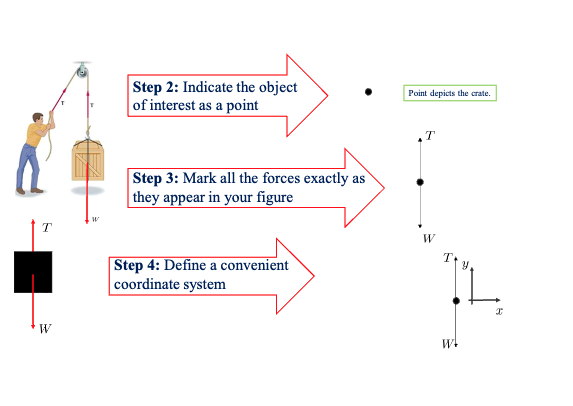
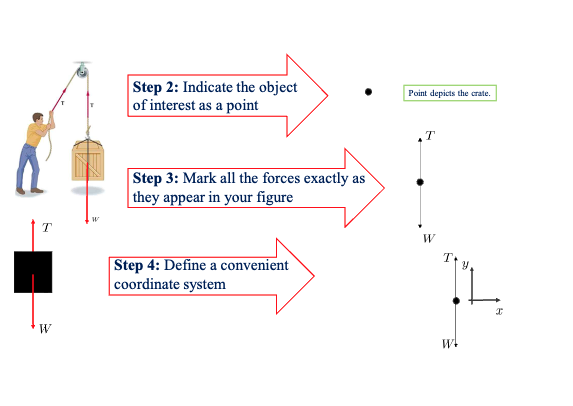
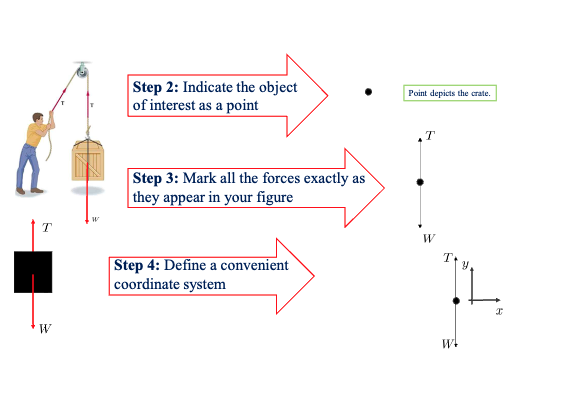
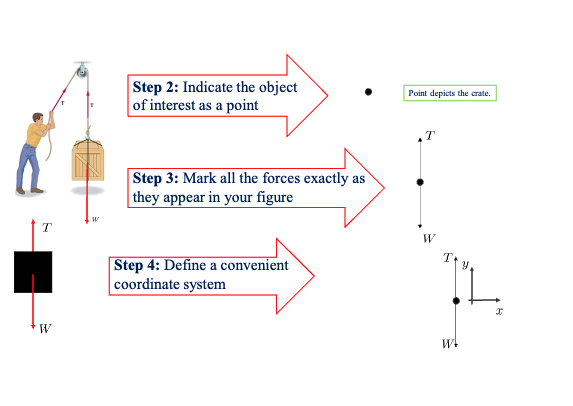
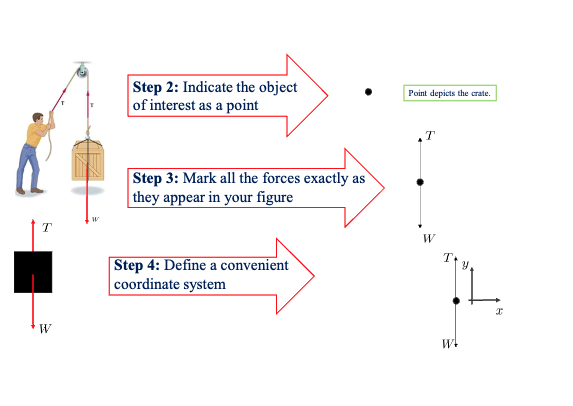
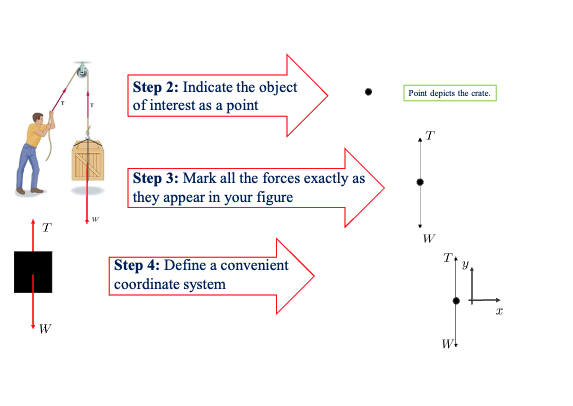
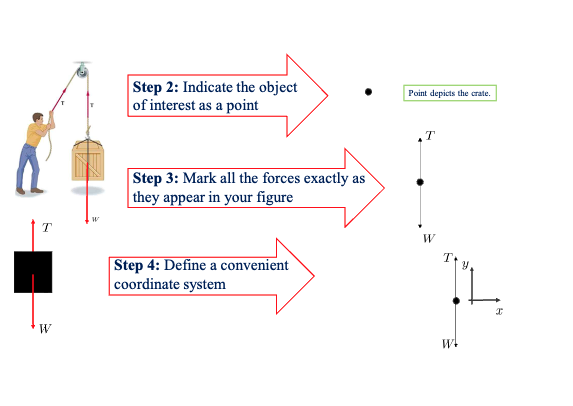
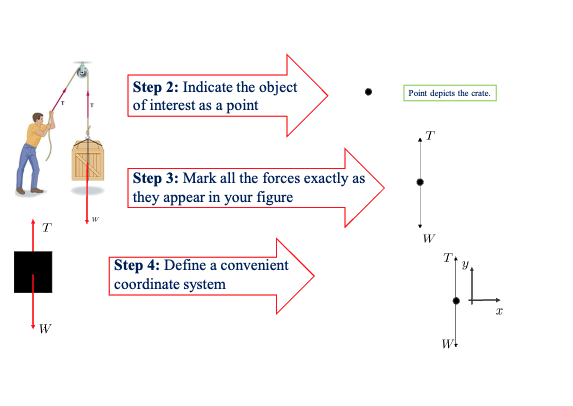
What is the first step when drawing a Free Body Diagram (FBD)?
Draw the situation and identify all forces acting on the object of interest.
What is the object of interest in this example?
The crate.
Why do we ignore the person and pulley when drawing the Free Body Diagram?
Because the problem only asks for the forces acting on the crate
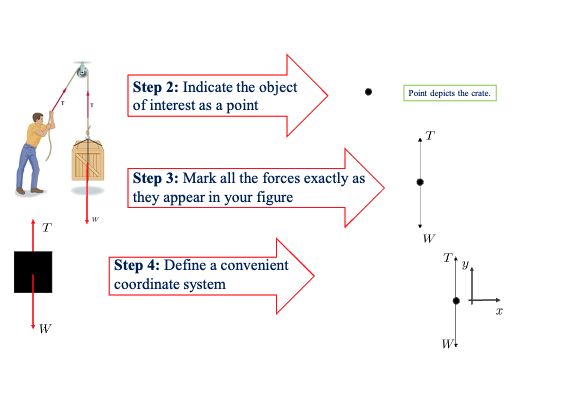
What force does the rope exert on the crate?
Tension (T)
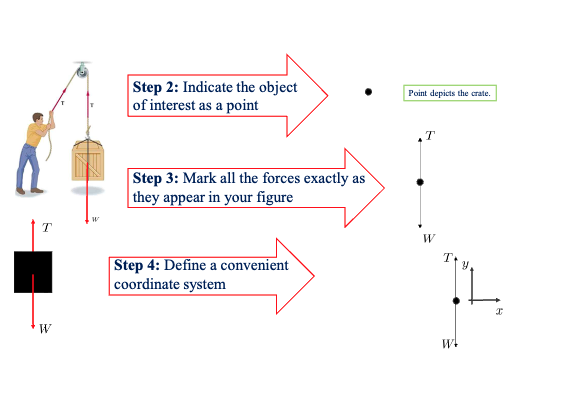
In which direction does the tension force act on the crate?
Upward
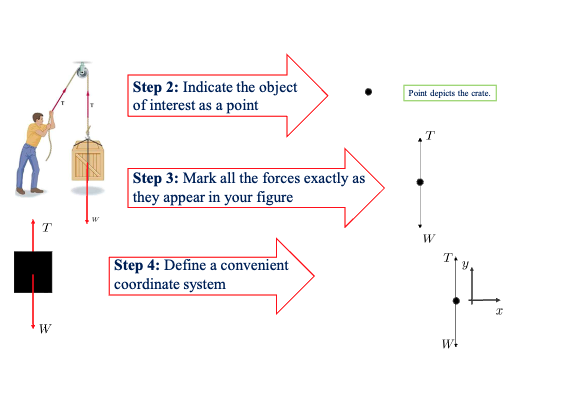
What does the symbol T represent?
Tension force.
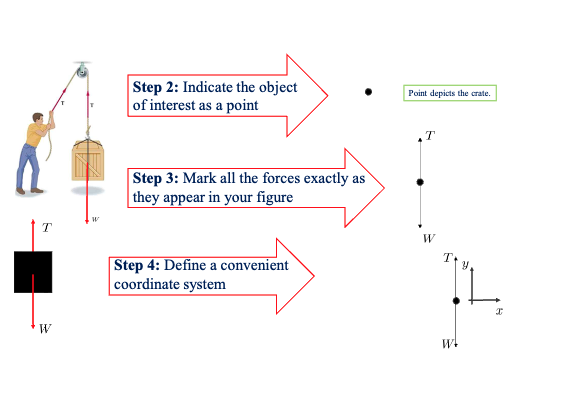
What force always acts on an object that has mass?
Gravity (weight)
What does the symbol W represent?
Weight (gravitational force).
In which direction does weight act?
Vertically downward.
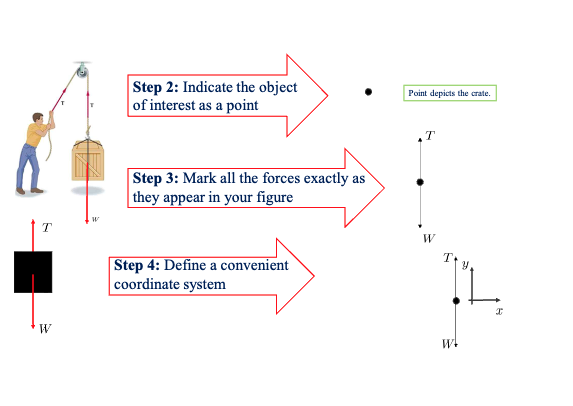
What are the only two forces acting on the hanging crate?
Tension upward and weight downward.
Why is there no normal force acting on the crate?
Because the crate is not touching a surface.
When does a normal force exist?
When two surfaces are in contact.
Does a hanging object have a normal force?
No.
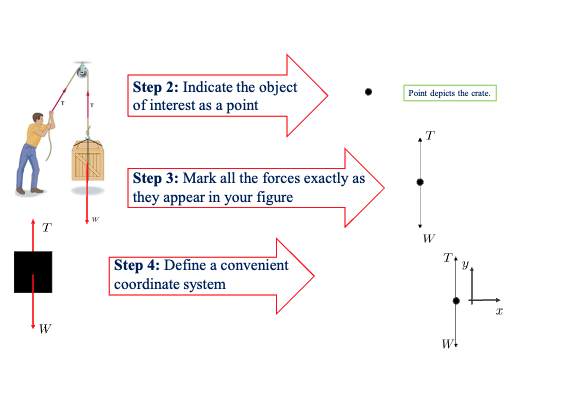
What is the second step when drawing a Free Body Diagram?
Represent the object as a point mass.
Why do we replace the crate with a point in the FBD?
To simplify the force analysis.
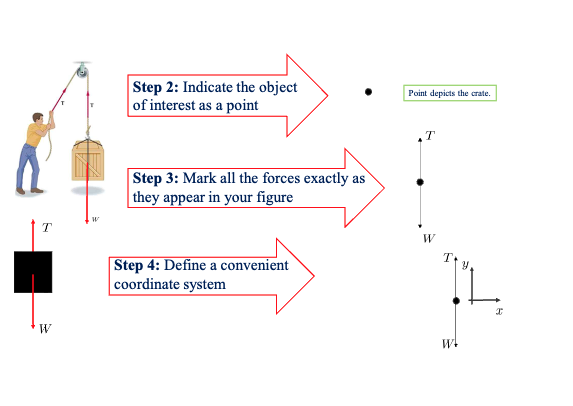
After replacing the crate with a point, what forces should still be shown?
The same forces that acted on the crate: tension and weight.
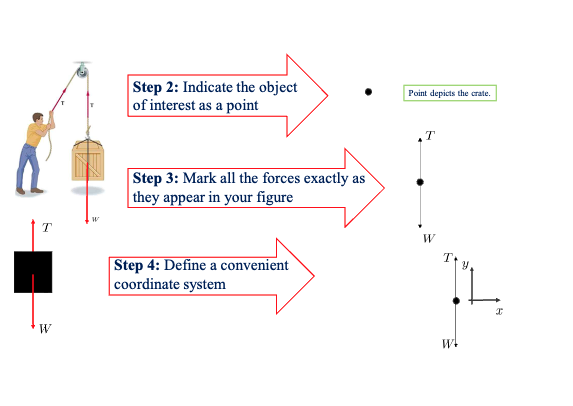
What is the third step in constructing a Free Body Diagram?
Draw all forces on the point mass exactly as they act on the object.
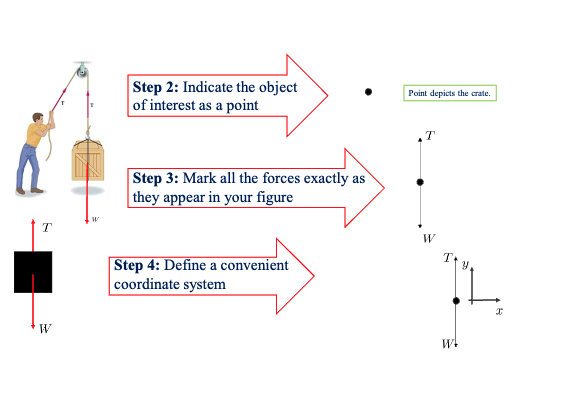
What is the fourth step in constructing a Free Body Diagram?
Choose a convenient coordinate system.
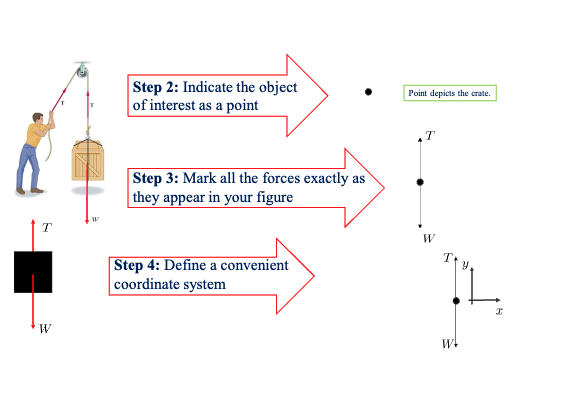
What coordinate directions are chosen in this example?
Positive xxx to the right and positive y upward.
How can you quickly recognize a tension force in a problem?
Look for a rope, cable, chain, or string attached to the object.
How can you quickly recognize a weight force in a problem?
If the object has mass, gravity acts downward on it.
What is this slide teaching?
When an object is on a frictional incline, the Free Body Diagram contains three forces:
Weight (W) → straight downward
Normal force (N) → perpendicular to the surface
Friction force (f) → parallel to the surface and opposes motion
The biggest takeaway:
Weight is NOT drawn along the ramp. Weight always points straight down.
What object are we interested in?
The box.
Why do we replace the box with a point?
To simplify the force analysis.
What three forces act on the box?
Weight (WWW), Normal force (NNN), and Friction (fff).
What does WWW represent?
Weight (gravitational force).
In which direction does weight act?
Straight downward toward Earth.
What does NNN represent?
Normal force.
What creates the normal force?
The ramp pushing on the box.
In which direction does the normal force act?
Perpendicular to the surface.
Does the normal force point straight upward?
Not necessarily.
It points perpendicular to the ramp.
What does fff represent?
Friction force.
Why is friction present in this problem?
Because the ramp is frictional.
In which direction does friction act?
Opposite the motion or attempted motion.
The box is sliding down the ramp. Which way does friction point?
Up the ramp.
Why does friction point up the ramp if the box is moving down?
Because friction opposes motion.
If the box were moving up the ramp, which way would friction point?
Down the ramp.
Which force is parallel to the ramp?
Friction.
Which force is perpendicular to the ramp?
Normal force.
Which force always points straight downward regardless of the ramp angle?
Weight.
What is usually chosen as the x-axis on an incline problem?
Parallel to the ramp.
What is usually chosen as the y-axis on an incline problem?
Perpendicular to the ramp.
A block is sliding down a rough incline. Which forces belong on the Free Body Diagram?
Weight, Normal Force, and Friction.
What equation relates weight and gravitational force?
W=Fg
If a Free Body Diagram shows an arrow labeled:
WWW
FgF_gFg
mgmgmg
What should you think?
Gravity pulling downward.