2- Inequality, living standards, emigration
 Call Kai
 Learn
Learn Practice Test
 Spaced Repetition
 Match
Match Flashcards
 Knowt Play
1/18

There's no tags or description
Looks like no tags are added yet.
Name | Mastery | Learn | Test | Matching | Spaced | Call with Kai | Chat |
|---|
No analytics yet
Send a link to your students to track their progress
19 Terms
Define living standards
Shapes well-being, mobility and productivity
What effect does inequality have
Decreased social cohesion and growth
How to create a mechanism to combat an issue
Identify who has problem and how much, then devise a mechanism to resolve the issue
GDP - Gross domestic product
GDP per capita
Total value from services provided and goods created within an economy in a period (A year)
GDP divided by population
Real household disposable income
Income for households after taxes adjusted for inflation
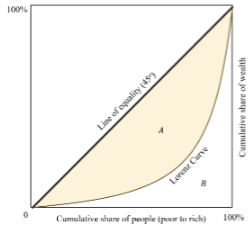
Draw a lorenz curve
What is the gini coefficient and what is the formula
The gini coefficient is the measure of the equality within an economy
Gini coefficient = A/A+B
What are drivers of inequality
Skill based technology improvements - Better pay for high end jobs, ai replacing routine tasks
Globalisation - Import competition, puts offshore pressure on sectors
Asset, housing and tax transferring systems - Wealthy accumulate more assets with spare income more assets = more income - cycles, Lower redistribution
What are consequences of inequality
Productivity Loss - talent trapped by credit/entry barriers, under-investment in human and physical capital, weak aggregate demand when marginal propensity to consume falls at the top
Increased crime and antisocial behaviour, lack of trust in institutions
Under investment in education and skills, Poverty increased - health issues, poverty trap
What is demography
The statistical study of human populations
What are core indicators for demography
Birth and death rates
Fertility rate
Population growth rate
Age-dependency ratio
Life expectancy at birth
What do population pyramids show
Wide base and narrow top - high feritility, youthful population
Narrow base and wide top - low fertility aging population
Indentations or bulges - show shocks to the population - Wars, Immigration , baby booms
What is the process of long run population change
High birth and death rates mean a small stable population
Death rates fall due to improved healthcare, sanitation
Birth rates fall - contraception, education
Population begins to age
In some advanced economies results in labour shortage increased dependency for labour
What are the effects of migration
Balanced labour supply
affects wages, productivity and demographics
Connects with inequality, living standards and ageing
Lil stat - 2023: over 11,000 migrants and asylum seekers arrived in Lampedusa, Italy → increasing migration flows
2022: 2.6 million people legally immigrated to the US, and OECD countries saw a record 6 million
permanent migrants
Causes of migration
Economic factors - higher wages and employment in other country
Political factors - war, tyrants
Climate change - extreme weather, droughts, rising sea levels
Chain migration - Migrants follow other migrants to areas due to information about jobs and housing
Explain the push pull framework
Push: poverty, unemployment, conflict, tyrants
Pull: wages, jobs, housing, security
Networks lower information and settlement costs
note migrants can also move within countries - US houston after hurricane katrina they moved to houston leading to average wage decreasing by 0.7% low skilled workers compared to high skilled
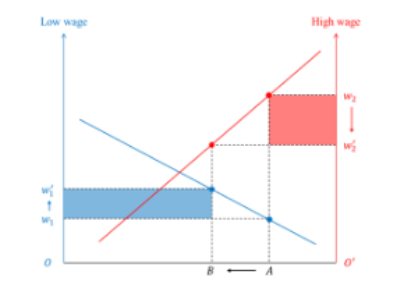
explain diag
Movement from high wage country to small wage country leads to high wage country decrease wage, and the opposite for small wage country , if the labour are perfect substitutes
Name some migration policies
Selective point systems (UK, Australia, Canada) prioritises skills
Border control (US)
Asylum policies - Germany taking in syrian refugees
Demographic policies (Advanced, ageing populations) attracting refugees (Japan and europe)
What is the migration hump theory
Increasing economic development leads to increased migration until origin country becomes wealthier leading to less migration
Give some examples of climate migration
Climate change could displace 150-300 million people by 2050 (Asian Development Bank, 2012)
Examples include - sea levels rising (kiribati and tuvalu)
drought in horn of africa (1.1 million somalis and 590 thousand ethiopians displaced),
sahara desert expansion (Farmers in Chad, niger and mali moving
Extreme weather (2018 hurricane maria - 500,000 puerto ricans came to the US