w/o pics APHUG Unit 2 Concepts
 Call Kai
 Learn
Learn Practice Test
 Spaced Repetition
 Match
Match Flashcards
 Knowt Play
1/39

There's no tags or description
Looks like no tags are added yet.
Name | Mastery | Learn | Test | Matching | Spaced | Call with Kai |
|---|
No analytics yet
Send a link to your students to track their progress
40 Terms
Agricultural density
The number of farmers per unit of arable land; used to measure development and agricultural efficiency
Natural increase rate
The percentage by which a population grows in a year, calculated by subtracting the crude death rate from the crude birth rate
Epidemiologic transition model
A model that explains changes in population health and causes of death as societies develop
Arithmetic density
The total number of people divided by the total land area; a general measure of population density
Crude birth rate
The number of live births per 1,000 people in a given year
Population pyramid
A bar graph showing the age and sex distribution of a population, which can indicate growth trends and social conditions
Census
An official count of a population, including demographic data such as age, gender, occupation, typically conducted every 10 years
Demography
The scientific study of population characteristics including size, distribution, and trends
Ecumene
The portion of Earth's surface that is permanently inhabited by humans
Infant mortality rate
The number of deaths of infants under 1 year of age per 1,000 live births
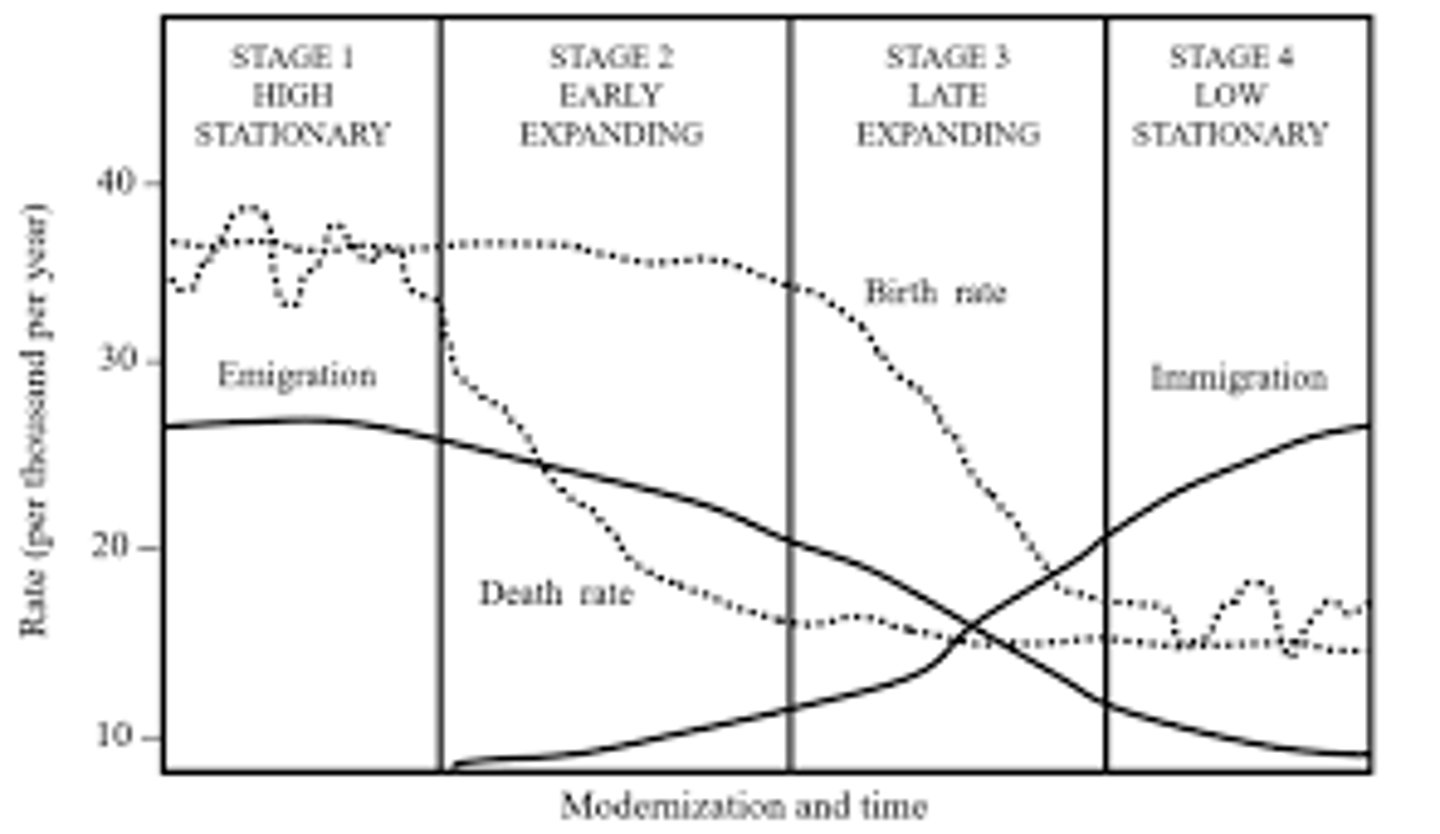
Demographic transition model
A model showing how population growth changes over time as a country develops, through 5 stages based on birth and death rates
Carrying capacity
The maximum number of people that an environment can sustainably support without degrading resources
Overpopulation
A situation where the population exceeds the environment's ability to support it with adequate resources
pandemic
A disease outbreak that spreads over a large geographic area and affects a high proportion of the population
Total fertility rate
The average number of children a women is expected to have in her lifetime in a given population
Physiological density
The number of people per unit of arable land
Life expectancy
The average number of years a person is expected to live based on current mortality trends
Thomas Malthus
A British economist who theorized that population growth would outpace food supply, leading to widespread famine and conflict unless controlled
Pro-natal policy
A government policy that encourages people to have more children
Anti-natal policy
A government policy aimed at reducing birth rates
Doubling time
The number of years it takes for a population to double in size at its current rate of natural increase
Zero population growth
A condition in which the birth rate equals the death rate, resulting in no natural increase in population
Asylum
Protection granted to someone who has left their home country as a political refugee, fearing persecution based on race, religion, nationality, or political opinion
Lee's Model of Migration
A model that explains migration as influenced by push factors, pull factors, and intervening obstacles
Quota
A limit set by a government on the number of immigrants allowed into a country during a specific time period
Brain drain
The emigration of highly trained or intelligent people from a country, often for better opportunities abroad
Migrant
A person who moves from one place to another, either within a country or across borders, for any reason
Ravenstein's Laws of Migration
A set of theories from geographer Ernst Ravenstein that describe typical migration patterns
Chain migration
The process by which migrants from a particular area follow others from that area to a particular destination, often due to familial or cultural connections
Net-in migration
When more people are immigrating into a country than emigrating out of it
Refugee
A person who is forced to flee their home country due to war, persecution, or disaster, and seeks protection in another country
Forced migration
Migration that is compelled by threats to life or freedoms, such as war, natural disasters, or human rights violations
Net-out migration
When more people are emigrating from a country than immigrating into it
Transhumance
A seasonal form of migration in which people move livestock between mountain and lowland pastures
Guest worker
A person who temporarily migrates to another country for work, often under a legal work visa or program
Pull-factor
A positive condition or perception that attracts people to a new location
Voluntary migration
When people choose to move, usually for economic or personal reasons, not because they are forced
Internally displaced person
Someone forced to leave their home but remains within their country's borders
Push-factor
A negative condition that drives people to leave their home (e.g., war, poverty, natural disaster)
Zelinsky's Migration Transition Model
A model that links migration patterns to a country's stage in the DTM, showing how migration shifts as societies develop