2.5 economic growth
 Call Kai
 Learn
Learn Practice Test
 Spaced Repetition
 Match
Match Flashcards
 Knowt Play
1/29

There's no tags or description
Looks like no tags are added yet.
Name | Mastery | Learn | Test | Matching | Spaced | Call with Kai |
|---|
No analytics yet
Send a link to your students to track their progress
30 Terms
what factors can cause economic growth
Improving the labour force, with a better quality due to higher education. Improving human capital via higher education, and vocational training programmes can improve worker skills and productivity.
A larger labour force. This may be due to migration, birth rates or improved participation rates.
Improved technology, which is more productive. This means resources are used more efficiently. Rise of IT has boosted sectors e.g. can work from home now, and become its own.
More investment in physical capital, to fuel economic growth. More machinery can be bought and factories built, which will increase production. Infrastructure like transportation networks can be upgraded.
Discovering new natural resources to be exploited - fuels growth e.g. discovery of oil in Saudi Arabia leading to rapid economic growth.
Government incentives for enterprise, such as tax breaks to stimulate investment, subsidies, low interest rates to encourage investment and spending
what is the difference between actual and potential growth
Actual growth is the percentage increase in a country's real GDP and it is usually measured annually. It is caused by increases in AD.
Potential growth is the long run expansion of the productive potential of an economy. It is caused by increases in AS. The potential output of an economy is what the economy could produce if resources were fully employed.
Key differences:
- Measurement: Actual growth is observed in real-time changes in GDP, while potential growth is an estimate of the economy's capacity.
- Influences: Actual growth is influenced by short-term factors (demand), whereas potential growth is driven by long-term factors (supply).
what is export led growth
Export led growth occurs when countries open up their economies to the international market.
- International trade is important for this. Countries can specialise where they have a comparative advantage, which increases world output and lowers average costs. A country has comparative advantage when it can produce goods and services at a lower opportunity cost than another.
- It will initially increase AD, so will only bring about short term growth. However, it will encourage firms to invest and therefore bring about long term growth by improving the supply-side of the economy.
- It allows the government to bring about economic growth and high employment without seeing a current account deficit.
what are the negative implications of export-led growth
Export led growth means the economy is unbalanced, since there is a surplus on the current account on the balance of payments. Whilst this means there are net injections into the economy, it is not necessarily sustainable. However, the growth in the economy may lead to an increase in imports which will balance the current account.
Moreover, it means the country relies on the economic state of other countries, since these are the consumers of their goods and services. If there is a recession in a major export market, exports will fall and so will economic growth.
how can international trade lead to economic growth
International trade, particularly exports, can significantly drive economic growth.
Increased Market Size: Access to larger international markets allows firms to achieve economies of scale.
Foreign Exchange Earnings: Exports bring in foreign currency, enabling countries to import goods and services they cannot produce efficiently.
Technology Transfer: Exposure to international markets and competition can lead to the adoption of new technologies and practices.
Job Creation: Export industries create jobs, reducing unemployment and boosting incomes.
Real-World Example:
The rapid economic growth of East Asian countries (e.g., China, South Korea) in the late 20th and early 21st centuries was largely driven by export-led strategies, focusing on producing goods for international markets.
what is the difference between actual growth rates and long-term trends in growth rates
The long run trend rate of growth is the average sustainable (without generating inflation) rate of economic growth over a period of time. It is what tends to happen over a long period of time; the average.
It is determined by fundamental factors such as technology, labor force growth, capital accumulation, and productivity improvements.
Actual growth is the actual change (i.e. the change in real GDP) over time and its changes are what make up the business cycle.
It reflects the economy's short-term performance, influenced by demand and supply shocks, fiscal and monetary policies, and other cyclical factors.
Example: If a country's real GDP grows from $1 trillion to $1.05 trillion, the actual growth rate is 5%.
The difference between the two is an output gap.
what is an output gap
An output gap is the difference between the actual level of output (real GDP) and the maximum potential level of output
what is a positive output gap
Positive output gap:
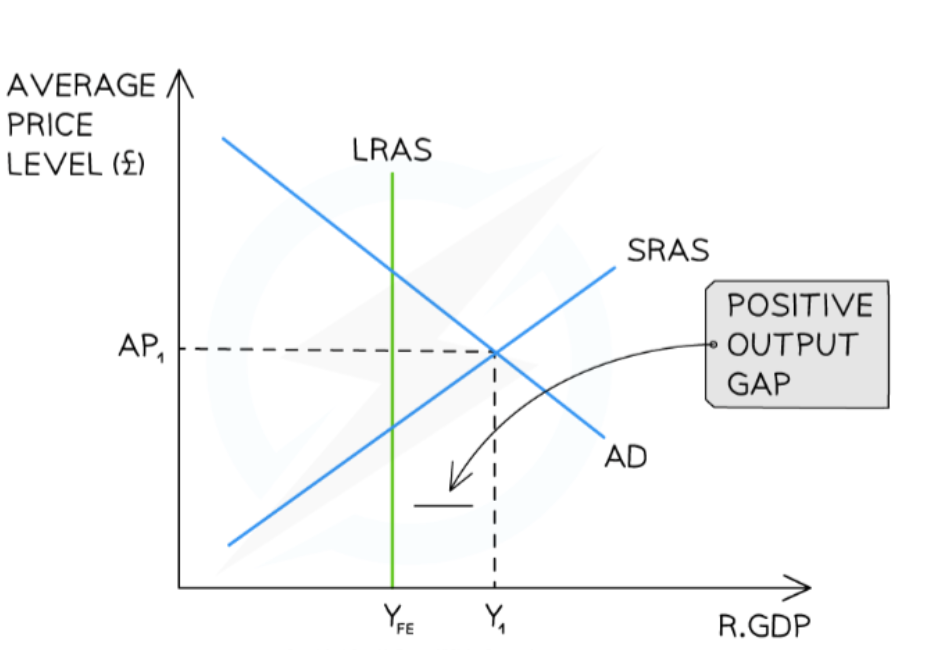
A positive output gap occurs when real GDP is greater than the potential real GDP e.g. using resources at an unsustainable rate
It is not possible to depict using Keynesian graph
It is not sustainable and the Classical view is that the output will return to Y FE, but at a higher price level
what is a negative output gap (keynesian)
Negative output gap:
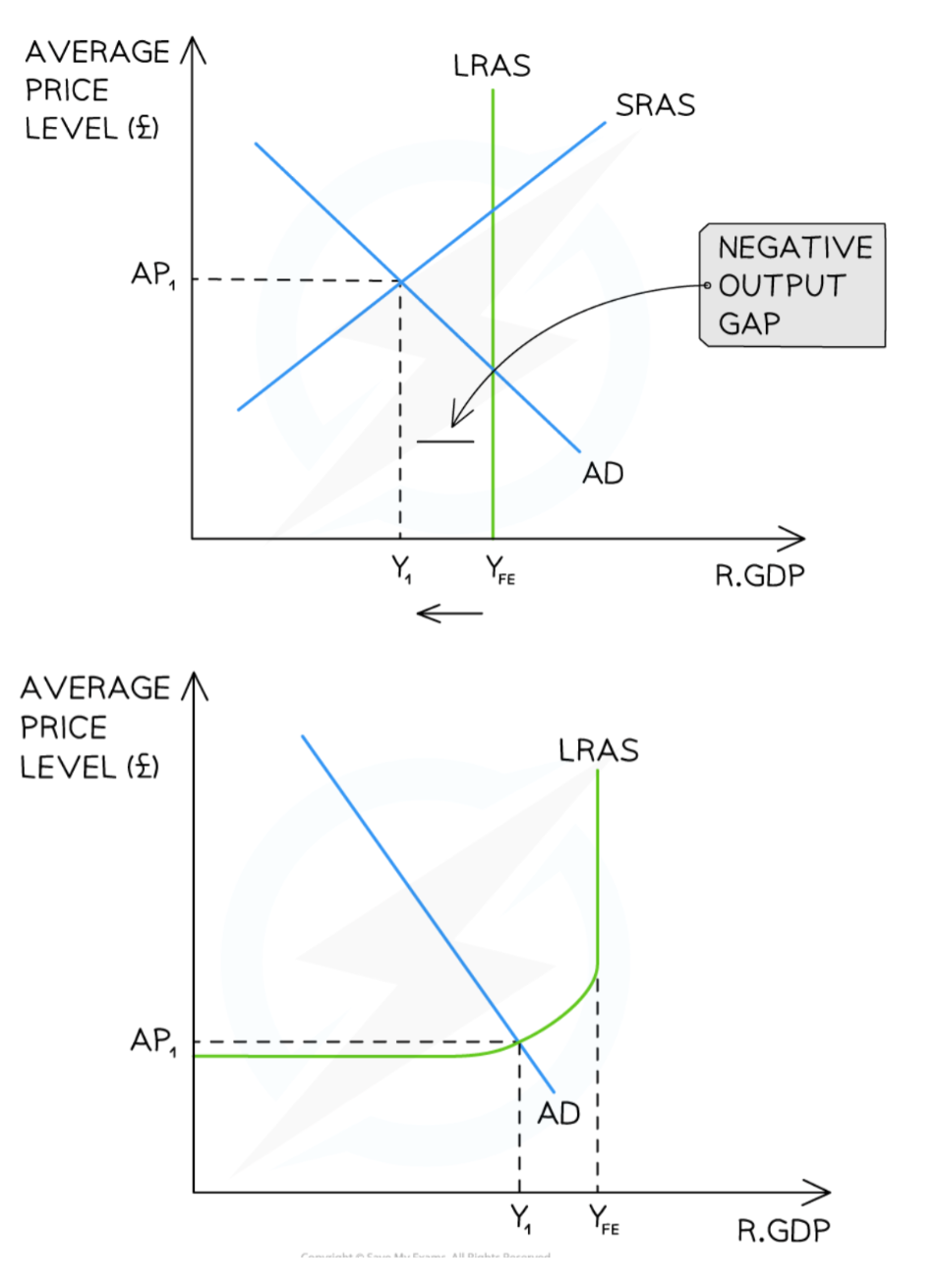
A negative output gap occurs when the real GDP is less than the potential real GDP
There is spare capacity in the economy to produce more goods/services than are being produced
The Keynesian view is that an economy may be stuck in a negative output gap for a long period of time
what is a negative output gap (classical)
Negative output gap:
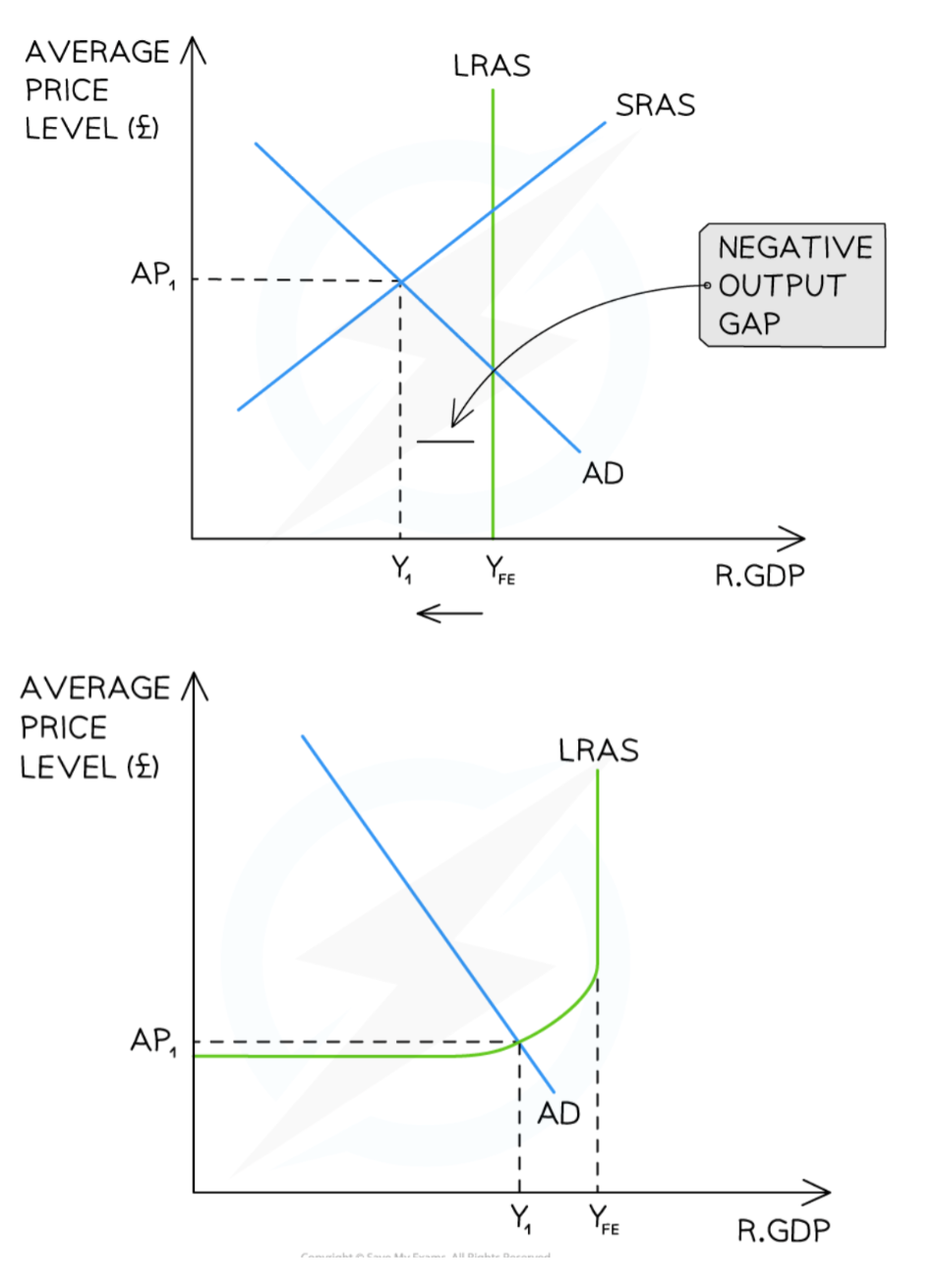
A negative output gap occurs when the real GDP is less than the potential real GDP
There is spare capacity in the economy to produce more goods/services than are being produced
The Classical view is that the output will return to Y FE in the long-run, but at a lower average price level
why is it difficult to measure output gaps accurately
It is difficult to measure output gaps accurately
This is because it is hard to know exactly what the maximum productive potential of an economy is
Rapidly rising prices can indicate a positive gap is developing
Rising unemployment and slowdown in economic growth can indicate that a negative gap is increasing
how does economic growth benefit consumers
Benefits:
Increased Income and Wealth: Economic growth typically leads to higher GNI per capita and increased wealth.
Example: Rapid economic growth in China has lifted millions out of poverty and into the middle class.
However: law of diminishing returns means that the utility derived from increased consumption is short term and decreases with each additional unit consumed.
Improved Quality of Goods and Services: Higher incomes lead to greater demand for better quality goods and services.
Example: Technological advancements leading to improved smartphones, healthcare, and education.
However: more shoe leather costs, which means they have to spend more time and effort finding the best deal while prices are rising.
Greater Employment Opportunities: Growth leads to job creation, reducing unemployment rates.
Example: Expansion of the technology sector has created numerous job opportunities.
how does economic growth cost consumers
Costs:
Inequality: Benefits of growth may not be evenly distributed, leading to greater income inequality.
Example: Economic growth in the U.S. has led to rising income inequality since the 1980s.
Inflation: Rapid growth can lead to demand-pull and cost-push inflation. If aggregate supply cannot keep up with demand, prices may rise, eroding real purchasing power
Example: Hyperinflation in Zimbabwe in the late 2000s reduced consumer purchasing power drastically.
how does economic growth benefit firms
Benefits:
Higher Profits: Increased consumer spending boosts sales and profits.
Example: Booming e-commerce has significantly increased profits for companies like Amazon.
Economies of Scale: Firms can expand and achieve lower costs per unit due to larger scale production.
Example: Automotive industry benefits from large-scale production reducing costs per vehicle.
Innovation and Investment: Growth encourages firms to invest in new technologies and innovation.
Example: Investment in renewable energy technologies by firms like Tesla.
how does economic growth cost firms
Increased Competition: More firms entering the market can lead to increased competition.
Example: Entry of new tech firms increases competition for established companies like Microsoft and Apple.
However: this can push firms to become more efficient and innovative
Resource Depletion: Rapid growth can lead to overexploitation of natural resources, increasing costs in the long term.
Example: Deforestation in the Amazon due to increased agricultural and industrial activities.
Firms could face more menu costs as a result of higher inflation. This means they have to keep changing their prices to meet inflation.
Increased investment: allows development of technology etc
how does economic growth benefit the government
- Higher Tax Revenues: Economic growth increases incomes and corporate profits, leading to higher tax revenues.
- Public Investment: Higher revenues allow for greater investment in public infrastructure and services.
Example: Improved transportation networks and healthcare systems in developed countries. - Investment Opportunities: Growth attracts domestic and foreign investment leading to innovation, increased productive capacity (LRAS), and further job creation.
- Fiscal dividend - higher economic growth will raise tax revenues and reduce government spending on unemployment & poverty related welfare benefits
- Accelerator effect - rising growth stimulates new investment e.g. in low-carbon technologies. Better growth may attract foreign direct investment projects
how does economic growth cost the government
Inflationary Pressures: Managing inflation becomes challenging during periods of rapid growth.
Example: Governments implementing tight monetary policies to curb inflation during economic booms.
Environmental Degradation: Economic growth can lead to pollution and environmental damage.
Example: Industrial pollution in rapidly growing economies like China and India.
More strain and pressure on healthcare
Financial Instability: if rapid growth is fueled by excessive borrowing and speculative investment, this can result in financial bubbles and subsequent crashes.
E.g. 2008 financial crash due to speculative investment
how does economic growth benefit current and future living standards
Reduced Poverty: Economic growth increases access to education, healthcare, and necessities. Many fast-growing countries have made important progress in reducing extreme poverty and improvements in human development outcomes. (HDI Index)
Improved Living Standards: Growth leads to better infrastructure, healthcare, education, and overall quality of life.
Example: Increased life expectancy and literacy rates in countries experiencing sustained growth.
Technological Advancements: Innovations improve efficiency and quality of life.
Example: Advancements in medical technology improving health outcomes.
how does economic growth cost current and future living standards
Environmental Sustainability: Growth can lead to environmental degradation, affecting future living standards.
Example: Climate change impacts due to greenhouse gas emissions from industrial activities.
Resource Exhaustion: Overuse of natural resources can lead to scarcity, impacting future generations.
Example: Overfishing leading to depletion of fish stocks in oceans.
what is a trade business cycle
A trade (business) cycle refers to the fluctuations in real GDP/economic growth/economic activity that occur in an economy over time.
The real GDP will fluctuate above and below the long-term trend rate of growth
This flow of real GDP can be moderated by government intervention
E.g. increasing taxes in a boom period or increasing spending in a recession
The global economy experienced a significant business cycle during the 2008 financial crisis, with a deep recession followed by a gradual recovery.
what are the key points in the trade business cycle
There are some recognisable points in the cycle:
- Expansion/boom: Period of increasing economic activity, rising GDP, employment, and income levels, possibly causing inflation. Percentage rate of growth of real GDP is fast and higher than the long-term trend - positive output gap
- Peak: The height of economic growth, where the economy is at its maximum output, growth rates may start to fall.
- Contraction/economic downturn/recession: Period of declining economic activity, falling GDP, rising unemployment, and reduced spending.
- Trough: The lowest point of economic activity before the cycle begins again with expansion.
- Depression: A prolonged downturn in the economy and where a nation's real GDP falls by at least 10 per cent
- Economic recovery (economic growth becomes positive and growth rates pick up)
how can economic recovery come about
Economic recovery (economic growth becomes positive and growth rates pick up)
May take several years for national output to full recover to pre-recession
There is no single cause of a recovery. Monetary and fiscal policy decisions are important. So too, economic events in other countries.
Recovery can come from:
- Cuts in interest rates (monetary policy)
- One or more types of fiscal stimulus
- A rebound in business and consumer confidence
how do you identify output gaps on trade business cycle diagram
A positive output gap is identified as growth of real GDP that is above the trend (real output is greater than the long-term trend, therefore a positive output gap).
A negative output gap is identified as growth of GDP that is below the trend
what is an economic boom
Boom: A boom is characterized by rapid economic growth and high levels of economic activity.
When actual growth of real GDP is well above a country's trend growth rate. This creates a positive output gap as real GDP exceeds potential.
Can have internal and external causes.
AD shifts to the right, SRAS can shift to the left as well
Evaluation: Economic booms are typically fairly short-lived because of the other macroeconomic consequences they cause not least upward pressure on costs and consumer prices. Central banks typically respond by raising their monetary policy interest rates to control surging demand and to limit inflationary pressures.
what are the key effects of an economic boom
Key effects:
High GDP growth: Significant increase in the production of goods and services.
Example: During the tech boom of the late 1990s, the U.S. saw high GDP growth rates.
Decreased unemployment and increased job vacancies: High demand for labour leads to low unemployment rates.
Example: Unemployment rates in the U.S. dropped to around 4% during the late 1990s boom.
Increased consumer spending: High levels of disposable income and consumer confidence drive spending.
Example: Increased spending on luxury goods, housing, and travel.
Rising investment: Businesses invest heavily in capital and technology to expand production.
Example: Surge in technology investments during the dot-com boom.
Inflationary pressures: High demand can lead to increased prices and inflation
Example: Rising housing prices during economic booms.
Stock market optimism: Stock prices tend to rise, reflecting investor confidence and potentially leading to more risky behaviour.
Example: Bull markets in the stock exchanges.
Reduction of negative output gap or creation of a positive gap. Spare capacity is reduced or eliminated.
An improvement in the government budget as tax revenues rise and expenditure falls.
how can an economic boom come to an end
Rising inflation leads to a tightening of monetary policy by central banks - higher interest rates curb spending and lead to a rise in saving
If prices start rising faster than incomes, then real spending power of consumers begins to drop
With rising costs, business confidence turns and planned capital investment may decline
External factors causing a boom may reverse leading to a contraction in export sales, production & investment
Asset price booms (bubbles) burst - for example, stocks, shares and housing becomes less valuable - leading to a negative wealth effect
Once an economic boom finishes, banks may become reluctant to lend - credit becomes harder to access and more expensive
what is one of the biggest factors in affecting the economic cycle
One of the biggest factors causing turning points in an economic cycle is a change in business and consumer sentiment. Keynes labelled this an "animal spirits." When expectations change, so too does planned spending which directly impacts one or more components of AD.
what is an economic recession
Recession: A recession is a period of negative economic growth spread across the economy, across two consecutive quarters (6 months), visible in GDP, income, employment, and production.
A slowdown in global economic growth or the emergence of trade tensions can negatively impact a country's exports and economic prospects.
AD shifts to the left
what are the key effects of an economic recession
Key effects:
Negative GDP growth: Decline in the production of goods and services over two consecutive quarters.
Example: During the 2008 financial crisis, many countries experienced significant GDP contractions.
High unemployment: Reduced demand for goods and services leads to job losses.
Example: Unemployment rates in the U.S. peaked at around 10% in 2009.
Decreased consumer spending: Lower disposable incomes and consumer confidence reduce spending.
Example: Reduced spending on non-essential goods and services.
Reduced investment: Businesses cut back on investment due to uncertainty and lower demand.
Example: Decreased investment in new projects and infrastructure during recessions.
Deflationary pressures: Falling demand can lead to decreased prices.
Example: Falling prices in the housing market during the Great Recession.
Stock market declines: Falling corporate profits and economic uncertainty lead to declines in stock prices.
Example: Major stock market indices fell sharply during the 2008 crisis.
Increase in government expenditure perhaps leading to a great budget deficit.
Increasing negative output gap and spare production capacity.
what can cause an economic recession
Can have many causes:
- Central banks might respond to an increase in inflation by raising interest rates to cool down the economy and prevent excessive inflation. Higher interest rates can slow down consumer spending and business investment, leading to an economic slowdown.
- Some recessions are caused by policy changes such as a significant rise in interest rates (contractionary monetary policy) or the impact of higher taxes and cuts in real government spending (fiscal contraction)
Recessions often follow a demand or supply-side shock or a combination of both. For example, a financial crisis that affects the stability of the banking system can lead to a credit crunch, making it difficult for individuals and businesses to access credit. The 2008 financial crisis was characterized by a banking crisis and a severe credit contraction, contributing to a global recession.