Hell World: Term 2 Week 8: Hellenistic Medicine
 Call Kai
 Learn
Learn Practice Test
 Spaced Repetition
 Match
Match Flashcards
 Knowt Play
1/1678

There's no tags or description
Looks like no tags are added yet.
Name | Mastery | Learn | Test | Matching | Spaced | Call with Kai | Chat |
|---|
No analytics yet
Send a link to your students to track their progress
1679 Terms
What did the Hippocratic medicine period have a lot of?
Hippocratic medicine and beyond- period of intense discussion and debates
Who was Hippocrates? (date, place)
A person who pratticed medicine, became famous for his ideas on holistic medicine and how to cure people on a theoretical basis, a contemporary of Plato. 5th century BC, he travelled a lot but is mostly associated with the island Cos
What is it hard to match Hippocrates with?
Its hard to match this historical figure with all the writings that have been translated under his name
What is the Hippocratic Collection?
The Hippocratic Collection, it was seen as a collection very early on, around 60/65 texts- rather early Greek manuscripts (early means 9th-10th century AD, later than Hippocrates). The Hippocratic collection is these texts which became a big reference for ancient doctors- but for authorship there is a giant problem as there is not a single text that can be directly safely tied to Hippocrates (wide range of topics, surgery, ontology etc), when reading these texts there is a huge amount of disagreement amongst the texts so they were certainly all written by different people- some can be grouped together though
Would physicians use the Hippocratic collection, what other texts would they use?
Physicians for centuries and centuries did use that body of text as a point of reference- it was not the only reference they would have been reading things by Plato and Aristotle as well.
What was medicine at the time often connected with?
Medicine at the time would have had many connections with things like philosophy
Explains bodies in balance
Bodies in balance: fluids, pneuma- ancient doctors looked at equilibrium in the body that reflected the elements of the rest of the natural world
Explain the four humours
The ‘four humours’: blood, phlegm, black bile, yellow bile- we are looking for a balance between the four, none should be in an excess or displayed in the wrong place e.g. black biles accumulates in the stomach that is the beginning of an infection.
Where is this theory reflected in the Hippocratic texts?
this is the theory reflected in one Hippocratic text ‘ont he natrue of man’ outside of these texts you would come across mentions fo different bodily fluids.
Did everyone accept the four humours theory in the Hellenistic World?
Not everyone in the Hellenistic world accepted the four humours, some believed there were onyl two or three major humours and some authors included other bodily fluids like sweat or other ‘waste products’- up to 11 bodily fluids mentioned in the medical texts
When did a dogma appear in medicine?
Dogma appearing in medicine after Galen 2nd centry AD.
How would they restore the balance of the humours?
Restoring the balance: food and drink, remedies, surgery… the practice of remedying the imbalance unifies medicine a bit more- many doctors would have had dietary measures as what can help people, more about lifestyle changes then true remedies. However there were ‘pharmaceutical’ remedies such as plants and animal products that became more available so pharmacology expands a lot in the Hellenistic period
What does pneuma mean?
Pneuma means the movement of breath- concerns the idea of breath moving around the body?
How was surgery perceived in the Hellenistic World?
Surgery- an area where ancient doctors were very cautious, they knew how dangerous it was to deal with open wounds and cuts. Dealing with fractures was a very ancient practice. Anything with an open wound is what was difficult for them to handle due to infection.
What wals the big curiosity in surgery in the Hellenistic World?
Big curiosity in how to improve surgery during the Hellenistic period, connection to anatomy- bolder approach to it, mad amount of innovations round it- new instruments to fix the body. More sophisticated plasters to place on wounds as well
What was there a rise of in medicine in the Hellenistic World?
Healing cults
What is the most famous healing cult?
Asclepius at Epidaurus
What do texts about that healing cult say?
Quite a number of texts on this about people sleeping over at the Asclepion sanctuary and being healed there
What century did healing cults begin to rise in?
Spread from 5th c. BC
How did the changing world in the Hellenistic period impct medicine?
A changing world: Kingdoms and empires replace the smaller city states which does impact how medicine devolves, as people would have had access to new libraries e.g. library fo Alexandria and Pergamum which would have attracted intelligent people from all over- lots of medical texts are in these places and they become a source of reflection and debate, this is the time when commentaries also start benign produced around these ancient texts to refine them
Who would the Hellenistic kings attract?
Most kings would have attracted the most prominent doctors of the time to be personal and family physicians- not just about having access to new plants but also learning about different medical traditions from the wider world
What is a problem we have with sources (particularly Hippocrates)
Common view: Hippocrates –GAP - Galen- we have few texts from Hippocrates, the only ones that survive of Hippocrates are fragments in Galens work (Galen came much later than Hippocrates and he was very opinionated, had an aim when translating earlier physicians work). This is why Hellenistic medicine is so difficult to tackle
What do we have on papyri?
WE have important texts on papyri, but there is no authors name on them- they are interested in facts and give a different view of physiology
Who were important people in medicine in Alexandria
HEROPHILUS of Chalcedon (3rd c. BC)
ERASISTRATUS OF CEOS- a physician of 3rd century BC who Galen really hated, these people had views on medicine and health that were later consider ‘mad’- our view on Erasistratus is largely shaped by how Galen portrays him
*School of Alexandria has eclipsed other medical centres such as Ephesus, Pergamum,…
Identify this image
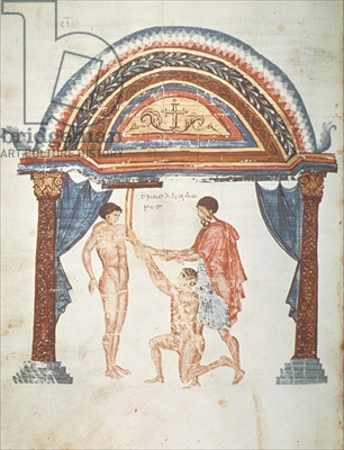
Apollonius of Citium (1st c. BC), commentary to Hippocrates’ Joints
(a prominent Hellenistic work still extant)
What other texts would they have been interest in with medicine?
Hippocratic texts were only part of the common ground they would have also been interested in a lot of philosophical texts e.g Aristotle, Theophrastus and the Lyceum- this plays a huge role in Hellenistic medicine in terms of writing and how people learned to actually organise knowledge and present knowledge, its all hugely influenced by aristotelian texts
What is medicine a part of?
Medicine is part of the bigger world of sciences and is shaped by the way philosophers view nature and living beings as part of that
What does the evidence of Egyptian medicine show?
Ancient evidence of Egyptian expertise in the art of healing, knowledge of plants (Homer), Egyptian doctors would have been influenced by Greek doctors as they would have learnt Greek. Egyptian doctors created anatomical terms in Greek
What was there interaction between in Alexandria and what did it compass?
Interaction between the Greek and Egyptians in Alexandria that is very special- doesn’t just compass medicine, a number of ‘magical’ texts in the Egyptian tradition would have been incorporated into the reading that physicians would have been able to do in Alexandria
What did translated works from Egyptian to Greek show?
Pamphilus translated Egyptian works into Greek and the knowledge reflects not just medicine but astrology and magic, blending traditions and passing it on into Greek for Greek physicians to read- we know a little about this as Galen complains about this tradition that ‘pollutes’ the Hippocratic tradition due to the inclusion of too much magic- important part of Hellenistic medicine that Greek doctors would have been more open to eastern traditions than before
What is embalming?
Embalming: a facilitator for anatomical investigations? Corpses were dealt with in different ways- often put forward as why Alexandria was a centre of medical teaching, particularly anatomy. People would traveal to Alexandria for their medical training
What other areas did medicine typically cross over with?
Cross-fertilisation of medicine with other areas of knowledge: magic, alchemy, astrology, … (Democritus aka Bolos of Mendes; Pamphilus; Xenocrates of Ephesus…)
Identify this amulet and what it represents?
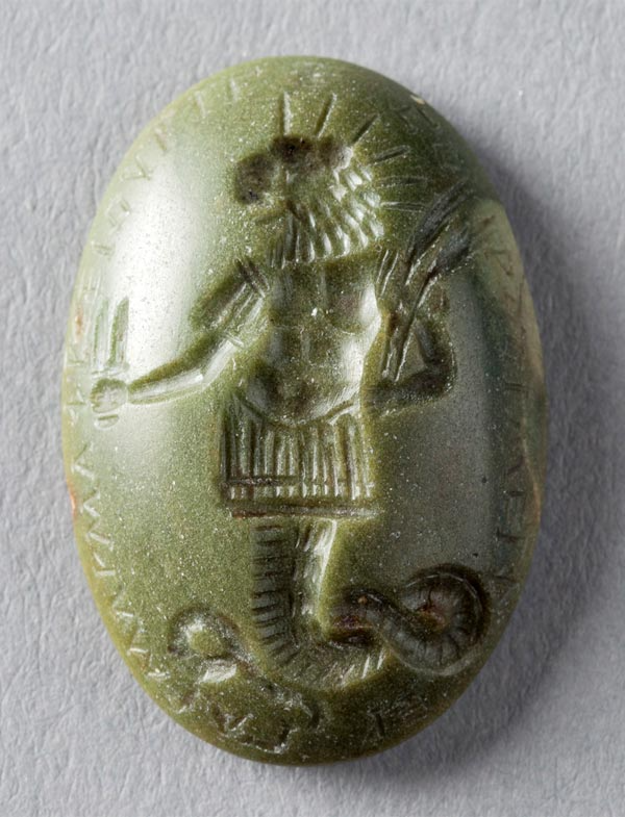
Chnoubis – for stomach aches Kelsey Museum:
Amulet that we have from the ancient world, this one represents Egyptian deity that would have impacted stomach problems. Symbol of the blending Greek and Egyptian traditions due to the Greek incarnation
Analyse this text and identify the author of it: Pigeon dung, since it warms and burns more, is mixed profitably with bruised meal; with vinegar, it dissipates scrofulous swellings of glands, with honey and linseed, it breaks off carbuncles all around, and when triturated with oil, it treats burns. (…) Stork’s dung, drunk with water, is believed to be good for epileptics and it is reported that the dung of the vulture, when burned so as to produce smoke, expels embryos/fetuses. (…) Fresh human feces, plastered on wounds, maintain them free from inflammation and glue them together, and when smeared with honey on people with sore throats, it has been reported that they help them. Lizard dung is suitable to use on women for healthy coloration and for a glowing complexion. (…)’
Dioscorides, Materia Medica, II, 80
Dioscorides was an army physician who would have traveleld a lot, he assembled a wide range on knowledge when it comes to remedies
The use of dung here is not completely medical even though it is presented as such- may have ‘magical’ undertones
Medicine is always something between the transgressions nd ethics of saving lives, healing but with appropriate measures- important debate
Increasing medical knowledge is subject to a number of possibilities that even in the modern world there are questions about what is legitimate to require knowledge about biology and medicine- question on if they can experiment on bodies and animals- what makes those experiments legitimate and what can those experiments entail- can you experiment of live animals and living human beings? These questions came back after WW2 due to the Nazis and theire experiments.
In the Hellenistic period what was there a big shift in with medicine?
In the Hellenistic period there is a shift between major fundamental disagreement of what is medicine about- is it just a practical body or remedies or is it something more theoretical and scientific?
What did the empiricists say about medicine?
The empiricists claim that medicine can be totally experienced based, empiricists think all you need is to be knowledgeable about to to fix things and apply that to the patients and if they arent aware of the exact issue they use what else they know about other illnesses- its very practical and symptoms based
What did the rationalists say about medicine?
Rationalists (they are not a singular school in the way the empiricists were), they based on a bunch of theories believed you could reach a more positive view on how the body works and how medicine should be applied- more intellectual and more difficult, strong background of logic would be necessary- an area where debate is fundamental
Do we see more rationalists or empiricists in surviving texts?
What we have mostly in ancient sources is the rationalist trend- Galen, althogh Galen was trained by empiricists his beliefs aligned more with the rationalists (i think),
When were the empiricists powerful?
In the Hellenistic period the empiricist were very powerful, especially in pharmacology- accumulating knowledge about remedies, and in the area of commentating on Hippocrates- they were excellent at deciphering him and his texts. They werent convinced that there was more you could learn about the body
What did the empiricists think of the study into anatomy?
Empiricists would have considered anatomy and the search into it as useless, unethical and dangerous while H and E, and their followers believed in it and believed you could learn more about how to practice medicine by cutting into the body
How did Herophilus and Erisistratus learn more about anatomy?
H and E, how did they become so important in this area? It is thought that at some point they were allowed by the king to use criminals sentenced to death- allowed to experiment as they were going to die anyway. This created a considerable stir, people question the authenticity of this, did they really perform vivisection? It is likely that they did: Quote by G Lloyd:
‘For all the ancients’ respect for the dead, corpses were desecrated often enough by people other than scientists. Moreover, when we reflect that the ancients regularly tortured slaves in publich in the law courts in order to extract evidence from them, and that Galen, for example, records cases where new poisons were tried out on convicts to test their effects, it is not too difficult to believe that the Ptolemies permitted vivisections to be practised on condemned criminals.’
what does this image show:
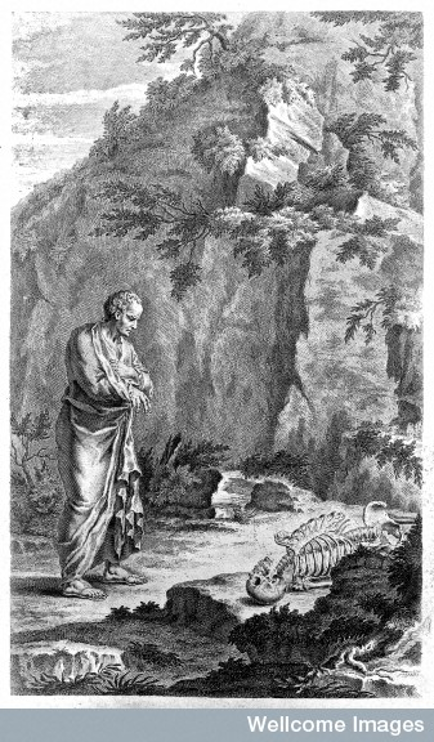
Modern image of Galen finding a skeleton in a natural area (strange as he predominantly focused on animals)
Did Alexandria remain a major medical centre?
Alexandria remained a major medical centre, esp. as a teaching place throughout antiquity
Best place for learning anatomy (Galen, 2nd c. AD)
Where is Roman medicine derived from?
A lot of Roman medicine is derived from Hellenistic anatomy, the whole field of anatomy in a sense emerged from the Hellenistic anatomy as in the Hippocratic texts there was no such thing as ‘anatomy’
Write out: Galen, De anatomicis administrationibus 9.5 (II, p. 731 K.) = fr. 79 Von Staden p. 199:
‘Next pay attention to how, when it [the vermiform process, sc. the woodworm-shaped process lying on the aqueductus cerebri] is bent forward, the result is that the posterior ventricle [of the brain], the fourth, is exposed, and, when it is moved backwards, that the larger part of the ventricle is covered and only that part is visible which Herophilus likened to the carved out groove of a pen [kalamos] with which we write. You see, it really is like a pen, since it has a hollow, like an incision [posterior median sulcus], in the middle, and on either side of this each of the two lateral parts [eminentia facialis] extends up to as great a height as they rise in pens from the line in the middle. Particularly in Alexandria they carve out the pens with which we write in this way, and since Herophilus lived there, it is likely that, when he was dissecting, he applied this name [sc. ‘pen’, kalamos], being induced to do so by the similarity of the image.’
Write out GALEN, De pulsuum dignotione 3.3 (VIII, p. 911-913 K) = fr. 173 Von Staden, p. 346-347:
‘In all these things many insoluble difficulties necessarily occur in the medical factions in differentiation of rythms, and I think it is for this reason that physicians after Herophilus did not even attempt to write anything on prognosis based on rhythms. And while Herophilus himself in many places mentions rhythms with a view to prognoses, it is very difficult to discover just what he means by ‘rhythm’ (rhythmos): is it the ratio (logos) of the time of dilation (diastolè) to the time of contraction (systolè) only, or does he also attribute to ‘rhythm’ the time of the pause (èremia) which follows upon each of the two motions? This is why there is no agreement, not even among those who are named ‘Herophileans’, after him, concerning just what Herophilus really thought about rhythms. For his words do not indicate one of the two alternatives clearly, nor is the nature of these things capable of providing information…’
In Hippocrates there is hardly anything about the pulse, there is no theory of the pulse and what it means in terms of health- so this is very important for Galen who wrote thousands and thousands of pages on the pulse. Theory of the pulse is complicated