Lecture 4 - Clinical Psychology
 Call Kai
 Learn
Learn Practice Test
 Spaced Repetition
 Match
Match Flashcards
 Knowt Play
1/27

There's no tags or description
Looks like no tags are added yet.
Name | Mastery | Learn | Test | Matching | Spaced | Call with Kai |
|---|
No analytics yet
Send a link to your students to track their progress
28 Terms
posttraumatic stress disorder (PTSD)
• An anxiety disorder in which a particularly stressful event, such as military combat, rape, or a natural disaster, brings in its aftermath intrusive reexperiencing of the trauma, a desire to avoid reminders of the event, changes in emotions and thought patterns, and indicators of heightened arousal.
acute stress disorder (ASD)
• A short-lived reaction to a traumatic event involving symptoms such as recurrent intrusive memories or dreams, attempts to avoid reminders or thoughts about the traumatic event, changes in emotions and thoughts, and signs of hyper-arousal; if it lasts more than a month, it is diagnosed as posttraumatic stress disorder.
What are other trauma- and stressor-related disorders in the DSM? (5)
• Adjustment Disorder (occurs after stressor, not trauma)
• Reactive Attachment Disorder (only applies to children)
• Disinhibited Social Engagement Disorder (only applies to children)
• Other specified TSR disorder
• Other unspecified TSR Disorder
• not in DSM, but ICD-11: complex PTSD
What is the timeline of the development of TSR disorders after trauma?
• trauma → Acute Stress Disorder (3 days - 1 month after trauma) → PTSD (if symptoms continue or occur later)
What are consequences of trauma? (4)
• personal consequences (symptoms, influence of relations, work/study, …)
• legal consequences
• political consequences
• wars
• …
psychotrauma/psychological trauma
• psychological term for trauma, because trauma can also be a medical term
What are 3 possible outcomes of psychotrauma?
• posttraumatic growth
• no problems or quick recovery (NB: having just some symptoms doesn’t indicate PTSD/ASD)
• PTSD, other mental health problems
prevalence
• ~81% lifetime prevalence for experience of any trauma (not big increase since 2009)
• lifetime prevalence of PTSD ~11% (increase since 2009)
Predictors of PTSD (8)
dissociation
• A symptom in which some aspect of emotion, memory, or experience is inaccessible consciously.
What are criteria for the diagnosis of PTSD? (8)
• A: trauma
• B: intrusion symptoms
• C: avoidance
• D: negative changes in mood and cognition
• E: arousal and reactivity
• F: duration
• G: significant distress/impairment
• H: not causes by substance or another medical condition
DSM trauma definition “criterion A” according to DSM-III (1)
• “event outside usual human experience”
DSM trauma definition “criterion A” according to DSM-IV (2)
• “actual or threatened death, serious injury, physical integrity”
• “fear, helplessness, or horror”
DSM trauma definition “criterion A” according to DSM-5 (5)
• “exposure to actual or threatened death, serious injury, or sexual violence”
Directly experiencing
Witnessing in person
Learning: close family member/friend
Repeated/extreme exposure to aversive details (not through movies/pictures, unless work related)
“B” intrusion symptoms (5)
→ minimum 1 of symptoms:
• intrusive distressing memories
• distressing dreams
• dissociative reactions (flashbacks)
• intense distress upon reminders
• physiological reactivity upon reminders
“C” avoidance (2)
→ minimum 1 of symptoms:
• avoidance internal reminders (e.g. memories, thoughts, feelings)
• avoidance external reminders (e.g. places, situations, people)
“D” negative changes in mood and cognition (7)
→ minimum of 2 symptoms:
• dissociative amnesia
• negative convictions and expectations
• excessive cognitions about cause, guilt, etc.
• persistent negative mood
• loss of interest
• estrangement
• inability to experience feelings
“E” arousal and reactivity (6)
→ minimum of 2 symptoms:
• irritable/aggressive outbursts
• self-destructive/reckless behavior
• hypervigilance
• exaggerated startle
• concentration problems
• sleeping problems
General criteria (3)
• F: duration of disturbance (criteria B, C, D, E) is more than 1 month
• G: disturbance causes clinically significant distress or impairment in social, occupational, or other important areas of functioning
• H: disturbance is not attributable to physiological effects of substance or another medical condition
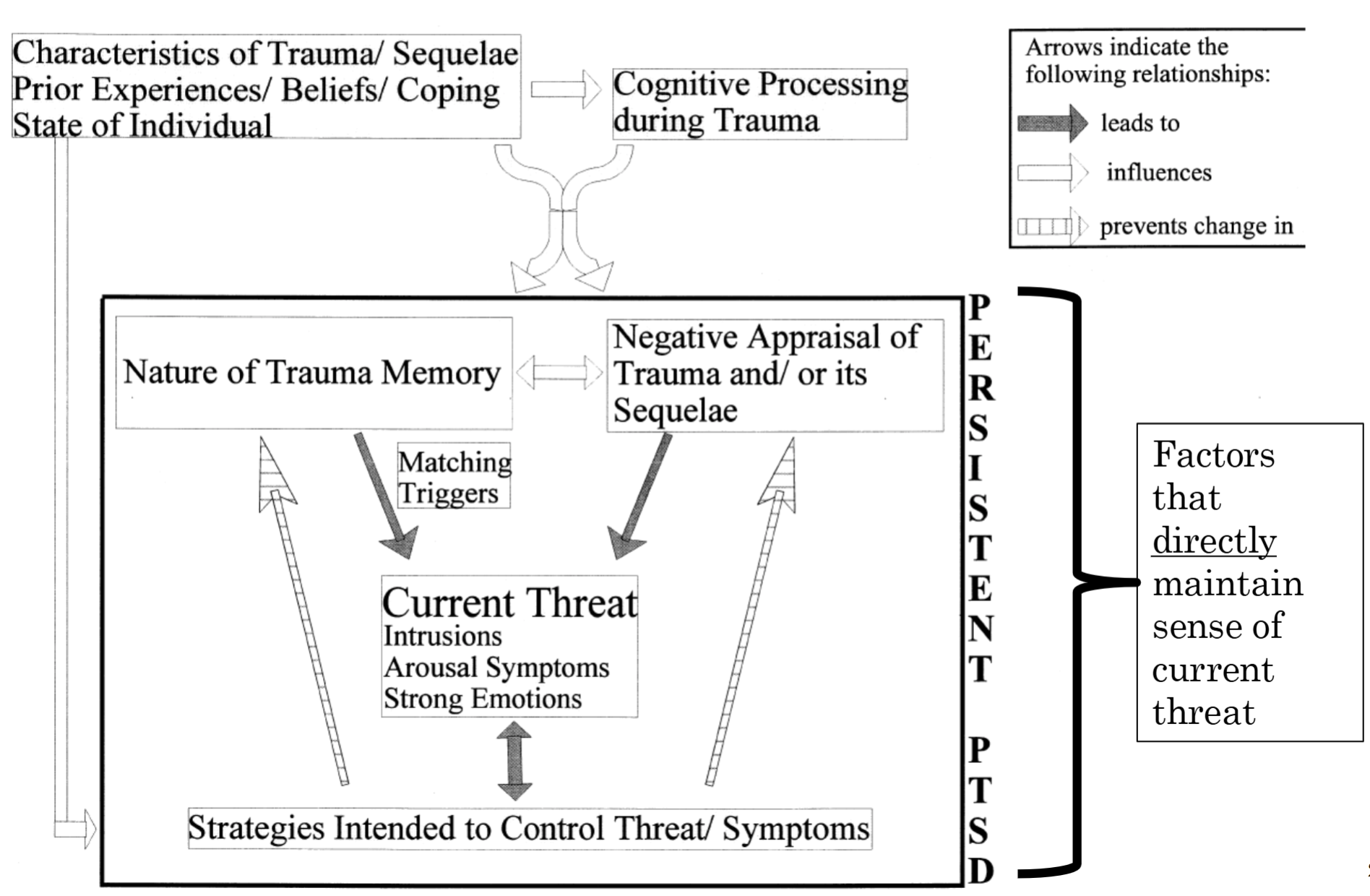
Cognitive Model PTSD
effectiveness of single session debriefing → critical incident stress debriefing (CISD)
• no significant differences between CISD and no intervention
• possible negative effect of CISD
guidelines on psychological PTSD treatment (Dutch)
diagnosis
First choice treatment
Try other first choice treatment
intensified care (e.g. condensed treatment, clinical treatment, pharmacotherapy)
Alternative/complementary treatments
First choice treatments for PTSD (8)
• imaginal/prolonged exposure
• cognitive therapy/cognitive processing therapy
• EMDR (eye movement desensitization and reprocessing)
• Trauma focused cognitive behavior therapy
• brief eclectic psychotherapy for PTSD
• narrative exposure therapy
• writing therapy
• imaginal rescripting
learning theory
→ theory behind prolonged exposure therapy
• CS-US (fearful) association stays intact (explains e.g. relapse)
• new CS-”no US” (non-fearful) association is learned that competes with/inhibits original CS-US association
Other theories possibly explaining the workings of prolonged exposure (2)
• memory: trauma becomes contextualized, integrated in autobiographical memory
• cognitive: new insights
Cognitive therapy
• can be used in treatment of PTSD
• directly identify and challenge dysfunctional/irrational cognitions
• often combined with exposure into (TF-)CBT
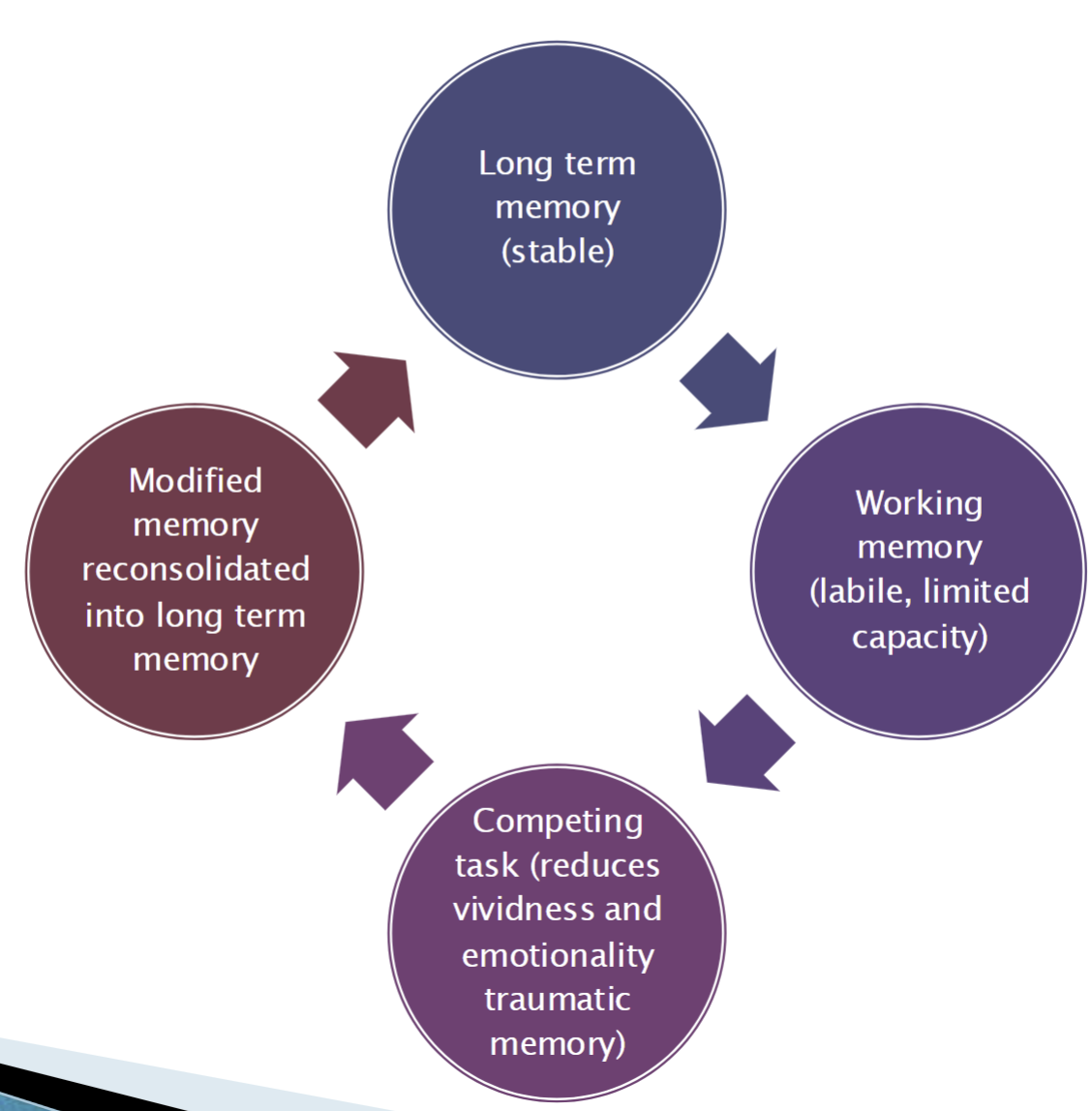
Working memory theory
→ theory that tries to explain working of EMDR
What are the different mechanisms that can be used in PTSD treatment and how do they differ?(4)
• exposure: new learning (CS > non-US)
• EMDR: trauma imagery directly modified
• imagery rescripting: trauma imagery also directly modified, but through new script instead of distracting task
• Propranolol: pharmacological disruption of memory reconsolidation
imaginal exposure
• Treatment for anxiety disorders and posttraumatic stress disorder that involves visualizing feared scenes for extended periods of time. Frequently used in the treatment of posttraumatic stress disorder when in vivo exposure to the initial trauma cannot be conducted.