Business Final Exam Questions
 Call Kai
 Learn
Learn Practice Test
 Spaced Repetition
 Match
Match Flashcards
1/96

There's no tags or description
Looks like no tags are added yet.
Name | Mastery | Learn | Test | Matching | Spaced | Call with Kai |
|---|
No analytics yet
Send a link to your students to track their progress
97 Terms
What is the moral responsibility of a business? WHAT IS RESPONSIBILITY
is the ability and moral obligation to respond (in
action or verbally) to normative questions concerning the rightness and
wrongness of actions or state of affairs.
WHEN IS SOMEONE RESPONSIBLE FOR SOMETHING? - CONDITIONS THAT
CONSTITUTE RESPONSIBILITY:
Causality
Knowledge
Free will
Position / Function / Relationship
Ability and Power
Business-specific (company-specific) responsibility
means the
sum of responsibilities a given business has regarding its specific operations,
products, services, and stakeholders. This includes all ethically critical societal,
environmental, global, and future effects that result from the business's
activities and products.
Determining business-specific responsibilities based on an
Ethical Life Cycle Assessment (ELCA)
[STEP 1]
DENTIFY SOCIETAL, ENVIRONMENTAL, GLOBAL AND LONG-TERM IMPACTS
THAT RESULT FROM THE ENTIRE PRODUCT LIFE CYCLE:
Sourcing
Production
Distribution
Use
Disposal
Step II:
Step II: ETHICALLY EVALUATE THOSE IMPACTS – IDENTIFY ETHICAL ISSUES
CI PRINCIPLE B:
All involved in, and affected by, the product life cycle
should be treated with respect:
No one should be treated as mere object
Vulnerable groups should not be exploited
The moral rights of all should be respected (e.g. human rights)
UTILITARIAN PRINCIPLE:
Is overall happiness maximized?
VIRTUE PRINCIPLE B:
Do all involved in, and affected by, the product life
cycle benefit? Do all have opportunities to thrive?
NO HARM PRINCIPLE
Others should not be harmed; harm to others and the
environment should be minimized
Step III: TO WHAT DEGREE CAN THE BUSINESS BE HELD ACCOUNTABLE FOR THE
ISSUES IDENTIFIED IN STEPS I AND II?
CRITERIA:
□ To what extent did the business cause the issue?
□ To what extent did the business know or could have known that the issue
occurs?
□ How much ability, expertise, and power does the business have to
address the issue?
(always in comparison to other actors / parties involved)
Step IV: IDENTIFY STRATEGIES FOR THE BUSINESS TO ASSUME RESPONSIBILITY AND
TAKE ACTION
CRITERIA:
□ Activities should effectively address the ethical issues
□ Activities should match the degree of responsibility defined in Step III
□ Activities should be economically feasible and ideally support the
business success
ELCA method – summary
STEP I
IDENTIFY CRUCIAL SOCIETAL, ENVIRONMENTAL, GLOBAL, AND LONG-TERM IMPACTS OF
THE PRODUCT LIFE CYCLE
Sourcing – Production – Distribution – Use – Disposal
STEP II
ETHICALLY EVALUATE THOSE IMPACTS AND IDENTIFY CRITICAL ISSUES
Utilitarian principle, CI principle B, Virtue principle B, No-harm principle
STEP III
DETERMINE WHAT DEGREE OF RESPONSIBILITY THE BUSINESS HAS FOR THE ISSUES
To what extent did the business cause the issue?
Did the business know or could it have known that the issue would occur?
How much ability does the business have to address the issue?
STEP IV
IDENTIFY STRATEGIES FOR THE BUSINESS TO ASSUME RESPONSIBILITY AND TAKE ACTION
Activities should effectively address the ethical issues
Activities should match the degree of responsibility defined in Step III
Activities should be economically feasible and ideally support business success
CORPORATE SOCIAL RESPONSIBILITY (CSR):
Corporate Social Responsibility is a management concept whereby
companies integrate social and environmental concerns in their
business operations and interactions with their stakeholders. CSR is
generally understood as being the way through which a company
achieves a balance of economic, environmental and social
imperatives ("Triple-Bottom-Line-Approach"), while at the same time
addressing the expectations of shareholders and stakeholders."
How many of the largest 250 global companies issue CR reports?
A) More than 90%
B) About 75%
C) About 50%
D) About 25%
E) Less than 25%
More than 90%
CHANGE IN MODERN BUSINESS: COMPANIES ASSUME BROADER RESPONSIBILITIES 1
Higher expectations from stakeholders: more awareness for ethical aspects of
business operations
CHANGE IN MODERN BUSINESS: COMPANIES ASSUME BROADER RESPONSIBILITIES 2
Businesses are influential societal and global players: more responsibility and civil
engagement
CHANGE IN MODERN BUSINESS: COMPANIES ASSUME BROADER RESPONSIBILITIES 3
Businesses can only thrive in stabile societies, a stabile global world, and a healthy
environment.
CHANGE IN MODERN BUSINESS: COMPANIES ASSUME BROADER RESPONSIBILITIES 4
Businesses broadly recognize their new and expanded responsibilities in today's
world regarding their stakeholders and sustainability challenges (and given the
limitations of markets and government regulations).
WHY IS CR IMPORTANT FOR A MODERN BUSINESS (BUSINESS CASE)?
Improves stakeholder relationships
Crucial information for investors and shareholders
Attracts highly qualified employees
Proactive risk management
Contribution to strategic management
Innovation and efficiency gains
Identification of new markets and products
Builds reputation
Improved competitiveness
Pillar model of CR: The responsible company
---
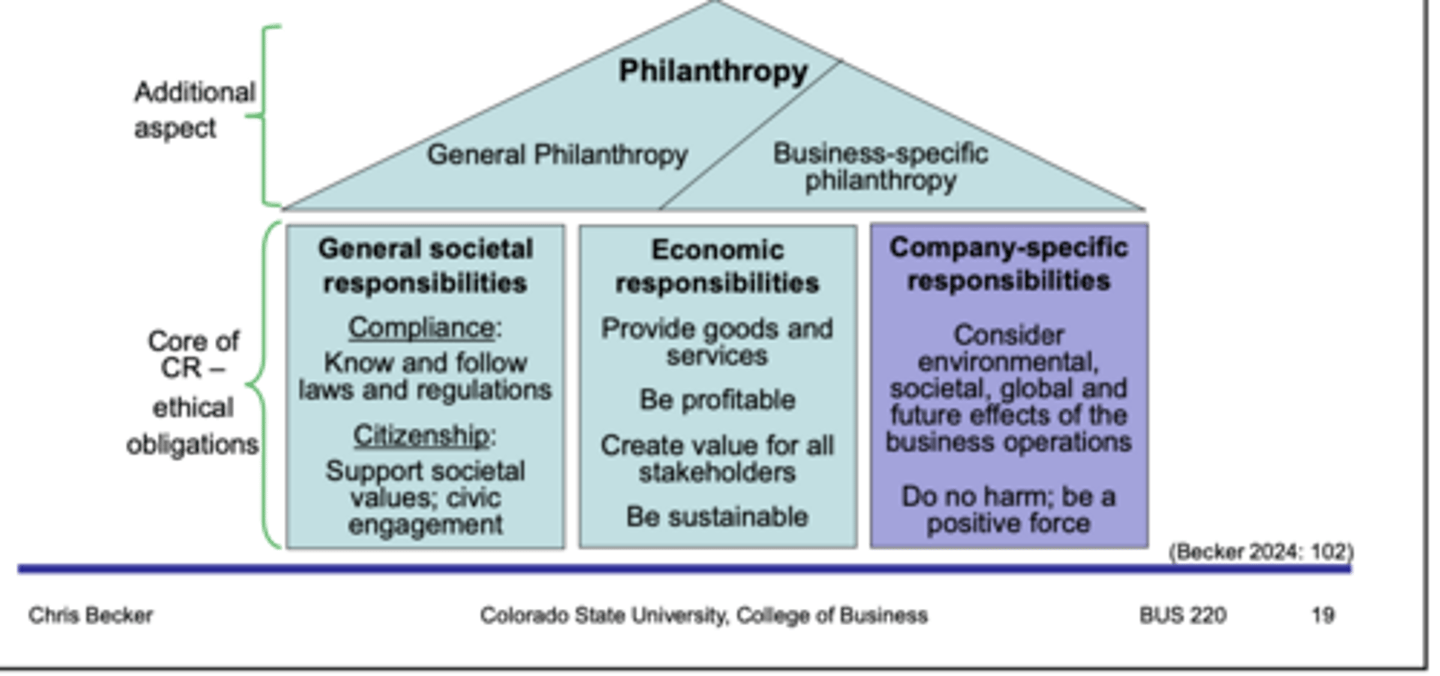
CR analysis – method
Evaluating CR strategies I.
Basics about the company and its business
Type of business/industry?
Mission statement?
Core data about the company?
CR analysis – method
Evaluating CR strategies II.
Crucial elements and operationalization of the CR
What areas and activities are at the core of the CR?
How are CR activities operationalized?
Core data about CR?
CR analysis – method
Evaluating CR strategies III.
Critical evaluation of the CR strategy
1 Ethical criteria
2 Economic criteria
3 Formal criteria
1 ETHICAL CRITERIA
Does the CR-strategy
sufficiently address the business-specific responsibilities of the
company? Determine business-specific responsibilities. Evaluate whether the CR strategy sufficiently addresses the
business-specific responsibilities. Is the CR-strategy credibly maintained in all
business operations?
2 ECONOMIC CRITERIA
Does the CR-strategy support the business success of the
company?
improves stakeholder relationships
proactively manages risks
contributes to strategic management
results in innovation and efficiency gains
assists with identifying new markets
improves competitiveness
builds reputation
3 FORMAL CRITERIA
Does the company issue a CR report?
(ii) Does the CR report follow established reporting guidelines and
business norms, such as GRI standards, SASB standards, UN
Global Compact, UN SDGs, Human Rights Declaration, etc.?
(iii) Does the CR report provide data and well-defined goals?
(iv) Does the company provide external assurance for its CR data?
(v) Is the CR strategy well integrated into corporate governance
and other business ethics programs of the company?
ethical culture of an organization
is the sum of
explicit and implicit values, principles, and ethical reflections that
underlie, and are expressed by, the interactions and actions of its
members
Kantian principles
Respect and reasons
o Participation and open critical discourse
o Responsibility
Virtue ethical principles
Empowerment
o Thriving
o Community
Care principles
Care for individual wellbeing
o Respect and accommodate vulnerabilities
Principles of fairness and equality
REMEMBER THIS ONE
PROMOTING A STRONG ETHICAL CULTURE
Organizational design and formal mechanisms
o Well-defined rules, policies, and procedures
o Supportive incentives and rewards
o Effective ethics and compliance program
o Effective diversity and inclusion program
□ Ethical leadership
□ Integration with governance
□ Living and developing the culture
□ Support from society and stakeholders
ethics and compliance program
is a formal
internal mechanism that implements ethics and compliance
throughout an organization
ELEMENTS OF AN ETHICS AND COMPLIANCE PROGRAM
Code of conduct
□ Ethics and compliance training
□ Mechanisms for members to raise concerns and speak up
□ Mechanisms to address issues
□ Mechanisms for program evaluation
□ Oversight and leadership
REASONS FOR IMPLEMENTING AN ETHICS AND COMPLIANCE PROGRAM
Promoting a strong ethical culture (fairness, respect, responsibility)
□ Minimizing risks of employee misconduct
□ Minimizing conflicts with stakeholders and society
□ Minimizing internal frictions and conflicts
□ Professionally dealing with issues, concerns, and conflicts
□ Legal expectations, e.g., by the United States Sentencing Guidelines
Chapter 8 of the USSG incentivizes business ethics:
“[O]rganizations can act only through agents and, under federal criminal law,
generally are vicariously liable for offenses committed by their agents. […] This
chapter is designed so that the sanctions imposed upon organizations and their
agents, taken together, will provide just punishment, adequate deterrence, and
incentives for organizations to maintain internal mechanisms for preventing,
detecting, and reporting criminal conduct.” (USSC, 2021, Ch.8, Intro. Comment.)
The USSG encourage the implementation of ethics and compliance programs to
reduce internal misconduct. If nevertheless some misconduct happens, a well-designed
ethics and compliance program may reduce the punishment for the organization:
The two factors that mitigate the ultimate punishment of an organization are: (i) the
existence of an effective compliance and ethics program; and (ii) self-reporting,
cooperation, or acceptance of responsibility.” (USSC, 2021, Ch.8, Intro. Comment.)
what does the USSG do
The USSG encourage organizations to actively promote an ethical culture. The USSG provide specific recommendations for the implementation of an ethics
and compliance program into an organization's governance structure:
ESG
s a business ethics approach that considers
environmental, social, and governance aspects of a business with
regards to its strategy, success, and impacts.
Environmental (ESG)
refers to the environmental aspects and performance of a company,
such as GHG emissions, energy and resource use, water footprint, ecological footprint,
impact on biodiversity, waste, among others (including supply chains).
Social (ESG)
refers to the societal aspects and performance of a company. This includes, for
instance, employee satisfaction, ethical culture, diversity, ethics and compliance, child
labor cases, human rights violations, accidents/injuries, stakeholder engagement, etc
Governance (ESG)
refers to the mechanisms and processes of directing a company. This
includes power structures, management system, rules and policies, actions, and
decision processes within a company. Crucial questions for ESG are: How well are responsibilities for environmental and societal performance
implemented in the governance of the company?
□ How well are responsibilities for internal ethics and ethical culture implemented
in the governance or the company?
ETHICAL AND BUSINESS ASPECTS
Promoting responsible business practice
□ Promoting business as a positive force
□ Proactively addressing environmental and societal risks
□ Strategically positioning a company toward sustainability issues (see also Chapter 7)
□ Meeting stakeholder expectations
□ ESG overall supports business success (Friede et al., 2015)
Ethics of consumption: consumption
the use of goods and services to satisfy needs and wants
Ethics of consumption Ethics:
the study of the right and the good
Ethics of consumption
How does consumption relate to wellbeing (the good)?
(ii) How does consumption relate to doing right?
INDIVIDUAL ROLES IN THE ECONOMY / BUSINESS / ORGANIZATIONS:
Consumer
Investor
Entrepreneur
Employer
Employee
Leadership roles
Member of a certain profession
Specific role in an organization
MORAL RIGHTS
Rights are fundamental claims that are grounded in ethical reasons and
demand general recognition
□ Rights protect crucial interests and wellbeing
MORAL RIGHTS KANTIAN ETHICS
everyone has the right to be respected as ends in
themselves and beings endowed with reason
MORAL RIGHTS VIRTUE ETHICS:
everyone has the right to thrive and develop the own
potential towards excellence
MORAL RIGHTS ETHICS OF CARE:
Everyone has the right that their vulnerability and lack
of power, ability, or knowledge is not ignored or abused, but cared for. Everyone has the right not to be harmed in person or property
POTENTIAL MORAL RIGHTS OF EMPLOYEES
Right to equal, fair, and respectful treatment in the workplace
□ Right to reason-based treatment
□ Right to participation
□ Right to privacy
□ Right to meaningful work and supportive work environment
□ Right to not get harmed
Examples for legal rights in the US:
Minimum wage
o Protection against discrimination (e.g., Civil Rights Act; ADA;
ADEA; Equal Pay Act; etc.)
o Workplace safety (OSHA)
Examples for legal rights in other countries:
Protections against arbitrary firing
o Paid vacation & paid sick leave
o Paid parental leave
DUE PROCESS
Guarantees fair, equal, and transparent treatment; provides
reasons for actions (in line with Kantian ethics)
□ For instance, well-defined rules and procedures for
evaluations, pay rises, promotions, getting fired
PARTICIPATION
Respects rational individuals as ends in themselves
□ Inclusion in decision-making processes
□ Compare different corporate governance models (e.g., EU;
US; Benefit corporation)
EMPLOYEE RESPONSIBILITIES
Performance
□ Professionalism
□ Ethical and legal conduct
□ Avoiding harm to the organization
□ Supporting the success of the organization
DEFINING GREAT LEADERSHIP
Great leadership is leadership that is effective
and ethical
Ethical Leadership
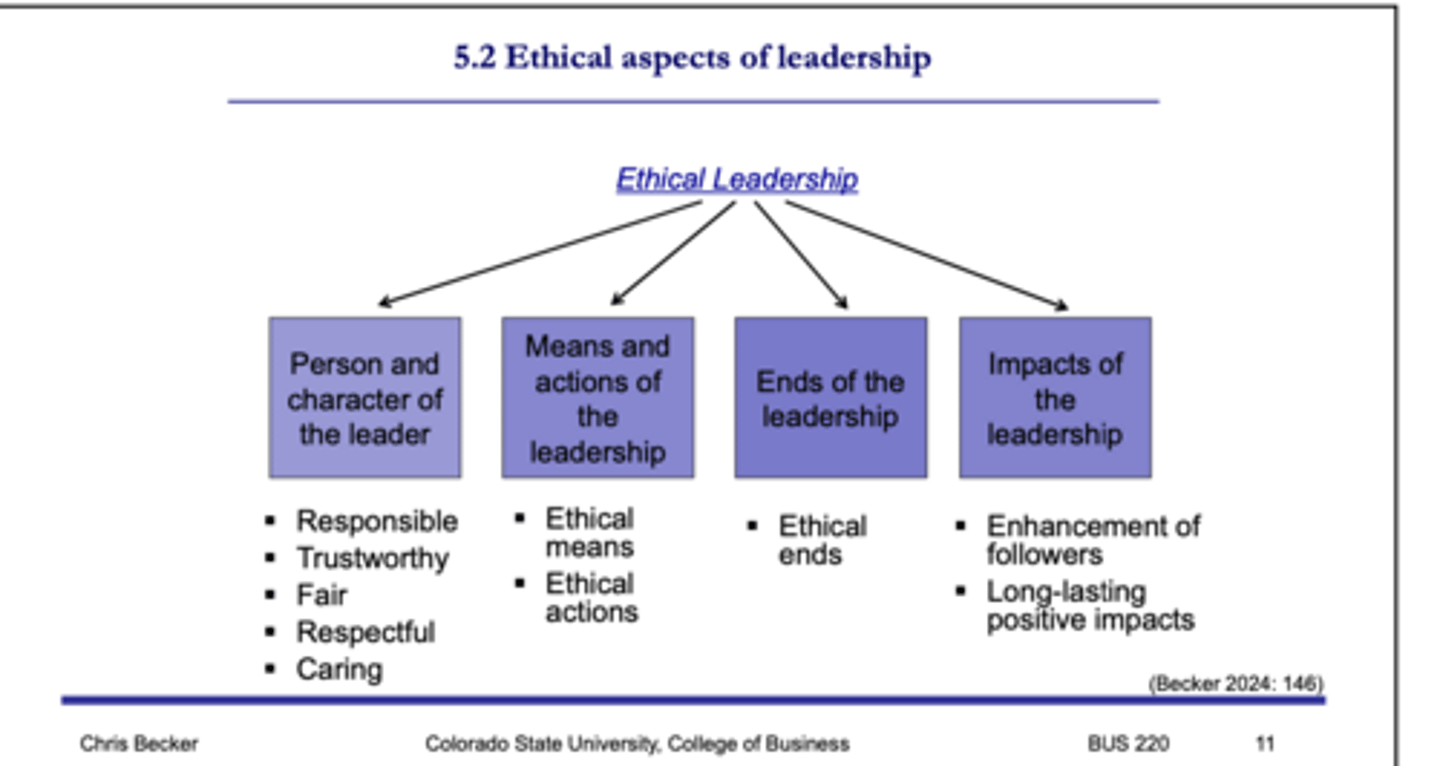
Great ethical leadership
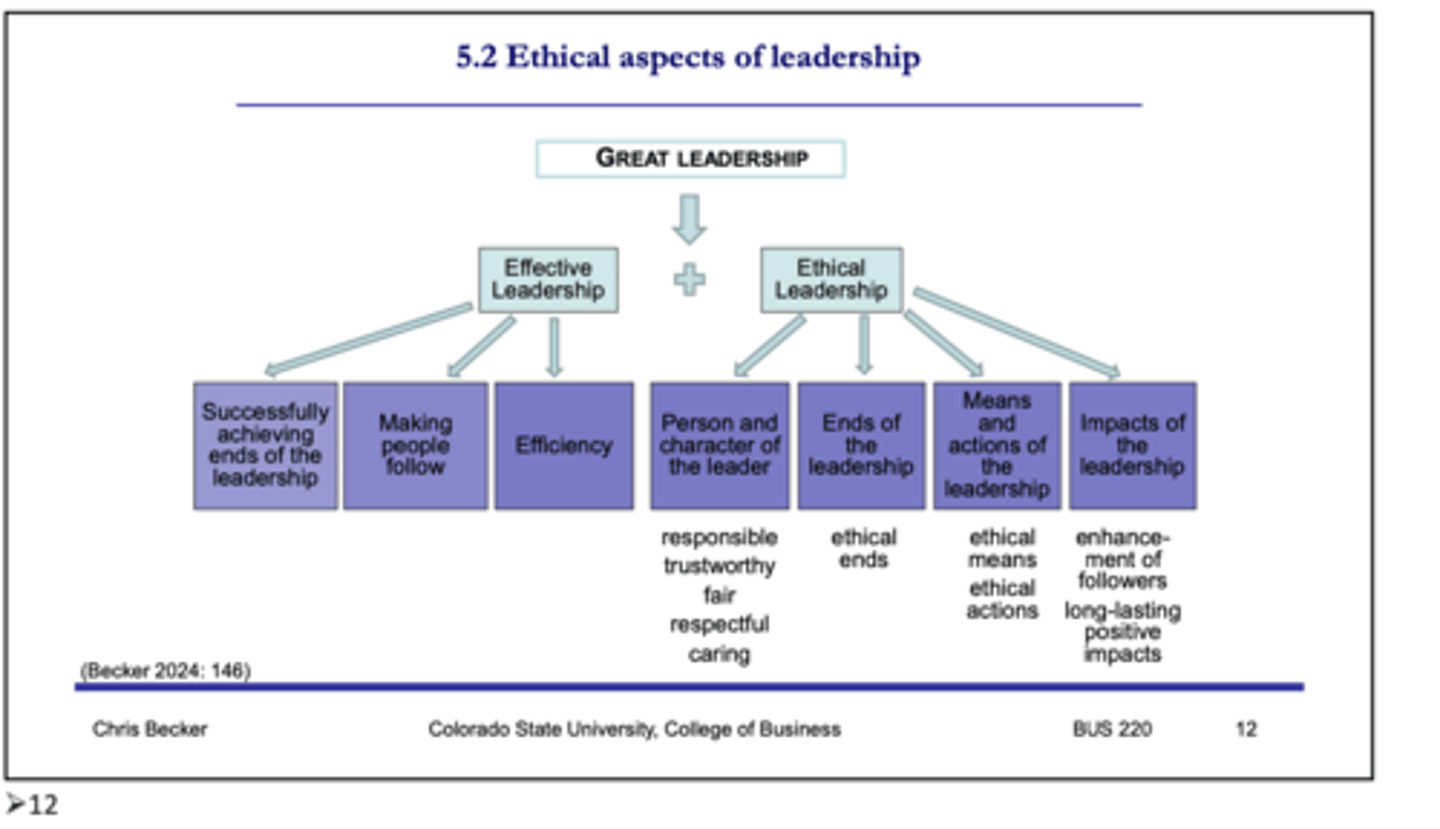
WHAT ARE ETHICAL FOUNDATIONS OF LEADERSHIP?
Ethical leadership is grounded in ethical principles
□ Ethical principles for leadership can be deduced from ethical theory
TEN PRINCIPLES OF ETHICAL LEADERSHIP
Principle 1: Ethical leadership is based on the fundamental values of a free and equal
society of autonomous, rational persons
Principle 2: Ethical leadership serves some common good
Principle 3: Ethical leadership is respectful
Principle 4: Ethical leadership is grounded in reasonable principles rather than in
oppressive or authoritarian power mechanisms
Principle 5: Ethical leadership requires only the minimum amount of power necessary to
lead
Principle 6: Ethical leadership is transparent, participatory, and empowering
Principle 7: Ethical leadership is responsible
Principle 8: Ethical leadership empowers individual responsibility of followers
Principle 9: Ethical leadership promotes excellence
Principle 10: Ethical leadership cares about followers
PROFESSION:
A profession is a well-defined vocation whose expertise serves a specific
public interest. A profession is typically based on extensive qualification, develops own
standards and criteria, and is self-regulated.
PROFESSIONAL ETHICS:
Specific professional expertise comes with specific ethical
responsibilities. If you are an expert in a certain field, others rely on you and trust you.
You are responsible for properly using your expertise.
CORE PRINCIPLES OF PROFESSIONAL ETHICS
Competency: Stay up to date of professional knowledge; only work in areas of
own competency
□ Objectivity: Adhere to established professional methods and norms; avoid
personal bias and external influence
□ Responsibility: Use expertise in a responsible way with regard to all parties
affected and professional standards
□ Integrity: Uphold professional principles and avoid conflicting and
contradicting actions
□ Public interest: Consider public expectations and public welfare related to
professional work
ACCOUNTING
involves gathering, classifying, summarizing, and reporting financial
information about an entity to interested users such as stockholders, creditors, potential
investors and creditors, governments, and other stakeholders."
MARKETING:
Linking business to existing and potential markets / customers
FIELDS OF MARKETING:
Advertising
□ Market research
□ Pricing
□ Sale
□ Internet and database marketing
□ Social media marketing
ETHICAL ISSUES IN MARKETING - EXAMPLES:
VW diesel car marketing: VW diesel ad
□ "Red Bull gives you wings"
□ Big data analysis and marketing
□ Advertisement to children
AREAS OF MARKETING AND RELATED ETHICAL ASPECTS - OVERVIEW:
□ Advertising – truthfulness, proper targeting, no manipulation
□ Pricing – fairness, transparency
□ Sale – fairness, transparency, respect
□ Internet and database marketing – privacy, transparency
□ Social media – no manipulation, privacy, transparency, respect
□ Market research – transparency, respect
ETHICAL INTELLIGENCE: TRAINING AI TO CONSIDER ETHICAL ASPECTS?
Ethical training based on empirical data [might perpetuate (past) biases]
□ Training in normative ethics: AI could apply ethical methods, e.g., utilitarian
method, CI method, virtue method, etc.
□ AI would probably be particularly good in applying utilitarianism
Analysis + Action = Solution
ANALYSIS:
□ Identifying the ethical issue
□ Identifying solutions
II. ACTION:
□ TYPE OF ISSUE: individual, organizational, regulatory? Is the issue controversial or
undisputed?
□ POSITION: management, consultant, employee, owner, etc.?
□ CONTEXT: organizational culture, policies, procedures?
□ COMMUNICATION AND PSYCHOLOGICAL ASPECTS: Whom to address? Ways to raise
concerns? Potential barriers?
(External) Whistleblowing
is the intentional act of a
member of an organization calling public attention to
some wrongdoing of the organization. Whistleblowing is a measure of last resort - an option to address serious cases if
there is no other resonable option left
□ It is important to recognize that this option exists for any individual person as an
ultimate reference point for morality
□ In some cases, whistleblowing can be considered as moral obligation of a
professional
ethical dilemma
is a situation in which one must
choose between two conflicting ethical values, norms,
or principles.
WHEN IS WHISTLEBLOWING JUSTIFIED?
Checking the facts: Is there enough unbiased evidence
about the wrongdoing/issue and its magnitude?
(Is there really a serious issue?)
2. Checking other ways to address the issue: Is there no
internal way to sufficiently deal with and fix the issue
within the organization?
3. Checking ethical justification: Has the ethical argument
been carefully considered? Are there strong ethical
reasons for blowing the whistle?
o Ethical reasons
o Professional ethics
o Fundamental principles
PERSONAL ASPECTS: whistleblowing
Personal risks and benefits
□ Professonal and personal responsibilities
□ Individual ethical decision: Speak up, leave the organization, or blow the whistle
ORGANIZATIONAL ASPECTS: whistleblowing
Organizations need internal mechanisms to avoid serious issues and potential
whistleblowing
□ Organizations should ensure a strong ethical culture and ways to speak up and
raise concerns internally
□ Lack of proper internal mechanisms is potentially dangerous to the organization,
its members, and society
SOCIETAL ASPECTS: whistleblowing
Society has an interest in whistleblowers who serve societal interests
□ Societal support for whistleblowers: laws, protection, rewards
False Claims Act: covers fraud to governmental programs; 15-30% of
recovered sum goes to the whistleblower
Whistleblower Protection Act: protection of federal employees that blow the
whistle
Tax Relief and Health Care Act (2006): reward to whistle-blowers: up to
30% of recovered tax
Sarbanes-Oxley Act: whistleblower protection; protection against retaliation
ETHICAL ISSUES IN THE GLOBAL ECONOMY:
Exploitation
Human rights violations
Environmental harm
Social and environmental injustice
UNDERLYING CAUSES ROOTED IN THE CHARACTERISTICS OF THE GLOBAL
ECONOMIC SYSTEM:
Large asymmetries in power, capabilities, and wealth
Lack of proper regulation around the world
Complexity of the global economic system
BASIC GLOBAL BUSINESS ETHICS
Uphold global norms and fundamental rights, Adhere to one's own ethical
principles and core values.Respect other cultures
and cultural values. at the heart is ethical reflection
ADVANCED GLOBAL BUSINESS ETHICS
Use business to be a positive force in the world
Create win-win
Participation
Empowerment
Development
The Anthropocene
the age of human dominance on earth
information about humans and the earth
Humans have become the dominant force on earth (Crutzen & Stoermer 2000; IPBES 2019)
Human activities are significantly impacting major earth systems: climate, freshwater,
biodiversity, oceans, fertile land, forests, ... (IPCC 2021; UNEP 2019; IPBES 2019; MEA 2005)
Overuse of earth's resources and sinks: climate change, biodiversity loss, water scarcity,
loss of rain forests, land degradation, overfishing, ... (IPCC 2021; UNEP 2019; IPBES 2019)
Sustainability as major challenge of the Anthropocene
"Sustainability means the ability to sustain systems, processes, and entities that are crucial
for the wellbeing of contemporaries, future generations, and nature" (Becker & Hamblin 2021)
"The concept of sustainability addresses the overall challenge of transforming technological,
societal, and economic systems to avoid further overuse of the planet and ensure thriving of
humans and nature in the long run" (Becker 2021)
sustainability facts and evaluations
Self-interest and sustainability
Ethical underpinnings of sustainability
Doing right to ...
... future people
... people around the world
... nature and non-human species
New ethical challenges: responsibilities, rights, obligations in the sustainability context
Sustainable economy and sustainable business
Transforming the economy toward a sustainable economy is key for a sustainable future
Factual and ethical challenges for the economy of the Anthropocene
Implications for sustainable business
Ethics of capitalism:
markets coordinate individual self-interests to promote societal
wellbeing (Smith 1776)
Individual freedom; choice; opportunities
Societal benefits: efficiency; growth; innovation
"Systemic ethics" of the capitalist market economy; everyone is better off
Limitations of Ethics of capitalism:
Exclusion of nature, future beings, many contemporaries
sustainable economy
is an economy that serves the wellbeing of
contemporaries, future generations, and nature in a systematic and well-defined way
and, by this, has the ability to continue in the long run without larger frictions or crises
sustainable business
is a business that systematically considers all
environmental, societal, global, and future impacts of its business operations and
products and, by this, improves its competitiveness and long-term success
HOW TO TRANSFORM A COMPLEX GLOBAL ECONOMIC SYSTEM?
Bottom-up approaches: responsibilities and actions of consumers, investors, businesses,
communities, etc.
The role of businesses
Capability: power, dynamic, and global reach
Responsibility
Action: Transition is already happening and shapes future business
Companies assume broader environmental and societal responsibilities: Corporate
Responsibility, sustainability strategies, supply-chain responsibility, ESG
Triple bottom line: improving financial, environmental, and societal performance
WHY SHOULD BUSINESS CARE ABOUT SUSTAINABILITY? ethical
Business needs to consider societal and global norms/values
Economic activities have been a major factor in causing sustainability issues
Responsibility: everyone is responsible for one's own actions and its effects on others
Business should ideally be a positive force in the world and needs to realize this ideal in
the broader sustainability context
WHY SHOULD BUSINESS CARE ABOUT SUSTAINABILITY? economic
REPUTATION, RISK, AND STRATEGIC MANAGEMENT:
Need for strategic positioning toward increasingly scarce materials and energy, as
well as changing investor and consumer expectations, changing preferences, and
future regulations
BUSINESS OPPORTUNITIES: Sustainability provides business opportunities, such as
efficiency gains and new markets
SUSTAINABILITY AS BUSINESS OPPORTUNITY - EXAMPLES:
Sustainable landscaping
Sustainable construction and development
Sustainable cars / transportation
DEFINING GREAT LEADERSHIP