Topic 28: The cytoskeleton & Actin Self-Assembly
 Call Kai
 Learn
Learn Practice Test
 Spaced Repetition
 Match
Match Flashcards
 Knowt Play
1/25

There's no tags or description
Looks like no tags are added yet.
Name | Mastery | Learn | Test | Matching | Spaced | Call with Kai |
|---|
No analytics yet
Send a link to your students to track their progress
26 Terms
Assembly of cytoskeletal filaments from small subunits allows for what?
rapid remodeling
what underlie cell motility, alternating cell contact and cell division?
dynamic cytoskeletal rearrangements
why is rapid reorganization possible?
because large cytoskeletal filaments are built up from small aoluble subunits
what are able to create stable, long-lasting strucutures?
cytoskeletal polymes
stable structures that persist for the lifetime of the cell can be assebled, but what happens to the individual subunits within them?
they continue to flux in and out of the structures
what are sturdy, but easily altered by polymerization and depolymerization?
cytoskeletal filaments
how are cytoskeletal filaments altered?
depolymerization and polymerization
What is nucleation?
the rate limiting step for the formation of actin filaments in a test tube
what are the starting conditions of nucleation?
tube with high concentration of free actin subunits, but concentration of salt is too low for polymerization.
then: add salt
Lag Phase in actin polymerization
small oligomers form, fall apart, & form again
“nucleation”
growth phase in actin polymerization
-filaments grow long enough to become stable, rapid elongation occurs
“elongation”
equilibrium phase in actin polymerization
free soluble actin concentration has dripped to the point where addition of new subunits is just balanced by loss of old subunits
“steady state”
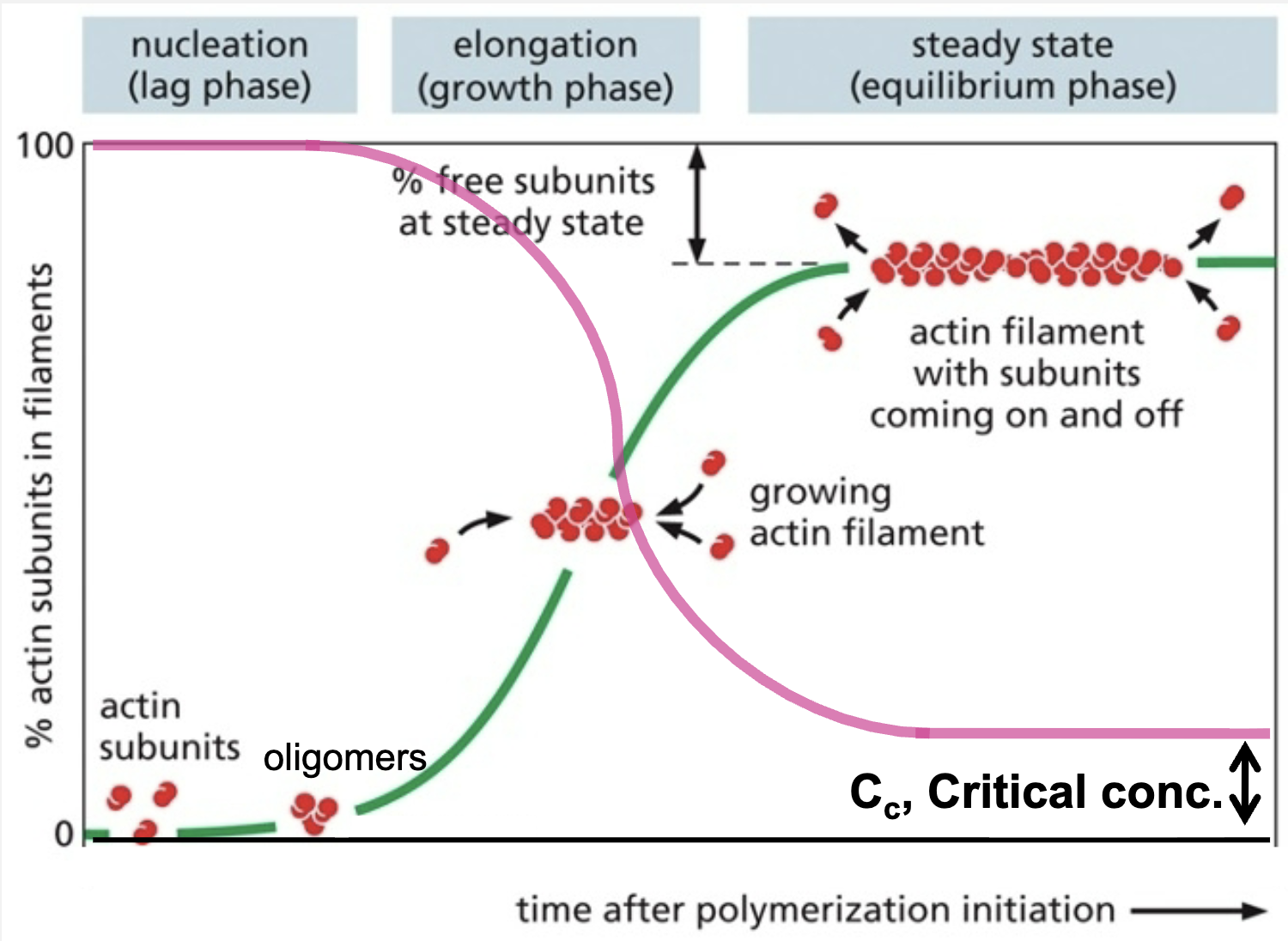
Through the 3 phases (lag, growth, equilibrium) what are actin filaments able to do in vitro?
self assemble
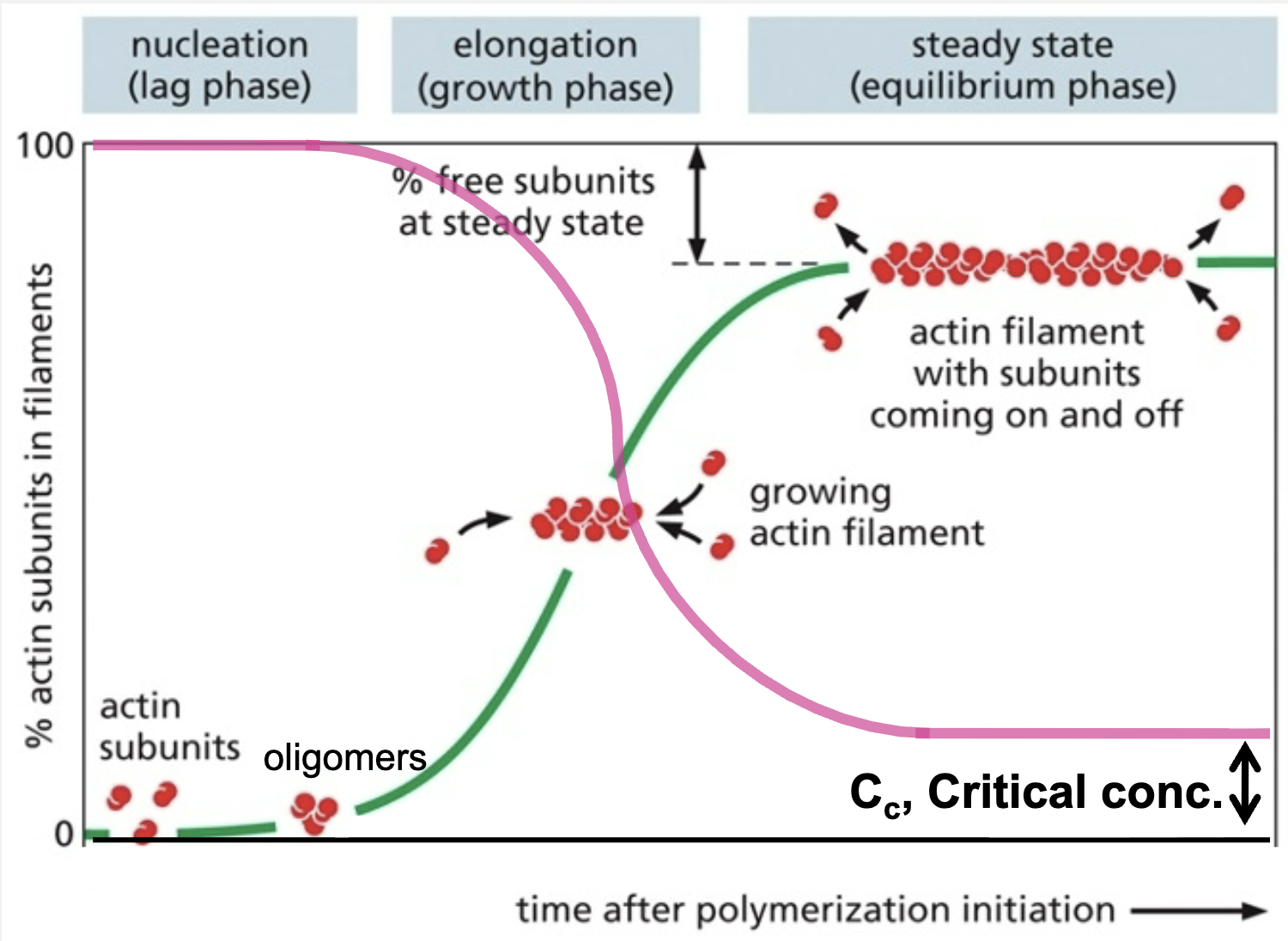
what does its mean at Cc (critical concentration)?
at Cc rate of subunit addition = rate of loss
How can the lag phase in actin polymerization be eliminated?
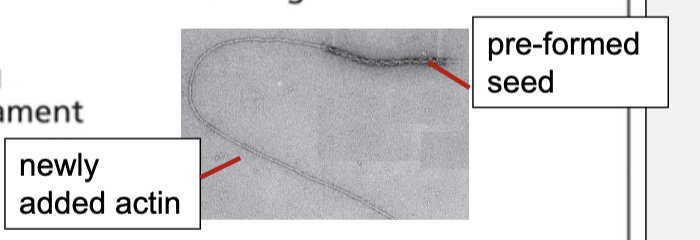
by adding preformed filament seeds
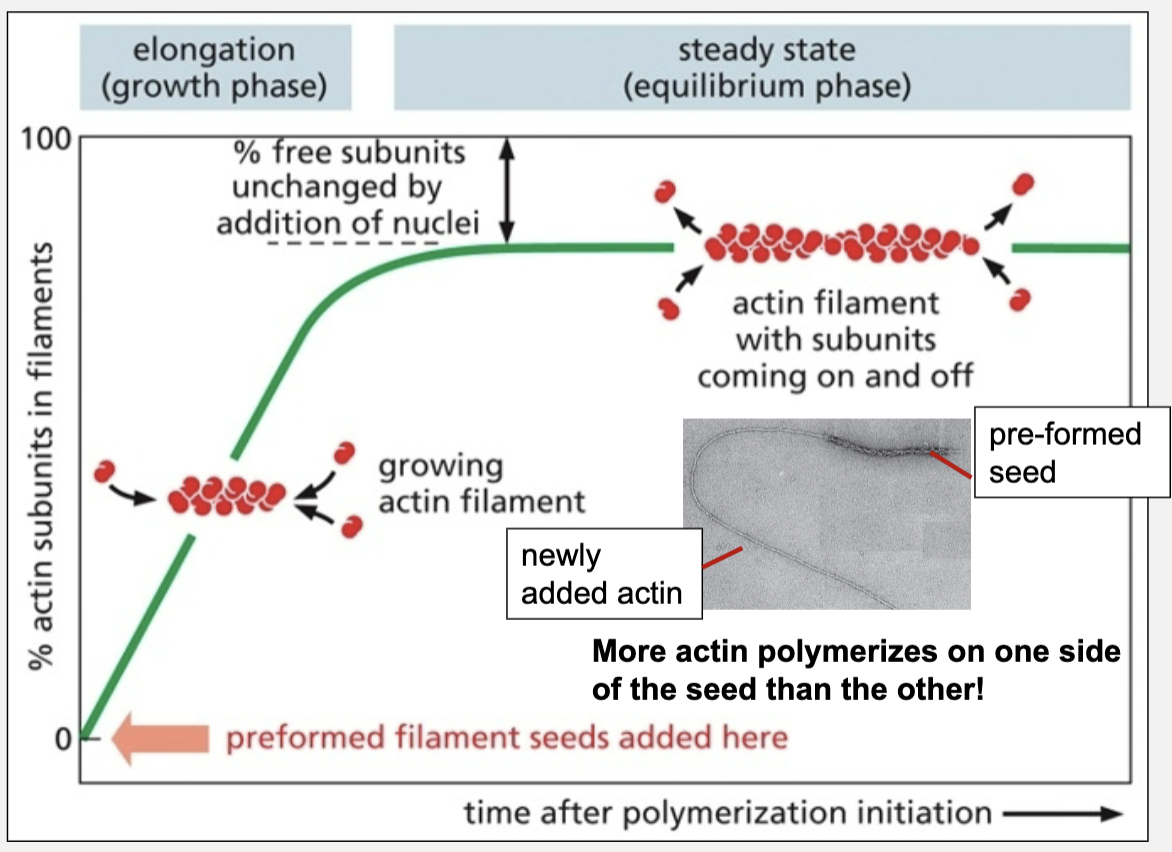
what is a key feature of the actin filament structure?
actin monomers within a filament all “point” in the same direction - actin filaments have polarity
which end of the actin filament is more dynamic?
the (+) end is ore dynamic than the (-) end
what end is new actin filament added to?
added to (+) end of the seed
when do actin subunits hydrolyze their ATP nucleotides?
after polymerization
T-form
ATP-actin
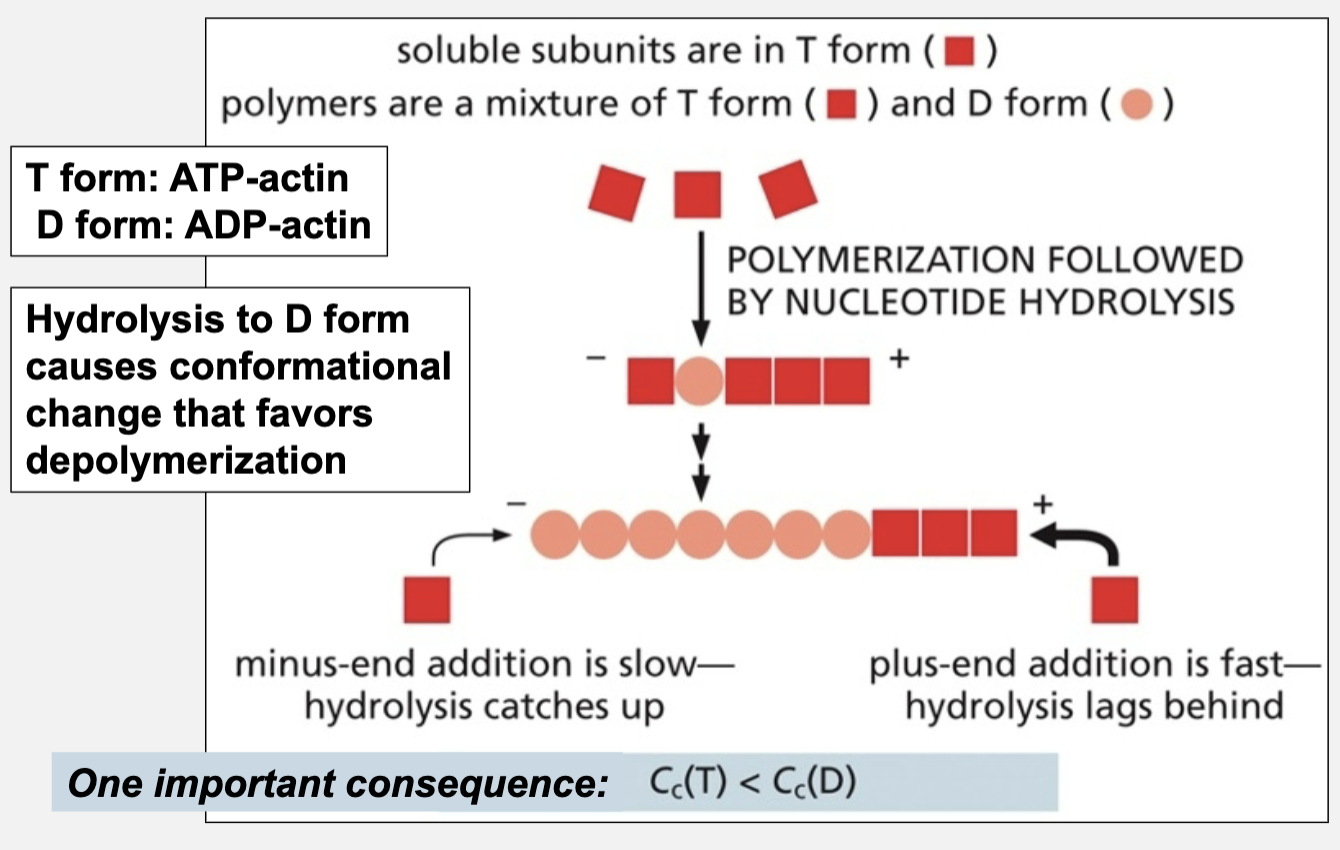
D-form
ADP-actin
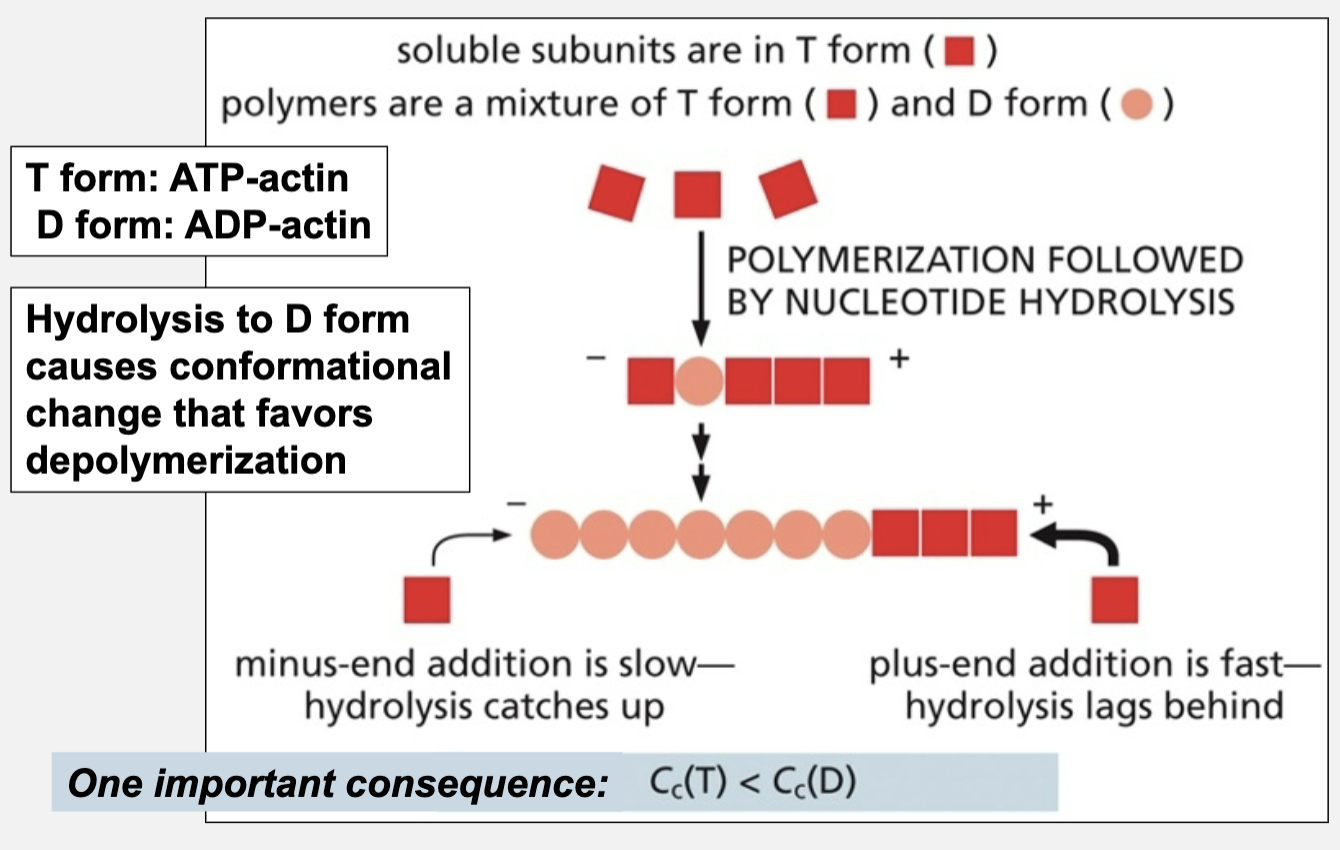
what does the hydrolysis of T form to D form cause?
causes a conformational change that favors depolymerization
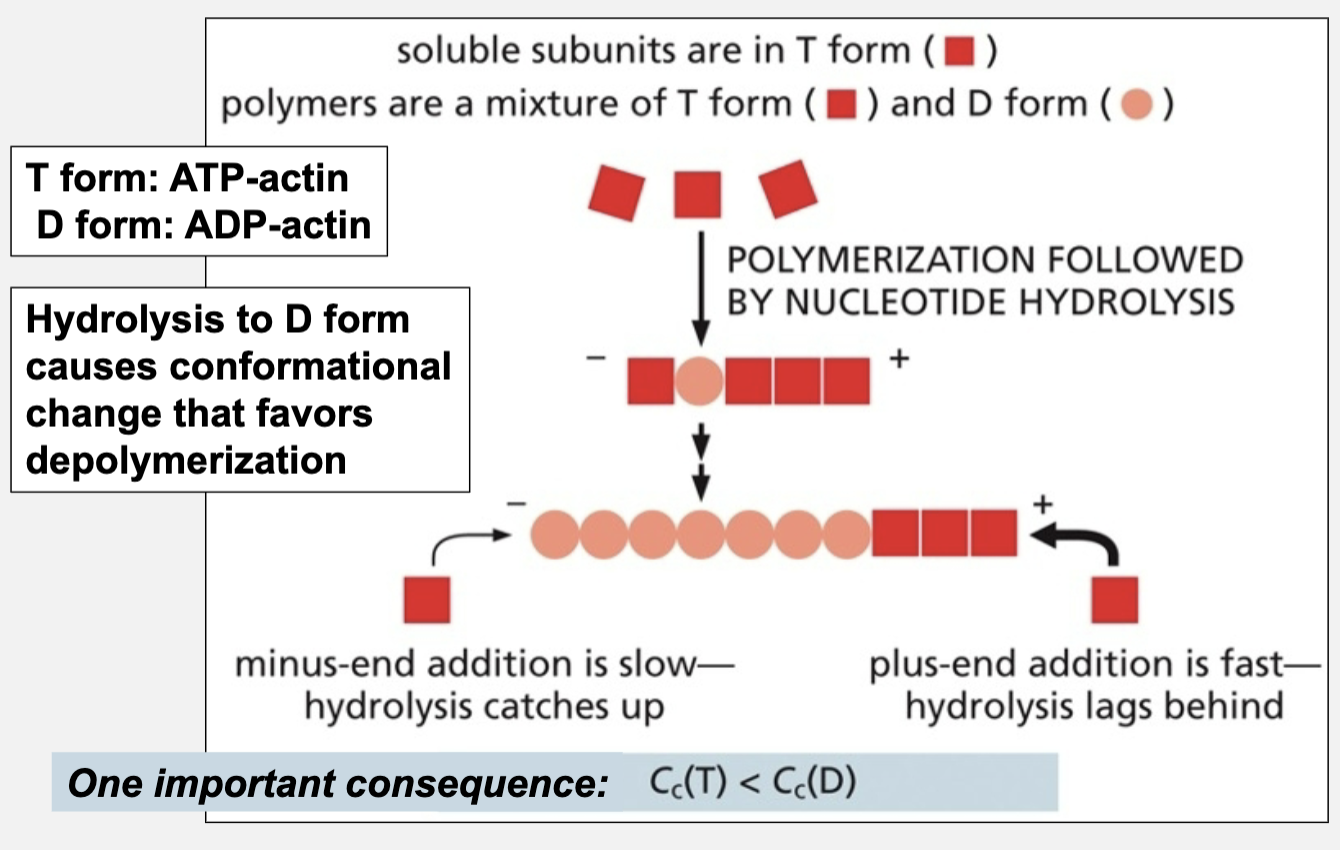
which rate of subunit addition is favored more? Form D or T?
form D is favored
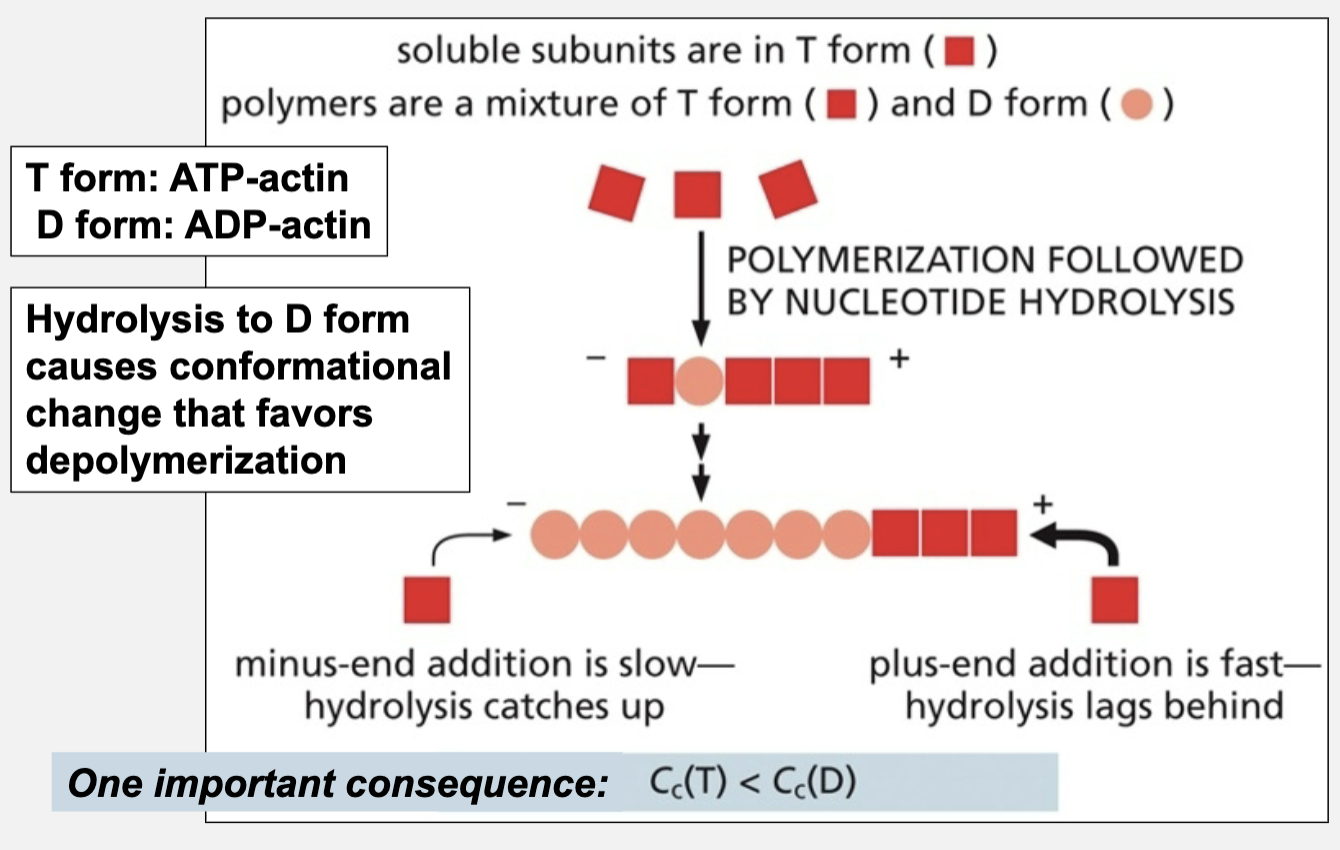
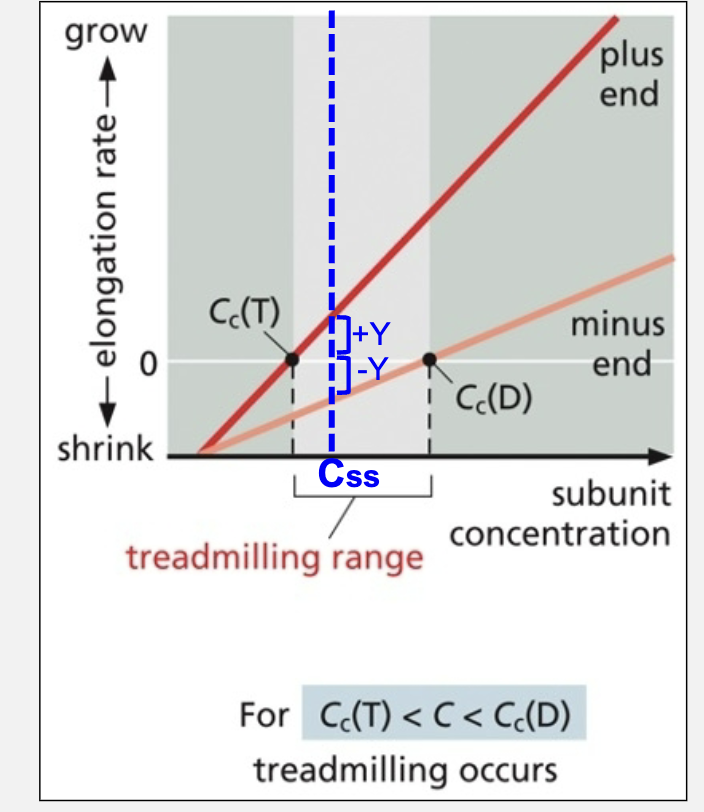
A lower Cc at the (+) end than the (-) end creates the possibility for what?
treadmilling
what is treadmilling?
net addition to plus end with net loss at minus end
what is Css and what is happening?
Css = concentration at steady state, where subunit addition at the T (+) end is just balanced by subunit loss at the D (-) end