Language - Chapter 11
 Call Kai
 Learn
Learn Practice Test
 Spaced Repetition
 Match
Match Flashcards
 Knowt Play
1/60

There's no tags or description
Looks like no tags are added yet.
Name | Mastery | Learn | Test | Matching | Spaced | Call with Kai |
|---|
No analytics yet
Send a link to your students to track their progress
61 Terms
What are the 5 features of human language?
1. Symbolic
2. Rule-governed and generative
3. Able to refer to past, future, hypothetical
4. Hierarchical, recursive structure
5. Suited for storytelling and complex social thought
Why don't nonhuman primates speak?
1. Limited vocal anatomy
2. Reduced fine motor control for speech
3. Less voluntary vocalization
4. Less precise breath control
Can apes learn human-like language?
They can learn signs/symbols for objects, actions, and simple concepts.
What are characteristics of human-like language acquired by apes?
1. Short
2. Tied to immediate context
3. Limited in syntax and combinatorial complexity
4. Lacking generative structure
Why is language a uniquely human cognitive system?
Lack of animal model of language; language is lateralized in brain (left hemisphere)
What is the language pathway?
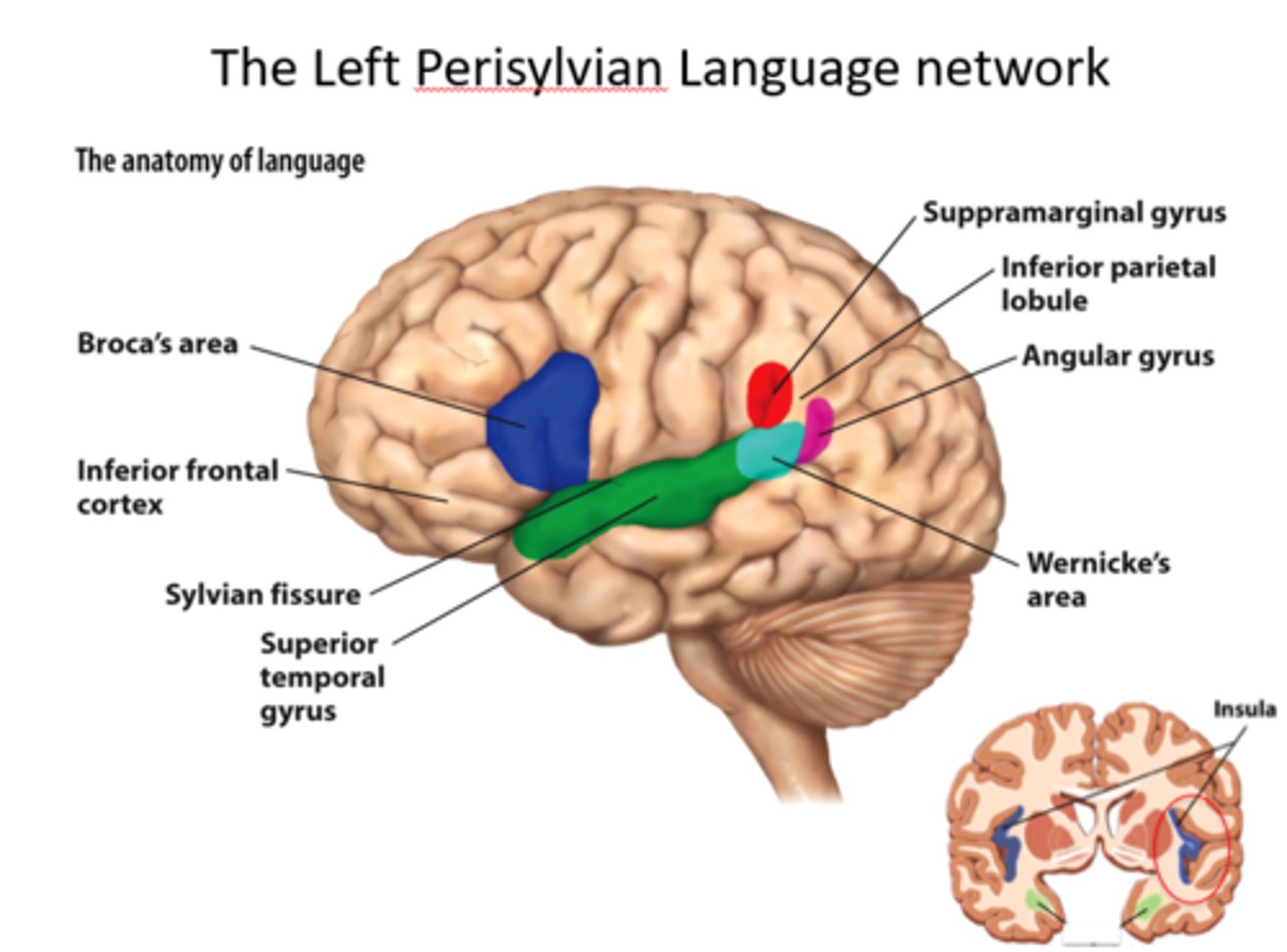
Left perisylvian language networks, with major dorsal and ventral pathways linking temporal, parietal and inferior frontal cortex
Aphasia
Partial/complete loss of language abilities caused by brain damage. Impacts speaking, comprehension, reading/writing/grammar
Broca's Aphasia
Non-fluent speech with preserved comprehension
Patients are aware of language deficits
Due to lesions in left inferior frontal lobe, including Broca's area
Wernicke's aphasia
Fluent speech with impaired comprehension of spoken and written language
Patients are often unaware.
Due to lesions in left posterior superior temporal cortex and Wernicke's Area
Neologisms
Made-up words in Wernicke's aphasia
Paraphasias
words are malformed, wrong, or invented
Conduction aphasia
Difficulty repeating words despite relatively preserved comprehension and fluent speech.
Due to lesions in left temporoparietal cortex, and white matter pathways, including arcuate fasciculus
Anomia
Word-finding difficulty, loss of the ability to name objects or retrieve names of people.
Results in vague descriptions and circumlocution, while object recognition is intact.
Results in lesions in left temporal or parietal areas associated with lexical access
Where and how are language areas generally mapped to in the brain?
Frontal and posterior temporal regions. However, precise locations varied across individuals.
Structural asymmetries and language lateralizations resulted in anatomical differences. For example, a longer left Sylvian fissure (in RH individuals) or a larger left planum temporale
Explain what happens with language testing in split brain patients
Things in the right visual field or hand can be described or named, not the left.
Findings: lateralized deficits support idea that the left hemisphere is typically dominant for language.
What does do the left and right hemisphere contribute to language?
The left hemisphere is the predominant language center, with key regions forming a network around the Sylvian fissure in the temporal cortex.
The right hemisphere contributes to prosody and discourse-level comprehension. Additionally, auditory, visual, and motor systems support input for language comprehension and language production, respectively.
Mental lexicon
The mental dictionary of words and their meanings. Includes the ideas of semantics, syntax, phonology, context, and orthography.
Has three core functions in comprehension: access, Selection, Integration.
Has four key organizing principles: morphemes, phonemes, frequency, semantic relationships
What are three core functions of the mental lexicon?
1. Access, matching input to stored word representations.
2. Selection, choosing the most appropriate word based on context.
3. Integration, combining words into meaningful syntactic and semantic structures.
What are the four key organizing principles of rapid word retrieval?
1. Morphemes as building blocks. Smallest unit of meaning to help recognize, generate and modify words.
2. Phonemes as sound units. Smallest unit of sound to distinguish words that differ only in words.
3. Frequency shapes access. More frequent words are accessed more quickly and easily, while less frequent are subject to retrieval failure.
4. Semantic relationship. Mental lexicon is organized by semantic relationship between words, where similar meanings are nearby in semantic space (network model).
Free vs. bound morphemes
Free morphemes can stand alone as a complete word, while bound morphemes cannot
What is the semantic relationship?
Words with similar meanings are represented near each other, with connection strength reflecting how closely related two words are
Semantic paraphasia
Substitution of one word for another word that is similar in meaning
"glass" for "cup"
Suggests semantically related words are represented near one another in the lexicon
Progressive semantic dementia
Increasing disruptions to conceptual understanding, despite preserved syntax and grammar.
Category-specific deficits
Impaired access to words from specific categories
Supports idea that different semantic categories rely on partly distinct neural systems.
Wernicke-Lichtheim Model
Classical model stating flow of information across specialized language regions
Auditory input to Wernicke's for word recognition and comprehension, via arcuate fasciculus to Broca's area for speech planning, then to motor cortex for spoken output. With B being a conceptual center for word meaning and associations.
Damage to specific regions or connections predicts distinct aphasia syndromes.
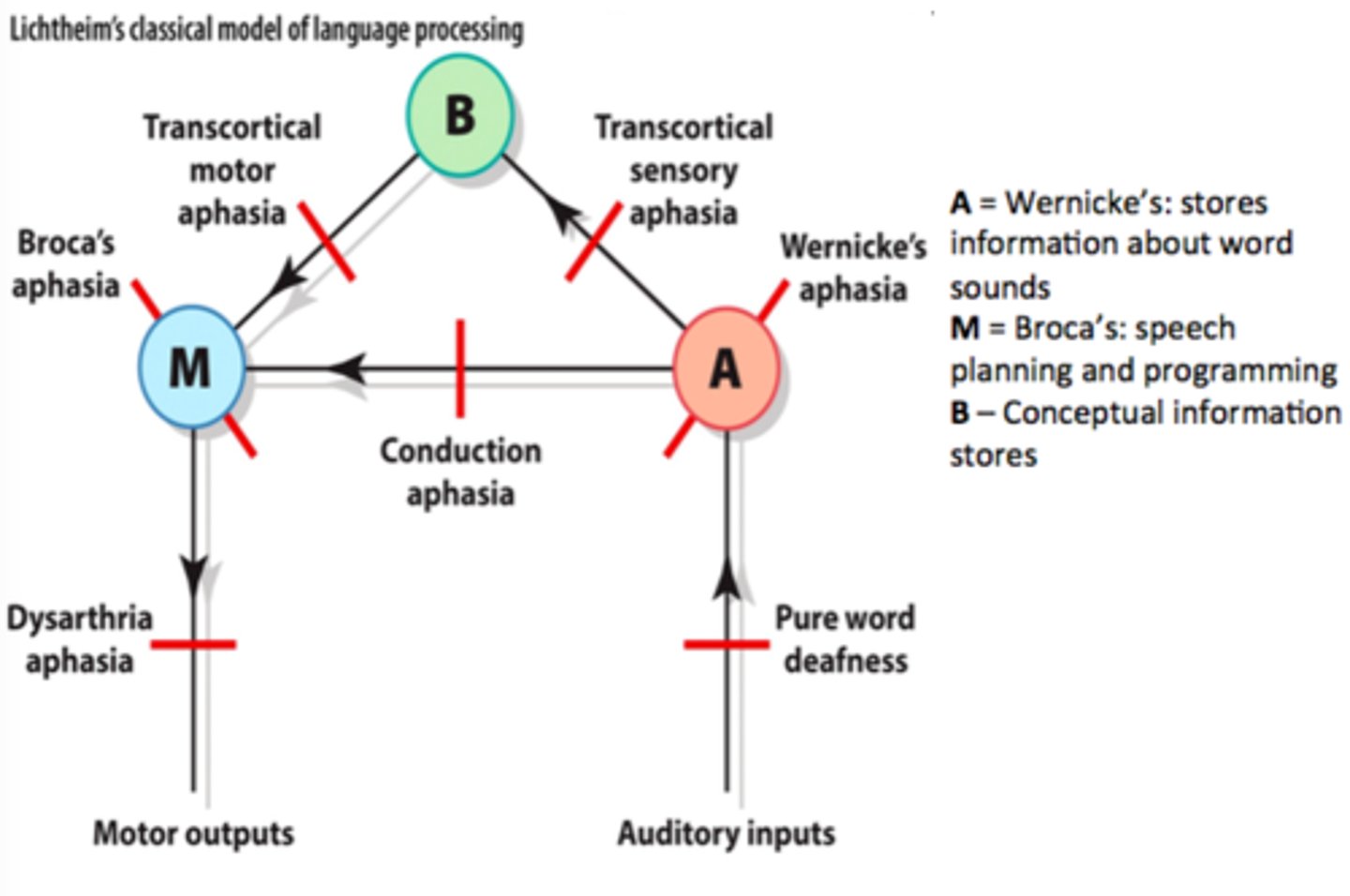
Limits of the Wernicke-Lichtheim Model
Oversimplifies language processing; aphasia can result from damage outside the network since the arcuate fasciculus is not the only pathway linking Wernicke's and Broca's areas
Challenges to classical model of language
1. Individual variability
2. Anatomical localization of deficits are not clean
3. Multifunctions of classical language areas
4. Lexical category specificity
5. Expanded frontal network for linguistic processing
6. Bilingual language representation
7. Age of acquisition effects
8. Broca's area beyond language
What area is important for verb retrieval?
Left premotor cortex
How are bilinguals neural representations?
Distinct neural representations for different languages
How does timing of a second language's acquisition impact neural representation?
When acquired early, neural organization is overlapping; later-acquired leads to more separation of representations
What else does Broca's area contribute to?
Aspects of memory
How does the brain recognize written words?
Visual processing and orthographic decoding
Selfridge's Hierarchical Model of Visual Recognition
Four-stage bottom-up, feedforward model for visual pattern recognition.
Stages represent discrete steps in a serial, hierarchical processing stream.
Highlights how complex visual input can be processed through simpler sequential subtasks.
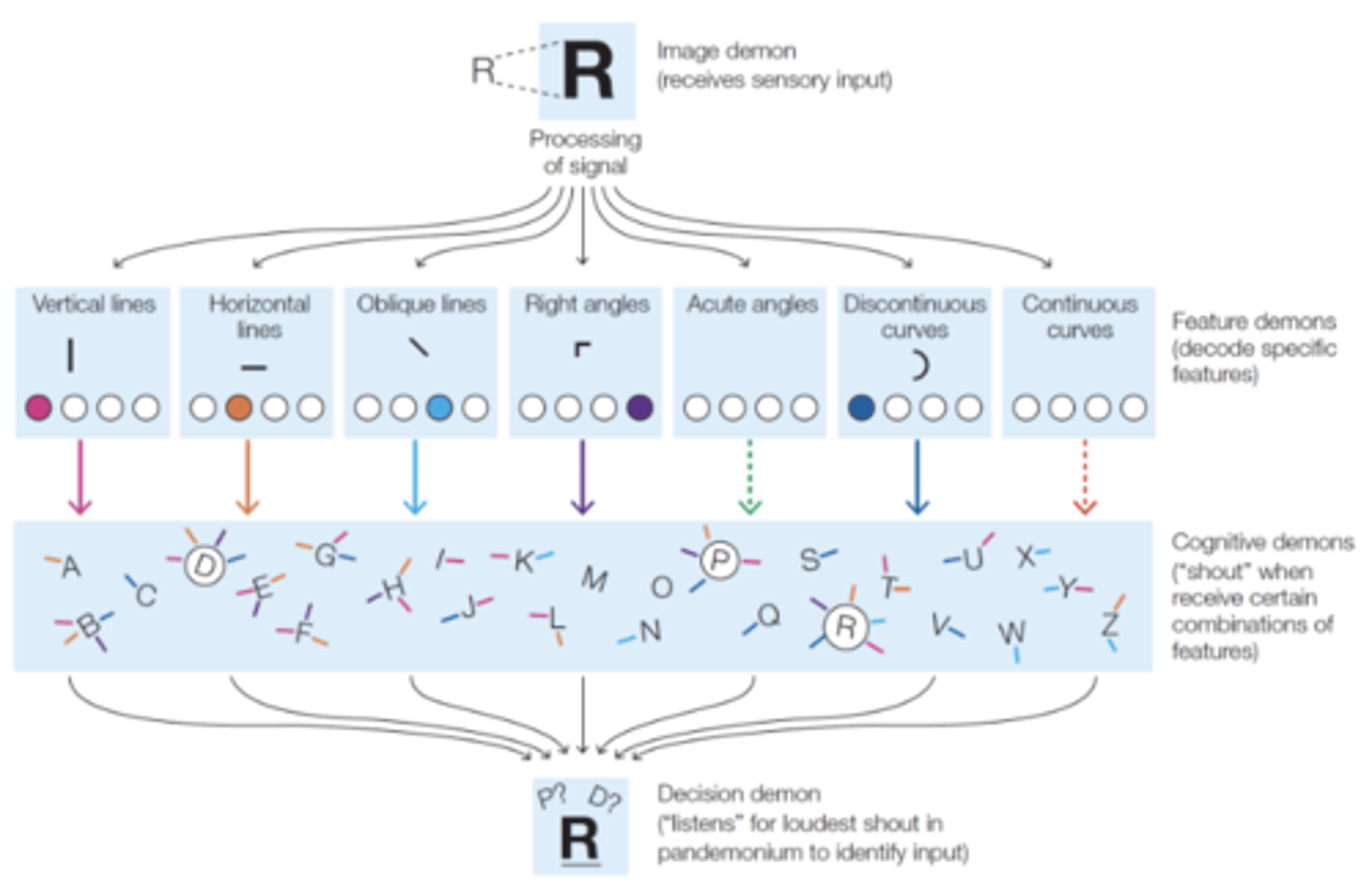
Stage 1 of Selfridge's Model
Image demon: raw visual input from retina. Provides initial image for later stages to process.
Stage 2 of Selfridge's Model
Feature demons: Receives input from image demon and detects visual features and responds selectively when that feature is present in the input.
Breaks image into meaningful visual components
Stage 3 of Selfridge's Model
Cognitive Demons: receives input from feature demons; each demon represents a specific higher-level patter, such as a letter or shape.
Sensitive to particular combination of features. Responds when preferred pattern is detected
Stage 4 of Selfridge's Model
Decision Demon: receives input from all cognitive demons and selects most strongly activated one to output best guess about visual input.
Works well for basic pattern recognition, but lacks explicit word-level representation.
What's an issue with Selfridge's Model?
Cannot explain context-sensitive effects (e.g. word superiority effect)
McClelland and Rumelhart's Interactive Activation Model
Three stage model with distributed, interactive network architecture with units organized in layers with bidirectional activation.
Information follows in parallel, not serially through inhibitory/excitatory connections with interactive processing across levels.
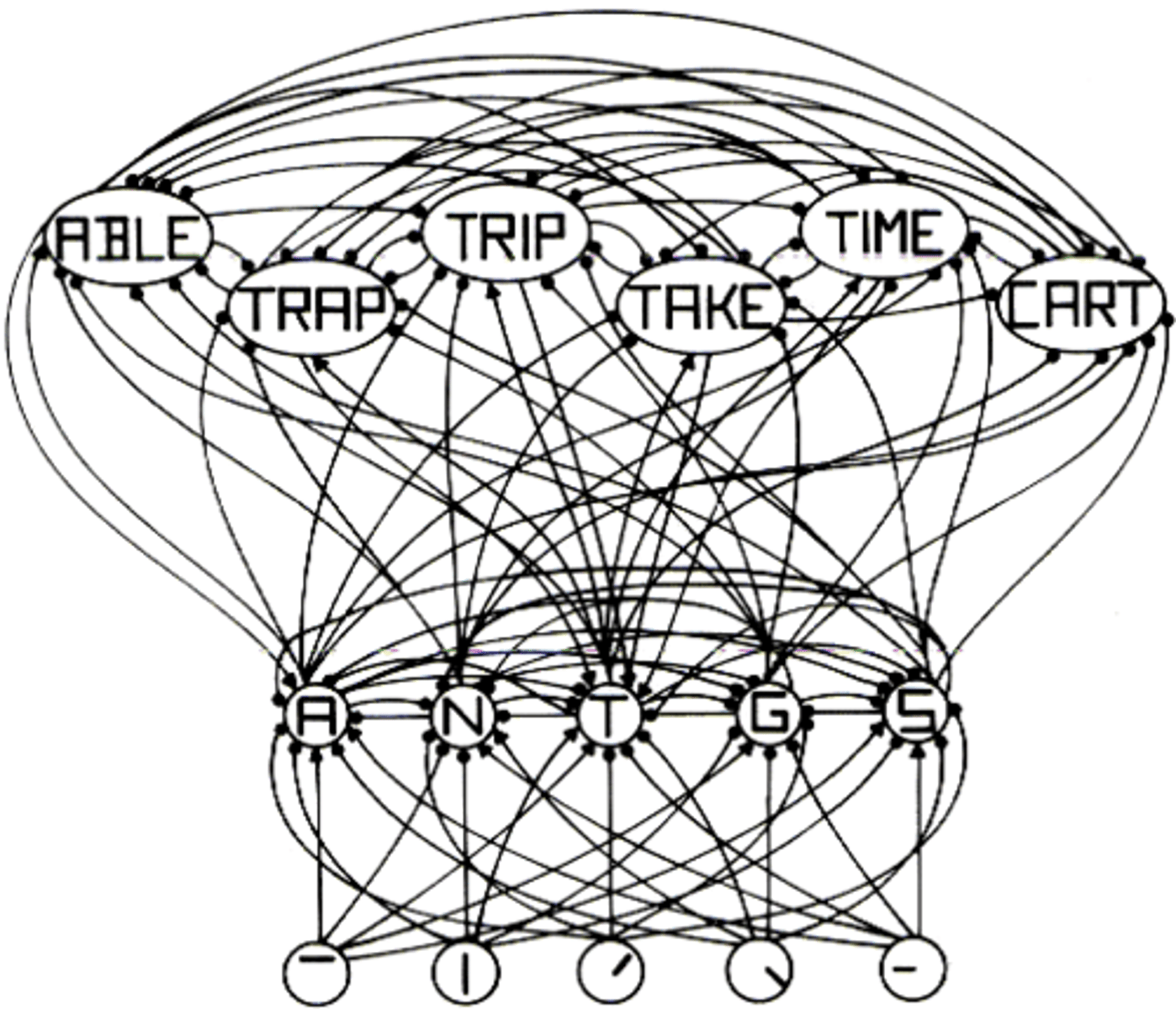
Interactive Activation Model: Feature Layer
Initial stage of processing for letters/words; detects basic visual elements such as lines and edges.
The units respond selectively to specific visual features.
Interactive Activation Model: Letter Layer
Receives input from feature detectors; identifies specific letters at specific positions since letter activation is influenced by feature and lateral interactions.
Key role in identifying specific letters at specific positions.
Interactive Activation Model: Word layer
Units are individual words in mental lexicon;
activated by letter input that matches a word's spelling pattern and lateral interactions to capture context expectancy since word units also influence one another through lateral interactions.
Visual word form area
An area of the left occipitotemporal temporal cortex that responds preferentially to words and other strings of letters.
Receives input from early visual processing regions in posterior occiptal cortex and is connected to the perisylvian language regions (including Broca's area).
What happens if you damage the VWFA?
Pure alexia; a reading deficit despite intact vision and spoken language
Dyslexia
impairment of the ability to read; linked to visual word recognition and phonological processing deficits.
Linked to phonological processing deficits, not just visual word recognition.
Due to reduced activity in left posterior language regions, with compensatory activation in left anterior and right hemispheres
Auditory pathways for spoken word recognition
Primary auditory cortex processes basic acoustic features like pitch and duration
Superior temporal sulcus/gyrus support phonetic analysis and mapping speech sounds to lexical representations.
Acoustic sensitivity decreases and speech intelligibility increases as processing moves outward. Processing of real words is more left-lateralized than processing pseudowords.
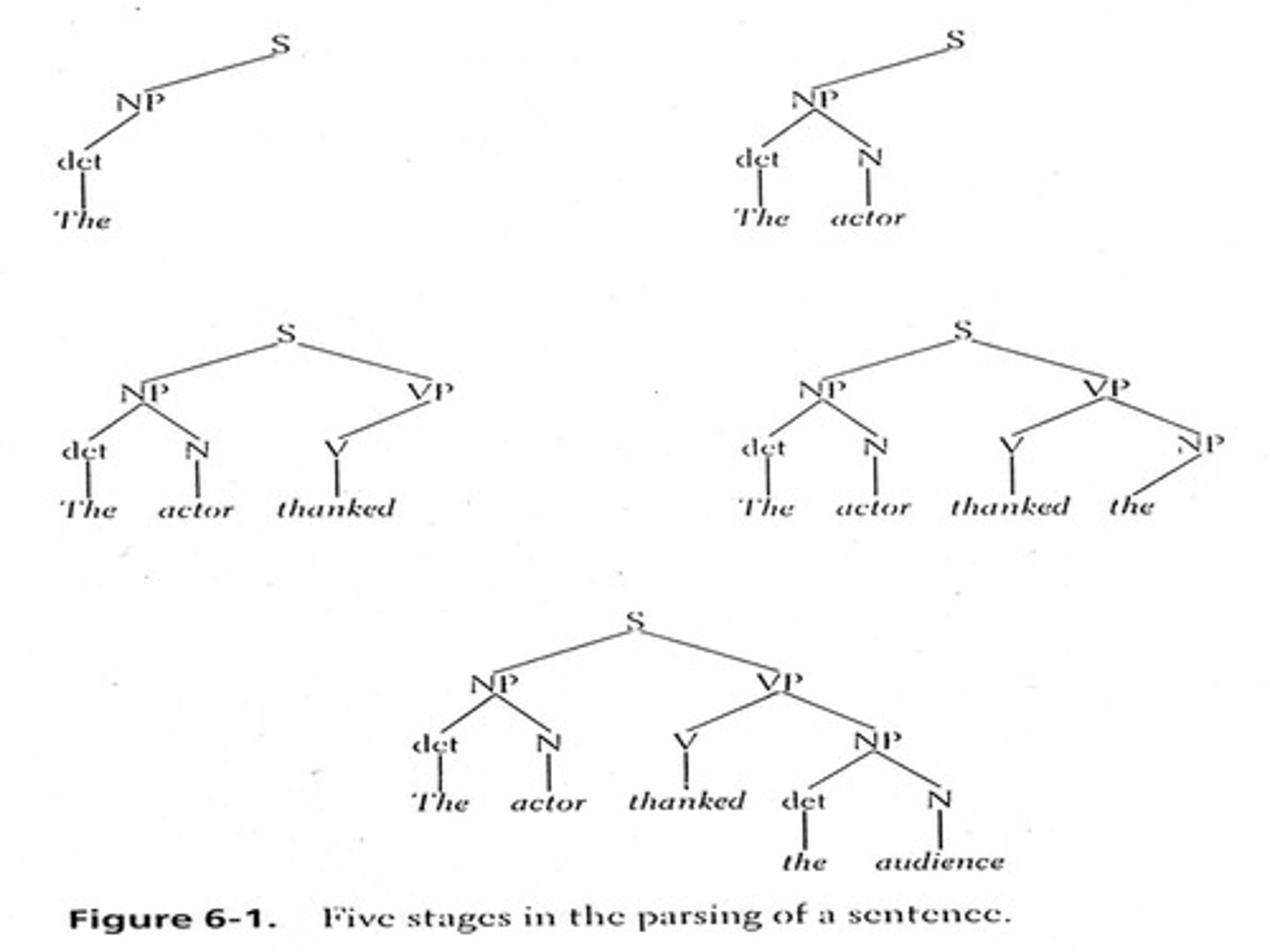
Syntactic parsing
Building the syntactic structure of a sentence identifying grammatical relationships. Key to link word recognition to sentence comprehension.
Involves distributed network of different regions for phrase, argument, themes, etc.
Damage to anterior temporal and inferior frontal regions is linked to syntactic deficits in aphasia.
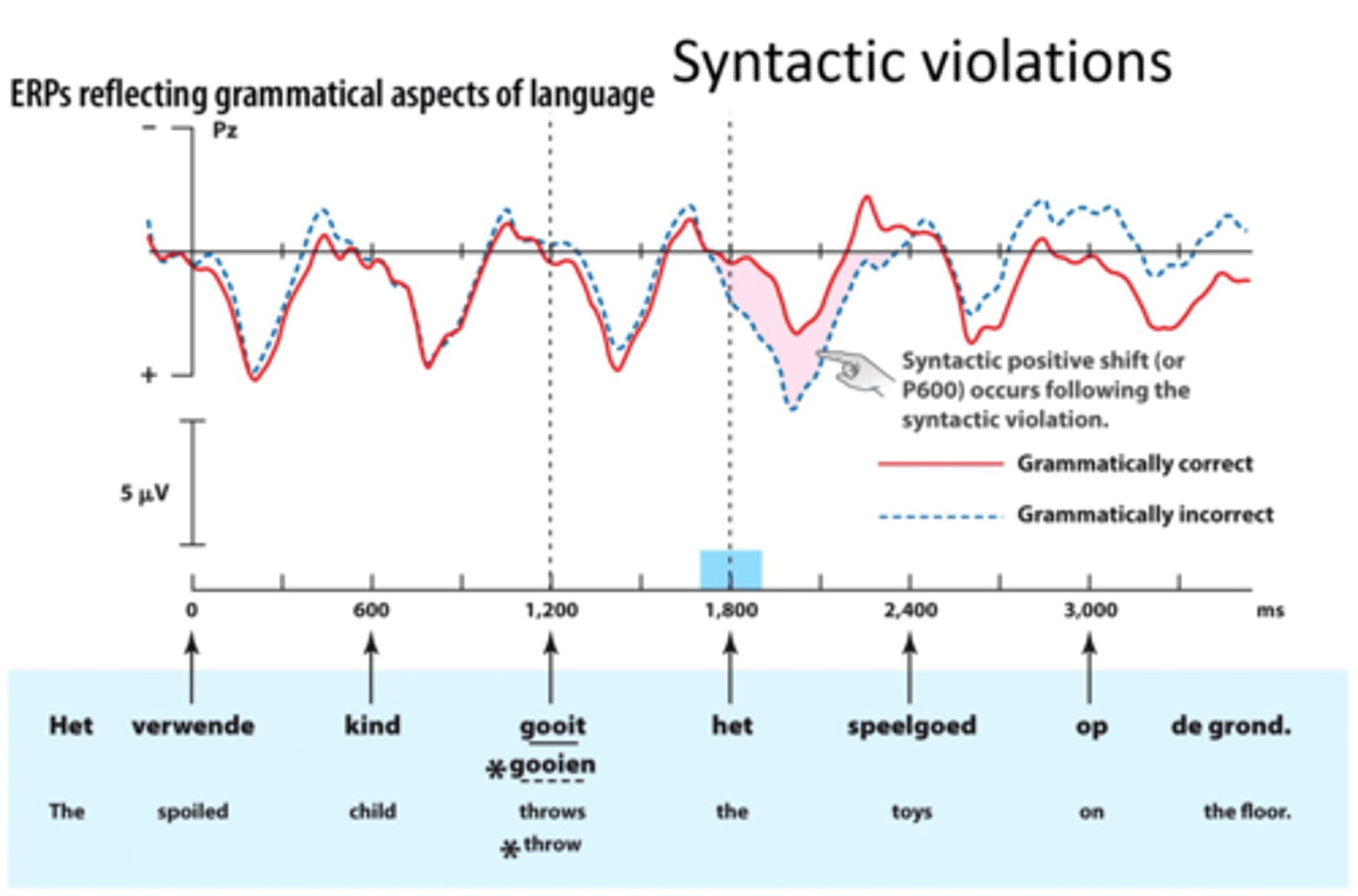
What is the ERP component that peaks around 600ms after a syntactic anomaly?
P600. It has more positive amplitude for ungrammatical vs. well-formed sentences.
Reflects syntactic reanalysis and integration attempts. Modulated by sentence complexity, working memory, and language proficiency.
What does N400 refer to in ERP studies?
An ERP component peaking around 400ms after semantically meaningful input.
There is more negative amplitude for semantically incongruous stimuli vs. congruent stimuli.
Reflects difficulty integrating meaning into current context.
How is N400 impacted in aphasia?
There's reduced and delayed N400 in aphasiac patients, suggesting impaired semantic integration due to left hemisphere damage.
Lesions are typically in the left temporal cortex.
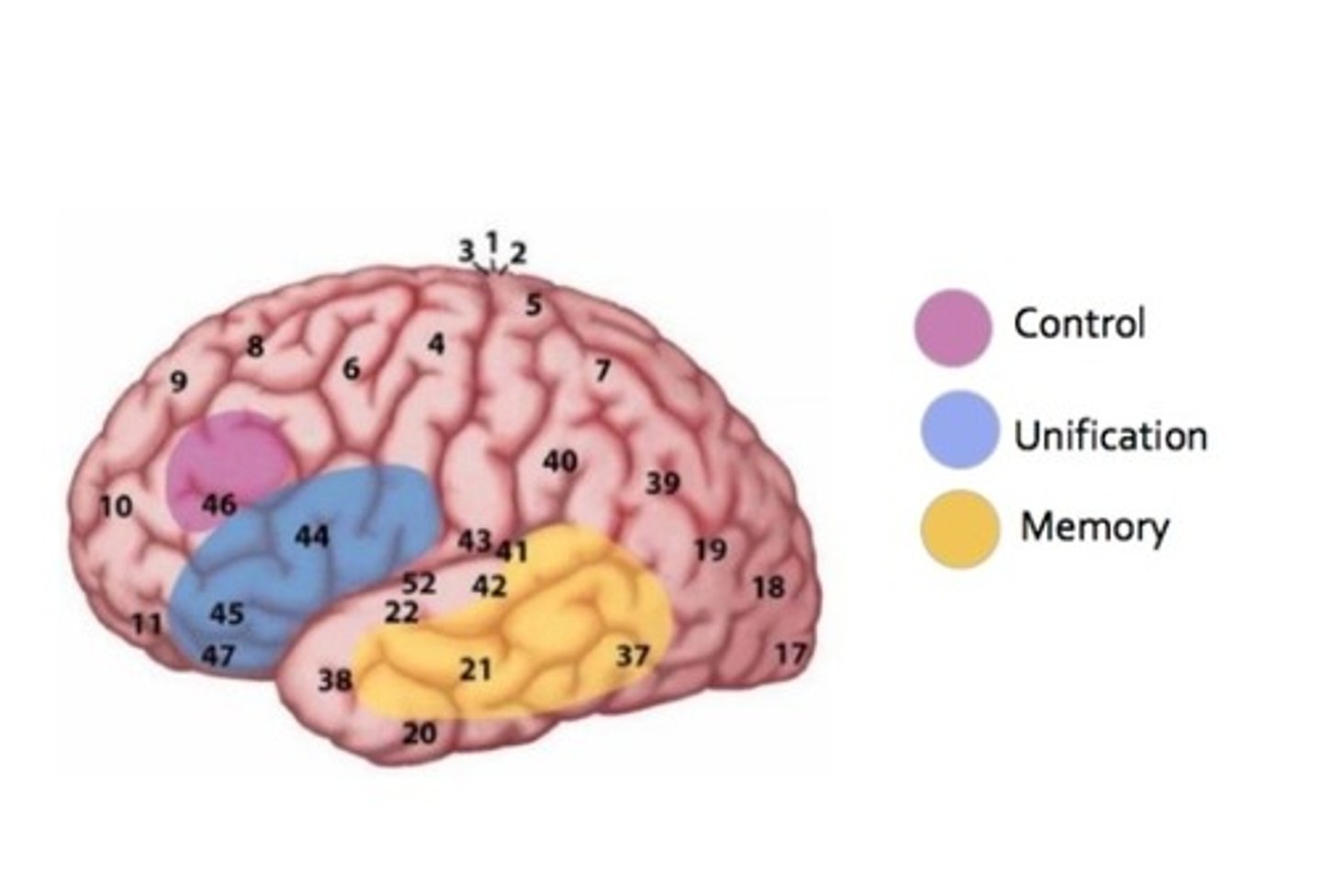
Memory-Unification-Control Model of Language
Language involves memory, unification, control.
Memory: Stores and retrieves linguistic knowledge, including lexical and contextual information
Unification: Integration of phonological, syntactic and semantic information to build sentence meaning
Control: Regulates attention, information flow and coordination with working memory during language processing
What does the MUC model say about bottom-up vs. top-down processing for language?
Language comprehension requires both. Working memory supports attention and integration across M, U, N systems. Control processes guide comprehension based on context, goals, and prior knowledge.
What are the major pathways supporting spoken language?
Two dorsal pathways that connect posterior temporal and frontal lobes. They support articulation for speech preparation and for syntactic processing.
Two ventral pathways that connect posterior temporal lobe to anterior temporal lobe and frontal operculum to support semantic processing and word comprehension.
These dorsal and ventral pathways are interconnected to support language.
Language comprehension to production
Language comprehension takes in modality-specific input (written vs. spoken) to go through early processing in corresponding visual and auditory cortices, to recognition with semantic and syntactic analysis.
Afterwards, premotor coding and motor control of speech results in language production.
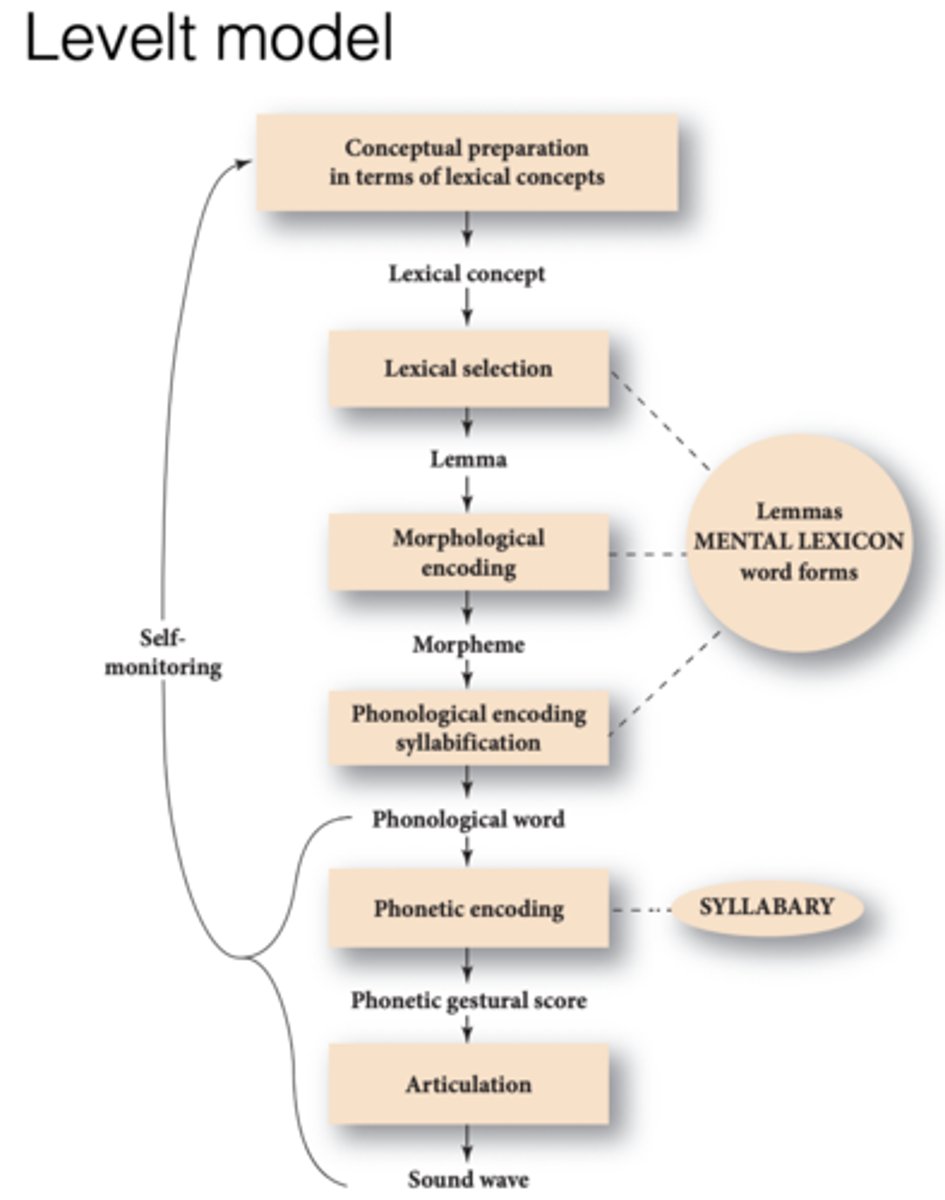
Levelt's speech production model
1. Conceptualizing: Select relevant concepts from message and organizes into a mental representation of what they want to communicate.
2. Lexical selection: Select appropriate words to express intended concept. Word must be retrieved from mental lexicon along with syntax.
3. Morphological/phonological encoding: After word selection, appropriate morphemes are added before being encoded into a phonological form.
4. Phonetic encoding: Phonological representation is transformed into a motor plan of articulatory movements to produce speech sounds.
5. Articulation: Speaker executes motor plan to produce intended speech sounds.
What does Hickok's Hierarchical State Feedback Control Model propose?
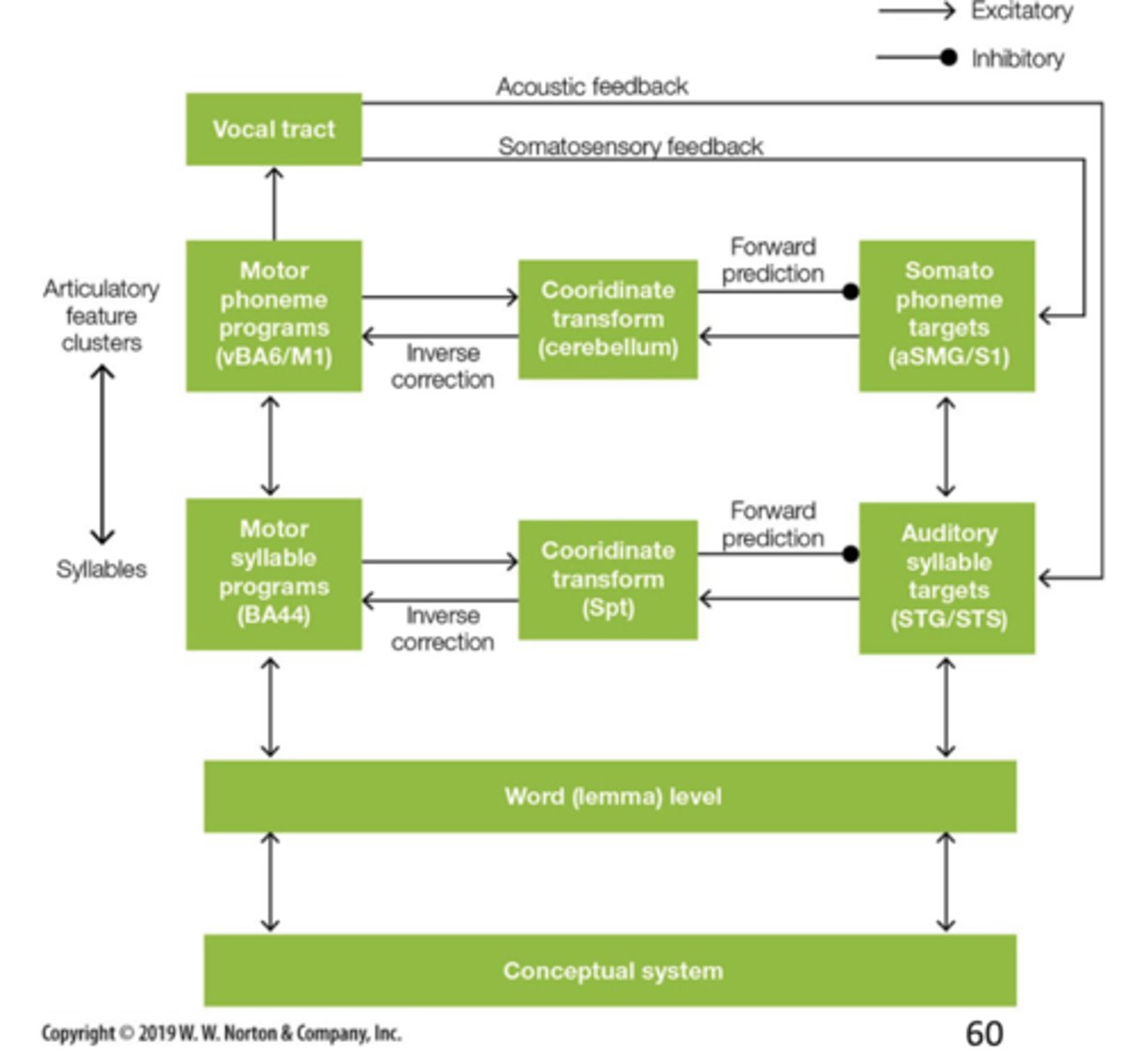
Parallel processing in sensory and motor systems across all levels of control; emphasizes role of sensory feedback in shaping speech production.
Begins with activation of conceptual representation and word selection, but splits phonological system into sensory and motor components.
Each component includes internal and external feedback loops for adjusting speech in real time.
Apraxia of speech
Impairment in the ability to coordinate movements of the tongue, lips, and throat required to produce the proper sequence of speech sounds despite no weakness or paralysis
Perisylvian language areas
Cortical regions responsible for language comprehension and production in the left lateral hemisphere. Includes Broca's, Wernicke's, connected by the arcuate fasciculus.
Superior Temporal Sulcus
The most superior sulcus in the temporal lobe, situated just below the superior temporal gyrus.
Supports phonetic analysis and mapping speech sounds onto lexical representations.
Parietal Lobe
Linked to lexical access.
Damage may lead to conduction aphasia (usually in addition to temporal damage).
Frontal Lobe
Involved in syntactic processing, integrating syntax with meaning, semantic processing and word comprehension.