GEOL100 Practice Exam 3 Answers
 Call Kai
 Learn
Learn Practice Test
 Spaced Repetition
 Match
Match Flashcards
 Knowt Play
1/72

There's no tags or description
Looks like no tags are added yet.
Name | Mastery | Learn | Test | Matching | Spaced | Call with Kai |
|---|
No analytics yet
Send a link to your students to track their progress
73 Terms
According to the evidence compiled by the IPCC, natural forcings alone account for surface temperature observations since 1960.
True
False
False
How does the arrangement of continents on the surface of the planet affect climate?
Land masses clustered at the south pole lead to a cooler planet
Land masses clustered at the equator lead to a cooler planet
Land masses clustered at the equator lead to a warmer planet
Land masses clustered at the north pole lead to a cooler planet
Land masses at clustered at the south pole lead to a cooler planet
Ice core data show that atmospheric CO2 concentrations were higher during each of the major glacial periods and lower during the warmer interglacial periods.
True
False
False
The greenhouse effect represents
alteration of climatic patterns by global warming
particularly intense solar radiation
anthropogenic global warming
“trapping” of heat by atmospheric gases
"trapping” of heat by atmospheric gases
The two most abundant gases in the atmosphere are:
carbon dioxide and oxygen
carbon dioxide and nitrogen
hydrogen and oxygen
nitrogen and oxygen
hydrogen and carbon dioxide
nitrogen and oxygen
The burning of wood, coal, and natural gas produces
carbon dioxide
oxygen
nitrogen
methane
carbon dioxide
Even if we stop putting greenhouse gases into the atmosphere tomorrow, warming and sea-level rise will most likely occur anyway
True
False
True
How might global warming exacerbate coastal hazards?
global warming will likely be accompanied by sea level rise
warmer water is more highly erosive on coastlines
ocean currents will be stronger in a warmer world
under warmer conditions, waves are likely to be substantially larger
global warming will likely be accompanied by sea level rise
Ice is a substance with a high albedo, which means it __________.
absorbs most of the light that falls on it
requires heat to raise its temperature by 1°C
reflects most of the light that falls on it
strongly refracts(bends) light that falls on it
reflects most of the light that falls on it
Some areas of the Atacama Desert in Chile have not had measurable rainfall in over 400 years. What type of desert is the Atacama?
polar
subtropical
rain shadow
midlatitude
coastal
coastal
What type of desert region includes the Sahara Desert of north Africa?
polar
subtropical
rain shadow
midlatitude
coastal
subtropical
When solar ultraviolet radiation interacts with the Earth’s surface, it
is re-radiated as energy in the infrared spectrum
is re-radiated as energy in the visible light spectrum
is absorbed to a greater degree by the land surface than by the oceans
is absorbed to a greater degree by ice than by the land surface
is contributing to the hole in the ozone layer
is re-radiated as energy in the infrared spectrum
Which of the following is NOT part of the definition of a desert?
high temperatures
mean annual rainfall of less than 25 centimeters per year
dry with the capability to evaporate more water than falls as precipitation
incapable of supporting abundant life
all of the choices
high temperatures
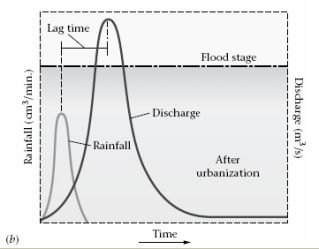
Identify the statement that best describes the effects of urbanization on stream flow as shown in the diagrams.
Diagram A illustrates that there is more infiltration after urbanization, and therefore less water reaches the stream channel.
Diagram A shows water from the storm getting into the stream channel faster than it does in diagram B.
Diagram A must show the situation after urbanization of an area.
Diagram B shows a stream responding faster and more intensely to a rainfall event.
Flooding potential for a stream is less after urbanization than before.
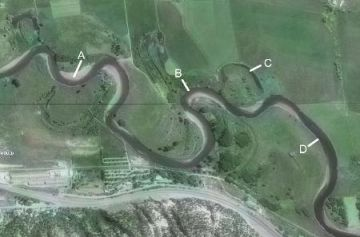
On the stream diagram, identify the:
oxbow lake — location C
cutbank - location B
stream channel — location D
pointbar — location A
The sediment load of a stream consists of only those grains that are fine enough to stay in suspension.
True
False
False
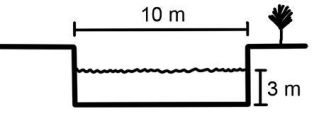
The stream in the diagram flows at a velocity of 6 meters per second. Its discharge is:
About 30 cms
About 600 cms
About 1800 cms
About 66 cms
About 180 cms
About 180 cms
Which of the following statements about the hydrologic cycle is false?
There is an exchange of water among oceans, land, and atmosphere.
Water that manages to infiltrate the land is lost to the cycle.
Sheetwash is a thin film of water that moves down slopes.
Meteoric water can fall directly into a stream, accumulate in a standing body, become sheetwash, or infiltrate the soil.
Surface snow and ice is part of this cycle.
Water that manages to infiltrate the land is lost to the cycle.
Within a stream meander, where is sediment most likely to be deposited?
on the outer banks of the meander
on the inner banks of the meander
uniformly to either side of the meander
on the inner banks of the meander
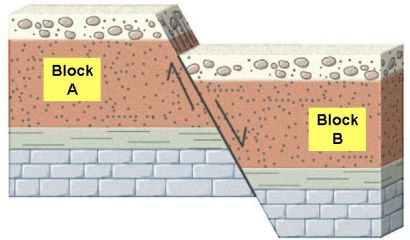
For this fault, identify the hanging wall in the diagram:
block B
All islands along a hot-spot chain remain volcanically active for the lifetime of the mantle plume involved.
True
False
False
A tsunami at least as big as the 2004 Indian Ocean event can conceivably strike the east coast of the United States in the geologic future.
True
False
True
Bombs, ash, and cinders are all examples of ____.
intrusive igneous rocks
extrusive igneous rocks
volatiles
pyroclastic debris
pyroclastic debris
Do all earthquakes in the ocean cause tsunami?
no, only some seismic waves can travel into water and cause tsunami
no, not all ocean crust quakes have vertical displacement of the seafloor
yes, seismic waves can travel into water and cause tsunami for all ocean quakes
yes, all ocean crust quakes have seafloor displacement but most tsunami are small
no, not all ocean crust quakes have vertical displacement of the seafloor
How much stronger is the shaking in a M6 quake than a M3?
10 times stronger
100 times stronger
1000 times stronger
10000 times stronger
100000 times stronger
1000 times stronger
If you die in an earthquake, the most likely reason will be:
You fell over during the shaking and bonked your head
Your house fell on you
You were buried in a landslide
A fracture opened up underneath your feet and you fell in
Your house fell on you
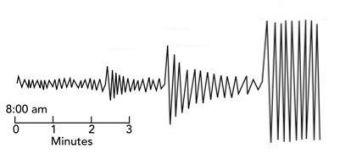
In this diagram, the approximate lag time between the arrival of the P and S wave is _________.
about 1.5 minutes
about 3 minutes
about 4 minutes
about 6 minutes
about 1.5 minutes (?)
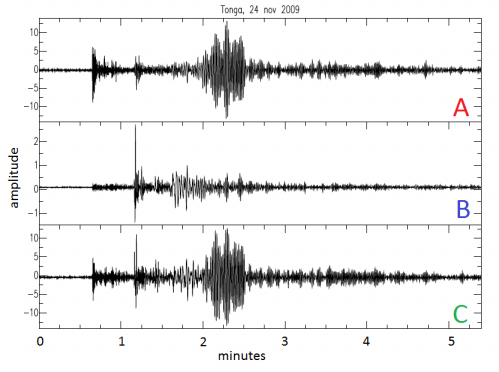
In this diagram, the approximate lag time between the P and S-waves in seismogram B is:
30 seconds
1 minute
1 minute 15 seconds
2 minutes
30 seconds
The arrival time of the P and S waves recorded at one seismic station can determine:
the location of the earthquake
the damage at the focus
the distance to the earthquake
the intensity of the earthquake
the distance to the earthquake
The earthquakes that occurred in 1811 in New Madrid were unusual because
They were very large and produced enormous tsunami
They were felt in California
They were located on a fault far from a plate boundary
They did not occur on a fault
They were located on a fault far from a plate boundary
The most destructive earthquake waves are the ______________; the fastest are the ______________.
P-waves; P-waves
S-waves; P-waves
surface waves; Love waves
surface waves; P-waves
surface waves; S-waves
surface waves; P-waves
The most widely used scale for describing the energy released by earthquakes is the ________ scale.
Richter
modified Mercalli Intensity
moment magnitude
Community Intensity
Richter
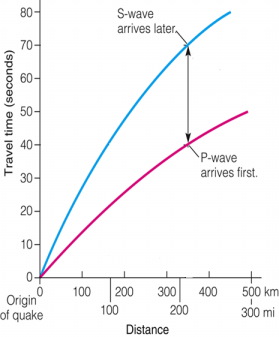
The P-wave arrives after about 25 seconds and the S-wave arrives after about 48 seconds. How far is the seismograph from the epicenter of the earthquake?
100 kilometers
200 kilometers
300 kilometers
400 kilometers
500 kilometers
200 kilometers
The San Andreas Fault Zone in southern California is an example of a ____ plate boundary.
convergent
divergent
transform
transform
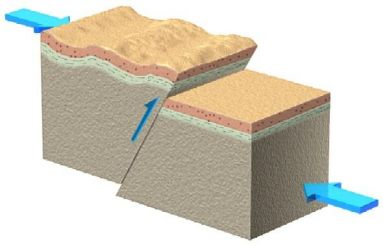
This fault is a ____________ fault.
normal dip-slip
strike slip
reverse dip-slip
obtuse dip-slip
reverse dip-slip
Tsunami generated by the Japan 2011 earthquake resulted from ________.
Seismic waves entering a body of water from the shaking of the shoreline
Vertical displacement of the seafloor above a subduction zone
Seismic waves entering a body of water from the solid oceanic crust
Horizontal displacement of the seafloor above a transform fault
Vertical displacement of the seafloor above a subduction zone
Which earthquake would likely cause the most damage, given that all factors are the same?
Magnitude 7.5, focus depth 15 km
Magnitude 4.5, focus depth 20 km
Magnitude 4.5, focus depth 10 km
Magnitude 7.5, focus depth 10 km
Magnitude 7.5, focus depth 20 km
Magnitude 7.5, focus depth 10 km
The difference between lava and magma is that ____.
magma is light in color and lava is dark
magma usually has mafic composition and lava usually has felsic composition
magma is found beneath the Earth's surface, whereas lava has reached the surface
magma flows more quickly than lava.
magma is found beneath the Earth's surface, whereas lava has reached the surface
Where did the oxygen in the atmosphere that we are breathing today come from?
Comets
Volcanoes
Photosynthesis
Sunlight interacting with atmosphere
Chemical weathering
Photosynthesis
All islands along a hot-spot chain remain volcanically active for the lifetime of the mantle plume involved.
True
False
False
An air mass contains a set amount of water vapor. If the temperature of the air mass increases, what will happen to the relative humidity of that air mass?
It will increase
It will decrease
It will remain the same
It is impossible to tell without additional information
It will decrease
Convection occurs in the troposphere due to uneven heating of Earth's surface because:
warming air expands, becomes less dense, and rises.
warming air is pushed upward by the heat.
cooling air expands, becomes less dense, and rises.
convection due to uneven heating doesn't happen.
warming air expands, becomes less dense, and rises.
Ice is a substance with a high albedo, which means it __________.
absorbs most of the light that falls on it
requires heat to raise its temperature by 1°C
reflects most of the light that falls on it
strongly refracts(bends) light that falls on it
reflects most of the light that falls on it
Where is most of the ozone in the planet’s atmosphere found?
troposphere
stratosphere
outer atmosphere
volcanoes
the oceans
stratosphere
Why are mathematical climate models important to the study of climate change?
their mathematical character makes their conclusions and predictions completely accurate
they are easier to use and more reliable than geologic data
they have the ability to predict changes in the future
they make monitoring of climatic conditions obsolete
they aren’t important as they are highly unreliable and in need of major improvements
they have the ability to predict changes in the future
A flood hazard maps shows:
the area that will be flooded just once per century.
the boundaries of a river’s flood plain (unless decreased by adequate levee systems).
land areas where there is 1 percent annual flood probability, and an 0.2 percent annual flood probability
the elevations below which flood risk is great and above which flood risk is not great.
areas where extremely high tides and tsunamis may cause flooding.
land areas where there is 1 percent annual flood probability, and an 0.2 percent annual flood probability
Choose the list that ranks the three types of sediment load in a stream from smallest to largest.
bedload --> suspended load -->
dissolved loadsuspended load --> dissolved load -->
bedloaddissolved load --> suspended load -->
bedloaddissolved load --> bedload --> suspended load
dissolved load —> suspended load —> bedload
How much of the Earth’s surface is covered by oceans?
71%
In terms of the hydrologic cycle, evaporation is:
when water percolates into the subsurface
when water flows across the surface and collects into streams
when water falls as droplets from the atmosphere
when water evaporates from the surface of the Earth
when water evaporates from the surface of a plant
when water evaporates from the surface of the Earth
In the 13th century, there is evidence that the oceanic conveyor belt slowed significantly or stopped in the North Atlantic probably due to a large influx of freshwater into the ocean basin. How did this affect the climate of the Northern Hemisphere?
Glaciers and ice pack began to grow again
Glaciers and ice pack began to shrink again
There was no significant difference in the ice pack
The climate warmed significantly
There was no measureable difference in climate over land but the ocean got colder
Glaciers and ice pack began to grow again
The Hawaiian-Emporer seamount chain is the only evidence of mantle plume activity currently active on the planet today.
True
False
False
Which factors control the cooling time of magma within the crust? Select all that apply.
the depth at which magma cools
the volume oft eh intruded magma
the rate at which heat is absorbed from the surroundings
the heat different between the magma and the surroundings
surface water passing over the magma
the depth at which magma cools
the volume oft eh intruded magma
the rate at which heat is absorbed from the surroundings
the heat different between the magma and the surroundings
(?)
In terms of the hydrologic cycle, evaporation is:
when water percolates into the subsurface
when water flows across the surface and collects into streams
when water falls as droplets from the atmosphere
when water evaporates from the surface of the Earth
when water evaporates from the surface of a plant
when water evaporates from the surface of the Earth
A lahar like the one that occurred at Mt. Pinatubo is:
a glowing cloud of pyroclastic grains and hot gas.
a cinder cone.
an enlarged volcanic crater.
a volcanic mud and debris flow that resembles fluid concrete.
a lava lake in a summit crater.
a volcanic mud and debris flow that resembles fluid concrete.
All of the melt in the magma chambers beneath Yellowstone is felsic composition.
True
False
False
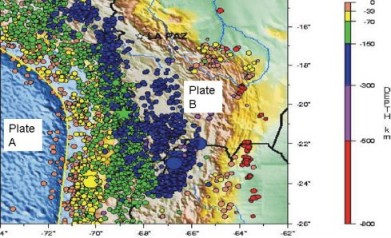
Based on the pattern and location of earthquakes on the diagram, which plate is subducting?
Plate A
Even if you don’t see displacement at the surface, every earthquake occurs on a plate boundary.
True
False
False
Fayal, an island in the Azores off the coast of Africa, is located on an oceanic divergent boundary. What composition lava erupts on the island?
Rhyolite
Andesite
Basalt
Basalt
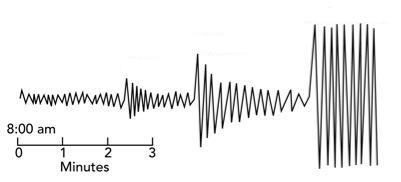
How would this diagram change if the seismic station were farther from the earthquake?
the P-waves only would arrive later
the S-waves only would arrive later
there would be a larger gap between the arrivals of the P- and S-waves
the S-waves would arrive before the P-waves
all the waves would arrive later and there would be a larger gap between them
all the waves would arrive later and there would be a larger gap between them
If an area has shallow, intermediate, and deep earthquakes, what can you infer?
it is near a subduction zone
the shallow earthquakes will be closer to the trench than deeper ones
the depth pattern of earthquakes can be used to determine which way the slab is inclined
this area has the potential for large earthquakes
all of the possible answers are correct
all of the possible answers are correct
If the volatile content of magma is increased, its viscosity will ____.
increase
decrease
stay the same
decrease
If you feel the shaking of an earthquake and sometime later the water pulls back and the offshore reef is exposed, what should you do to ensure your best chance of survival?
Go out to help the stranded fish
Set up your camera on the beach
Get to high ground
Climb to the top of a really tall tree
Get to high ground
Lava flows are the greatest volcanic hazard to human life because they travel so fast.
True
False
False
Mt. Saint Helens erupted in 1980, sending out gas and pyroclastics. Geologists have found evidence of many eruptions of Mt. St. Helens, dating back 37,000 years. The mountain is huge and is composed of layers of lava and pyroclastics. Which of the following is most likely true?
When lava flows, it will be basalt.
It will not erupt again.
It's a stratovolcano (or composite cone).
It's on a transform plate boundary.
It's a cinder cone.
It’s a stratovolcano (or composite cone).
Olympus Mons on Mars is a shield volcano. What composition lava is most likely to have formed it?
Rhyolite
Andesite
Basalt
Basalt
Roughly 80% of the earthquake energy released on Earth comes in the continental collision zone where the Himalayas are still growing; the remaining 20% is scattered at random locations worldwide.
True
False
False
Shear seismic waves can be modeled by:
sinusoidal curves
pendulum motion
spring motion
parabolic curves
sinusoidal curves
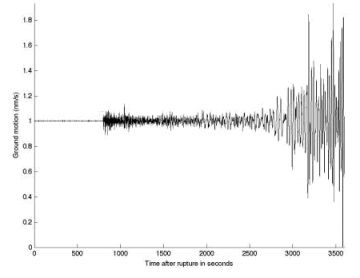
The seismogram shows a local recording of the Sichuan earthquake that devastated eastern China at 2:28 pm on May 12th, 2008, what is the lag time?
about 800 seconds
about 3500 seconds
about 2000 seconds
about 1250 seconds
about 1000 seconds
about 2000 seconds
Tonga, an island in the South Pacific, is above an ocean-ocean convergent boundary. What composition lava erupts from its volcanoes?
Rhyolite
Andesite
Basalt
Andesite
Vesuvius erupted—a very violent explosion—in 79 C.E. and buried the residents of Pompeii and Herculaneum in ash. On the basis of this information, which of the following would you least expect to find at Vesuvius?
Basalt
lapilli (cinders)
welded tuff
rhyolite domes
Basalt
Which magma would have the lowest viscosity?
Low temperature mafic
High temperature felsic
High temperature mafic
Low temperature felsic
High temperature mafic
Which of the following events is a warning sign of imminent eruption?
earthquake activity
bulges on the volcano's surface
decrease in mass movement events
a tsunami in the surrounding body of water
earthquake activity
bulges on the volcano's surface
Which of the following are characteristics of stratovolcanoes? Check all that apply.
Formed from explosive eruptions.
The type of volcanoes that formed Hawaii.
Formed by a single eruption.
Composed of solidified lava and pyroclastic debris.
Referred to as "homogeneous volcanoes."
Typically composed of a single material.
Formed form explosive eruptions
Composed of solidified lava and pyroclastic debris.