3.4 Theories of Cognitive Development
 Call Kai
 Learn
Learn Practice Test
 Spaced Repetition
 Match
Match Flashcards
 Knowt Play
1/28

There's no tags or description
Looks like no tags are added yet.
Name | Mastery | Learn | Test | Matching | Spaced | Call with Kai |
|---|
No analytics yet
Send a link to your students to track their progress
29 Terms
Cognitive Development
How individuals skills and thinking change overtime
Jean Piaget
Studied how children learn and think overtime; believed children developed schemas or framework to understand the world, as you age the schemas are refined and more precise
Schemas are impacted by the AA
Assimilation and Accommodation
Assimilation in Schema
Individual experiences new information and puts them into existing schema; seeing a cat, realizing it has 4 legs and putting it in the schema with dogs
Accommodation in Schema
Refine and adjust Schemas; dogs and cats having their own as they make separate noises
4 stages of development by Piaget
Sensorimotor stage, Preoperational stage, Concrete operational, Formal Operational stage
Sensorimotor stage
2 years old, gains access to movement, learning occurs through touching, hearing, actions (grabbing, pushing, throwing items) and Object Permanence
Object Permanence
Understanding that objects continue to exist even when they are out of sight
Preoperational stage
2 years to 6-7 years; Develop symbolic thinking, learn to use language, engage in pretend play, Animism. Struggle with: Conservation, Reversibility, children are egocentric (three mountain task), and theory of mind
Symbolic thinking
ability to think about things that are not right in front of a person
Pretend play
Child uses their imagination to act out scenarios with objects and children
Animism
Giving human-like qualities to non-living things, toys having feelings (personification)
Conservation
Same amount of something even though it changes shape
Reversibility
the ability to mentally reverse actions; kids can do 2+2=4 but not 4-2 = 2
Egocentric
Seeing the world from their own point of view
Piaget Three Mountain task
Placed a doll in 3 mountains of different height and had kids pick out the picture of what the doll was seeing; kids often picked what they saw not the doll, reinforcing the egocentrism
Theory of Mind
ability for a child to understand that people have thoughts, feelings, perspectives, different from their own
Concrete operational
6-7 years to 11-12 years; children become more logical, classification, seriation; struggle with: Hypotheticals, and reasoning with possibilities
Classification
sort objects based on color and shape
Seriation
arrange objects in quantitively, arranging sticks from shortest to longest
Formal operational stage
11-12; Children can think abstractly, use logic, consider hypotheticals, ponder philosophical questions, can use deductive reasoning; some kids may never reach this stage
Deductive Reasoning
Starting with a general principle and applying to a question
Lev Vygotsky
Believed that learning happens through the environment, Sociocultural theory
Sociocultural theory
children develop skills and knowledge by interacting with people around them
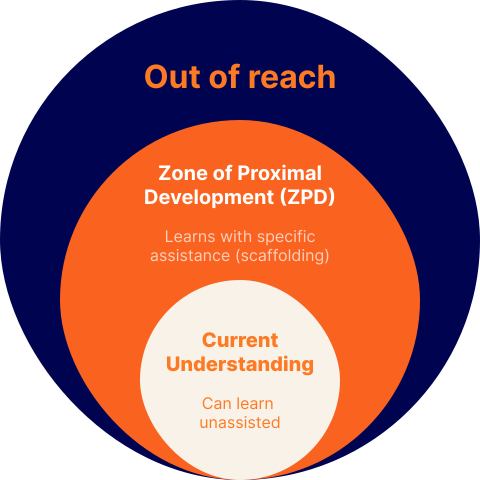
Zone of Proximal development
Some skills I know on my own, others I need help with, and others will never be reached in my lifetime
Scaffolding
Teacher/guider only provides enough information so the child can get to the next step NOT the answer
As an individual grows their crystallized intelligence (vocab, facts) grows, but their fluid intelligence (ability to think and reason quickly) declines
As an individual grows… (effects on fluid and crystalized intelligence)
Dementia
Broad term for cognitive disorders that significantly impair memory, reasoning, and other mental abilities
Alzheimers
Most common cognitive disorder. It causes severe memory loss, cognitive decline, and behavioral changes