Lecture 23: Secretory Pathway & Protein Quality Control
 Call Kai
 Learn
Learn Practice Test
 Spaced Repetition
 Match
Match Flashcards
 Knowt Play
1/100

There's no tags or description
Looks like no tags are added yet.
Name | Mastery | Learn | Test | Matching | Spaced | Call with Kai |
|---|
No analytics yet
Send a link to your students to track their progress
101 Terms
secretory pathways includes proteins that are ________ from the cell or become ________ proteins
secreted; membrane
in addition to secreting proteins, the secretory pathways also inserts and folds ________
integral membrane proteins
the cell is packed with ________
membranes
what type of experiment did Palade use to study the secretory pathway?
Pulse-chase experiment
pulse-chase experiments are good for studying ________ pathways/processes
continuous
what type of radioactive amino acid did the palate pulse-chase experiment use?
leucine
how were labeling amino acids useful for following the secretory pathway?
radioactive aa were incorporated into secretory proteins
palace fixed cells for ________ at various time points
electron microscopy
in the palade pulse-chase experiment, the radioactive grains appear as ________
black dots
immediately after the pulse, the radioactivity was found on top of the ________
rough ER
40minutes after the exposure, the radioactivity was found in ________
vacuoles
the Palade experiment discovered that the pathway of secretory proteins was:
ER → Golgi → vesicles → out of cell
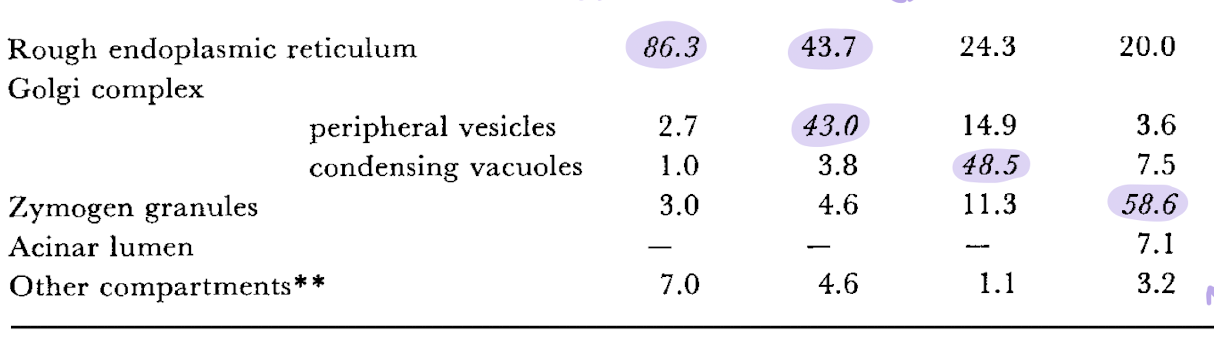
in this table: what do each of the percentages mean?
the amount of radioactivity in each corresponding compartment
the secretory pathway ________ and ________ proteins for secretion
prepares; packages
what is the process by which vesicles release proteins outside the cell
exocytosis
what are the 3 parts of the golgi?
cis, medial, trans
what is the other with which secretory proteins move through the different golgi?
cis → medial → trans
compartments of the secretory pathway are ________ equivalent
topologically
the inside of vesicles are equivalent to the ________ of the cell
outside
the ________ is the central organelle of the secretory pathway
golgi
Othman reconstituted golgi trafficking in ________
cell-free extracts
in rothmans experiments; he creates a mutated cell line that lacked ________ in addition to a wilftype cell line that lacked the ________
glycosyltransferase; protein
without complementation neither the mutant or wild type would express a ________ (Rothman experiment)
glycosylated VSV-G protein
if the cell lines were mixed; you could see the ________ protein ONLY if the protein was ________ via a ________ from mutant to WT cell (Rothman experiment)
glycosylated; transferred; vesicle
in the Rothman experiment; only the wild type ________ golgi was able to complement the glycosylation defect of the mutant cell line
medial
the Rothman experiment allowed them to identify which ________ are needed for ________
proteins; trafficking
membrane traffic begins with ________ and formation of the ________
cargo selection; vesicle
when the vesicle first starts budding off the membrane; it is covered in ________
coat proteins
during vesicle transport, the ________ are removed from the outside
coat proteins
after vesicle transport, the vesicle will ________ on the accepting membrane
dock
after the vesicle docks with the membrane; it will ________ via ________ proteins
fuse; t-SNARE
snare proteins are needed to mediate ________
fusion
how do SNARE proteins mediate fusion?
wind together with proteins on vesicle
are snare proteins only found on the target membrane?
no on vesicle and target membrane
the target membrane SNARE protein is called ________, and the vesicle version is called ________
t-SNARE; v-SNARE
what are three jobs of the ER that help mediate formation of a mature protein?
folding, disulfide formation, and glycosylation
the ER can induce ________ cleavage and the formation of ________ complexes
proteolytic; multimeric
in addition to proteins; the ER plays a large role in ________ and ________ synthesis
lipid; cholesterol
proteins are folded via the ________ effect
hydrophobic
protein folding is due to ________ regions folding to exclude ________ and increase ________
hydrophobic; water; entropy
protein folding is often assisted by ________
chaperones
what does BiP stand for?
binding protein
what does BiP do?
assist protein folding
BiP will bind to ________ regions of a peptide as it is being ________ and threaded into the ________
hydrophobic; translated; ER
BiP proteins also use ________ to help ________ the peptide through the translocase
energy; pull
what is PDI used for?
fixing and making disulfide bonds
why are misfiled proteins bad?
they aggregate and cause disease
what are 3 diseases that are caused by aggregation of misfolded proteins?
Alzheimer’s, Huntington’s, Parkinson’s
what is a disease that is caused by a mutated protein, but NOT caused by aggregation?
cystic fibrosis
what protein is mutated that causes cystic fibrosis?
chlorine channel
what mutation causes CF?
phe deletion
is the Phe deletion that causes CF located near the channel?
no! (its no where near the “active site”)
why does the Phe deletion cause issues in the protein?
slow to fold, cells degrade it
because they are a lack of Cl- channels on the membrane of CF patients, this causes the ________ to be thrown off leading to an excess of ________
osmotic balance; mucus
there is a fine balance between the proper ________ of a protein and the ________ required to do so
folding; length of time
glycosylation is used as ________ for proteins
quality control
sugars are added to ________ proteins, this allows them to bind to ________ on the ER membrane which helps them fold. once the protein is folded, the sugar is ________
unfolds; calnexin; chopped off
where is calnexin located?
ER membrane
what happens when a protein leaves calnexin, but is still not properly folded?
glycosyl transferase adds another sugar on, and cycle repeats
the ER has lots of potential for ________ because it is small and there are many unfolded proteins
aggregation
when there is an increase of aggregation in the ER, this caused ________
ER stress
when the ER is stressed; you want to ________ translation, ________ the number of chaperones, ________ transcription, ________ ER volume, and ________ cell growth
decrease; increase; decrease; increase; stop
cell growth can leads to an ________ in ER stress
increase
during ER stress, you want to decrease the amount of mRNA, specifically for ________ proteins
ER-bound
________ and ________ are key signalers for unfolded protein response (UPR)
IRE1; PERK
what is UPR
unfolded protein response
what kind of proteins are IRE1 and PERK?
kinase sensors
ER stress causes the ________ (general)
unfolded protein response
the unfolded protein response induces actions to help decrease ________
ER stress
IRE1 and PERK sense ________ proteins and will ________ causing a series of ________
unfolded proteins; dimerize; phosphorylations
what is ATF6?
a UPR sensor
ATF6 is normally held in the ________, however, during ER stress it will travel to the ________ where it will be cleaved and become a ________
ER; golgi; TF
PERK phosphorylates a ________ factor
translation initiation factor
which IF does PERK inhibit?
eIF2
the inactive form of eIF2 is ________
phosphorylated
when eIF2 is phosphorylated, ________ will decrease
translation
the inactivation of eIF2 will increase the activity of ________
ATF4
what does ATF4 do?
activate transcription of chaperones
IRE1 is a ________/________ that will splice its target
kinase; endonuclease
IRE1 is activated by binding to ________
unfolded proteins
once IRE1 is activated it ________
ligimers
the ________ activity of IRE1 will cleave the XBP1 mRNA
ribonuclease
XBP1 mRNA is an inactive mRNA because an ________ was left it in
intron
IRE1 cleaves the ________ out of XBP1 mRNA, which activates it for ________
intron; translation
the XBP1 protein is a ________ for the expression of ________
TF; chaperones
in addition to cleaving XBP1 mRNA, IRE1 is able to degrade mRNA located at the ________, which help reduce the load of ________ on the ER
translocon; proteins
which particular mRNA sequence does IRE1 splice and activate?
XBP1
ER-associated degradation targets ________ misfolded proteins for ________
terminally; degradation
what is ERAD?
ER-associated degradation
why does the ER need to transport proteins OUT of the ER for degradation?
no proteosomes in the ER
what is the process called of moving a protein back out of the ER?
reverse translocation
what are 2 ways that a UPR is able to sense a misfolded protein?
exposed hydrophobic regions and unformed disulfides
when the ER stress is too great, what does the cell do?
apoptosis (cell death)
how does type 2 diabetes cause ER stress
increased demand for insulin secretion
how could you induce ER stress in the lab?
inhibit glycosylation
two of the main functions of the Golgi is ________ of glycosyl modifications and ________ of proteins into secretion ________
remodeling; packaging; vesicles
which once of the following proteins does NOT enter the secretory pathway?
SRP
disulfide bonds are common in proteins to be ________
exported (secreted)
what does Hsp 70 do?
heat shock chaperones
what does calreticulin do?
assist with protein folding/chaperoning