Econs unit 2
 Call Kai
 Learn
Learn Practice Test
 Spaced Repetition
 Match
Match Flashcards
 Knowt Play
1/28

There's no tags or description
Looks like no tags are added yet.
Name | Mastery | Learn | Test | Matching | Spaced | Call with Kai | Chat |
|---|
No analytics yet
Send a link to your students to track their progress
29 Terms
MACROECONOMIC ACTIVITY
The concept of macroceconomics
Macroeconomics is the study of the performance of the entire economy rather than individual markets. Macroeconomists collect and investigate economic indicators relating to the total level of production, expenditure and income in the economy. These indicators help economists to describe and explain trends in economic activity and suggest policies which will improve short term/long term economic performance.
The concepts of total spending, total output and total income and the relationship between them
Total spending is the amount of money people spend to buy goods and services. Total output is the amount of goods and services being produced by firms. Total income is the amount of money people make from working. The value of output produced must equal the value of income paid to resource owners which must equal the value of spending by households to produce the output.
Circular flow of income model
It shows how money circulates in an economy.
Draw the circular flow of income model
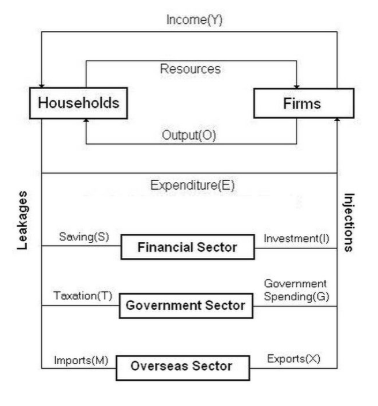
The concept of the five sector circular flow of income
Household- Households are the owners of the resources- land, labour, capital and enterprise. They also buy and consume all goods and services.
Firm- The employers of resources, they produce all goods and services.
Financial- Households save some of their income. Saving is money not spent by households. Households store their savings in financial institutions like a bank. Firms use these funds to invest in machinery and equipment that enables them to grow their business and produce more goods.
Government- Households are required to pay a part of their income to the government. This is called taxation and is used by the government to provide public services such as healthcare, education, roads, public transport, national defence and welfare.
Overseas- Imports are goods that are produced overseas and purchased by consumers in a country. Exports are goods that are produced in a country and sold to consumers overseas.
What are leakages?
Savings, taxes and imports are leakages as they reduce the amount of money flowing through the economy. However, we can see that they are crucial to helping the economy function.
What are injections?
Investment, government expenditure (spending) and exports are injections as they increase the amount of money flowing through the economy, leading to more jobs and allow citizens to satisfy more wants.
When does equilibrium occur?
Equilibrium occurs when leakages are equal to injections. It also occurs when income=output=expenditure.
the effect of changes in leakages and injections on the level of equilibrium in the circular flow of income model
If injections exceed leakages, economic growth occurs and the flow of income in an economy will rise. If leakages exceeds injections, the economy contracts and there will be a decrease in the flow of income in an economy.
What are the components of aggregate expenditure?
Consumption- Consumption on durable and non durable goods.
Investments- Business expenditure on new capital equipment which will produce final goods and services in the future- machines, factories, aircrafts, tools, expenditure on new buildings.
Government spending (expenditure)- Two types- G1 and G2. G1 is current expenditure, which provides for day to day functions of government. G2 is capital expenditure which provides for future needs such as schools, roads, power, communication, dams, etc.
Net exports- The value of goods and services sold to overseas, minus the value of goods and services brought from overseas.
What are durable and non durable goods?
Durable goods: Goods that are consumed slowly after purchase. Many durable goods are considered discretionary goods because they are not essential. Examples are TVs and computers.
Non durable goods: Goods that are consumed quickly after purchase. They are usually cheaper than durable goods. Examples are food and clothing.
Factors affecting consumption
The level of disposable income- Disposable income is the income households receive after tax. There is a positive relationship between the amount households spend on consumption and their disposable income.
Cost of credit- Interest rates represent the price of money- the cost of borrowing. Low interest rates have a positive effect on household spending because interest payments on borrowed money represents a smaller slice of disposable income when interest rates are low and the opportunity cost of consumption falls. Consumers can either save or spend their income. Saving is less attractive when interest rates are low because there is a lower rate of return. Vice versa for higher interest rates.
Household stock and personal wealth- Households that hold real assets such as property or shares tend to feel ‘wealthier’ when these asset prices rise, therefore consumers feel more confident in spending. If asset prices fall, this can lead to a fall in spending patterns.
Consumer expectations- Expectations are positive or negative sentiments people hold about the future state of the economy. Reports concerning economic growth, unemployment, inflation, interest rates, etc affect household confidence and their willingness to purchase goods and services. Consumer sentiment has a greater impact on discretionary items such as holidays and computers.
Government policies- The RBA administers monetary policies to influence the cash rate, which impacts interest rates. The Commonwealth Government also uses fiscal policy (government spending and taxes) to influence household spending decisions. E.g. increasing personal tax rates is likely to lead to a fall in consumption spending.
Factors affecting investments
Rate of interest- When other things are being held equal, interest rates and the level of investment expenditure are negatively related. This is because Interest rates represent the price of borrowed money so when interest rates rise, so do repayments for capital items purchased with borrowed funds. Interest rates also represent the opportunity cost for money. Firms have a choice of using retained profits for investment or alternative purposes. Therefore when interest rates are high, opportunity cost increases.
Profitability- Many firms retain a portion of their profits for expansion, When economic conditions are challenging and profits are low, firms may run down their capital equipment over a longer period of time. On the other hand a booming economy increases profits and the pool of funds to spend on new capital equipment.
Business expectations- Business expectations are what businesses think about the current level of economic activity and forecasts for the future. Business perceptions are formed as a result of current economic events such as levels of sales and enquires from buyers. If expectations about future sales and profit levels are positive, then there will be more demand to invest. If expectations are negative there will be a fall in business confidence and a reduction in the level of planned investment.
Government policies- Government policy is designed to influence business investment. the Commonwealth Government also uses fiscal policy (government spending and tax) to influence business investment decisions. E.g. increasing company tax rates is likely to lead to a fall in investment.
Factors affecting government spending
Stabilisation of macroeconomic fluctuations- The government also undertakes considerable long term investment in essential infrastructure- public utilities such as power and water supply, roads, railways and communication networks. These decisions are also governed by the need to provide appropriate levels of services across the economy. It would be inappropriate for example to undertake a major new infrastructure project when the economy was operating at full capacity, as his may worsen supply bottlenecks and build inflationary pressure.
Factors affecting net exports
Domestic economic activity
Overseas economic activity
Levels of protection
Membership of multilateral organisations (WTO)
Exchange rates
ECONOMIC GROWTH
The meaning/definition of economic growth
Economic growth refers to the increasing ability of a nation to satisfy the material wants of its people over time.
The definition of gross domestic product (GDP), and the difference between nominal, real GDP and real GDP per capita
GDP is defined as the total market value of all final goods and services produced in a country during a period of time (usually a year). Nominal GDP is the the value of output expressed in current prices. Real GDP is the value of goods and services produced in an economy, adjusting for inflation. Real GDP per capita is a nation’s GDP divided by its population.
The measurement of economic growth - the expenditure approach to measuring GDP
Economic growth is measured by GDP. GDP can be measured in two ways:
GDP = C+I+G+(X-M)
GDP=C+I+G1+G2+(X-M)
The importance of real GDP per capita
The importance of real GDP per capita is that it measures a country’s living standards- it reflects the average value of income per person. If GDP per capita increases, living standards also increase.
The demonstration of economic growth using the PPF
The production possibility frontier model shows the combinations of output that an economy can produce using its available resources and level of technology for a given time period. It is bowed out because of the law of increasing opportunity cost. The opportunity cost of increasing the production of one good in an economy with scarce resources will normally increase.
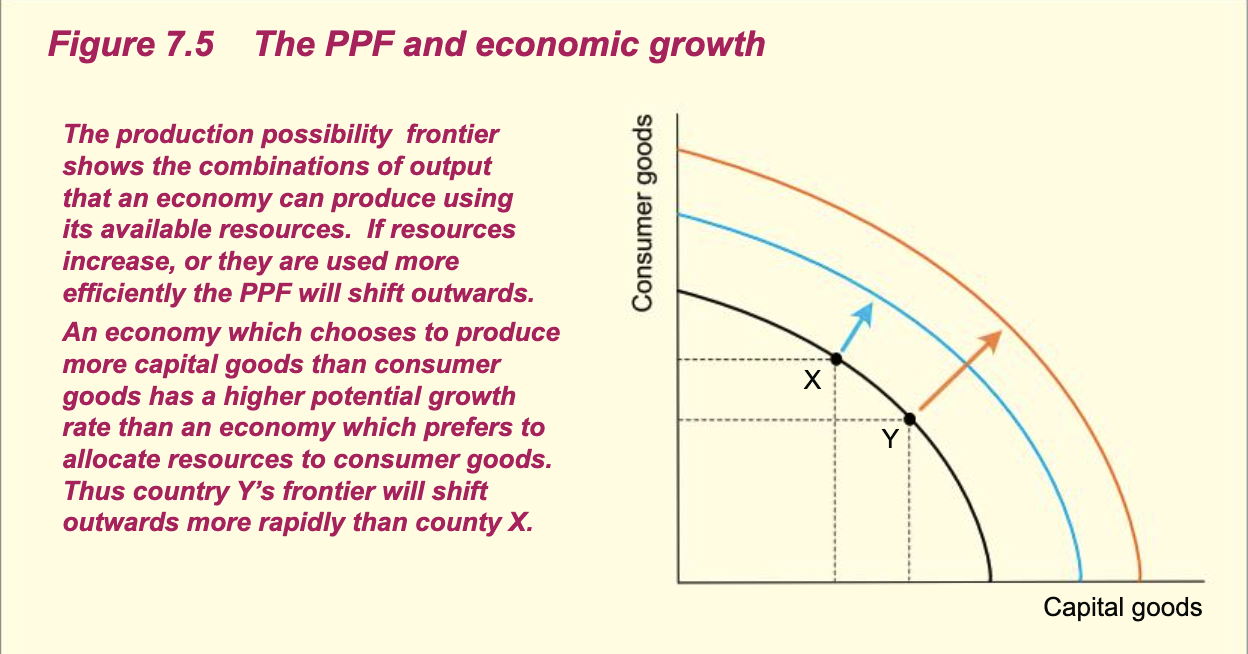
The demonstration of economic growth using the APF
The APF model helps explain the cause of economic growth. It shows the relationship between real GDP and the labour force. It is curved downwards because of the law of diminishing returns, which states that if more units of labour are used with a fixed amount of capital input, then output would rise but at a decreasing rate.
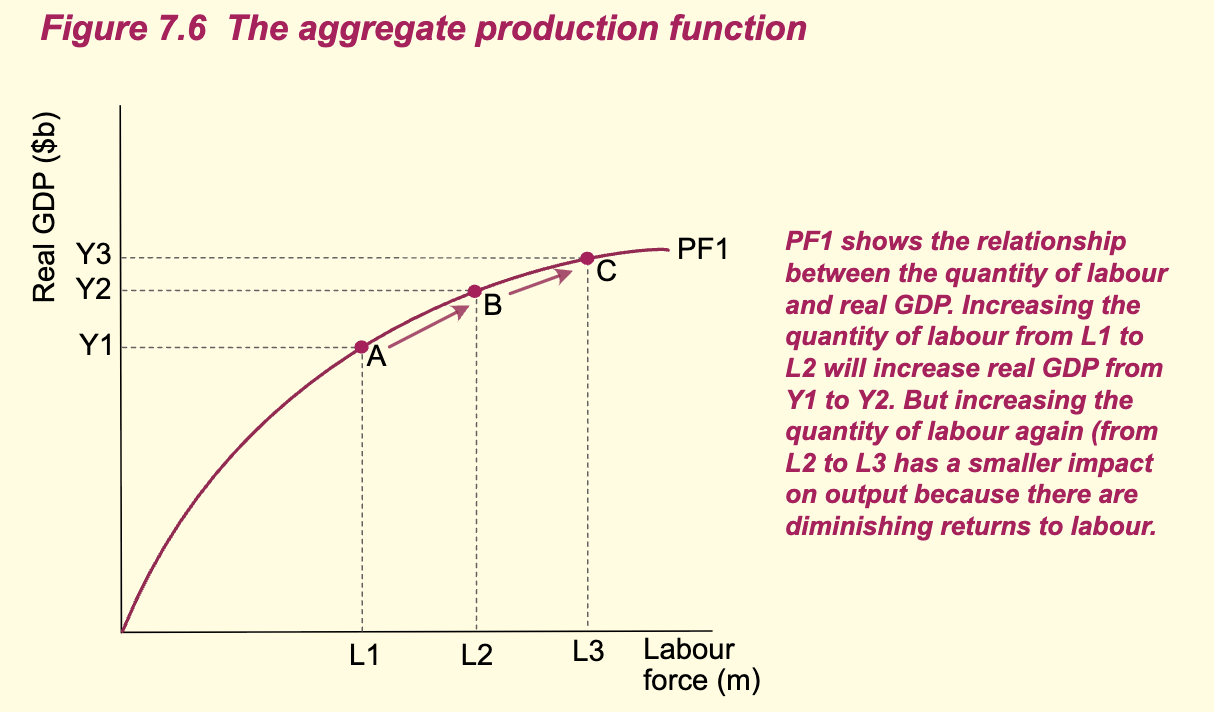
The limitations of GDP as a measure of economic welfare
GDP is a useful measure of economic progress but it is less effective as a social progress indicator. It doesn’t take into account:
economic activity that isn’t paid for
the environment
value judgement
leisure time
how income is distributed
working hours
working conditions
change in health, nutrition, provisions and quality of medical services, education and rights of citizens
The costs and benefits of economic growth
Benefits:
Increasing real income and material welfare
Higher quality goods and services
More economic opportunities
A tax dividend to government
Increase in leisure time
Costs:
It may not raise the living standards of everyone in the community at the same rate
It may bring inflationary pressure
It is associated with structural change in the economy
It is associated with economic ‘bads’ as well as ‘goods’
It is associated withs social problems
The determinants of economic growth
Determinants of economic growth are those that increase the capacity of the economy to produce more goods and services with available resources. Examples of this are capital, labour, land and enterprise.
Target rate of economic growth
3-4%
The impact of economic growth above or below the target rate
If economic growth is above the target rate it would cause:
Inflation: an increase in aggregate demand may cause shortages of goods and services which result in prices in the economy rising. Cost push inflation may also occur because of a rise in production costs due to shortage of labour and materials.
Decrease quality of life: Longer working hours, reduced leisure time, effects on health and reduced non material living standards.
If economic growth is below the target rate it would cause:
Unemployment
Slower wage growth
Lower standard of living
Trends in economic growth over the last 5 years
2020 Covid 19- Severe but short term decline in economic growth. Decrease in EG -5%. Australia experienced a recession.
2021- rapid but short term recovery EG 10%
2022-2023- falling EG
2022- 6% decrease in EG
2023- 3% decrease in EG
2023-2025- EG continue to fall below target range. Current annual real GDP 1.3% march quarter 2025.