CHATER 2 WORK BOOK
 Call Kai
 Learn
Learn Practice Test
 Spaced Repetition
 Match
Match Flashcards
 Knowt Play
1/165

There's no tags or description
Looks like no tags are added yet.
Name | Mastery | Learn | Test | Matching | Spaced | Call with Kai |
|---|
No analytics yet
Send a link to your students to track their progress
166 Terms
The bony thorax consists of (A) the single __________________________ anteriorly, (B) 2 __________________________, (C) 2 __________________________, (D) 12 pairs of __________________________, and (E) 12 __________________________ posteriorly.
The two important bony landmarks of the thorax that are used for locating the central ray on a PA and AP chest projection are the (A) __________________________ and the (B) __________________________, respectively
The four divisions of the respiratory system are: A. ______________ B. ______________ C. ______________ D. ______________
Adam’s apple
Shoulder blade
Voice box
Breastbone
Collarbone
List the three divisions of the structure located superior to the larynx that serve as a common passageway for both food and air
What is the name of the structure that acts as a lid over the larynx to prevent foreign objects such as food particles from entering the respiratory system? __________________________
The trachea is located __________________________ (anteriorly or posteriorly) to the esophagus.
The __________________________ bone is seen in the anterior portion of the neck and is found just below the tongue or floor of the mouth.
If a person accidentally inhales a food particle, it is likely to enter the (A)________bronchus because it is (B)_______________
What is the name of the prominence, or ridge, seen when looking down into the trachea where it divides into the right and left bronchi? __________________________ B. This prominence, or ridge, is approximately at the level of the __________________________ vertebra.
What is the term for the small air sacs located at the distal ends of the bronchioles, in which oxygen and carbon dioxide are exchanged in the blood? __________________________
The delicate, double-walled sac or membrane that contains the lungs is called the
The outer layer of this membrane adhering to the inner surface of the chest wall and diaphragm is the
The inner layer adhering to the surface of the lungs is the __________________________ or
The potential space between these two layers (identified in B and C) is called the
Air or gas that enters the space identified in D results in a condition called __________________________.
Lower, concave portion
Central area in which bronchi and blood vessels enter the lungs:
Upper, rounded portion above the level of the clavicles
Extreme, outermost lower corner of the lungs
Explain why the right lung is smaller than the left lung and the right hemidiaphragm is positioned higher than the left hemidiaphragm
List the four important structures located in the mediastinum.
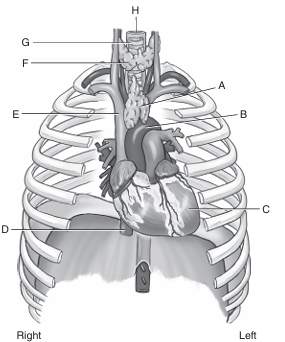
A
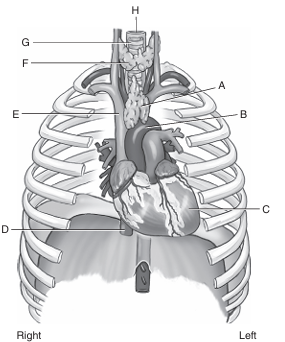
B
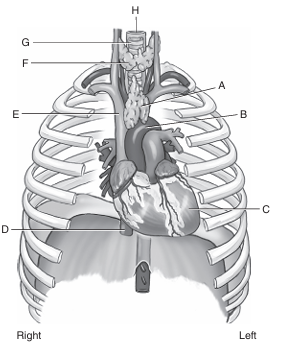
C
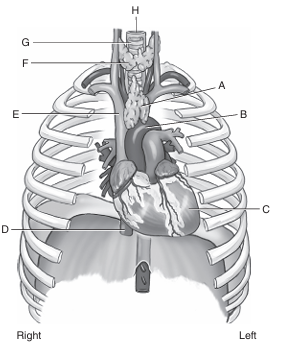
D
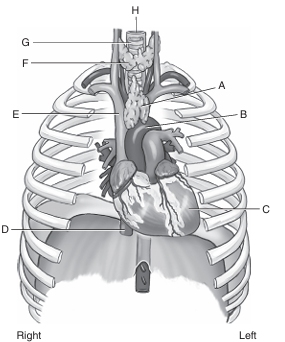
E
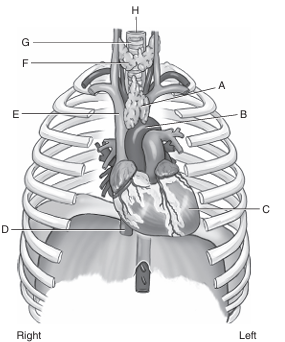
F
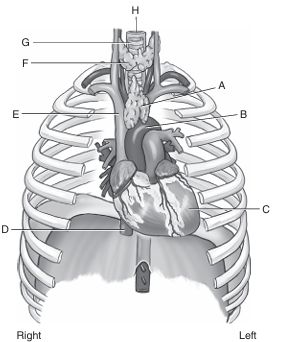
G
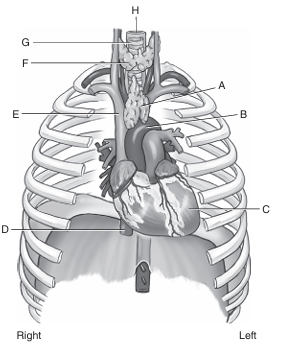
H
The heart is enclosed in a double-walled membrane called the
The three parts of the aorta are the ___________________________, ___________________________, and _____________________________
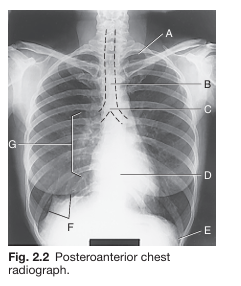
A
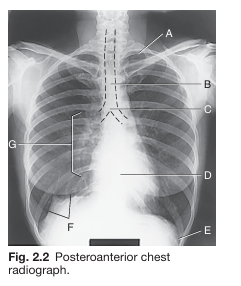
B
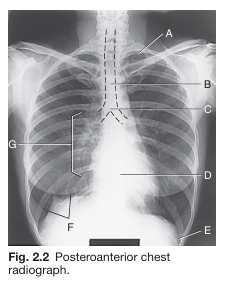
C
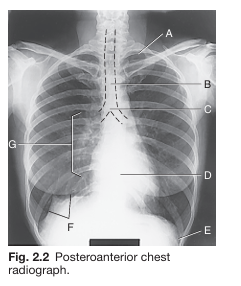
D
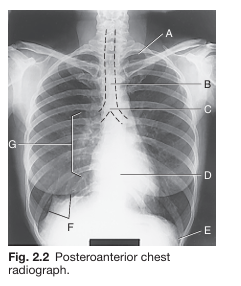
E
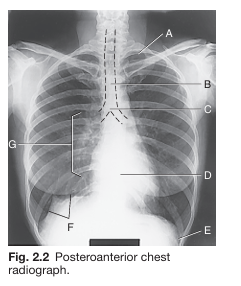
F
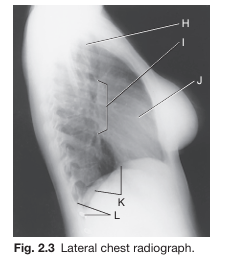
H
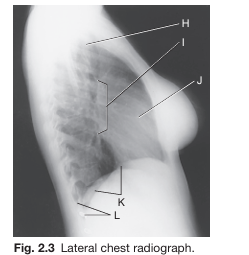
I
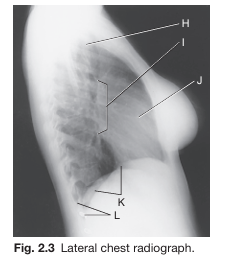
J
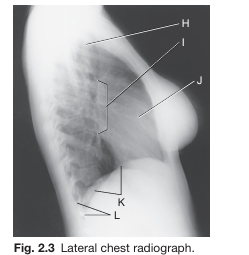
K
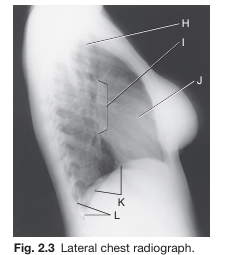
L
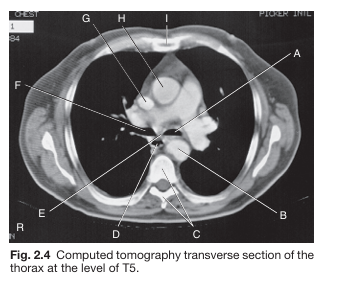
A
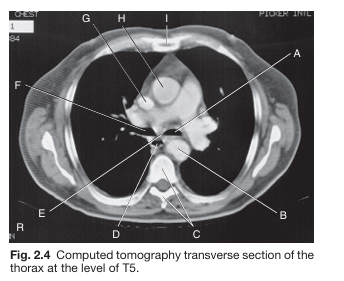
B
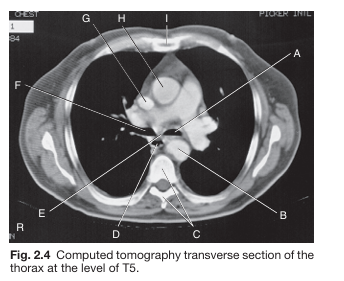
C
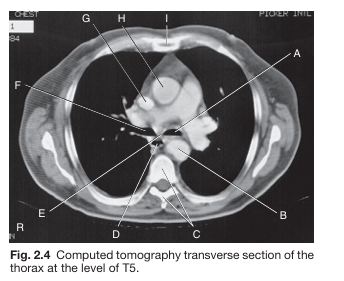
D
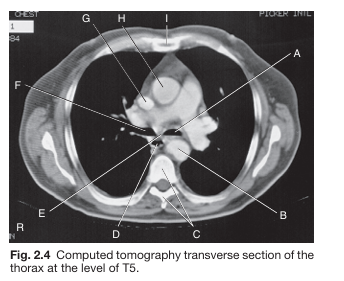
F
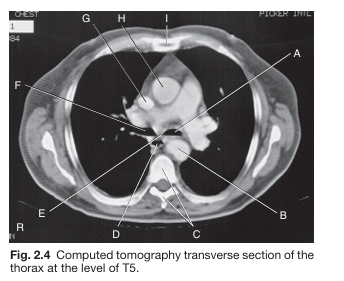
G
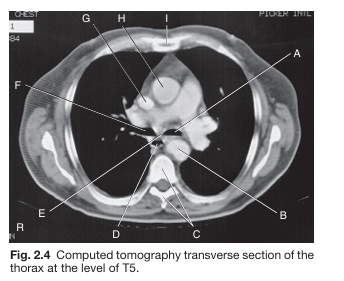
H
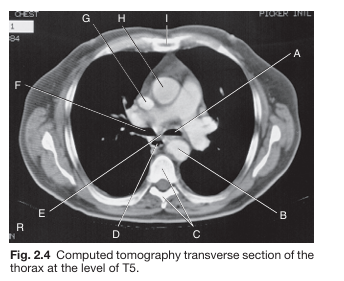
I
Which type of body habitus is associated with a broad and deep thorax? __________________________
Which of the following types of body habitus may cause the costophrenic angles to be cut off if careful vertical col limation is not used?
What is the minimum number of ribs that should be demonstrated above the diaphragm on a PA radiograph of an average adult chest with full inspiration?
Which of the following objects should be removed (or moved) before chest radiography? (Choose all that apply.)
True/False: Long hair may produce an artifact when imaging with digital radiographic systems.
True/False: Chest radiography is the most commonly repeated radiographic procedure because of poor positioning or exposure factor selection errors
Chest radiography for the adult patient usually uses a kilovoltage range of __________________________ to __________________________ kVp
True/False: Generally, you do not need to use radiographic grids for adult patients for PA or lateral chest radiographs
Optimal technical factor selection ensures proper penetration of the:
Describe the way optimal image exposure of the lungs and mediastinal structures can be determined on a PA chest radiograph
True/False: Because the heart is always located in the left thorax, the use of anatomic side markers on a PA chest projection may not be necessary
What is another term for the condition termed visceral inversion?
Which of the following devices should be used for the erect PA and lateral chest projections for an infant?
Which of the following sets of exposure factors is recommended for a chest examination of a young pediatric patient?
True/False: Because they have shallower (superior–inferior dimension) lung fields, the central ray is often centered higher for geriatric patients
True/False: CR centering for the PA chest projection on a bariatric patient is 1–2 inches (2.5–5 cm) lower than for a sthenic patient
To ensure better lung inspiration during chest radiography, exposure should be made during the __________________________ inspiration.
List four possible pathologic conditions that suggest the need for inspiration and expiration PA chest projections.
List and explain briefly the three reasons chest projections should be taken with the patient in the erect position (when the patient’s condition permits).
Why do the lungs tend to expand more with the patient in an erect position than in a supine position?
Explain the primary purpose and benefit of performing chest radiography using a 72-inch (180-cm) source image receptor distance (SID)
Which of the following anatomic structures is examined to determine rotation on a PA chest radiograph
Which positioning tip will help prevent the patient’s chin and neck from being superimposed over the upper airway and apices of the lungs for a PA chest radiograph
For patients with the following clinical histories, which lateral projection would you perform—right or left
Patient with severe pains in left side of chest
For patients with the following clinical histories, which lateral projection would you perform—right or left
Patient with no chest pain but recent history of pneumonia in right lung
For patients with the following clinical histories, which lateral projection would you perform—right or left
Patient with no chest pain or history of heart trouble
Why is it important to raise the patient’s arms above the head for lateral chest projections?
The traditional central ray centering technique for the chest is to place the top of the image receptor (IR) _____ inches (_____ cm) above the shoulders.
A recommended central ray centering technique for a PA chest projection requires the technologist to palpate the __________________________ and measure down from that bony landmark _____ inches (_____ cm) for a male and _____ inches (_____ cm) for a female patient.
Should the 14- × 17-inch (35- × 43-cm) image receptor be aligned in portrait or landscape orientation for a PA chest projection of a hypersthenic patient?
For an asthenic patient? _________________________
bony landmarks is palpated for centering of the AP chest projection
True/False: With most digital chest units, the question of IR placement into either the portrait or the landscape posi tion is eliminated because of the larger IR
True/False: In general for an average patient, more collimation should be visible on the lower margin of the chest image than on the top for a PA or lateral chest projection
True/False: The height, or vertical dimension, of the average-to-more broad individual’s chest is greater than the width or horizontal dimension.
True/False: Multislice CT (MSCT) can produce high-resolution images of the heart on one breath-hold
True/False: Single-photon emission computed tomography (SPECT) is frequently used to diagnose myocardial infarction
True/False: Diagnostic medical sonography (DMS) is not an effective modality to detect pleural effusion.
True/False: Echocardiography and electrocardiography are basically the same procedure
One of the most common inherited diseases
Condition most frequently associated with congestive heart failure
Dyspnea
Accumulation of air in pleural cavity
Accumulation of pus in pleural cavity
A form of occupational lung disease
A contagious disease caused by an airborne bacterium