HEL l The Anglo-Saxon world
 Call Kai
 Learn
Learn Practice Test
 Spaced Repetition
 Match
Match Flashcards
 Knowt Play
1/19

There's no tags or description
Looks like no tags are added yet.
Name | Mastery | Learn | Test | Matching | Spaced | Call with Kai |
|---|
No analytics yet
Send a link to your students to track their progress
20 Terms
the Franks casket
A small Anglo-Saxon chest from the early 8th century. Decorated with knife-cut narrative scenes with inscriptions mostly in Anglo-Saxon runes
Wearmouth and Jarrow
A monastery in which Venerable Bede spent most of his lifetime
Synod of Whitby
a meeting held by the Christian church of the Anglo-Saxon kingdom of Northumbria in 663/664 to decide whether to follow the Celtic or the Roman rite.
How does the area of Whitby and Jarrow relate to the Franks casket?
the area of Whitby and Jarrow might have been the home of Franks casket or the home of a person who carved the inscription.
Franks casket read more in your notes
Franks casket riddle
fisc flōdu āhof on fergenberig wearþ gasric grorn þær hē on greot giswom hronæs bān. There’s alliteration indicating verse. The repetition of the same sounds in stressed syllables of lexical words.
gi: early form of the prefix ge
aes: early form of the saxon genitive es'
prefix ge (gi) is used to indicate the collective meaning
the meaning of Franks casket riddle
fish raised waters against steep wall the savage creature became sad when it swam onto sand whale’s bone
the answer to the riddle
The Franks casket is made out of whale bone. Medieval riddles were a part of Anglo-Saxon tradition. The last word of the riddle: hroanes ban (whalebone) is the answer to the riddle.
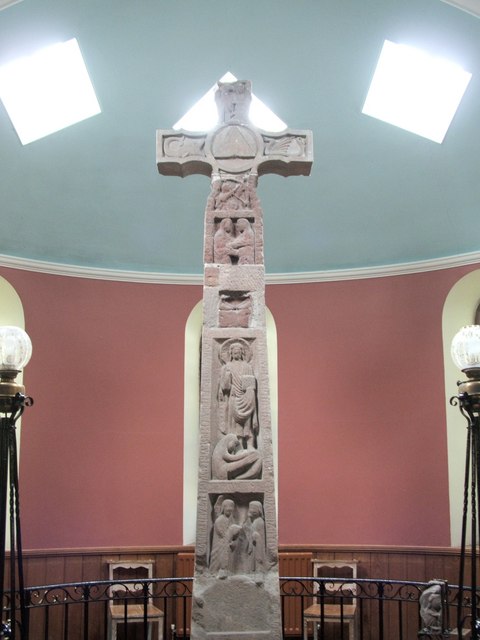
Ruthwell cross
the most famous and elaborate Anglo-Saxon sculpture. Contains the oldest surviving text in OE poetry. The running inscription running along the edges on the side wall represent the Northumbrian version of Dream of the Rood.
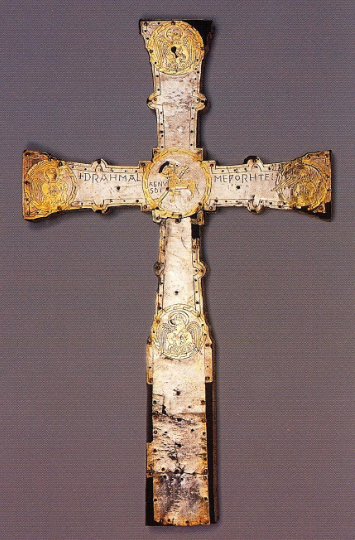
Brussels Cross
fragment of Dream of the Rood in Latin. Has an inscription: Drahmal made me.
Vercelli Book
second half of the 10th century. One of the oldest of the four Old English Poetic Codices. Contains:
Andreas
The Fates of the Apostles
Soul and Body
Dream of the Rood
Elene
a fragment of a homiletic poem
the Armarium
an upright cupboard, cabinet, or chest used by monks to store sacred books. Since early medieval monastic libraries were small, books were often stored in this type of secure, enclosed wooden cabinet rather than a separate library room.
metal bosses
Metal bosses: metal pins placed on the edges, center, back. Animal skin is sensitive to humidity. It’s used to keep it in the same shape.
The bosses are used for protecting the books from being scratched.
How Dream of the Rood begins in Vercelli Book?
hwaet
Beowulf
an annonymous epic poem of 3182 lines in alliterate metre preserved in Vercelli Book. Beowulf also beings with hwaet.
Exeter Book
a mansucript dated in the 10th century. Containing OE alliterate verse.
lacuna
blank spaces in the text
Caedmon’s hymn
he was the first English poet known by name. A herdsman who cared for the animals at the Whitby Abbey, during the abbacy of St. Hilda (657–680); originally ignorant of ‘the art of song’, Cædmon was divinely inspired to compose religious verse; he later became a monk and an accomplished Christian poet.
vocabulary in cademon’s hymn
weard=guard
hlaf=bread
Brytenrices weard
rices weard
wuldor=glory
wuldor feader=in old germanic tradition it’s the father of armies (norse mythology; Woden/Odin is called herja-fathir)
why caedmon used words from Old Norse?
Caedmon uses this pre-christian term into christian reality (synonym for God). Used vernacular to talk about Christian matter, using words rooted in the Old Language to create Christian poetry. That’s why the manuscript survived.