Theorems
 Call Kai
 Learn
Learn Practice Test
 Spaced Repetition
 Match
Match Flashcards
 Knowt Play
1/5

There's no tags or description
Looks like no tags are added yet.
Name | Mastery | Learn | Test | Matching | Spaced | Call with Kai |
|---|
No analytics yet
Send a link to your students to track their progress
6 Terms
The definition of a limit and continuity
A function y=f(x) is continuous at x=a, if:
f(a) is defined
The limit of f(x) as x approaches a exists
This implies that both the left-sided and right-sided limits exists and equal the same value: limx→a+f(x)=limx→a−f(x) 1
The limit of f(x) as x approaches a is equal to f(a).
Otherwise, f is discontinuous at x=a.
1(The limit exists if both corresponding one sided limits exist and are equal.)
Intermediate-Value Theorem (IVT)
A function y=f(x) that is continuous on a closed interval [a,b] takes on every value between f(a) and f(b).
or
For a function f, where f(x)=y,
Rolle's Theorem
If a function f is continuous on a closed interval [a,b] and differentiable on (a,b), such that f(a) = f(b), then there is at least one number c in the open interval (a,b) such that f′(c)=0.
Mean Value Theorem (MVT)
If a function f is continuous on [a,b] and differentiable on (a,b), then there is at least one number c in (a,b) such that (b−a)[f(b)−f(a)]=f′(c).
The average rate of change equals the instantaneous rate of change at some point on (a,b).
Extreme Value Theorem
If a function f is continuous on a closed interval [a,b], then f(x) has both a maximum and a minimum on [a,b].
L'Hopital's Rule
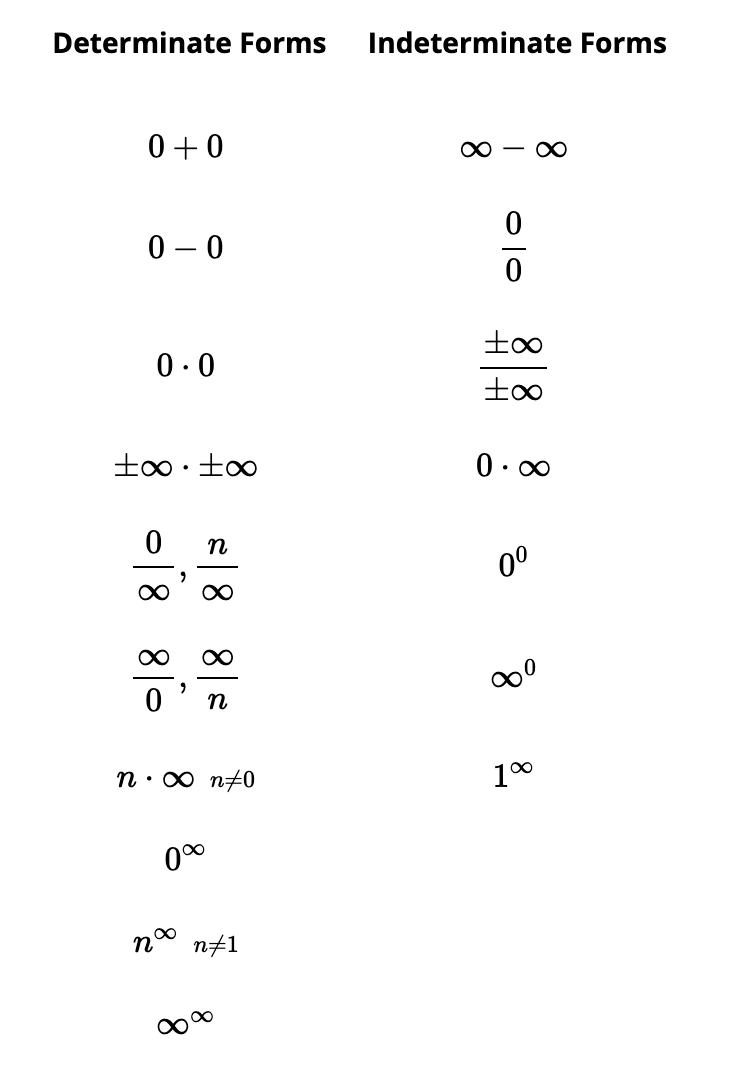
If the limit of g(x)f(x) as x approaches a is of an indeterminate form, and if the limit of f′(x)/g′(x) as x approaches a exists, then the limit of f(x)/g(x) as x approaches a is equal to the limit of f′(x)/g′(x) as x approaches a.