Excretory System: Kidneys and Nephrons

0.0(0)
Studied by 0 people
call kaiCall Kai
learnLearn
examPractice Test
spaced repetitionSpaced Repetition
heart puzzleMatch
flashcardsFlashcards
GameKnowt Play
Card Sorting

1/45

encourage image

There's no tags or description

Looks like no tags are added yet.

Last updated 9:17 PM on 6/22/26
Name
Mastery
Learn
Test
Matching
Spaced
Call with Kai

No analytics yet

Send a link to your students to track their progress

46 Terms

1
New cards

Excretion

Process in which metabolic wastes are filtered out by the blood and removed from the body as urine.
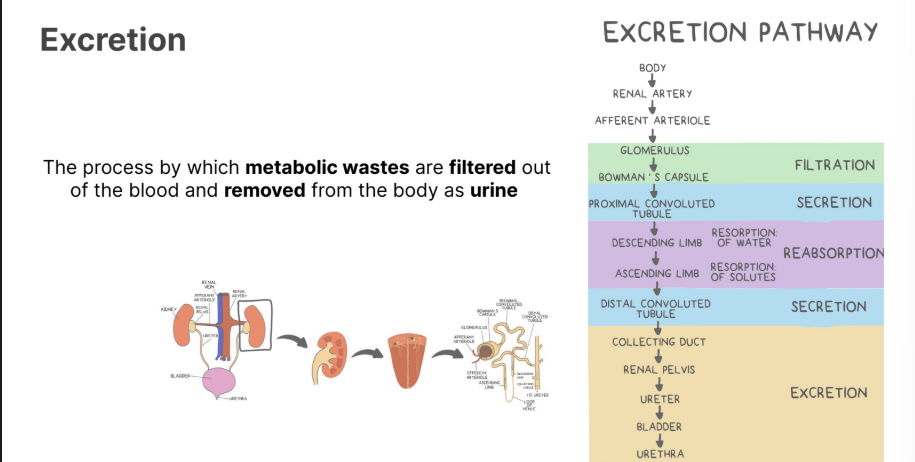
<p>Process in which<strong> metabolic wastes </strong>are <strong>filtered </strong>out by the <strong>blood </strong>and <strong>removed </strong>from the body as <strong>urine. </strong></p>
2
New cards

Kidneys

  • Purpose

  • Distinctions in the parts

The kidneys are responsible for the aforementioned filtration of the blood and the preparation of a urine product for excretion

Key anatomical distinctions between the kidney cortex and the kidney medulla.
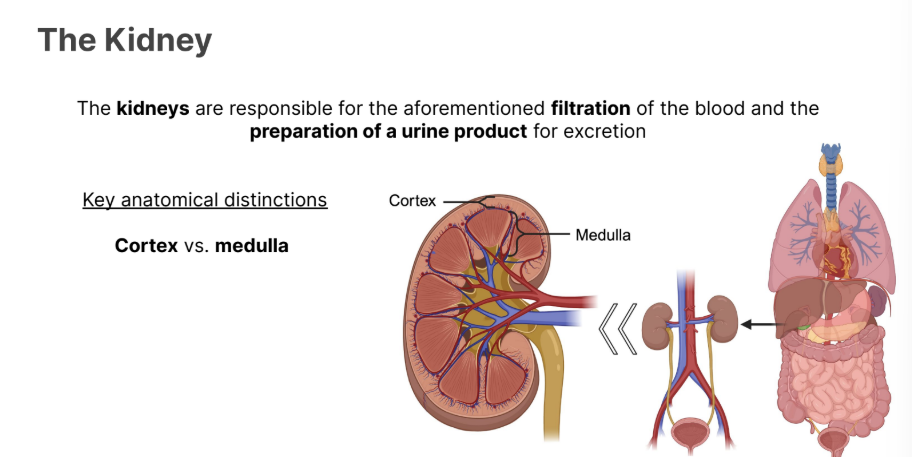
<p>The <strong>kidneys </strong>are responsible for the aforementioned <strong>filtration </strong>of the <strong><em>blood </em></strong>and the <strong>preparation of a urine product </strong>for excretion</p><p></p><p>Key anatomical distinctions between the kidney <strong>cortex </strong>and the kidney <strong>medulla. </strong></p>
3
New cards

3 main Kidney Functions

  • Regulation of blood pressure

  • Regulation of pH

  • Stimulate the generation of red blood cells.

(liver breaks them down, and the epiphyseal are of bones makes them [erythrocytes])

<ul><li><p>Regulation of <strong>blood pressure</strong></p></li><li><p>Regulation of <strong>pH</strong></p></li><li><p>Stimulate the generation of <strong>red blood cells. </strong></p></li></ul><p></p><p>(liver breaks them down, and the epiphyseal are of bones makes them [erythrocytes])</p><p></p>
4
New cards

What is a nephron

Functional Unit of the kidney

5
New cards

Nephron structures

Main structures

  • Glomerulus

  • Proximal convoluted tubule

  • Loop of Henle

  • Distal convoluted tubule

  • Collecting duct

<p>Main structures</p><ul><li><p>Glomerulus</p></li><li><p>Proximal convoluted tubule</p></li><li><p>Loop of Henle</p></li><li><p>Distal convoluted tubule</p></li><li><p>Collecting duct</p></li></ul><p></p>
6
New cards

Structures in the Renal Corpuscle

  • Glomerulus

  • Bowman’s capsule

Bolded are the most important ones

  • Afferent Arteriole

  • Podocytes

  • Efferent Arteriole

<ul><li><p><strong>Glomerulus</strong></p></li><li><p><strong>Bowman’s capsule</strong></p></li></ul><p><em>Bolded are the most important ones</em></p><ul><li><p>Afferent Arteriole</p></li><li><p>Podocytes</p></li><li><p>Efferent Arteriole</p></li></ul><p></p>
7
New cards

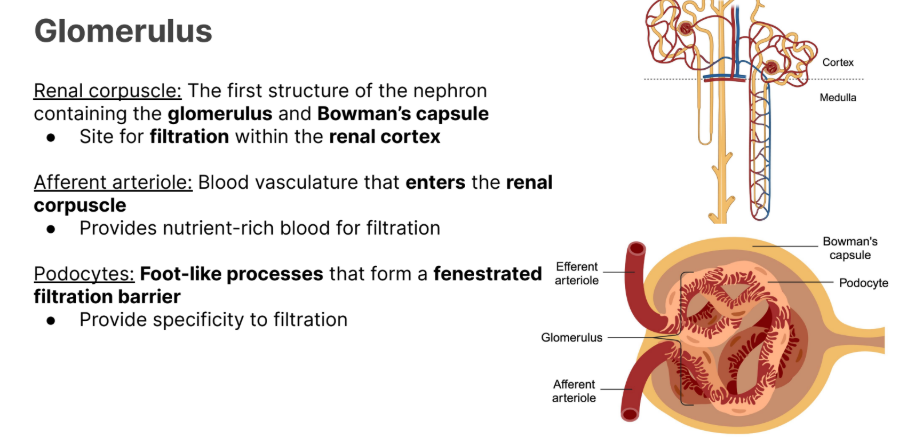
Renal Corpuscle

Renal Corpuscle

  • The first structure of the nephron that contains the glomerulus and the bowman’s capsule.

    • Site for filtration within the renal cortex.

RENAL CORTEX
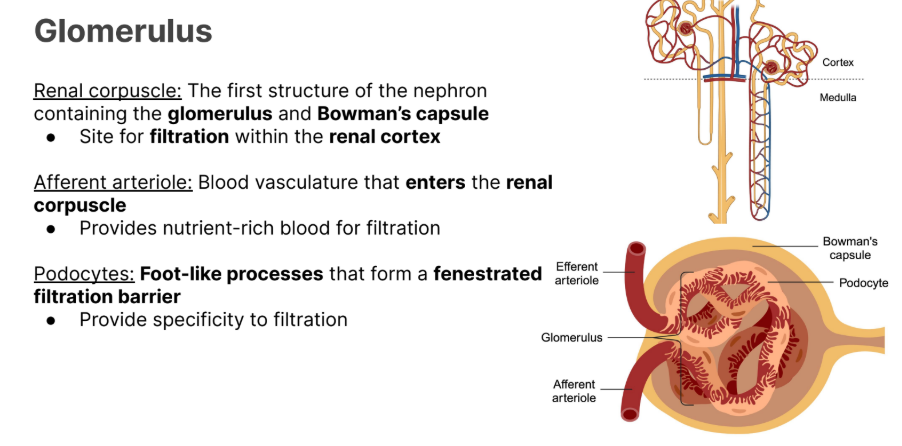
<p><strong>Renal Corpuscle</strong></p><ul><li><p>The first structure of the <strong>nephron</strong> that contains the <strong>glomerulus </strong>and the <strong>bowman’s capsule.</strong></p><ul><li><p>Site for <strong>filtration </strong>within the <strong>renal cortex.</strong></p></li></ul></li></ul><p></p><p><strong>RENAL CORTEX</strong></p><p></p>
8
New cards

Bowman’s Capsule

First step of filtration, filters blodo
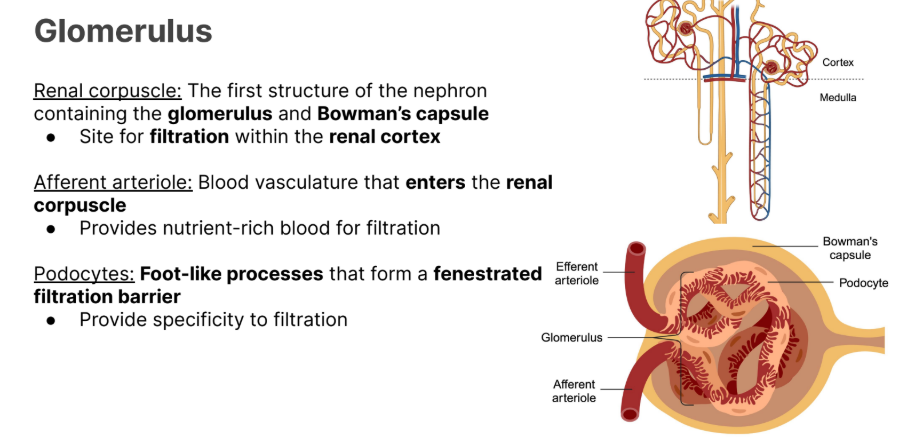
<p>First step of filtration, filters blodo</p>
9
New cards

Glomerulus

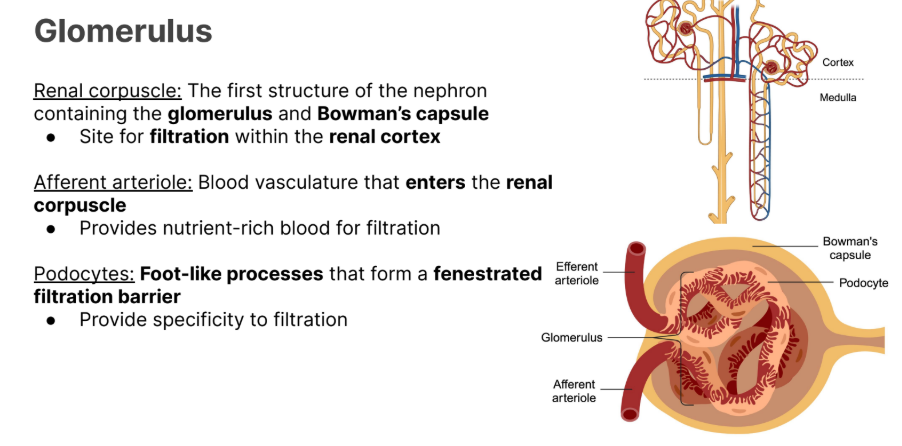
site inside the renal corpuscle that makes up the filtering network of arterioles. BLOOD COMES IN (afferent arteriole), and we see the secretion of filtrate into the bowman’s capsule and into the system followed then BLOOD LEAVING (through the efferent arteriole)

IN THE RENAL CORTEX
<p><strong>site </strong>inside the <strong>renal corpuscle </strong>that makes up the filtering network of arterioles. BLOOD COMES IN (afferent arteriole), and we see the secretion of filtrate into the bowman’s capsule and into the system followed then BLOOD LEAVING (through the efferent arteriole)</p><p></p><p><strong>IN THE RENAL CORTEX</strong></p>
10
New cards

Afferent Arteriole

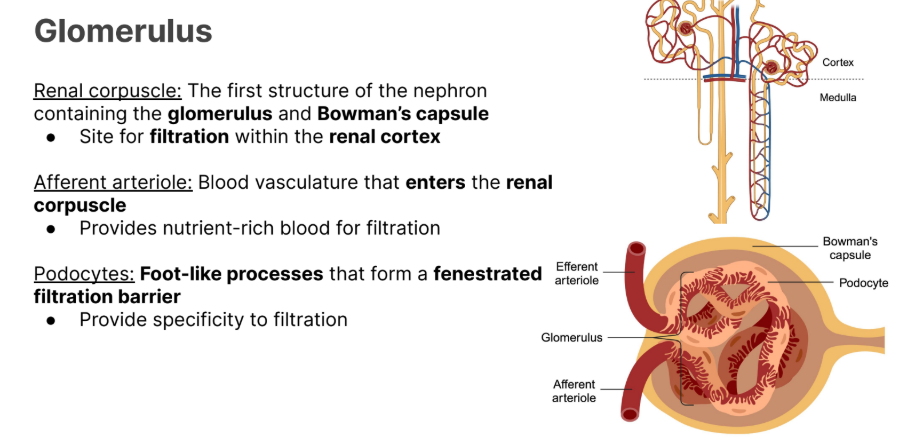
Blood vasculature that enters the renal corpuscle

  • Provides nutrient-rich blood for filtration
<p>Blood vasculature that enters the renal <strong>corpuscle</strong></p><ul><li><p>Provides<strong> nutrient-rich blood</strong> for filtration</p></li></ul><p></p>
11
New cards

Podocytes

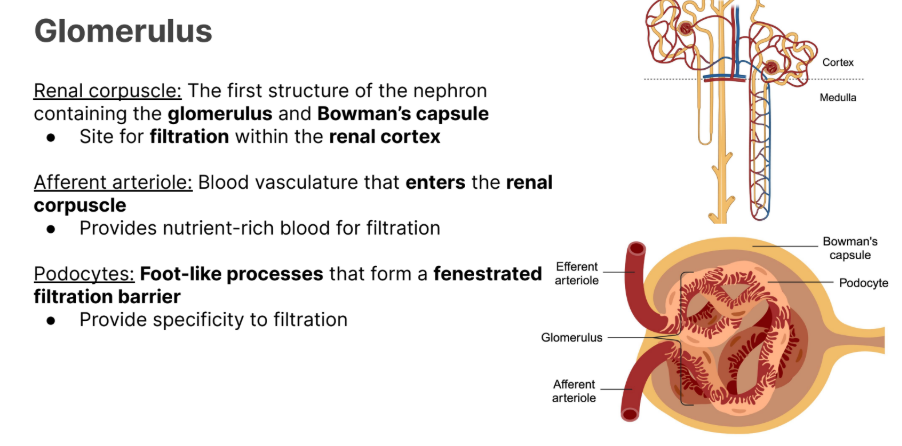
Foot Like Processes that form a fenestrated filtration barrier

  • Used for filtration specificity.

  • Makes sure the right things come in (no rbc’s etc)
<p><strong>Foot Like Processes </strong>that form a <strong>fenestrated filtration barrier</strong></p><ul><li><p>Used for filtration <strong>specificity</strong>.</p></li><li><p>Makes sure the right things come in (no rbc’s etc)</p></li></ul><p></p>
12
New cards

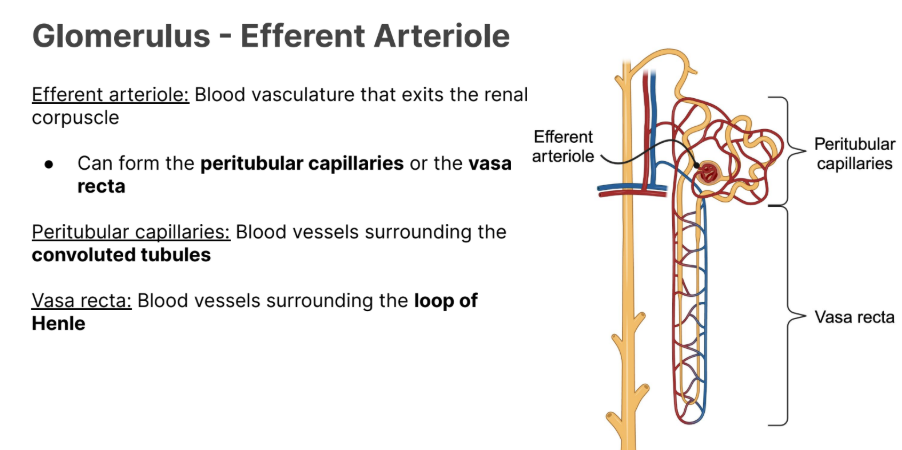
Efferent Arteriole

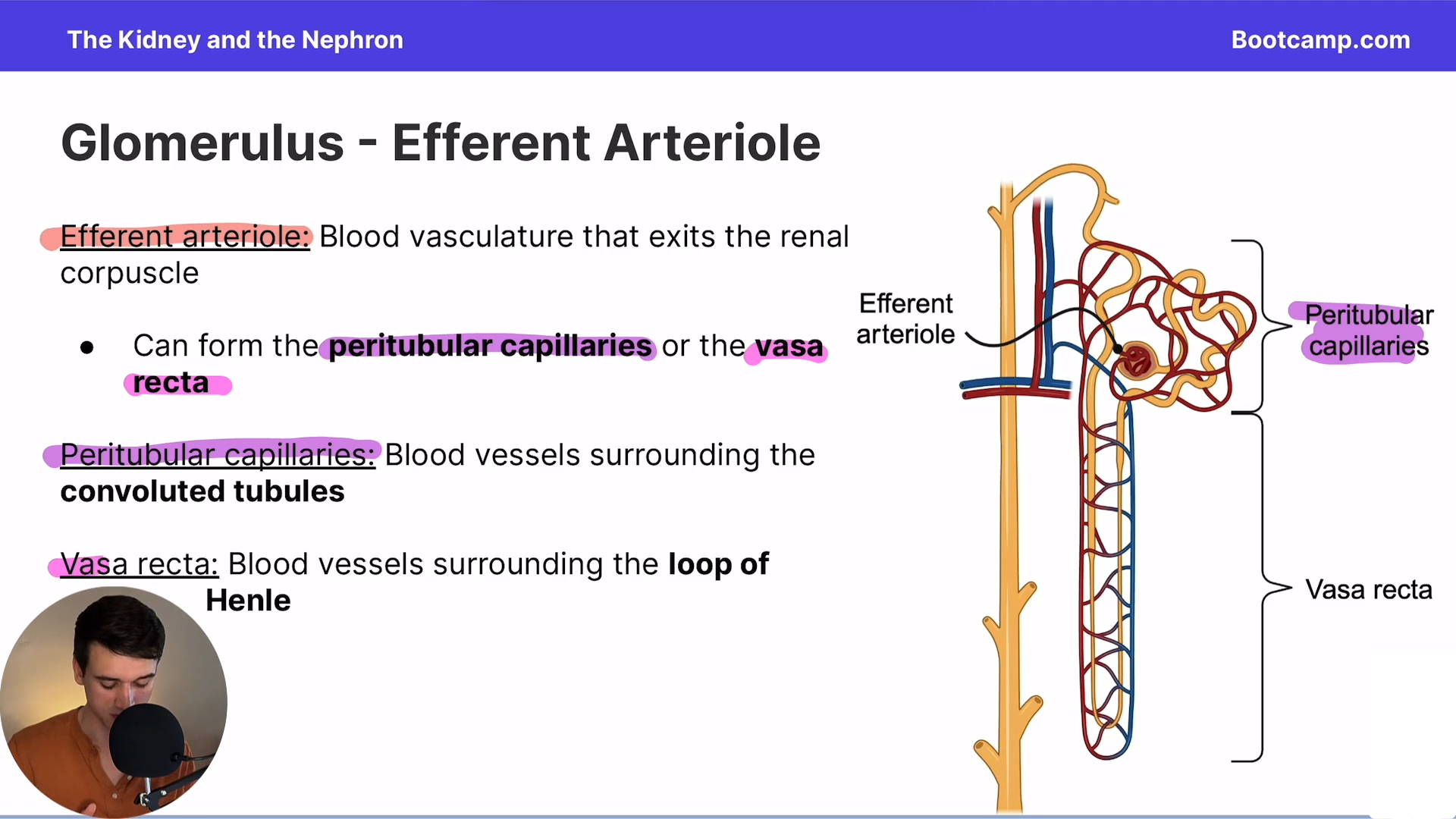
Blood vasculature that exits the renal corpuscle

  • Can form the peritubular capillaries or the vasa recta

13
New cards

Peritubular capillaries

Blood vessels surrounding the convoluted tubules

They are more toward the renal cortex
<p>Blood vessels surrounding the <strong>convoluted tubules</strong></p><p></p><p>They are more toward the<strong> renal cortex</strong></p>
14
New cards

Vasa recta

Blood vessels surrounding the loop of Henle

More toward the renal medulla.
<p>Blood vessels surrounding the <strong>loop of Henle</strong></p><p></p><p>More toward the <strong>renal medulla.</strong></p>
15
New cards

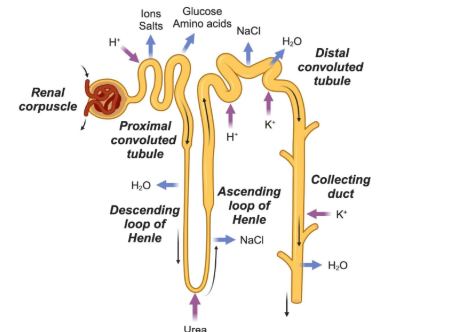
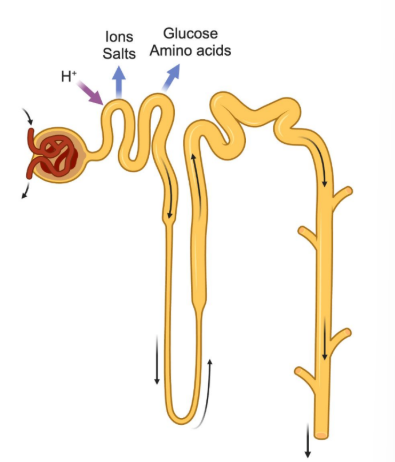
Proximal Convoluted Tubule

  • What is secreted?

  • What is absorbed?

  • What makes it special?

Site of the majority of reabsorption

There is reabsorption via active transport.

Reabsorbed:

  • Na+, Cl-

  • 100% of reabsorbed glucose and amino acids

Secreted:

● H+

Cotransport occurs here
<p>Site of the <strong>majority of reabsorption</strong></p><p>There is <strong>reabsorption </strong>via <strong>active transport.</strong></p><p></p><p><strong><em>Reabsorbed:</em></strong></p><ul><li><p><strong>Na+, Cl-</strong></p></li><li><p><strong>100% of reabsorbed glucose and amino acids</strong></p></li></ul><p></p><p><strong><em>Secreted:</em></strong></p><p><strong>● H+</strong></p><p></p><p></p><p><strong>Cotransport occurs here</strong></p>
16
New cards

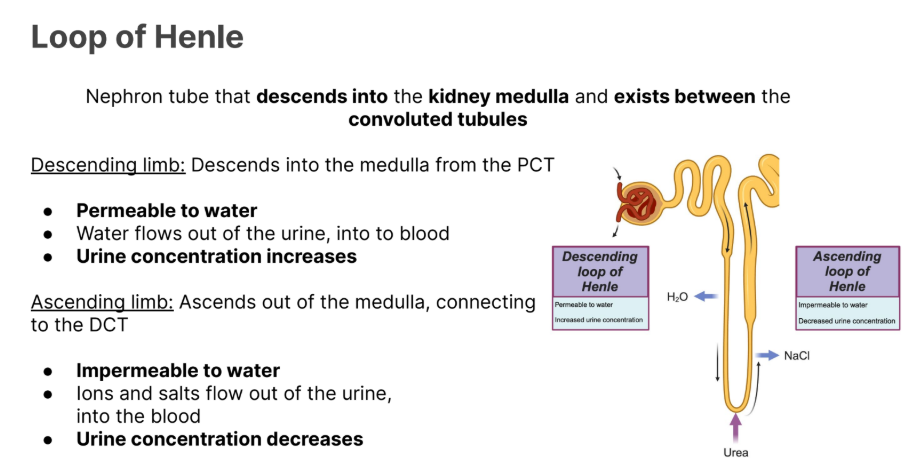
Loop of Henle

  • Def

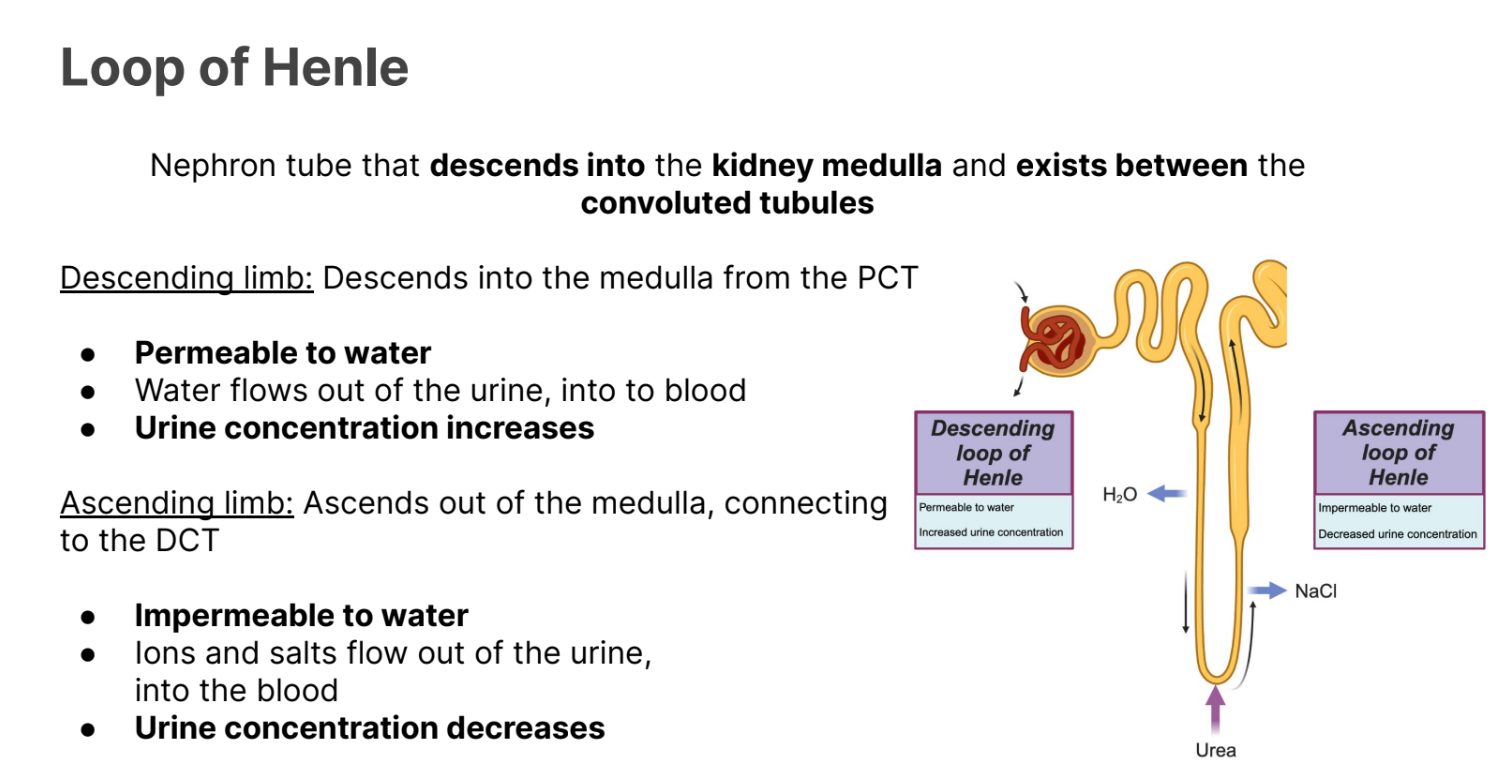
  • Nephron tube that descends into the kidney medulla and exists between the convoluted tubules
<ul><li><p>Nephron tube that <strong>descends </strong>into the <strong>kidney medulla </strong>and <strong>exists between</strong> the <strong>convoluted tubules</strong></p></li></ul><p></p><p></p><p></p><p></p>
17
New cards

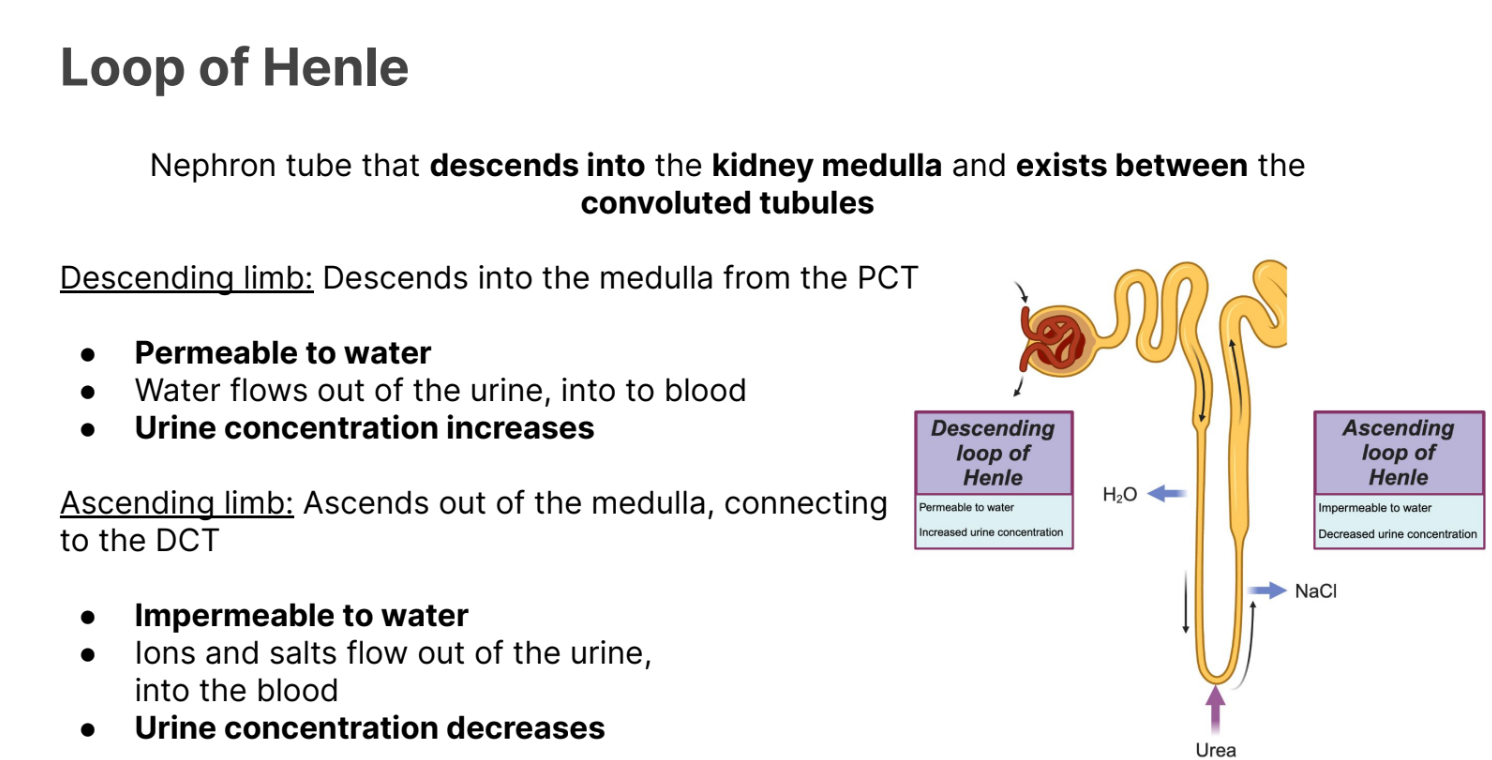
Descending Loop of Henle

Descends into the medulla from the proximal convoluted tubule.

  • Permeable to water

  • Water flows out of the urine, into the blood

  • Urine concentration increases

INCREASES CONCENTRATION
<p>Descends into the medulla from the <strong>proximal convoluted tubule.</strong></p><ul><li><p><strong>Permeable to water</strong></p></li><li><p>Water flows <strong>out </strong>of the urine, into the <strong>blood</strong></p></li><li><p><strong>Urine concentration increases</strong></p></li></ul><p></p><p></p><p>INCREASES CONCENTRATION</p><p></p>
18
New cards

Ascending Limb

Ascending limb: Ascends out of the medulla, connecting to the DCT

  • Impermeable to water

  • Ions and salts flow out of the urine, into the blood

  • Urine concentration decreases

DESCREASES CONCENTRATION

(water cannot leave)
<p><strong>Ascending limb: </strong>Ascends out of the medulla, connecting to the DCT</p><ul><li><p><strong>Impermeable to water</strong></p></li><li><p><strong>Ions </strong>and <strong>salts </strong>flow out of the urine, into the blood</p></li><li><p><strong>Urine concentration decreases</strong></p></li></ul><p></p><p><strong>DESCREASES CONCENTRATION</strong></p><p>(water cannot leave)</p>
19
New cards

Distal Convoluted Tubule

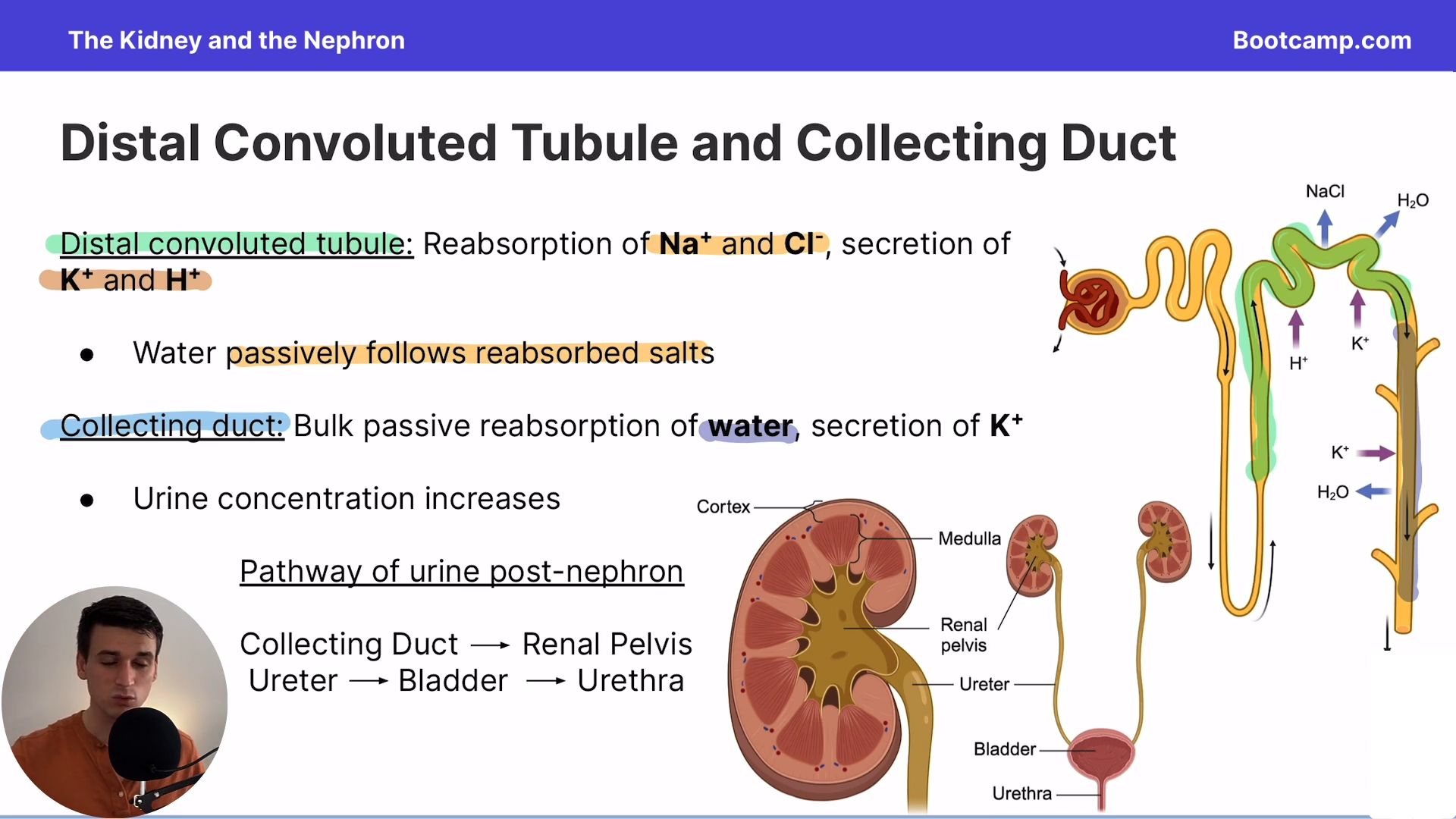
  • Reabsorption of Na+ and Cl-

  • Secretion of K+ and H+

    • Water passively follows reabsorbed salts

    • (water leaves the tubule)

20
New cards

Collecting Duct

Bulk passive reabsorption of water, secretion of K+

  • Urine concentration increases

Has a lot of aquaporins
<p>Bulk passive <strong>reabsorption </strong>of <strong>water</strong>, <strong>secretion </strong>of K+</p><ul><li><p>Urine <strong>concentration increases</strong></p></li></ul><p></p><p><strong>Has a lot of aquaporins</strong></p>
21
New cards

Pathways of the urine AFTER nephron

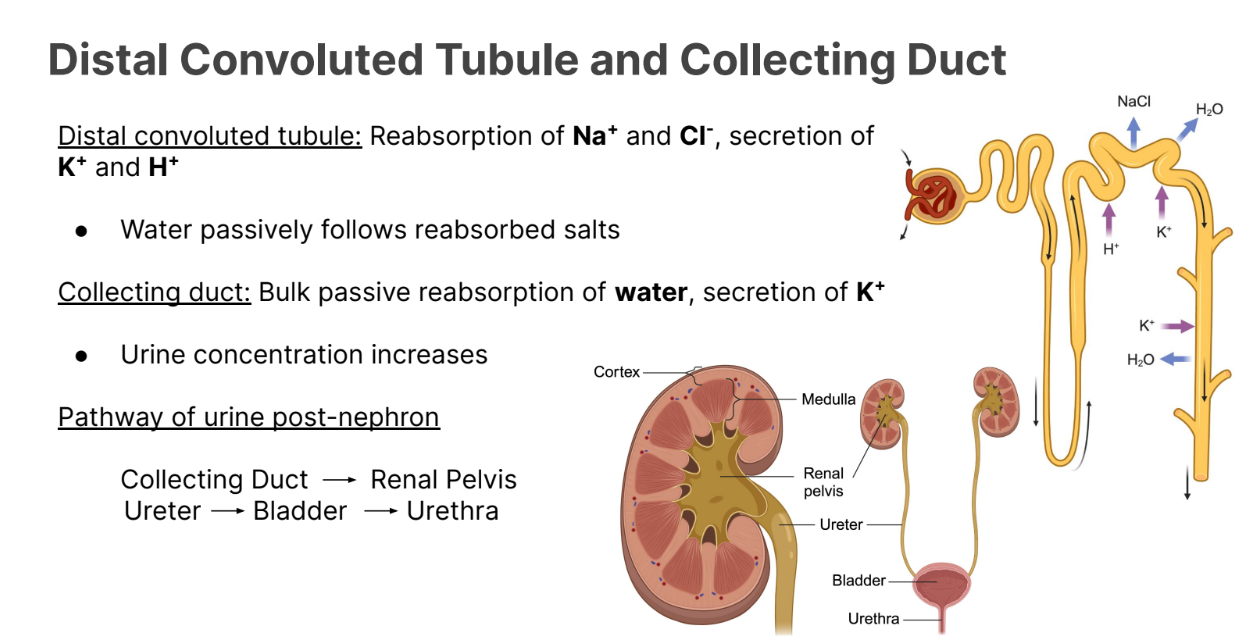
Collecting Duct → renal pelvis → Ureter → Bladder → Urethra
<p><strong>Collecting Duct → </strong>renal pelvis → Ureter → Bladder → Urethra</p>
22
New cards

Excretory Hormones

  • Def

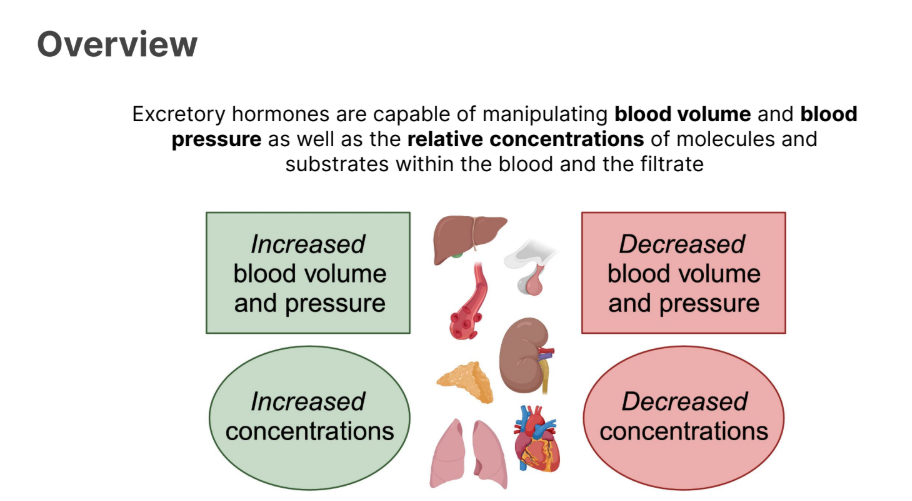
Excretory hormones are capable of manipulating blood volume and blood

pressure as well as the relative concentrations of molecules and substrates within the blood and the filtrate
<p>Excretory hormones are capable of <strong>manipulating blood volume</strong> and <strong>blood</strong></p><p><strong>pressure </strong>as well as the relative <strong>concentrations </strong>of <strong>molecules </strong>and substrates within the blood and the filtrate</p>
23
New cards

Renin - Angiotensin - Aldosterone system (RAS)

A system of hormones, tissues, and organs which together are capable of increasing blood pressure in response to detected low blood pressure
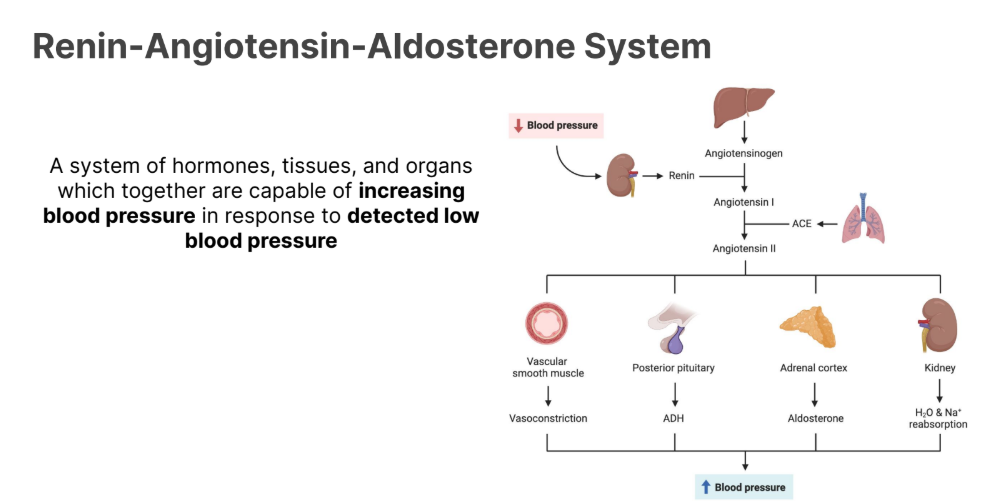
<p>A system of hormones, tissues, and organs which together are capable of <strong>increasing blood pressure</strong> in response to <strong>detected low blood pressure</strong></p>
24
New cards

Renin - Angiotensin - Aldosterone System

  • Key Players

Angiotensinogen

Renin

Angiotensin I

Angiotensin II

Aldosterone

25
New cards

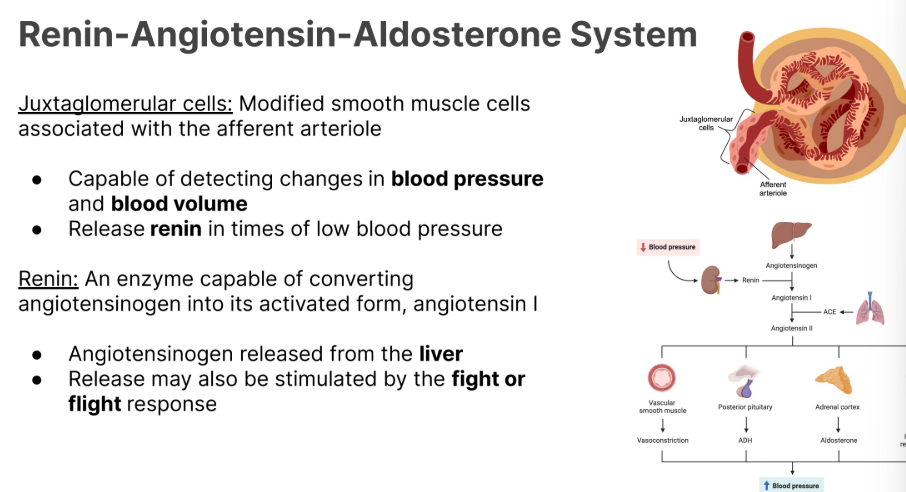
Juxtaglomerular cells

  • Function

  • What do they release

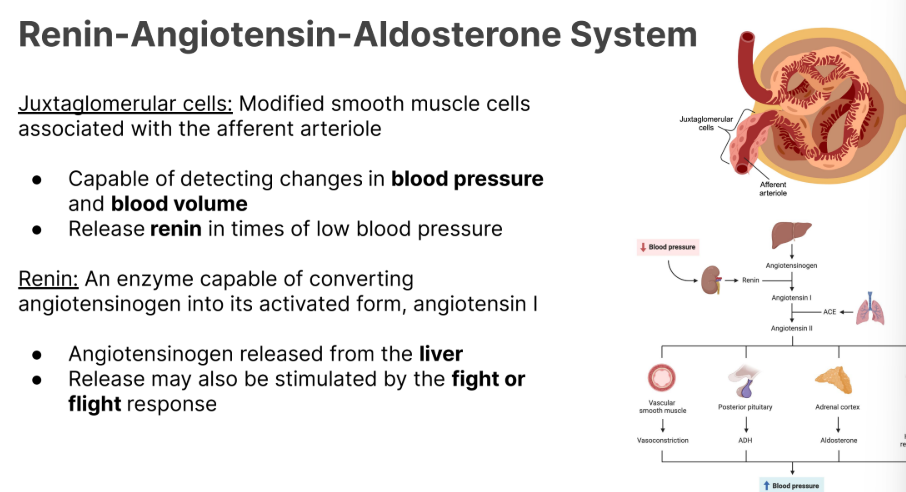
Juxtaglomerular cells (in the liver): Modified smooth muscle cells associated with the afferent arteriole

  • Capable of detecting changes in blood pressure and blood volume

  • Release renin in times of low blood pressure
<p><strong>Juxtaglomerular cells (in the liver)</strong>: Modified <strong>smooth muscl</strong>e cells associated with the afferent arteriole</p><ul><li><p>Capable of detecting changes in <strong>blood pressure </strong>and <strong>blood volume</strong></p></li><li><p>Release <strong>renin </strong>in times of low blood pressure</p></li></ul><p></p>
26
New cards

Angiotensinogen

First step in the Renin - Angiotensin - Aldosterone System

Released from the liver

  • Gets activated by renin

<p>First step in the <strong>Renin - Angiotensin - Aldosterone System</strong></p><p></p><p>Released from the <strong>liver</strong></p><ul><li><p>Gets activated by renin</p></li></ul><p></p>
27
New cards

Renin

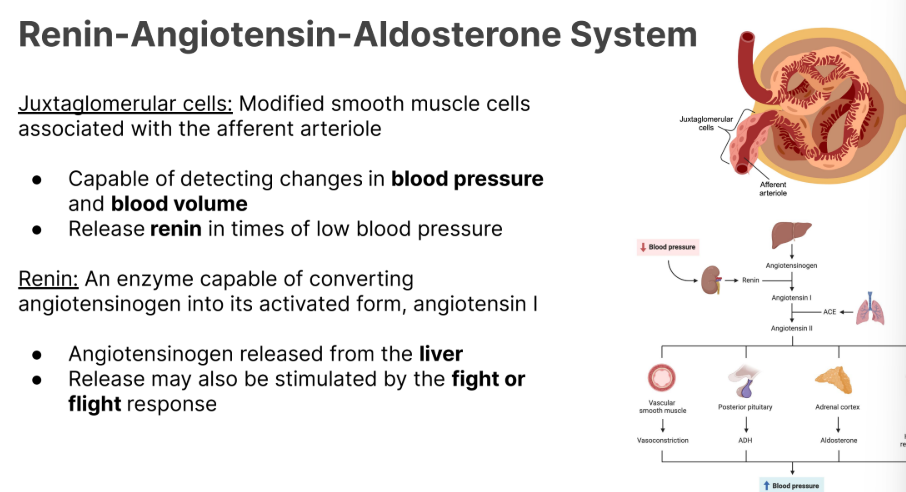
An enzyme capable of converting angiotensinogen into its activated form, angiotensin I

  • Can also be triggered by the fight or flight response

  • Can be released by low bp or blood volume
<p>An enzyme capable of converting <strong><em>angiotensinogen </em></strong>into its activated form, <strong>angiotensin I</strong></p><ul><li><p><strong>Can also be triggered by the fight </strong>or <strong>flight response</strong></p></li><li><p><strong>Can be released by low bp or blood volume</strong></p></li></ul><p></p>
28
New cards

Angiotensin Converting enzyme (ACE)

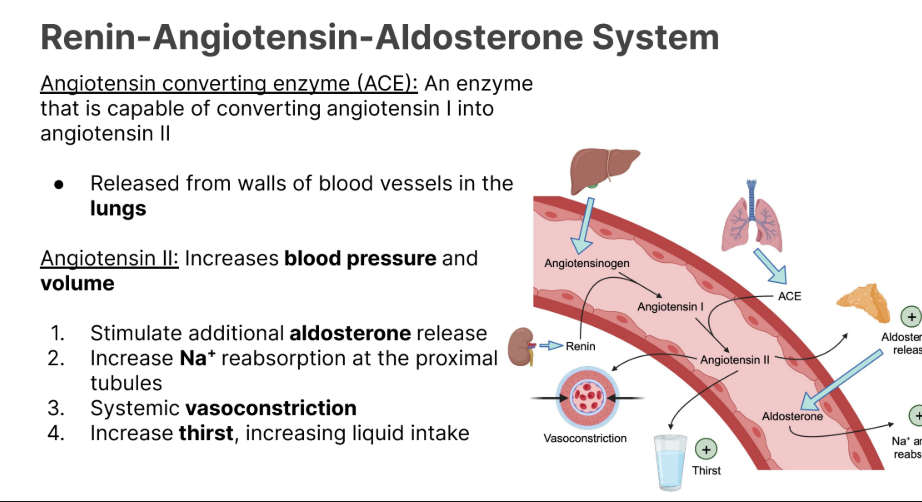
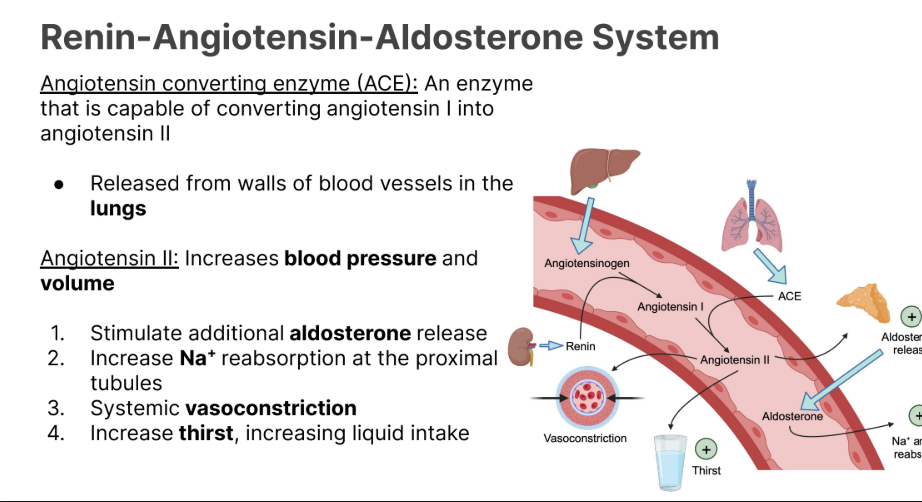
An enzyme that is capable of converting angiotensin I → angiotensin II

  • Released from the walls of blood vessels in the lungs..
<p>An enzyme that is capable of converting <strong>angiotensin I → angiotensin II</strong></p><ul><li><p>Released from the walls of blood vessels in the <strong>lungs.</strong>.</p></li></ul><p></p>
29
New cards

Angiotensin II

Increases blood pressure and volume (is created when the lungs release ACE)

  1. Stimulate additional aldosterone release

  2. Increase Na+ reabsorption at the proximal tubules

  3. Systemic vasoconstriction

  4. Increase thirst, increasing liquid intake
<p>Increases <strong>blood pressure </strong>and <strong>volume </strong>(is created when the lungs release ACE)</p><ol><li><p>Stimulate additional <strong>aldosterone </strong>release</p></li><li><p>Increase <strong>Na+</strong> reabsorption at the proximal tubules</p></li><li><p>Systemic<strong> vasoconstriction</strong></p></li><li><p>Increase <strong>thirst</strong>, increasing liquid intake</p></li></ol><p></p>
30
New cards

Aldosterone

  • Where is it from

  • How does it act

  • How does it affect them?

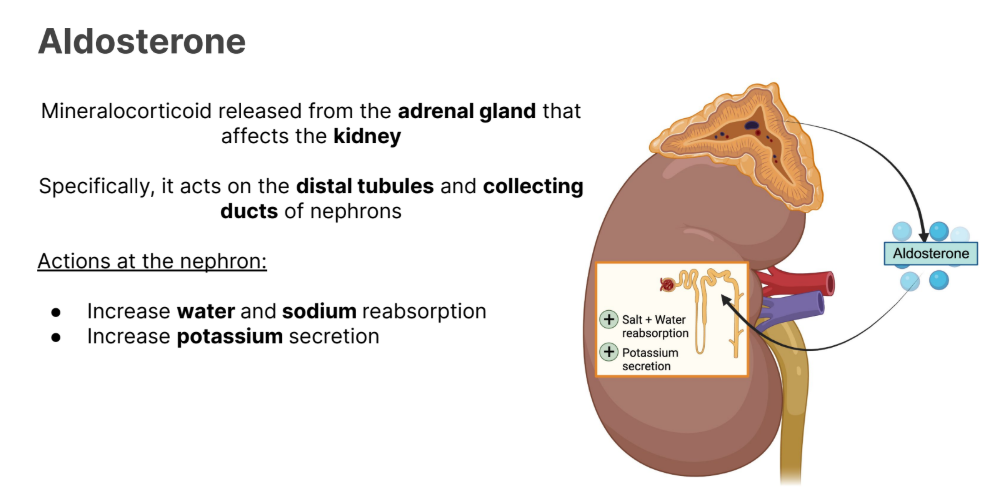
Mineralocorticoid released from the adrenal gland (cortex) that affects the kidney

Specifically, it acts on the distal tubules and collecting ducts of nephrons

Increases water and sodium reabsorption

Increases potassium secretion
<p>Mineralocorticoid released from the <strong>adrenal gland (cortex) </strong>that affects the kidney</p><p></p><p>Specifically, it acts on the <strong>distal tubules </strong>and collecting <strong>ducts </strong>of nephrons</p><p></p><p><strong>Increases water </strong>and <strong>sodium </strong>reabsorption</p><p><strong>Increases potassium </strong>secretion</p>
31
New cards

Renin-Angiotensin-Aldosterone System (RAS)

  • ALL STEPS

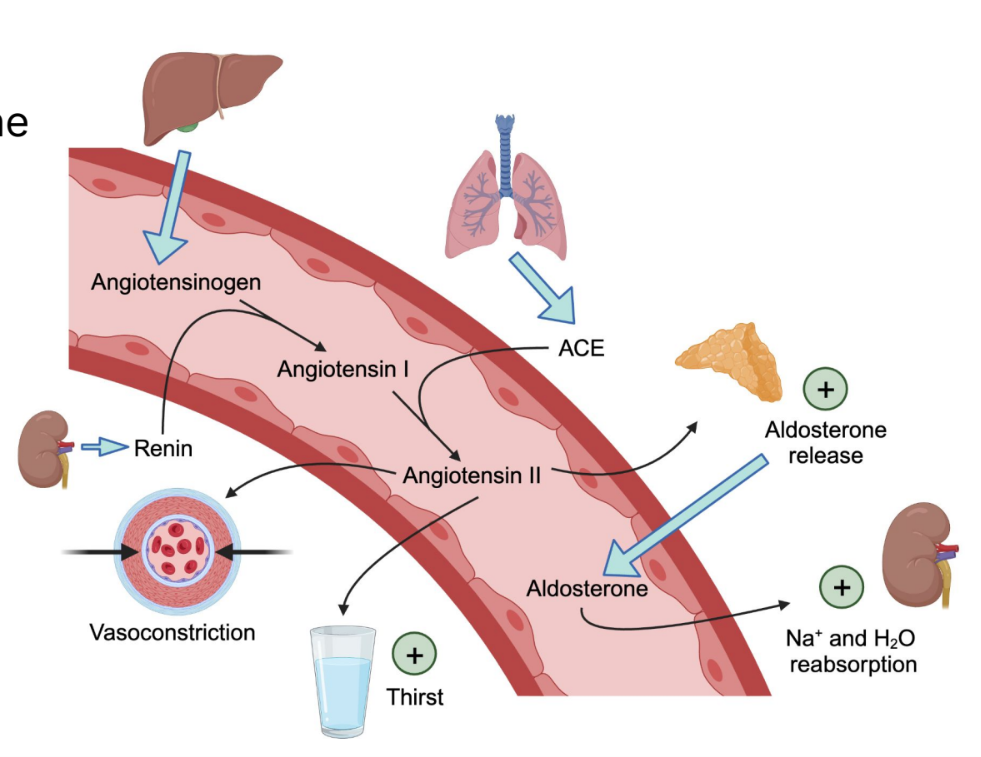
Juxtaglomerular cells sense changes in blood pressure and blood volume.

  • Angiotensinogen is released from the liver. It floats around in the blood stream.

  • Renin is released from kidneys due to a fight or flight response or low blood pressure (juxtaglomerular cell in kidney). Makes Angiotensinogen into angiotensin I

  • Angiotensin converting enzyme (ACE): An enzyme that is capable of converting angiotensin I into angiotensin II

  • Angiotesnin II increases blood pressure and volume

    • Stimulates additional aldosterone release

    • Increases Na+ reabsorption at the PROXIMAL tubules (more pressure)

    • Systemic Vasoconstriction

    • Increase thirst, increasing liquid intake.

Aldosterone is released, which increases water and sodium reabsorption and increases potassium secretion
<p><strong>Juxtaglomerular cells </strong>sense changes in <strong>blood pressure </strong>and blood <strong>volume.</strong></p><p></p><ul><li><p><strong>Angiotensinogen </strong>is released from the liver. It floats around in the blood stream.</p></li></ul><p></p><ul><li><p><strong>Renin </strong>is released from <strong>kidneys </strong> due to a fight or flight response or <strong>low blood pressure (juxtaglomerular cell </strong>in kidney<strong>). </strong>Makes Angiotensinogen into <strong>angiotensin I</strong></p></li></ul><p></p><ul><li><p><strong>Angiotensin converting enzyme (ACE): </strong>An enzyme that is capable of converting <strong>angiotensin I</strong> into<strong> angiotensin II</strong></p></li></ul><p></p><ul><li><p><strong>Angiotesnin II </strong>increases <strong>blood pressure </strong>and <strong>volume</strong></p><ul><li><p>Stimulates additional <strong>aldosterone </strong>release</p></li><li><p>Increases <strong>Na+ </strong>reabsorption at the <strong>PROXIMAL tubules </strong>(more pressure)</p></li><li><p>Systemic Vasoconstriction</p></li><li><p>Increase <strong>thirst, </strong>increasing liquid intake.</p></li></ul></li></ul><p></p><p><strong>Aldosterone is released, </strong>which increases <strong>water </strong>and <strong>sodium </strong>reabsorption and increases <strong>potassium </strong>secretion</p><p></p>
32
New cards

Antidiuretic Hormone (ADH or Vasopresin)

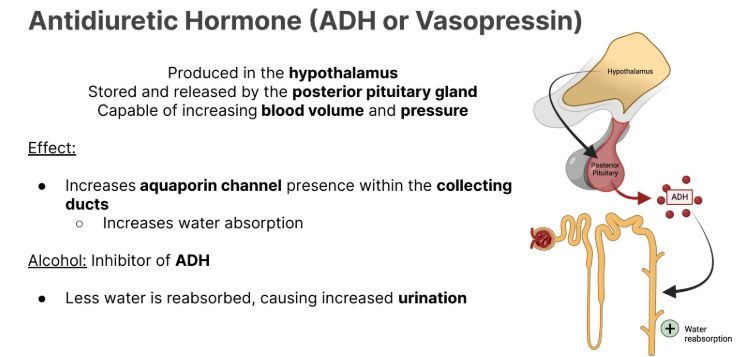
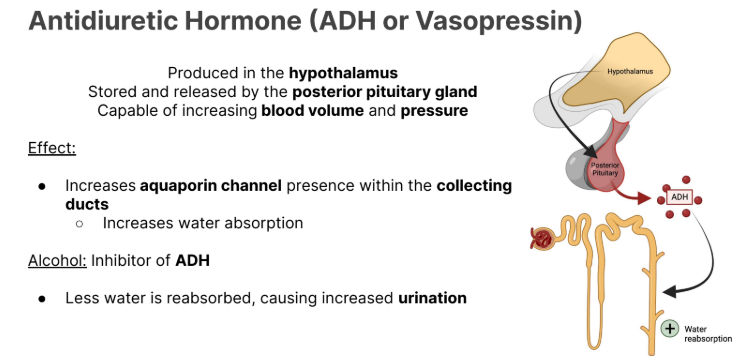
Produced in the hypothalamus

Stored and released by the posterior pituitary gland

Capable of increasing blood volume and pressure

Effect:

  • Increases aquaporin channel presence within the collecting ducts

  • Increases water absorption

<p>Produced in the <strong>hypothalamus</strong></p><p>Stored and released by the <strong>posterior pituitary gland</strong></p><p></p><p>Capable of <strong>increasing blood volume </strong>and <strong>pressure</strong></p><p></p><p>Effect:</p><ul><li><p>Increases<strong> aquaporin channel presence</strong> within the collecting ducts</p></li><li><p>Increases <strong>water absorption</strong></p></li></ul><p></p><p></p><p></p>
33
New cards

What inhibits ADH

Alcohol: Inhibitor of ADH

  • Less water is reabsorbed, causing increased urination

  • Why it is easy to get dehydrated when drinking.
<p><strong>Alcohol</strong>: Inhibitor of <strong>ADH</strong></p><ul><li><p>Less water is reabsorbed, causing<strong> increased urination</strong></p></li><li><p>Why it is easy to get <strong>dehydrated </strong>when drinking. </p></li></ul><p></p>
34
New cards

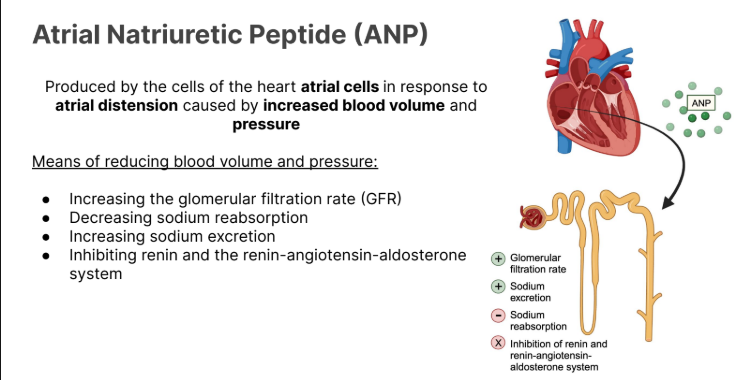
Atrial Natriuretic Peptide (ANP)

Produced by the cells of the heart atrial cells in response to atrial distension caused by increased blood volume and pressure

Means of reducing blood volume and pressure:

  • Increasing the glomerular filtration rate (GFR)

  • Decreasing sodium reabsorption

  • Increasing sodium excretion

  • Inhibiting renin and the renin-angiotensin-aldosterone system
<p>Produced by the cells of the <strong>heart atrial cells </strong>in response to <strong>atrial distension </strong>caused by<strong> increased blood volume </strong>and <strong>pressure</strong></p><p></p><p>Means of <strong>reducing blood volume </strong>and <strong>pressure</strong>:</p><ul><li><p>Increasing the <strong>glomerular filtration rate</strong> (GFR)</p></li><li><p>Decreasing <strong>sodium reabsorption</strong></p></li><li><p>Increasing <strong>sodium excretion</strong></p></li><li><p><strong>Inhibiting </strong><em>renin and the renin-angiotensin-aldosterone system</em></p></li></ul><p></p>
35
New cards

Osmoregulation

The maintenance of internal water balance by an organism

  • Achieved via absorption and secretion of water and solutes

  • Affected by water and solute concentrations of the surrounding environment

36
New cards

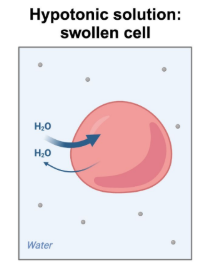
Hypotonic Solution

Swollen Cell

<p><strong>Swollen Cell</strong></p>
37
New cards

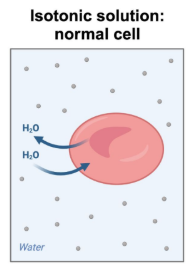
Isotonic Solution

Normal Cell

<p>Normal Cell</p>
38
New cards

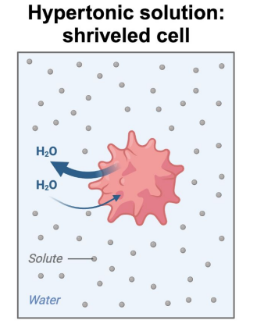
Hypertonic Solution

Shriveled Cell

<p><strong>Shriveled Cell</strong></p>
39
New cards

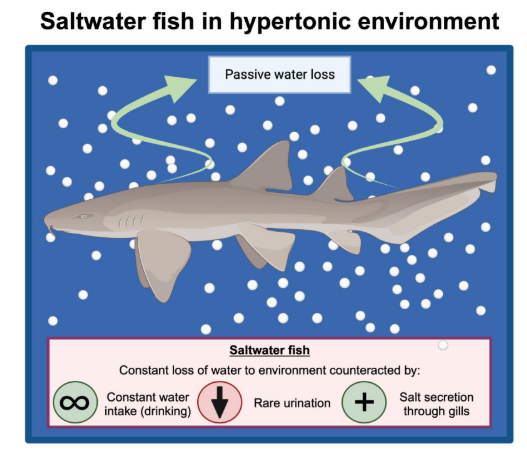
Marine (saltwater fish) and how they undergo osmoregulation

  • Hypotonic to their environment

    • Environment has higher solute concentration

  • Passive water loss to environment

Maintenance adaptations:

1. Constant drinking

2. Rare urination

3. Secretion of salt through the gills
<ul><li><p><strong>Hypotonic </strong>to their environment</p><ul><li><p>Environment has higher solute concentration</p></li></ul></li></ul><ul><li><p>Passive water loss to environment</p></li></ul><p></p><p>Maintenance adaptations:</p><p>1. <strong>Constant drinking</strong></p><p>2. <strong>Rare urination</strong></p><p>3. <strong>Secretion </strong>of <strong>salt </strong>through the <strong>gills</strong></p>
40
New cards

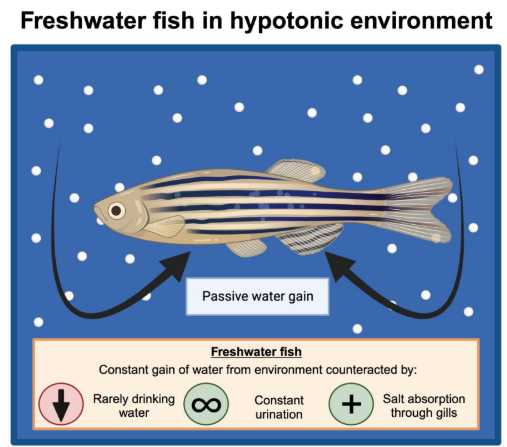
Freshwater Fish

  • Hypertonic to their environment

    • Environment has a lower solute concentration

  • Passive water gain from environment

Maintenance adaptations:

  1. Rarely drink water

  2. Constant urination

  3. Absorption of salt through the gills

<ul><li><p><strong>Hypertonic </strong>to their environment</p><ul><li><p>Environment has a lower solute concentration</p></li></ul></li><li><p>Passive water gain from environment</p></li></ul><p></p><p>Maintenance adaptations:</p><ol><li><p><strong>Rarely drink water</strong></p></li><li><p><strong>Constant urination</strong></p></li><li><p><strong>Absorption of salt through the gills</strong></p></li></ol><p></p>
41
New cards

Small Substanse filtration in nephrons

Afferent Arteriole → Glomerulus → Bowmans capsule.

42
New cards

What is fluid and substances filtered from the blood and bowmans capsule called?

Filtrate

43
New cards

Four main processes in nephron

Filtratio

Reabsorption

Secretion

Excretion

44
New cards

What passes the bowman’s capsule and what is stopped

Passes:

  • Urea

  • Sodium

  • Water

  • Calcium

Stops:

  • Protein

  • RBC’s

45
New cards

What kind of pressure causes bowman’s capsules to move filtrate in?

Hydrostatic Pressure.

46
New cards

Aldosterone increases potassium secretion