Artificial Limbs 2
 Call Kai
 Learn
Learn Practice Test
 Spaced Repetition
 Match
Match Flashcards
 Knowt Play
1/36

There's no tags or description
Looks like no tags are added yet.
Name | Mastery | Learn | Test | Matching | Spaced | Call with Kai |
|---|
No analytics yet
Send a link to your students to track their progress
37 Terms
What are prosthetics used to help with
problems with blood circulation
injuries
cancer
birth defects
what is the economic strain of undergoing an amputation of patients with diabetes mellitus
Patients with diabetes mellitus have an astounding 30 times greater lifetime risk of undergoing an amputation when compared to patients without diabetes mellitus, which translates to an economic strain in healthcare systems of over $4.3billion in annual costs in the USA alone
Transfemoral
amputation above knee
knee disarticulation
amputation at knee
transtibial
amputation below knee
What are the parts of the lower limb prosthetics
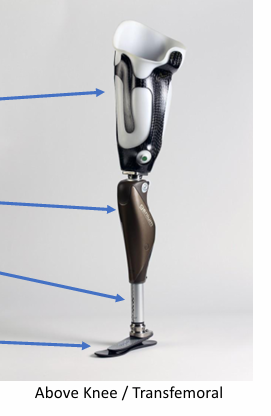
socket, knee, adaptors/pylon, foot
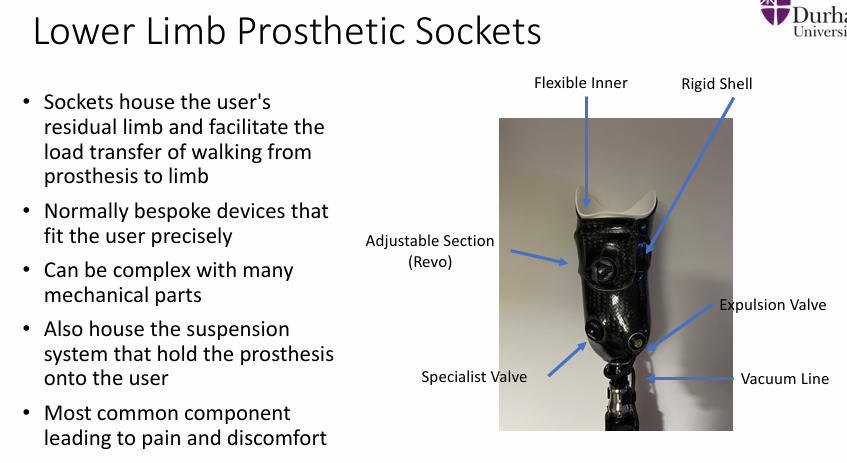
lower limb prosthetic sockets
Sockets house the user's residual limb and facilitate the load transfer of walking from prosthesis to limb, also house the suspension system that hold the prosthesis onto the user, most common component leading to pain and discomfort
How are lower limb prosthetics sockets fabricated
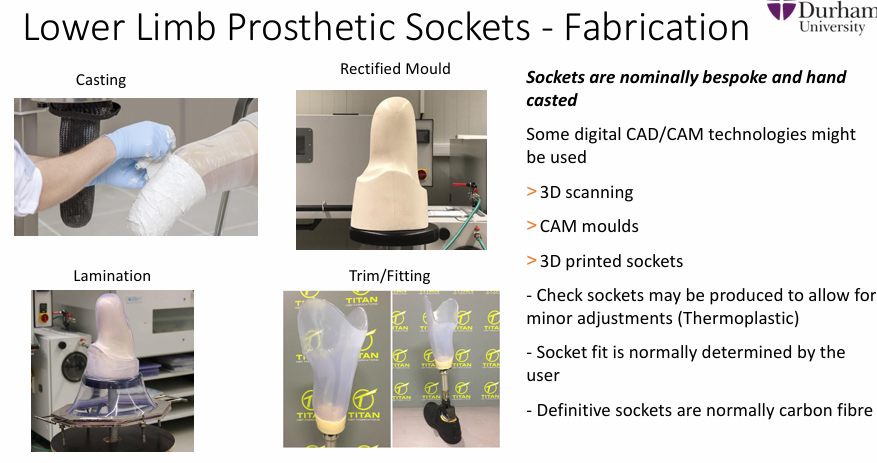
casting, rectified mould, lamination, trim/fitting
How are prosthetic socket loaded
for lower limb prosthetic the socket is the load transfer interface and there are limited pressure tolerant areas on the residuum. Pressure distribution is normally achieved through material addition and reduction in the mould rectification stages
suspension
method of affixing the prosthesis onto the limb
what are the different types of prosthetic suspension
cuff, sleeve, vacuum, pin lock and magnetic
what is involved when tissue response to external forces
tissue deformation, interstitial fluid flow, ischemia, reactive hyperemia, sweat, pain and skin discoloration
what can happen when moderate static forces are applied to the skin
When moderate static forces are applied to the skin, the underlying blood vessels and lymphatic drainage can be occluded (fully or partially) and metabolism impaired
what can happen when there is impaired tissue function
Impaired tissue function can lead to tissue breakdown (superficial and deep)
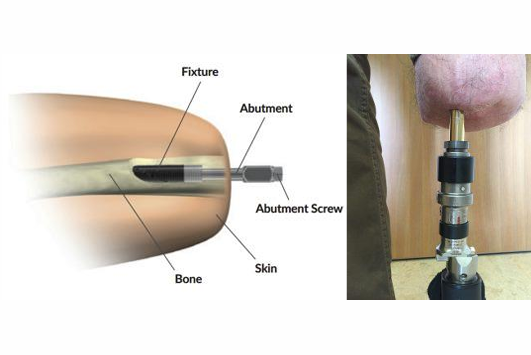
osseointegration
Osseointegration involves affixing an implant to the bone that allows direct fitment of limbs.
The implant permanently protrudes from the skin
This replaces the socket
If there is a fault with this implant then further amputations may be required
Implant technologies may become outdated
Risk of infections is increased during both surgery and post operation
alignment of the prostheses
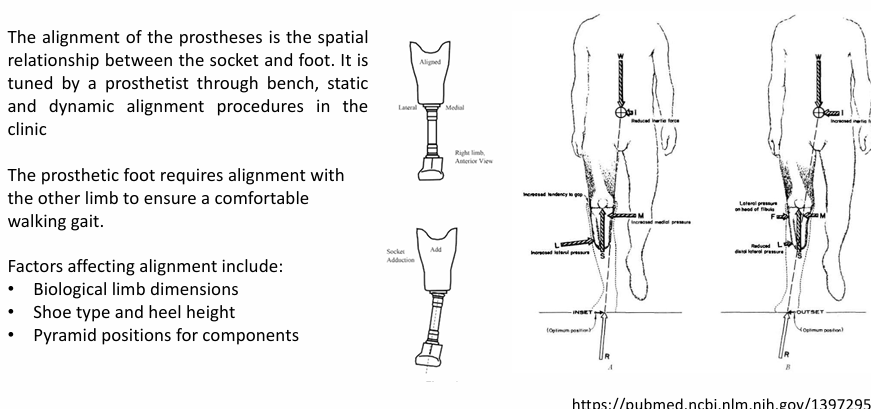
The alignment of the prostheses is the spatial relationship between the socket and foot. It is tuned by a prosthetist through bench, static and dynamic alignment procedures in the clinic
why does the prosthetic foot require alignment with the other limb
ensures a comfortable walking gait
what are the factors affecting alignment
biological limb dimensions, shoe type and heel height and pyramid positions for components
what are the different types of alignment/adaptor
pyramid/angle adaptors, rotation adaptor, shift adaptor, tube/length adaptor
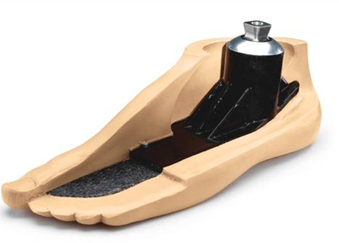
SACH (Solid Ankle Cushion Heel)
basic,
durable
inexpensive
suitable for individuals who have limited walking requirements
does not adapt to terrain
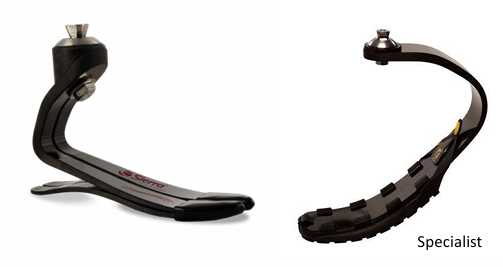
ESR (Energy Storage and Return)
designed to store energy during early stance and then release a portion of that energy during late stance.
during gait, work is provided by the weight of the body to load the spring into compression.
The material of the prosthesis stores this work as potential energy
the energy is then released as work to act upon another object when the compressive force is released
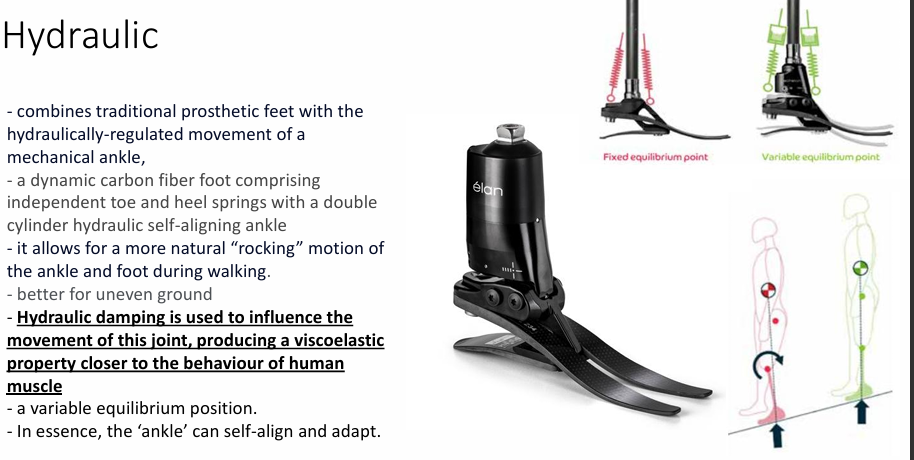
hydraulic foot
combines traditional prosthetic feet with the hydraulically-regulated movement of a mechanical ankle
e.g. a dynamic carbon fiber foot comprising independent toe and heel springs with a double cylinder hydraulic self-aligning ankle, allows a more natural rocking motion
what is hydraulic damping used to influence
Hydraulic damping is used to influence the movement of this joint, producing a viscoelastic property closer to the behaviour of human muscle (allows the ankle to self align and adapt)
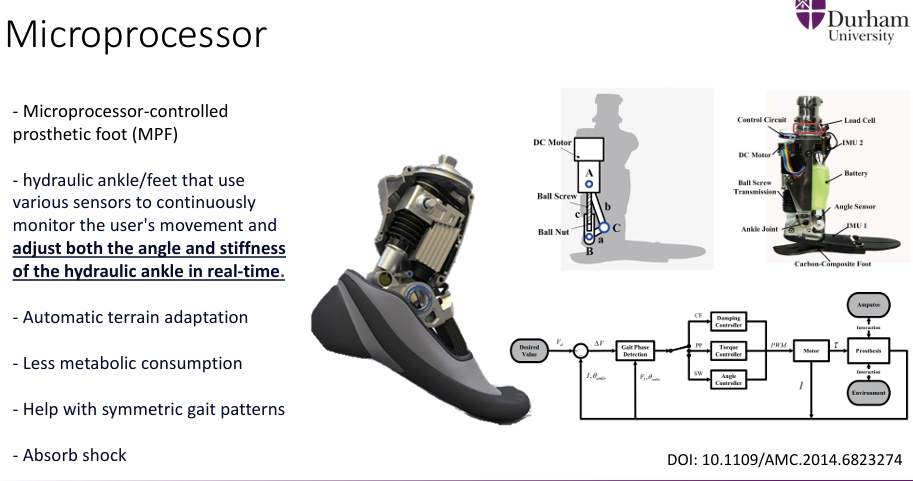
MPF (microprocessor-controlled prosthetic foot)
hydraulic ankle/feet that use various sensors to continuously monitor the user’s movement and adjust both the angle and stiffness of the hydraulic ankle in real time
What are the critical design points of prosthetic feet
create as natural of a walking gait as possible
user comfort
weight
cost
reduced energy/expenditure activity level
life span
technology/materials/improvements
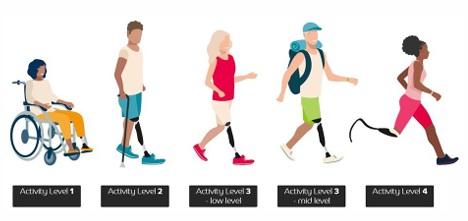
K1 prosthesis
Has the ability or potential to use a prosthesis for transfers or ambulation on level surfaces at fixed cadence. Typical of the limited and unlimited household ambulator
K2 prosthesis
Has the ability or potential for ambulation with the ability to traverse low-level environmental barriers such as curbs, stairs, or uneven surfaces. Typical of the limited community ambulator
K3 prosthesis
Has the ability or potential for ambulation variable cadence. Typical of the community ambulator who has the ability to traverse most environmental barriers and may have vocational, therapeutic, or exercise activity that demands prosthetic utilisation beyond simple locomotion
K4 prosthesis
Has the ability or potential for prosthetic ambulation that exceeds the basic ambulation skills, exhibiting high impact, stress, or energy levels, typical of the prosthetic demands of the child, active adult, or athlete
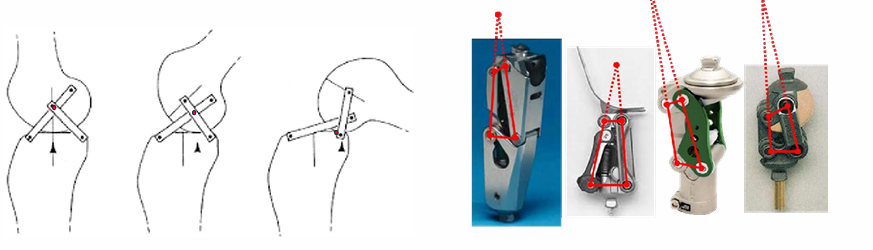
what can the knee be considered as
The knee joint can be considered similar to an eccentric rolling joint rather than a single axis revolute joint
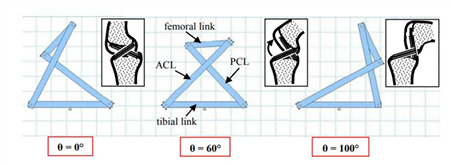
flexion mechanics simulated by
This motion can be simulated with a 4 bar link mechanism.
Prosthetics must simulate this motion without necessarily being placed in the same location as the removed biological knee joint.
Other solutions (bioinspired) have been proposed
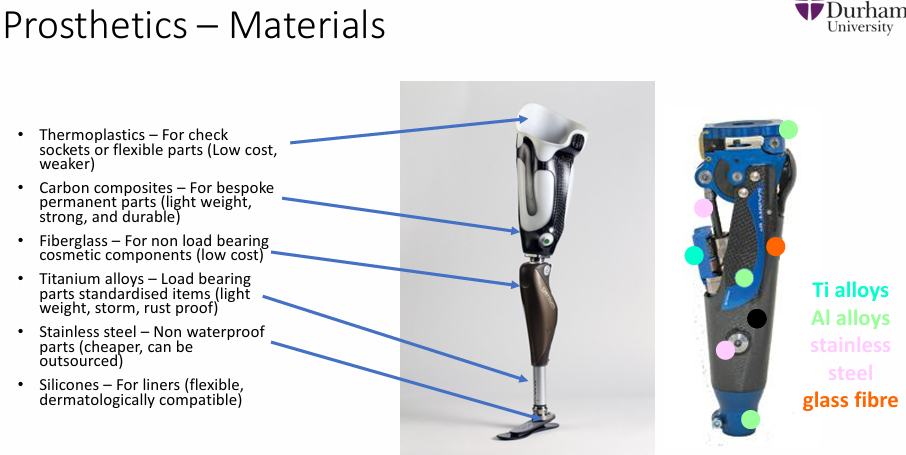
Materials for prosthetics
thermoplastics, carbon composites, fiberglass, titanium alloys, stainless steel, silicones
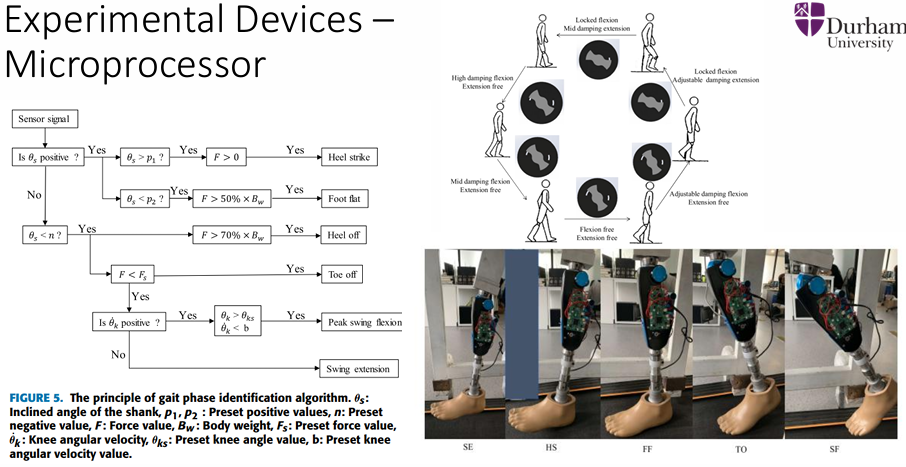
microprocessor lower limb prosthetics
Microprocessor lower limb prosthetics nominally work by estimating the stage in walking gait using accelerometers, and position sensors.
microprocessor controlled knees
Microprocessor-controlled knees provide the amputee with more stability on all kinds of terrains, slopes and steps (Joint design with an electrically controlled hydraulic damper, Therefore, in flexion the damper will contract and thus the piston will be driven downwardly in the cylinder by body load. In extension, the damper lengthens and the piston is pulled upwardly by body action)
what can a butterfly valve be used for
The butterfly valve is able to vary flow port areas and fluid flow rates to thereby vary resistance to knee joint rotation in either flexion or extension at the same time
Electromyography (EMG)
Electromyography (EMG) measures muscle response or electrical activity in response to a nerve’s stimulation of the muscle
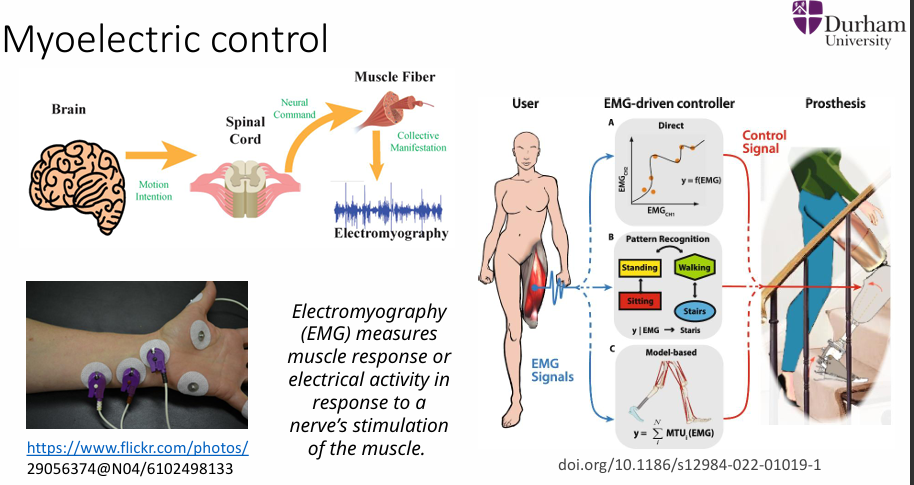
lower limb prosthetics control
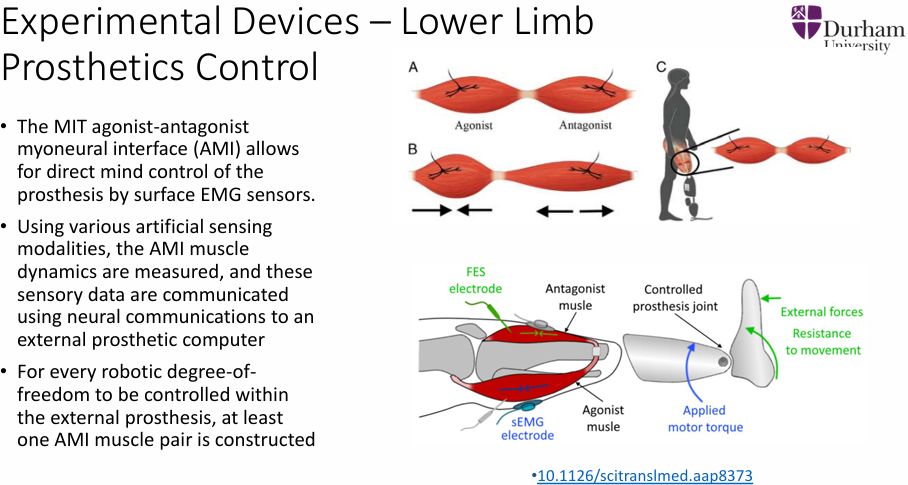
The MIT agonist-antagonist myoneural interface (AMI) allows for direct mind control of the prosthesis by surface EMG sensors.
Using various artificial sensing modalities, the AMI muscle dynamics are measured, and these sensory data are communicated using neural communications to an external prosthetic computer
For every robotic degree-of freedom to be controlled within the external prosthesis, at least one AMI muscle pair is constructed
The use of muscles through AMI will reduce the atrophy effect of the muscles possible leading to further socket fit issues.
The communication is one way, but feedback from positional change simulates two way communication.
This is due to native contractile mechanoreceptors within the natural tendon