Finance WK 3
 Call Kai
 Learn
Learn Practice Test
 Spaced Repetition
 Match
Match Flashcards
 Knowt Play
1/11

There's no tags or description
Looks like no tags are added yet.
Name | Mastery | Learn | Test | Matching | Spaced | Call with Kai |
|---|
No analytics yet
Send a link to your students to track their progress
12 Terms
What is debt and features of debtholders
when investors contribute capital temporarily for a pre-specified time eg. 5 year loan
Generally No voting rights
Fixed and prior contractual right to a return on capital (interest payments)
Fixed and prior contractual right to a return of capital(principal) upon liquidation.
Are interest payments tax deductible
Yes
Types of debt
Bank Loans
Short term bank loans
bank overdraft
inventory loans
bridge loans
Long term
term loans
Debt securities
Short term
bills of exchange
Medium term
debentures
Long term
bonds
unsecured notes
corporate bonds
What are debt covenants
Mechanisms that allow debtholders to protect their investments
You can have two types of debt coveneants
Negative components(where debtholders impose restrictions on certain actions by borrowers)
Companies can limit the access the other company has to future debt
Companies can have the potential to limit your holdings of certain investments
Companies can say they can limit the amount of dividends the other company is able to pay
Positive covenants: that require borrowers to take specific actions
companies can say that the other company should maintain assets and collateral
can specifiy that companies should provide audited statements to companies
Equity vs debt
Equity
Equity is more valuable if cash flows are more volatile (cuz if there's a lot cash, shareholders benefit)
Shareholders More risk loving
Debt
Main concern is of defaulting
Debtholders(lender) dislike risky projects
Through covenants, debtholders try to reduce firms’ downside risk.
What is a lease and the difference between a lessor and lessee
a contract where the lessor receives fixed payments from lessee in return for use of asset
lessor: is the legal owner of the asset
lessee: the user of the asset
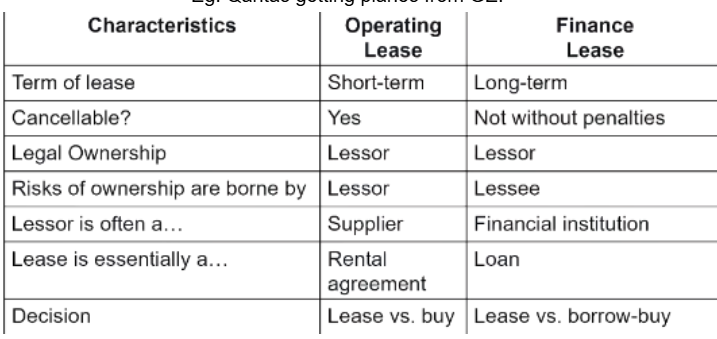
Types of leases
Operating leases
Like a rental agreement
Generally short term (car, telephones, coffee machines-bought by companies)
Able to be cancelled by lessee at short notice generally without substantial penalty
Risks of ownership are handled by lessor eg. if they lessee cancels and they lose income from it
Finance Lease
Long term lease
Generally over the entire life of the asset eg. for airplanes.
Can be cancelled with substantial penalty
Risk of ownership is handled by lessee
Is an alternative to borrowing funds to buy an asset
What is k (the discount rate) in the NPV calculations
after tax cost of borrowing: interest rate on loan x (1- corporate tax rate)
Valuation considerations by Lessee
Valuation by Lessee
CONSIDERATIONS OF LESSEE when leasing or borrowing to buy
Cost of asset 👍
Lease payment 👎
Tax shield from lease payment👍
Depreciation tax shield 👎
Residual payment/value (what happens to the asset at the end of contract)👎
Tax on gain/loss of sale👍👎(if its a gain, its good cuz you don’t have to pay)
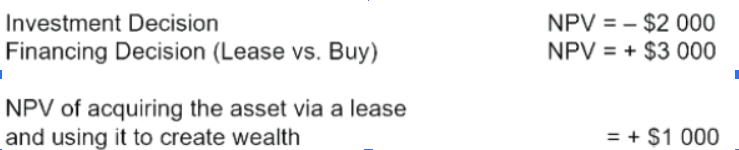
Investment decision
The question between leasing and buying from debt is a financing decision
Whether to invest is an investment decision
Overall + npv so generally should take project, but should remain skeptical because the financing decision is rescuing the investment project and every other company can find financing conditions to help lead to a +NPV
Advantages of Leasing
Because of market frictions enable NPVlessee>0 and NPVlessor>0
Frictions
Company Taxes
If lessors tax rate>lessee’s tax rate (eg. shields on dep and gain on sale) and the lessor shares this tax benefit through lower lease payments, then leasing exists
Different costs of capital
If costs of capital is sufficiently lower for lessor and lessor gives benefit to lessee, then npv for both can be positive. and lessor can sometimes borrow at cheaper rates.
ie. bc lessor can borrow more cheaply hence get asset more cheaply and pass on through cheaper lease payments
Transactions costs
Is lessee defaults then lessor might be subject to simpler and less costly bankruptcy process since they own asset. ie easier than recovering a loan from a firm that’s gone bankrupt.
Standardization might lead to low transaction costs eg. ne lessor can buy multiple planes in bulk and lease them out to multiple firms
Off balance sheet financing (doesn't really apply)
Not an advantage anymore cuz of accounting standards
where leasing used to be able to be undisclosed to understate debt levels, but this doesn’t apply anymore
Hybrid securities
Securities that display qualities of both debt or equity based on where they are in their life cycle
Convertible notes (short term), convertible bonds (long term)
Give option to holder to be able to convert the note or bond into an ordinary share at a specific date
Debt to equity
Do it cuz it overcomes negative signal associated with issuing equity (markets think its overpriced)
Interest rate on convertibles is less than debt
Preference shares
Usually give holder preference over ordinary shareholders
Cumulative: must be paid any accumulated dividends before maying div to ordinary shareholders
Irredemable: no maturity date
Non participating (don’t give excess money)
Non-voting
Have a specified dividend rate