polymorphisms and mutations
 Call Kai
 Learn
Learn Practice Test
 Spaced Repetition
 Match
Match Flashcards
 Knowt Play
1/19

There's no tags or description
Looks like no tags are added yet.
Name | Mastery | Learn | Test | Matching | Spaced | Call with Kai | Chat |
|---|
No analytics yet
Send a link to your students to track their progress
20 Terms
why use DNA as a diagnostic tool
dna profiling
dna fingerprinting
diagosting tests: Diagnose genetic variant underlying a disease or phenotype
Determine individuals who may be pre-disposed to developing a genetic disorder
Enable the selection of desirable traits in the livestock, or the breeding out of less desirable traits
what does the choice of test depend on
isthe underlying mutation known or not
what size is the lesion- point mutation, whole chromosome?
Klinefelter syndrome
XXY- extra sex chromosome
individuals often have no phenoytpe but can cause sterility of hypogonadism
karotying
what is it used for
what stage must chromosomes be
used for detection of gross changes in number orsructure of chromosomes
chromosomes must be in metaphase to discern by eye as above
karotyping-chromosomal defects
what are many cancers caused by and what does this form
examples
many cancers are caused by chromosomes breaking and reattaching to other chromosomes forming fusion genes eg chronic myelogenous leukaemia
hi res karyotyping
what can this distinguish and why is this a disadvantage
how much percent of variation in the human genome come from copy number variations
can only distinguish large deletions or duplications (>3Mb DNA)
yet many deletions that cause DNA are smaller (Kb rather than Mb)
13 percent of variation in human genome comes from copy number variations- small diffs in the copies of DNA sequences between individuals
array comparative genomic hybridisation
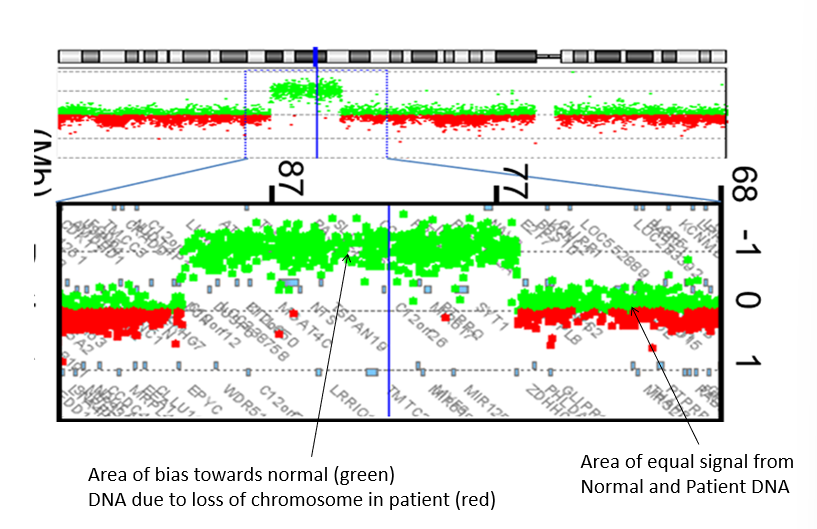
sample and normal reference dna labelled and hybridised to chip spotted with bits of every chromosome
if there are equal numbers of copies of a DNA sequence then the spot goes yellow. if there are more copies of a sequence in the sample than in the reference then the signal is biased towards the sample and goes red. if there are fewer copies in the samplle DNA than in the normal DNA then signal is biased towards the normal and goes green
slide scanned to quantify amounts of red and green signal
plot of gain or loss of DNA along chromosome generated.
array CGH readouts
pre implantation genetic diagnosis
performed in conjunction with ivf from parents with genetic disorder
multiple embryos made from parents egg and sperm
1-2 cells removed from each
dna isolated and tested for mutation/ chromosomal abnormality
embryos without the mutation implanted into mothers uterus
embryos with the mutation are discarded
screen single gene mutations, karyotype changes, or copy number variations
VNTR polymorphisms and DNA fingerprinting
how much base pairs and how many times repeated for mini vs micro
what can we use these differences for
genome contains large numbers of mini or micro satellite repeat sequences- VNTR
•Mini: 10-100bp in length, repeated >1000 times (e.g. at telomeres)
•Micro: 2-10bp in length, repeated 4-40 times
•Variable between individuals
•Utilise these differences to identify individuals or parentage
performing a dna profile with VNTR
•Isolate DNA from samples of interest
•Break into small fragments (restriction enzymes)
•Run on gel to separate by size (electrophoresis)
•Blot gel onto membrane (Southern Blot)
•Incubate with radioactive probe that binds VNTR sequences only
•Image blot on photographic film – only areas where probe has bound will expose onto film, giving bands
restriction fragment length polymorphisms
utilises restriction enzymes which recognise specific dna sequences and cleave dna at or near the recognition site
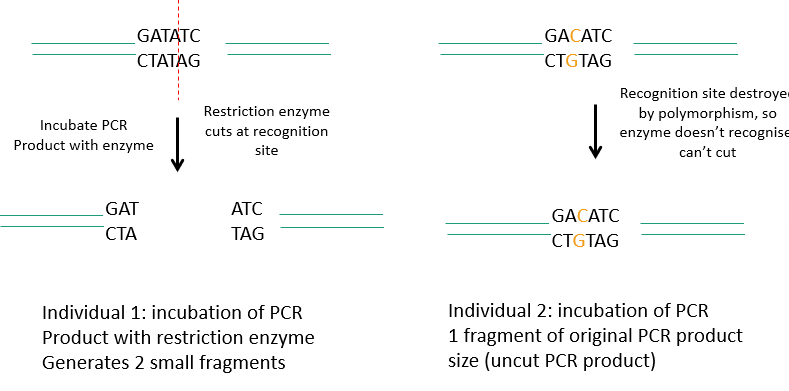
limitations of using rflps for diagnostics for
designing PCR primers
selecting an appropriate restriction enzyme
mutation location
need to know the dna sequence either side of the mutation site to design pcr primers
need to know the mutation in order to select an appropriate restriction enzyme
mutation needs to be in a restriction site
different asay required for each mutation
sanger method- what is attached at the 3 end of
dNTPs
ddNTPs
oh group allows bonding to next base in chain-dNTP
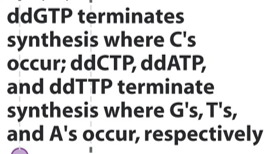
h group in place of oh inhibits bonding so stop any more nucleotides from being added- ddNTP
sanger
Perform PCR with mix of dNTPs and ddNTPs – when ddNTP incorporated, chain elongation stops
Creates lots of molecules of different lengths – separate on gel to determine sizes.
By linking different coloured flourescent dyes to each ddNTP, we can determine what nucleoetide is at the end of the chain.
identifying nucleotide variations by sanger
isolate dna from individual
perform pcr for region of interest
sequence pcr product
limiting of the sanger sequencing
can only read 500bp accurately which is equivalent to 2-3 exons for most genes. problem for large genes
error prone- 1/1000 called incorrectly. need to sequence repeatedly to ensure correct seq.
next gen sequencing approaches
exome sequencing- sequence all exons
transcriptome sequencing (rna-seq)- sequence all rna in a cell- mrna trna, non coding rna
whole genome sequencing- sequence the entire dna sequence of the individual
limitations of next gen
huge amounts of data
need special software and users to interpret data correctly
big variation between individuals
exome sequencing only idnetifies variants in protein coding sequences- splice site mutations, non coding dna variants?
nanopore sequencing device
a small disposable sequencing chip tha t contains the nanopores, required fluidics and eectronic sensors
only need prepared dna sample and a laptop with usb to plut