ECN 211 ASU Final Exam Marburger
 Call Kai
 Learn
Learn Practice Test
 Spaced Repetition
 Match
Match Flashcards
 Knowt Play
1/81

There's no tags or description
Looks like no tags are added yet.
Name | Mastery | Learn | Test | Matching | Spaced | Call with Kai |
|---|
No analytics yet
Send a link to your students to track their progress
82 Terms
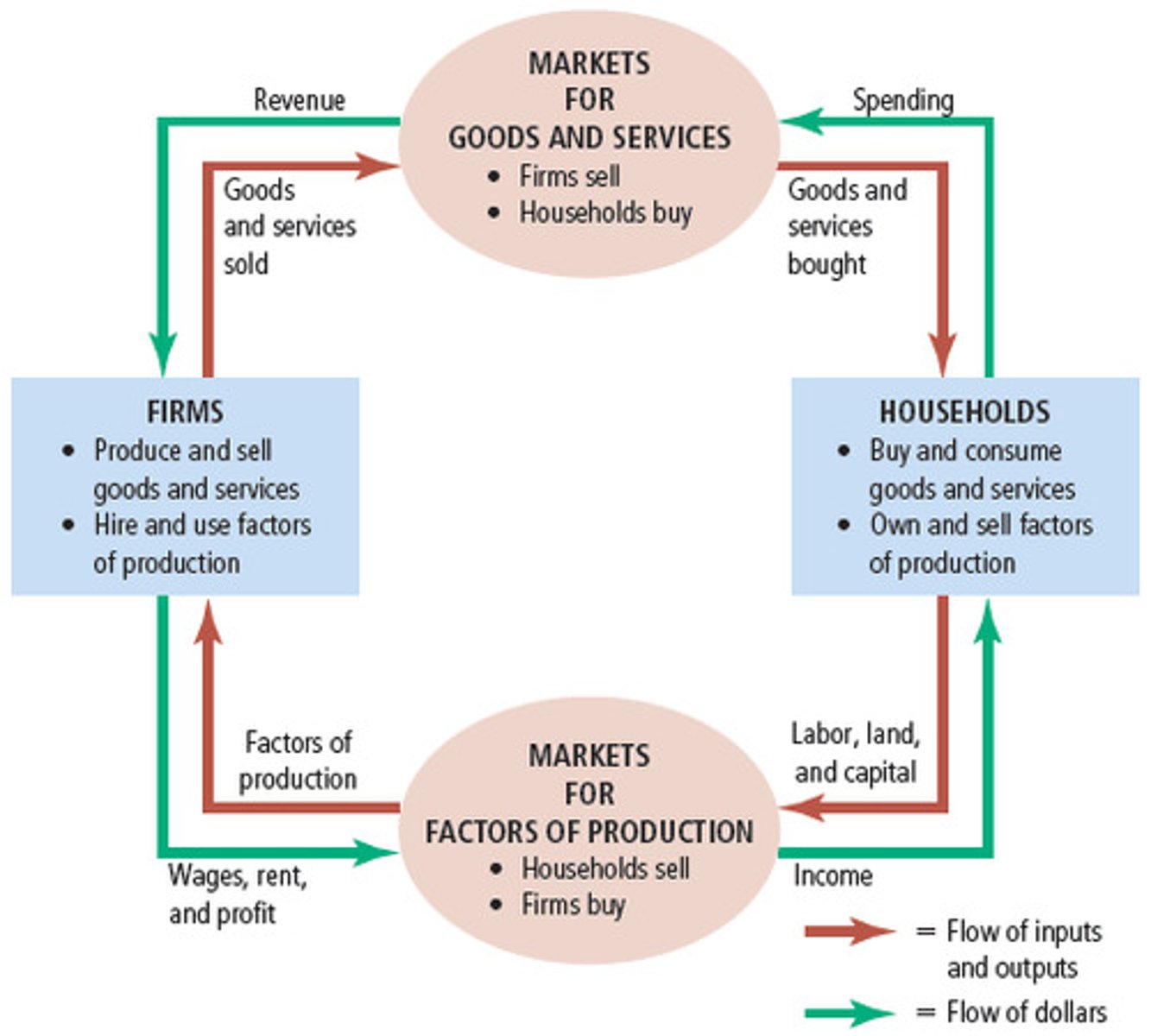
The Circular Flow Diagram
Green arrows represent the flow of money and red represents to flow of goods/services
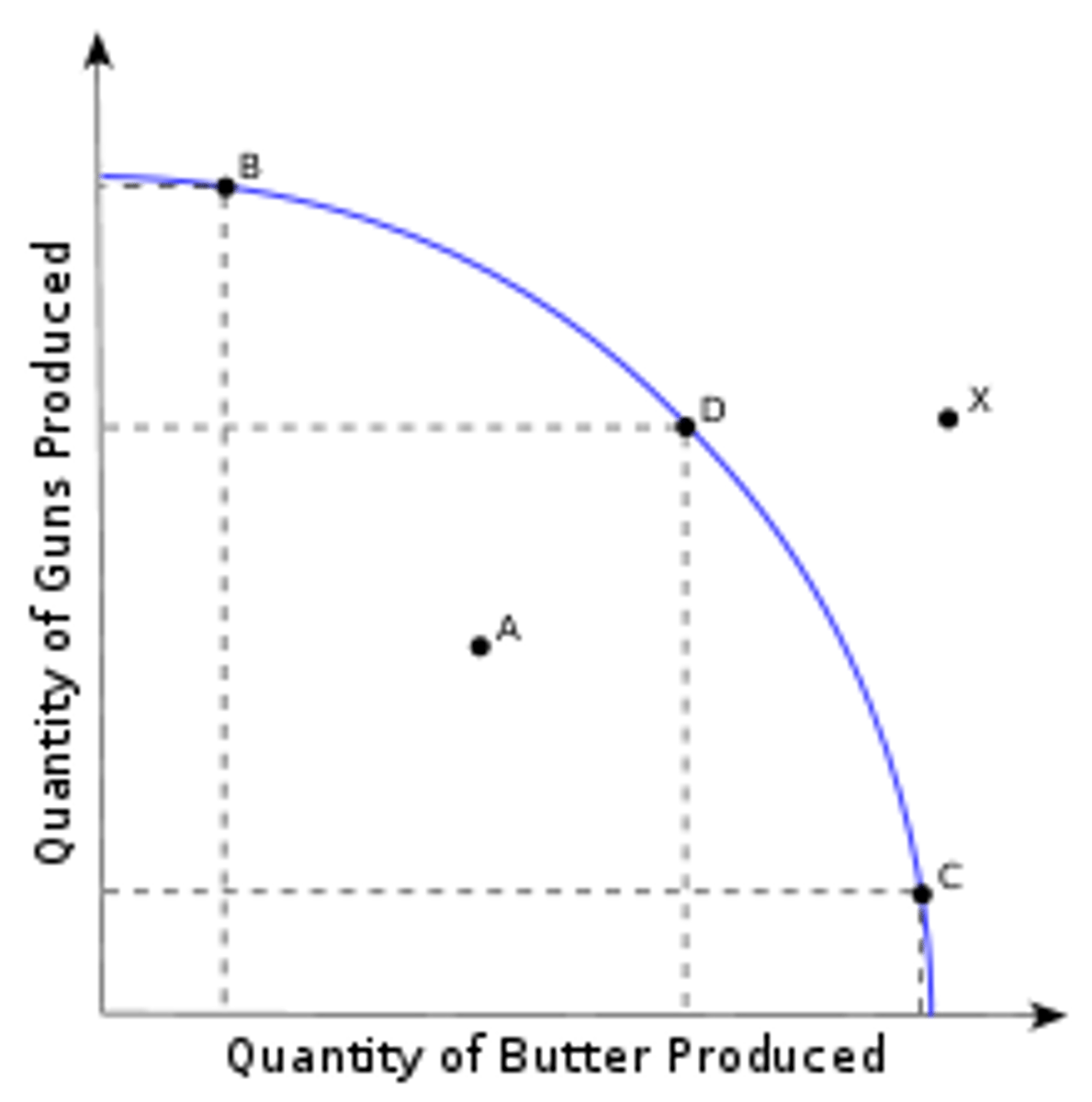
Production possibilities Frontier/ Curve PPF: PPC
The curve shows what is possible within an economy
D- impossible
A&B - feasible efficient
C - feasible & inefficient
PPF shifts out when...
the economy can produce more of everything
Opportunity Cost
the cost of what you give up to get something else in terms of time, money, or other goods
Absolute Advantage
Who can make most of that good
Comparative Advantage
The lowest opportunity cost for that good
What would allow Panama and Canada to trade?
They want to trade within their opportunity cost
Demand
The amount consumers are willing and able to purchase
Supply
The amount that producers are willing and able to produce
Law of demand
Demand always slopes down
Law of supply
Supply always slopes up
Equilibrium
Where the two curves meet
Demand shifters
- Price of substitute or complement
- Consumer preference
- population growth
- Income and expectation of future income
Supply shifters
- Price of input
- Technological advancement
- Number of producers
- Producer expectation
Solve for Equilibrium Price and Quantity
Make both sides equal to each other
Ex. Q = 100 - 6P & Q = 28 + 3P
100 - 6P = 28 + 3P
72 - 9P
P = 8
28 + 3(8)
28 + 24
52 = Q
Economic Growth is measured...
Growth is measured in many ways, usually GDP (the market value of all final goods and services produced in a nation's borders) Productivity (output/labor hours)
What causes productivity?
- Human Capital
- Natural Resources
- Physical Capital
- Technological Knowledge
Human Capital
Knowledge and skills of workers (education, training)
Natural Resources
Anything that comes from nature (timber, oil, coal)
Physical Capital
All the physical tools and machines used to do business
Technological Knowledge
The general knowledge of the world
GDP Equation
GDP = G + C + I + NX = ALL PRODUCTION = ALL CONSUMPTION
Consumption (C)
Things purchased for final use
Investment (I)
Things purchased to use to make more money later
Government Spending (G)
Any money the government uses
Nominal GDP
is this years' prices * this years quantities
Real GDP
is base years' prices * is years quantities
GDP Deflator
Nominal GDP/Real GDP*100
Inflation
using GDP deflator = (this years deflator - last years' deflator) last years' deflator
CPI- Consumer Price Index
Makes a basket of good to calculate the cost of living for a given year. Multiply current year prices * base year quantities
Price Index
Costs of this years basket * 100
Labor Force Participation Rate
labor force/adult population * 100
Unemployment rate
unemployed workers/labor force*100
Types of Unemployment
- Frictional
- Cyclical
- Structural
frictional unemployment
The time it takes for employees and employers to find each other
cyclical unemployment
The cycle of money
structural unemployment
The structure of the economy
Labor force
Anyone in the adult population who is able to work
Discouraged Worker
Someone who is out of work and no longer looking for a job
Employed
Person with a job
Unemployed
Someone who did not work in the last week and is actively seeking employment
People can "save" their money in numerous ways
- Corporate bonds
- Municipal bonds
- Stocks
- Deposit certificates
Corporate Bonds
Individual loans money to a company in return for interest the more risky the company the higher the interest
Municipal bond
Loan money to the government usually the lowest interest rate but also the least risk of getting paid back. Can loan to foreign governments
Stocks
Purchase ownership in company
Deposit Certificates
Depositing money in a bank
Y(GDP)
Y(GDP) = C + I + G
S(pub) = PUBLIC SAVINGS
S(pub) = PUBLIC SAVINGS = T - G
S (priv) = PRIVATE SAVINGS
S (priv) = PRIVATE SAVINGS = Y - C - T
S(tot) = PUBLIC PRIVATE SAVINGS
S(tot) = PUBLIC PRIVATE SAVINGS = I
Money can be used as a...
- Medium of exchange
- Unit of account
- Store of value
Medium of exchange
using money to pay for things
Unit of account
using money to compare values 1 dollar is like 1 inch
Store of value
Keeping money and saving it for later
Liquidity
How quickly can i use money to pay for something
Commodity money
Paying with things that have a real value trading goods not paper money
Fiat Money
Money that derives its money from a governmental decree. A dollar is only worth 100 cents because the government says so
The Federal Reserve
- 12 banks across the country
- Control Monetary Policy
- Use Open Market Operations to set money supply- they buy and sell bonds to increase or decrease the money supply
- Set required reserve ratio for how much banks must hold in reserves
Banks
Banks are required to hold a certain percentage of their deposits in cash called RESERVES. The fed sets the REQUIRED RESERVE RATIO. Banks can also choose to hold extra cash on hand called EXCESS RESERVES.
Banks (2)
Any money not held in reserves can be loaned or used to purchase securities out to other clients who spend the money where it then gets deposited into a new bank and loaned out again. This created extra money which we find by
Leverage Ratio
All assets (reserves + securities + loans)/ capital (owners equity)
Discount Rate
Interest rates for banks to borrow from the Fed when they need to increase their reserves
Federal Funds Rate
Interest rate for banks to borrow from each other for short (overnight loans)
Classical Dichotomy
The distinction between nominal (today's dollars) and real variables (the actual worth of the money based on how much you can purchase with it)
Monetary Neutrality
Changes in money supply will only affect nominal values not real ones
Inflation
Is when nominal values increase over time
Deflation
Is when nominal values decrease over time
Inflation tax
Cost of inflation cause by when the government prints money to pay off debts
Velocity of Money
The number of times units of currency is used to pay newly produced goods or services V=(P*Y)/M
V = Velocity, P= Price level, Y= GDP, M= Money supply
Menu Costs
Cost of having to constantly update prices
Shoe Leather Costs
Cost of having to run cash to the bank or use it before it becomes worthless
Unit-of-account-costs
Inflation causes people to trust money less so it becomes less useful to measure costs
Recession
A recession is 6 months or more of falling real GDP
Aggregate
Aggregate is just a fancy way of saying all of. Aggregate Demand is everything being demanded in a country AD=GDP
Shifters in Aggregate Demand
- Any of the components of GDP (C,I,G,NX)
- Wealth of consumers
- Interest rates
- Taxes
- Exchange rates
Aggregate Supply
Changes in money supply will change nominal values like income or inflation but not real values like the factors of production (monetary neutrality) which determine Long Run Aggregate Supply (LRAS)
Long Run Aggregate Supply (LRAS)
LRAS is tied to the rate of unemployment (0 cyclical unemployment) so if the natural rate decreased LRAS will increase
Short Run Aggregate Supply (SRAS)
Short Run Aggregate Supply (SRAS) cruve slopes upward because prices are sticky (sticky price theory) which means that when money supply changes and prices need to change it takes time for suppliers to adjust their prices from what they expected to the actual nominal variables
Shifters in Aggregate Supply
- Input prices
- Human capital
- Government regulations
- Anything that will cause a change in overall productivity
- If one curve shifts the other will need to shift to return the long run aggregate supply curve
Fiscal Policy
Fiscal policy = government spending and taxation whereas Monetary Policy = fed changing money supply and interest rates
Government Policy
In a hypothetical closed economy if the government spends money it get a multiplier just like the fed increasing money supply. The spending multiplier = 1/(1-MPC) where MPC is the percentage at which people spend their money
Government Policy (2)
While government spending will increase public spending, it will also cause crowding out and raise the interest rate slightly lowering the increase in public spending