identity, necessity and conditionals
 Call Kai
 Learn
Learn Practice Test
 Spaced Repetition
 Match
Match Flashcards
 Knowt Play
1/33

There's no tags or description
Looks like no tags are added yet.
Name | Mastery | Learn | Test | Matching | Spaced | Call with Kai |
|---|
No analytics yet
Send a link to your students to track their progress
34 Terms
numerical identity
they are one and the same thing - strict identity
sometimes is is used to demonstrate numerical identity
qualitative identity
sameness in some (typically important) respects
count how many things there are (if there’s one, numerical; if there are two, qualitative)
other types of identity
‘Changing one’s identity’
‘Losing its identity’
‘Identity theft’
‘Identity crisis’
‘Ethnic/national identity’
‘Personal identity’
These can generally be understood as properties that tell you something important about what someone (or something) is like
indiscernibility of identicals
If a=b, then every property of a is a property of b (and every property of b is a property of a)
can argue for non-indentity = If a and b don’t share all properties, then a≠b
the identity of indiscernible
if a≠b, then a and b must differ in at least one property
There is serious disagreement about this – it definitely cannot be assumed!
The principle rules out the possibility of two perfect duplicates existing, whose only difference is that they are not identical to each other
worry 1: identity through change
•considerations of identity tell me that I cannot be identical to something that has different properties to me here and now
worry 2: different descriptions
Doechii is famous; Jaylah Hickmon isn’t; therefore Doechii ≠ Jaylah Hickmon
But the problem is, they are identical! Does this show the Indiscernibility of Identicals is false?
No: fame is tied to the way we are described, but the property isn’t any different – Jaylah Hickmon is famous, but isn’t famous under that name
worry 3: knowledge and belief
Lois Lane knows that Superman can fly; Lois Lane doesn’t know that Clark Kent can fly; therefore Superman ≠ Clark Kent
But again, they are the same person!
worry 4: what’s in a name
The model Twiggy was named this because of her build so:
Twiggy was so-called for her build, but:
Lesley Hornby = Twiggy, so:
Lesley Hornby was so-called for her build (?!)
But this seems false! Carefully rephrasing the above shows the mistake:
Twiggy was called ‘Twiggy’ for her build, and Lesley Hornby = Twiggy, so Lesley Hornby was called ‘Twiggy’ for her build
The problem comes only if we make the different inference to Lesley Hornby was called Lesley Hornby for her build
substituting into opaque contexts
where properties depend on how something is named, or what people believe, these are called opaque contexts
in such situations, we get incorrect or strange-looking inferences if we carelessly move from one name to another
what is usually assumed
Logical truths are necessarily true
Logical truths can be known a priori
necessary/contingent distinction
metaphysical distinction - ways the world can, or must, be
contingent truth/fact
If something is true but could have been false
necessary truths/facts
things that could not have been otherwise – they had to be that way
eg Bachelors are unmarried, 2+3=5
nomological/physical necessity
truths which are necessary provided we keep the laws of nature fixed
metaphysical necessity
truths which are necessary given the nature of reality
perceived hierarchy
logical necessity → metaphysical necessity → nomological/physical necessity
F necessity
truths which are necessity provided we keep F fixed
a priori/ a posteriori distinction
epistemological distinction - how things are known
a posteriori
known from experience
a priori
know certain things without having to appeal to evidence
an a priori truth is a truth which is knowable a priori
eg I know that 2+2=4
If I in fact reason without using evidence, then my knowledge is a priori
if something could be reasoned without using evidence, then the truth itself is a priori
a priori complication
I in fact know these things without appeal to experience, but perhaps not everyone will know them that way
eg they might do all maths via a calculator
innate knowledge and a priori knowledge
Some philosophers (like Plato) have tried to explain a priori knowledge by saying that it is innate, but the two are not the same!
Philosophers like Locke and Hume denied that we have any innate knowledge, but they didn’t deny that we had a priori knowledge
Innate knowledge was unpopular for a long time, but it was partially resurrected by linguists like Chomsky in the 20th century
necessity and a-priority
If a truth is necessary, then it doesn’t matter how the world is, it’ll still be true – so I don’t need to check how the world is to know it’s true – it’s knowable a priori
If a truth is knowable a priori, then knowing it doesn’t require checking the world, but that means specific features of the world don’t change it – it must be a necessary truth
Saul Kripke and Hilary Putnam in particular argued this – consider:
Billie Holiday is Eleanora Fagan
Water is H2O
Mary Shelley was the child of Mary Wollstonecraft
The ‘standard metre’ bar in Paris is 1 meter long
Kripke claimed that this is a priori, since if I know what the object is, I know it’s 1 meter long, but it’s contingent, since we could have chosen a different bar, of a different length
indicative conditionals
We take some condition (the antecedent) and assert something else (the consequent) that we expect to accompany it
These can appeal to the past, present or future
eg “If Otto is a dog, then he is a mammal”
Warning: if you see a ‘would’, then you very likely don’t have an indicative conditional – we’ll come back to this case
if and only if
If ‘if’ is not preceded by ‘only’, what follows it is the antecedent
If ‘if’ is preceded by ‘only’, what follows is the consequent
when do we assert indicative conditionals
when we strongly expect that something rules out, or makes unlikely, the combination “true antecedent, false consequent”
subjunctive conditionals
WOULD
they get us to consider an alternative situation, and say what else would be true in that case
Indicative conditionals and subjunctive conditionals can differ in truth value:
If Lee Oswald didn’t murder JFK, someone else did”
“If Lee Oswald hadn’t murdered JFK, someone else would have”
when do we assert subjunctive conditionals
generally subjunctive conditionals are used where we know or strongly expect that the antecedent is false – for this reason they’re often called counterfactual conditionals
more restricted in tense – we express them by appeal to the past
when something is false, but we think it most plausible that a situation in which it was true would be one in which something else was true
material conditionals
a logical operation represented by the formal symbol →
truth functional
cant represent subjunctive in this way
can appeal sometimes to indicative
equivalence thesis
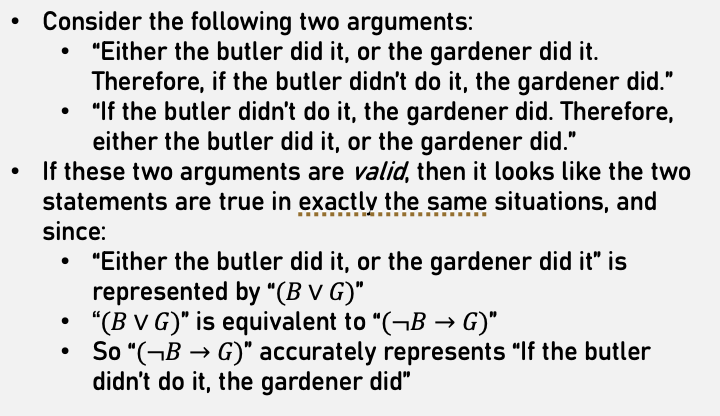
against equivalence thesis
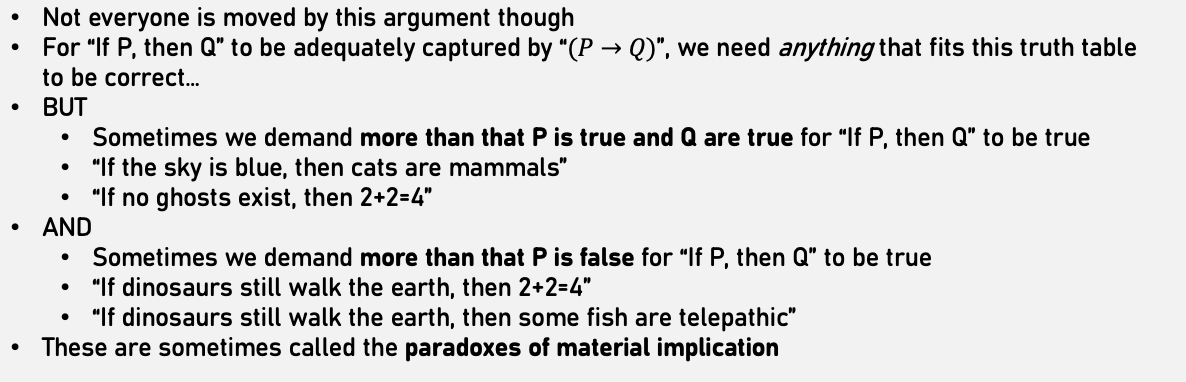
responses to paradoxes of material implication
there is a difference between truth and assertability
eg “I’m in the solar system or dogs can’t look up” is true, but why would I assert it?
even if “(P→Q)” doesn’t perfectly capture “If P, then Q”, it is the closest that we can come in TFL, and still allows us to understand many valid inferences