Psychology 3
 Call Kai
 Learn
Learn Practice Test
 Spaced Repetition
 Match
Match Flashcards
 Knowt Play
1/139

There's no tags or description
Looks like no tags are added yet.
Name | Mastery | Learn | Test | Matching | Spaced | Call with Kai |
|---|
No analytics yet
Send a link to your students to track their progress
140 Terms
Stages of development
Prenatal: conception - birth
Infancy- birth to 18/24 months
Childhood- end of infancy to 10/14 years
Adolescence- end of childhood to 18/21 years old
Adulthood- end of adolescence to old age and death
Conception
Union of egg and sperm forms a zygote
zygote develops into an embryo
Embryo becomes a fetus
How does the brain grow and mature
myelination
synaptic connections among neurons
Synaptic Pruning
“use it or loose it”
allows for the brain to adapt well to any environmental it may find itself in
eliminates un-used synaptic connections and allows for adaptation to the developmental environment
preserving synaptic connections that are used and getting rid of those that aren’t
Teratogens
agents that harm the embryo or fetus
can impair development in the womb
include: drugs, bacteria, caffeine, alcohol and viruses
Fetal alcohol spectrum disorders (FASDs)
exposure to alcohol during pregnancy
can lead to: low birth weight, face and head abnormalities, deficient brain growth, and evidence of impairment such as behavioral or cognitive problems or low IQ
Common features: small eye openings, and absence of the groove that normally appears between the nose and the lips, thin upper lip
Basic Newborn reflexes
grasping reflex- grasping a finger
rooting reflex- turning and sucking
sucking reflex
Dynamic systems theory
Development is a self-organizing process where new forms of behavior emerge through consistent interactions between a person and cultural and environmental
/ contexts
Visual Acuity
ability to distinguish differences among shapes, patterns, and colors
Habituation
decreased response to an unchanging stimulus
Salient Stimulus
something that is visually attention grabbing or unexpected or new as opposed ti habituated
Humans have an innate tendency to pay more attention to salient stimuli
Orienting reflex
an infant will look away more quickly from something familiar than from something unfamiliar or puzzling.
Attachment
string intimate, emotional connection between people that persists over time and across circumstances
Bowlby’s attachment theory
Attachment is adaptive: Attachment motivates infants and caregivers to stay near each other increasing the security that infants need to survive and thrive
Piaget’s stages of development
Sensorimotor( birth - age 2):
children acquire most of their senses through senses and motor exploration
learn through the perception and observation of the results of their actions
development of object permanence
Preoperational stage (2-7 years)
begin to think about objects not in their immediate view
children begin to think symbolically
cannot understand the concept of conservation quantity (realizing 8oz in a fat glass is the same as 8oz in a tall glass)
reason intuitively and not logically
Egocentrism: engage in thought processes that only revolve around their own perspectives ( a child covering here face during hide and seek and thinking other people cannot also see her)
Theory of mind
Concrete operational stage:
able to think logically about actual objects
understanding of conservation of quantity
can reason logically about a problem
understand with much more depth, how other people view and feel about things
reason about concrete things, cannot yet reason about the abstract or what might be possible
Formal operation stage:
critical thinking ( ability to form a hypothesis about something, test the hypothesis through deductive logic.
using information to systematically find answers to problems
relies on formal, abstract, cognitive operations
Adolescents can form hypothesis and test them rather than just acting randomly
Able to consider abstract notions and think about many viewpoints at once
Object permanence
Understanding that an object still exists even when hidden from view
assimilation
the process by which new information is placed into an existing scheme
accommodation
The process by which a new scheme is created or an existing scheme is drastically altered to include new information that otherwise would not fit into the scheme
Sensorimotor
infants acquire information about the world through their senses and motor skills
reflexive responses develop into more deliberate actions through the development and refinement of schemes
cbject permanence
The understanding that an object continues to exist even when it cannot be seen
Preoperational stage
Children think symbolically about objects, but they reason based on intuition and superficial appearance rather than logic
Concrete operational stage
Children begin to think about and understand logical operations and they are no longer fooled by appearances
Formal operational stage
People can think abstractly and they can formulate and test hypotheses through deductive reasoning
Theory of mind
Ability to understand that other people have mental states that influence their behavior
Pre-conventional
level
Earliest stage of moral development:
self interest and event outcomes determine what is moral
Conventional level
Middle stage of moral development; at this level, strict adherence to societal rules and the approval of others determine what is moral
Post conventional level
Highest stage of moral development; at this level, decisions about morality depend on abstract principles and the value of all life (ideals or moral principles)
Inequity aversion
A preference to avoid unfairness when making decisions about the distribution of resources
Factors that affect development
Teratogens
maternal illness
genetic mutations
hormones
Environmental Factors
Parenting styles
authoritarian: strict rules, little room for discussion (little flexibility with children)
permissive parenting: Fewer rules and expectations, lots of freedom (still play a role in children’s lives)
Negligent parents (completely uninvolved in their children's lives)
authoritative parenting: Clear rules and expectations with room for discussion. Explain reasoning and being open to input. Encourage independence while also setting guidelines.
Secure attachment
child feeling comfortable, exploring new places with their caregiver nearby
child feels safe and supported by caregiver
Insecure attachment style
avoidant attachment: avoid or ignore their caregivers, showing little emotion if their parent leaves or comes back
anxious attachment/ambivalent or resistant: Overly dependent on parents and show extreme distress when separated. Resist parents comfort even when they return, showing distrust.
Disorganized attachment: inconsistent or frightening caregiving. Showing contradictory or confusing behaviors
Separation anxiety
When a child feels scared or afraid when their caregiver is not around
Foreclosure
high degree of commitment to a particular identity or idea without exploring other options
Diffusion
When an individual has not committed to a set idea or identity and has not explored any possibilities, often resulting in a lack of direction
Moratorium
When an individual is actively exploring their identity and possible options, however, they do not have a commitment to one particular identity or idea just yet (better understand who they are and what they believe)
Achievement
Individual has a set identity and has explored their options (able to come to their own conclusion about their identity.)
Erik Erikson stages of psychosocial development
Trust Versus Mistrust (Born-1 years old): if infants needs are met, they develop trust about their caregivers and world
Autonomy vs Shame and Doubt (Toddler): starts to explore their independence. if there is encouragement, the child develops confidence and autonomy. If met with criticism, shame
Initiative versus guilt (Pre-school (3-6)): Sense of purpose, ask lots of question. If children are supported in their creativity and questions, start to develop initiative.
Industry vs inferiority (childhood): Children start to compare, am i good, competence and pride
Identity vs role confusion (adolescence): Individual explores identity and personal values, peer groups become extremely important. Necessary strong development of self. Who am i question?
Intimacy versus isolation (early adulthood): young adults are looking for meaningful relationships. If able to form close and meaning relationships, more satisfied and happy. Struggle: become isolated and lonely
Generativity vs stagnation (adulthood): contributing to society and providing for the next generation, Success: useful and accomplished
Integrity VS Despair: Sense of fulfillment, allow them to accept their older age and the concept of death
Inequity aversion
A preference to avoid un fairness
Primary emotions
emotions that are innate, voluntarily adaptive and universal across cultures
anger, fear, sadness, surprise and contempt
Secondary emotions
blends of primary emotions
Remorse, guilt, shame,jelousy, pride, love, and contentment
Valance
positive or negative
Arousal
low to high
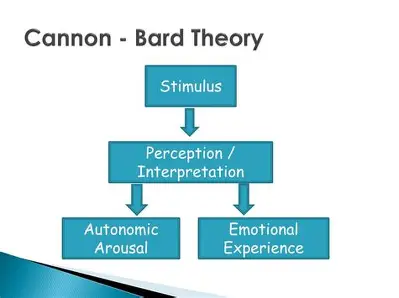
Cannon bard theory
information about stimuli is sent simultaneously to cortex and the body and results in emotional experience and bodily reactions, respectively.
Schachter singer model ( generalized physiological arousal and cognitive appraisal can
Balance theory
people are motivated to achieve harmony in their interpersonal relationships. A triad is balanced when the relationships are all the same direction or if two relationships are negative and one is positive.
Cognitive dissonance
The unpleasant feeling of being aware of holding two conflicting beliefs or a belief that conflicts with a behavior.
Core values
strongly held beliefs about the enduring principles that are most important and meaningful. Values promote emotions and actions when they are aroused or threatened.
Disparity rules
rules learned through socialization that dictate which emotions are stable in given situations
Drive
A psychological state that by creating arousal, motivates an organism to satisfy a need.
emotion
an immediate, specific negative or positive response to environmental events or internal thoughts
extrinsic motivation
motivation to perform an activity because if the external goals toward which that activity is directed
homeostasis
the tendency for bodily functions to maintain equilibrium
ideal affect
emotional and affective states that people want to feel or that cultures especially value
incentives
external objects or external goals rather than internal drives, that motivate behaviors
Intrinsic motivation
Motivation to preform an activity because of the value or pleasure associated with that activity, rather than for an apparent external goal or purpose
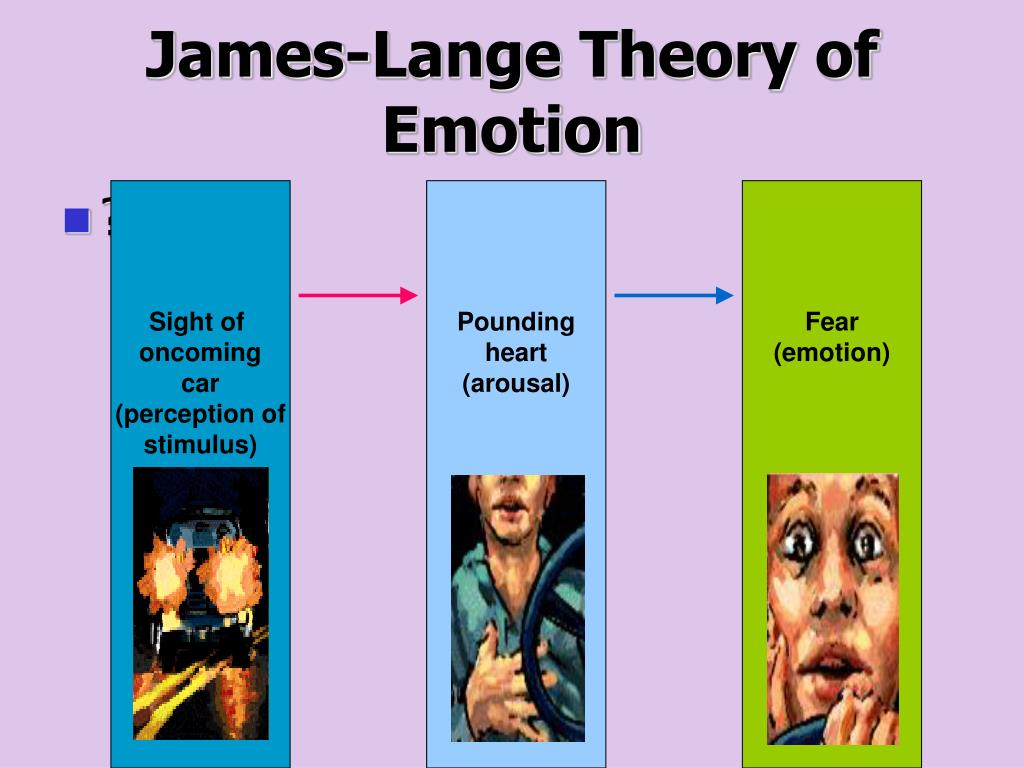
James-Lange theory
Theory of emotion stating that people perceive specific patterns of bodily responses and as a result of that perception feel emotion
motivation
A process that energizes, guides, and maintains behavior towards a goal
need
A state of biological, social, or psychological deficiency
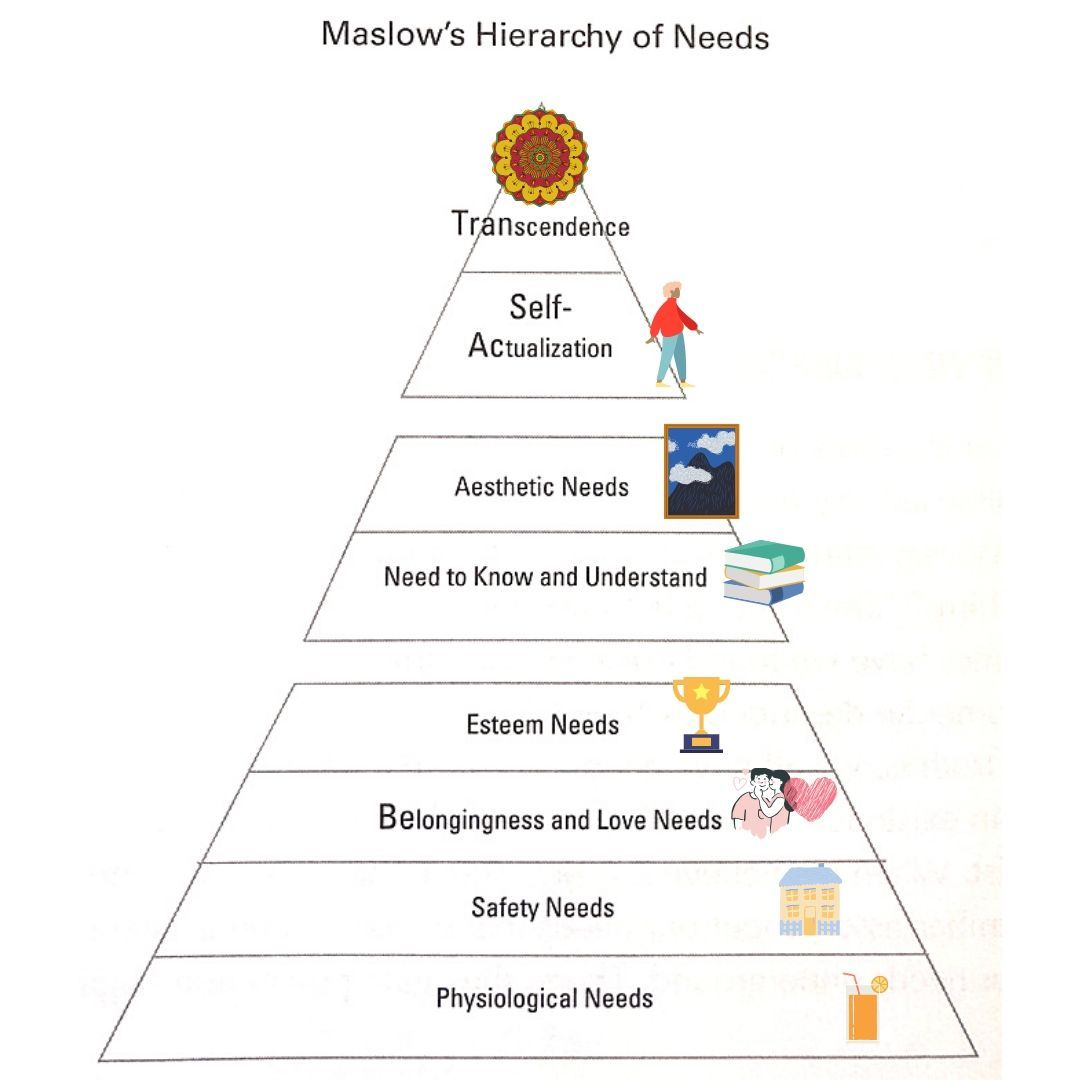
need hierarchy
Maslows’s arrangement of needs in which basic survival needs must be met before people can satisfy higher needs
physiological needs
safety needs
love and belonging
Esteem
Self actualization
need to belong
The need for interpersonal attachments, a fundamental motive that has evolved for adaptive purposes
Self actualization
state that is achieved when ones personal dreams and aspirations have been attained
self affirmation
a need for a sense of self that is coherent and stable
self efficacy
The belief that efforts toward a goal will result in success
Self regulation
The process by which people direct their behavior toward the attainment of goals
two factor theory
theory of emotion stating that label applied to physiological arousal results in the experience of an emotion
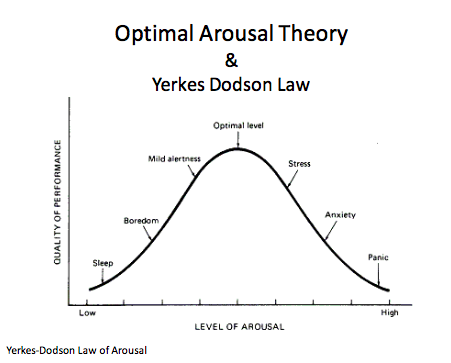
Yerkes Dodson law
Principle that performance on challenging tasks increases with arousal up to a moderate level. After that additional arousal impairs performance
Personality trait
pattern of thought emotion and behavior that is relatively consistent over time and across situations
temperament
aspects of a personality more determined by biology. Based on a childs activity level,emotionality,and sociability.
trait
patterns of thoughts,feelings,and behaviors that are relatively consistent over time and situations.
5 factor theory
The idea that personality can be described using five factors: openness to
experience, conscientiousness, extraversion, agreeableness, and neuroticism.OCEAN)
conscientiousness- describes how careful, organized, and detail oriented a person is
Extraversion-social vs retiring,fun loving vs sober, affectionate vs reserved
agreeableness- soft hearted vs ruthless,trusting vs suspicious,helpful vs uncooperative
Neuroticism-worried vs calm, insecure vs secure,self pitying vs self satisfying
openness to experience- imaginative vs down- earth, likes variety vs like routine, independent vs conforming
Trait approaches
Approaches to studying personality that focus on how individuals differ in
personality dispositions.
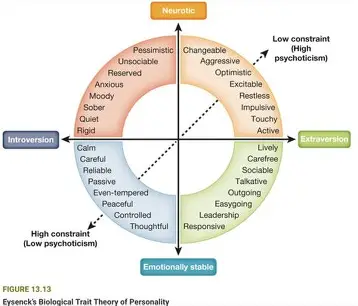
Eysenck’s Biological Trait Theory of Personality
personality is composed of traits that occur in three
dimensions: extraversion/introversion, emotionally stable/neurotic, and high
constraint/low constraint
Emotional stability
consistency in a persons emotions and moods
Neurotic
frequent and dramatic mood swings especially toward negative emotions compared to those who are more stable
often feel anxious, depressed, and hold very low opinions of themselves
psychoticism (constraint)
aggression, poor impulse control,self centeredness, and lack of empathy
how well or poorly someone is able to control their emotions
Extraversion vs Introversion Arousal
Extraversion: lower baseline of arousal, thrill seeking
Introversion:higher levels of arousal, seek calming activities
Behavioral Approach, Behavioral Inhibition, and Fight-Flight-Freeze
Systems
BAS (extraversion)reflects reward sensitivity. BIS(neuroticism) and FFFS reflect punishment sensitivity and serve separable functions.
BIS slows behavior and increases vigilance.
FFFS responds to direct threats by engaging in protective behaviors such as flight or freezing.
Humanistic approaches to personality
Emphasize personal experience, belief systems, the
uniqueness of the narrative of each human life, and the inherent goodness of each
person.
unconditional positive regard.
Parents should love and pride for their children no matter what
leads to a fully functioning person
Locus of control
how much control people believe that they have over their lives ‘
internal locus of control: your rewards come from the inside, you bring your own reward
External locus of control: your rewards come from the outside, something else brings you the reward (forces beyond control)
Reciprocal determinant theory-bandura
three factors interact with one another to influence behavior: environment, person factors, and behavior.
self schema
integrated set of memories, beliefs, and generalizations about the self that helps us efficiently
perceive, organize, interpret, and use information related to ourselves
self serving bias
tendency for people to take personal credit for their successes but blame their failures on external factors
Ego, superego,id
Ego: conscious mind, controls impulses, deals with stimuli, decider between id and superego
superego: represents ideals and judgements (moral component of personality)
id: unconscious mind- strives to satisfy basic drive, immediate satisfaction (sx and hunger
Sigmund freud stages (psychodynamic theory)
Oral stage (birth-18 months)- individuals focus on oral stimulation
Anal stage (18-36 months)- individuals focus on being able to control their bowel movements
Phallic stage (3-6): children may start feeling their genitals and exploring their body
Latency stage )6-puberty): individuals sexual feelings are hidden, their focus is on past fixations
Genital stage (puberty-on): individuals get sexual pleasure from sexual behavior (mast. & inter)
Defense mechanisms to protect against stress
repression
projection
denial
sublimation
compensation
expectancy theory
We react in a certain way to situations because we learned from a previous experience what happened before and expect the same result
Control our outcome: Locust of control
Internal locust of control: How we control and impact our own fate
External locus of control: different outside factors that impact us and could determine our fate and outcome (how much money you have, people at school,) high eLC- don’t believe you can impact the situation
Banduras social learning theory
multiple factors that shape a personality
observational learning, self efficacy (our belief and ability to do something and be good at it (specific task), reciprocal determinism (environment, behavior, and beliefs).
Drive reduction theory of motivation
theory that we are motivated because our body is not at homeostasis and our drive kick in to tell us what we need to fix in order to maintain homeostasis
Arousal theory
Group homogeneity effect
tendency to perceive outgroup members as stereotypically more similar than in group members are
Group polarization
the process by which initial attitudes of groups become more extreme over time
group think
the tendency for a group to make bad decisions as a result of preserving the group and maintaining cohesiveness, especially when the group is under intense pressure, facing external threats, and is biased in a particular direction
social facilitation
social loafing
deindividualization
Cooperation and Subordinate goals
Implicit vs Explicit attitudes
explicit attitudes: attitudes a person can report
implicit attitudes: attitudes that influence a persons feelings or behavior at an unconscious level
Cognitive dissonance