EECS 563 Midterm 2
 Call Kai
 Learn
Learn Practice Test
 Spaced Repetition
 Match
Match Flashcards
 Knowt Play
1/191

There's no tags or description
Looks like no tags are added yet.
Name | Mastery | Learn | Test | Matching | Spaced | Call with Kai |
|---|
No analytics yet
Send a link to your students to track their progress
192 Terms
What do transport services and protocols provide?
Provides logical communication between application processes running on different hosts.
What are two transport protocols available to internet applications?
TCP and UDP
What are the two transport protocol actions in end systems?
Sender and receiver
Transport layer sender
Passed an application layer message
Breaks app messages into segments,
determines segment header fields values
creates segment
passes to network layer
Transport layer receiver
Receives segment from IP
Checks header values and extracts the application-layer message
Reassembles segments into messages
passes to application layer
TCP
Transmission Control Protocol
Reliable, in-order delivery
Congestion control
Flow control
connection setup
UDP
User Datagram Protocol
Unreliable, unordered delivery
No-frills extension of “best-effort” IP
Services not guaranteed by TCP and UDP
No delay guarantees
Can not promise how fast your data will arrive
No bandwidth guarantees
Do not guarantee a fixed data rate
Transport vs Network layer
Transport layer: logical communication between processes
Network layer: logical communication between hosts
What possible problems come from the network layer?
It may:
Drop messages (datagrams)
re-order messages
delivers duplicate copies of a given message
limits messages to some finite size
delivers messages after long delays
Multiplexing at sender
Handle data from multiple sockets, add transport header (later used for demultiplexing)
Demultiplexing at receiver
Use header info to deliver received segments to correct socket
How does the server know which data belongs to which client when multiple clients send data?
By using multiplexing and demultiplexing
Connectionless (UDP) demultiplexing
When creating datagram to send into UDP socket, we must specify the destination IP address and destination port #
UDP datagrams with same dest. port #, but different source IP addresses and/or source port numbers will be directed to same socket at receiving host
Connection-oriented (TCP) demultiplexing
TCP socket is identified by 4-tuple
Demux: receiver uses all four values (4-tuple) to direct segment to appropriate socket
Server may support many simultaneous TCP sockets
TCP socket 4-tuple
Source IP address
Source port number
Dest IP address
Dest port number
Why is there a UDP?
No connection establishment (which can add RTT delay)
Simple (no connection state at sender, receiver
Small header size (8 bytes vs 20 bytes for TCP)
No congestion control
UDP can blast away as fast as desired
Can function in the face of congestion
Use cases that primarily use UDP
DNS
SNMP (simple network management protocol
Goal of UDP Checksum
Detect errors (flipped bits) in transmitted segment
UDP checksum: Sender
Treat contents of UDP segment as sequence of 16 bit integers
Add all 16-bit numbers together like normal binary addition and wraparound carry
Take one’s complement
Checksum value put into UDP checksum field
What is a wraparound in checksum?
If addition produces a carry out of the leftmost bit (17th bit), add that carry back to the result
UDP checksum: receiver
Compute checksum of received segment
Check if computed checksum equals field value
not equal - error detected
equal - no error detected
Goals of reliable data transfer (RDT)
Data integrity - no packet loss, no packet duplicated, in-order delivery
Flow control - avoid overflow on receiver’s buffer
What determines the complexity of a reliable data transfer protocol?
The characteristics of the unreliable channel.
More issues → more mechanisms needed → higher complexity
Why must sender and receiver communicate their state in reliable data transfer?
Because they cannot know each other’s state directly
they only learn via messages
rdt_send()
the function call the application layer uses to give data to the reliable data transfer (rdt) sender.
deliver_data()
when the transport layer receiver passes the correctly received data up to the application layer.
udt_send()
when the transport layer sends a packet into the unreliable channel (network).
rdt_rcv()
the event that occurs when a packet arrives from the unreliable network channel to the transport layer.
rdt1.0
Reliable transfer over a reliable channel
Underlying channel perfectly reliable
no bit errors, no loss of packets
Separate FSM for sender and receiver
rdt 2.0
Channel with bit errors
Underlying channel may flip bits in packet → packet error
How to recover from errors in rdt?
Acknowledgements (ACKs): receiver explicitly tells sender that pkt received OK
Negative acknowledgements (NAKs): receiver explicitly tells sender that pkt had errors
Sender retransmits pkt on receipt of NAK
Sender sends on packet, then waits for the receiver response
What happens if ACK/NAK is corrupted?
Sender doesn’t know what happened at receiver
Can’t just retransmit: possible duplicate
What is rdt2.0’s fatal flaw?
If ACK/NAK is corrupted
How does rdt2.1 manage duplicates?
Sender retransmits current pkt if ACK/NAK corrupted
Sender adds sequence number to each pkt
Receiver discards if sequence number is not what it is currently expecting
Difference between rdt2.0 and rdt2.1?
rdt2.0: corrupted ACK/NAK causes confusion
rdt2.1: uses sequence numbers so retransmissions do not cause duplicate delivery
rdt2.2
Same functionality as rdt2.1, using ACKs only, NO NAKs
Instead of NAK, receiver sends ACK for last pkt received OK
Receiver must explicitly include seq # of pkt being ACKed
Duplicate ACK at sender results in same action as NAK:
retransmit current pkt
What new problem does rdt3.0 solve?
Channels with errors and loss
Adds new channel assumption: underlying channel can also lose packets (data, ACKs)
what if a packet (or its ACK) is lost completely, not just corrupted?
rdt3.0 approach
Sender waits “reasonable” amount of time for ACK
retransmits if no ACK received in this time
if pkt (or ACK) just delayed (not lost)
retransmission will be duplicate, but seq # already handles this
receiver must specify seq # of packet being ACKed
All the rdt protocols are forms of …?
Automatic Repeat Request (ARQ)
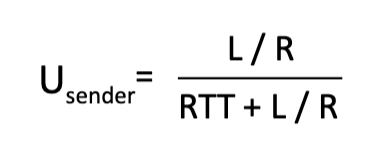
Usender: utilization
Fraction of time sender busy sending
Time to transmit packet into channel?
Length of packet/Rate
How can we increase channel utilization ?
Pipelining
Pipelining
Sender allows multiple, “in-flight”, yet-to-be-acknowledged packets
Range of sequence numbers must be increased
buffering at sender and/or receiver
Usender Formula
Go-back-N
Sender can have up to N unacked packets in pipeline
Receiver only sends cumulative ack
Sender has timer for oldest unacked packet
When timer expires, retransmit all unacked packets
Selective repeat
Sender can have up to N unacked packets in pipeline
Receiver sends individual ack for each packet
sender maintains timer for each unacked packet
When timer expires, retransmit only that unacked packet
What relationship is needed between sequence # size and window size to avoid the receiver mistaking a packet as a NEW packet vs a RETRANSMISSION of an old packet?
Size of the seq #s should be at least two times of the window size
Suppose a receiver that has received all packets up to and including
sequence number 24 and next receives packet 27 and 28. In
response, what are the sequence numbers in the ACK(s) sent out by
the GBN and SR receiver respectively?
A. [27,28], [28]
B. [24,24], [27,28]
C. [27,28], [27,28]
D. [25], [25]
E. [nothing], [27, 28]
B
What do TCP sequence numbers represent?
They represent byte positions, not packets
What does the sequence number in a TCP segment indicate?
The number of the first byte in that segment
If a segment has a sequence number 1000, what does that mean?
The first byte in that segment is byte 1000
What does the TCP ACK number represent?
The next byte the receiver is expecting
What does ACK = X mean in TCP?
I have received all bytes up to X-1 and I expect byte X next
What type of ACK system does TCP use?
Cumulative ACKs
What does TCP do if it receives a byte out of order?
It stores it instead of throwing it away.
Maximum segment size (MSS)
The maximum number of bytes of application data in a single TCP segment (not including headers)
How to set TCP timeout value?
Longer than RTT, but RTT varies
What if the TCP timeout value is too short?
Premature timeout, unnecessary retransmissions
What if the TCP timeout value is too long?
Slow reaction to segment loss
How to estimate RTT?
Average across several recent SampleRTT measurements, not just current SampleRTT
SampleRTT
Measured time from segment transmission until ACK receipt
EstimatedRTT formula
influence of past sample decreases exponentially fast
typical value: alpha = 0.125

TimeoutInterval Formula
EstimatedRTT plus “safety margin”

DevRTT formula
EWMA of SampleRTT deviation from EstimatedRTT
typically beta = 0.25

What does EWMA stand for
Exponential Weighted Moving Average
What does the TCP sender do given it received data from some application
Creates a segment with seq #
Seq # is byte-stream number of first data byte in segment
Start timer if not already running
What does the TCP sender do given there is a timeout?
Retransmit segment that caused timeout
Restart timer
What does the TCP sender do given ACK was received?
If ACK acknowledges previously unACKed segments
update what is known to be ACKed
start timer if there are unACKed segments
TCP event at receiver —> TCP receiver action?
arrival of in-order segment with expected seq #. All data up to expected seq # already ACKed
delayed ACK. Wait up to 500ms for next segment. If no next segment, send ACK
TCP event at receiver —> TCP receiver action?
arrival of in-order segment with expected seq #. One other segment has ACK pending
immediately send single cumulative ACK, ACKing both in-order segments
TCP event at receiver —> TCP receiver action?
arrival of out-of-order segment higher-than-expect seq. # . Gap detected
mmediately send duplicate ACK, indicating seq. # of next expected byte
TCP event at receiver —> TCP receiver action?
arrival of segment that partially or completely fills gap
immediate send ACK, provided that segment starts at lower end of gap
Delayed ACK
Receiver waits a short time before sending an ACK
TCP fast retransmit
If sender receives 3 additional ACKs for same data (“tripe duplicate ACKs”), resent unACKed segment with smallest seq #
likely that unACKed segment lost, so don’t wait for timeout
Flow control
Receiver controls sender, so sender won’t overflow receiver’s buffer by transmitting too much, too fast
How does TCP flow control prevent receiver overflow?
The receiver advertises available buffer space using the rwnd (receive window) field, and the sender limits how much unACKed data it sends to this value.
What is rwnd and how is it determined?
rwnd = available space in the receiver’s buffer (RcvBuffer), which is set via socket options and often automatically adjusted by the OS.
Before exchanging data in TCP, what do the sender and receiver do?
handshake
agree to establish connection (each knowing the other willing to establish connection)
agree on connection parameters (e.g., starting seq #s)
How many handshakes does TCP use to establish this connection
3-way handshake
SYN bit
Synchronize
Start a connection and sync sequence numbers
Used in the handshake
ACK bit
ACK field is valid
Used in almost every TCP segment after connection starts
ACK = 1 → im acknowledging data
FIN bit
Finish bit
Client, server each close their side of connection
Send TCP segment with FIN bit = 1
Respond to received FIN with ACK
on receiving FIN, ACK can be combined with own FIN
Congestion
Informally: “too many sources sending too much data too fast for network to handle”
What are the effects of congestion?
Long delays (queuing in router buffers)
Packet loss (buffer overflow at routers)
Congestion control vs Flow control
Congestion control: too many senders, sending too fast (don’t overwhelm the network)
Flow control: One sender too fast for one receiver (don’t overwhelm the receiver)
What causes congestion in this scenario?
One router, infinite buffers
input, output link capacity: R
two flows
No retransmissions needed
Delay builds up with infinite buffer as queue grows larger and larger
What causes congestion in this scenario?
One router, finite buffers
Finite buffers cause packet loss and retransmissions
Congestion idealization: perfect knowledge
Sender sends only when router buffers available
Congestion idealization: some knowledge
Packets can be lost (dropped at router) due to full buffers
Sender knows (infers) when packet has been dropped: only resends packet known to be lost
Congestion idealization: some perfect knowledge
Packets can be dropped, but the sender knows exactly when a packet is lost and retransmits only lost packets, avoiding unnecessary duplicates.
Congestion realistic scenario: un-needed duplicates
Packets can be lost, dropped at router due to full buffers — requiring retransmissions
but sender can time out prematurely, sending two copies, both of which are delivered
Wasted capacity due to un-needed retransmissions
When sending at R/2, some packets are retransmissions, including needed and un-needed duplicates, that are delivered
Costs of congestion
More work (retransmission) for given receiver throughput
unneeded retransmissions: link carries multiple copies of a packet
decreasing maximum achievable throughput
when packets are dropped, any upstream transmission capacity and buffering used for that packet was wasted!
What causes congestion in this scenario?
four senders
multi-hop paths
timeout/retransmit
Multiple senders over multi-hop paths combined with timeout-based retransmissions, which increase traffic and overload shared router buffers.
End-end congestion control
No explicit feedback from network
congestion inferred from observed loss, delay
Approach taken by TCP
Network-assisted congestion control
Routers provide direct feedback to sending/receiving hosts with flows passing through congested router
may indicate congestion level or explicitly set sending rate
TCP congestion controll: AIMD
Senders can increase sending rate until packet loss (congestion) occurs, then decrease sending rate on loss event
Additive increase multiplicative decrease
Additive Increase
Increase sending rate by 1 maximum segment size every RTT until loss detected
Multiplicative Decrease
Cut sending rate at each loss event
TCP slow start
When connection begins, increase rate exponentially until first loss event
Initial rate is slow, but ramps up exponentially fast