EASC 2919 Part 12: Sediments
 Call Kai
 Learn
Learn Practice Test
 Spaced Repetition
 Match
Match Flashcards
 Knowt Play
1/73

There's no tags or description
Looks like no tags are added yet.
Name | Mastery | Learn | Test | Matching | Spaced | Call with Kai |
|---|
No analytics yet
Send a link to your students to track their progress
74 Terms
2 main sources of sediment?
Terrigenous: most by volume, 45% of seafloor
Biogenic: 55% of seafloor
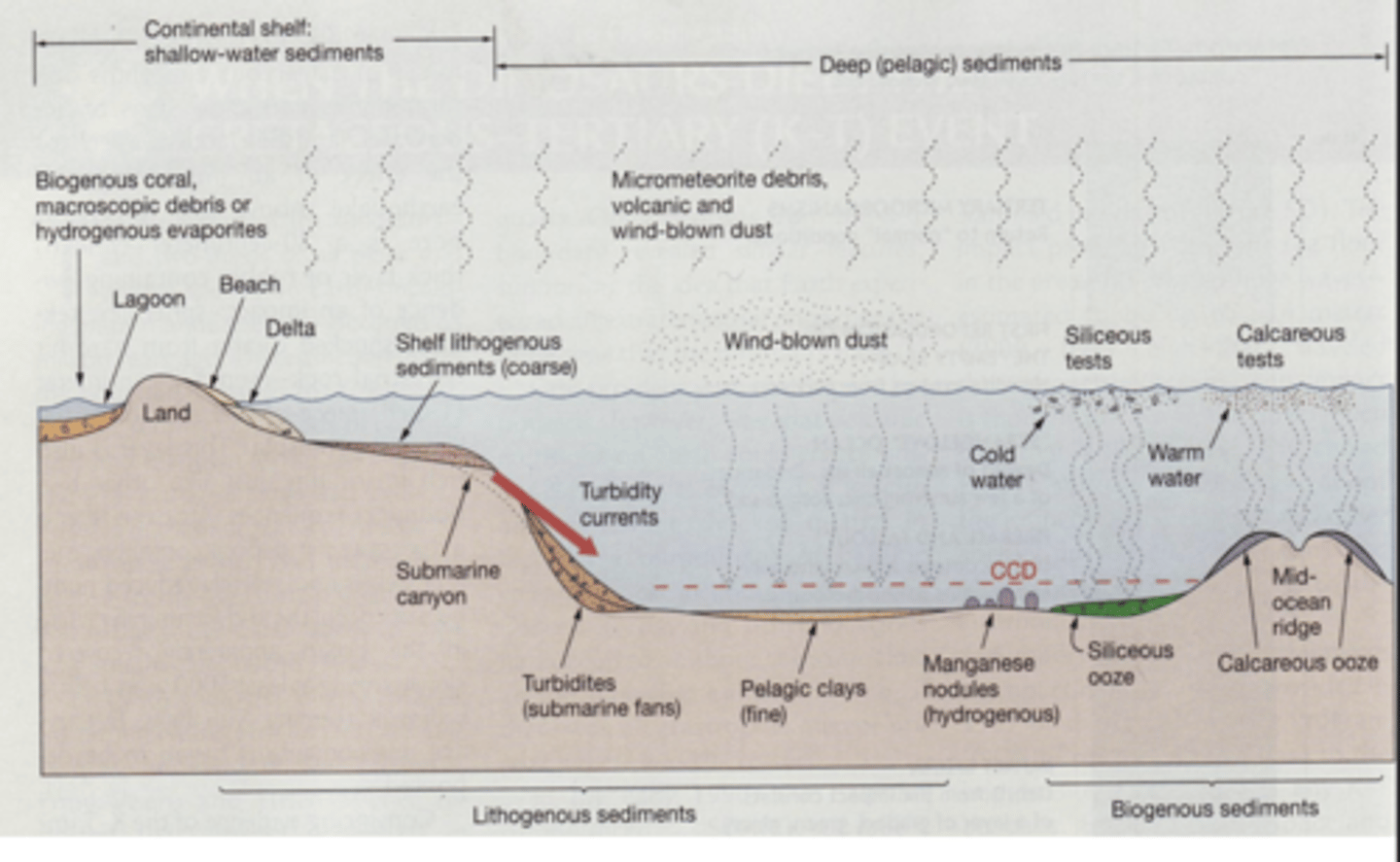
3 minor sources of sediment?
Hydrogenous: nodules, hydrothermals, evaporites
Volcanogenous
Cosmogenous
What 3 main processes determines distribution of sediments?
Sedimentation
Transport
Erosion
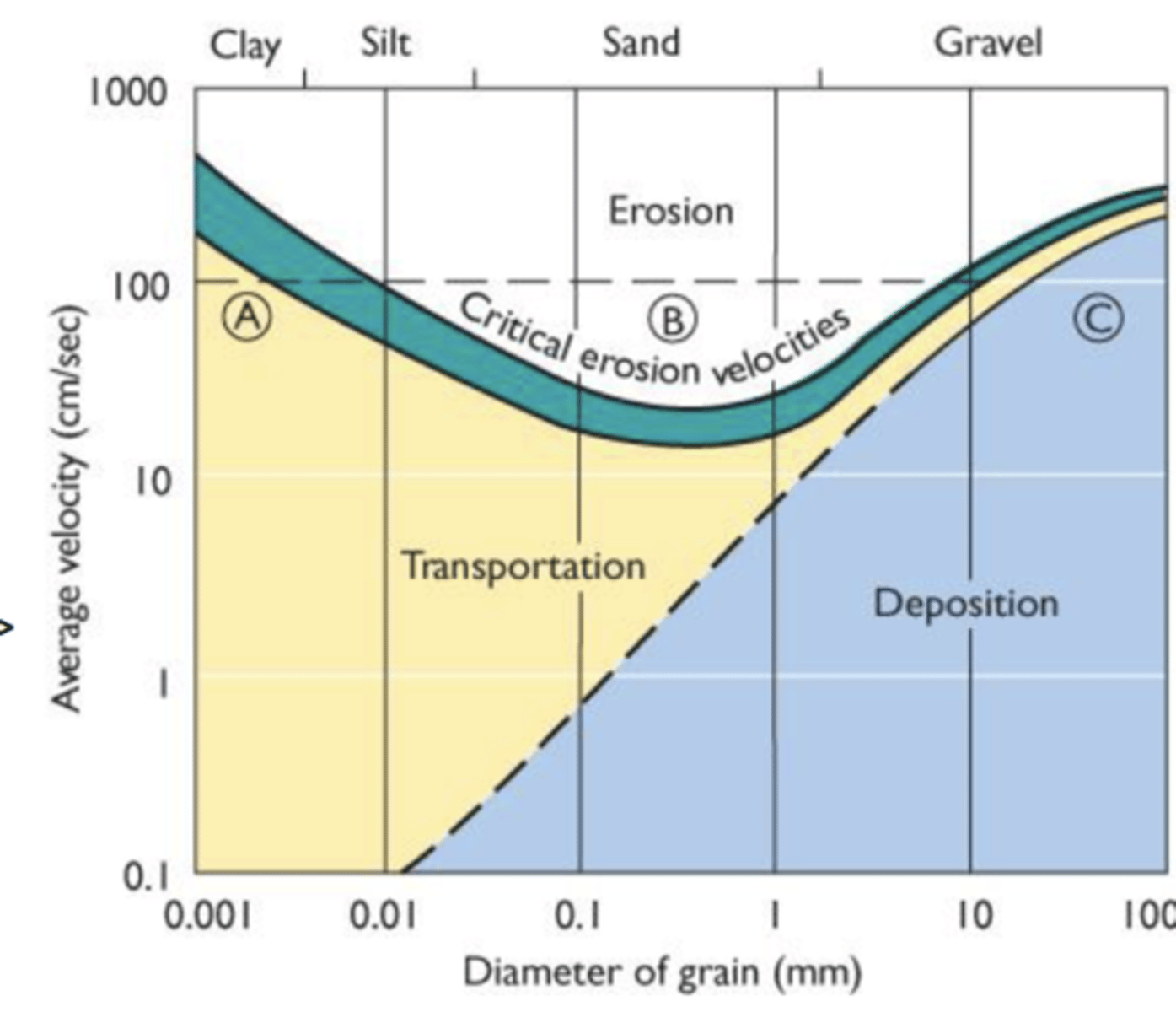
What does transport depend on?
Particle size, energy (velocity), particle clumping (flocculation)
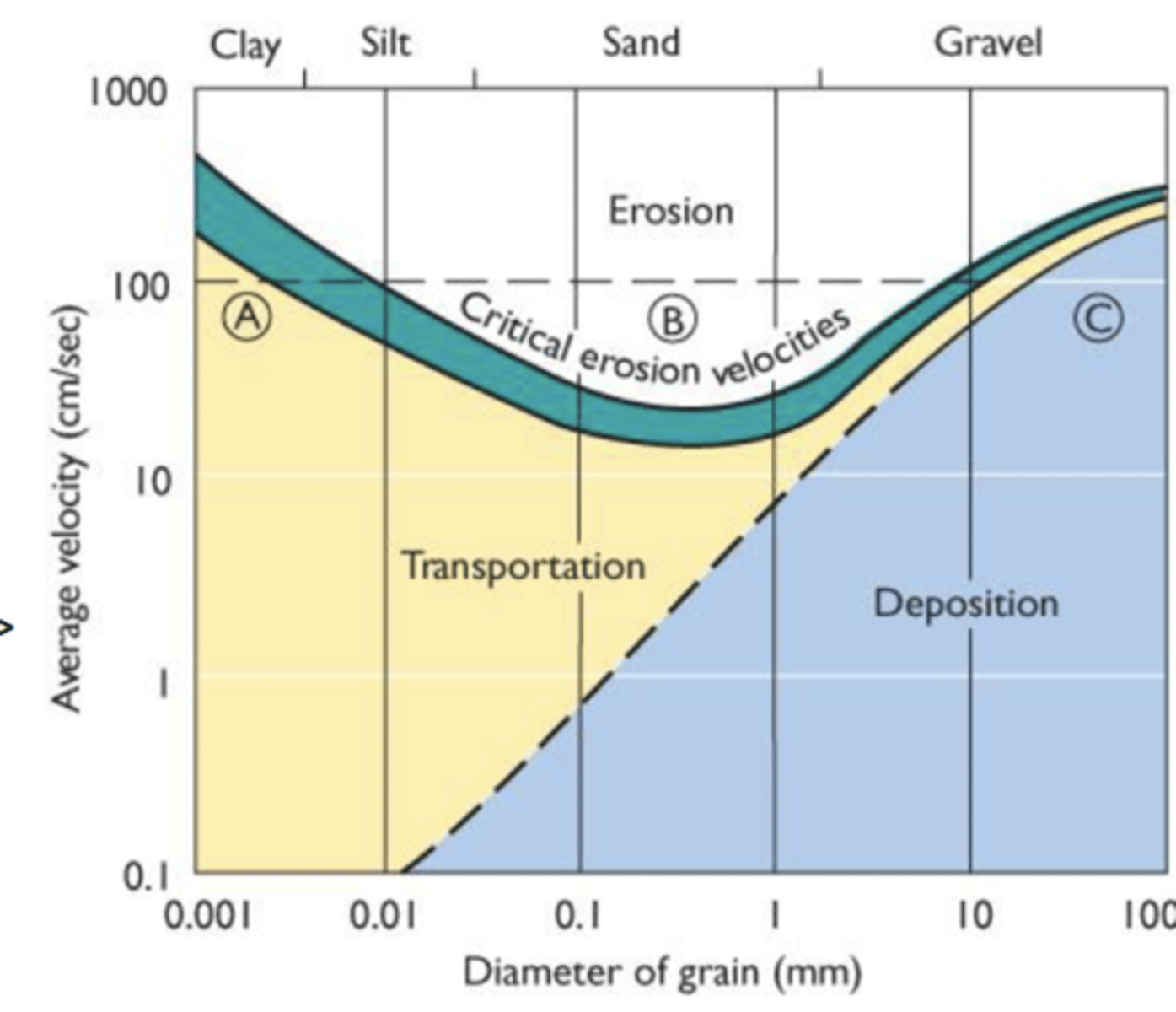
Why are clays hard to erode despite being so small? Or, why is the shape of erosion different from deposition on the diagram?
Flocculation due to static cohesion between grains
What sediments dominate on the shelf?
Terrigenous
In what places are biogenic sediments important on shelves?
Places with coral reefs, and productive waters away from rivers where algal blooms occur
What creates oil deposits?
Algal sediments covered by terrestrial, decomposition prevented due to lack of O2
How does particle size change with distance from shore and depth? Why?
Particle size decreases with distance. Energy decreases away from shore so smaller particles settle farther away
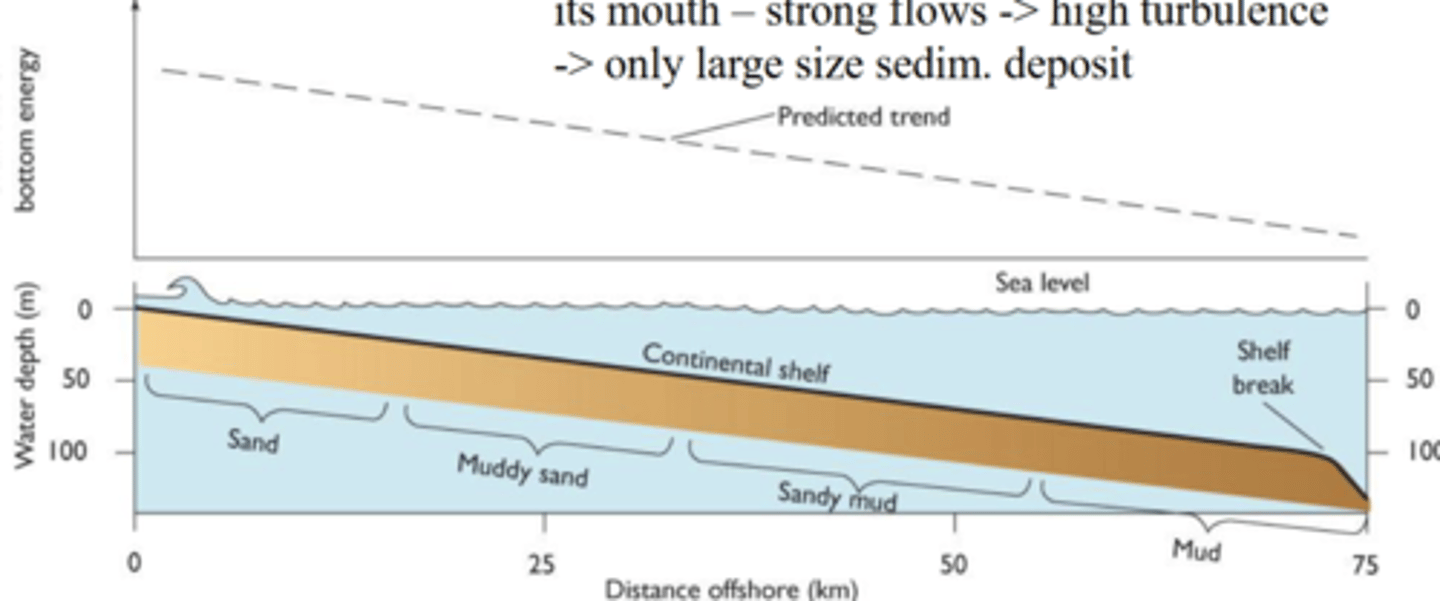
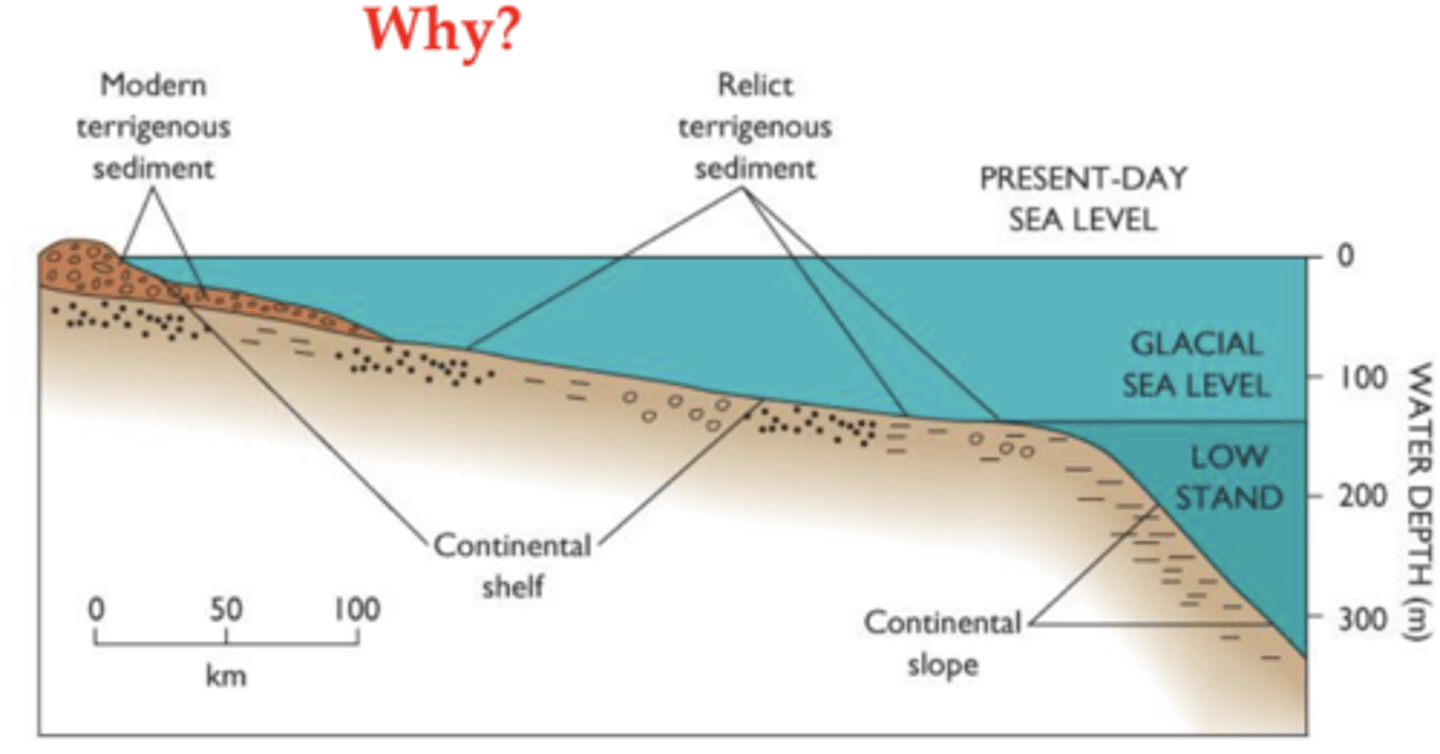
Why do many shelves have coarse sediments farther out?
Change in sea level moves river mouth
What conditions allow carbonate shelves?
Warm waters with low terrigenous influx, coral reefs form
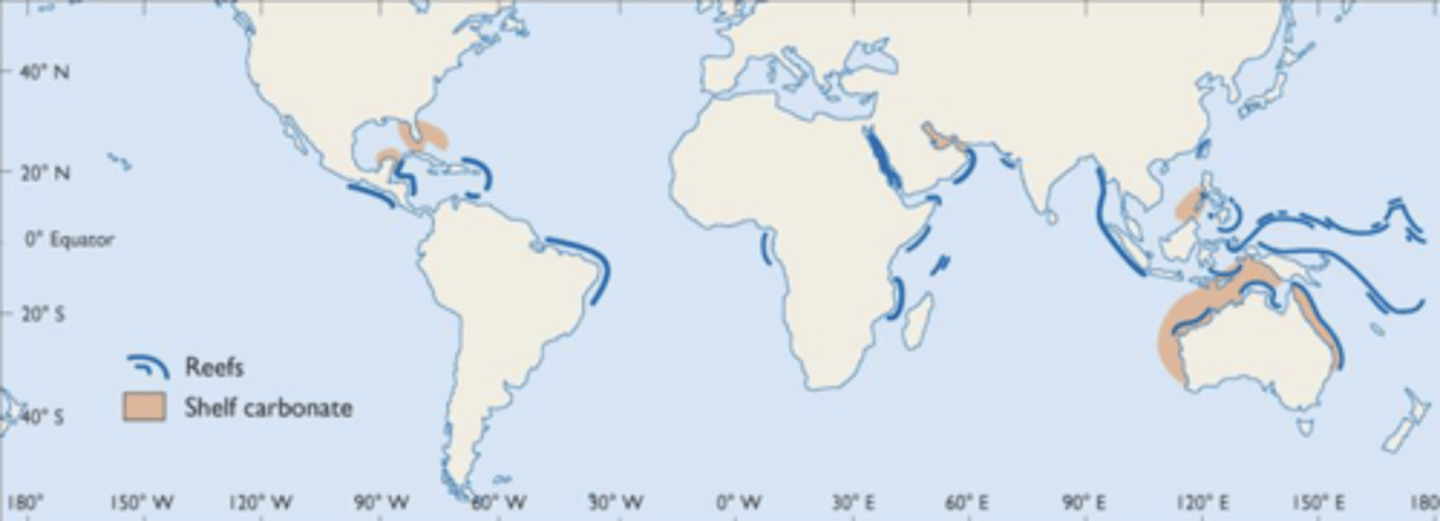
Why are there reefs south of the Amazon river, but not north?
Gyre flows North, so terrigenous sediments go North and prevent coral
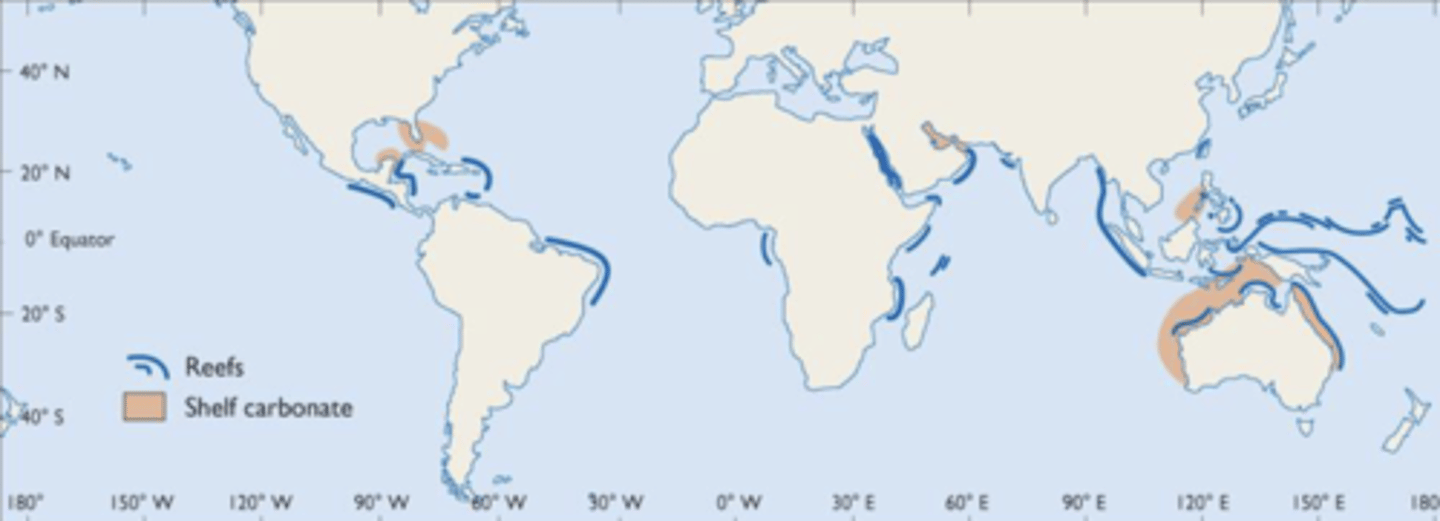
What sediments dominate tropical, temperate, and polar shelves?
Tropical: calcareous
Temperate: terrigenous
Polar: till and ice-rafted sediments
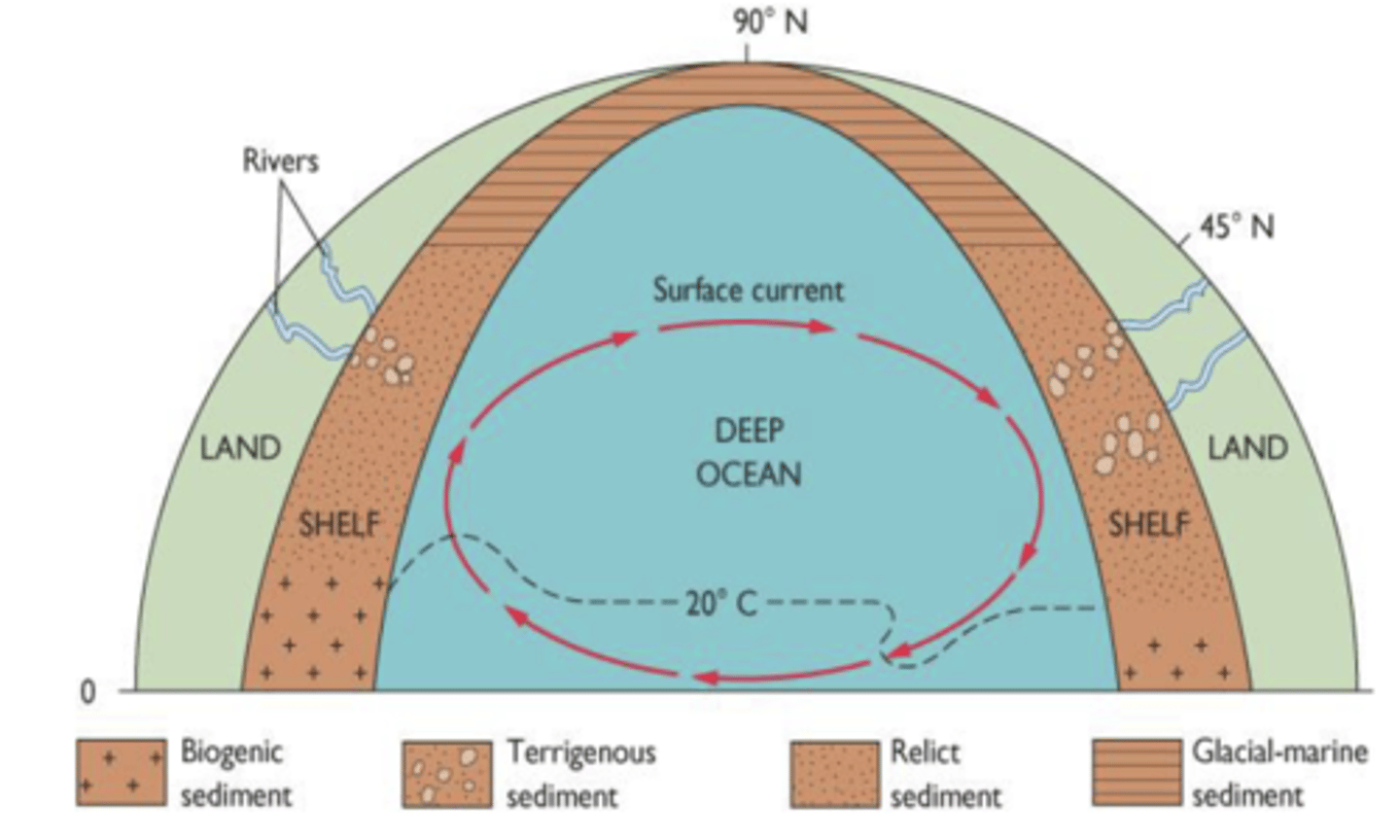
Why do calcareous sediments dominate tropical shelves?
Carbonates precipitate in warm water, corals need sunlight.
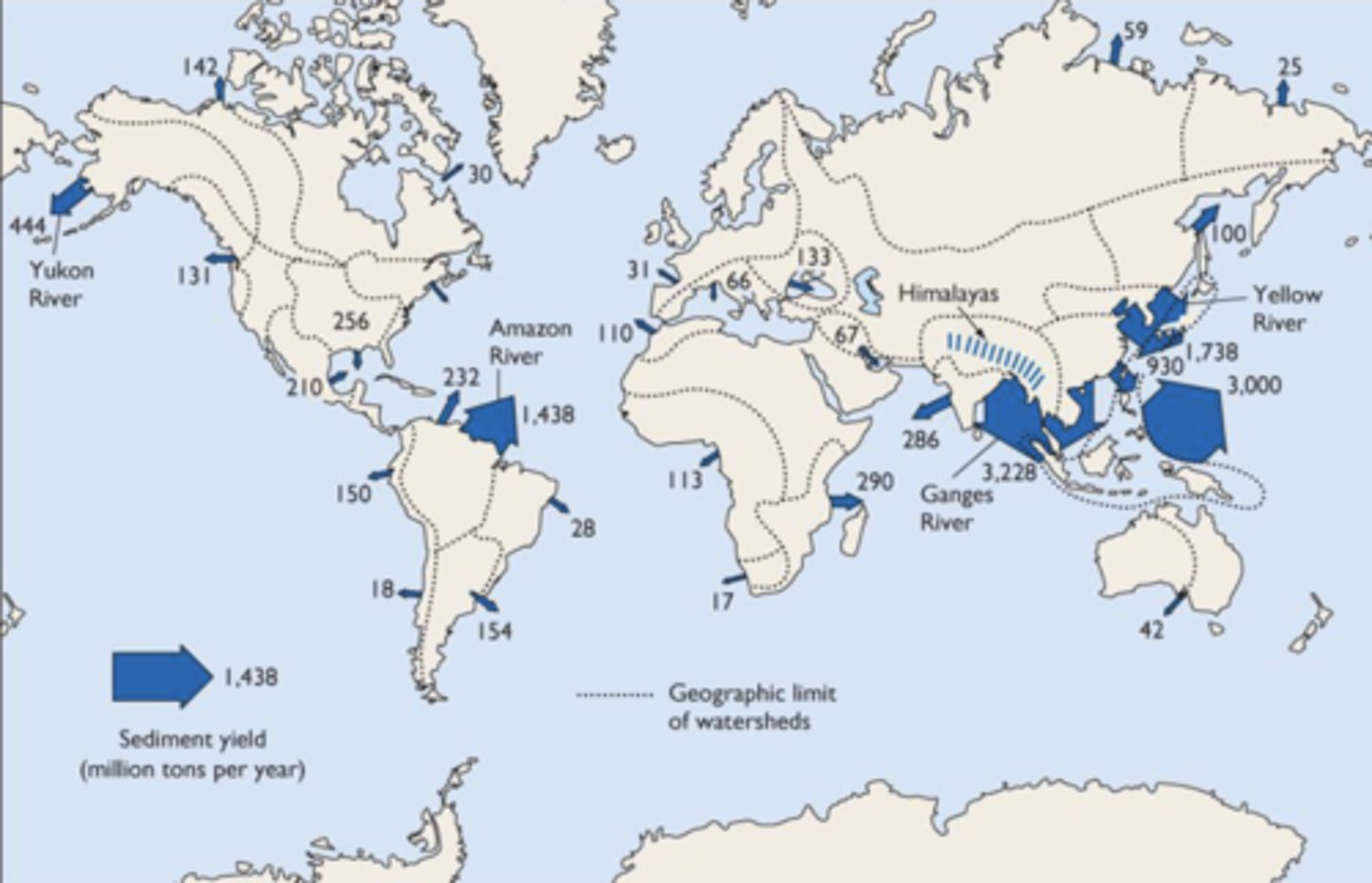
Why does Amazon have less sediments than Ganges or Indonesian rivers?
The majority of Amazon basin is low-lying, so little erosion beside the Andes. With the Ganges, the Himalayas make up much of the basin so much more erosion
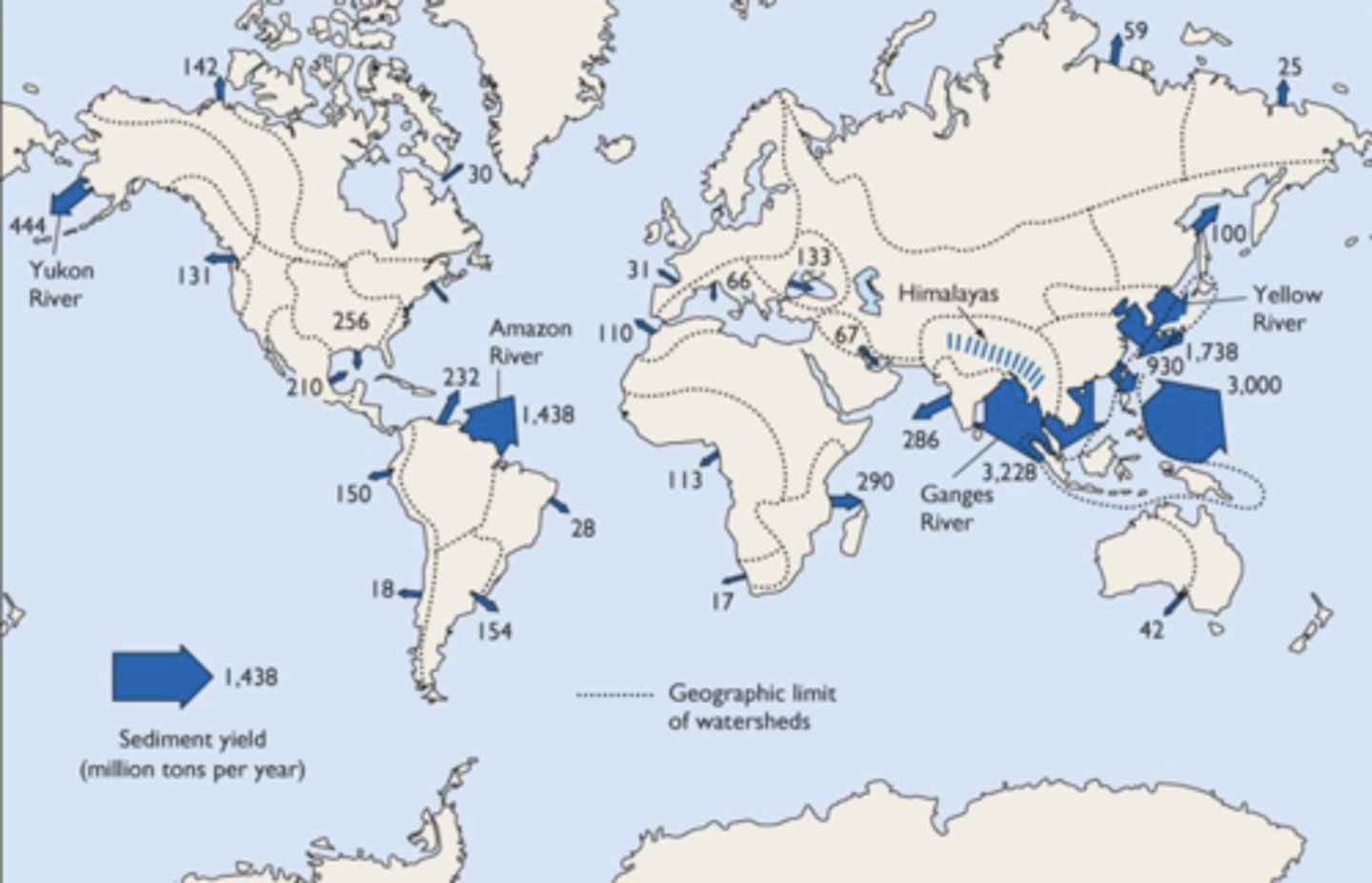
Why do Indonesian rivers have so many sediments?
Because volcanic rocks weather easily, and much of land is cleared for farming, so lots of erosion
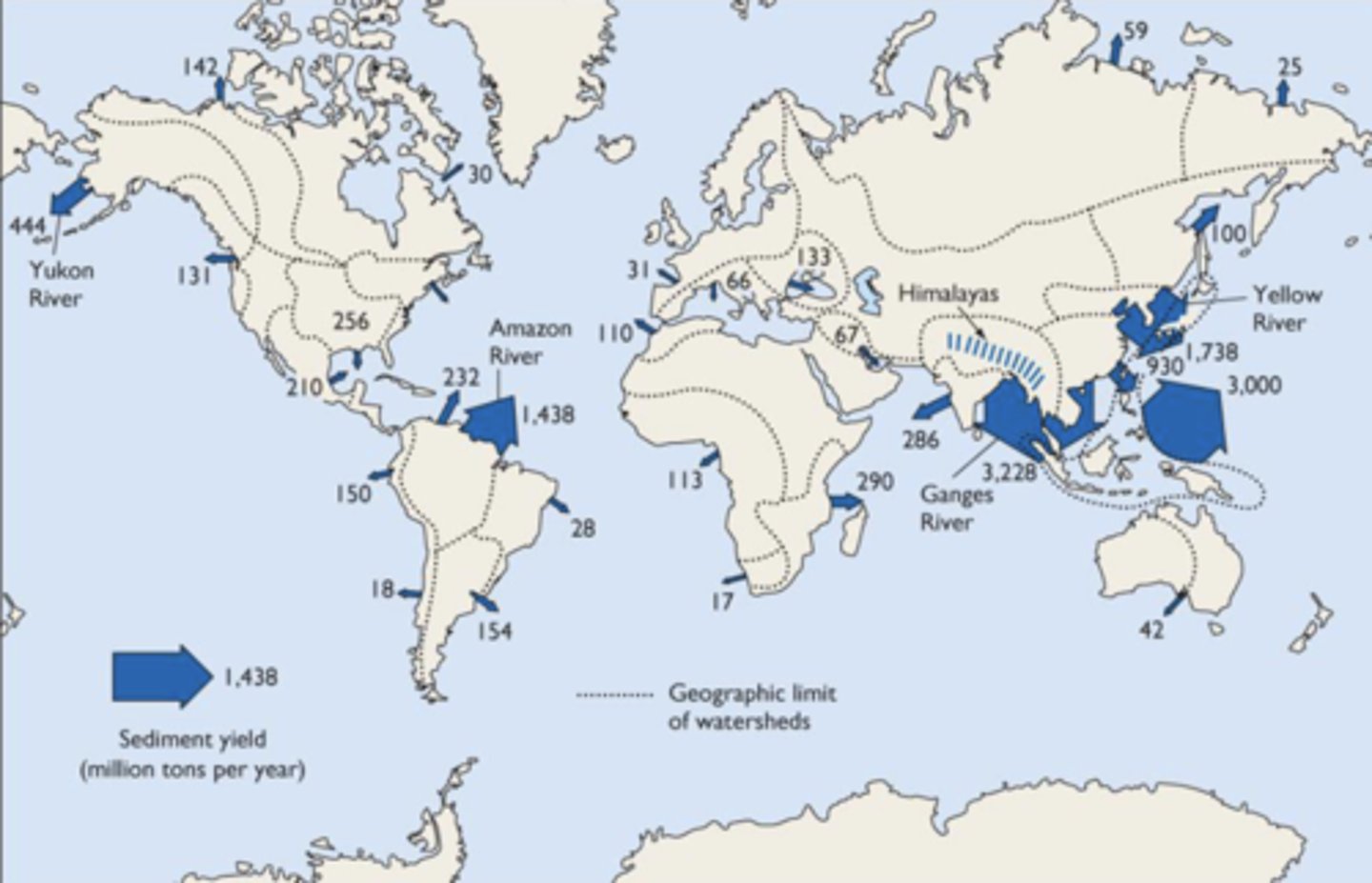
Why does the Nile have so few sediments?
Dams in the Nile have significantly reduced sediments
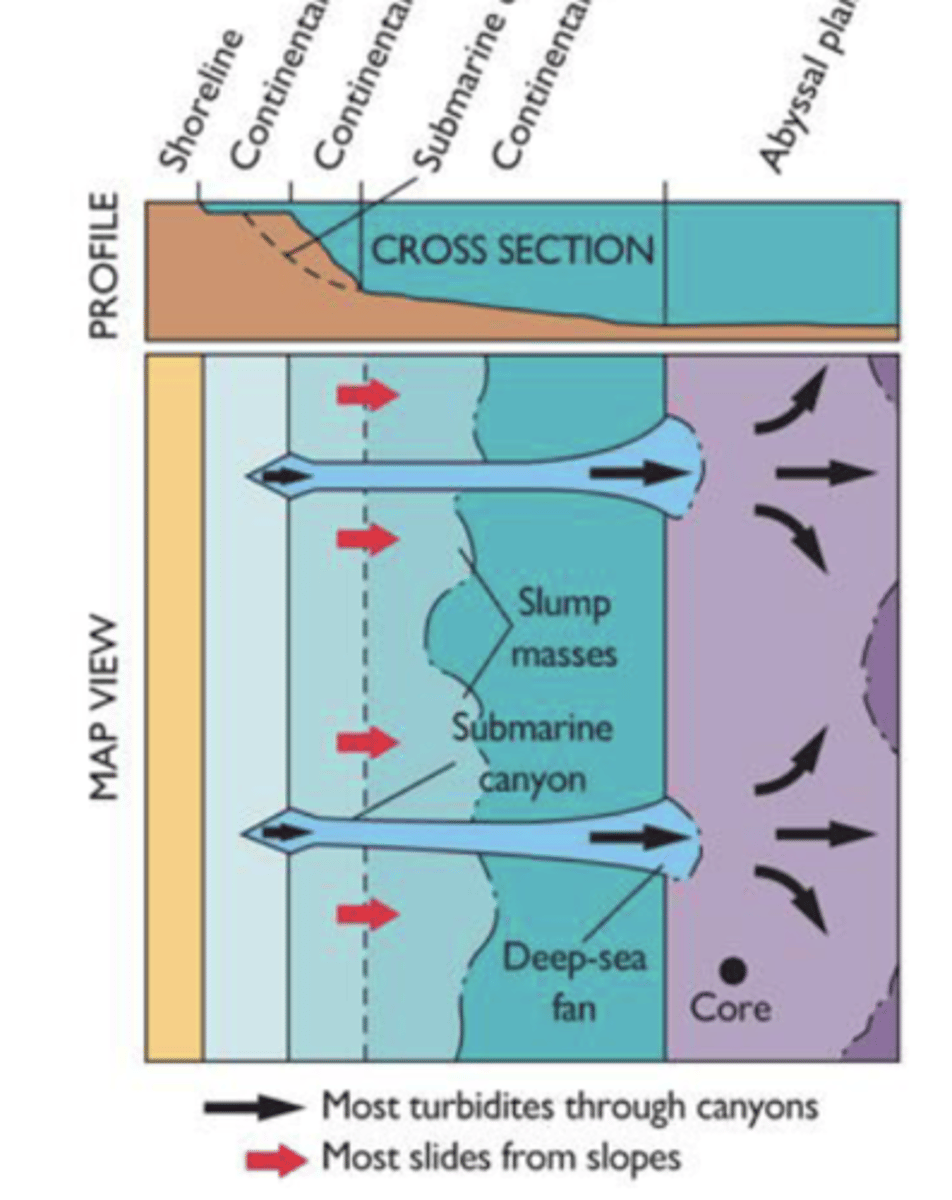
What are 2 main ways that terrigenous sediments get past the shelf?
Horizontal advection of fine grains
Flows along bottom
Why do debris flows and slumps occur despite relatively low angle of the slope?
Because they are waterlogged so they fail much easier
What are debris flows?
Underwater avalanches
What are slumps?
Underwater mudslides
What are turbidity currents?
Water with suspended sediments, denser than surrounding water so it flows along bottom, forming large fans at the end of canyons
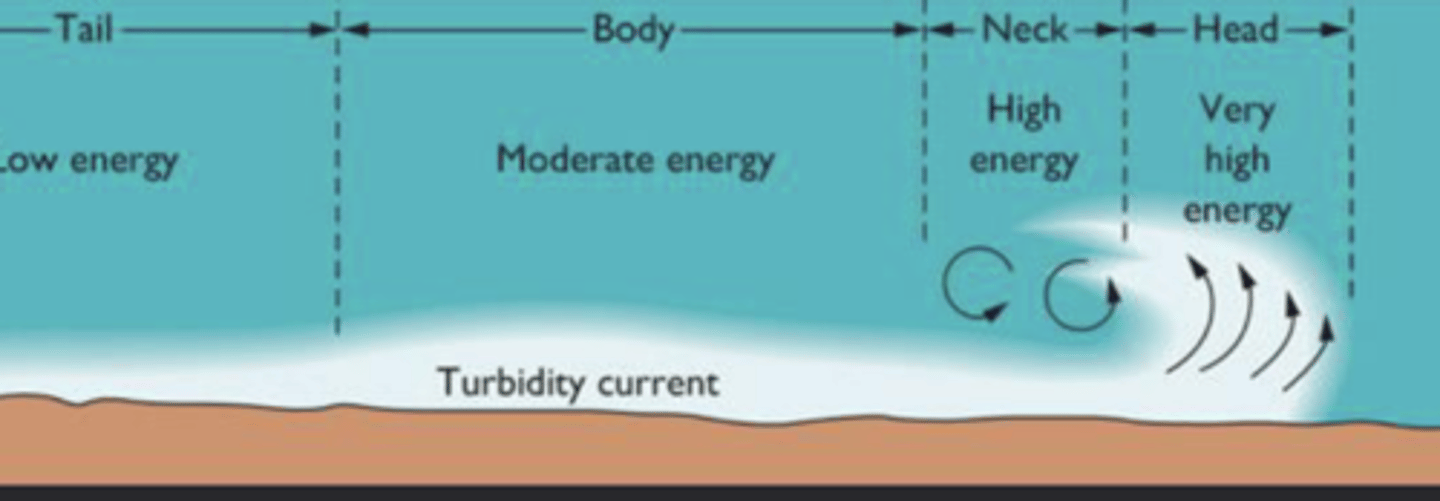
Explain turbidite structure
Head: v. high energy, erodes bottom
Body: lower energy, larger grains deposit
Tail: v. low energy, finer grains settle
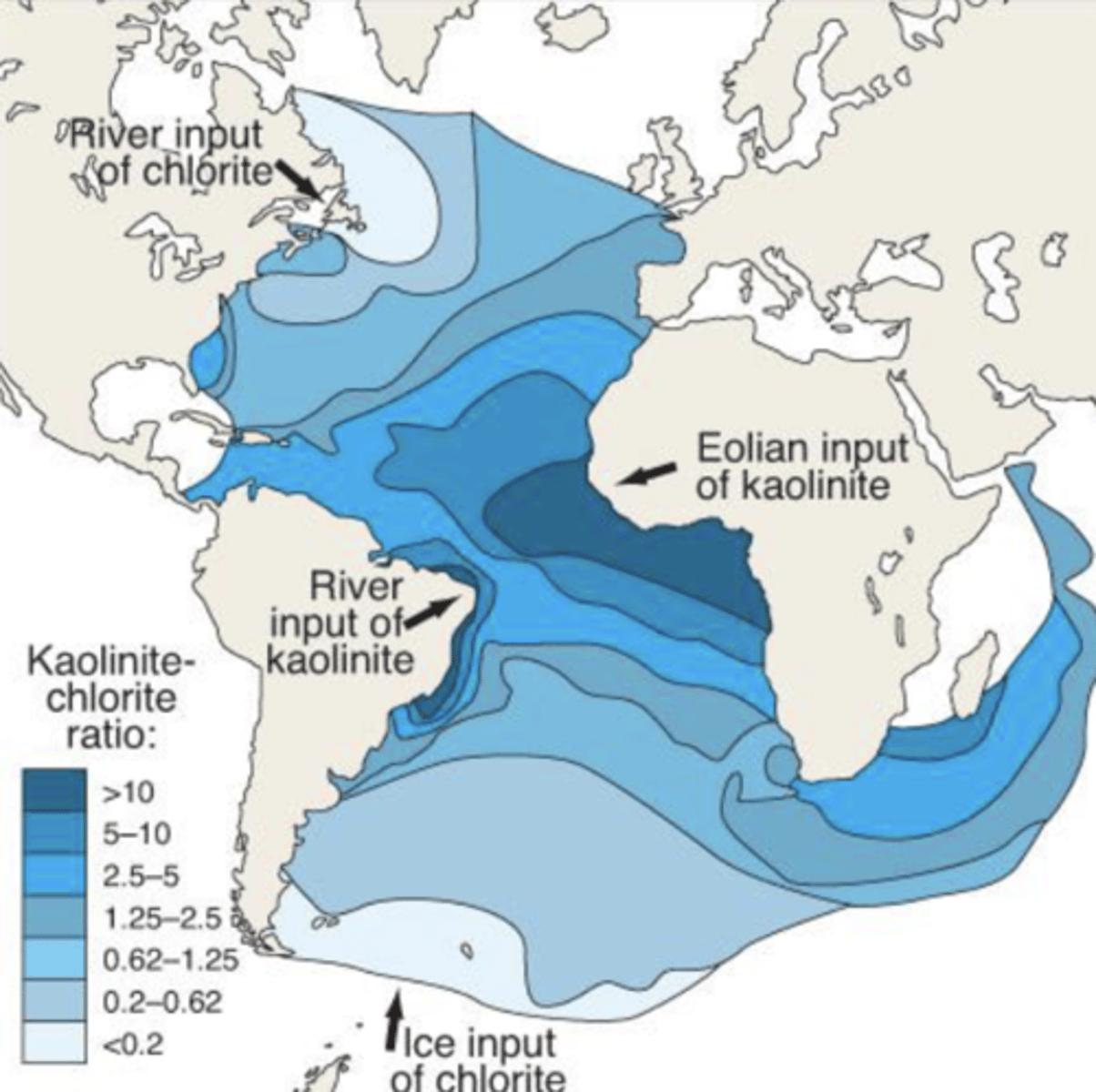
Why were aeolian sediments very common during ice age?
Low sea level
How do clay minerals change with latitude? Why is this important?
Kaolinite results from chemical weathering -> low lats
Chlorite is made from grinding of rocks -> glacial, high lats
Important because we can determine latitude of sediment source
Why is volcanic ash commonly found in red clays from periods of major eruptions?
Ash is relatively minor sed, so only noticeable in places where there is no other major sed source -> aeolian dominated red clays
What are tektites?
Glassy gravels formed and ejected during meteorite impacts
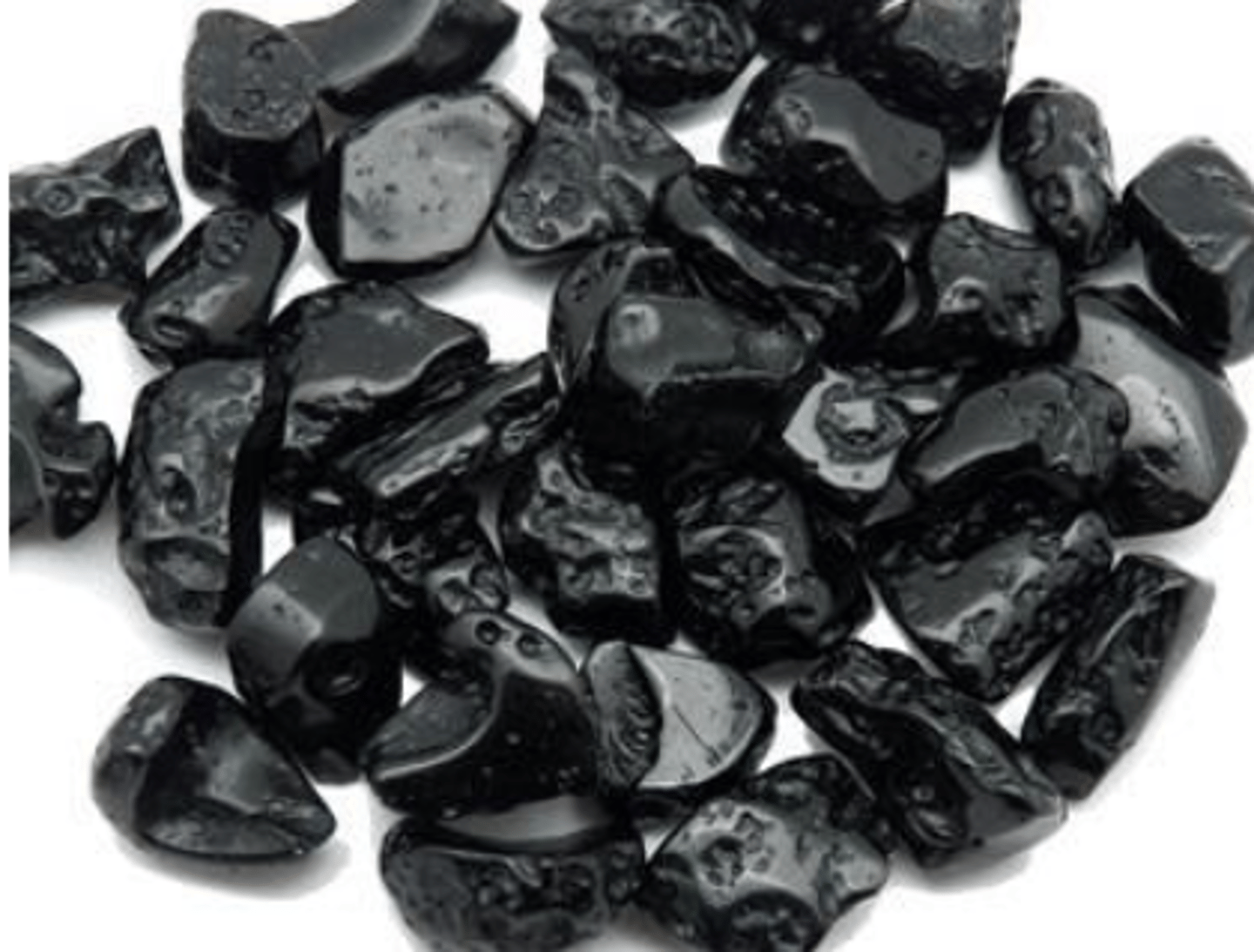
How can marine geology tell us if an extinction is due to volcanism vs meteorite?
Meteorite has irridium
What are 3 authigenic sediments?
Fe-Mn nodules
Phosphorites
Metal sulfides
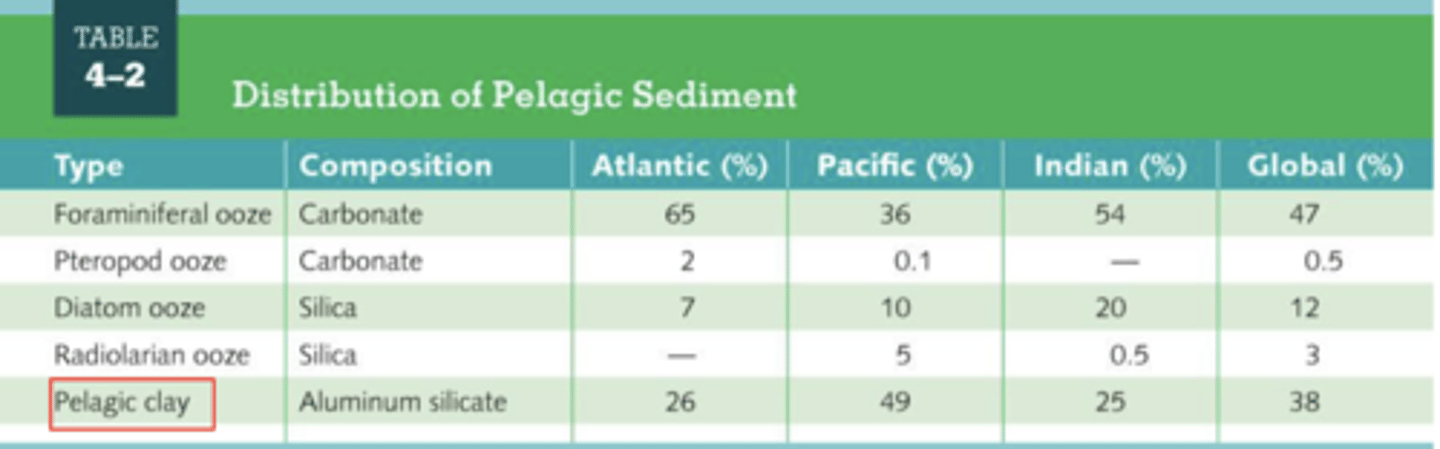
Why is pelagic clay much more dominant in pacific?
Water is older and more acidic, dissolves carbonates
How do you tell if seds are glacial vs riverine or aeolian?
Riverine seds close to river, glacial is not
Aeolian grains very small
What 3 factors determine the distribution of biogenic oozes?
Rates of production in surface waters
Rates of dissolution in water column
Rates of dilution by terrigenous seds
What is an ooze?
>35% biogenic by volume
How quickly do oozes typically accumulate?
1-10cm/kyr
What are 2 silicious organisms?
Diatoms
Radliolarrans
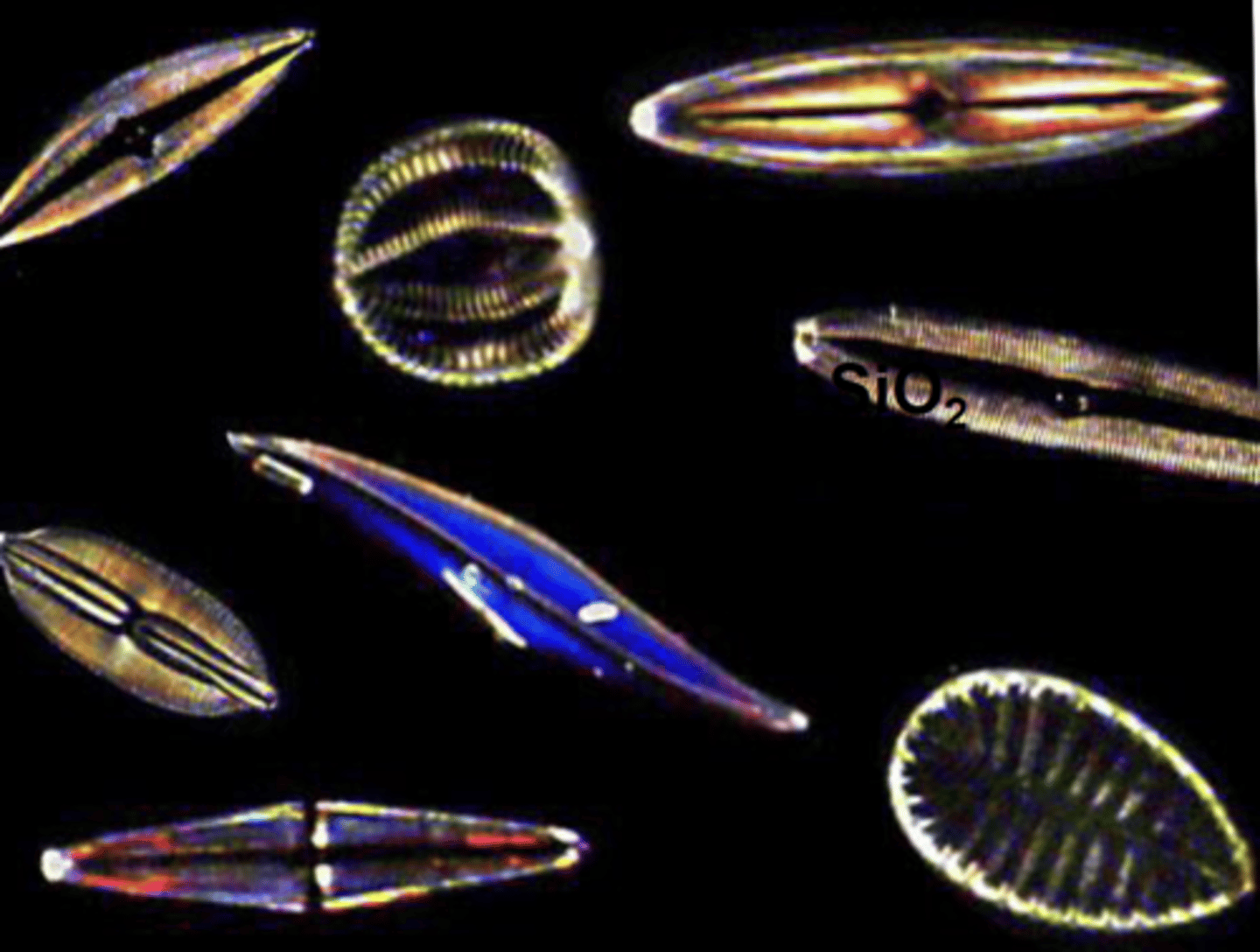
What are diatoms? Where are they abundant?
Single cell algae. Abundant in cold nutrient rich surface waters at high lats and upwelling zones
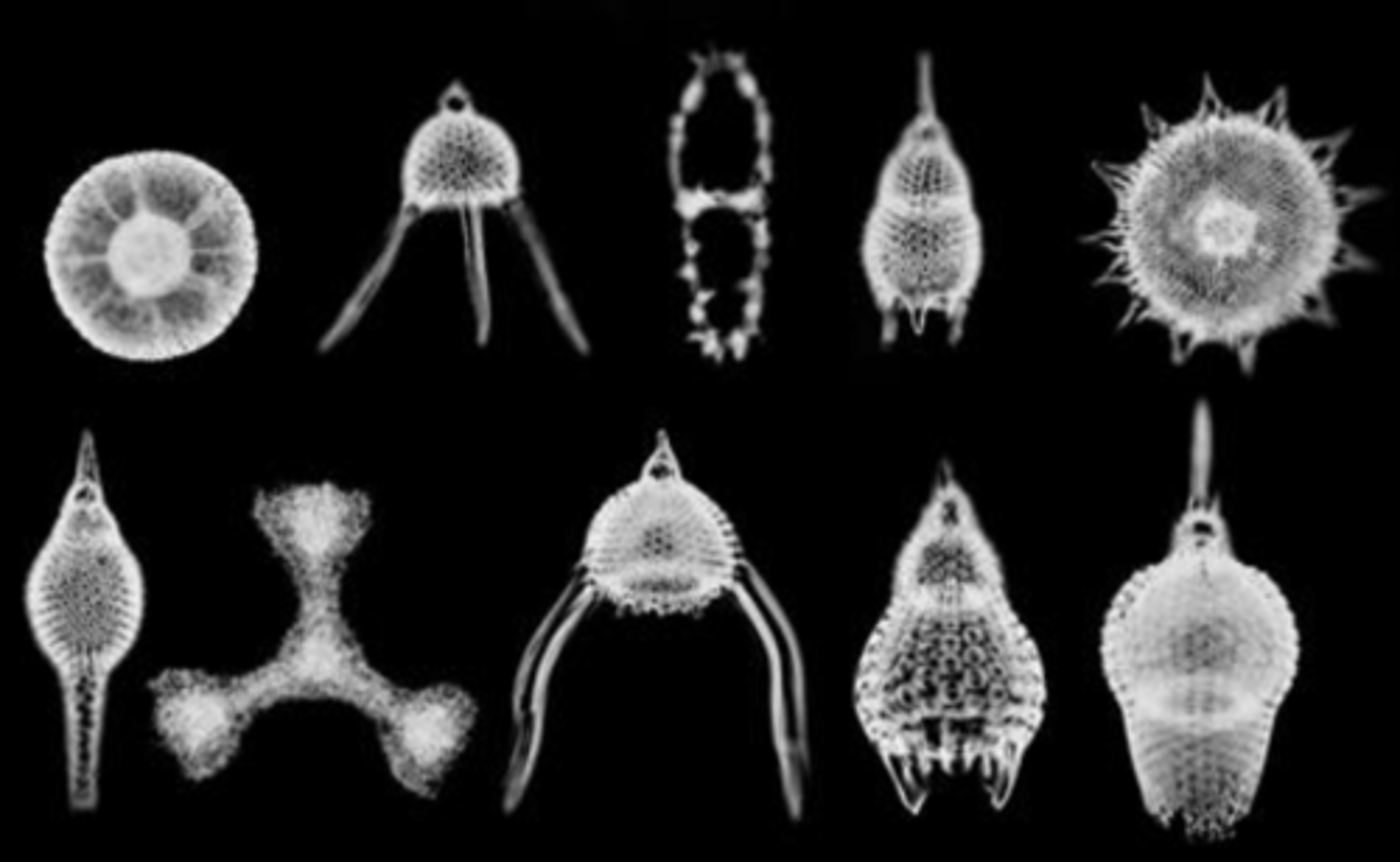
What are radiolarians? Where are they abundant?
Amoeba-like protists that fish with strands of cytoplasm -> not limited to surface waters, prefer warm waters
Explain dissolution of silica in water column
Dissolves at surface because low saturation, doesnt dissolve at depth because water is more saturated
Where do silicious sediments dominate?
Only in regions with highest silica production
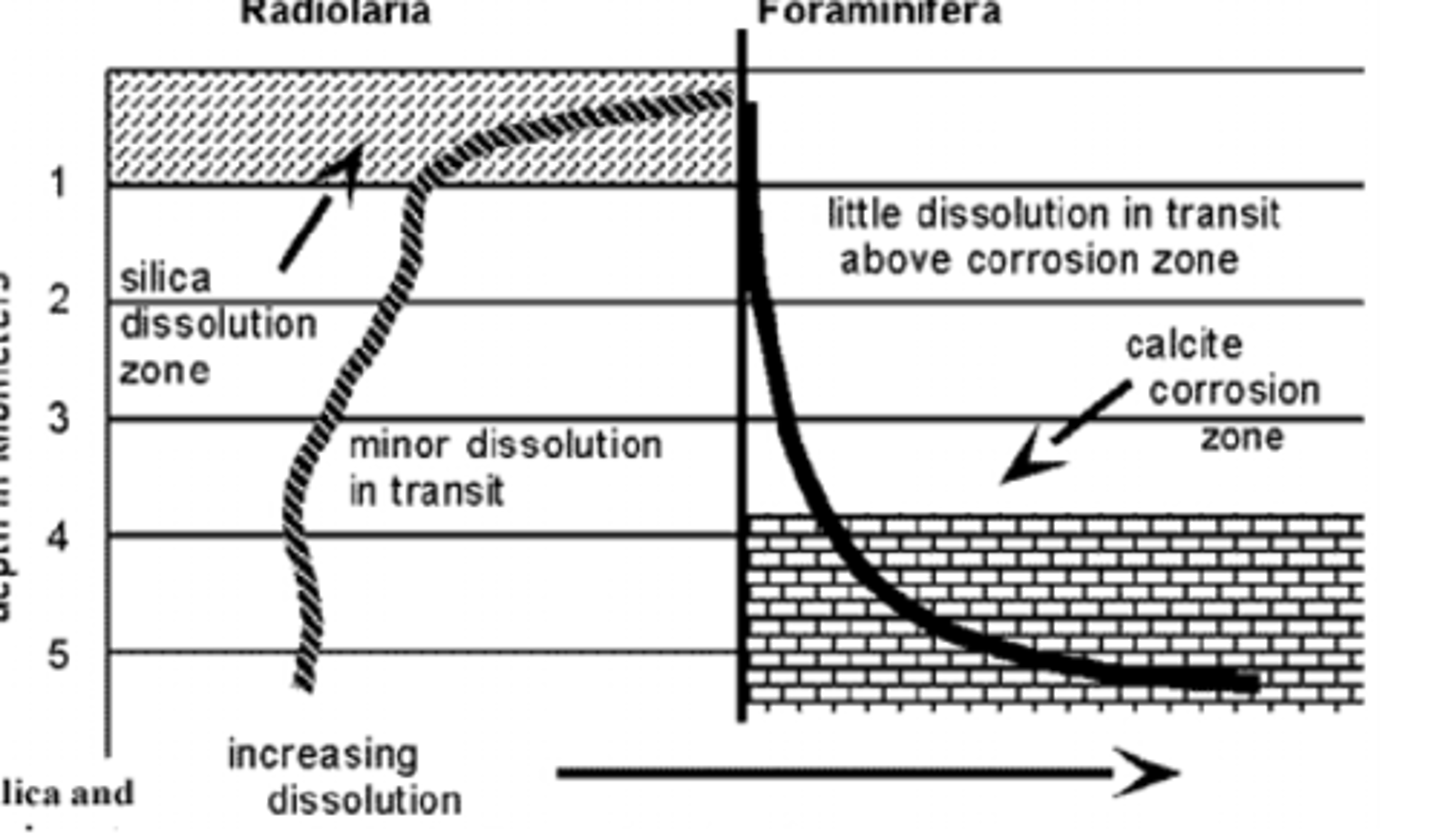
Why is silica undersaturated in surface?
Because organisms use it and die and sink
Why is surface silica high around Antarctica and Alaska?
High Si from glacial erosion and upwelling
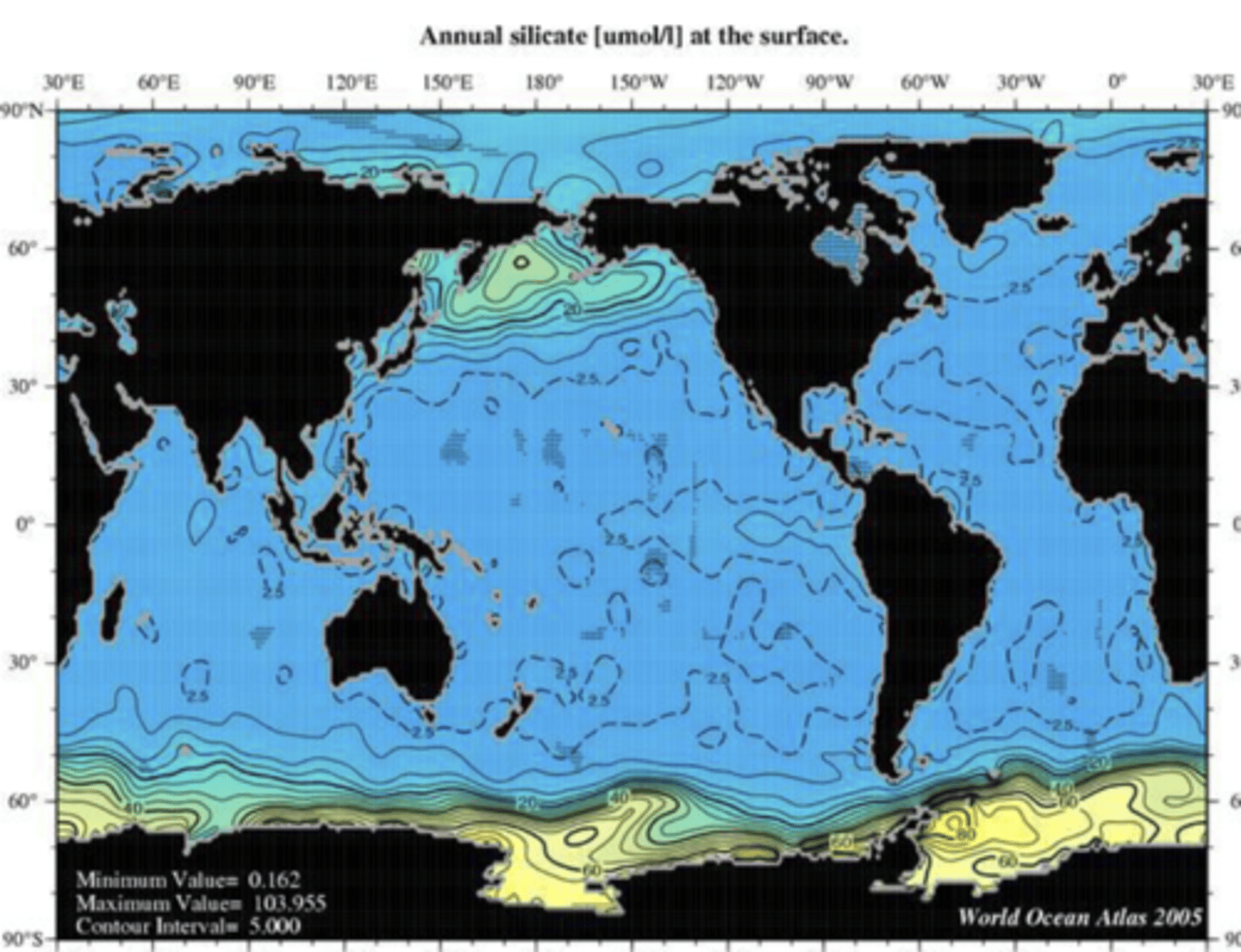
How can silicious organisms accelerate glaciation?
During glaciation there is more weathering on land because less plants -> wind brings silica and rust (Fe) -> diatom growth, CO2 removed from atm
Why does CO2 decrease during glaciation despite there being fewer plants so less CO2 uptake on land?
Because fewer plants = more erosion = more diatoms which remove CO2
What is chert?
Microcrystalline quartz formed when silicious ooze dissolves and reprecipitates on ocean floor
What are 4 calcareous organisms?
Coccolithophora (low Mg calcite)
Forams (low Mg calcite)
Pteropods (aragonite)
Ostracods
What are the 2 forms of CaCO3? How do they differ?
Calcite: less soluble, but physically weaker
Aragonite: more soluble, but physically stronger
Explain Ca/Mg in calcite
Mg subs for Ca, substitution increases in warmer water, so Mg/Ca can be used as temp proxy.
Rank low Mg calcite, high Mg calcite, and aragonite from least to most soluble
Low Mg calcite < aragonite < high Mg calcite
What organisms are high-Mg calcite?
Coralline algae
Why are corals most susceptible to ocean acidification?
Coralline algae made of high-Mg calcite which dissolves easiest so they die
What organism is the biggest supplier of calcareous sediments?
Forams
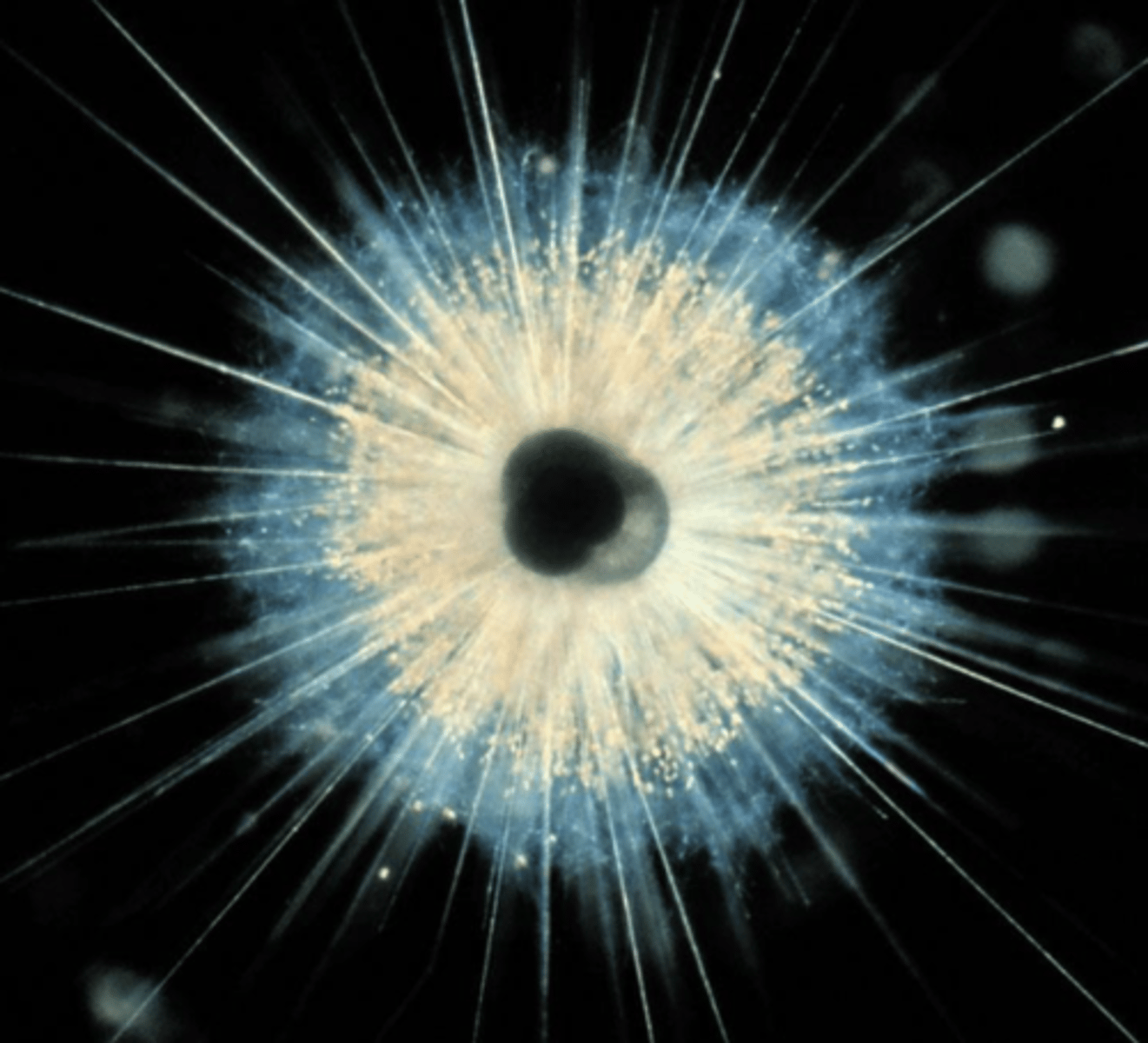
What are forams? Where are they abundant?
Amoeba-like protists (similar to radiolarans). Low Mg calcite. Not limited to surface waters
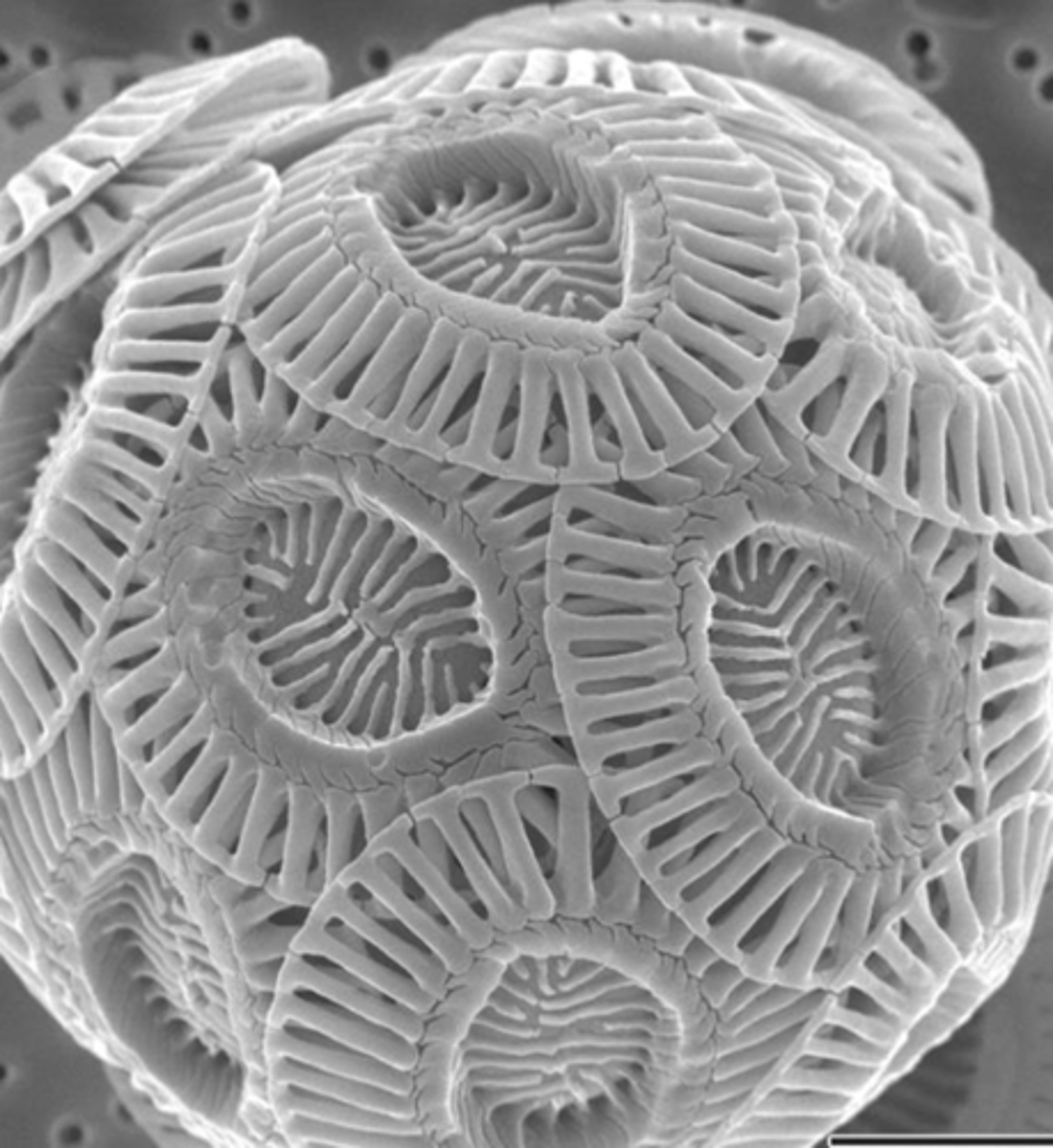
What are coccolithophores? Where are they abundant?
Single cell algae. Low Mg calcite. Abundant in warm shallow water.
What are pteropods? Where are they abundant?
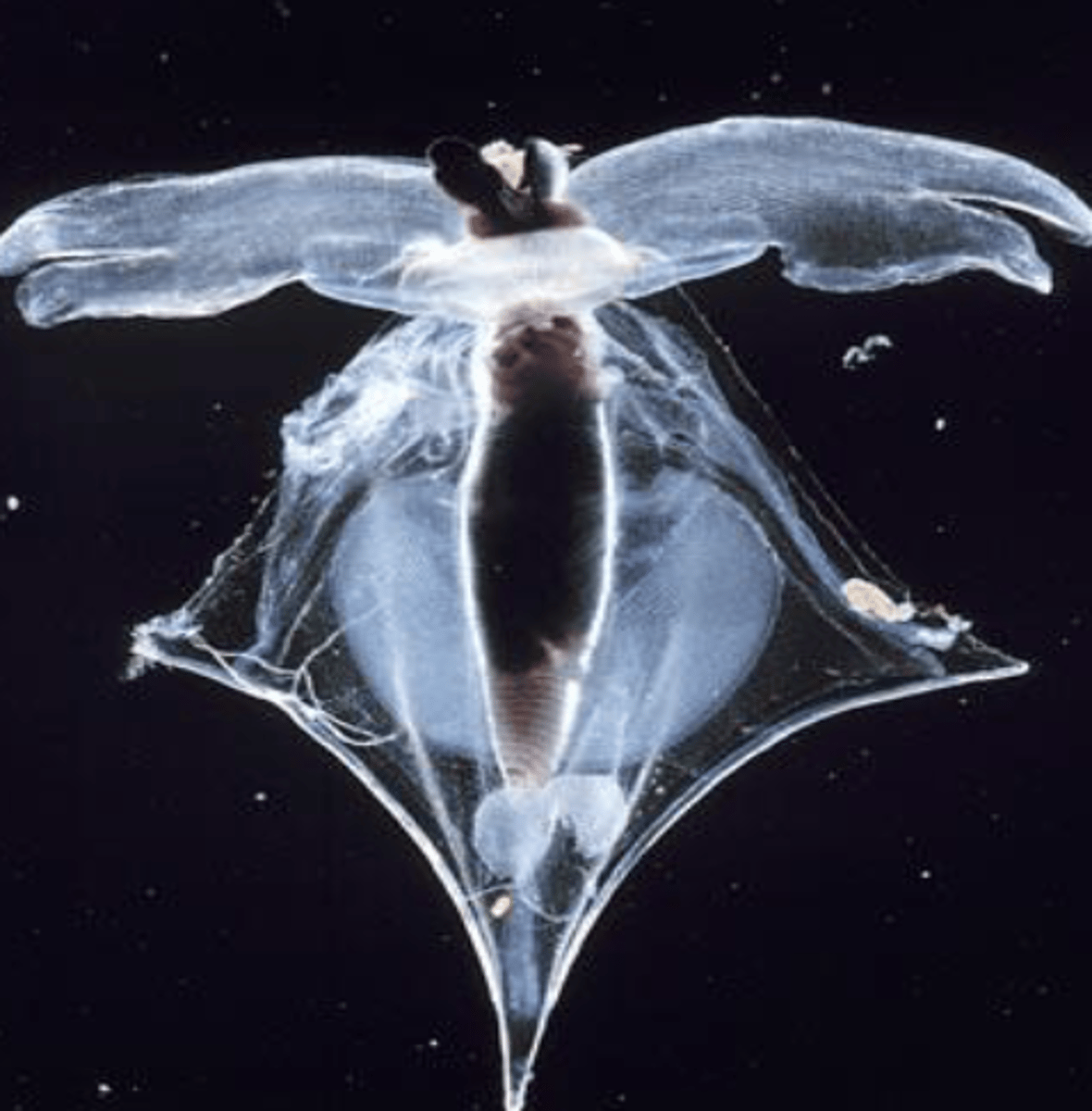
Small pelagic snails. Aragonite. Only shallow warm waters because aragonite is very soluble
Explain saturation index, Ω.
Tells us the solubility of CaO3.
Ω > 1 = oversaturated, no dissolution
Ω < 1 = undersaturated, dissolution
What affects Ω?
Ω decreases with lower temp, higher CO2 (acidity), and greater depth
What is the lysocline?
Depth below which water becomes undersaturated in CaCO3 and dissolution greatly increases
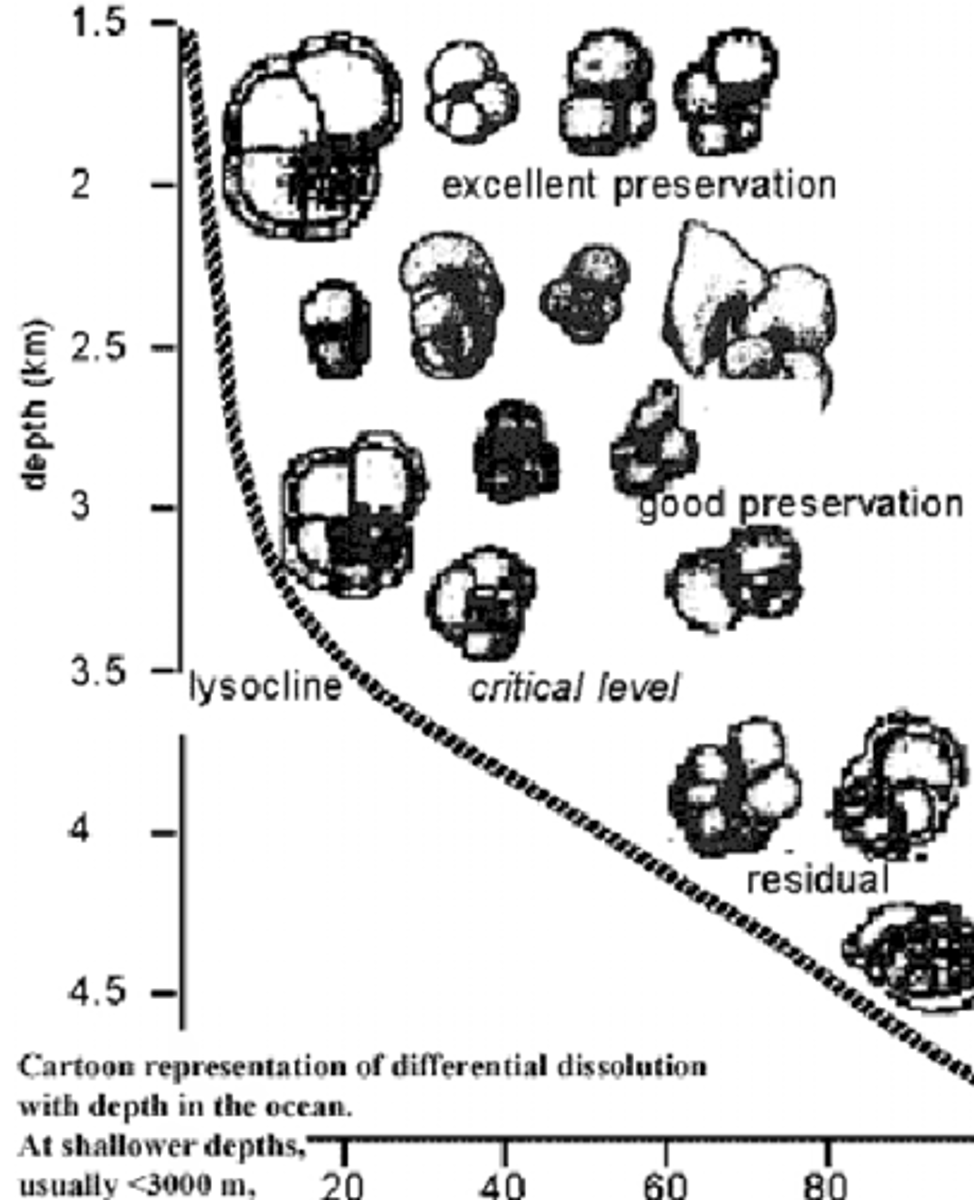
What is CCD (carbonate compensation depth)?
Depth where dissolution outpaces supply, so no CaCO3 accumulates
View how the aragonite lysocline is much higher than the calcite lysocline
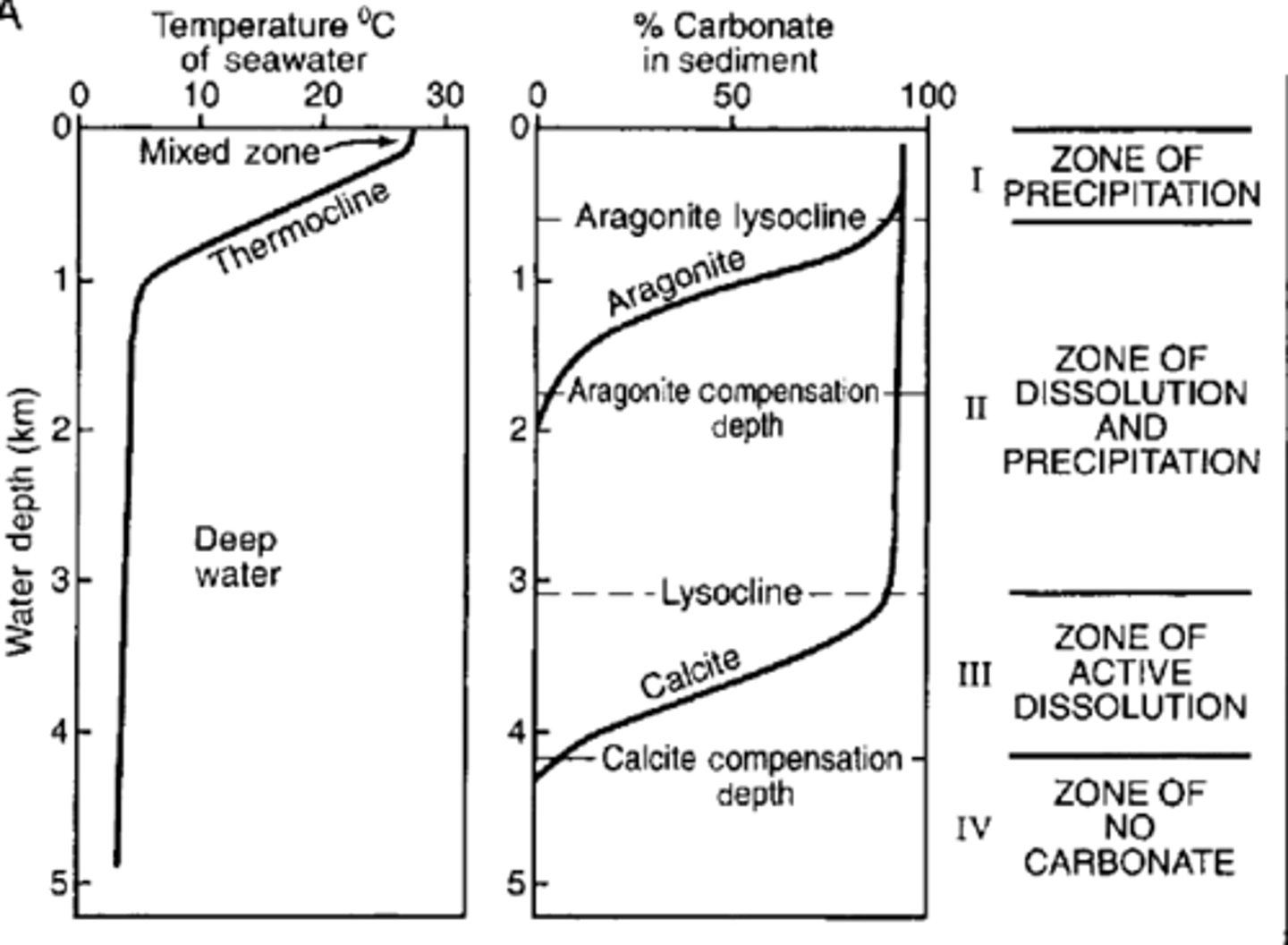
Why are calcareous sediments found in warm water?
Because calcite is less soluble at higher temp
Why is calcite not found in deep ocean?
Because solubility increases with depth as temperature decreases and acidity increases -> CCD
Why is CCD higher around the poles?
Because solubility increases with colder temp
Why is CCD higher in Pacific than Atlantic?
Because of THC, pacific water much older so more acidic
View how the aragonite saturation depth is much higher than calcite because aragonite is more soluble
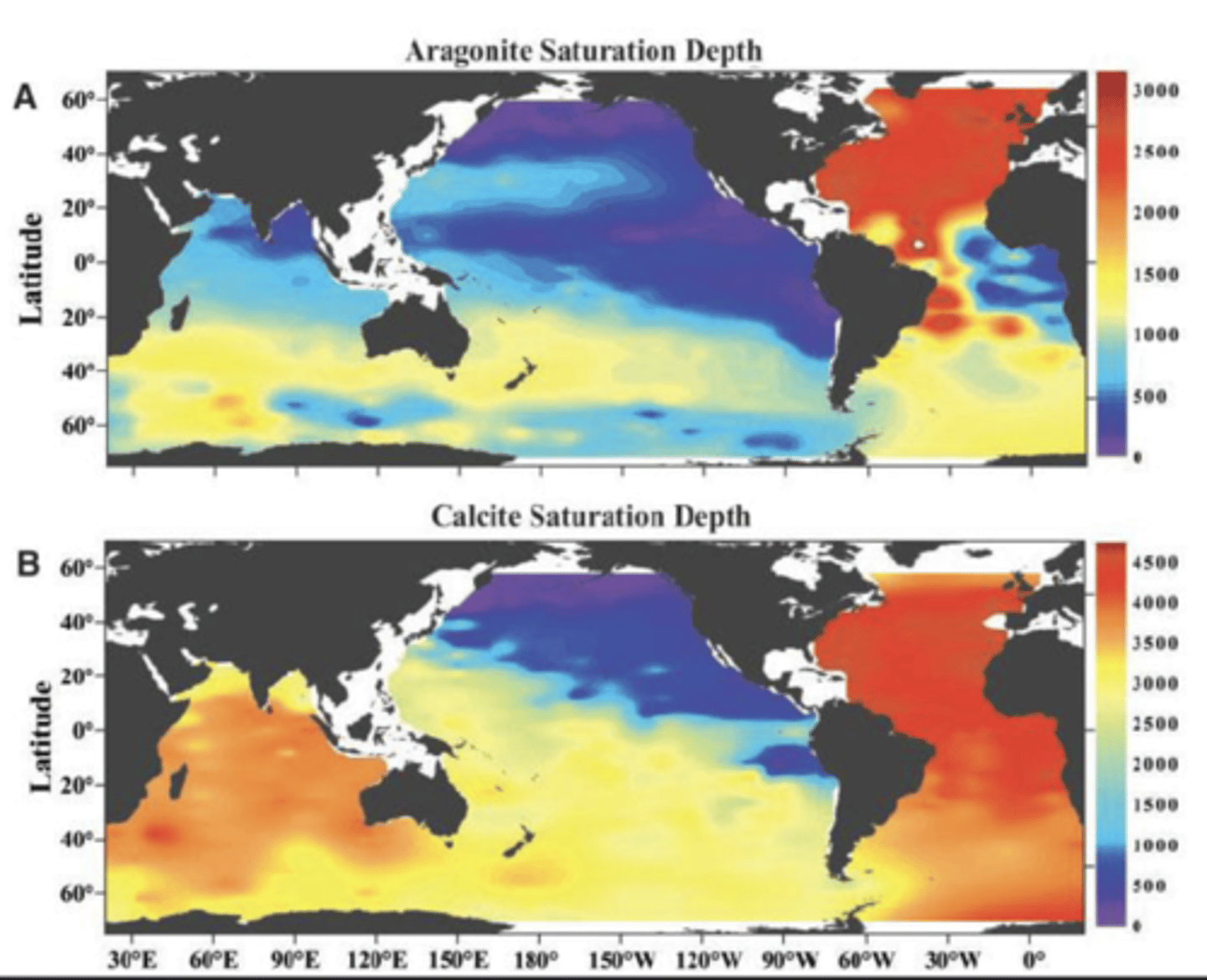
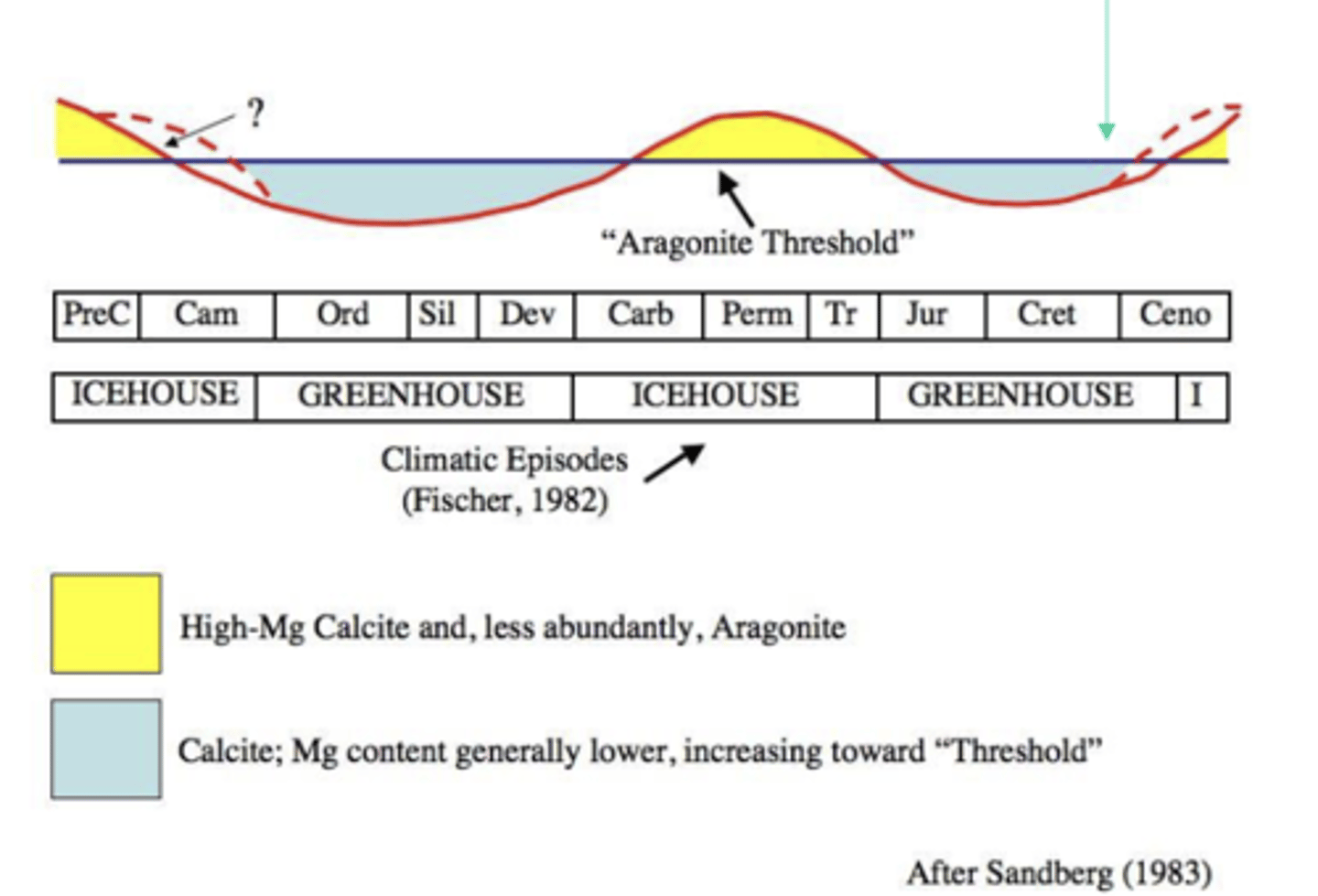
What determines whether there are calcite seas vs aragonite seas?
Calcite dominates in greenhouse because high CO2. Aragonite and high Mg calcite forms when colder because less CO2.
Algae and silt should take years to sink but instead they take weeks
They travel in fecal pellets and gelatinous larvacean houses
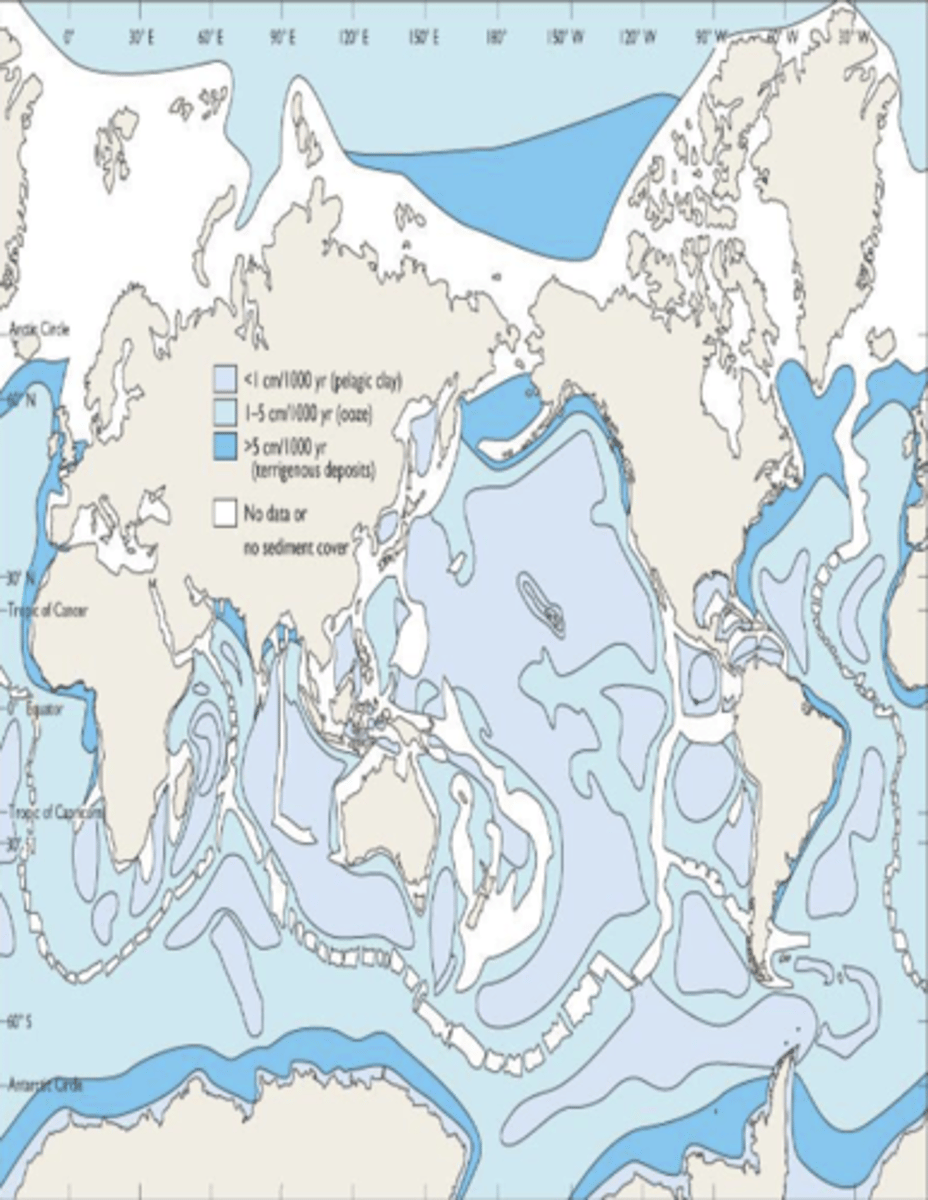
Where are sediment rates the slowest (<1cm/ky)?
Places where pelagic clay dominates due to no other sediment source
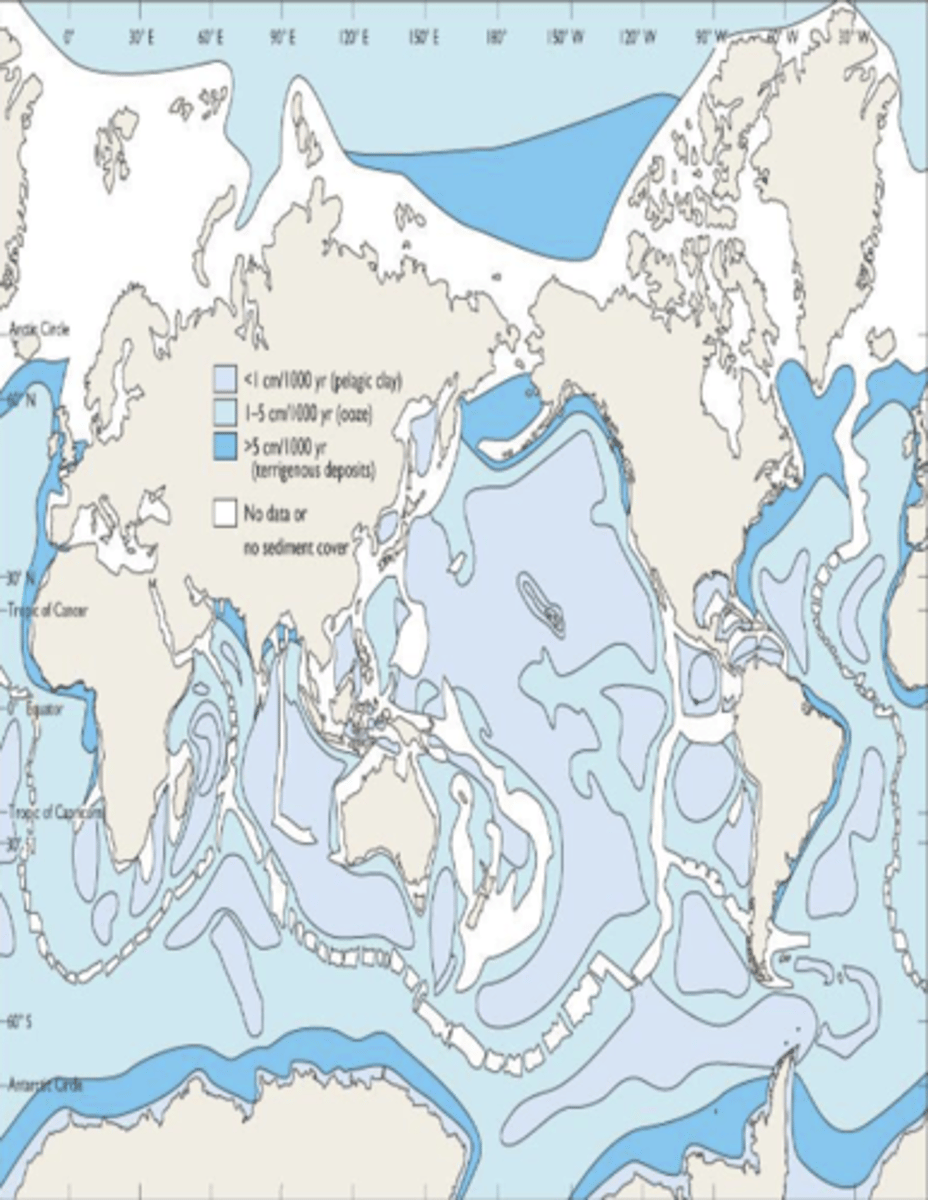
Where are sediment rates intermediate (1-5cm/ky)?
Places where oozes dominate (both Ca and Si) like shallow water, warm water, upwellings
Where are sediment rates the highest (>5cm/ky)?
Terrigenous deposits
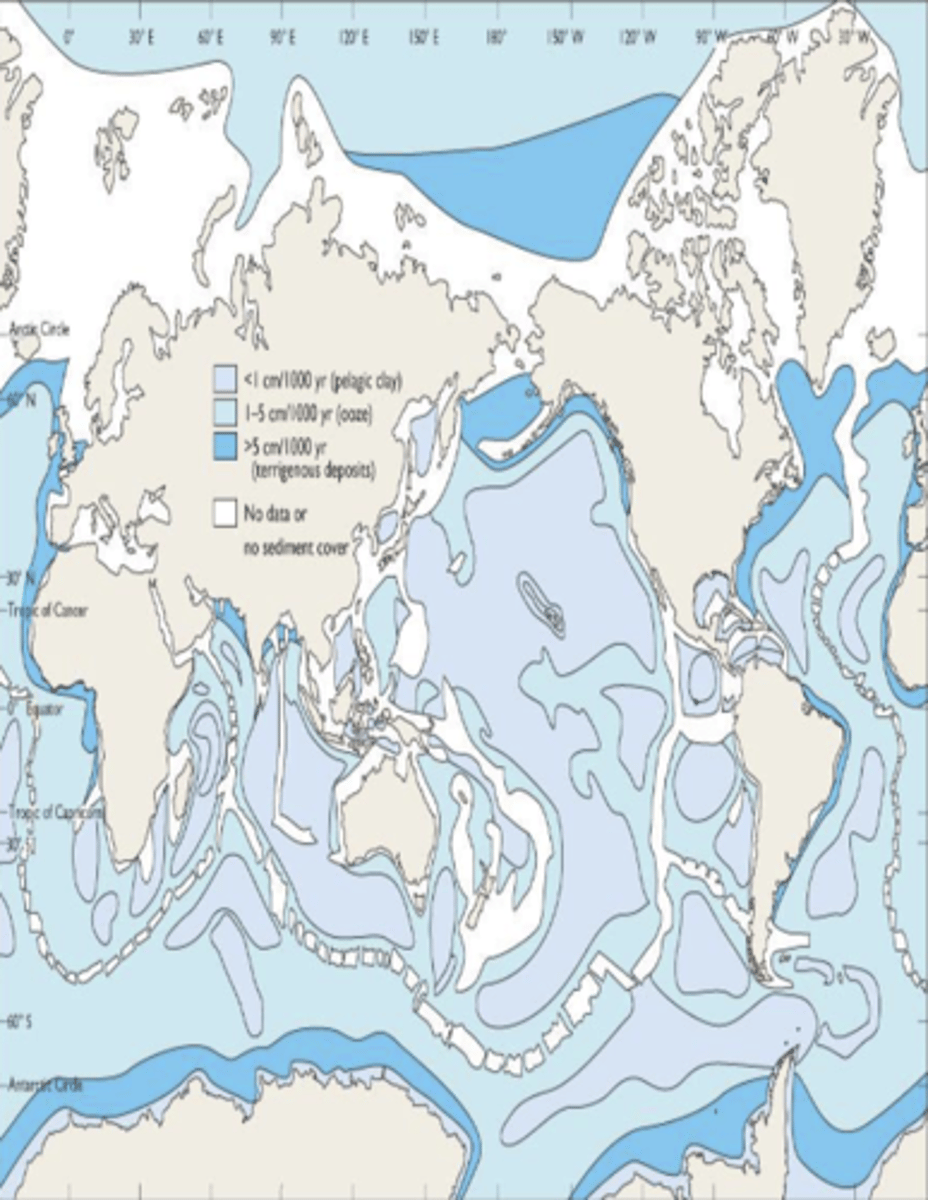
Where is there no available data of sediment rates?
MOR because rocks are steep so seds dont build up
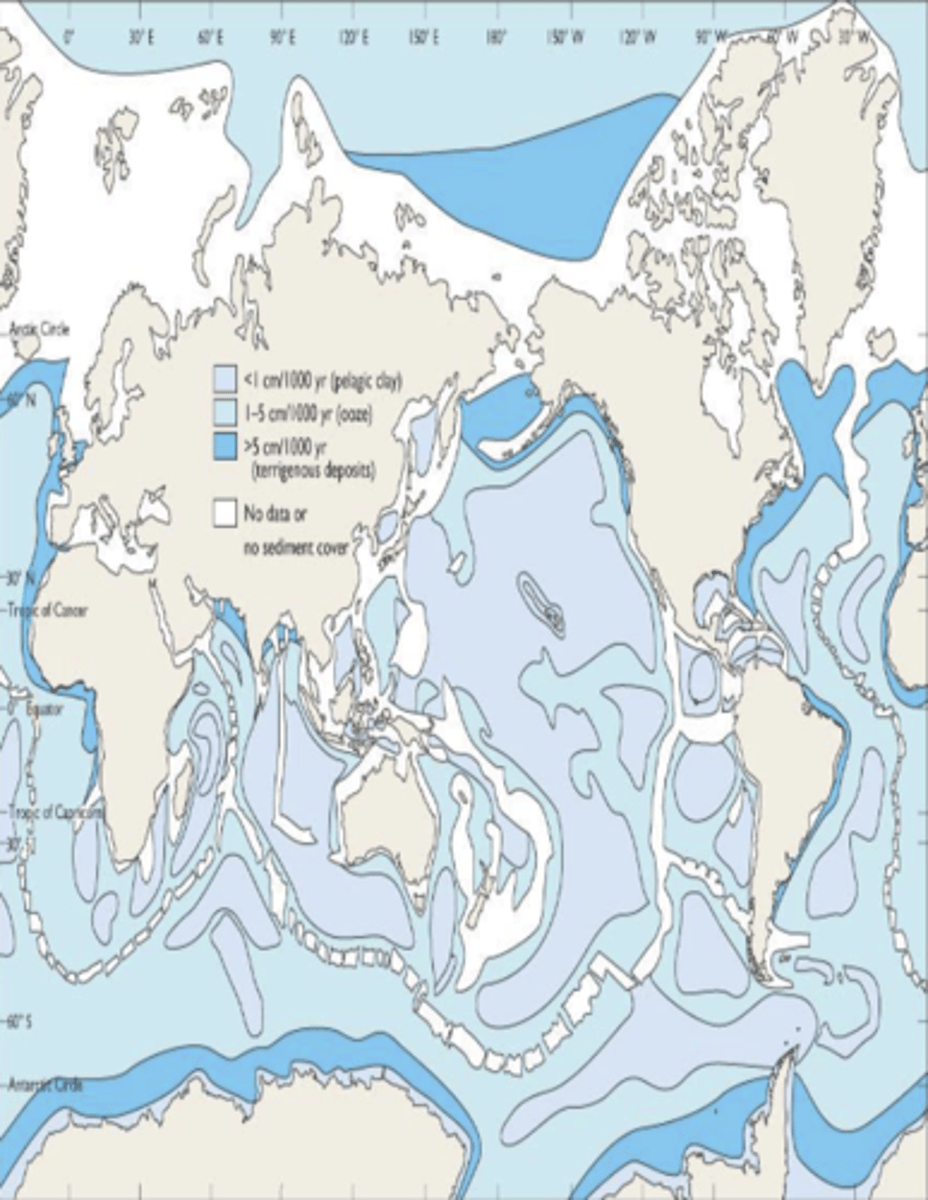
How do you calculate ocean sed thickness?
Sed rate x time
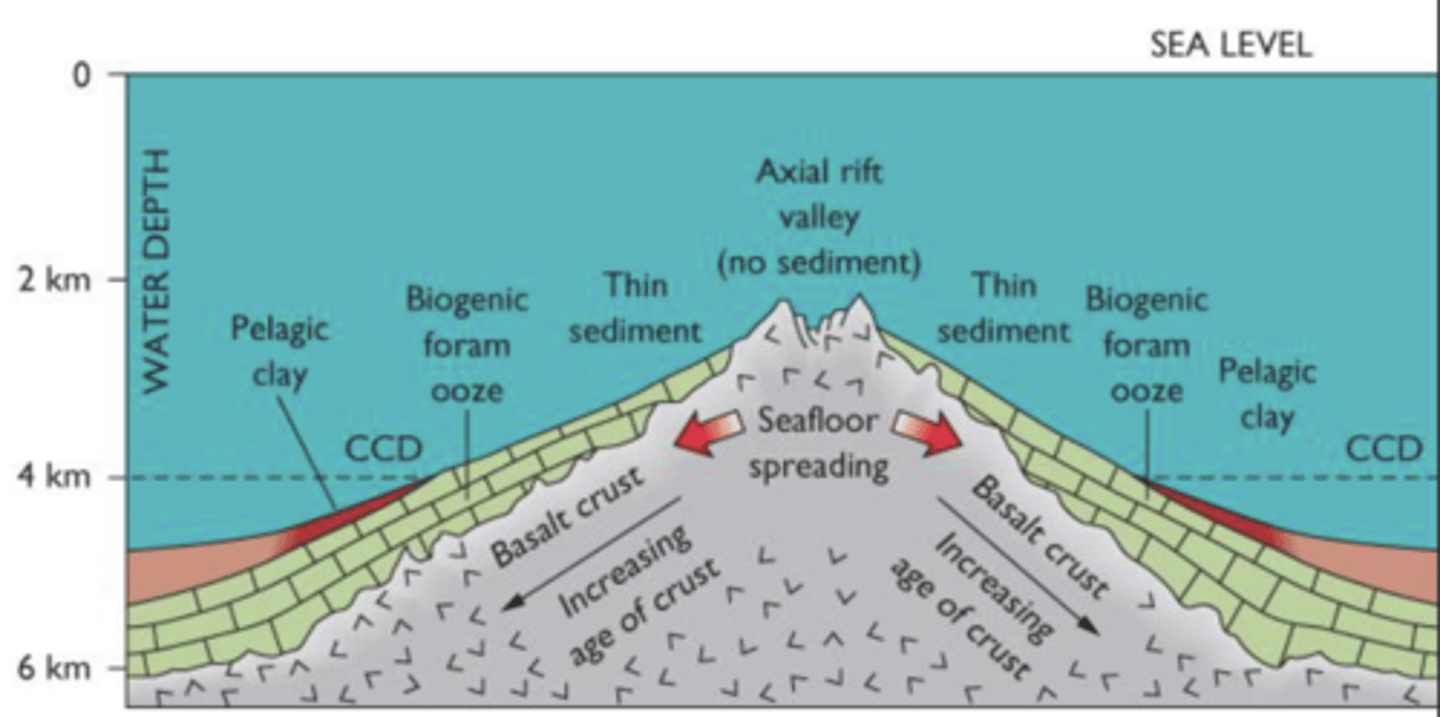
Why is Atlantic sediment like a 2 layer cake?
Around MOR rocks are higher, above CCD - Calc forams
Away from MOR rocks are lower, below CCD - pelagic clay
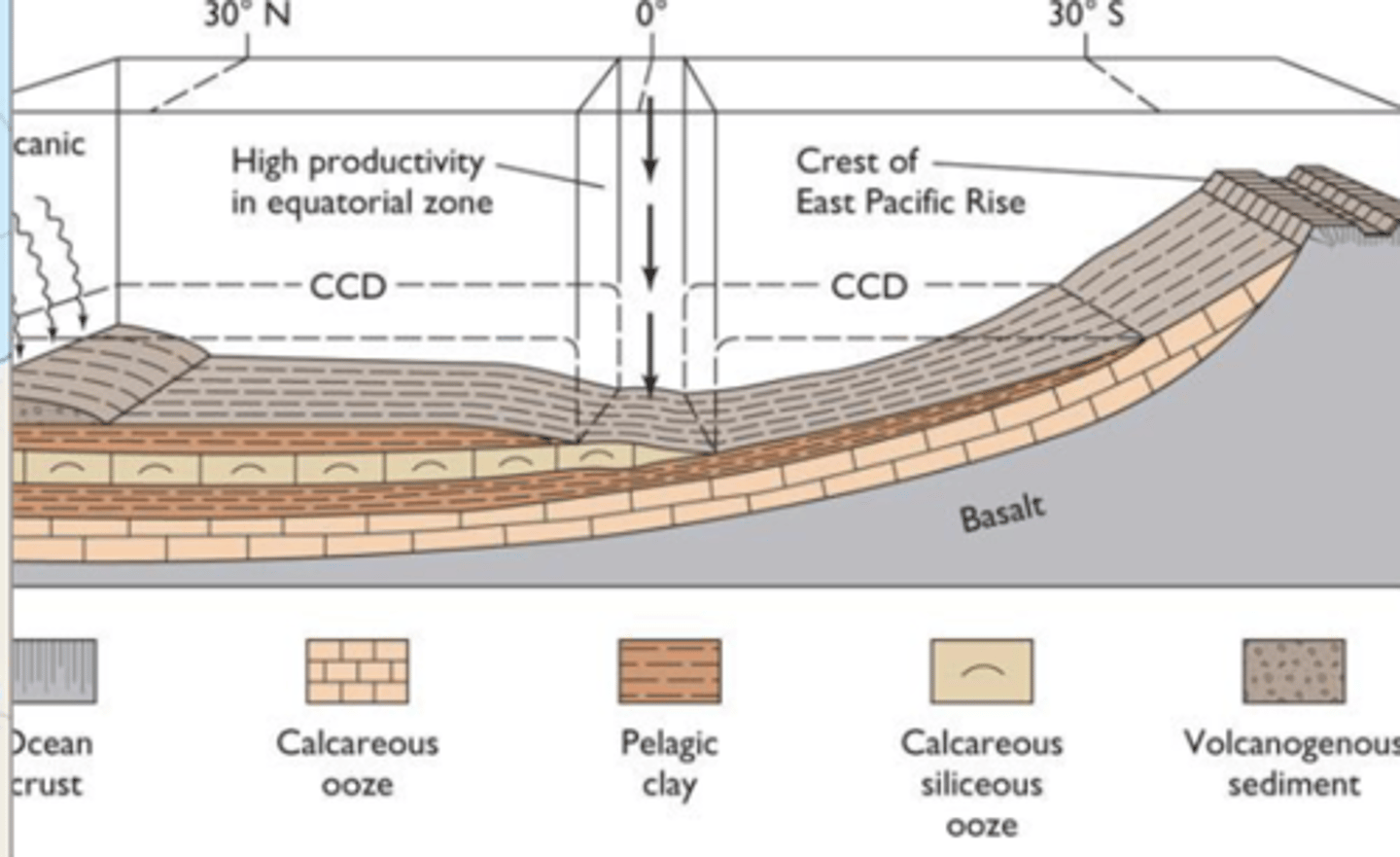
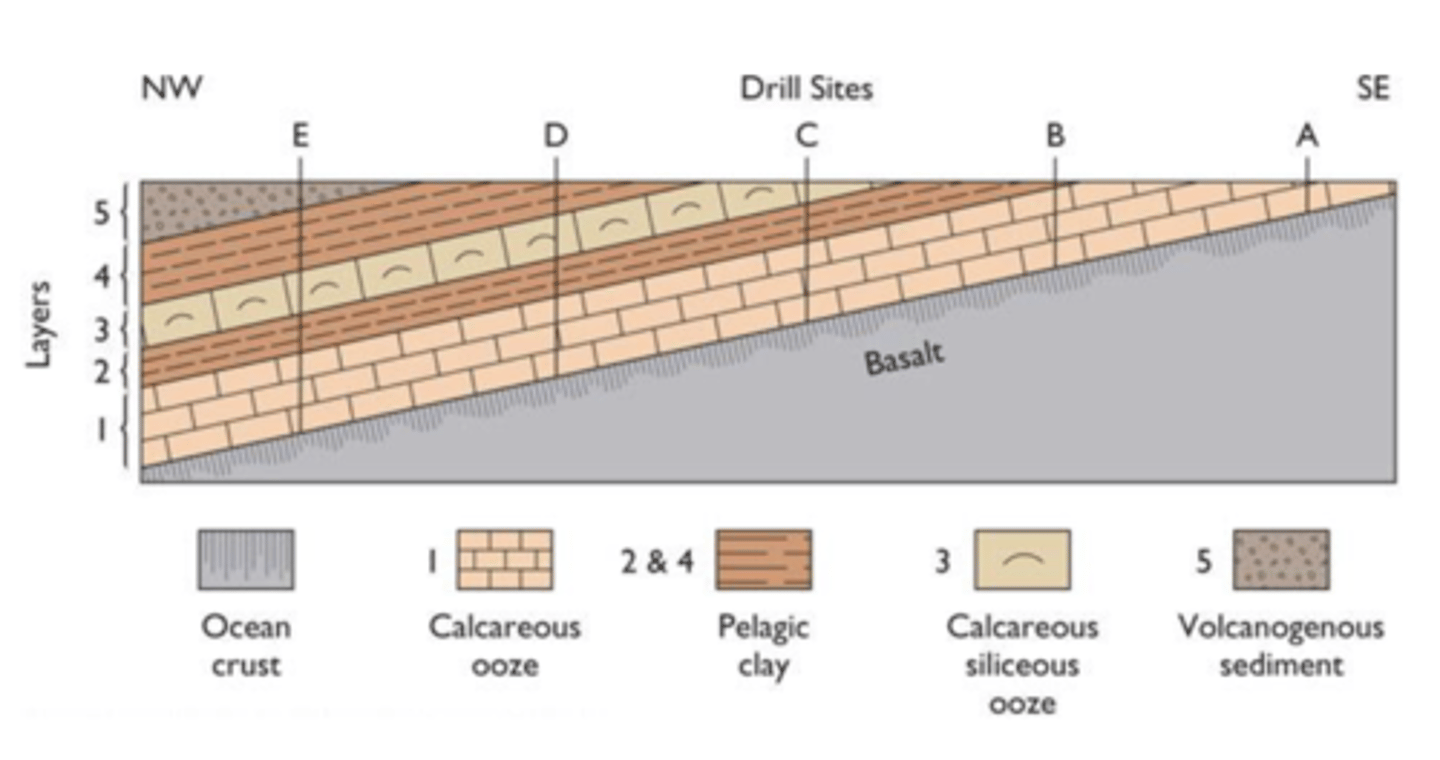
Why is Pacific sediment like a 5 layer cake? Note that the cross-section goes from SE-NW pacific
1) Ca ooze near MOR
2) Pelagic clay away from MOR
3) Ca-Si ooze at equator
4) Pelagic clay away from equator
5) Volcanogenous and terrigenous seds at volcanic arc
Why is there Ca-Si ooze at Pacific equator despite depth being far below regular Pacific CCD?
High productivity neutralizes water as shells dissolve, preventing further dissolution and lowering the CCD along the equator