A306 Exam 3
 Call Kai
 Learn
Learn Practice Test
 Spaced Repetition
 Match
Match Flashcards
 Knowt Play
1/267

There's no tags or description
Looks like no tags are added yet.
Name | Mastery | Learn | Test | Matching | Spaced | Call with Kai |
|---|
No analytics yet
Send a link to your students to track their progress
268 Terms
Questions to ask when preparing each budget:
ØWhat should the starting point be? What other inputs are needed?
ØIs a beginning balance (or inventory) relevant?
For budgets that include inventory:: ØWhen calculating quarterly values for beginning and ending inventory, you cannot sum the____– beginning inventory reflects the value at the ____and ending inventory reflects the value at the ___
individual monthly values, beginning of the quarter , end of the quarter
For budgets that focus on cash:
ØBe careful to differentiate between
cash sales/purchases (that occur immediately) and credit sales/purchases (that occur later)
For budgets that focus on cash:ØBe careful to exclude
non-cash items (e.g., depreciation)
Operating Budgets
Sales Budget, Purchases Budget
Financial Budgets
Cash Receipts Budget, Cash Budget, Cash Payments Budget
Sales revenue =Sales budget
budgeted sales unit times selling price
ØDesired ending inventory =Purchases budget
20% of next month’s sales
Budgeted sales (units) is from the - Purchases budget
sales budget
Budgeted sales (Q1) =Purchases budget
SUM
total units needed=Purchases budget
budgeted sales (units) + ending inventory
total cost of purchases =Purchases budget
budgeted purchases (units) times cost per unit
budgeted purchases (units)=Purchases budget
total units needed-beginning inventory
Beginning inventory in January
= Ending inventory in
= 20% of ___ budgeted sales, Purchases budget
December, January’s
Beginning inventory
Purchases budget=
previous month’s ending inventory
Beginning inventory (Jan)
=
Beginning inventory (Q1)
Ending inventory (Mar)
=Purchases budget
Ending inventory (Q1)
Cash receipts
(collections) budget: Note: Add down the columns to determine the amount of
cash collected each month
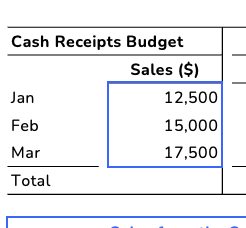
Cash receipts
(collections) budget
Sales from the Sales Budget
ØCollected in the…Cash receipts
(collections) budget
cash/sum of cash
The total cash collections for Q1 is the sum of all cash collections in___ Cash receipts
(collections) budget
Jan, Feb, and Mar
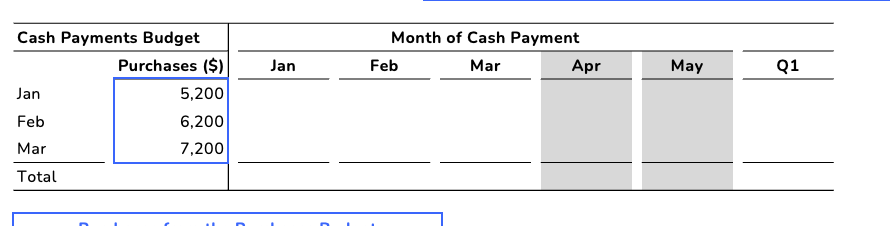
Cash payments
(disbursements) budget
Purchases from the Purchases Budget: Note: Add down the columns to determine the
amount of cash paid in each month
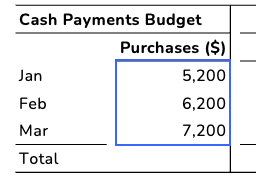
Purchases from the Purchases Budget
month of cash payment =Cash payments
(disbursements) budget
paid in the same month (or second month) % times purchases
The total cash payments for Q1 is the sum of all- Cash payments
(disbursements) budget
cash payments in Jan, Feb, and Mar
cash collections is from - Cash budget
From the Cash Receipts (Collections) Budget
cash payments is from - Cash budget
From the Cash Payments (Disbursements) Budget
A line of credit is available:Cash budget
borrowing, repayment
A line of credit is available: borrowing occurs ____;- Cash budget
at the beginning of the month
A line of credit is available: repayment occurs at the ___ (as soon as ____ is available)- Cash budget
end of the month, sufficient excess cash
Borrowing- Cash budget
= Minimum cash balance – excess (deficiency)
Beginning cash balance (Feb)
=Cash budget
Ending cash balance (Jan)
Interest=Cash budget
repayment of principal times interest rate
Beginning cash balance (Mar)
=Cash budget
Ending cash balance (Feb)
Beginning Q1 cash =Cash budget
Beginning Jan cash
Ending Q1 cash =Cash budget
Ending Mar cash
Sales revenue: Budgeted income statement
From the Sales Budget
COGS: Budgeted income statement
Number of units × cost per unit
sales revenue - cogs- Budgeted income statement
gross margin
gross margin- S&A expenses =Budgeted income statement
net operating income
net operating income- interest expense =Budgeted income statement
net income
S&A:Budgeted income statement
(Number of units × variable $ per unit) + fixed $
Interest is From the; Budgeted income statement
Cash Budget
Q1 = SUM( ____ )- Budgeted income statement
Jan, Feb, Mar
Operating Budgets
Sales Budget, Materials Purchases Budget, Production Budget, OH Budget, Direct Labor Budget, S&A Expense Budget, COGS Budget, Budgeted Income Statement
Financial Budgets
Cash Receipts Budget, Cash Payments Budget, Investing and Financing Budgets, Cash Budget, Budgeted Balance Sheet
Budgeted Income Statement, what adds into here
everything in operating budget
Cash Receipts Budget- what adds into here
sales budget
Cash Budget- what adds into here
Cash Receipts Budget, Cash Payments Budget, Investing and Financing Budgets
Budgeted Balance Sheet- what adds into here
everything in financial budget
Cash Payments Budget- what adds into here
Expense
what adds into here- COGS Budget
Materials Purchases Budget, Direct Labor Budget, OH Budget,
NOT S&A expense budget
what adds into here- Production Budget
Sales Budget
Cash budget question
What is the expected timing of cash inflows and outflows?
How much cash needs to be borrowed/repaid (including interest)?
Selling & administrative expenses budget question
How much are expected S&A costs?
Manufacturing overhead budget question
How much are expected OH costs?
rect labor budget question
How many DL hours are needed to meet production needs?
Materials purchases budget question
How much material do we need to purchase to meet production needs?, How much material do we need as ending inventory?
Production budget question
How many units do we expect to make?
How many units do we expect to need as ending inventory?
Sales budget question
What are expected sales (units & selling price)?
How much revenue do we expect to generate?
Starting point: for Sales budget
Sales forecasts
Sales forecasts
ØManagers use a variety of information to determine the sales forecast including
Sales forecasts- ØManagers use a variety of information to determine the sales forecast including
ØActual sales for the preceding period
ØResearch on overall industry trends
ØInput from top management about target sales objectives
ØInput from R&D about new product introductions, new features of existing products
ØPlanned marketing activities
Sales forecasts- ØManagers use a variety of information to determine the sales forecast including- Ø___for the preceding period
Actual sales
Sales forecasts- ØManagers use a variety of information to determine the sales forecast including- Research on
overall industry trends
Sales forecasts- ØManagers use a variety of information to determine the sales forecast including- Input from ____about target sales objectives
top management
Sales forecasts- ØManagers use a variety of information to determine the sales forecast including-ØInput from ___ about new ___, new features of ___
R&D, product introductions, existing products
Sales forecasts- ØManagers use a variety of information to determine the sales forecast including-ØPlanned ___
marketing activities
Example:- Starting point: Sales forecasts
ØBagel Bros makes and sells bagels, where each package (unit) has a dozen bagels. Based on market research and sales trends, the company expects to sell:
ØJan – 5,600 units
ØFeb – 6,000 units
ØMar – 6,600 units
ØApr – 7,600 units
ØMay – 7,600 units
ØThe expected selling price is
$25 per unit.
budgeted sales times selling price =
sales revenue
apr and may are
Needed for subsequent budgets
Questions addressed by the Production Budget:
ØHow many units do we expect to make?
ØHow many units are needed as ending FG inventory?
Starting point: ___(from the Sales Budget)
Budgeted unit sales
ØBeginning and ending ___need to be considered in Budgeted unit sales (from the Sales Budget)
FG inventory
Example (continued):- Budgeted unit sales (from the Sales Budget)- ØBeginning and ending FG inventory need to be considered
ØBagel Bros’ inventory policy is to have ending FG inventory equal to 5% of next month’s sales.
budgeted production =Production budget
budgeted sales +ending inventory -beginning inventory
Ending inventory = ___ of next month’s budgeted sales in Production budget
%
Beginning inventory in January
= Ending inventory in December
=__of January’s budgeted sales in Production budget
%
Beginning inventory = in Production budget
previous month’s ending inventory
in Production budget Beginning inventory (Jan)
=
Beginning inventory (Q1)
in Production budget Ending inventory (Mar)
=
Ending inventory (Q1)
Questions addressed by the Materials Purchases Budget:
ØHow much material do we need to purchase to meet production needs?
ØHow much material do we need as ending inventory?
Starting point___(in units) from the Production Budget
: Budgeted production
Starting point: Budgeted production (in units) from the Production Budget
ØBeginning and ending RM inventory need to be considered
Example (continued):Starting point: Budgeted production (in units) from the Production Budget
ØBeginning and ending RM inventory need to be considered
ØAt Bagel Bros, each unit (dozen bagels) is expected to require 2 pounds of raw material (flour), and the price per pound is expected to be $1.00 per pound throughout the year.
ØManagement wants raw materials on hand at the end of each month to be 10% of the following month’s production needs, and the expected inventory of raw material (flour) on January 1 is 1,124 pounds.
Production Budget, budgeted production units →
material purchases budgeted production (units)
Ending inventory = ___of next month’s materials needed for _ in Materials purchases budget
%,production
materials for production = in Materials purchases budget
budgeted production (units) times materials per unit
materials to purchase = in Materials purchases budget
budgeted production (units) times materials per unit + ending inventory - beginning inventory
total cost of materials = in Materials purchases budget
materials to purchase times cost per pound
Beginning inventory = ___ in Materials purchases budget
previous month’s ending inventory
Beginning inventory in January
= Ending inventory in December
= _____ In Materials purchases budget
% of January’s budgeted sales
Materials purchases budget- Beginning inventory (Jan)
=
Beginning inventory (Q1)
Materials purchases budget-Ending inventory (Mar)
=
Ending inventory (Q1
Questions addressed by the Direct Labor Budget:
ØHow many DL hours are needed to meet production needs?
Starting point: ___ from the Production Budget- Direct labor budget
Budgeted production (in units)
Starting point: Budgeted production (in units) from the Production Budget- Example (continued):
ØAt Bagel Bros, 0.25 hours of direct labor is budgeted per unit, and the average labor rate is expected to be $16.00 per hour.
Budgeted DL time= Direct labor budget
Budgeted production (units) times Labor hours per unit
Budgeted DL cost = Direct labor budget
Budgeted DL time times Budgeted DL cost/DLH