Lecture 7 - Motion Detection
 Call Kai
 Learn
Learn Practice Test
 Spaced Repetition
 Match
Match Flashcards
 Knowt Play
1/55

There's no tags or description
Looks like no tags are added yet.
Name | Mastery | Learn | Test | Matching | Spaced | Call with Kai |
|---|
No analytics yet
Send a link to your students to track their progress
56 Terms
Define motion.

Explain how you build a motion detector.
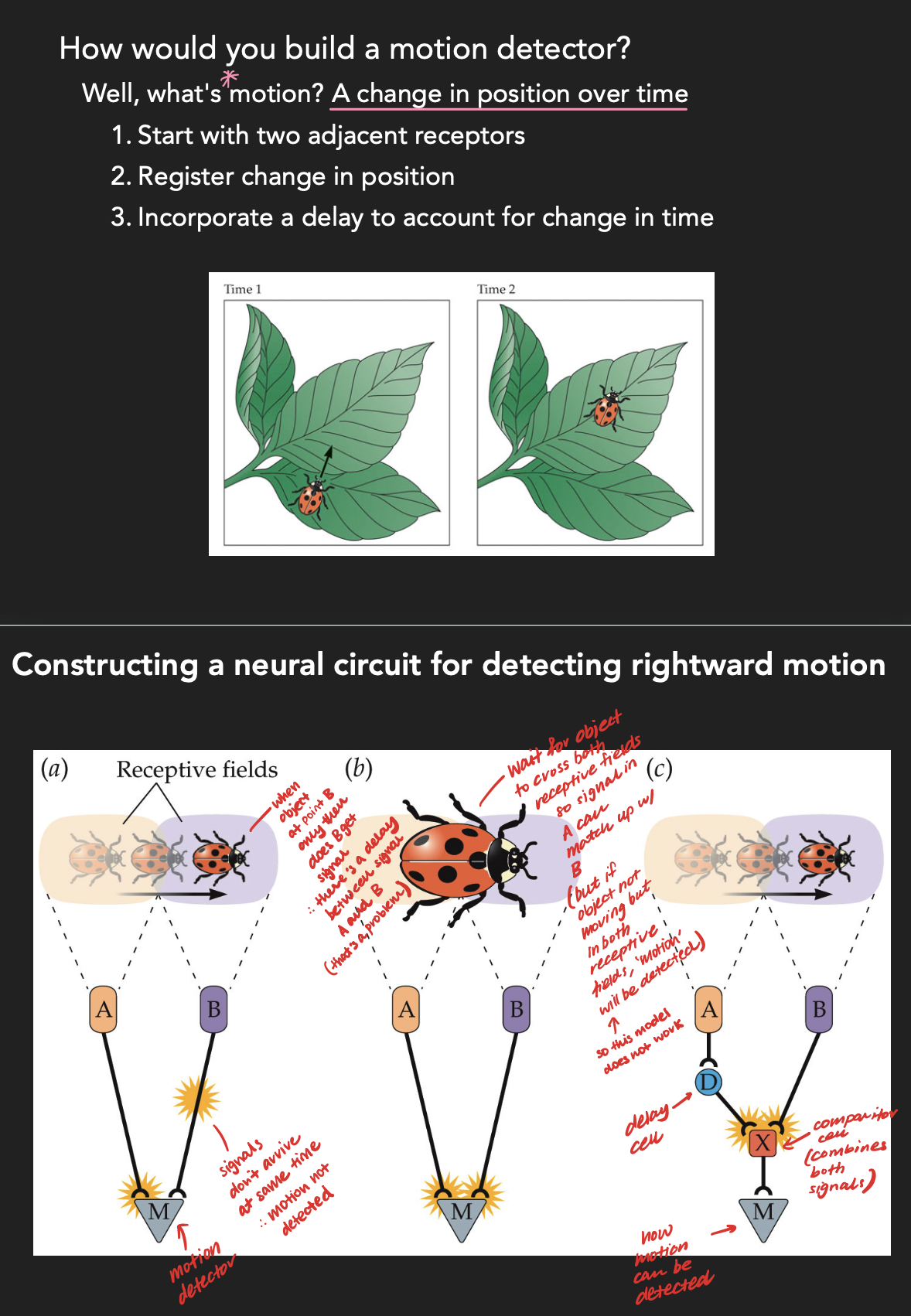
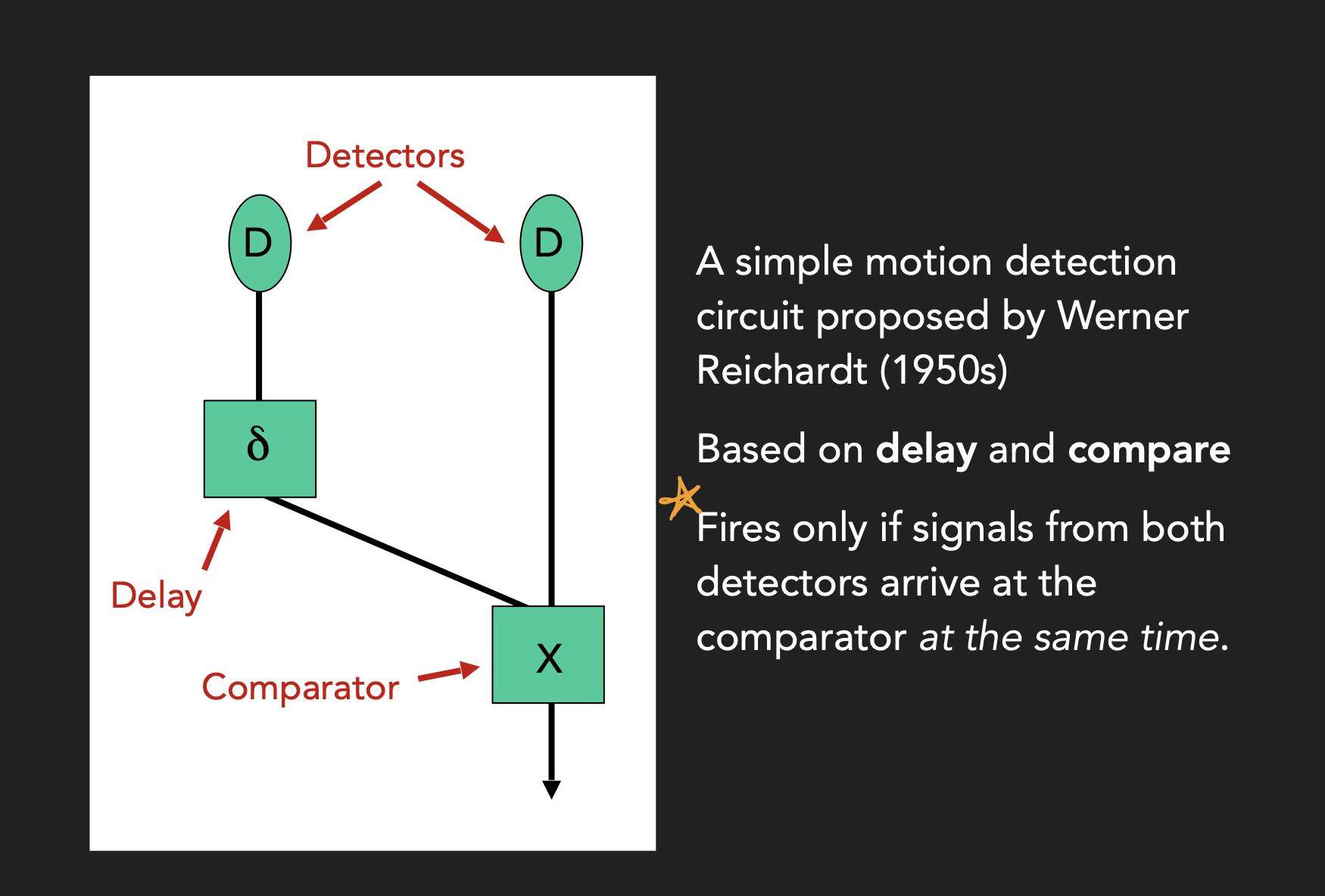
Explain how Reichardt Motion Detector’s work.
You have two adjacent receptors that activate when something is in their receptive fields
There is a delay that delays the first motion signal before it goes to the comparator
The second motion detector signal goes to the comparator
Only when both signals hit the comparator at the same time is motion detected
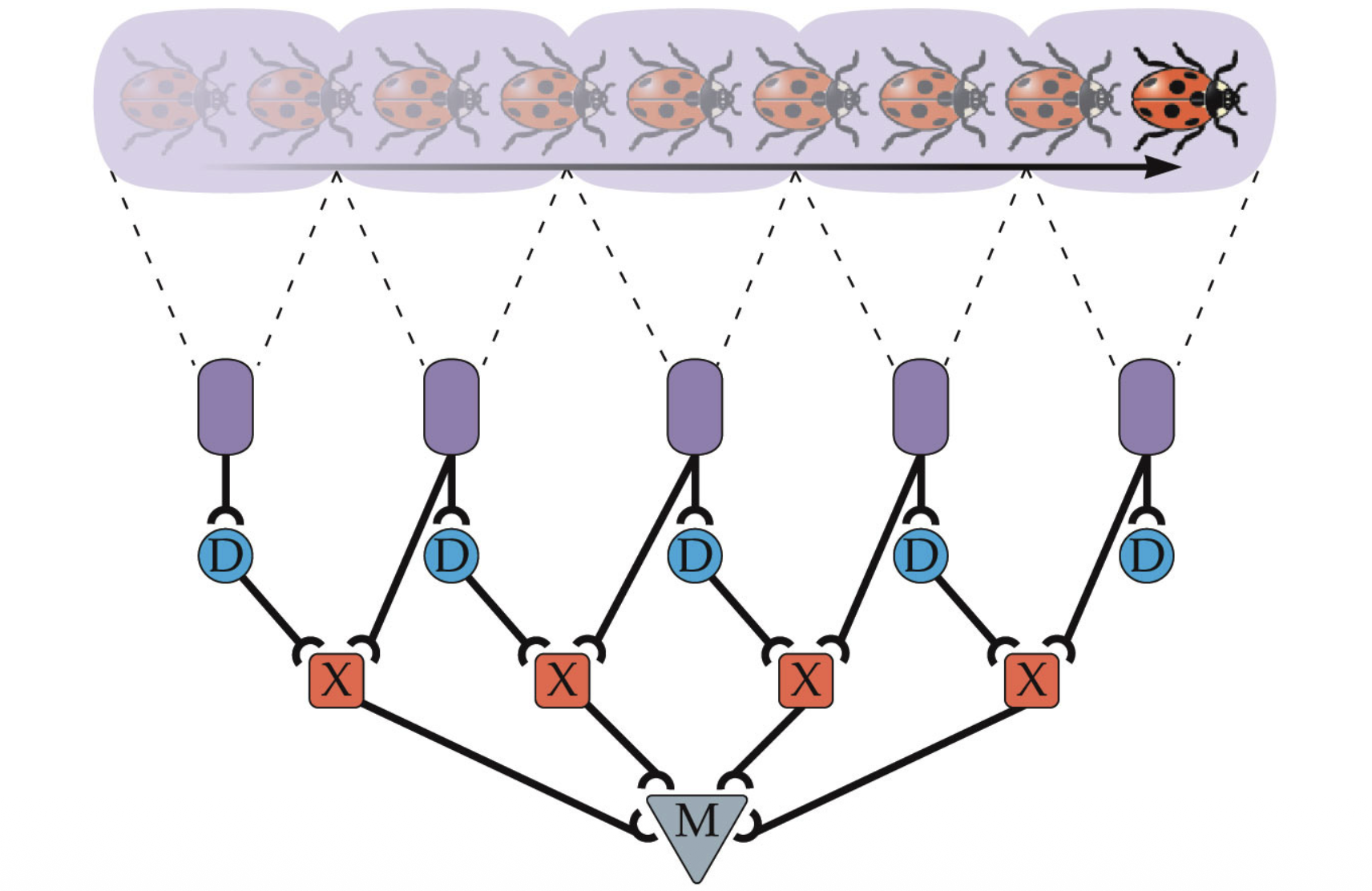
Explain how you register motion across your entire visual field.
You set up a motion detector chain where multiple motion detectors are linked together. Therefore, allowing you to detect motion across a large space.
*multiple comparators will get activated and the signals will now all go to a larger motion detector (M) at the end
What are Reichardt detectors tuned to?
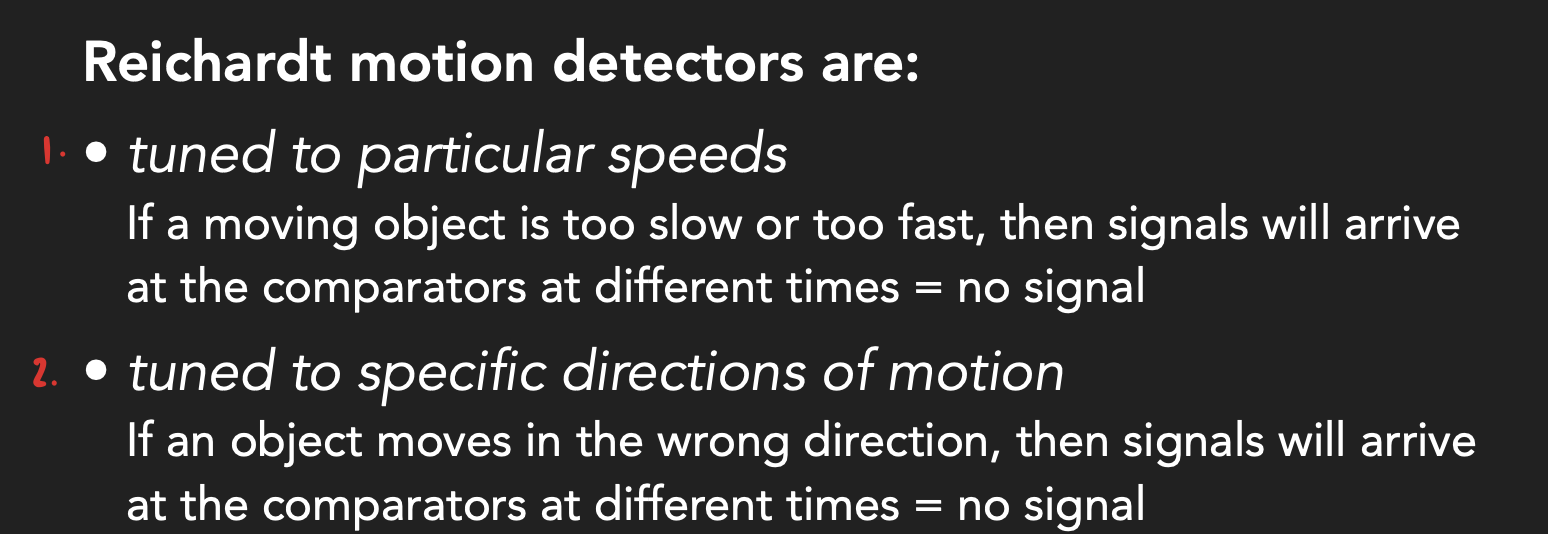
What’s the issue with Reichardt detectors?
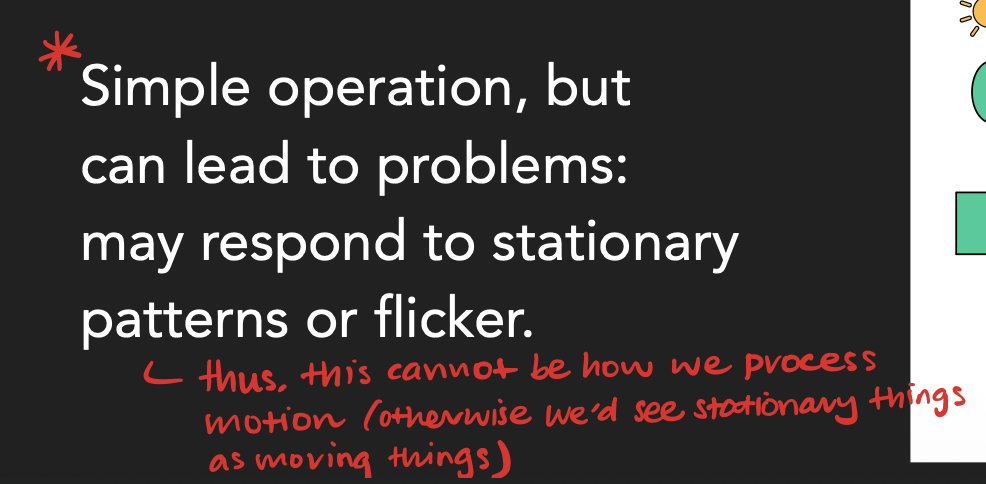
How do we overcome the directional issue found in simple Reichardt motion detectors?
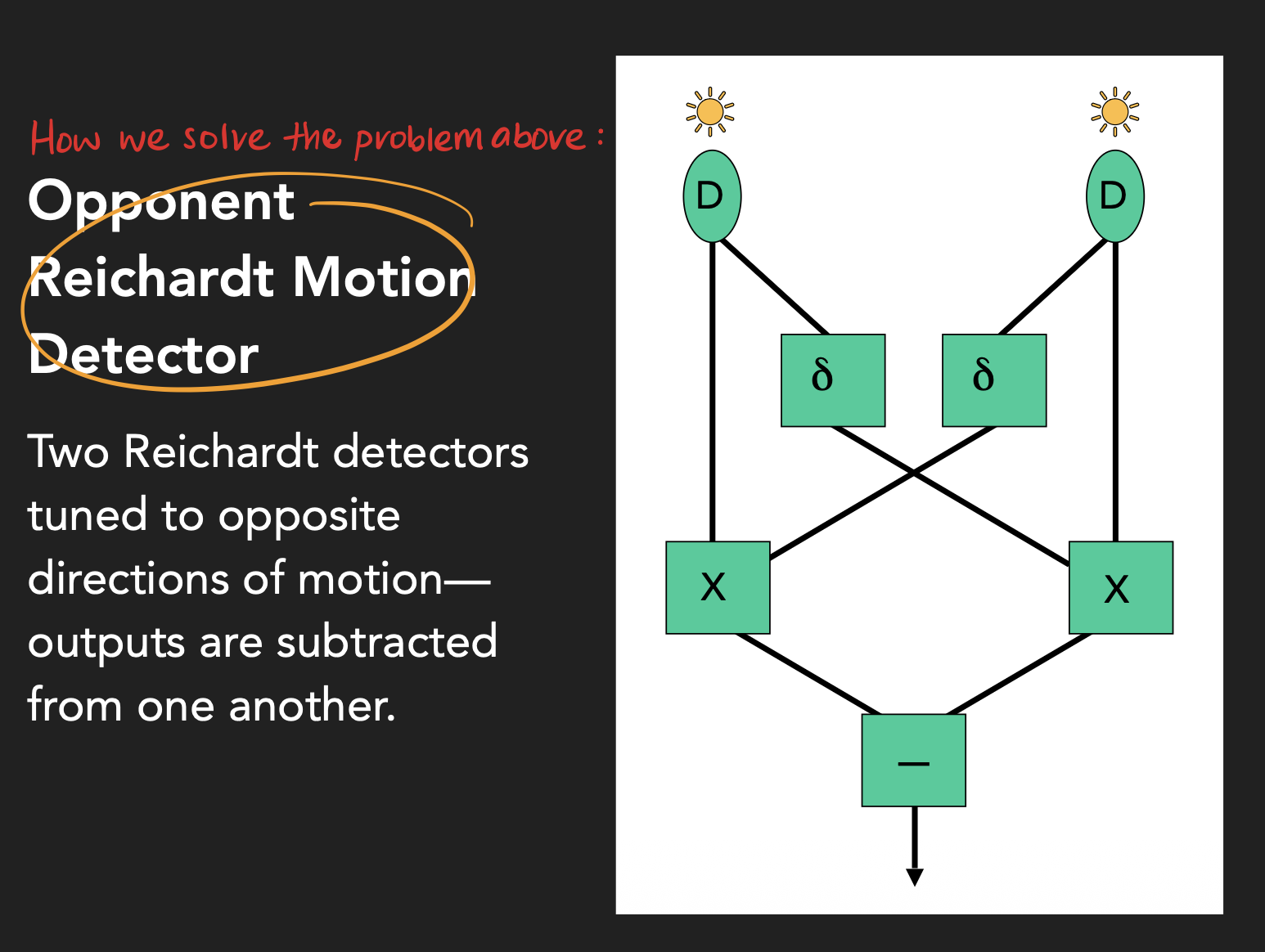
We use an Opponent Reichardt Motion Detector
This detector is tuned for the same speed, but different directions. Therefore, no matter what direction the stimulus comes from, the detector can accurately detect it as the outputs get subtracted from one another.
*unlike the simple motion detector, we won’t perceive flashing lights as moving since both detectors will activate the same amount and their outputs will cancel each other out to 0 (thus, telling us there is no motion).
Define apparent motion.
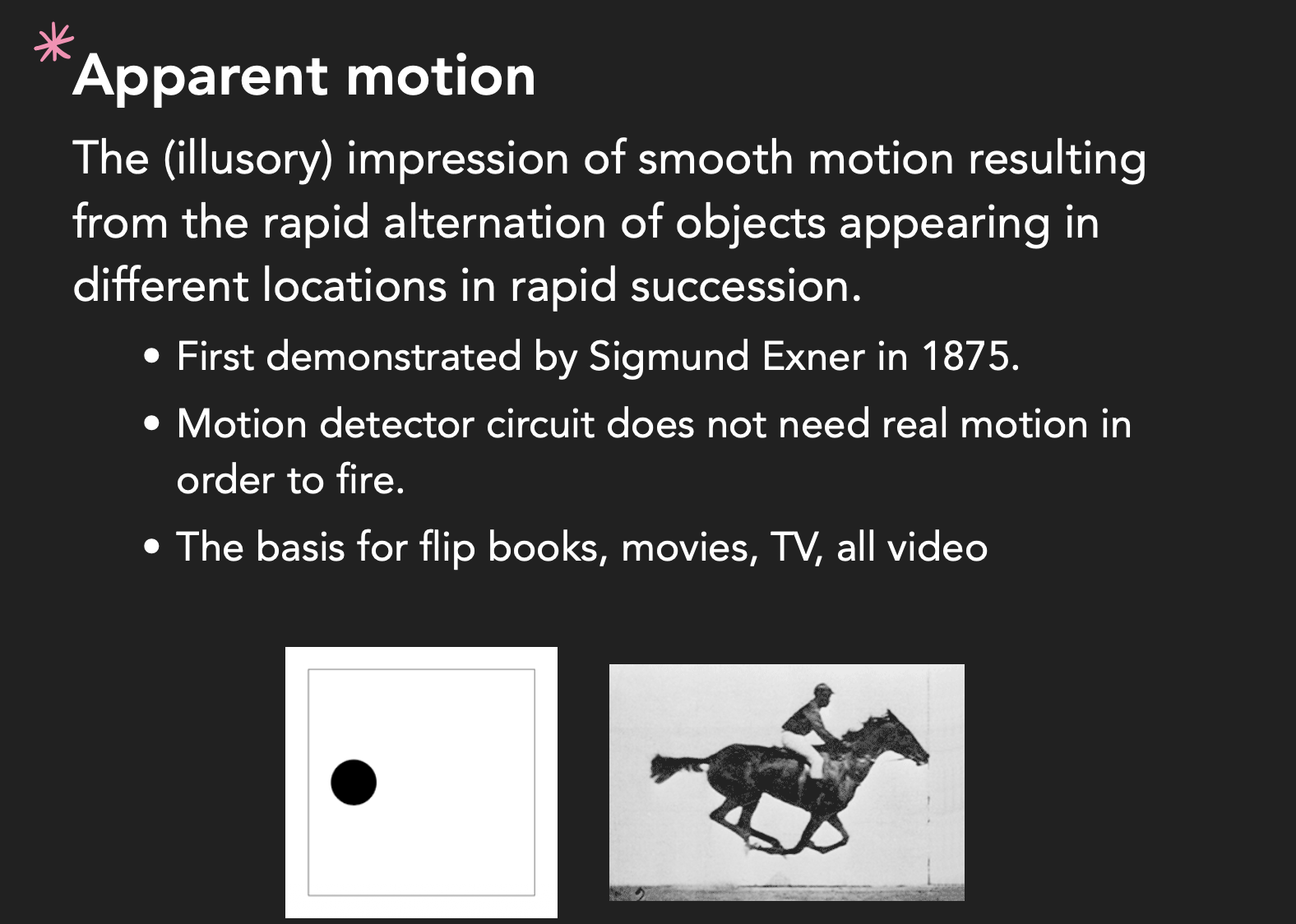
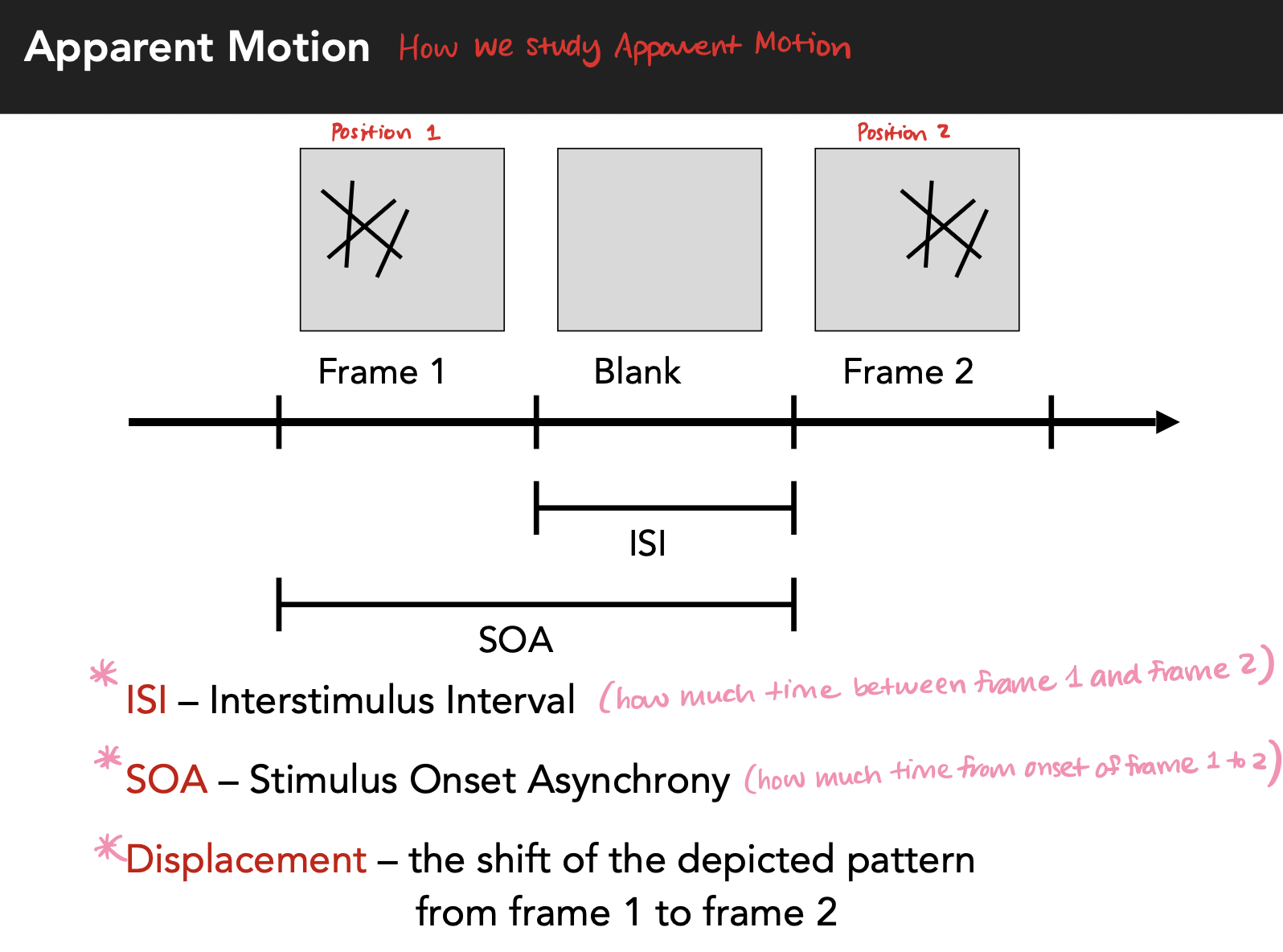
How do we study apparent motion?
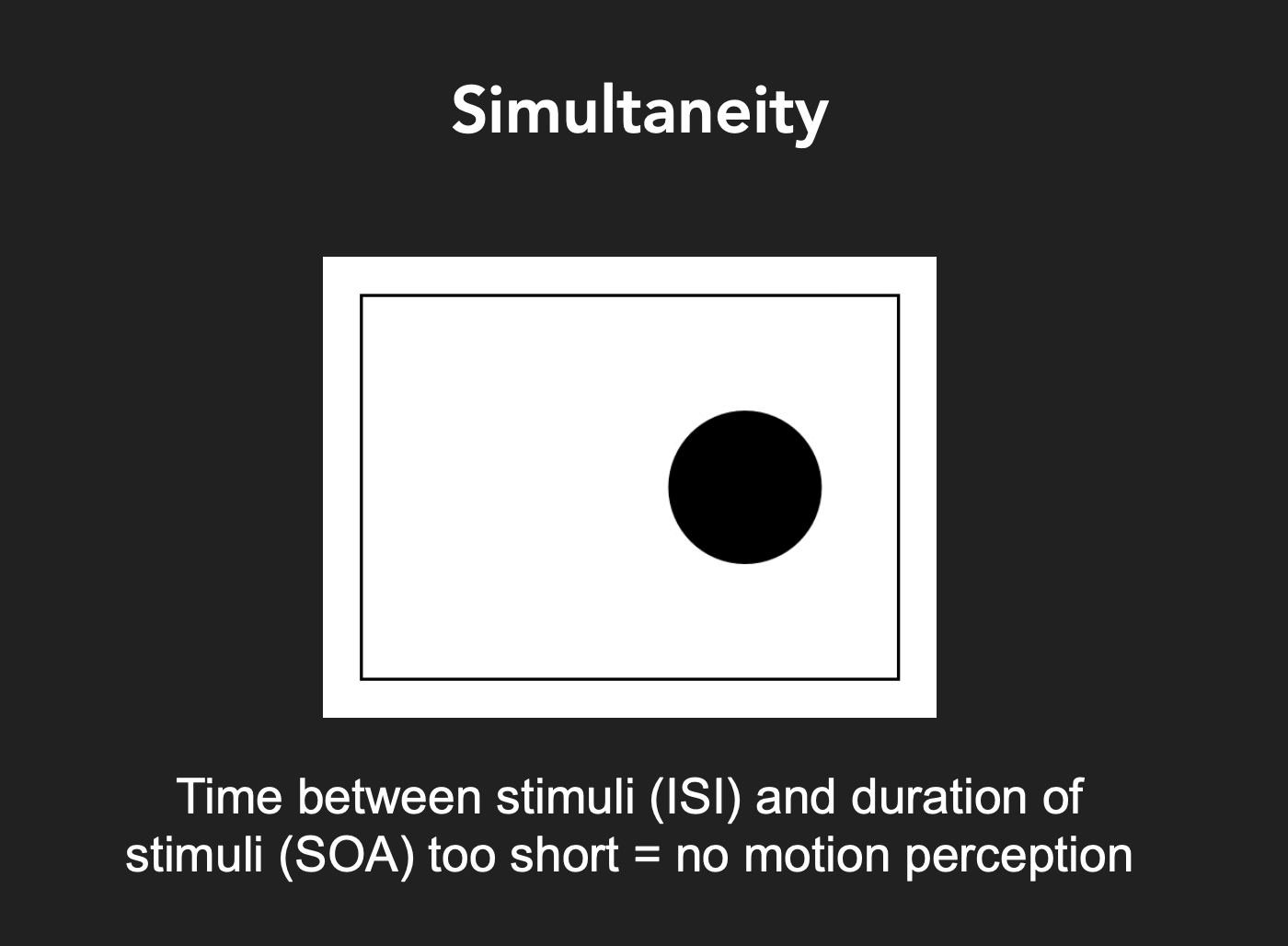
Define simultaneity.
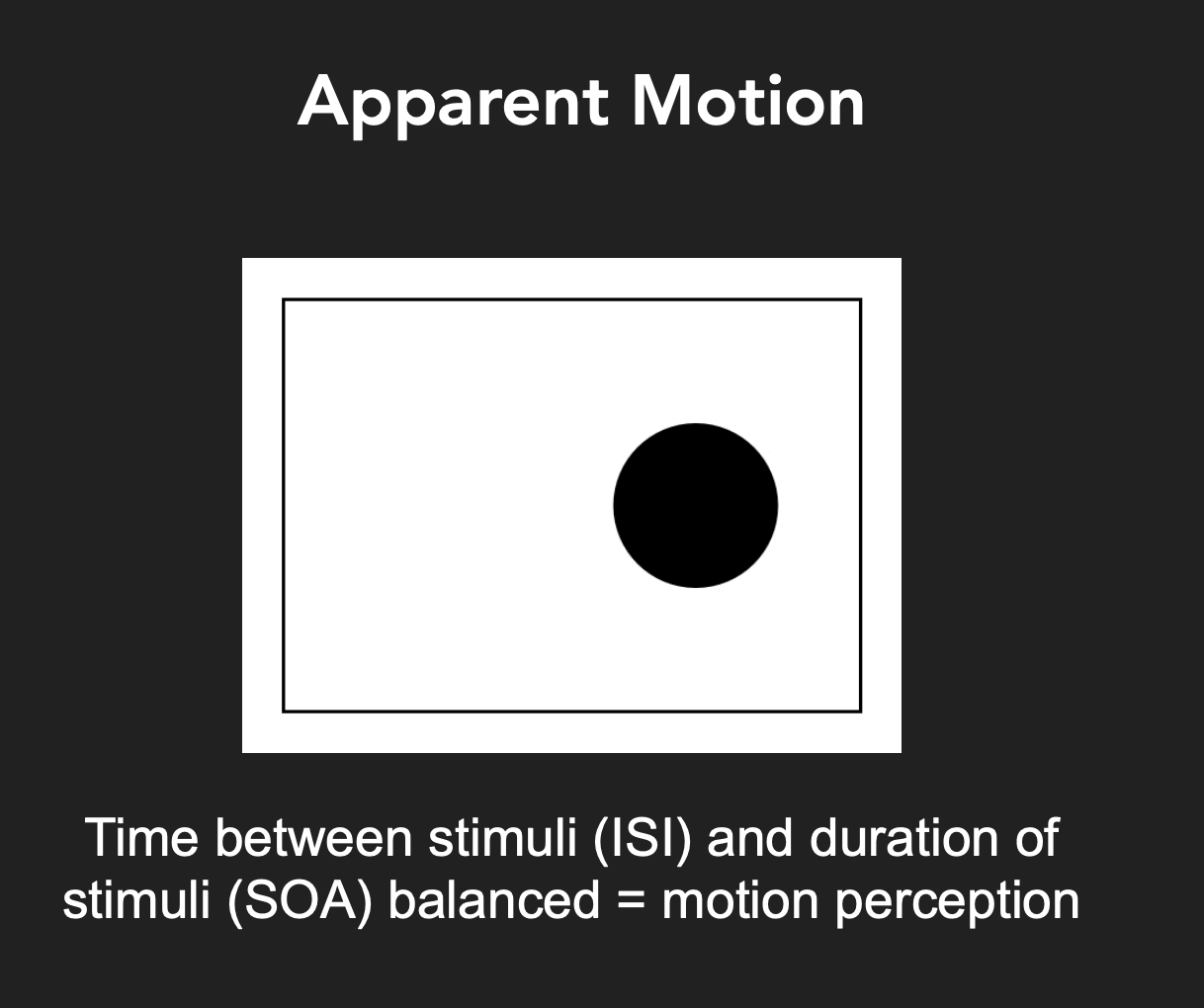
Define apparent motion.
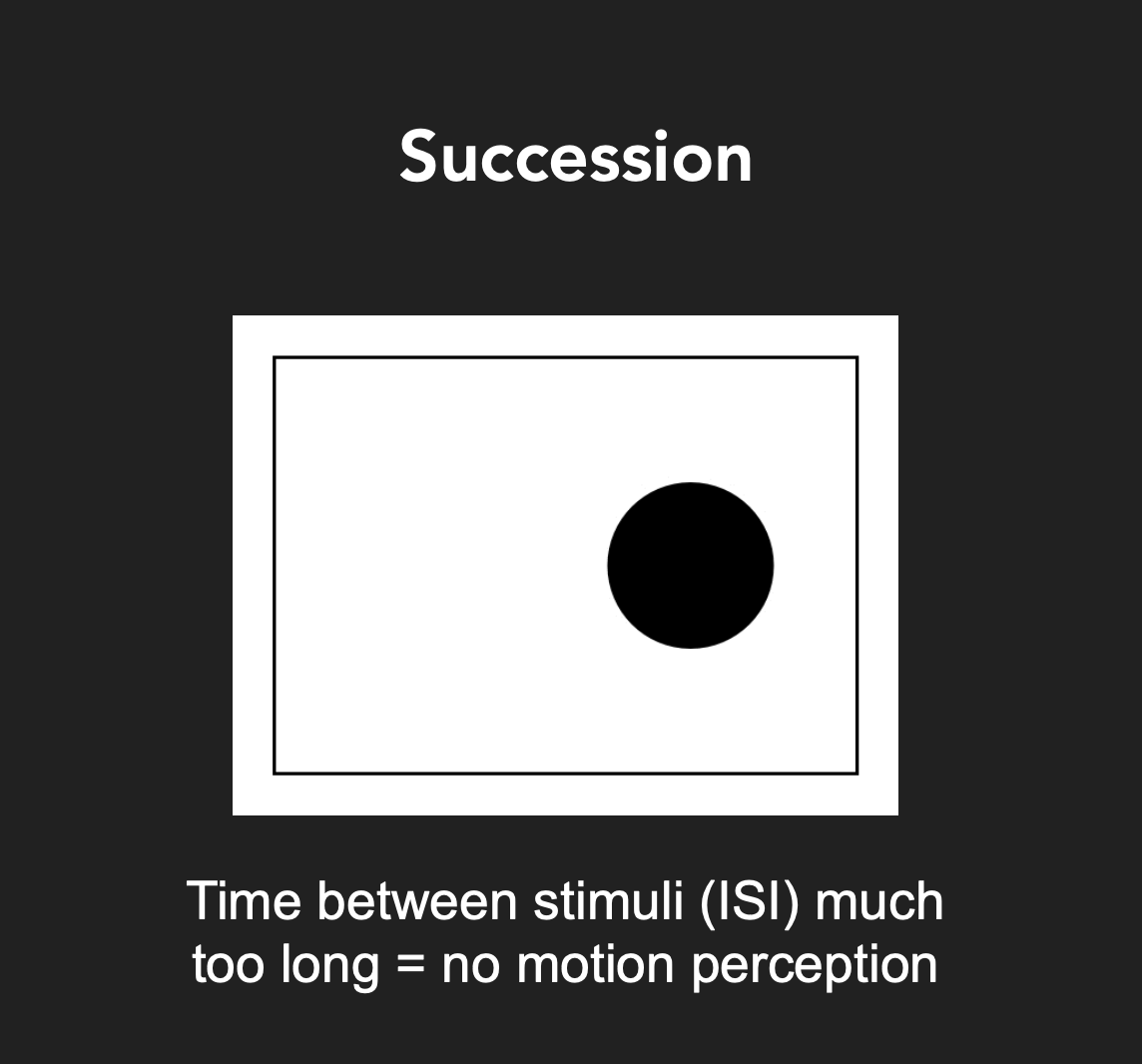
Define succession.
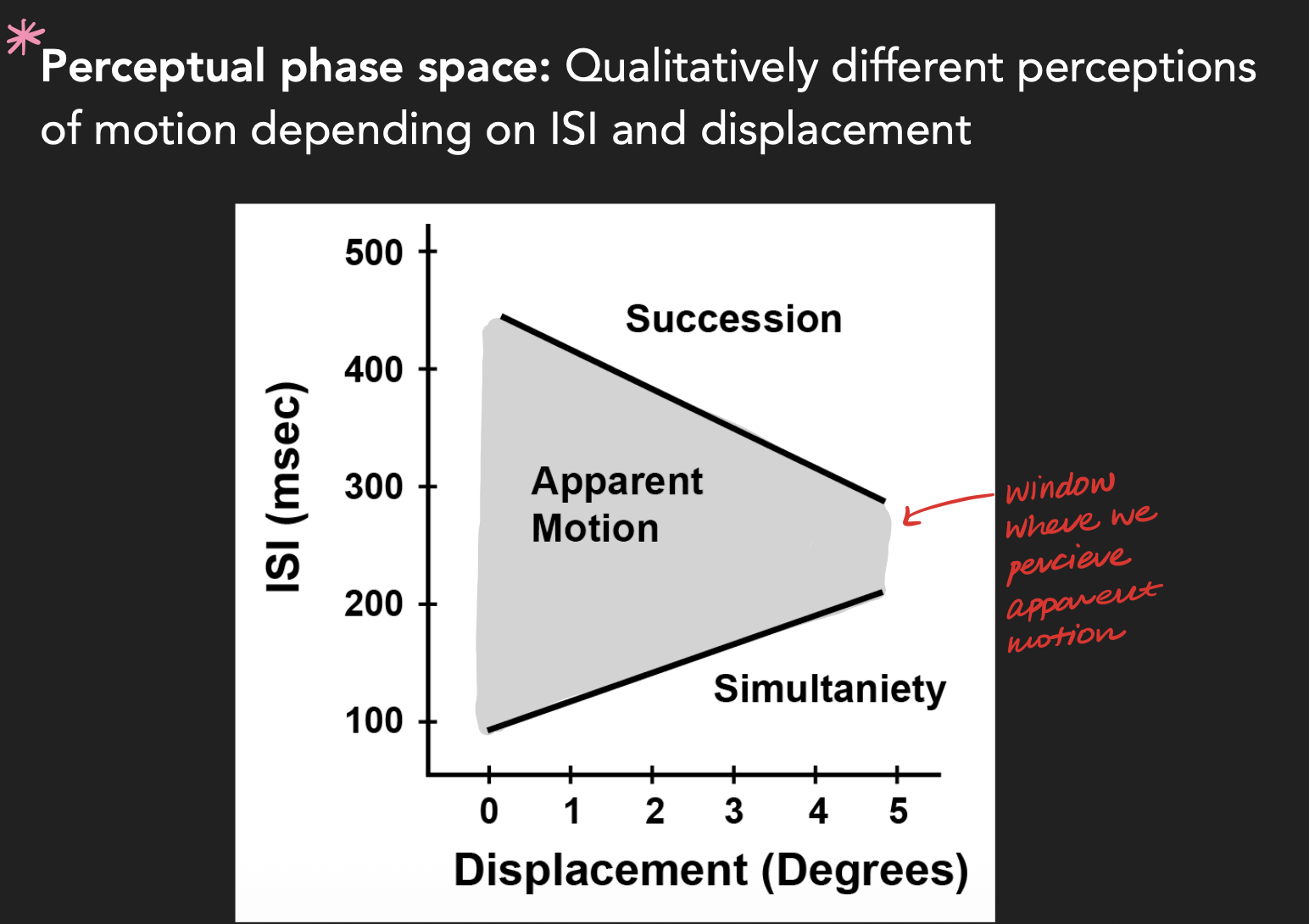
Define the perceptual phase space.
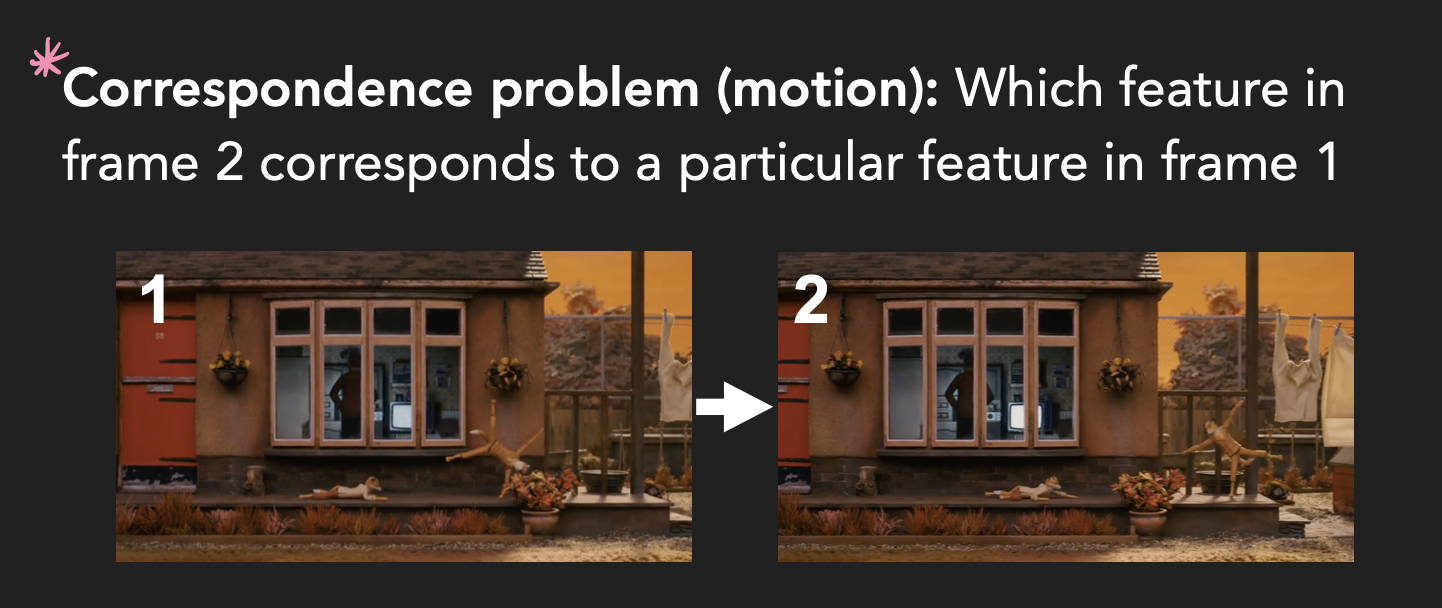
Define the correspondence problem.
The problem of trying to figure out which feature from one moment in time matches a particular feature in the next moment in time.
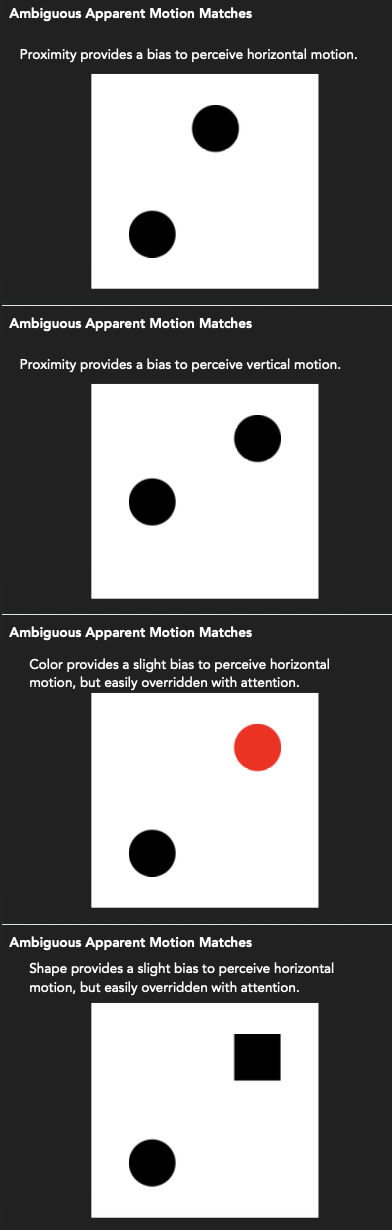
Which gestalt principles can influence how we perceive motion?
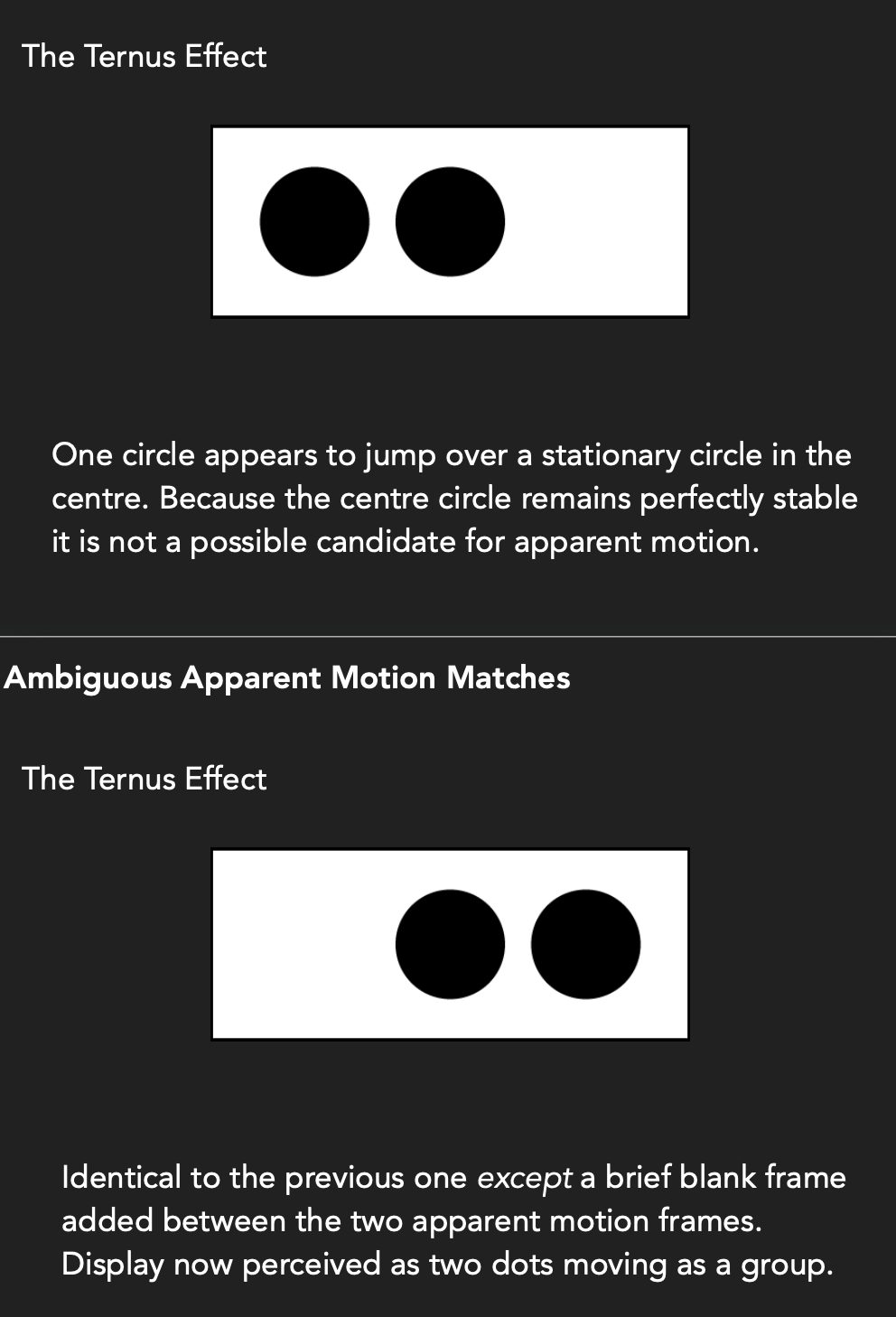
Explain the Ternus Effect.
A visual illusion of apparent motion where three horizontally aligned items, alternating between two positions, appear to move as a group or as a single jumping item depending on the timing, often showing "element motion" (end element jumps) at short intervals and "group motion" (all move) at longer intervals
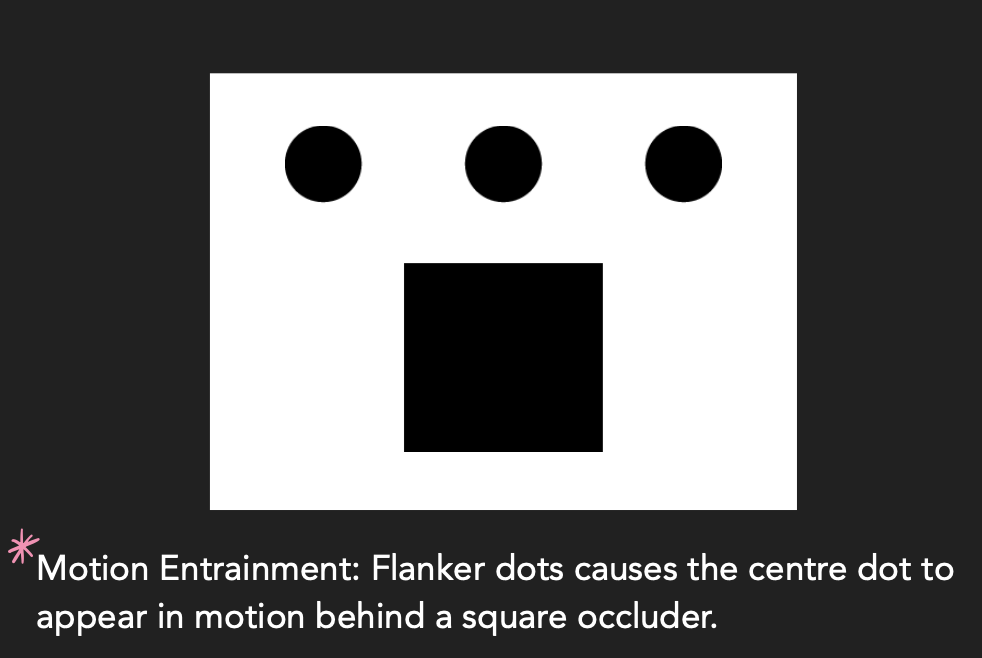
Define motion entrainment.
Define first order motion.

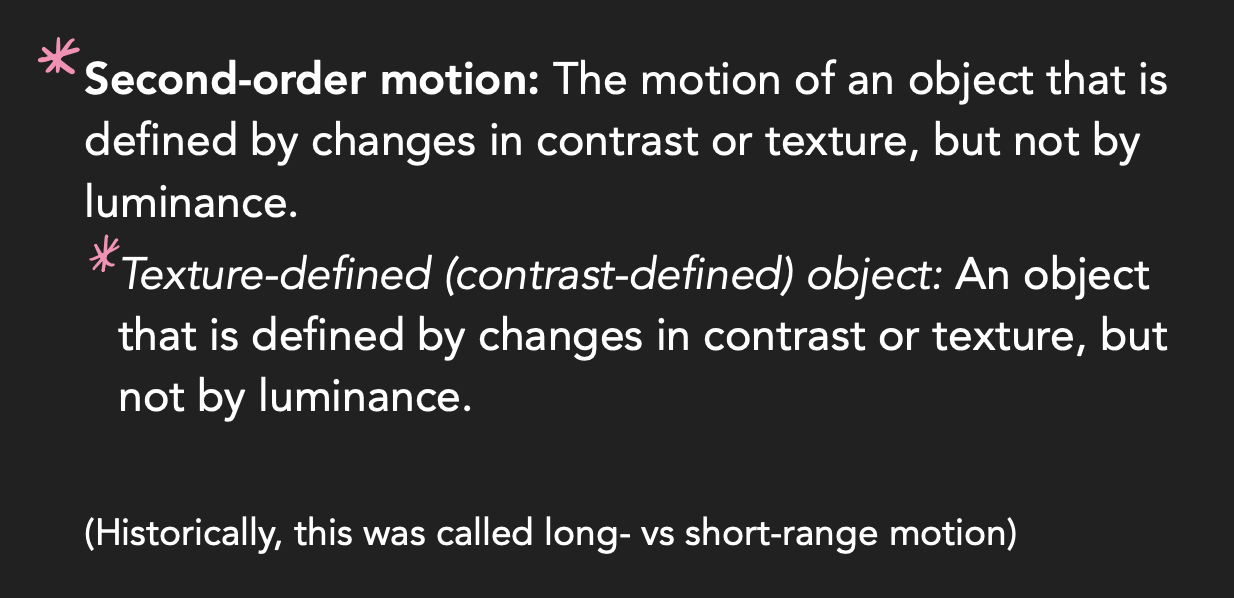
Define second order motion.
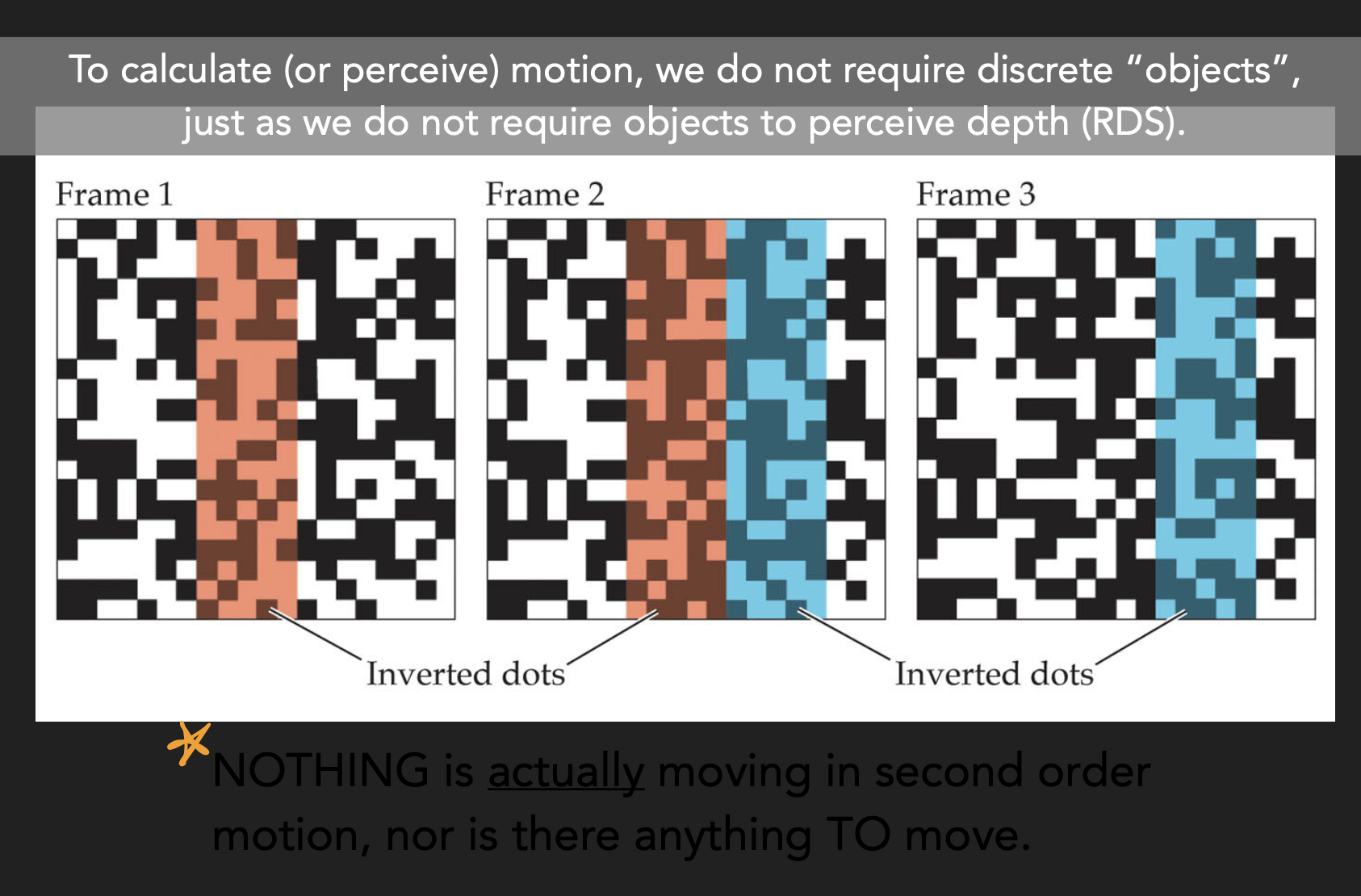
Do things actually move in second order motion?
No.
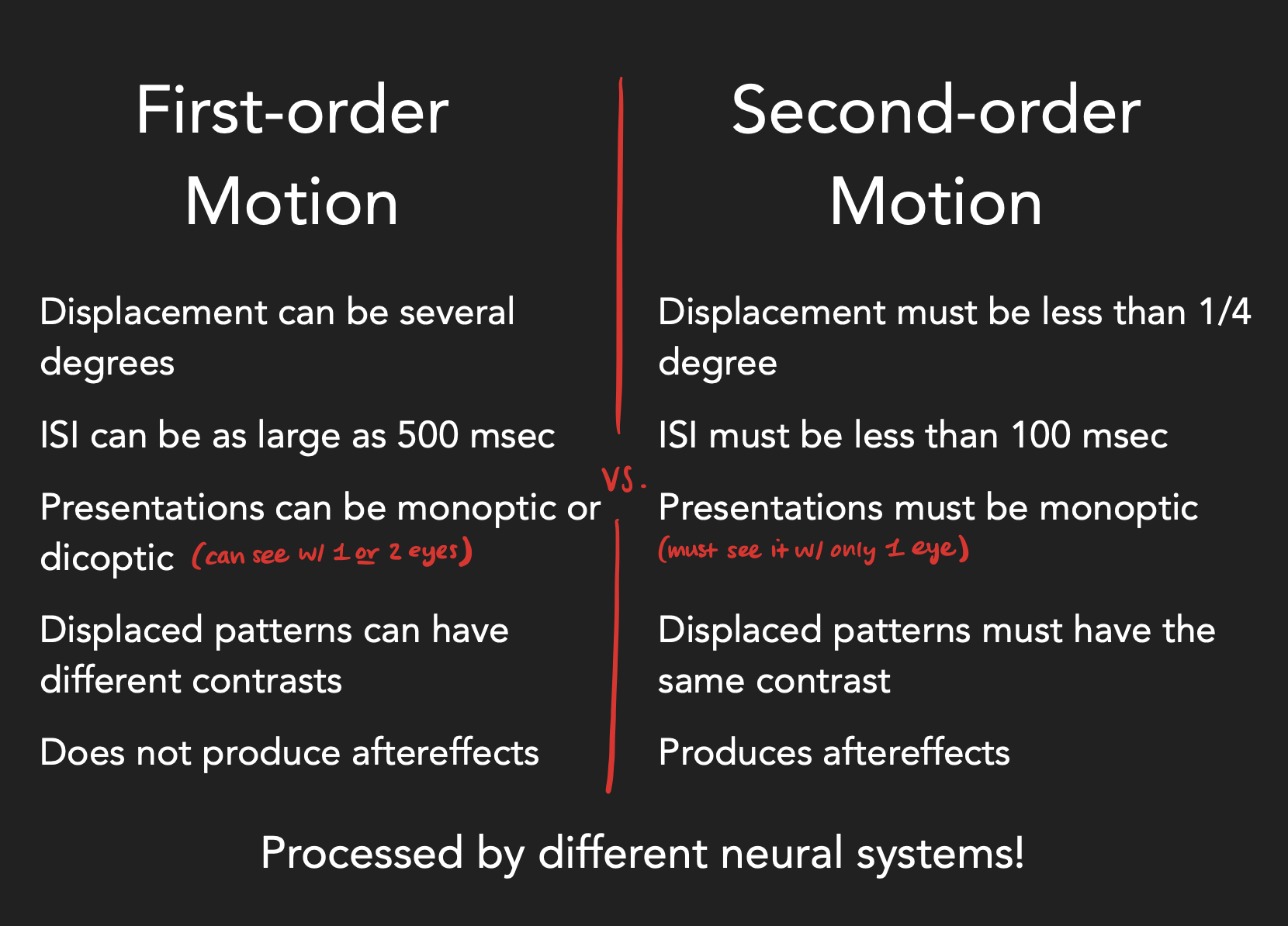
Compare and contrast first and second order motion.
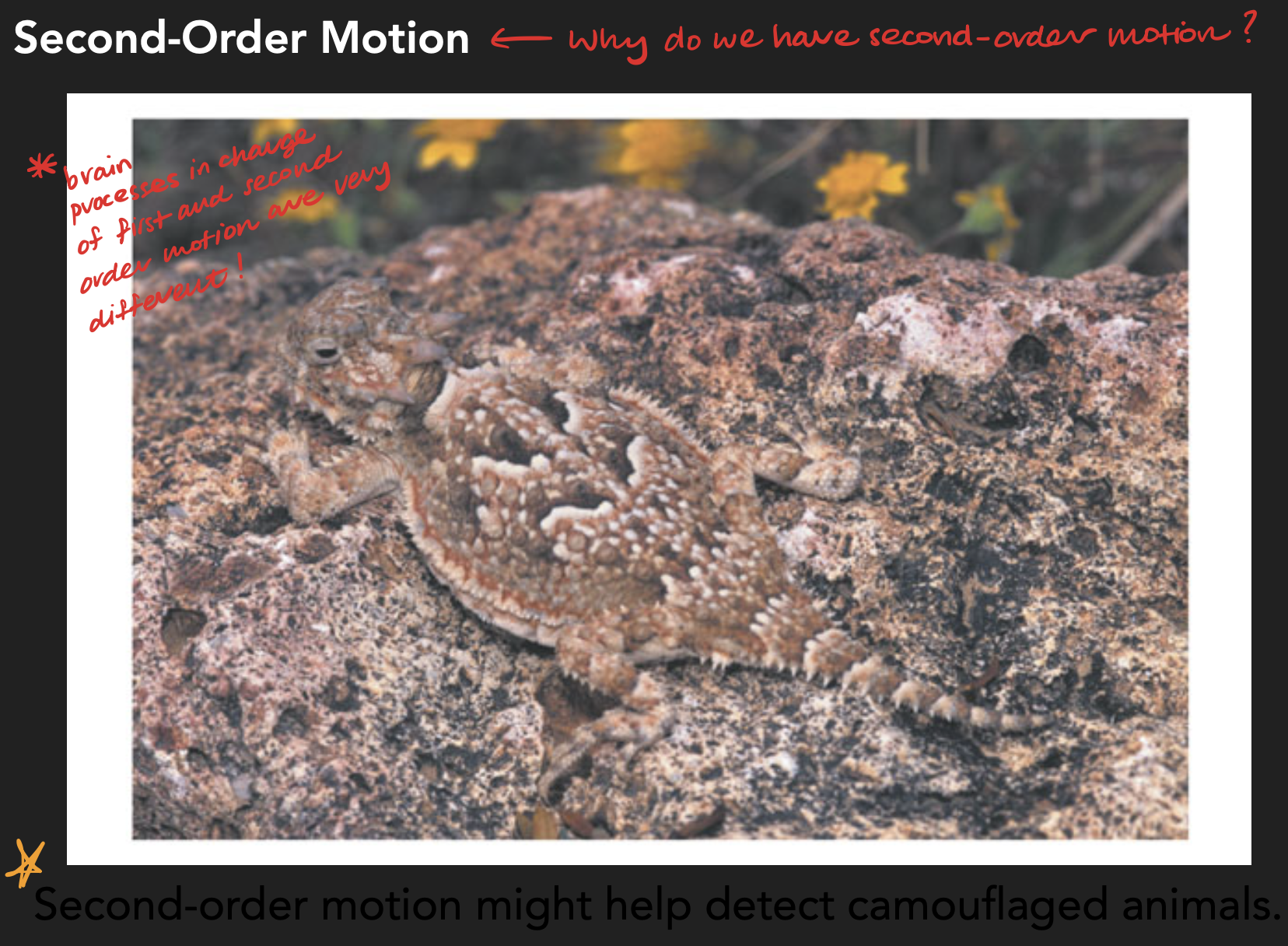
Why do we need second order motion?
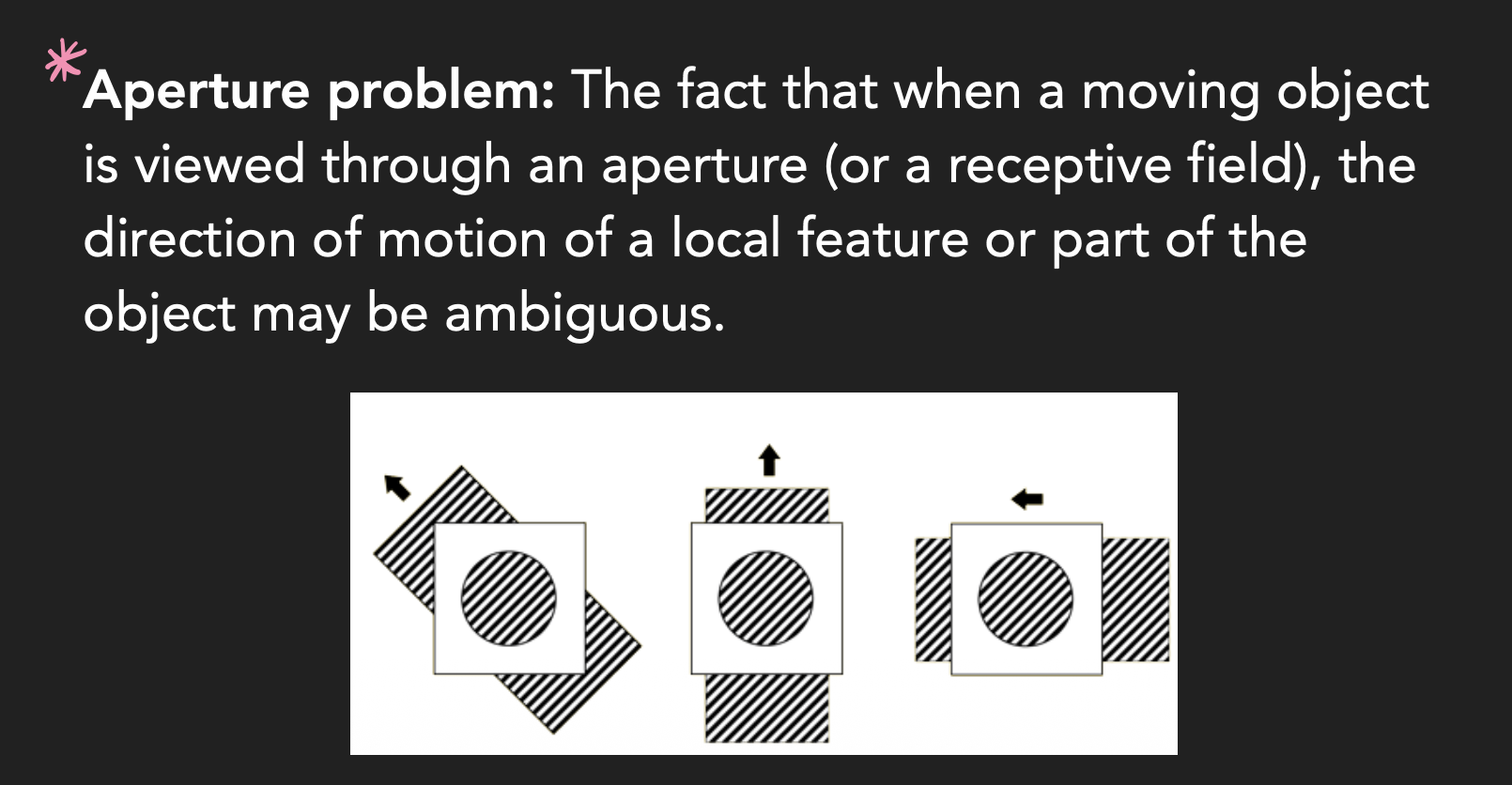
Define aperture.

Define the aperture problem.
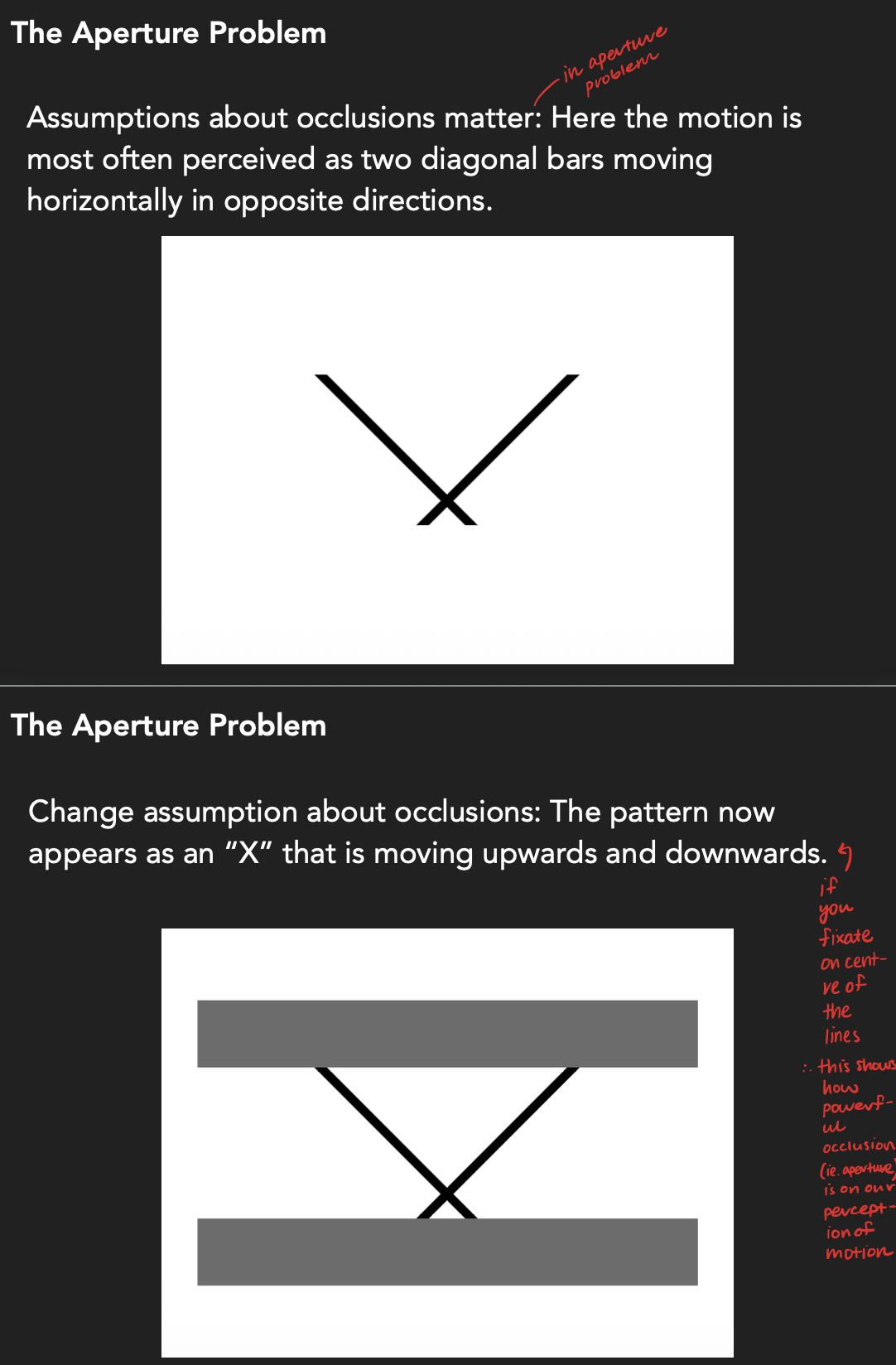
Explain how our assumptions about occlusions matter when perceiving motion.
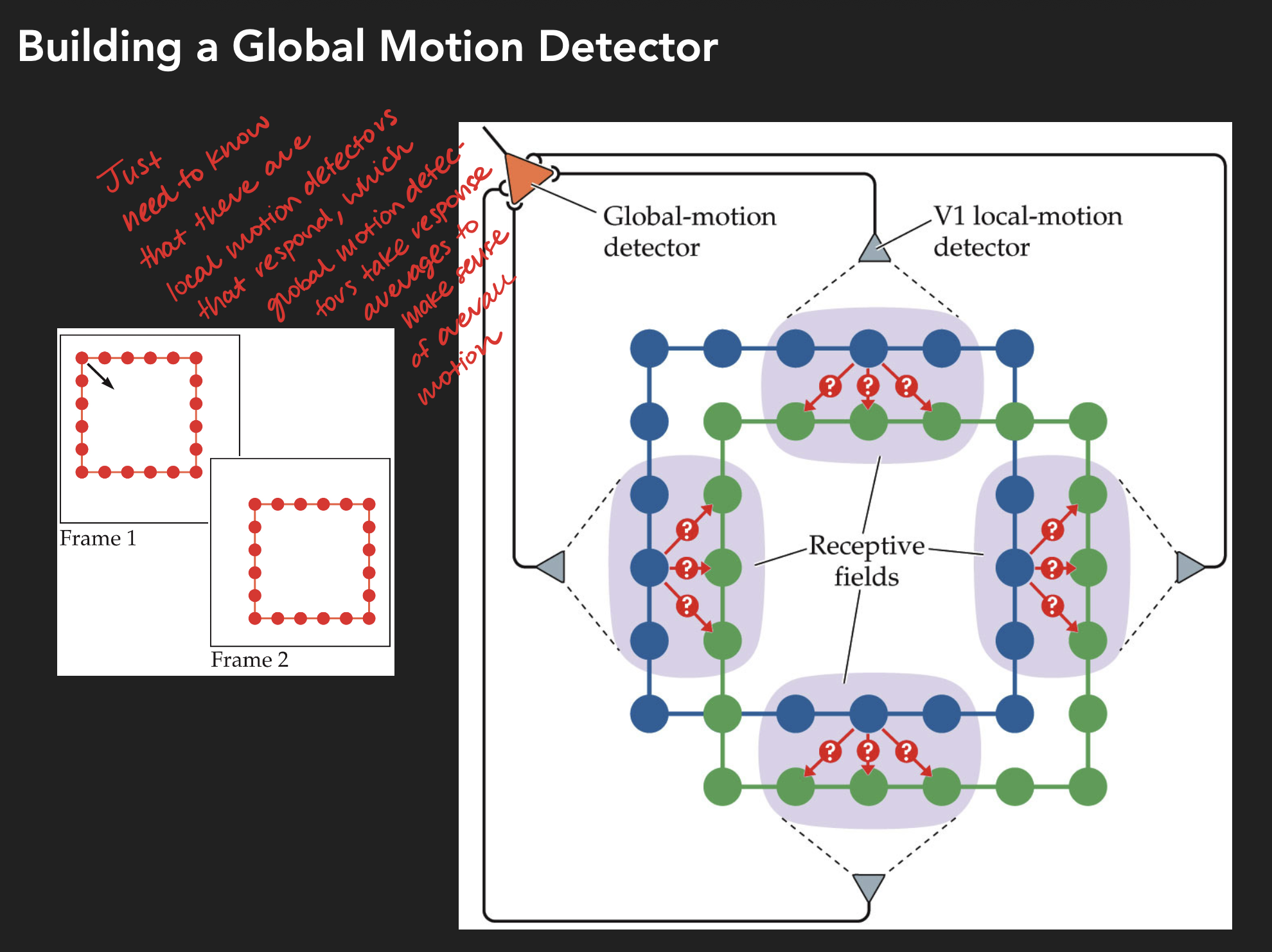
Explain (roughly) how global motion detectors work.
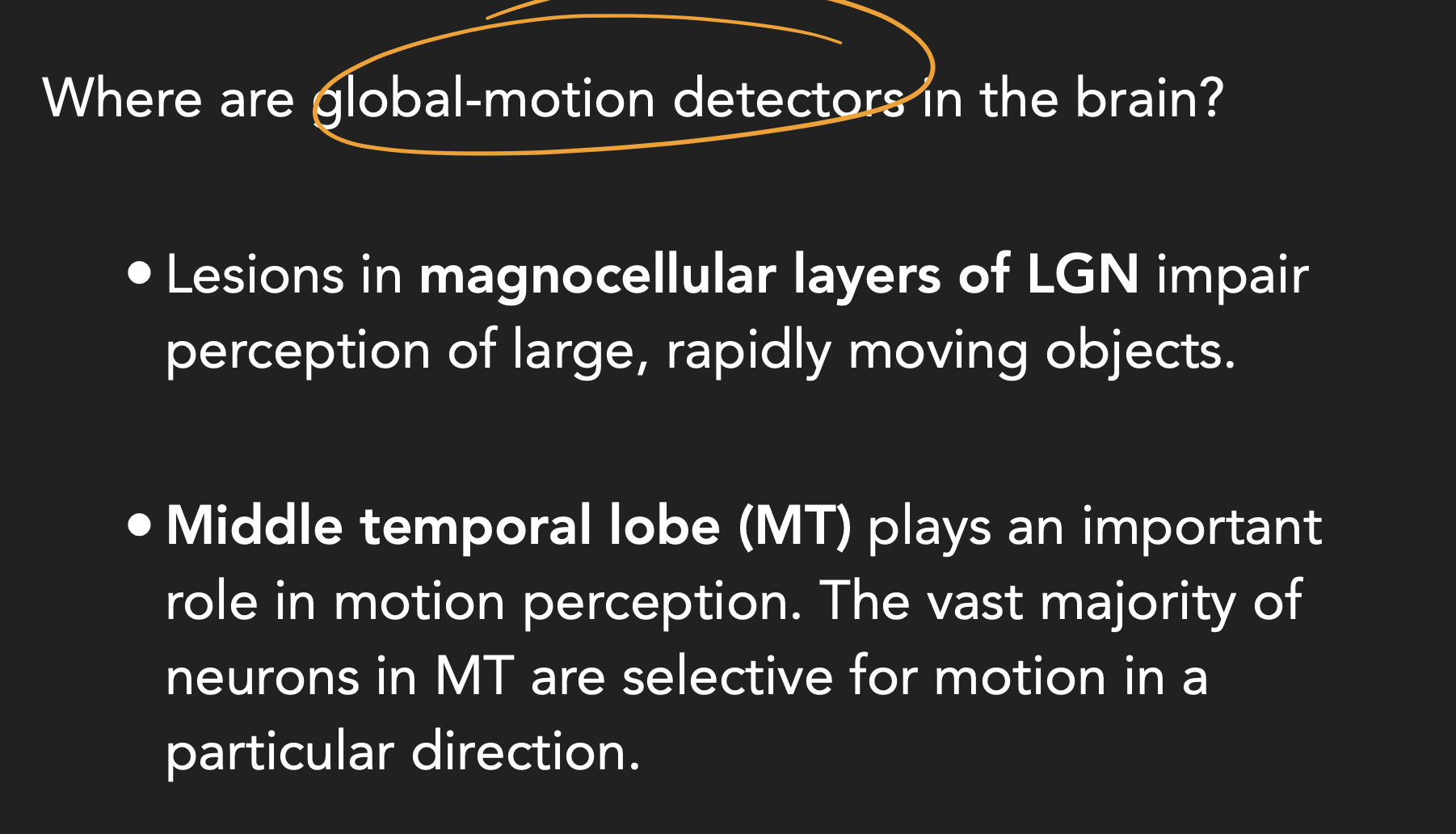
Where are global motion detectors located in the brain? What does each brain section respond to?
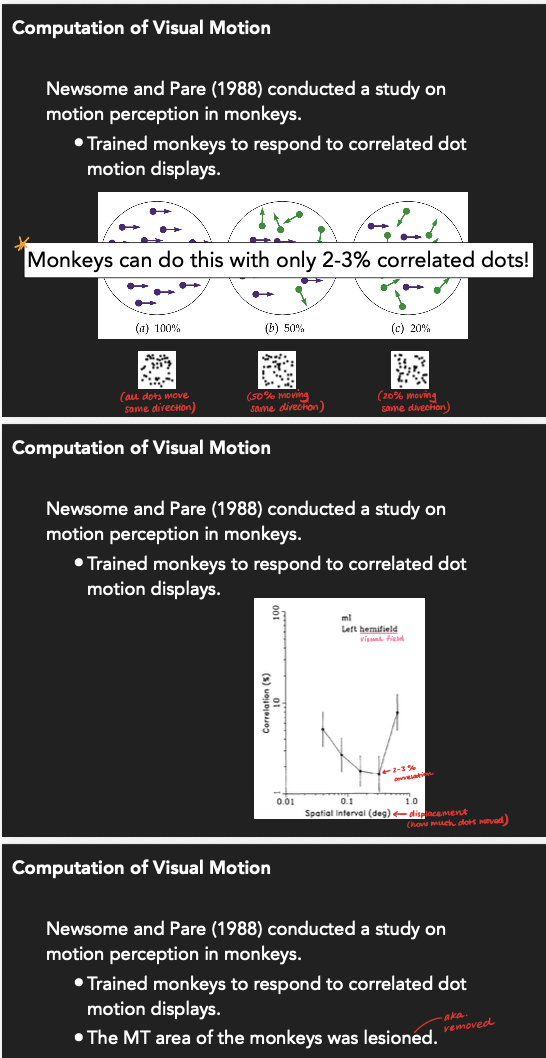
Explain what Newsome and Pare (1988) did in their study.
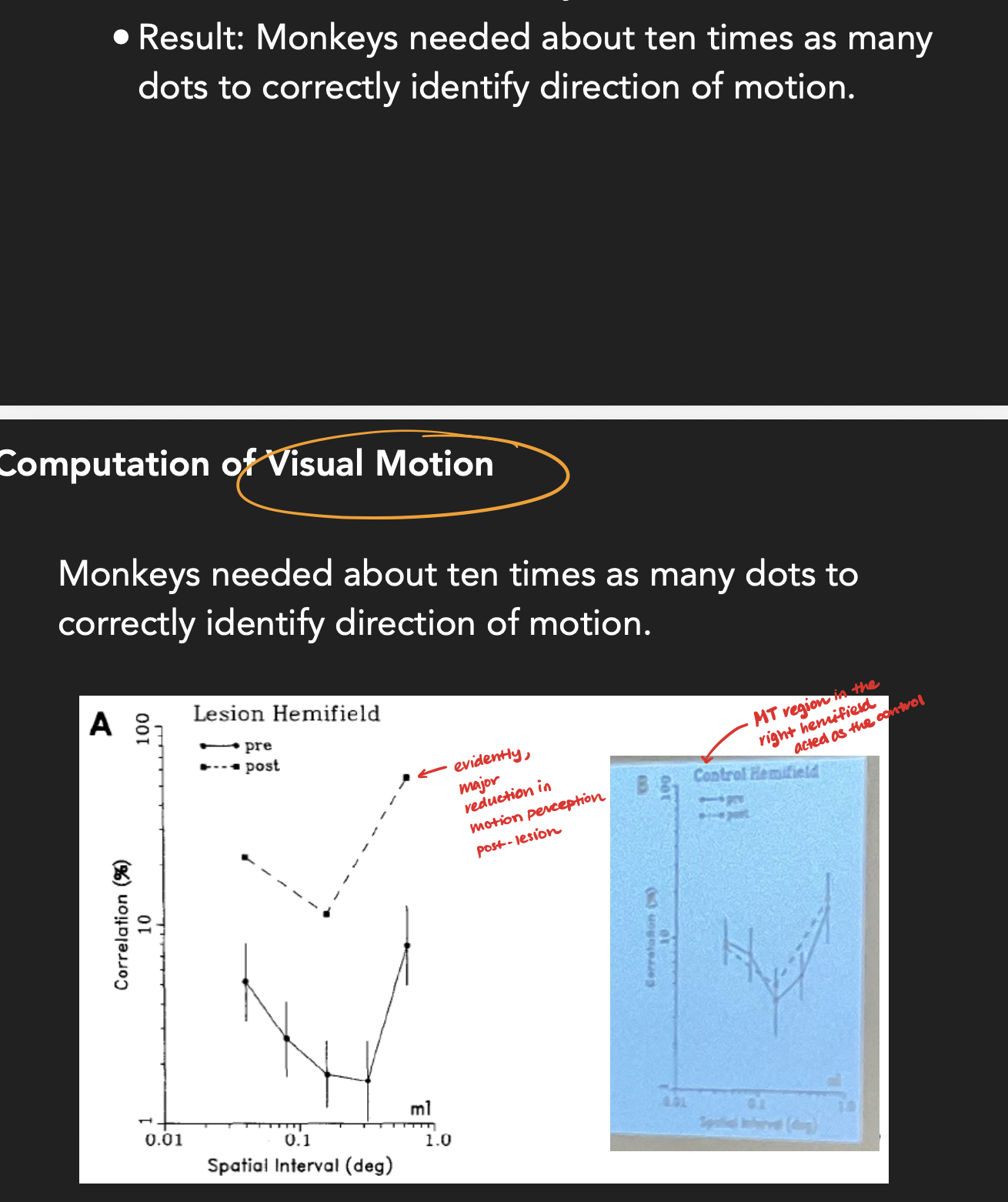
What happened as a result of Newsome and Pare (1988) adding lesions?
In the hemifield that they added a lesion to, you can see that the monkey’s ability to identity the direction of motion severely decreased (see left graph).
However, in the control hemifield where no lesion was added, you can see that there was no change to monkey’s ability to detect the direction of motion before and after a lesion was added in a different hemifield (see right graph).
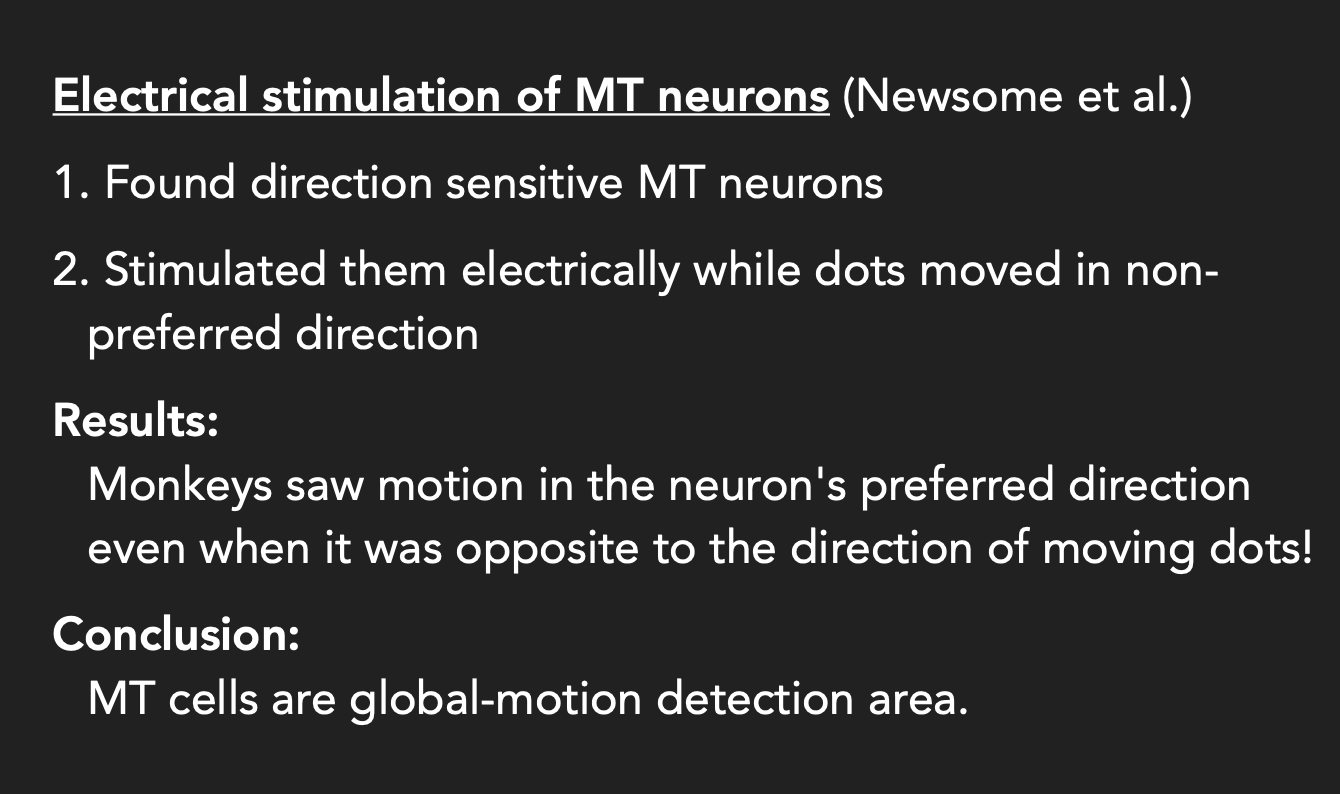
Explain the follow up study did Newsome et al. conducted. What were the results and conclusion?
What are the disadvantages of using lesions in studies?
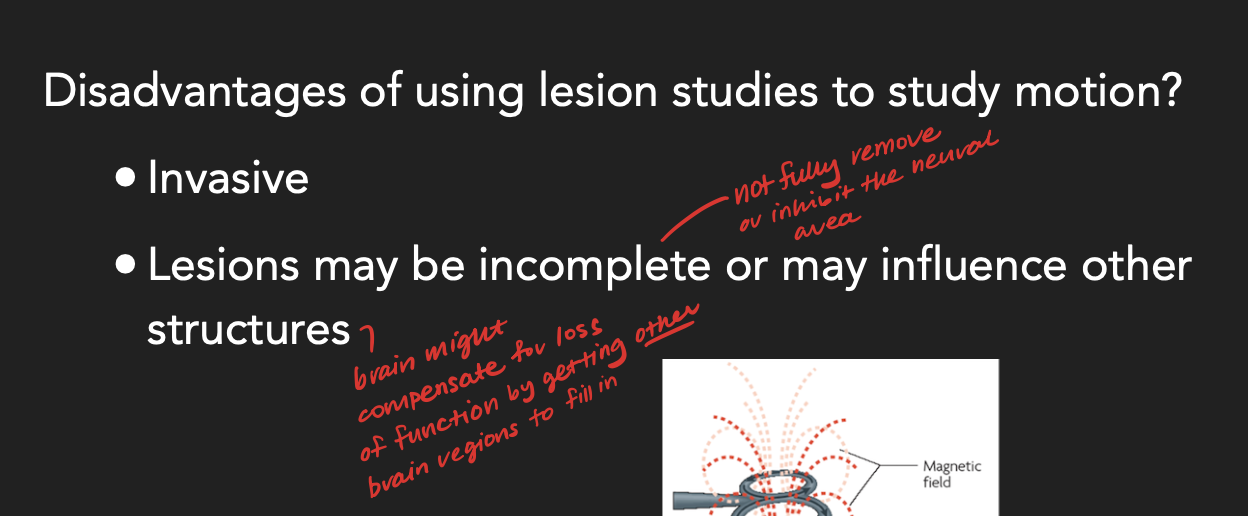
What is a potential solution to alleviate the disadvantages of lesions?
Transcranial Magnetic Stimulation (TMS)
A wand introduces a small transcient electromagnetic field into the neurons of area MT which acts like a lesion because it disrupts brain processes.
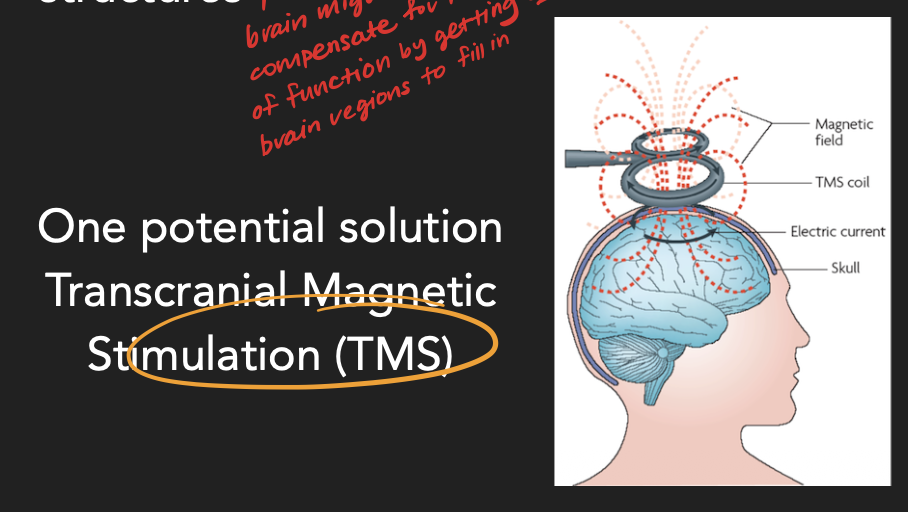
Define motion after effect (MAE).
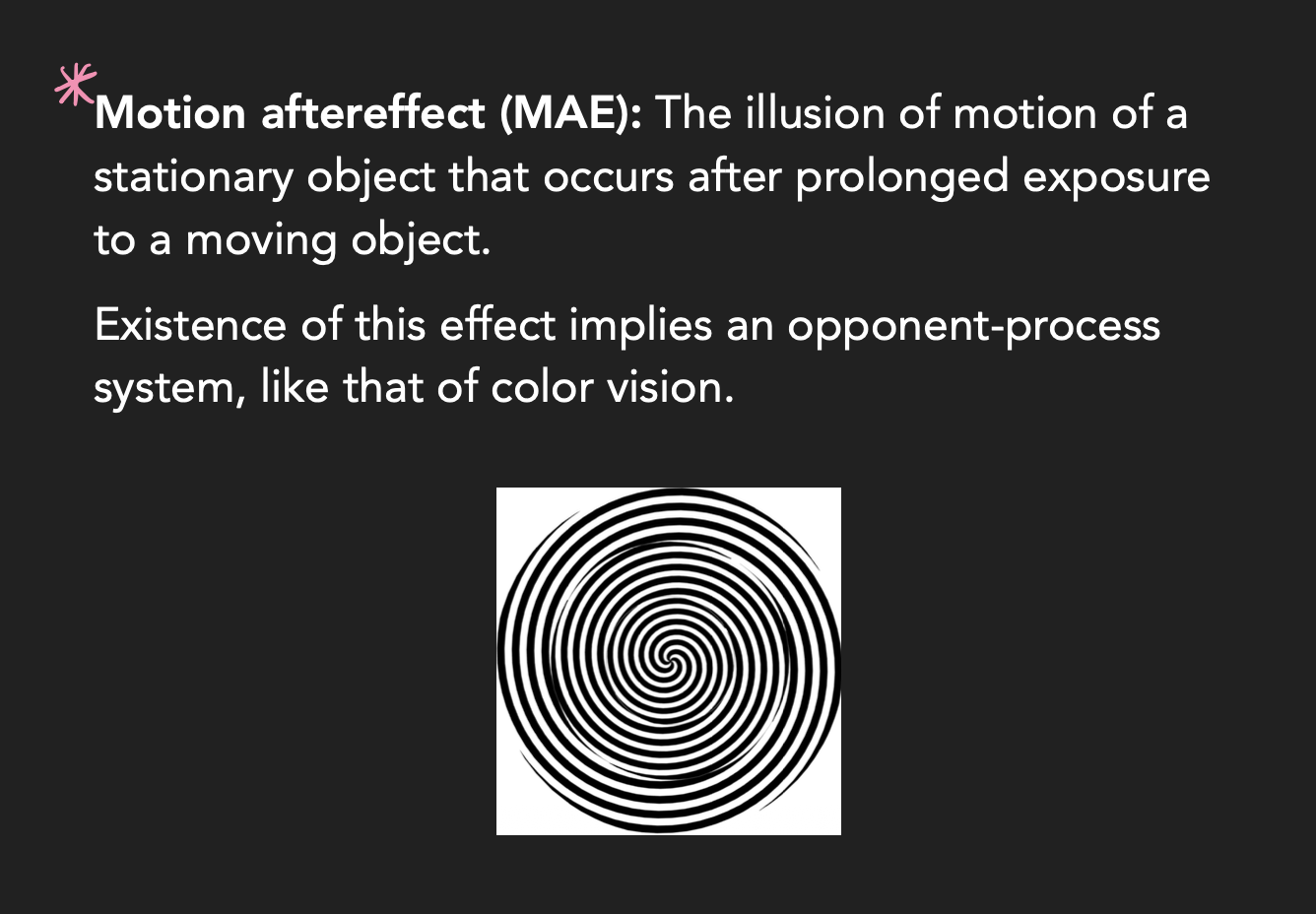
Define interocular transfer.

What does interocular transfer tell us about where the processing of the motion after effect is located in the brain?
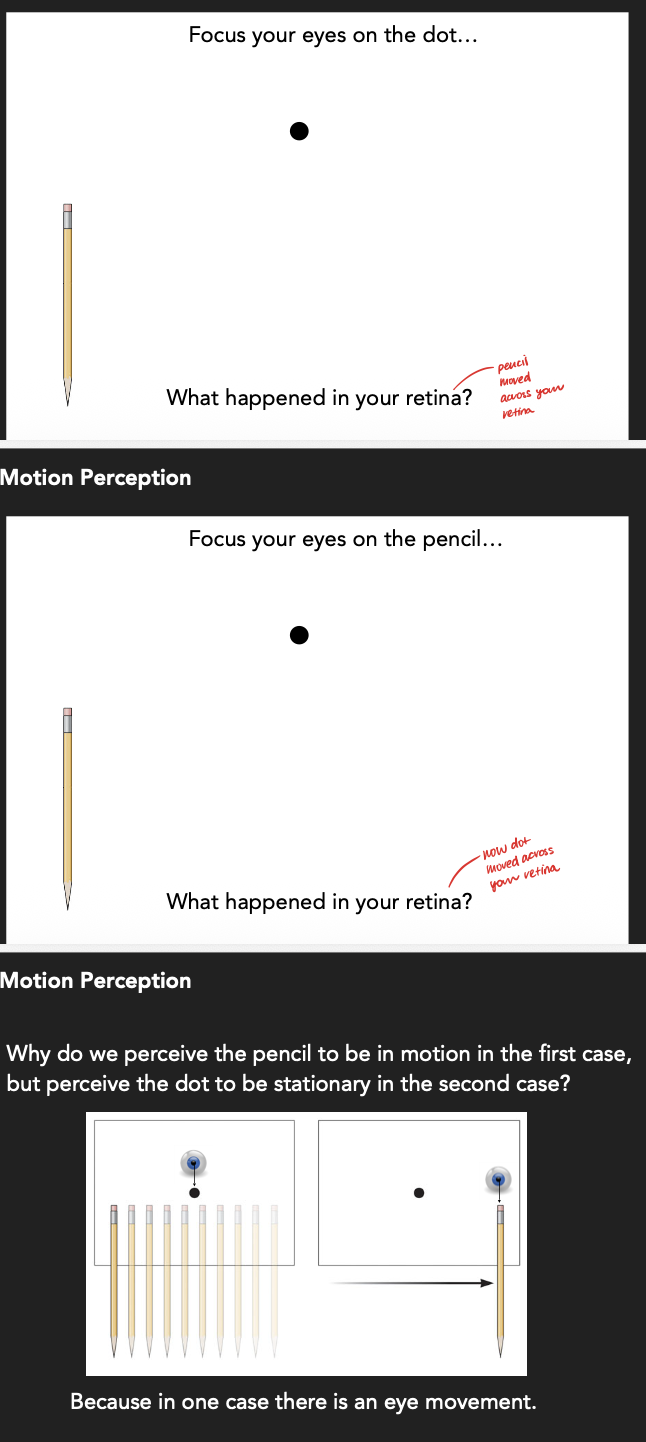
Why did we perceive the pencil to be in motion in the first demonstration, but the dot to be stationary in the second demonstration when the same display was shown on our retina?
Because in the first demonstration, our eyes were fixated on the dot. But in the second demonstration, we followed the pencil.
Hence, this eye movement in the second demonstration allowed us to differentiate between changes in object position due to motion, or due to our eyes moving around.
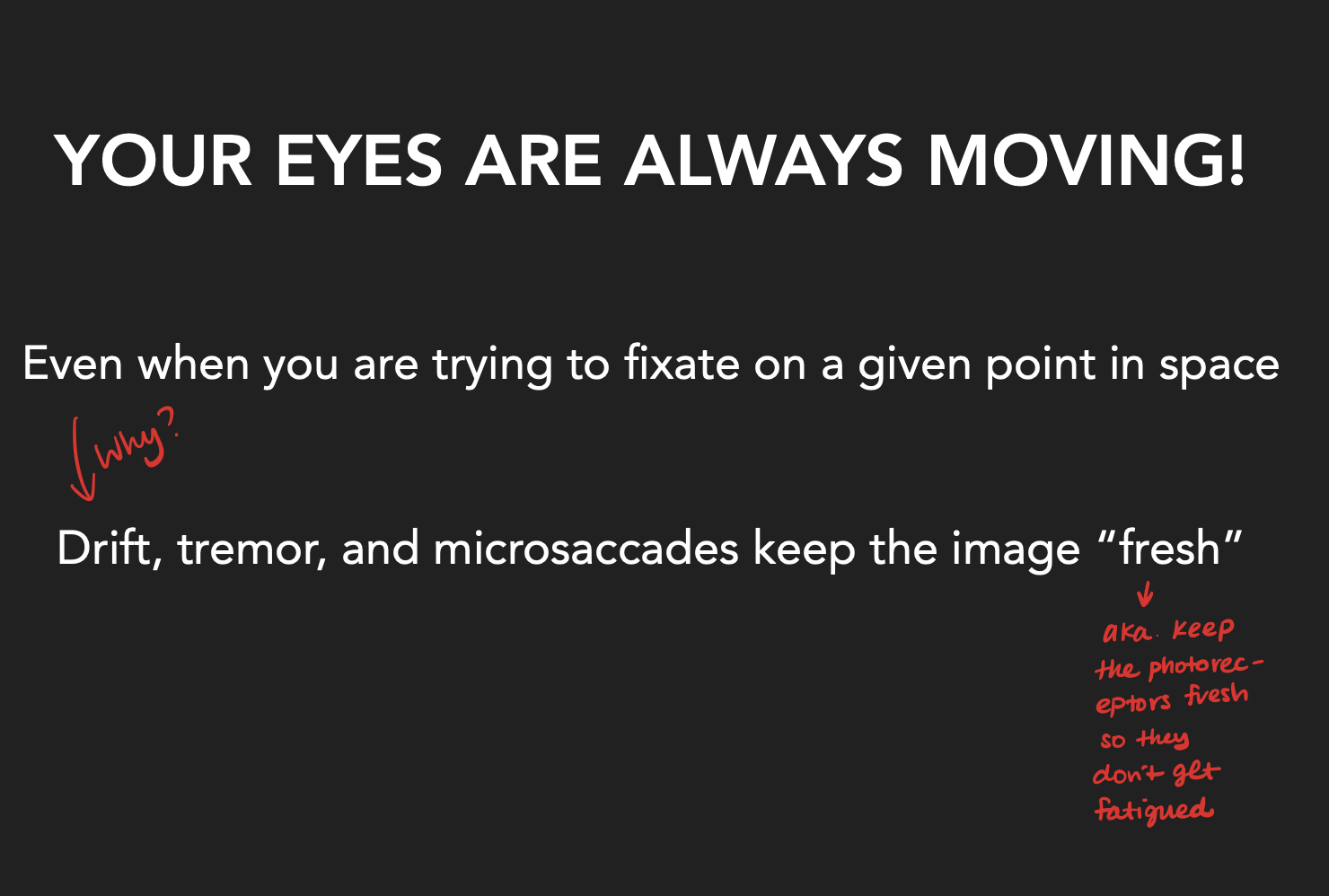
Are our eyes always moving? If yes, why?
Yes!
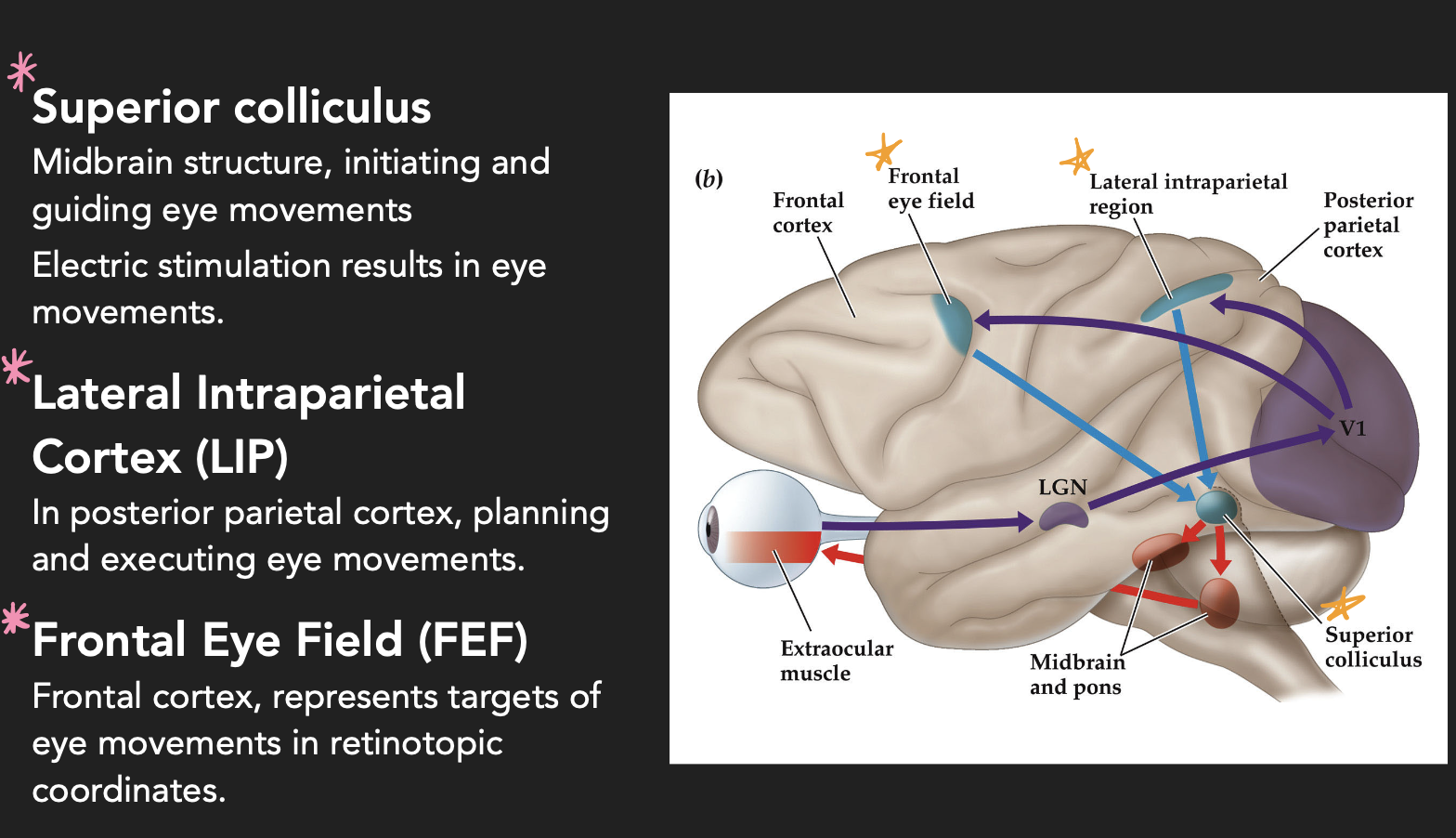
Which 3 regions allow us to move our eyes?
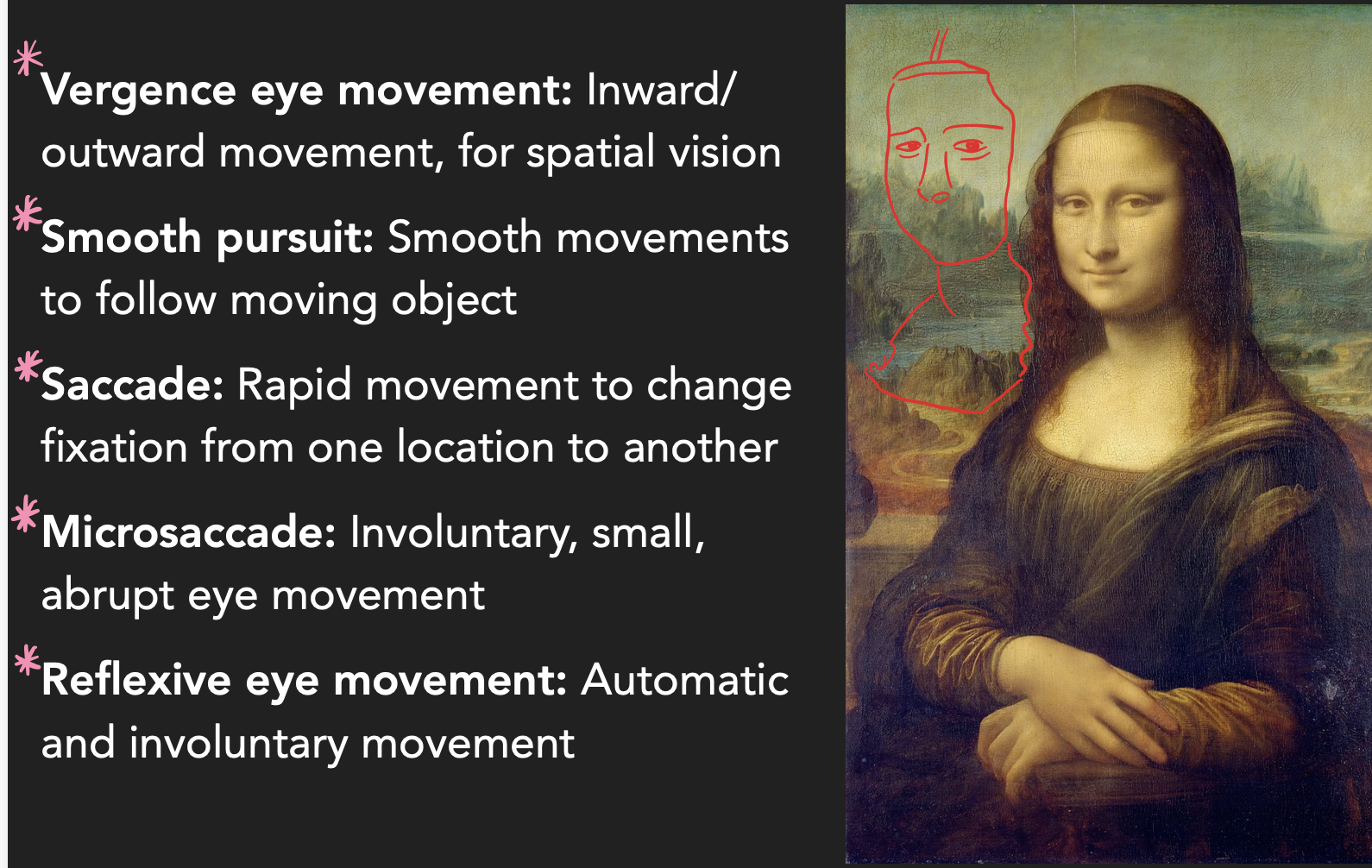
What are the 5 different types of eye movements?
Vergence Eye Movements
Smooth Pursuit
Saccade
Microsaccade
Reflexive Eye Movement
Define Vergence Eye Movements, Smooth Pursuit, Saccade, Microsaccade and Reflexive Eye Movement.
What are the different types of reflexive eye movements?
Optokinetic Nystagmus (OKN)
Vestibulo-ocular Reflexes (VORs)
Define Optokinetic Nystagmus (OKN).

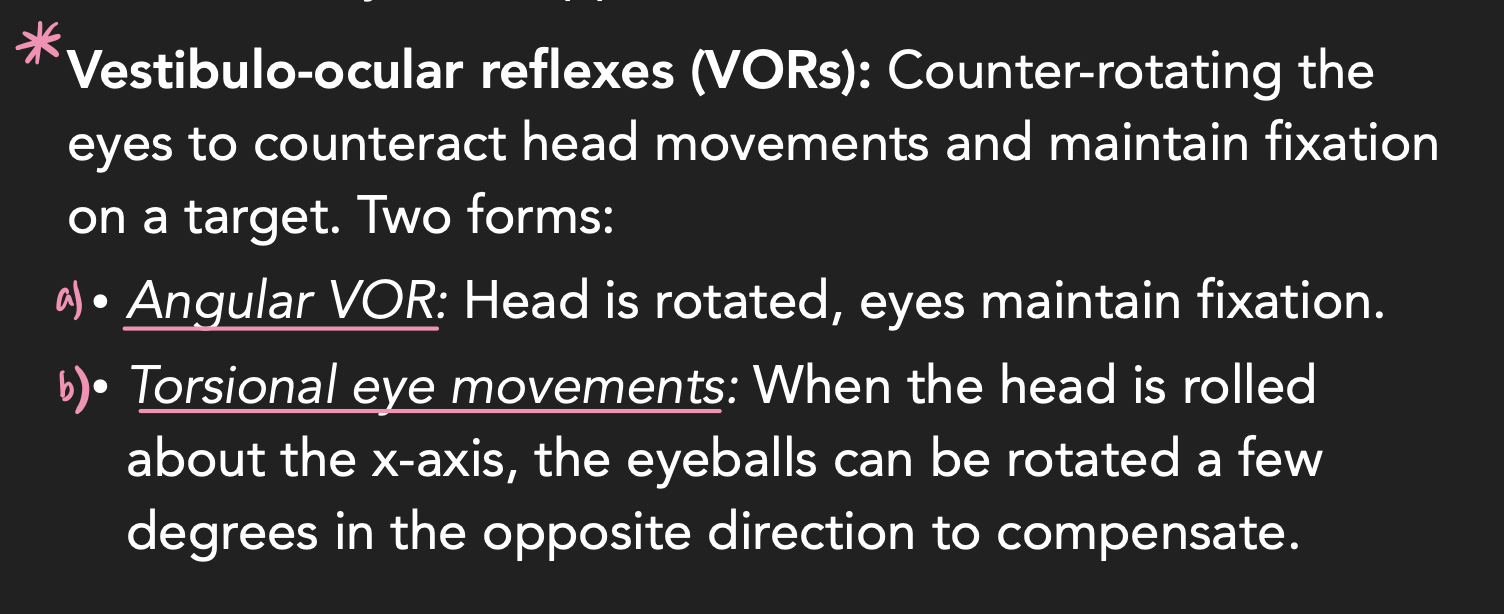
Define Vestibulo-ocular Reflexes (VORs).
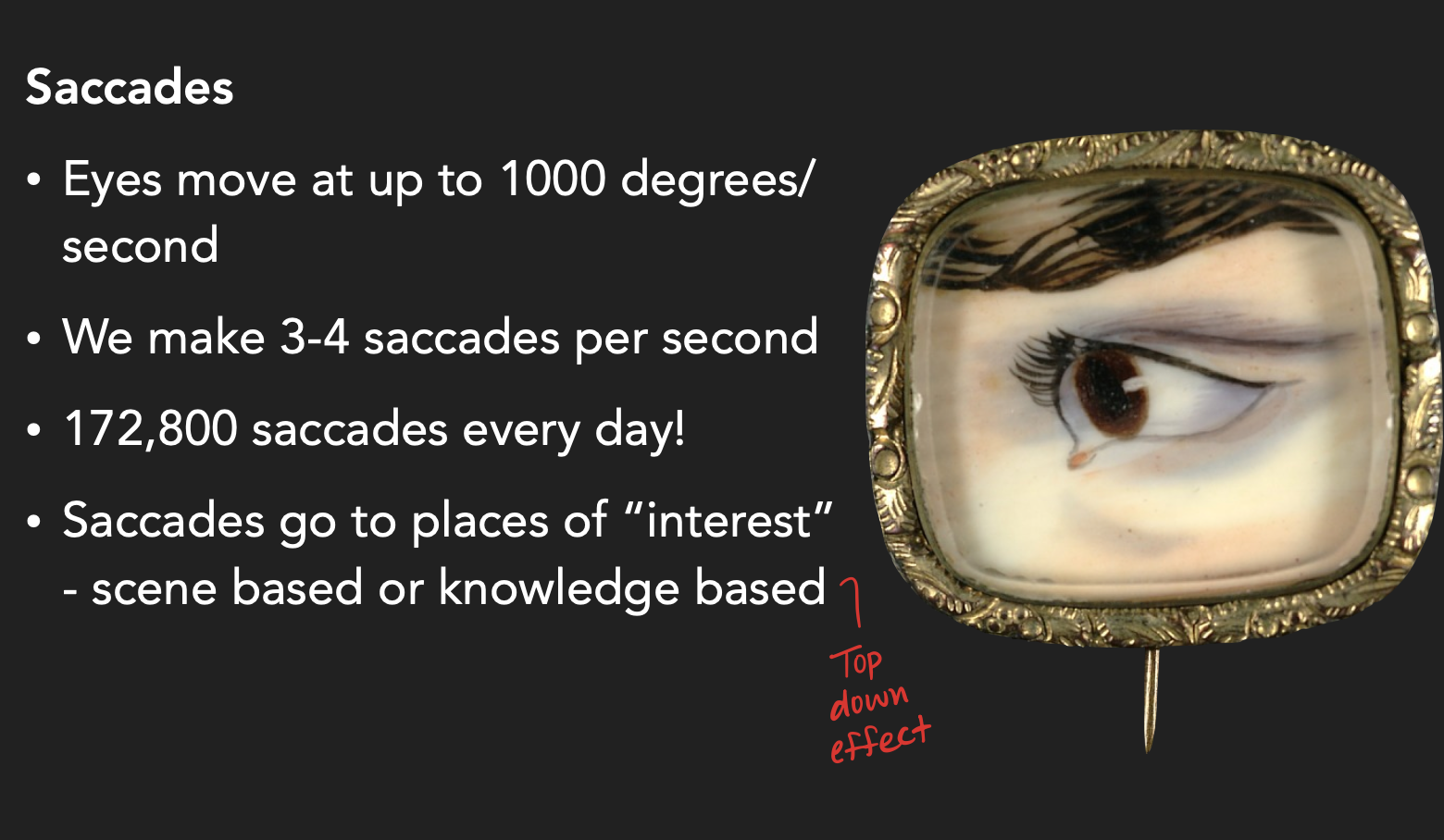
Explain the speed, frequency and what influences our saccadic eye movements.
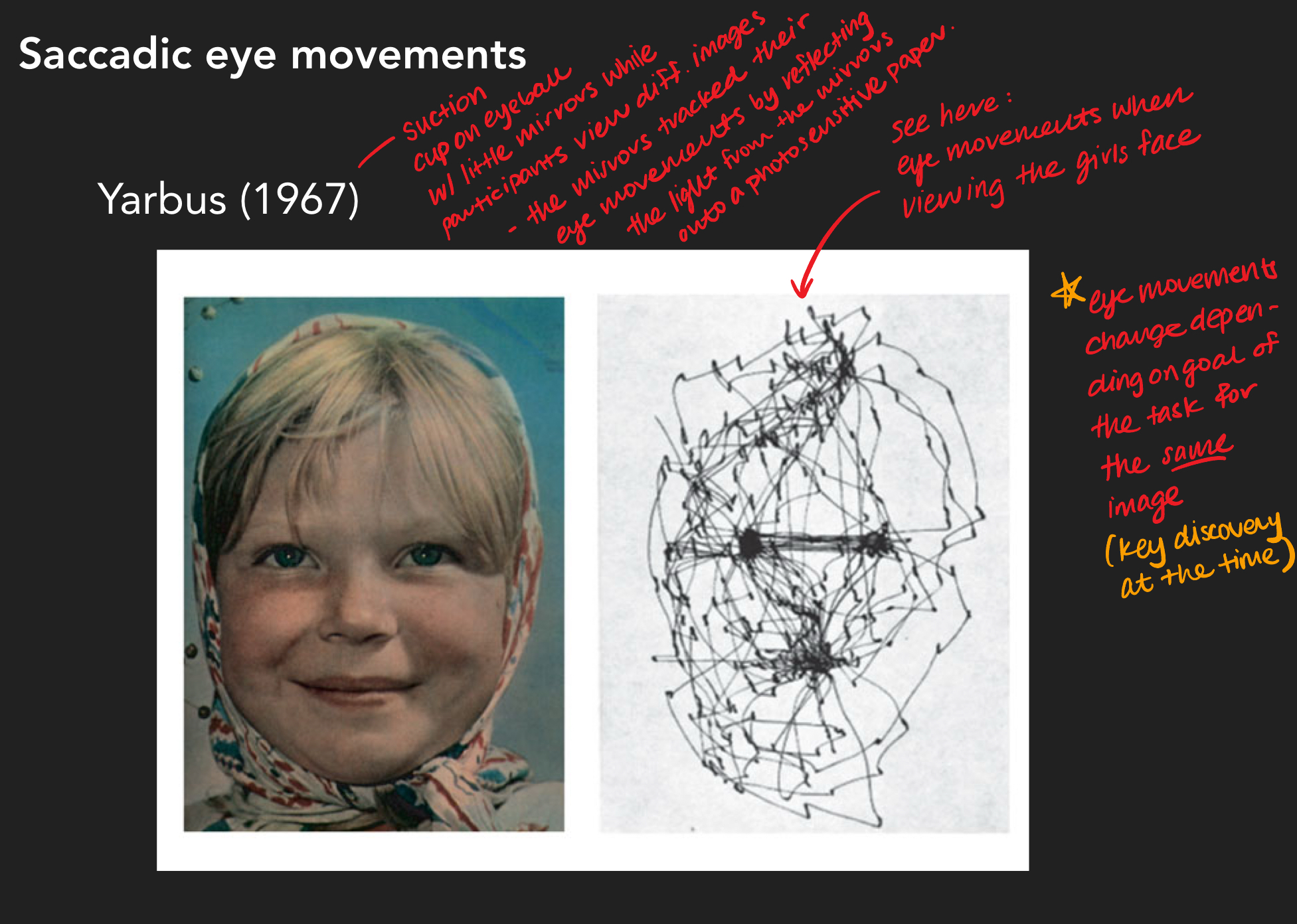
Explain what Yarbus (1967) did in his study? What did he show and what did he discover?
Explain how we can see a stable dot when we move our eyes around the dot, but a moving dot when we manually move our eyes.
Saccadic suppression only occurs when we make saccadic eye movements. Hence, when we manually move our eyes, saccadic suppression does not occur and the dot appears to be moving.

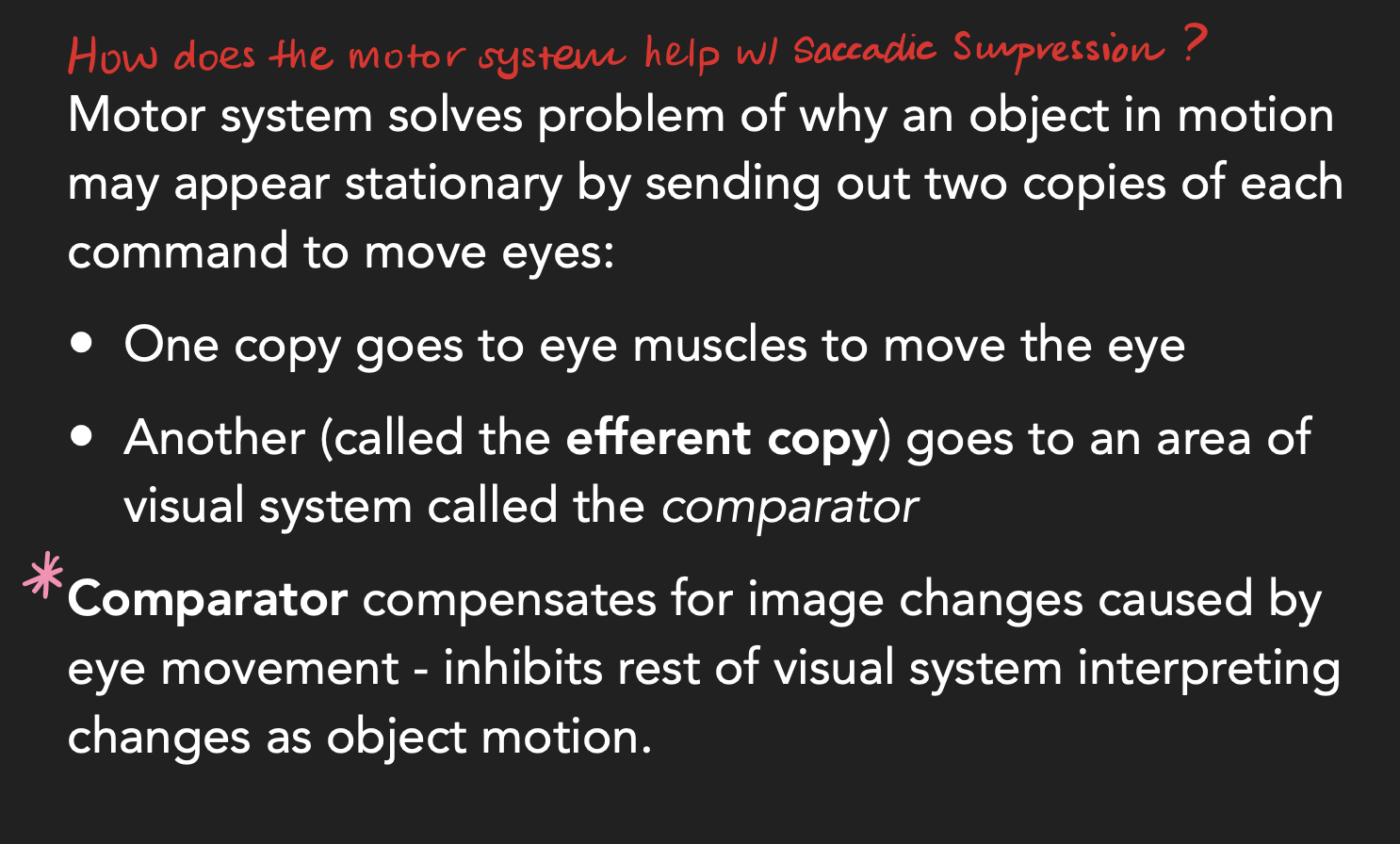
Explain how our motor system help with saccadic suppression.
*the efferent copy that hits the comparator inhibits processing in the visual system—preventing you from seeing a smear of your visual world.
What motion information do we use to navigate our surroundings?
Optic array
Optic flow
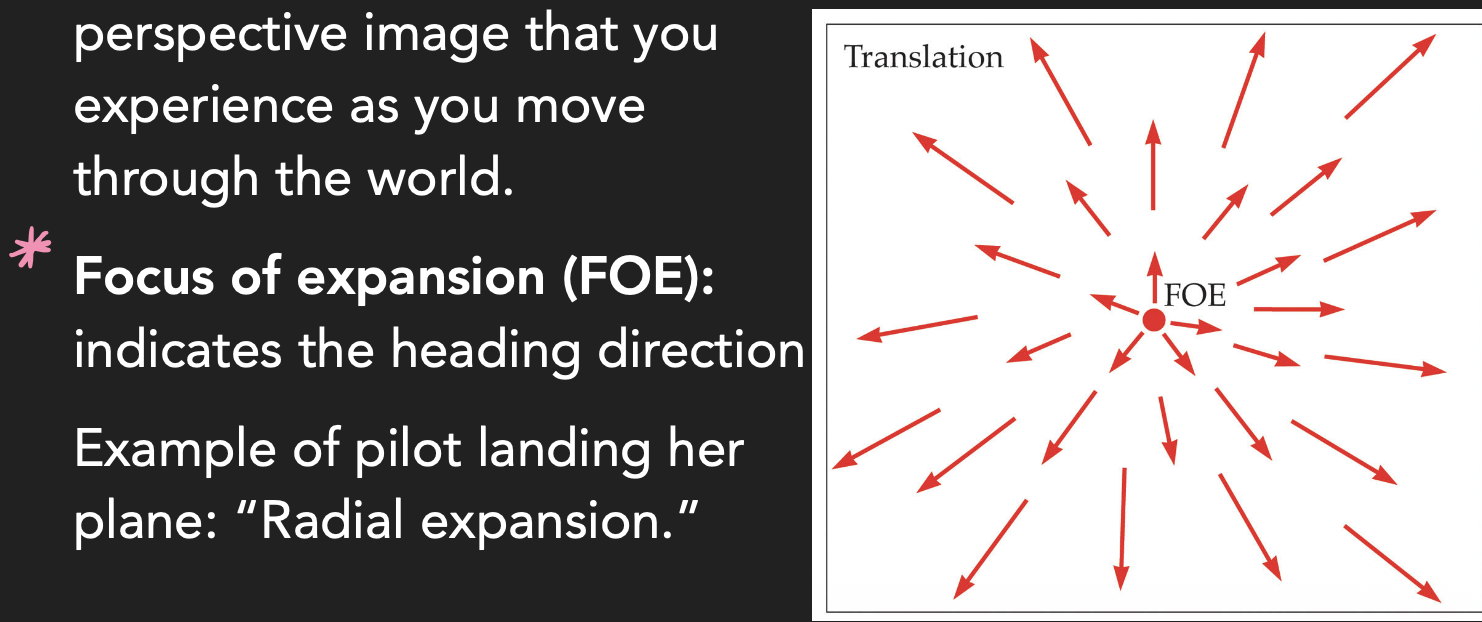
Focus of expansion (FOE)
Define optic array.

Define optic flow.
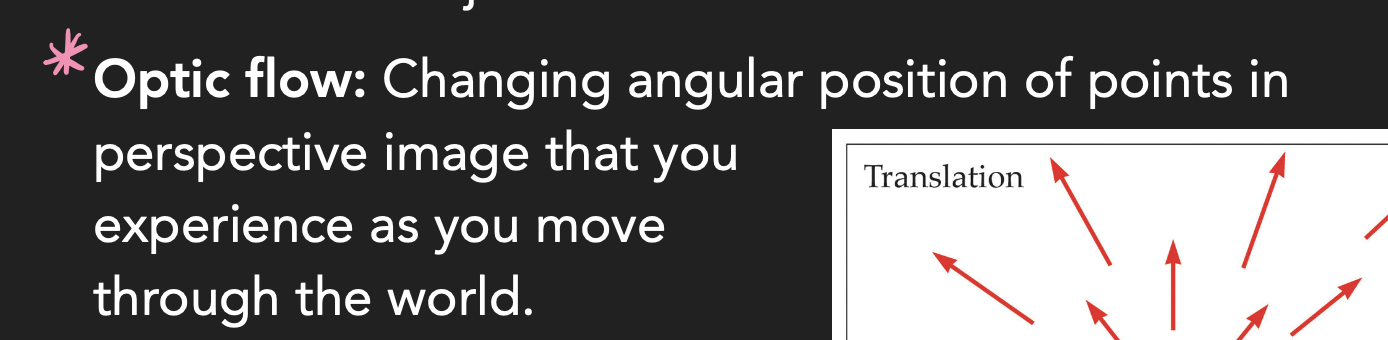
Define focus of expansion (FOE).
What is optic flow used for in computer vision?
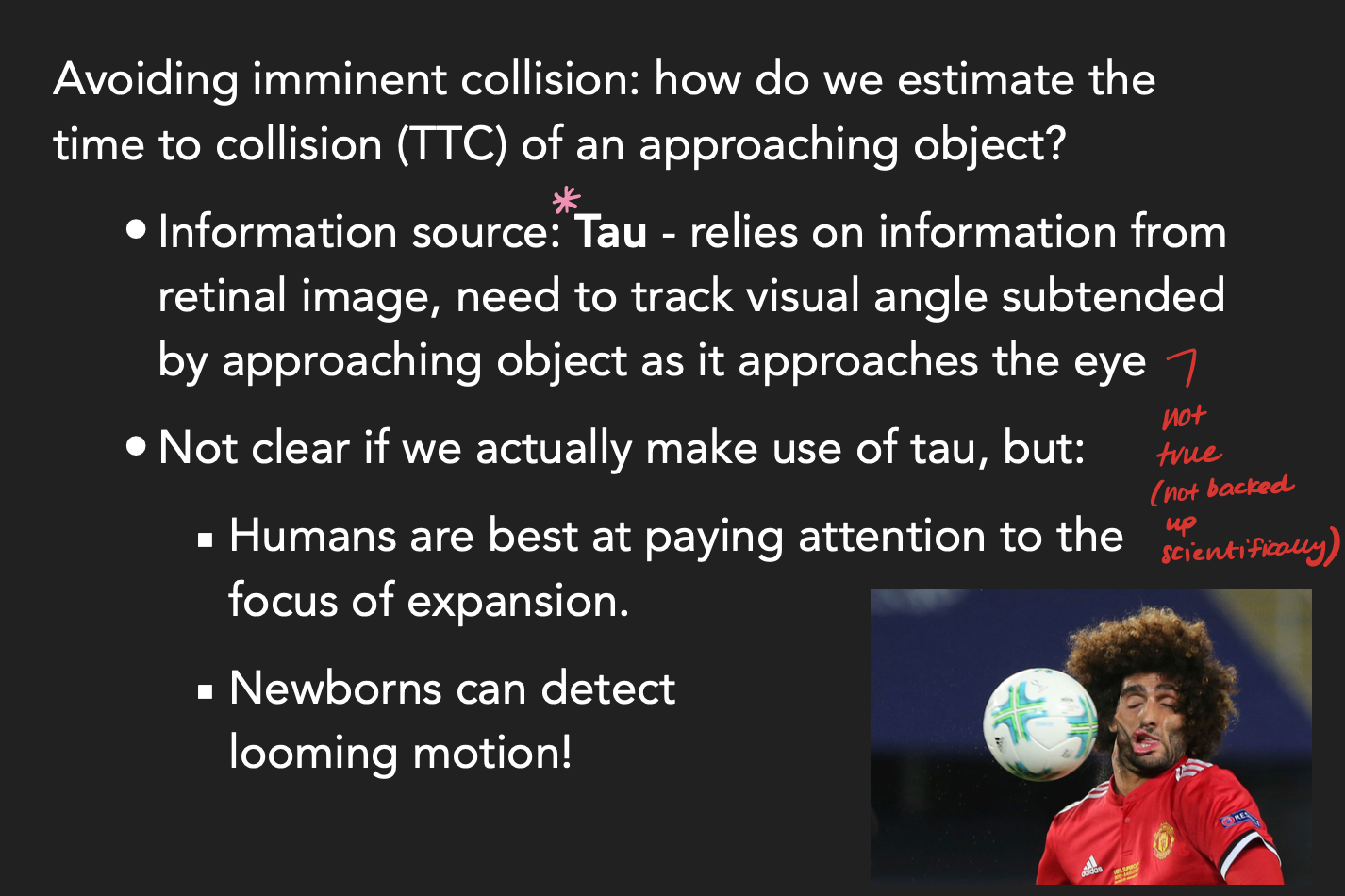
How did people think we estimated the time to collision (TTC) of an approaching object?
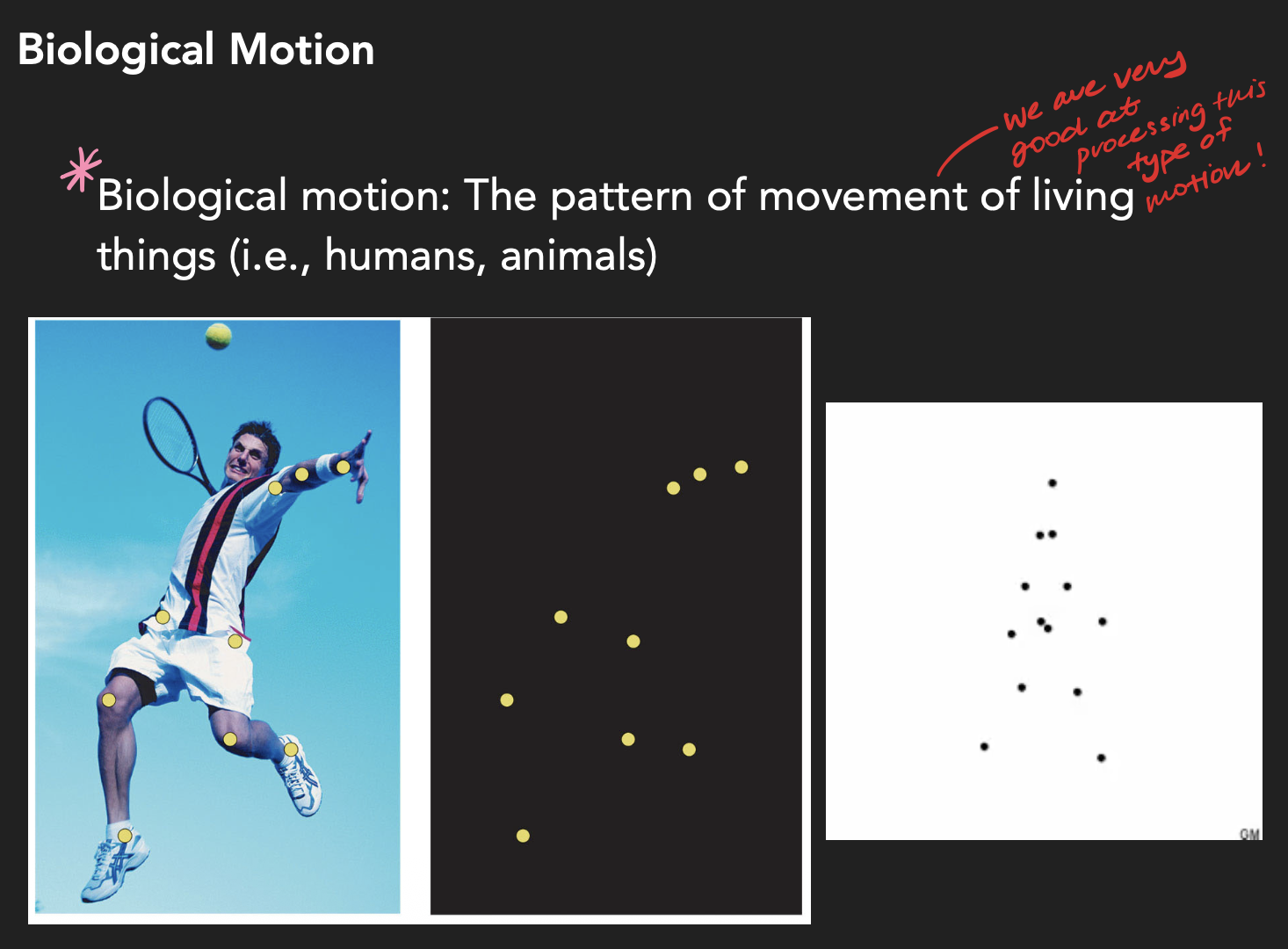
Define biological motion.
Define motion induced blindness.

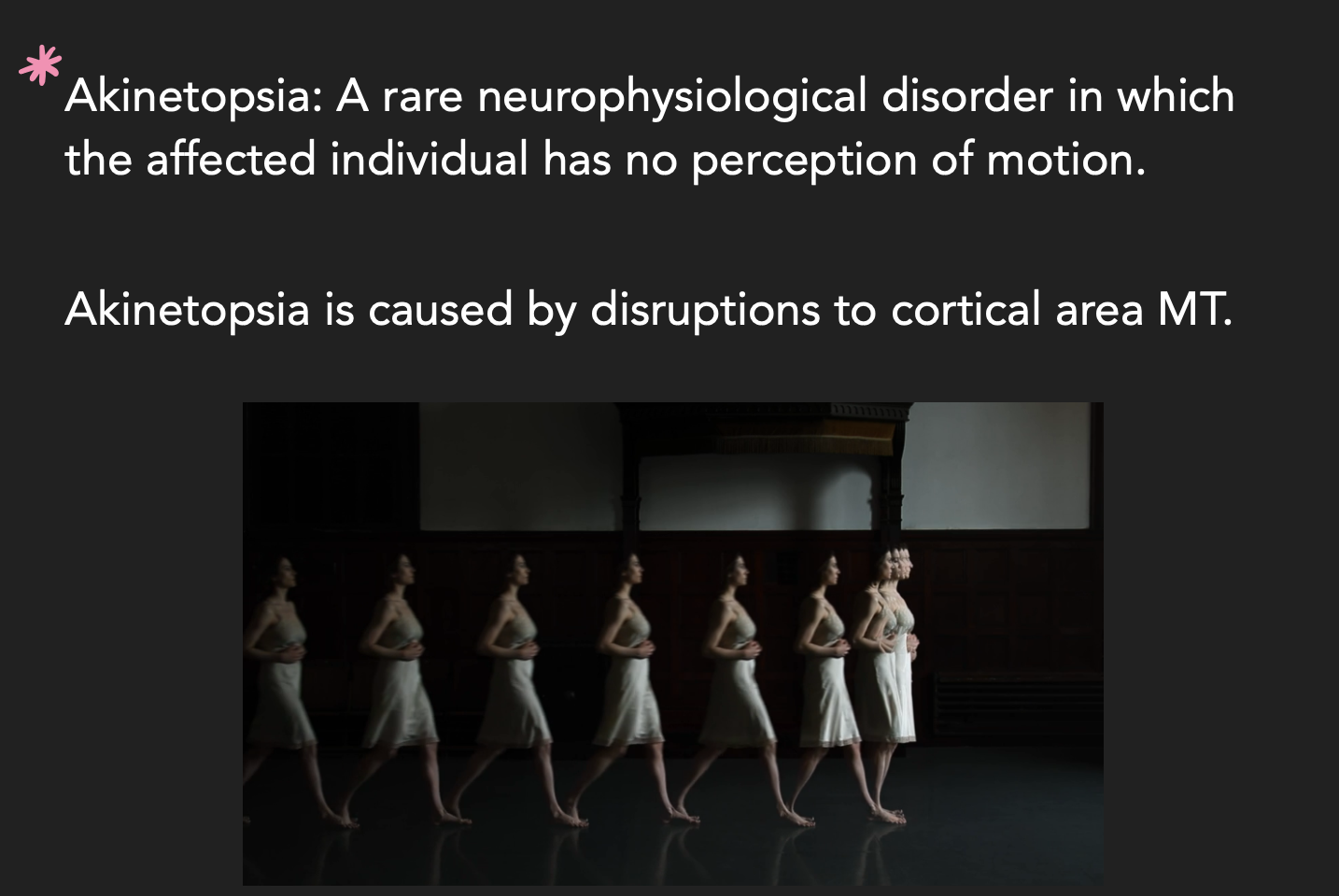
Define Akinetopsia.