ap bio final review
 Call Kai
 Learn
Learn Practice Test
 Spaced Repetition
 Match
Match Flashcards
 Knowt Play
1/82

There's no tags or description
Looks like no tags are added yet.
Name | Mastery | Learn | Test | Matching | Spaced | Call with Kai |
|---|
No analytics yet
Send a link to your students to track their progress
83 Terms
structure of amino acid and what molecules does it have
carbon, amino group, carboxyl group, hydrogen, side chain
CHONS
what is lipid function
energy storage, membranes, hormones
__________ proteins are made in cytoplasm, imported into the _________, and assembled with ______ in the _______ into ribosomal ___________.
ribosomal proteins are made in cytoplasm, imported into the nucleus, and assembled with rRNA in the nucleolus into ribosomal subunits
endomembrane system
The endomembrane system is a group of membranes in eukaryotic cells that work together to make, modify, and transport proteins and lipids
What’s included in the endomembrane system?
Think of it as a connected “shipping + processing network”:
Nuclear envelope (surrounds nucleus)
Rough endoplasmic reticulum (rough ER)
Smooth endoplasmic reticulum (smooth ER)
Golgi apparatus
Transport vesicles
Lysosomes (in animal cells)
Plasma membrane
What it does (big idea):
It moves materials through the cell using vesicles, like a delivery system.
Main jobs:
Make proteins and lipids (ER)
Modify and sort them (Golgi)
Transport them in vesicles
Export them or send them to organelles
Break things down (lysosomes)
nucleic acid function
store and transmit genetic info
protein functions
🔬 Enzymatic (Catalysts): Speed up chemical reactions (e.g., lactase breaks down lactose, amylase breaks down starch).
🛡 Defense: Recognize and neutralize pathogens (e.g., antibodies/immunoglobulins).
✈ Transport: Carry small molecules across membranes or throughout body fluids (e.g., hemoglobin transports
O2
𝑂2
; proton pumps move
H+
𝐻+
).
🧬 Signal/Regulation: Act as chemical messengers between cells (e.g., hormones like insulin regulate blood sugar).
🏗 Structure: Provide physical support and strength (e.g., collagen in skin/tendons, keratin in hair/nails, tubulin in microtubules).
🔄 Movement/Contractile: Enable cells or organisms to move (e.g., actin and myosin in muscles).
🎒 Storage: Store amino acids for development (e.g., casein in milk, albumin in egg whites).
where is phosphorus found
nucleic acids, phospholipids
nucleic acid molecules
CHONP
what molecules is nitrogen in
amino acids (amino group) and nucleic acids (nitrogenous base)
carbohydrate bond name
glycosidic bond
what is the carbohydrate bond between
OH group of monosaccharides
what molecules is peptide bond between
COOH and NH2
what molecules is phosphodiester bond between
sugar and phosphate
shape of carbs
chains or rings
describe how rRNA goes to the rough er
rRNA (nucleolus) → ribosome (cytoplasm) → signal sequence?
Yes → rough ER (membrane/export proteins)
No → stays free (internal proteins)
shape of protein
folded shape (structure is function)
DNA structure
double helix
RNA structure
single strand
mRNA
messenger RNA
tRNA
delivering specific amino acids to ribosomes during translation
rRNA
It acts as a ribozyme to catalyze peptide bond formation (protein synthesis) and provides a structural scaffold for ribosomal proteins. Located in the nucleolus (eukaryotes) or cytoplasm (prokaryotes), rRNA binds mRNA and tRNA during translation
are ribosomes in all organisms
yes
Prokaryotes (and inside Mitochondria/Chloroplasts) have what type of ribosomes .
70s
eukaryotes have what kind of ribosomes
80s
Proteins destined to stay in the ______, ________, or _______ are synthesized on free ribosomes in the cytoplasm, not the Rough ER.
Proteins destined to stay in the cytosol, mitochondria, or nucleus are synthesized on free ribosomes in the cytoplasm, not the Rough ER.
Proteins synthesized on the RER are for secretion (out of the cell), integral membrane proteins, or residency in organelles within the endomembrane system.
rough er function
how to know if protein made in rough er or free ribosome
Function:
Secreted proteins (leave the cell)
Membrane proteins (embedded in membranes)
Endomembrane system proteins (Golgi, lysosomes, vesicles)
Free ribosome proteins:
Stay in the cytoplasm while being made
Function:
Used inside the cell (cytosol, nucleus, mitochondria, etc.)
structure and function of golgi
Modification: Modifies proteins and lipids, notably through glycosylation (adding sugar chains) and phosphorylation.
Sorting and Packaging: Sorts products based on final destination (e.g., lysosome, plasma membrane, or secretion) and packages them into new vesicles.
Secretory Pathway: Essential for exporting substances via exocytosis (e.g., secreting hormones, mucus, or matrix components).
Lysosome Formation: Produces lysosomes used to break down waste.
Carbohydrate Synthesis: Synthesizes polysaccharides, such as pectin and hemicellulose for plant cell walls
a change in nucleotide sequence changes _______
change in amino acid sequence means change in ________ folding
condons
protein folding
triglyceride
glycerol + 3 fatty acids
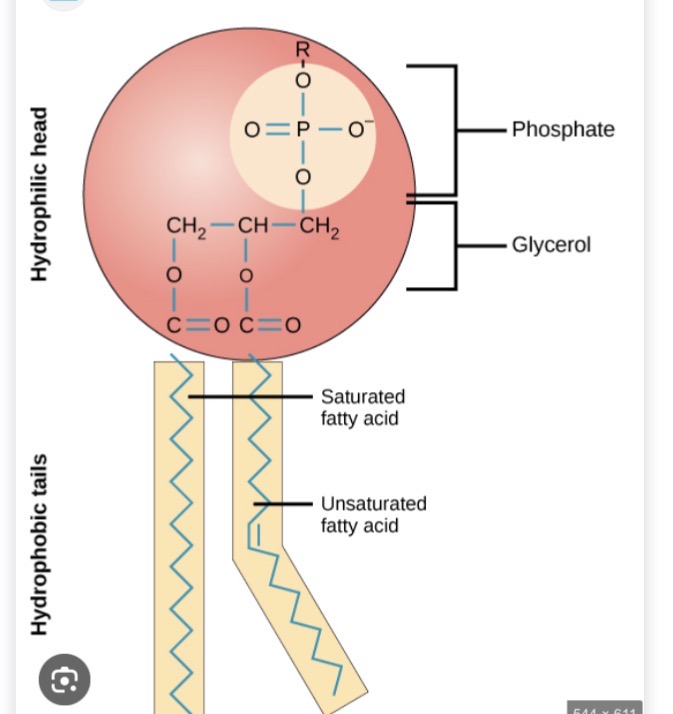
phospholipid
glycerol + 2 fatty acid tails + phosphate head
how many carbon rings is a steroid
4
how does a lysosome do apoptosis
by releasing their acidic, enzyme-rich contents into the cytosol through lysosomal membrane permeabilization (LMP
how does vacuole keep turgor pressure
stores water, pushes against cell wall, keeps plant rigid
cell wall in plants
cellulose
cell wall in fungi
chitin
cel wall in prokaryotes
peptidoglycan
atpase
ATPases are enzymes that catalyze the decomposition of ATP into ADP and a free phosphate ion
Na+/K+ pump
what goes in and out
3 Na out, 2 K in
how does the Na+ / K+ pump keep membrane potential
Makes it more negative inside. By moving a net charge of +1 (three positive charges out, two positive charges in) out of the cell per cycle, the pump directly contributes to maintaining a resting membrane potential of roughly -70 mV.
water moves from ____ solute to _____ solute
low solute to high solute
why did mitochondria come first
all eukaryotes have the, only some have chloroplast
evidence for endosymbiosis theory
mitochondria and chloroplast have their own dna, double membrane, and ribosomes like bacteria
endosymbiosis theory means
mitochondria and chloroplast were once bacteria
what are hormones made of
Amino Acid-Derived/Peptide Hormones: These are small molecules or proteins (like insulin or epinephrine) that usually act quickly and often have names ending in "-ine".
Steroid Hormones: These are lipid-soluble molecules derived from cholesterol, such as cortisol, testosterone, and estradiol, which often remain in circulation longer and have names ending in "-ol" or "-one
water moves from _____ water potential to ______ water potential
HIGH Ψ → LOW Ψ
smooth ER function
Responsible for lipid synthesis (phospholipids/cholesterol), detoxification of drugs and toxins, and storing calcium ions.
what is water potential
The tendency of water to move.
water moves always moves to where there is _____ solute. this is when water potential is (higher or lower)
more, negative
What does “low water potential” mean?
More negative, less free water (more solute)
How does more solute affect water potential?
Makes Ψ more negative
What is pressure potential (Ψp)?
Physical pressure on water (like cell walls)
Where does water move based on solute?
Toward higher solute concentration
Where does water move based on water potential?
Toward more negative Ψ
Water moves DOWN the gradient (high → low Ψ)
in photosynthesis, hydrogen protons go from the __________ to the ___________.
stroma to the thylakoid
What process splits water to provide electrons? Where do the hydrogens, oxygen, and electrons go
Photolysis (in Photosystem II), hydrogen in the thylakoid space, electrons go to replace ones lost in ps2
the thylakoid space (inside the thylakoid) has a _____ concentration of hydrogen ions
high
what is a byproduct of photosynthesis? where does it come from
oxygen, water splitting by ps2
What is the overall equation for photosynthesis?
6CO₂ + 6H₂O + light → C₆H₁₂O₆ + 6O₂
What is the purpose of the light reactions?
Convert light energy into ATP and NADPH (energy carriers)
Where do the electrons in photosynthesis originally come from?
Water (H₂O)
Why is water essential for photosynthesis?
It is the source of electrons that power the entire electron transport chain
What is this ATP-producing process called in photosynthesis?
photophosphorylation
What molecule is the final electron acceptor in photosynthesis?
NADP⁺ → becomes NADPH
Where do the electrons in glucose ultimately come from?
Water (H₂O) via NADPH
What is carbon fixation?
CO₂ is attached to RuBP to begin sugar production
What are the 3 phases of the Calvin cycle?
Carbon fixation
Reduction
Regeneration of RuBP
What is lactic acid fermentation?
A process cells use to keep making ATP when oxygen is not available by regenerating NAD⁺.
What is the main purpose of fermentation?
To regenerate NAD⁺ from NADH so glycolysis can continue producing ATP without oxygen.
How much ATP does fermentation produce?
0 ATP directly (ATP comes only from glycolysis → 2 ATP per glucose total)
What are the steps of alcohol fermentation?
Pyruvate → acetaldehyde + CO₂
Acetaldehyde + NADH → ethanol + NAD⁺
What is the final electron acceptor in alcohol fermentation?
Acetaldehyde
What organisms use alcohol fermentation?
Yeast and some bacteria
What is lactic acid fermentation?
A process where pyruvate is ________ to ________ to regenerate NAD⁺.
reduced to lactate