Chapter 29
 Call Kai
 Learn
Learn Practice Test
 Spaced Repetition
 Match
Match Flashcards
 Knowt Play
1/57

Earn XP
Description and Tags
only red
Name | Mastery | Learn | Test | Matching | Spaced | Call with Kai |
|---|
No analytics yet
Send a link to your students to track their progress
58 Terms
What key traits appear in nearly all plants?
reproduction: alternation of generations
walled spores produced in sporangia
growth: apical meristems
What is alternation of generations
Type of plant life cycle consisting of multicellular forms that gives rise to each other in turn.
What are the two multicellular generations in the plant life cycle?
Gametophyte (n) and sporophyte (2n).
What does the gametophyte produce, and by what process?
Haploid gametes (sperm and eggs, n) by mitosis.
What does the sporophyte produce, and by what process?
Haploid spores (n) by meiosis
what do spores develop into?
Gametophytes (n)
What does a fertilized egg (zygote, 2n) develop into?
a sporophyte (2n)
What is the plant life cycle called "alternation of generations?”
Because plants alternate between haploid gametophytes and diploid sporophytes, both multicellular.
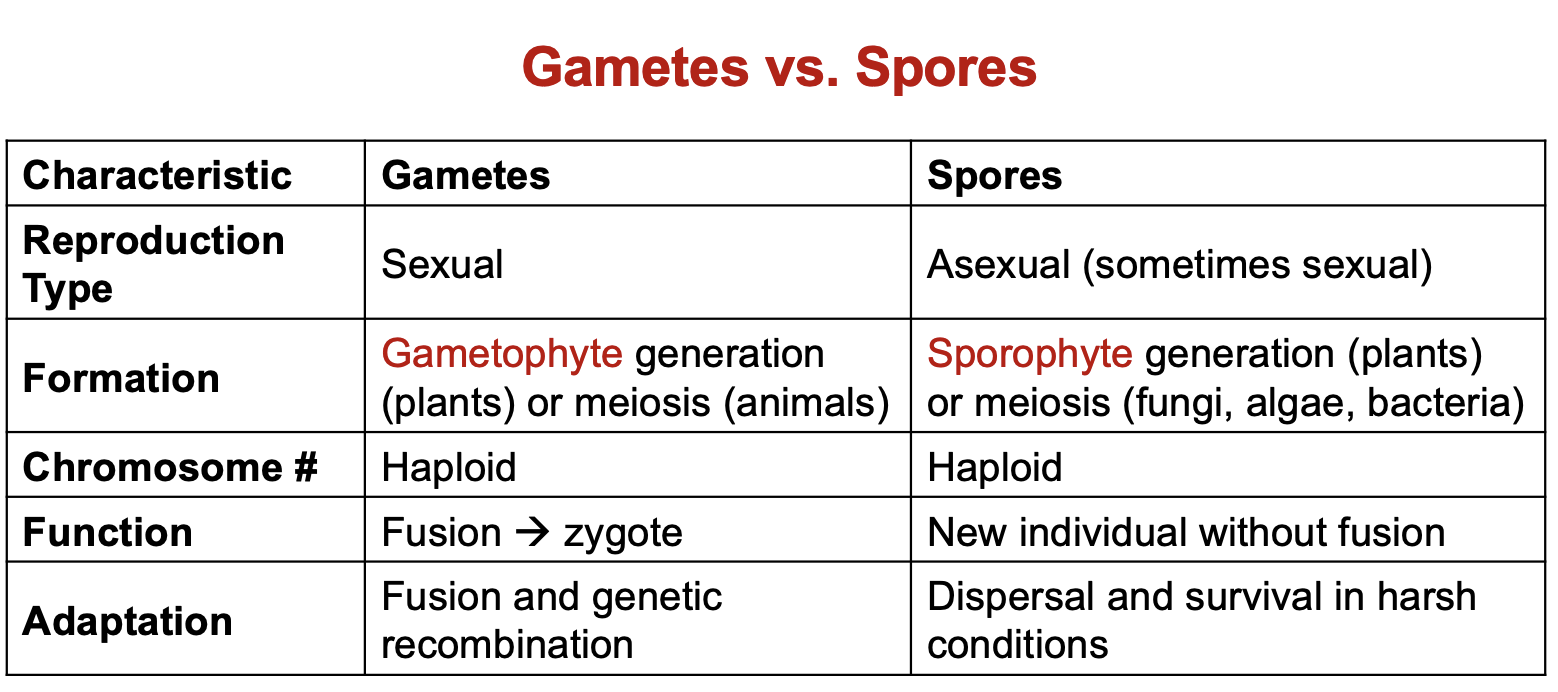
The sporophyte produces spores in multicellular organs called….
sporangia
spore walls contain …… which makes them resistant to harsh environments
sporopollenin (structural integrity to spores)
Determinate growth
organism or part of an organism grows to a certain size and then stops
Indeterminate growth
organism or part of an organism continues to grow indefinitely, without a predetermined endpoint
Apical Meristems
Localized regions of cell division at the tips of roots and shoots
Primary growth (apical meristem)
tips of roots and shoots; length
Secondary growth (apical meristem)
thickening of the trunk and branches
Vascular cambium (secondary growth in apical meristem)
produces new layers of xylem and phloem
Cuticle
a waxy covering of the epidermis that reduces water loss
Stomata
pores that facilitate gas exchange between the outside air and internal plant tissues; close to decrease water loss
Ectomycorrhizae
dense sheath around roots
hyphae extend into the soil to increase nutrient absorption
Endomycorrhizae
hyphae penetrate the root cells (arbuscules)
produce food through photosynthesis
Autotrophs
informal term for all nonvascular plants - liverworts, mosses, and hornworts
Bryophytes
club mosses and their relatives
Lycophytes
ferns and their relatives
monilophytes
Gymnosperms
seeds are not enclosed in chambers
Angiosperms
seeds develop inside chambers that originate within flowers
Bryophytes are represented today by three phyla of small, herbaceous (nonwoody) plants:
Liverworts, phylum Hepatophyta
Mosses, phylum Bryophyta
Hornworts, phylum Anthocerophyta
(all require standing water for reproduction)
In bryophytes (mosses, liverworts, hornworts), which generation is dominant?
The haploid gametophyte is dominant - it is larger, longer-living, and supports the sporophyte.
Mass of green, branched, one-cell-thick filaments produced by spores
Protonema
What do Protonema do?
absorbs water and nutrients; forms “buds” that develop into gametophytes
Most bryophytes are constrained in….
height
Some moss species have …… that enable growth
conducting tissues
remember: multicellular, but no vascular tissue
root-like structures that anchor gametophytes to the substrate
Rhizoids
Gametophytes can produce multiple …., structures that produce gametes
gametangia
Archegonia
female gametangia, produce a single nonmotile egg
Gametophyte → Gametangia → Gametes
Antheridia
male gametangia, produce many motile sperm
Gametophyte → Gametangia → Gametes
…… swim to the …… through a film of water in response to chemical attractants
Flagellated sperm, egg
Antheridia to Archegonia
In bryophytes, where is the fertilized egg and resulting embyro retained?
within the archegonium
What is sexual reproduction limited by for bryophytes
water availability
proximity of male and female gametophytes
How does a sporangium (capsule) produce spores
meiosis
What is an ecological importance of moss?
help retain nitrogen in bare, sandy soil
Where are seedless vascular plants restricted to?
moist habitats where the sperm can swim to the egg
What are ferns and other seedless vascular plants characterized by
Life cycles with dominant sporophytes
Transport in vascular tissues called xylem and phloem
Well-developed roots and leaves
Spore-bearing leaves called sporophylls
In seedless vascular plants, are sporophytes or gametophytes dominant?
Sporophytes are larger and more complex (dominant) than gametophytes
Xylem does what
conducts most of the water and minerals and includes tube-shaped cells called tracheids
What are xylem strengthened by
a polymer called lignin
How are the cells of phloem tissue organized and what do they do
Arranged in tubes for transport of organic materials, such as sugar
Why are vascular tissue like xylem and phloem important
provides the structural support and long-distance transport needed for plants to grow tall
organs that anchor vascular plants into ground and absorb water and nutrients from soil
roots
What do leaves do
increases surface area for light capture
conducts most of the photosynthesis in plants
Two types of leaves
microphylls and megaphylls
What are microphylls
small, often spine shaped leaves with a single vein
found only in lycophytes
What are megaphylls
larger leaves, with a highly branches vascular system
found in all other plant groups
Sporophylls
modified leaves with sporangia
Clusters of sporangia on the undersides of fern sporophylls
sori
Most seedless vascular plants are…
homosporous
one type of sporophyll and sporangium
All seed plants and some seedless vascular plants are….
heterosporous
two types of sporophylls
Megaspores - female gametophytes
Microspores - male gametophytes