TUT4 R9 Developing Self-Directed Learners
 Call Kai
 Learn
Learn Practice Test
 Spaced Repetition
 Match
Match Flashcards
 Knowt Play
1/45

Earn XP
Description and Tags
Robinson, J.D. & Persky, A. M. (2020). Developing self-directed learners. American Journal of Pharmaceutical Education, 84 (3), 292-296
Name | Mastery | Learn | Test | Matching | Spaced | Call with Kai |
|---|
No analytics yet
Send a link to your students to track their progress
46 Terms
Robinson and Persky 2020
Paper that discusses the meaning of self-directed learning, challenges with implementation, and strategies to overcome obstacles in educational settings
Lifelong Learning and Health Care
The Institute of Medicine emphasizes that health-care professionals must develop lifelong learning skills to maintain competence.
Lifelong Learning and SDL
Becoming a lifelong learner requires HCPs to be self-directed in how they identify learning needs and pursue knowledge
SDL is essential for modern health professionals
Lack of Consensus on SDL
Despite widespread use of the term, SDL does not have a clear or consistent definition
Uncertainty also exists around how SDL should be implemented and developed
Terminology Confusion
Confusion around SDL may stem from its similarity to related terms
“Self paced learning”
“Self regulated learning”
These overlapping concepts can blur what SDL specifically involves.
Purpose
The paper by Robinson and Persky 2020 seeks to:
Clearly define SDL and distinguish it from similar concepts
Review empirical evidence supporting development of SDL in adult education
Self Directed Learning
Self-directed learning (SDL) is the result of creating learning experiences that empower learners to make decisions about what knowledge or skills they want to develop.
Emphasizes learner autonomy
Commonly observed when students independently identify learning needs and seek out information
Where SDL Occurs
SDL is often seen in experiential settings, such as when students encounter unfamiliar situations and must independently research and learn
During a placement, a student realizes they lack skills in patient communication, sets a learning goal, seeks out relevant resources, applies new strategies in practice, and reflects on their effectiveness.
It also occurs in co-curricular activities, where learners pursue topics based on personal or professional interest.
Role of the Curriculum and Scaffolding
Although SDL frequently occurs outside the classroom, the skills required for SDL should be introduced in formal curriculums
This allows students to gradually develop these skills over time through scaffolding, rather than being expected to self-direct without preparation
Learner Responsibility in SDL
The core principle of SDL is that students take responsibility for learning beyond what is provided by instructors or the formal curriculum
Learners set their own goals, identify ways to assess progress, and locate appropriate resources, rather than relying on instructor-defined structures
Shift in Educator’s Role
SDL represents a fundamental shift for educators from being information providers to facilitators, motivators, and learning designers
In many cases, educators become co-learners, supporting students while also developing new instructional skills
Impact of SDL on Learners
Well-designed SDL environments foster autonomy, mastery, and purpose, increasing student motivation and confidence
SDL supports creativity and encourages lifelong learning by reinforcing students’ belief in their ability to learn independently
SDL vs Self-Paced Learning
Self-paced learning allows students to complete tasks within a flexible timeframe
Does not involve setting learning goals or identifying resources
Goals, content, and resources are determined by an instructor
Student controls the timing and speed, not what is learned
In contrast, SDL requires learners to define what they will learn and how they will learn it; therefore, self-paced learning alone is not self-directed learning
SDL vs Self-Regulated Learning
Refers to how learners manage their thoughts, emotions, and behaviors
Goals are set by an instructor
Involves changing affective, cognitive, and behavioral processes throughout a learning experience to reach a desired level of achievement
Stems from cognitive psychology and applied in formal academic settings
SDL requires learners to set their own goals and define how they will learn it. Also usually stems from adult education and takes place outside the traditional classroom
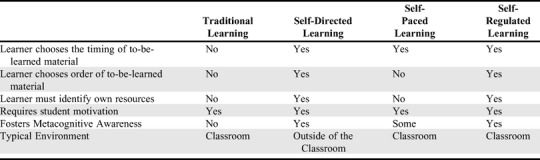
Table 1
Comparison of Traditional Classroom to Self-Directed Learning, Self-Paced Learning, and Self-Regulated Learning
Strategies to Develop Self Directed Learners
Understand SDL
SDL is a six-step process:
Develop learning goals
Define assessments to measure achievement
Outline structure and sequence of activities
Create a timeline
Identify resources
Locate a mentor/faculty for feedback
Scaffolded Learning Approach
An approach where the learner gradually gains more autonomy (to develop SDL)
Starts with teacher-directed or self-paced activities in the classroom
Gradually shift control to the student as they move to experiential learning settings
Early guidance helps students develop self-regulation skills
Health Profession Programs
Postsecondary education programs that prepare students for careers in healthcare
May employ certain educational components to develop SDL
Flipped classrooms
Learning contracts
Minimal guidance instruction
Flipped Classroom
Learning model where students learn foundational material independently before class
Allows students to develop confidence in self-regulation skills (study strategies, self-assessment)
Shifts class time from information delivery to active learning
Class time is used to apply, discuss, and deepen understanding
Team Based Learning
A highly structured form of the flipped classroom where students prepare in advance and work collaboratively during class
Emphasizes accountability, application of knowledge, and peer learning
More Self-Directed Flipped Classrooms
Flipped classrooms can be extended beyond class time by having students create individual learning plans to further explore course topics.
This shifts learning from instructor-led application to student-initiated inquiry.
Pre-class Guided Exploration
Students may be given guided questions to help them navigate key resources (e.g., hypertension treatment guidelines) before class.
This activates prior knowledge, introduces reliable professional resources (i.e. clinical guidelines), and builds foundational understanding.
In-class Application of Knowledge
Class time is then used to apply pre-learned material in new or complex situations.
This reinforces understanding and models how theory can be applied in practice.
Post-class Self-directed Inquiry
Students are encouraged to generate their own follow-up questions and develop a learning plan to explore topics of personal or professional interest.
This promotes autonomy and deeper engagement with the material.
SDL Example
Instructor given topic of “hypertension”
Develop learning goals
“I want to know how to treat hypertension in pediatric patients”
Define assessments to measure achievement
“I will provide an executive summary and a flow chart to illustrate understanding of hypertension guidelines”
Outline structure and sequence of activities
“I will read the current guidelines for adults and see if there’s mention of pediatric patients and then I will conduct a literature search.”
Create a timeline
“I will do this before next class.”
Identify resources
“I will access current guidelines, UptoDate, PubMed, pediatric cardiology organizations.”
Locate a mentor/faculty for feedback
“I will ask the cardiology instructor and my former preceptor who specializes in cardiology for help.”
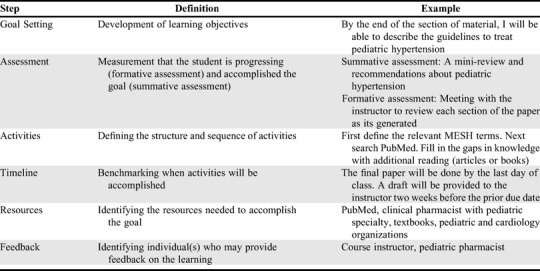
Table 2
Steps involved in self-directed learning
Learning Contracts
Formal agreements between the student and instructor that outline what the learner will complete within a set time period
They support organization, clarify expectations, and improve communication
Learning Contract Components
Learning contracts include:
Learning objectives
Resources and strategies
Target completion dates
Evidence of accomplishment
Evaluation criteria
These components align with the SDL process
Learning Contract Usage
Learning contracts can be used within courses, independent studies, and co-curricular or extracurricular activities
This flexibility makes them useful across academic and experiential settings
Learning Contract Benefits
Research in nursing education shows that learning contracts increase students’ sense of control, autonomy, and responsibility
They also enhance motivation and empowerment, particularly in professional training contexts
Learning Contract Challenges
Time constraints are a major barrier, especially in clinical settings, for both students (lacked ample time to implement contract) and instructors (extra time needed to supervise students)
Additional challenges include unrealistic goals, instructor discomfort with facilitating SDL
Minimal Guidance
Minimal guidance instruction suggests that learners benefit from limited direct instruction, encouraging independence
Common formats include problem-based learning (PBL) and inquiry-based learning (IBL)
PBL
An instructional approach where students learn by working through real-world, open-ended problems with minimal direct instruction. Students identify what they need to learn, seek out resources, and apply knowledge collaboratively to solve the problem.
SBL
Focuses on students learning through asking questions, investigating topics, and constructing knowledge through exploration. The instructor acts as a facilitator, guiding inquiry rather than delivering content directly.
PBL and SDL
Reviews of PBL show mixed results, though most studies suggest it supports SDL
Limitations of Minimal Guidance
The success of minimal guidance instruction may decline without consistent support and maintenance of instructional quality
Maastricht University has reported the process eroding over time because of administrative, faculty, and student behaviors requiring focused intervention to revitalize the PBL process.
Also likely only benefits learners when they have sufficiently high prior knowledge to provide their own guidance
Assessing SDL
It is difficult for faculty to assess how well students are developing SDL skills
SDL skills are affective
Limited objective measures
Use of self-reported tools
Qualitative, outcomes-based approaches
SDL skills are affective
Unlike measuring the results of self-direction (acquisition of skills and content), SDL skills are largely affective (problem-solving, communication, self-awareness)
Limited objective measures
There is a lack of strong literature on objective assessments of SDL skills. This is partly because many SDL-related abilities are internal and developmental rather than easily quantifiable.
Use of self-reported tools
Self-report measures are the most common method for assessing SDL. Tools such as the Self-Directed Learning Readiness Scale and the Oddi Continuing Learning Inventory are often used, though they mainly assess readiness for SDL rather than demonstrated outcomes.
Qualitative, outcomes-based approaches
Assessing SDL outcomes often relies on qualitative methods that focus on meaning-making and personal development. Common approaches include reflection activities, interviews, and observation of student behavior in learning or practice settings.
Common Challenges to SDL
Challenges include time demands, resistance to change, difficulty assessing learning, variable student motivation, and limited learner expertise. SDL can feel less efficient than direct instruction, especially early on.
Novice learners and lack of expertise
Students new to a field may struggle to set appropriate learning goals or identify high-quality resources. Traditional instruction is often effective here because instructors know what foundational skills and knowledge novices need.
Need for scaffolding in the curriculum
SDL should be gradually introduced into didactic (classroom-based) learning to prepare students for more independent learning later. This scaffolding builds confidence and competence before advanced experiential placements.
Individual differences in readiness
Student maturity, confidence, and prior experience affect readiness for SDL, meaning skill development will vary. Some students require more structure and support than others.
Role of instructor feedback
Targeted, ongoing feedback from instructors or coaches helps students refine goals, stay focused, and develop effective SDL skills over time.