Sample A nd B bio
 Call Kai
 Learn
Learn Practice Test
 Spaced Repetition
 Match
Match Flashcards
 Knowt Play
1/34

There's no tags or description
Looks like no tags are added yet.
Name | Mastery | Learn | Test | Matching | Spaced | Call with Kai |
|---|
No analytics yet
Send a link to your students to track their progress
35 Terms
What is an antibody?
A protein produced (by B lymphocytes) in response to (the presence of) an antigen.
Name the white blood cells that produce antibodies.
B lymphocytes or B cells.
Describe two differences between the primary and secondary immune responses shown in the graph.
Primary response produces a lower concentration of antibodies compared to the secondary response / the antibody concentration increases at a faster rate after secondary exposure compared to primary exposure / the antibody concentration remains higher after secondary exposure compared to primary exposure / the antibody concentration starts at a higher level in secondary exposure compared to primary exposure. Any two.
Exposure to an antigen can occur through natural infection. State another way in which a person could be exposed to an antigen.
Vaccination or Intoxication or pregnancy or allergy or organ transplant or blood transfusion or tumour.
Name one biomolecule, other than protein, that contains the element nitrogen.
Nucleic acids or DNA or RNA or ATP or ADP or urea or uric acid or NAD(P)(H) or nitrogenous base or named example of any of the above.
Where in the eukaryotic cell does transcription take place?
The nucleus.
Name the enzyme, labelled X, that catalyses the formation of mRNA.
RNA polymerase.
Write the mRNA sequence that would be produced from the double-stranded DNA sequence below. Template strand: AGGCTGAATCTGAG Coding strand: TCCGACTTAGACTC
UCCGACUUAGACUC
The diagram shown is an example of a model. Suggest one reason why models are used in Biology.
Helps understand (or predict) (biological) processes (or structures or systems or phenomena).
What is meant by the term enzyme?
A selective biological catalyst / that controls a biochemical reaction.
Give an example of an enzyme-catalysed reaction you have studied. In your response, state the enzyme, the substrate and the product.
Catalase acts on hydrogen peroxide to yield water and oxygen (or Amylase acts on starch to yield maltose).
State the model used to explain enzyme specificity.
The Induced Fit Model
Parts A, B and C all belong to one phase of the cell cycle. Name this phase.
Interphase.
During section B of the graph, the amount of DNA inside the cell doubles. Explain how this happens.
DNA replication / DNA doubling.
Number the phases 1 to 4 in the correct order that they occur during mitosis.
1: Prophase, 2: Metaphase, 3: Anaphase, 4: Telophase.
In the space provided, draw a labelled diagram of a cell undergoing Anaphase where 2n=4.
Diagram showing spindle fibers contracting and pulling 4 chromosomes/chromatids (split into two groups of 4) toward opposite poles of the cell. Labels: Spindle fiber, pole, chromosome/chromatid.
Bacteria do not undergo mitosis during cell division. Give a reason for this.
Bacterial cells do not possess a nucleus.
What is a mutation?
A change in the sequence (or structure) of DNA / a change in a gene.
Outline two ways in which cancer can be detected early.
Screening programs (e.g., mammograms, smear tests) / self-examination / genetic testing / scanning or biopsy.
Identify a role the liver plays in digestion of food.
Production of bile.
Outline two other functions of the liver apart from its role in digestion.
Storage of glycogen / deamination of excess amino acids / makes urea / breaks down red blood cells / produces heat / detoxification (removal of toxins like alcohol) / storage of fat-soluble vitamins. Any two.
Name the blood vessel that connects the small intestine to the liver.
Hepatic portal vein.
Give one reason why most nutrients absorbed in the intestine are transported first to the liver before travelling around the body.
So levels circulating in blood can be regulated
What is meant by the term mutation?
A change in the sequence (or structure) of DNA / a change in a gene.
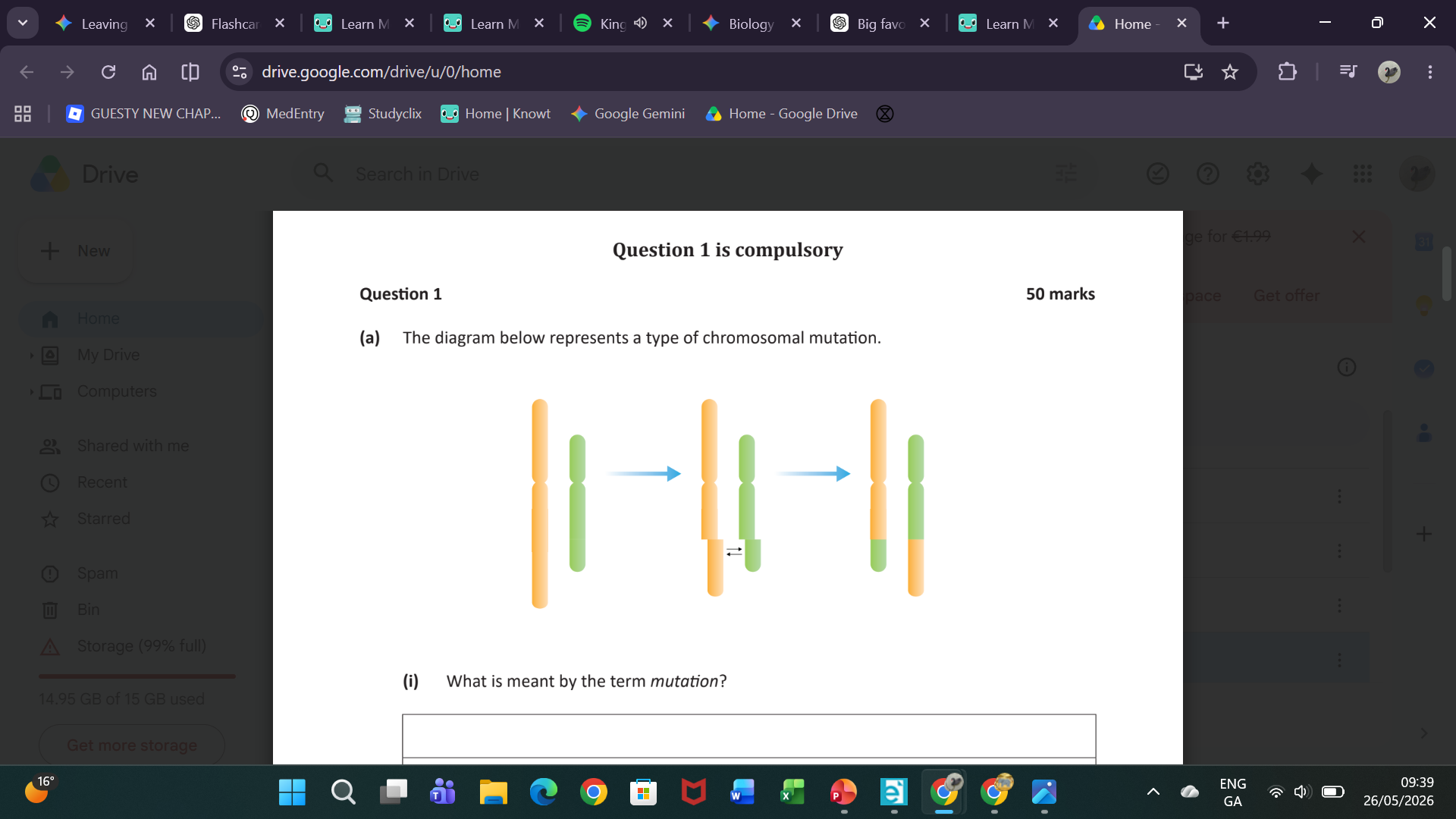
Identify the type of chromosomal mutation represented in the diagram.
Translocation.
Do you agree with the statement that chromosomal mutations are more likely to affect expression of one or more genes? Give reasons for your answer.
Yes. Chromosomal mutations involve large segments of a chromosome moving, deleting, or altering, which impacts many genes at once / point mutations typically alter only a single nucleotide base which might not even change the amino acid sequence (silent mutation).
Name the domains of life that contain prokaryotic organisms.
Bacteria / Archaea.
On what basis are organisms classified into separate domains?
Genetic characteristics or phylogeny or phylogenetic relatedness or molecular evidence (or DNA / RNA sequence analysis).
As part of your biology studies, you investigated quantitatively the level of reducing sugars in a range of food. Describe the method you used.
Add Benedict's solution to the food sample / heat in a water bath / compare to standard solution/ observe colour change from blue to brick red.
In the space provided below, draw a labelled diagram of the human digestive system. On your diagram label the following structures: oesophagus, stomach, small intestine, large intestine, pancreas, liver.
Diagram showing a continuous tube loop with a stomach widening, connected to distinct small/large intestine compartments along with distinct glands (pancreas/liver). Labels required: Oesophagus, stomach, small intestine, large intestine, pancreas, liver.
Name the main location of these symbiotic bacteria in the human digestive system.
Large intestine (or colon).
State one role of these bacteria in human health, apart from in digestion.
Vitamin production (Vitamin B or K) / immune system training / defense against pathogenic bacteria species.
Name the other form of nuclear division apart from meiosis.
Mitosis.
List the four phases that occur during the process named in (i).
Prophase, Metaphase, Anaphase, Telophase.
After nuclear division, the cytoplasm divides to complete cell division. Name this process.
Cytokinesis.