Bio Lecture-cellular basis of inhertience
 Call Kai
 Learn
Learn Practice Test
 Spaced Repetition
 Match
Match Flashcards
 Knowt Play
1/17

There's no tags or description
Looks like no tags are added yet.
Name | Mastery | Learn | Test | Matching | Spaced | Call with Kai |
|---|
No analytics yet
Send a link to your students to track their progress
18 Terms
Reproduction
-Most eukaryotes reproduce sexually and yet scientists agree of the advantages of asexual reproduction
Asexual reproduction by fragmentation, budding, or other methods do not require a member of the opposite sex and do not need to expend energy on finding or attracting a mate.
asexual reproduction
-all organisms are copies of one another
-no energy invested in finding a mate
-offspring will just be as sucessful as parent
-faster than sexual reproduction
sexual reproduction
-gentic variation in population
-offspring genetically distict from parents and other members of population
life cycles
Fertilization (the coming together or gametes) and meiosis (the production of haploid cells - gametes or spores) alternate in sexual life cycles.
The process of meiosis reduces the number of chromosomes by half when gametes are formed and fertilization restores the diploid condition.
There are three main categories of life cycles in multicellular organisms: diploid-dominant, haploiddominant, and alternation of generations.
diploid dominant life cycle
There is no multicellular haploid life stage
-most animals
halploid dominant life cycle
no multicellular diploid stage.
Characteristic of fungi and some protists
alternation of generations life cycle
two multicellular stages, haploid gametophytes and diploid sporophytes, alternate with one another.
Characteristic in plants and some protists.
Meiosis
In animals and plants, fertilization requires each gamete to be haploid, restoring the diploid number of chromosomes in the zygote.
Meiosis is the process of nuclear division that produces haploid daughter cells from a diploid parent cell.
meiosis is related to mitosis in that it employs many of the came cellular mechanisms for dividing the nucleus and the cell
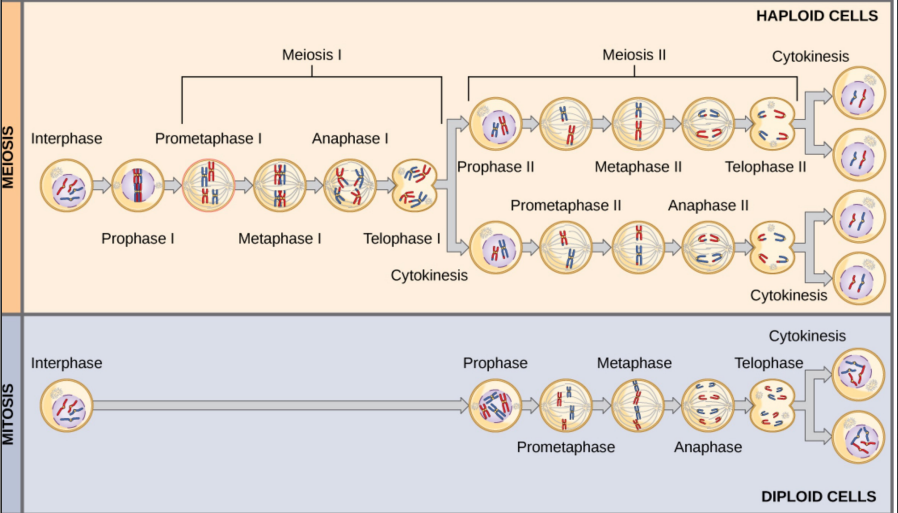
-Meiosis I and II
Prophase I
In Prophase I, the nuclear envelope begins to break down and the proteins associated with homologous chromosomes bring the pair close to each other.
This tight pairing of the homologs is called synapsis, and the genes on each chromosome are precisely aligned with one another.
An exchange of chromosome segments between the non-sister chromatids of the homologous pair occurs and is called crossing over.
Prometaphase I
is the attachment of the spindle fiber microtubules to the kinetochore proteins at the centromeres.
At the end of Prometaphase I, each tetrad (pair of homologous chromosomes) is attached to microtubules from both poles.
Metaphase I
homologous chromosomes are arranged in the center of the cell.
kinetochores are facing opposite poles.
The orientation of each pair of homologous chromosomes at the center of the cell is random, a process called independent assortment.
Halploid daughter cell
Meiosis II
Prophase II
Metaphase II
Anaphase II
Telophase II + Cytoksiness
Anaphase I
the spindle fibers pull the linked chromosomes apart.
The sister chromatids remain tightly bound together at the centromere.
Telophase I
the separated chromosomes arrive at the opposite poles of the cell.
The remainder of the typical telophase events may not occur, depending on the species.
In some organisms, the chromosomes decondense and nuclear envelopes form around the chromatids in Telophase I.
Cytokinesis
After the events of Meiosis I, cytokinesis results into the formation of two daughter cells, each haploid with one set of chromosomes.
Note that even though there are two sister chromatids in each chromosome, the daughter cells are still considered haploid.
Meiosis I consquences
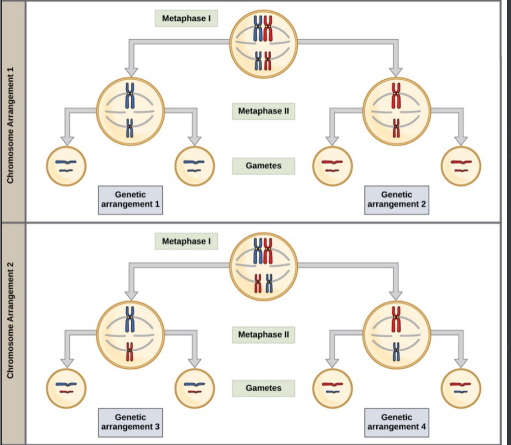
The orientation of each pair of homologous chromosomes along the metaphase plate in Meiosis I is random.
This randomness is called independent assortment, and this has very real genetic consequences.
As the figure to the left illustrates, when 2n=2 there are two possible arrangements of the homologous pairs of chromosomes in metaphase I.
These two orientations (shown in the upper panel) lead to the production of genetically different gametes.
With more chromosomes (and also the effects of crossing over between maternal and paternal homologous chromosomes) the number of genetically distinct gametes increases dramatically
Meiosis II
the connected sister chromatids remaining in the haploid cells from Meiosis I will be split to form a total of four haploid daughter cells
The two cells produced through Meiosis I go through the events of Meiosis II in synchrony.
Overall, Meiosis II resembles the mitotic division of a haploid cell.
Mitosis Vs Meiosis
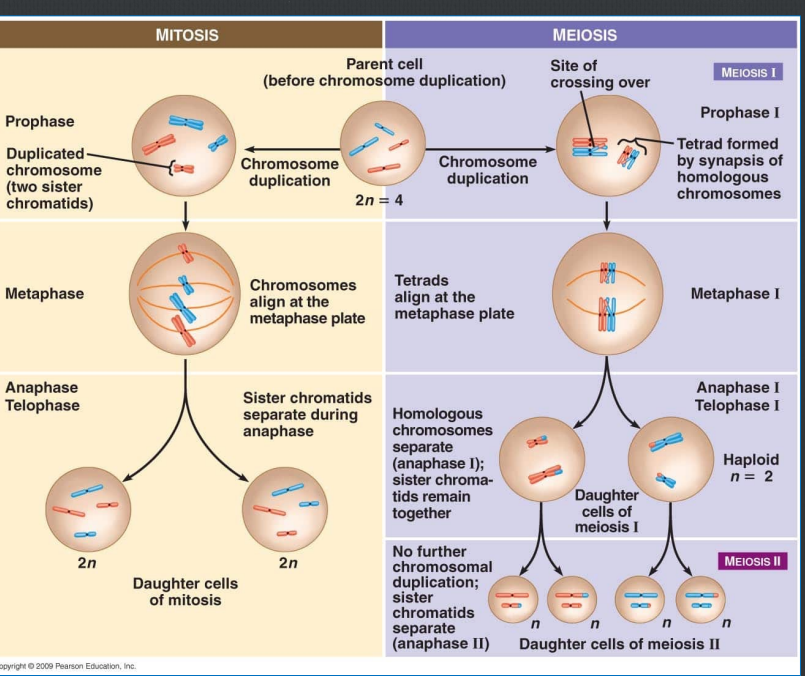
Mitosis is a single nuclear division that results in two daughter cells identical to the parent cell.
• Meiosis is two nuclear divisions that results in four daughter cells with half the number of chromosomes as the parent cell.
At metaphase of mitosis, individual chromosomes line up at the metaphase plate with the sister chromatids separating into the newly formed daughter cells.
• At metaphase I of meiosis, homologous pairs of chromosomes line up at the metaphase plate and each chromosome (composed of two sister chromatids) separates from its pair into the newly formed daughter cells.
Synapsis and crossing over between nonsister chromatids of a homologous pair occur in prophase I of meiosis only, never in mitosis.
Cells produced by mitosis will function in different parts of the body as a part of growth or replacing dead or damaged cells; they may even be involved in asexual reproduction in some organisms.
• Cells produced by meiosis in a diploid-dominant organism will only participate in sexual reproduction.