Conservation, Hope and Right Relationships - Chapter 14
 Call Kai
 Learn
Learn Practice Test
 Spaced Repetition
 Match
Match Flashcards
 Knowt Play
1/22

There's no tags or description
Looks like no tags are added yet.
Name | Mastery | Learn | Test | Matching | Spaced | Call with Kai |
|---|
No analytics yet
Send a link to your students to track their progress
23 Terms
Rachel Carson and the birth of modern environmentalism
The science: WHAT sprayed aerially across the US with little understanding of ecological or human health impacts.
Carson traced the mechanism: chemical persistence + fat storage =
biomagnification = WHAT in birds of prey
Rachel Carson and the birth of modern environmentalism
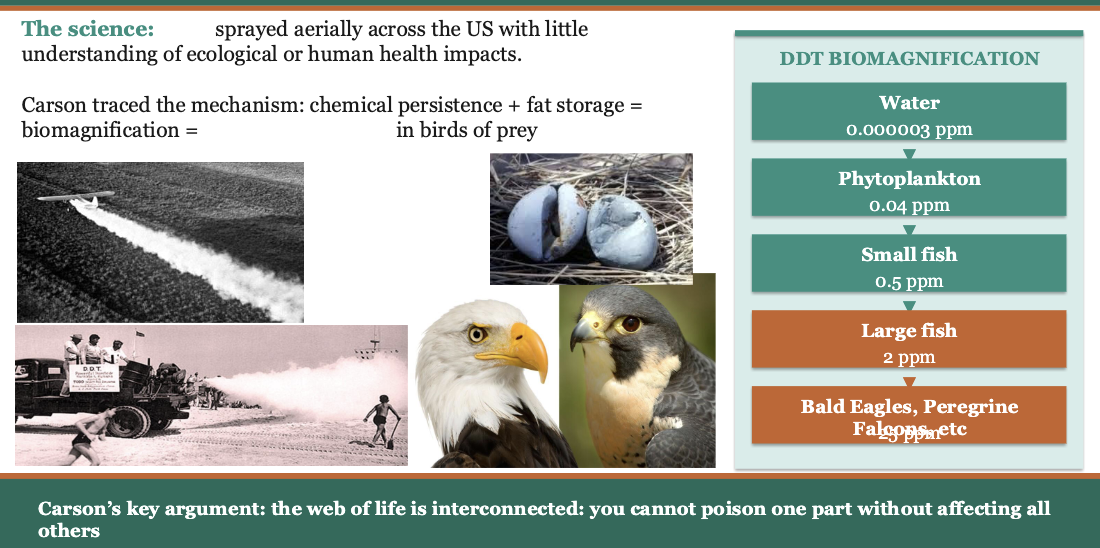
The science: DDT sprayed aerially across the US with little understanding of ecological or human health impacts.
Carson traced the mechanism: chemical persistence + fat storage =
biomagnification = EGGSHELL THINNING in birds of prey
Rachel Carson and the birth of modern environmentalism
The response: Chemical industry mounted a massive lobbying campaign calling her ‘hysterical’ and unscientific.
The moment: She testified before the U.S. Senate while dying of breast cancer (1963).
The shift: the public began to notice and care about human impacts on the WHAT.
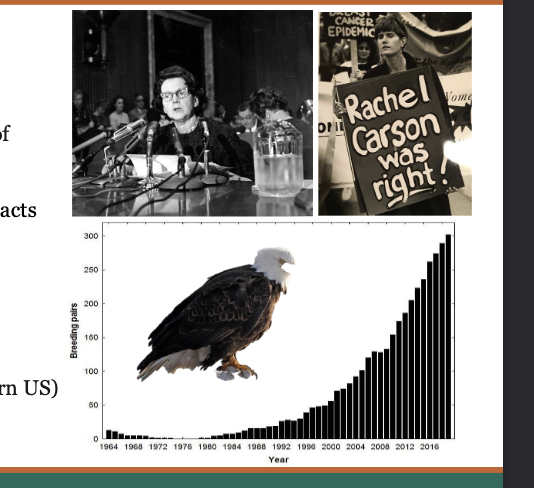
The result: DDT banned (Canada 1969; US 1972) Eggshell thinning reversed within a generation. Bald eagle nesting pairs: 417 in 1963 to 9,700 today (lower 48) Peregrine falcon nesting pairs: 39 in 1970 to 3,000+ today (eastern US
Rachel Carson and the birth of modern environmentalism
The response: Chemical industry mounted a massive lobbying campaign calling her ‘hysterical’ and unscientific.
The moment: She testified before the U.S. Senate while dying of breast cancer (1963).
The shift: the public began to notice and care about human impacts on the ENVIRONMENT.
The result: DDT banned (Canada 1969; US 1972) Eggshell thinning reversed within a generation. Bald eagle nesting pairs: 417 in 1963 to 9,700 today (lower 48) Peregrine falcon nesting pairs: 39 in 1970 to 3,000+ today (eastern US
What had actually changed
WHAT
WHAT
WHAT
WHAT
What had actually changed
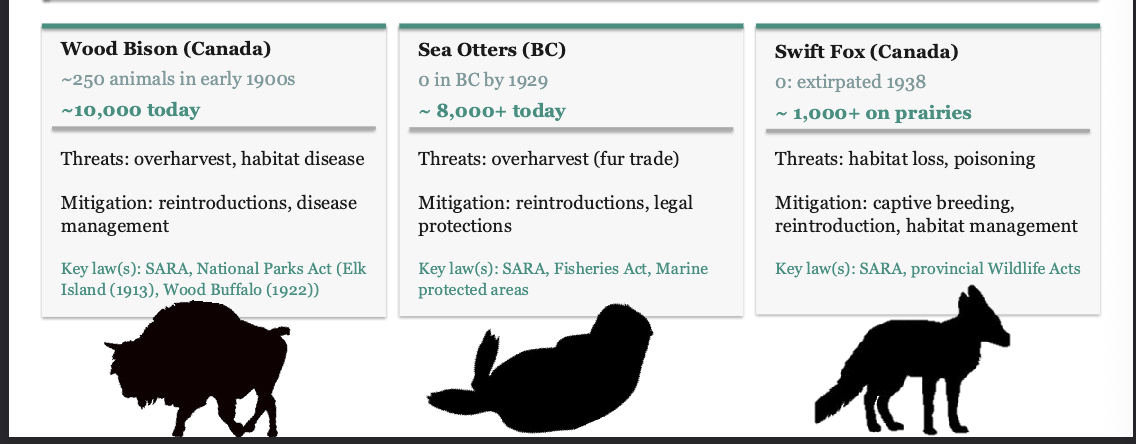
The recoveries: DDT ban (1972) → bald eagle, peregrine falcon, brown
pelican all rebounded. Proof of concept: identify the mechanism, remove itThe science: Conservation biology emerged as a formal scientific
discipline. IUCN Red List. Species monitoring. We started measuring what we were losingThe awareness: Environmental problems became undeniable. Public concern turned to political pressure. Governments were pushed to act, regulate and be accountable
The laws: A legal framework for protecting what remains emerged. The start of environmental law, regulations, monitoring and enforcement systems
Conservation looks different across systems, but recovering always depends on WHAT, WHAT and WHAT the drivers of decline. It is work that is often triggered and sustained by laws
Conservation looks different across systems, but recovering always depends on IDENTIFYING, REGULATING and MANAGING the drivers of decline. It is work that is often triggered and sustained by laws
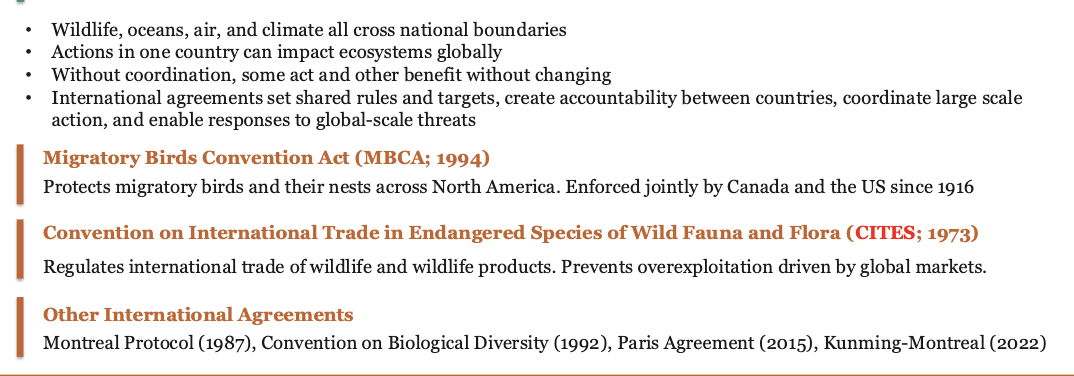
Tragedy of the commons
When a shared resource is overused because no one is (feels) RESPONSIBLE for protecting it. Without rules or coordination, shared resources easily become overexploited
Why conservation falls short
Slow response times: Species decline faster than laws can act. Listing, assessment, and protection are often delayed
Implementation Gaps: Laws exist on paper, but are weakly WHAT. Limited funding, monitoring, and capacity make enforcement difficult.
Political and Economic Pressure: Decisions influenced by WHAT, jobs, and short-term gains. Protections can be delayed, weakened, or reversed.
Reactive not proactive: Laws often respond after damage is already severe, and focus on crisis WHAT instead of WHAT.
Treating symptoms not causes: Protecting a species while destroying its habitat elsewhere. Often a way of continuing destruction with a green label.
Ignoring Indigenous stewardship: Laws built without Indigenous governance lose 10,000+ years of place-based ecological knowledge
Why conservation falls short
Slow response times: Species decline faster than laws can act. Listing, assessment, and protection are often delayed
Implementation Gaps: Laws exist on paper, but are weakly ENFORCED. Limited funding, monitoring, and capacity make enforcement difficult.
Political and Economic Pressure: Decisions influenced by INDUSTRY, jobs, and short-term gains. Protections can be delayed, weakened, or reversed.
Reactive not proactive: Laws often respond after damage is already severe, and focus on crisis MITIGATION instead of PREVENTION.
Treating symptoms not causes: Protecting a species while destroying its habitat elsewhere. Often a way of continuing destruction with a green label.
Ignoring Indigenous stewardship: Laws built without Indigenous governance lose 10,000+ years of place-based ecological knowledge
Example of when conservation falls short: Boreal caribou
BOREAL CARIBOU (RANGIFER TARANDUS)
Listed as Threatened under Canada's Species at Risk Act since 2003.
Two decades of legal protection and yet: most boreal caribou populations continue to decline.
Why the law keeps failing:
WHAT degradation: The recovery strategy requires <35% disturbed habitat in each range. Most ranges are at 50–80% disturbance from logging and oil sands development.
Industrial exemptions: Provinces issue exemptions under their own land-use plans, effectively overriding WHAT (Alberta!)
Treating symptoms: Annual wolf culls are funded to offset caribou declines killing 1,500+ wolves per year without addressing the WHAT
Example of when conservation falls short: Boreal caribou
BOREAL CARIBOU (RANGIFER TARANDUS)
Listed as Threatened under Canada's Species at Risk Act since 2003.
Two decades of legal protection and yet: most boreal caribou populations continue to decline.
Why the law keeps failing:
HABITAT degradation: The recovery strategy requires <35% disturbed habitat in each range. Most ranges are at 50–80% disturbance from logging and oil sands development.
Industrial exemptions: Provinces issue exemptions under their own land-use plans, effectively overriding FEDERAL RECOVERY TARGETS (Alberta!)
Treating symptoms: Annual wolf culls are funded to offset caribou declines killing 1,500+ wolves per year without addressing the ROOT CAUSE
Species can be listed and protected on paper while industrial development continues unabated. Law without WHAT, adequate WHAT, and genuine WHAT protection is not conservation
Species can be listed and protected on paper while industrial development continues unabated. Law without ENFORCEMENT, adequate FUNDING, and genuine HABITAT protection is not conservation
Quantity vs Quality Gap
Targets focus on area protected, but not all areas are equally important for biodiversity. Some parks are low risk, low value
Response: Prioritizing biodiversity WHAT and high value WHAT (KBAs = Key Biodiversity Areas)
Quantity vs Quality Gap
Targets focus on area protected, but not all areas are equally important for biodiversity. Some parks are low risk, low value
Response: Prioritizing biodiversity HOTSPOTS and high value ECOSYSTEMS (KBAs = Key Biodiversity Areas)
Ongoing Human Expansion
Urbanization, agriculture, and resource extraction continue to grow and outpace protection efforts
Response: recognizing WHAT (farms, cities) as part of conservation (pollinator corridors, urban green infrastructure, agri-environment programs)
Ongoing Human Expansion
Urbanization, agriculture, and resource extraction continue to grow and outpace protection efforts
Response: recognizing WORKING LANDSCAPES (farms, cities) as part of conservation (pollinator corridors, urban green infrastructure, agri-environment programs)
Connectivity is key
Protected areas can be isolated islands, species need to move across landscapes
Response: Emphasis on WHAT and WHAT (Yellowstone to Yukon Initiative, wildlife crossings)
Connectivity is key
Protected areas can be isolated islands, species need to move across landscapes
Response: Emphasis on CONNECTIVITY and CORRIDORS (Yellowstone to Yukon Initiative, wildlife crossings)
Global vs Local Reality
Globally increasing protected area coverage has not curbed biodiversity decline
Response: shift toward WHAT, WHAT-scale conservation
Global vs Local Reality
Globally increasing protected area coverage has not curbed biodiversity decline
Response: shift toward INTERGRATED, LANDSCAPE-scale conservation
The science behind 30%:
Protecting the most biodiverse 30% could prevent ~60% of projected species extinctions. 30% is a WHAT to slow biodiversity loss, emphasis on representation, connectivity, and functionality not just area
The science behind 30%:
Protecting the most biodiverse 30% could prevent ~60% of projected species extinctions. 30% is a MINIMUM THRESHOLD to slow biodiversity loss, emphasis on representation, connectivity, and functionality not just area

The Global Agreement: At COP15 (2022),
WHAT nations signed the Kunming Montreal Agreement, the most ambitious global biodiversity deal in history, committing to protect WHAT% of land and ocean by 2030.
The Global Agreement: At COP15 (2022),
196 nations signed the Kunming Montreal Agreement, the most ambitious global biodiversity deal in history, committing to protect 30% of land and ocean by 2030.

Canada’s progress:
Canada has expanded protected areas from 10.6% (2015) to ~WHAT% of land and ocean. Recent additions include Thaidene Nëne NP Reserve (26,376 km², NWT) and large Alberta conservation commitments.
Canada’s progress:
Canada has expanded protected areas from 10.6% (2015) to ~14% of land and ocean. Recent additions include Thaidene Nëne NP Reserve (26,376 km², NWT) and large Alberta conservation commitments.

Alberta’s role and challenges:
~15% protected. Bighorn Wildland (775,000 ha, 2020) and other designations contribute. But oil sands boreal leases, ongoing forestry, and absence of a provincial land-use plan remain major barriers to meaningful WHAT
Alberta’s role and challenges:
~15% protected. Bighorn Wildland (775,000 ha, 2020) and other designations contribute. But oil sands boreal leases, ongoing forestry, and absence of a provincial land-use plan remain major barriers to meaningful PROTECTION

80% of the world’s remaining biodiversity is found in WHAT (IPBES 2019) Not coincidental; a direct result of traditional stewardship
80% of the world’s remaining biodiversity is found in INDIGENOUS TERRITORIES (IPBES 2019) Not coincidental; a direct result of traditional stewardship
IPCAs: Indigenous Protected and Conserved Areas, Canada’s primary pathway to 30x30; often protect the most intact, WHAT, WHAT ecosystems on Earth because they already have been
IPCAs: Indigenous Protected and Conserved Areas, Canada’s primary pathway to 30x30; often protect the most intact, BIODIVERSE, CARBON-RICH ecosystems on Earth because they already have been
Remove or reduce the primary threat
The most powerful single action is correctly identifying and eliminating the ROOT CAUSE. The DDT ban was more effective than any direct eagle intervention
Strong laws are essential but not sufficient
Strong law backed by enforcement and funding is essential. Voluntary targets RARELY work at scale. Outcomes depend on IMPLEMENTATION, ENFORCEMENT, and POLITICAL will
Habitat is the foundation
Protecting species alone isn’t enough. Without habitat and their entire ecosystem, protection will fail. And, connection and function are more important than area
People must be involved
Communities that BENEFIT from conservation become its STRONGEST advocates. Communities EXCLUDED become its most committed OPPONENTS
It takes time
Most recoveries take decades. Patience and dedication are also fundamental to conservation success