Lecture 1
 Call Kai
 Learn
Learn Practice Test
 Spaced Repetition
 Match
Match Flashcards
 Knowt Play
1/28

Earn XP
Description and Tags
Organic chemistry, relationship of structure (Atoms, Bonds, Representing molecules, functional groups, systematics of substances), energy and reactivity
Name | Mastery | Learn | Test | Matching | Spaced | Call with Kai | Chat |
|---|
No analytics yet
Send a link to your students to track their progress
29 Terms
What is organic matter?
organic matter consists of carbon-containing compounds produced by living organisms, including plant and animal materials, as well as their byproducts.
What are organic compunds?
They are molecules containing carbon.
What is inorganic matter?
Inorganic matter consists of substances that do not primarily originate from living organisms, typically excluding carbon-based compounds, and includes minerals, metals, and gases.
Can you convert inorganic molecules into organic matter?
Yes, organic molecules can be synthesised from inorganic molecules using heat, electric energy or other catalysts.
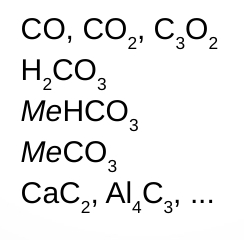
Which molecules containing carbon are NOT organic compunds?
oxides of carbon, carbonic acid, bicarbonates, carbonatesa and carbides
Which forms can organic compuns take?
chains, rings and scaffolds
What kind of bonds do organic compuns form?
Single bond, double bond and triple bond which can be between carbon atoms and other elements, in which case they would be called covalent bonds.
What is the phenomenon of isomerism?
When a single sum formula allows diffrent arrangements of atoms.
By which common characeristics can organic compounds be recognised?
they are combustible (flamable), heat sensitive (decompose/ denaturate), sensitive to UV and ionising radiation (decomposition, damaging to the DNA/RNA), easily reacting with strong oxidation agents
Why is carbon capable of forming a diversity of stable organic structures?
Carbon atoms can neither accepts or give up electrones easily and therefore provide the needed stability to create structure diversity, by sharing its electrones via covalent bonds.
What does reactivity mean?
The reactivity of a substance describes the potential of the structure to undergo chemical change. If likely (reactive/unstable) if unlikely (unreactive/stable)
What is the structure of a compound?
The structure describes what atoms are present and how they are bonded.
What is the potential energy?
The potential energy of a compound is dependand on the structure of it and describes its stored energy. If low, the compound is more stable and change is less likely; if high, the compound is less stable and change is more likely.

What is chemical change?
It is the redistribution of electrons and therefore change in configuration and is caused by the structures goal of lowering its energy (octate rule). This process of chemical bonding leads to either adding or taking away of outer shell (valence shell) electrones and therefore gaining a closed shell configuration.

What are the bonding possibilities of organic attoms to satisfy the octet?
Non-bondin, where electron pairs are localized on one atom (lone pairs), and bonding, where electron pairs get shared between two atoms (single bond, double bond, triple bond)
What is an electrone pair domain?
It is a region of high valence shell electrone density (bonding or non-bonding), meaning an area in the valence shell with a high concentration of electrones (negativ charge).

What do you understand about bonding patterns?
The bonding patterns of an atom describes the diffrent structures it can take depending on the amount of electronic pair domains and formal charge.


What is Borons special reactivity?
The Boron atom can tolerate an incomplete octet better than any other atom in the second row and is therefore the least suited second row element to carry a negative charge.

What is electronegativity?
The electronegativity of an atom measures the ability to attract electrons to itself.
What does the diffrence of two atoms electronegativity determine?
It determines what type of chemical bond the two atoms will form. ΔEN < 0.5 = covalent (equally shared electrons), 0.5 < ΔEN < 1.7 = polar covalent (electron withdrawal by induction) and ΔEN > 1.7 = ionic (not shared electrons)

Describe the Lewis Structure.
The Lewis Structure showcases ever atom in relation to its bonds via lines (multiple if double or triple bonds exist) and lone electrone pairs.

Describe the Line-Angle-Formula aka. skeletal formula
The skeletal formula looks the same as the Lewis Structure but without writing out the Carbon and Hydrogen (that is forming an HO) Atoms since they are so abundant in organic compounds and tell us little about the function. Carbons are indicated to be at every point/ corner of the structure and are connected to its hydrogen atoms.

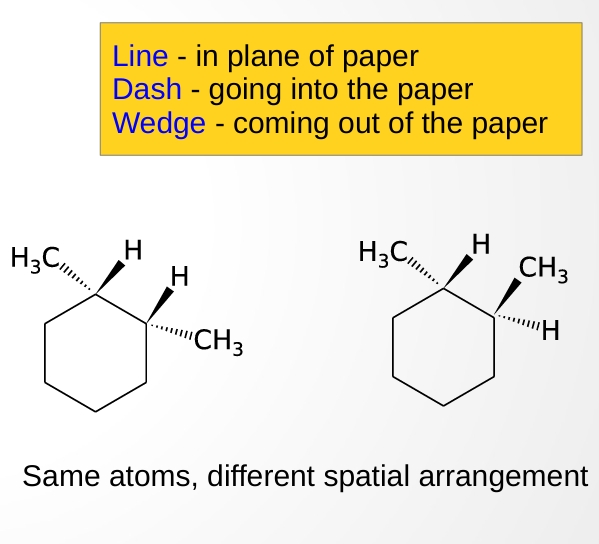
Describe the Line-Wedge-Dash representation (inspired by VSEPR).
A three-dimensional representation of molecular structure: solid lines lie in the plane of the page, wedged lines point forward toward the viewer, and dashed lines point backward away from the viewer.
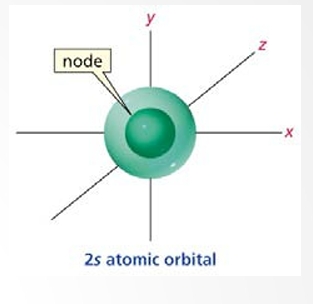
What are orbital drawings?
Orbital drawings are visual representations that show how an atom's electron density is distributed in three-dimensional space. These diagrams use spherical and dumbbell-shaped forms to depict the spatial orientation of orbitals, which typically align along the x, y, and z axes.
Explain this expression: 1s1
The expression describes the orbitals of an atom (Hydrogen). The first number tells us that this orbital describes the electron density of the first shell. The letter s means that the orbital has the shape of a sphere and the exponent is the number of electrons. If the letter were a p it would be the shape of a dumbbell.
What are hybrid orbitals?
Hybrid orbitals are a mix of a spherical and dumbell formed orbital and are used when needing to depict σ-bonds and lone electrone pairs. There are three types of hybrids: sp3 = 4 hybrids distributed to the corners of a tetrahedron, sp2 = 3 hybrids and one p distributed to the corners of a triangle and sp = 2 hybrids and 2 p distributed linearly

How are bonds depicted in orbital drawings?
In orbital drawings, bonds are depicted through the overlap of atomic orbitals. A single bond is a σ-bond, formed by direct, end-to-end overlap of orbitals along the bond axis. Double and triple bonds involve π-bonds, which arise from the side-by-side overlap of parallel p orbitals at two points on each atom (above and below the bond axis). Because of these two connection points, a π-bond cannot rotate around the bond axis the way a σ-bond can. In terms of electron density, a σ-bond concentrates it between the atoms, while a π-bond places it above and below the bond axis.

topics that still need to be added: orbitual drawings, functional groups, umbrella terms of organic compounds,