PHYSICS Ch. 5 Energy & Momentum

0.0(0)
Studied by 0 people
call kaiCall Kai
learnLearn
examPractice Test
spaced repetitionSpaced Repetition
heart puzzleMatch
flashcardsFlashcards
GameKnowt Play
Card Sorting

1/12

flashcard set

Earn XP

Description and Tags

Last updated 9:33 PM on 5/11/26
Name
Mastery
Learn
Test
Matching
Spaced
Call with Kai

No analytics yet

Send a link to your students to track their progress

13 Terms

1
New cards

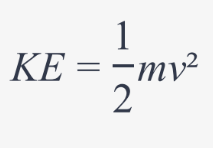
kinetic energy

KE = ½ mv2

  • m = mass (kg)

  • v = velocity (m/s)

<p>KE = ½ mv<sup>2</sup></p><ul><li><p>m = mass (kg)</p></li></ul><ul><li><p>v = velocity (m/s)</p></li></ul><p></p>
2
New cards

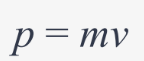
linear momentum

p = mv

  • m = mass (kg)

  • v = velocity (m/s)

<p>p = mv</p><ul><li><p>m = mass (kg)</p></li><li><p>v = velocity (m/s)</p></li></ul><p></p>
3
New cards

impulse

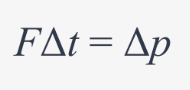
FΔt = Δp

  • F = applied force (N)

  • t = elapsed time (s)

impulse = change in momentum
<p>FΔt = Δp</p><ul><li><p>F = applied force (N)</p></li></ul><ul><li><p>t = elapsed time (s)</p></li></ul><p>impulse = change in momentum</p>
4
New cards

Kinetic Energy / Work energy theorem

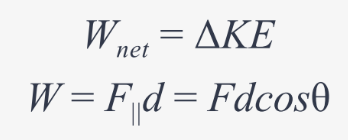
Wnet = ΔKE

W = F||d = Fdcosθ

  • F = applied force (N)

  • d = displacement (m)

  • θ = angle between force vector and displacement
<p>W<sub>net</sub> = ΔKE</p><p>W = F<sub>||</sub>d = Fdcosθ</p><ul><li><p>F = applied force (N)</p></li><li><p>d = displacement (m)</p></li><li><p>θ = angle between force vector and displacement</p></li></ul><p></p>
5
New cards

power

P = ΔE / Δt or w / Δt

  • ΔE = energy (J)

  • Δt = elapsed time (s)

  • w = work

SI unit: J/s

  • J = Kg*m2 / s2 → P = Kg*m2 / s3

  • Horsepower is another unit of measurement of power which is usually used when dealing with motors or engines
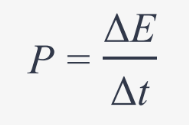
<p>P = ΔE / Δt or w / Δt</p><ul><li><p>ΔE = energy (J)</p></li><li><p>Δt = elapsed time (s)</p></li><li><p>w = work</p></li></ul><p>SI unit: J/s</p><ul><li><p>J = Kg*m<sup>2</sup> / s<sup>2</sup> → P = Kg*m<sup>2</sup> / s<sup>3</sup></p></li><li><p>Horsepower is another unit of measurement of power which is usually used when dealing with motors or engines</p></li></ul><p></p>
6
New cards

center of mass

xcm = Σmixi / Σmi

  • Σmi = sum of mass of objects (kg)

  • xi = distance from centre of objects to origin of system (m)
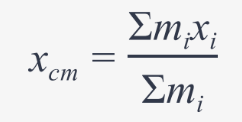
<p>x<sub>cm</sub> = Σm<sub>i</sub>x<sub>i</sub> / Σm<sub>i</sub></p><ul><li><p>Σm<sub>i</sub> = sum of mass of objects (kg)</p></li><li><p>x<sub>i</sub> = distance from centre of objects to origin of system (m)</p></li></ul><p></p>
7
New cards

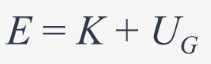
total mechanical energy

E = K + UG

  • K = kinetic energy (J)

  • UG = potential energy (J)

<p>E = K + U<sub>G</sub></p><ul><li><p>K = kinetic energy (J)</p></li><li><p>U<sub>G</sub> = potential energy (J)</p></li></ul><p></p>
8
New cards

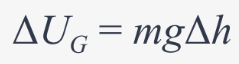
change in potential energy

ΔUG = mgΔh

  • m = mass (kg)

  • g = acceleration due to gravity (10 m/s2)

  • Δh = change in height (m)

<p>ΔU<sub>G</sub> = mgΔh</p><ul><li><p>m = mass (kg)</p></li><li><p>g = acceleration due to gravity (10 m/s<sup>2</sup>)</p></li><li><p>Δh = change in height (m)</p></li></ul><p></p>
9
New cards

conservation of mechanical energy

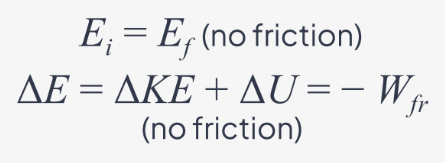
Ei = Ef (no friction)

ΔE = ΔKE + ΔU = − Wfr (no friction)

  • E = mechanical energy (J)

  • K = kinetic energy (J)

  • UG = potential energy (J)

<p>E<sub>i</sub> = E<sub>f</sub> (no friction)</p><p>ΔE = ΔKE + ΔU = − W<sub>fr</sub> (no friction)</p><ul><li><p>E = mechanical energy (J)</p></li><li><p>K = kinetic energy (J)</p></li><li><p>U<sub>G</sub> = potential energy (J)</p></li></ul><p></p>
10
New cards

efficiency

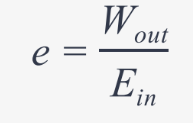
e = Wout / Ein

  • Wout = work done (J)

  • Ein = input energy (J)

<p>e = W<sub>out</sub> / E<sub>in</sub></p><ul><li><p>W<sub>out</sub> = work done (J)</p></li><li><p>E<sub>in</sub> = input energy (J)</p></li></ul><p></p>
11
New cards

negative net work done on an object means its kinetic energy _______

decreased

12
New cards

perfectly elastic collision

  • occurs when there is no loss of kinetic energy during the collision

  • both momentum and kinetic energy are conserved

13
New cards

completely inelastic collision

  • both objects stick together after colliding and will have the same final velocity

  • momentum is also conserved