HHP Exam 3
 Call Kai
 Learn
Learn Practice Test
 Spaced Repetition
 Match
Match Flashcards
 Knowt Play
1/21

There's no tags or description
Looks like no tags are added yet.
Name | Mastery | Learn | Test | Matching | Spaced | Call with Kai |
|---|
No analytics yet
Send a link to your students to track their progress
22 Terms
Cells are _________ coupled and can transmit forces (_________ _________) and _________ can sense and respond to force
Force → __________________ → __________________
Without gravity and loaded movement muscles _________
After spaceflight, _________ proteins (i.e. proteins of the _________) are lost in disproportionate amounts to other cellular proteins
Cells are mechanically coupled and can transmit forces (adherens junctions) and proteins can sense and respond to force
Force → cell signaling events → expression of proteins
Without gravity and loaded movement muscles atrophy
After spaceflight, contractile proteins (i.e. proteins of the sarcomere) are lost in disproportionate amounts to other cellular proteins
Body Mass Index: BMI
• What is it: Screening tool for _______ ________
Only considers ________ and ________
BMI equation = ________________________
• Interpret with caution:
Incomplete information
Does not quantify ________ or ________ ________ (fat mass vs. fat-free mass, i.e. body fat %)
Body Mass Index: BMI
• What is it: Screening tool for disease risk
Only considers height and weight
BMI equation = weight (kg) / height (meters^2)
• Interpret with caution:
Incomplete information
Does not quantify fitness or body composition (fat mass vs. fat-free mass, i.e. body fat %)
Correlation between BMI and disease risk
Observational study = measuring and collecting data without ________ ________
Study observed:
(Increasing/Decreasing) deaths (i.e. decreased survival) with (Increasing/Decreasing) BMI due to ________ and all-cause mortality
Generally, (increased/decreased) fitness = (increased/decreased) health risk
Recently, there has been interests in understanding health risk of _______ _________, but this is still being actively investigated
Correlation between BMI and disease risk
Observational study = measuring and collecting data without experimental manipulation
Study observed:
Increasing deaths associated with Increasing BMI due to CVD and all-cause mortality
Generally, increased fitness = decreased health risk
Recently, there has been interests in understanding health risk of extreme exercise, but this is still being actively investigated
What is Fitness?
• 5 components of fitness: ______________________
• Cardiovascular Fitness: Measurement of an individual's _______ _______ capacity
Ability to uptake, transport, and utilize _________
Quantified by ________ ________
L/min or ml/kg/mi
What is Fitness?
• 5 components of fitness: Cardiovascular, muscular strength, muscular endurance, flexibility, body composition
• Cardiovascular Fitness: Measurement of an individual's aerobic exercise capacity
Ability to uptake, transport, and utilize oxygen
Quantified by oxygen uptake
L/min or ml/kg/mi
Influence of BMI and Fitness on health outcomes?
Both cardiovascular fitness and BMI are correlated with health outcomes,
Generally:
CF has (positive/negative) health attributes
BMI associated with (positive/negative) health attributes
Common health metrics assessed:
________ disease risk
________ mortality
Influence of BMI and Fitness on health outcomes?
Both cardiovascular fitness and BMI are correlated with health outcomes,
Generally:
CF has positive health attributes
BMI associated with negative health attributes
Common health metrics assessed:
Cardiovascular disease risk
All-cause mortality
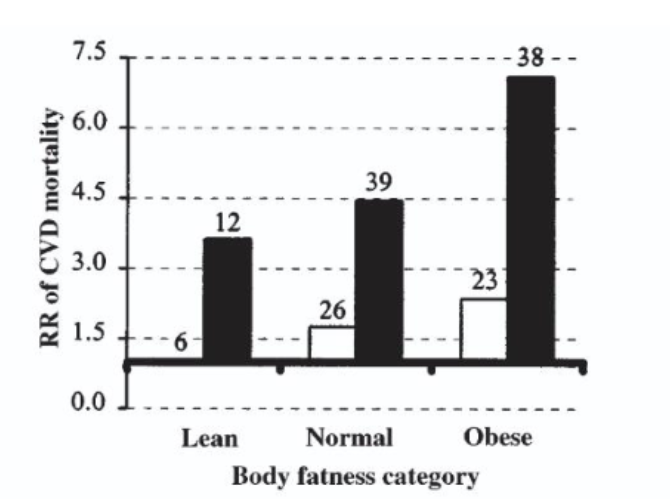
Influence of BF% and Fitness on health outcomes
Black bars = ________________________________
White bars = ________________________________
RR = ________________________________
Higher values = ________________________________
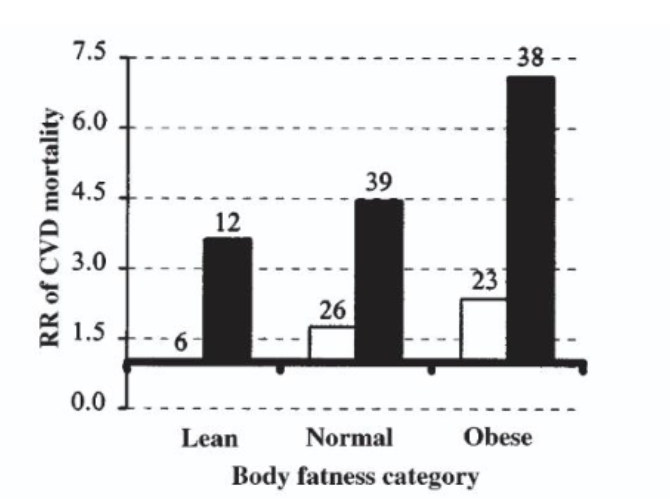
Influence of BF% and Fitness on health outcomes
Black bars = least fit men in each BF% category (lowest quartile of oxygen uptake)
White bars = fittest men in each category
RR = relative risk compared to control (fit, lean men)
Higher values = increased risk of dying from CVD
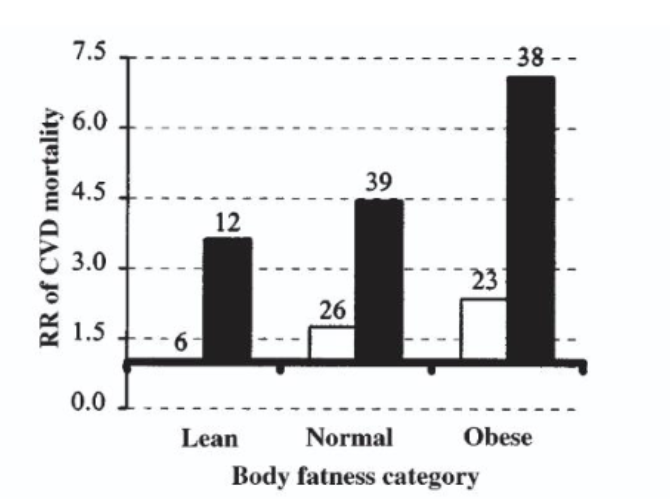
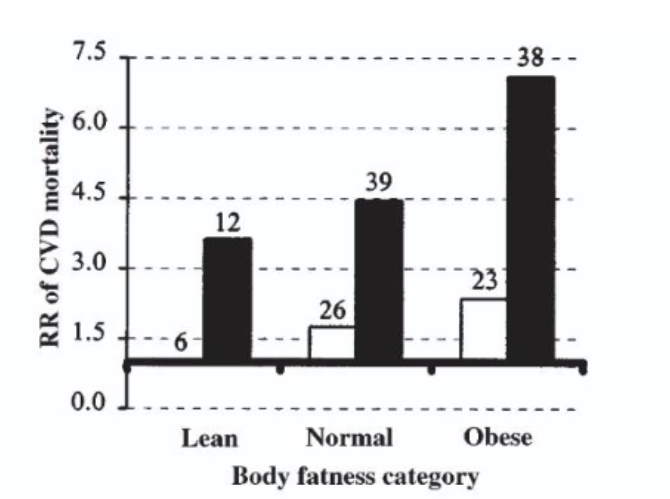
Increasing BF% (inc/dec) RR of CVD (increasing height of (black/white) bars)
BUT – Fittest men within each category had (inc/dec) risk of CVD ((black/white) bars are shorter than all (black/white) bars)
Authors conclude: The health benefits of leanness are limited to fit men, and being fit may reduce the hazards of obesity.
Key takeaway for future health or fitness professionals: De-emphasize the need/focus for _________, encourage _________ even if body weight is unchanging.
Sometimes, you just cannot see the positive physiological/cellular changes that accompany _________
Increasing BF% increased RR of CVD (increasing height of black bars)
BUT – Fittest men within each category had decreased risk of CVD (white bars are shorter than all black bars)
Authors conclude: The health benefits of leanness are limited to fit men, and being fit may reduce the hazards of obesity.
Key takeaway for future health or fitness professionals: De-emphasize the need/focus for weight loss, encourage PA even if body weight is unchanging.
Sometimes, you just cannot see the positive physiological/cellular changes that accompany PA
Physical Activity: ___________________
Physical Inactivity: the inverse of physical activity
Quantitatively inactivity would be less than ______________ (< (#) minutes / week)
If (#)% Americans report meeting activity recommendations, then (#)% of Americans quantitively considered inactive
Physical Activity: any bodily movement
Physical Inactivity: the inverse of physical activity
Quantitatively inactivity would be less than activity recommendations (< 150 minutes / week)
If 25% Americans report meeting activity recommendations, then 75% of Americans quantitively considered inactive
The Dallas Bed Rest Study (1966)
5 healthy 20-year-old men
(#) weeks at complete bed rest with no weight bearing allowed
At the time, standard patient care protocol after ___________
"Thus, 3 weeks of bed rest at age 20 years reduced ___________ capacity more than (#) years of aging."
Altered the way heart attack patients cared for
Encouraging ___________ and ___________ rehabilitation programs
The Dallas Bed Rest Study (1966)
5 healthy 20-year-old men
3 weeks at complete bed rest with no weight bearing allowed
At the time, standard patient care protocol after heart attack
"Thus, 3 weeks of bed rest at age 20 years reduced cardiovascular capacity more than 30 years of aging."
Altered the way heart attack patients cared for
Encouraging movement and cardiac rehabilitation programs
What is Cell Signaling: _____________________
Receptors throughout the body detect changes and respond to ________ ________
Utilized to monitor and communicate conditions that are regulated through ________ _______
(Positive/Negative) feedback is the most common
Few instances of normal (Positive/Negative) feedback in human function
What is Cell Signaling: The processes by which cells communicate with each other
Receptors throughout the body detect changes and respond to maintain homeostasis
Utilized to monitor and communicate conditions that are regulated through feedback loops
Negative feedback is the most common
Few instances of normal positive feedback in human function
Cellular messaging system
Cells respond to changes in the environment
Cells may respond to a ________ stimuli that increases other ________ in their membrane
________ signals the cell to position glucose transport channels into its membrane
Cell to Cell Communication
Direct Communication: _______________________
Contact Dependent: _________________________
Contact Independent: _________________________
Cellular messaging system
Cells respond to changes in the environment
Cells may respond to a chemical stimuli that increases other proteins in their membrane
Insulin signals the cell to position glucose transport channels into its membrane
Cell to Cell Communication
Direct Communication: Signals pass from the cytosol of one cell to an adjacent cell
Contact Dependent: Membrane bound signaling molecules
Contact Independent: Messenger molecule is released to communicate
Contact Independent Cell Signaling
Autocrine: _________________________________________
Auto- = ______ / -crine = ______
Example: ___________________________________________
Paracrine: ________________________________________
Para- = ____________
Example: _____________________________________
Endocrine: ____________________________________________
Endo = _______
Neurotransmitter: ________________________________________
Contact Independent Cell Signaling
Autocrine: An autocrine messenger stimulates the cell that originally secreted the signal
Auto- = self / -crine = secrete
Example: Immune System Function (white blood cells stimulate their own replication)
Paracrine: Chemical messengers that act on cells in the local environment
Para- = beside/adjacent
Example: Histamine during allergic reactions; protective response against viruses
Endocrine: Chemical messengers released by glands that utilize the blood to travel to target cells
Endo = internal/within
Neurotransmitter: Chemical messengers secreted by neurons to adjacent cells
Steps in Cell Signaling (Overview)
_____________/______________
______________
______________
Steps in Cell Signaling (Overview)
Signal Reception/Receptor Activation
Signal Transduction
Cell Response
Membrane Receptors (extra/intra-cellular)
Receptors on the cell membrane bind signaling molecule (______)
Receptor produce their own signal (i.e. produce a second signal)
This signal is called a _______________
Common receptors include:
___________________
___________________
Membrane Receptors (extracellular)
Receptors on the cell membrane bind signaling molecule (ligand)
Receptor produce their own signal (i.e. produce a second signal)
This signal is called a secondary messenger
Common receptors include:
G-protein Coupled Receptors
Receptor Tyrosine Kinases (RTKs)
Intracellular Receptors
Similar role to membrane receptor, just ____________
Some chemical messenger can cross through the __________
(Don’t need/Need) bind to a membrane receptor
Very (large/small) molecules
Or (hydrophobic/hydrophilic) messengers
Intracellular Receptors
Similar role to membrane receptor, just inside the cell
Some chemical messenger can cross through the membrane
Do not need bind to a membrane receptor
Very small molecules
Or hydrophobic messengers
What determines if a signaling messenger binds to an extracellular receptor vs. an intracellular one?
Chemistry! (______________ and ______________)
______ hormones, like _______, bind extracellular receptors
Because they are (hydrophobic/hydrophilic)
They (can/cannot) diffuse through the lipid bi-layer
______ hormones, like _______, bind intracellular receptors
Because they are (hydrophobic/hydrophilic)
They (can/cannot) diffuse through the lipid bi-layer
What determines if a signaling messenger binds to an extracellular receptor vs. an intracellular one?
Chemistry! (lipid solubility and membrane permeability)
Peptide hormones, like insulin, bind extracellular receptors
Because they are hydrophilic
They cannot diffuse through the lipid bi-layer
Steroid hormones, like cortisol, bind intracellular receptors
Because they are hydrophobic
They can diffuse through the lipid bi-layer
________ _________ – Adding phosphates
Often (simple/multistep) processes
Need to (transmit/amplify) signal
Common steps involve adding/removing a phosphate group to a ________
______________/_______________
Phosphorylation cascades: ____________________________
Signal Transduction – Adding phosphates
Often multistep processes
Need to amplify signal
Common steps involve adding/removing a phosphate group to a protein
Phosphorylation/dephosphorylation
Phosphorylation cascades: chain reaction of kinases phosphorylating other kinases
Kinases and Phosphatases: Enzymes that add or remove ___________
(Kinase/Phosphatase) adds
(Kinase/Phosphatase) removes
These enzymes commonly activated during ___________________
Either can activate/deactivate
Depends on ___________________
Common for phosphorylation to "turn (on/off)"
Modifying an already made protein is called ________________________
Kinases and Phosphatases: Enzymes that add or remove phosphate groups
Kinase adds
Phosphatase removes
These enzymes commonly activated during cell signaling/transduction
Either can activate/deactivate
Depends on the protein they are modifying
Common for phosphorylation to "turn on"
Modifying an already made protein is called post-translational modification (PTM)
Signal Transduction - Secondary Messengers
Second messengers: _____________________
Cyclic AMP (cAMP)
Adenylyl Cyclase: enzyme catalyzes ATP -> _____
Calcium (Ca2+)
Signal Transduction - Secondary Messengers
Second messengers: small molecules or ions that relay signals
Cyclic AMP (cAMP)
Adenylyl Cyclase: enzyme catalyzes ATP -> cAMP
Calcium (Ca2+)
G Protein Coupled Receptors: ____________________________
_______ __________ binding protein
G Protein w/ GDP = (OFF/ON)
G Protein w/GTP = (OFF/ON)
Example: G protein can activate _______ ________ to produce cAMP
G Protein Coupled Receptors: Membrane bound receptor protein that binds a "G protein"
Guanine nucleotide binding protein
G Protein w/ GDP = OFF
G Protein w/GTP = ON
Example: G protein can activate Adenylyl Cyclase to produce cAMP
Cell Response (fast and slow)
Cell response varies by ________ type and ________ type
Many pathways lead to the activation of ____________________
May involve the alteration of (intra/inter-cellular) structural proteins (fast/slow)
________ changes if movement is related to response
May affect the function of transcription factors (fast/slow)
Changes the expression of ________
Commonly seen in (intra/inter-cellular) receptor pathways
Cell Response (fast and slow)
Cell response varies by cell type and signal type
Many pathways lead to the activation of one or more enzymes
May involve the alteration of intracellular structural proteins (fast)
Actin changes if movement is related to response
May affect the function of transcription factors (slow)
Changes the expression of genes
Commonly seen in intracellular receptor pathways
3 Steps in Cell Signaling (Details)
Receptor Activation: ____________________________
Signal Transduction: ____________________________
Cellular Response
Cell response varies by ________ type and ________ type
Many pathways lead to the activation of ____________________
May involve the alteration of (intra/inter-cellular) structural proteins (fast/slow)
________ changes if movement is related to response
May affect the function of transcription factors (fast/slow)
Changes the expression of ________
Commonly seen in (intra/inter-cellular) receptor pathways
3 Steps in Cell Signaling (Details)
Receptor Activation: Signaling molecule binds to the receptor on the target cell causing a conformational change in the receptor to activate function
Signal Transduction: Initial signal is converted to a different signal inside the cell; this is carried out through proteins that form a signal transduction pathway
Cellular Response
Cell response varies by cell type and signal type
Many pathways lead to the activation of one or more enzymes
May involve the alteration of intracellular structural proteins (fast)
Actin changes if movement is related to response
May affect the function of transcription factors (slow)
Changes the expression of genes
Commonly seen in intracellular receptor pathways