Viruses ~Ch. 13 (The Condensed Version)
 Call Kai
 Learn
Learn Practice Test
 Spaced Repetition
 Match
Match Flashcards
 Knowt Play
1/4

There's no tags or description
Looks like no tags are added yet.
Name | Mastery | Learn | Test | Matching | Spaced | Call with Kai |
|---|
No analytics yet
Send a link to your students to track their progress
5 Terms
Review…broader microbe categories
• Microbes can be divided into those that are either:
• Truly cellular (bacteria, archaea, algae, protozoa, and fungi) and • Those that are acellular (viruses and prions)
• Cellular microbes can be divided into those that are:
• prokaryotic (bacteria and archaea) and those that are
• eukaryotic (algae, protozoa, and fungi)
Some general key points on viruses
• Complete virus particles are called virions.
• Most viruses range from 10-300 nm in diameter.
• Viruses infect humans, animals, plants, fungi, protozoa, algae, and bacterial cells….also some viruses can infect other viruses!
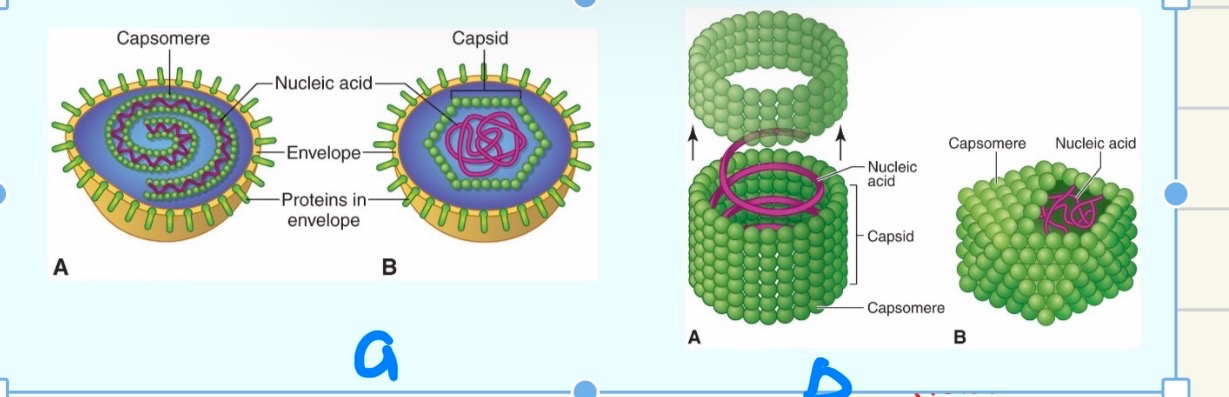
• A typical virion consists of
• A genome of either DNA or RNA (and this is either ds or ss)
• A capsid (protein coat) that surrounds this genome
•The capside is composed of protein units called capsomeres
• Some viruses (enveloped viruses) have an outer envelope.
DNA or RNA: may be ds or ☠
Explain this
A) A is an enveloped virus- stole lipid memebrane from the host cell
B) Is a non enveloped virus. Capsomere = the proteins
Viral Replication
A key feature of viral replication is that viruses need a host to reproduce.
• And they are released from the host by lysing or by budding.
• Those that escape by budding become enveloped viruses.