OMM Fall Cumulative

0.0(0)
Studied by 5 people
call kaiCall Kai
learnLearn
examPractice Test
spaced repetitionSpaced Repetition
heart puzzleMatch
flashcardsFlashcards
GameKnowt Play
Card Sorting

1/67

encourage image

There's no tags or description

Looks like no tags are added yet.

Last updated 5:35 PM on 4/19/26
Name
Mastery
Learn
Test
Matching
Spaced
Call with Kai

No analytics yet

Send a link to your students to track their progress

68 Terms

1
New cards

Cervical CS AC 1 TP

Ra

pt is supine

lateral aspect of C1 transverse process b/w ramus of mandible and mastoid process

rectus capitis lateralis muscle
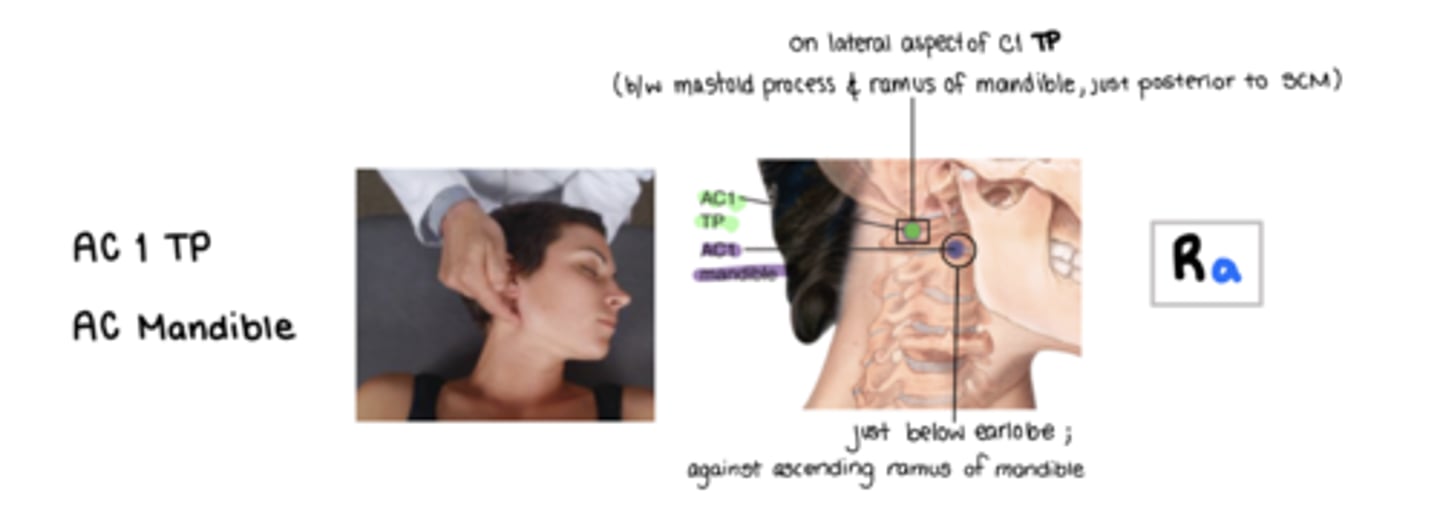
<p>Ra</p><p>pt is supine</p><p>lateral aspect of C1 transverse process b/w ramus of mandible and mastoid process</p><p>rectus capitis lateralis muscle</p>
2
New cards

Cervical CS AC1 Mandible

Ra

pt is supine

on the posterior surface of the ascending ramus of the mandible at or just below earlobe

rectus capitis anterior muscle

3
New cards

Cervical CS AC 2-6 TP

F Sa Ra

on anterior lateral aspect of the A/P tubercles of the transverse process of the corresponding vertebrae

2- middle scalene and longus colli mm.

3/4- anterior, middle scalenes, longus capitis and longus colli mm.

5/6- anterior, middle, posterior scalenes, longus capitis and longus collii mm.
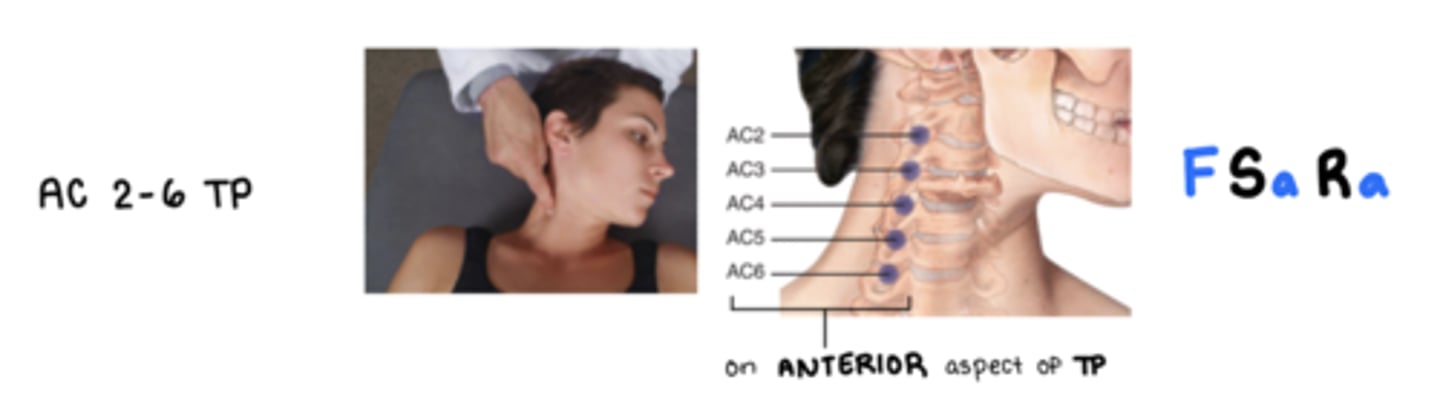
<p>F Sa Ra</p><p>on anterior lateral aspect of the A/P tubercles of the transverse process of the corresponding vertebrae</p><p>2- middle scalene and longus colli mm.</p><p>3/4- anterior, middle scalenes, longus capitis and longus colli mm.</p><p>5/6- anterior, middle, posterior scalenes, longus capitis and longus collii mm.</p>
4
New cards

Cervical CS AC8

F Sa Ra

on the superior medial end of the clavicle at the sternal attachment of the SCM
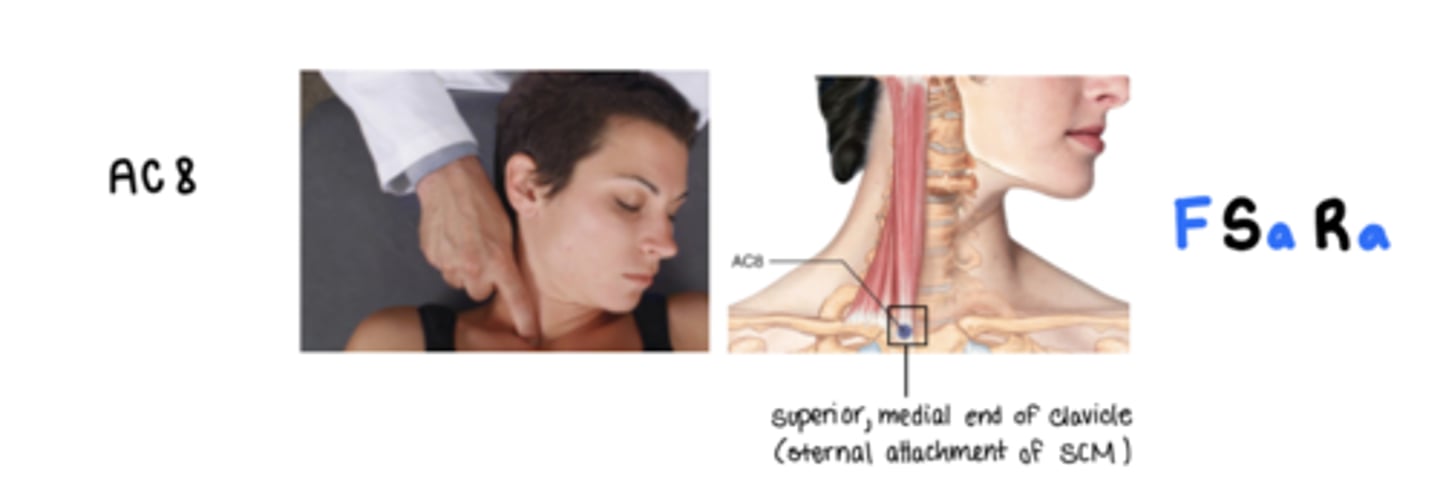
<p>F Sa Ra</p><p>on the superior medial end of the clavicle at the sternal attachment of the SCM</p>
5
New cards

Cervical CS AC7

F Ra St

lucky number 7

on the posterosuperior surface of the clavice at the clavicular attachment of the SCM
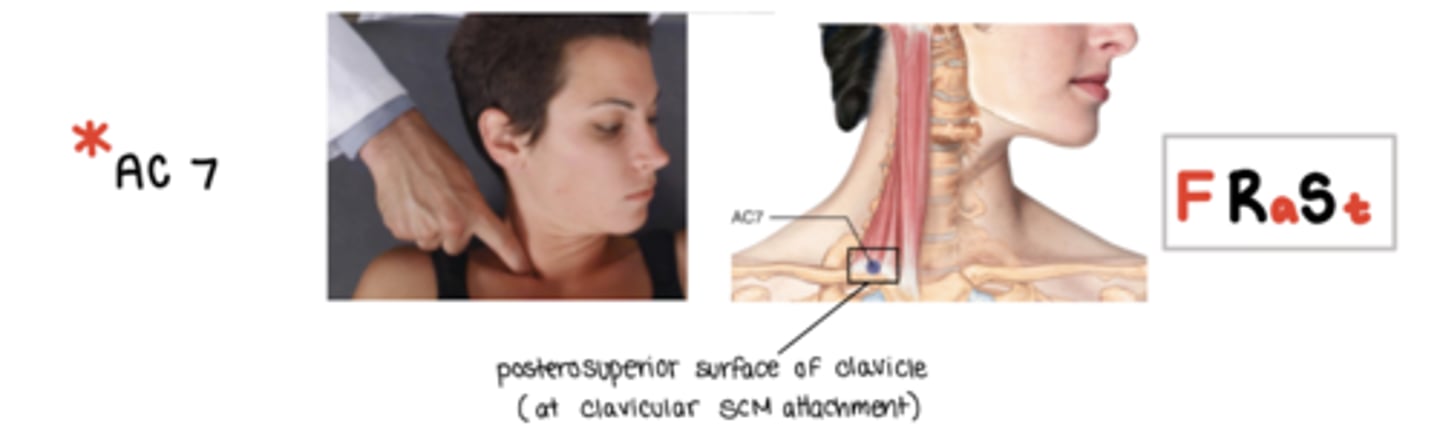
<p>F Ra St</p><p>lucky number 7</p><p>on the posterosuperior surface of the clavice at the clavicular attachment of the SCM</p>
6
New cards

Cervical CS PC1 Inion

F Ra St

on the inferior nuchal line, lateral to the inion
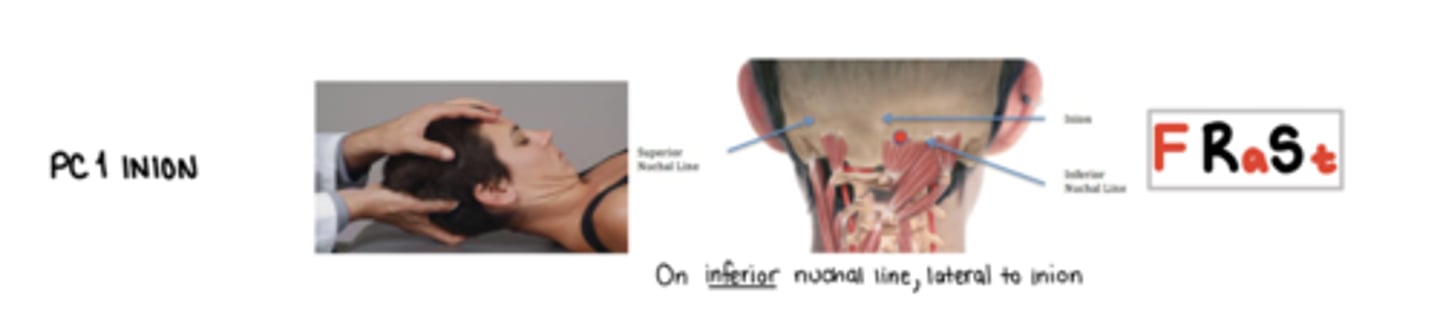
<p>F Ra St</p><p>on the inferior nuchal line, lateral to the inion</p>
7
New cards

Cervical CS PC1 Occiput

E Sa Ra

on inferior nuchal line midway b/w inion and mastoid

splenius capitis, rectus capitis posterior major/minor, oblique capitis superior mm.

<p>E Sa Ra</p><p>on inferior nuchal line midway b/w inion and mastoid</p><p>splenius capitis, rectus capitis posterior major/minor, oblique capitis superior mm.</p>
8
New cards

Cervical CS PC 2 Occiput

E Sa Ra

inferior nuchal line w/n the semispinalis capitis m

associated with greater occipital nerve

<p>E Sa Ra</p><p>inferior nuchal line w/n the semispinalis capitis m</p><p>associated with greater occipital nerve</p>
9
New cards

Cervical CS PC2 SP

E Sa Ra

**SUPERIOR aspect of SP C2

rectus capitis posterior minor/major and olbiquus capitis inferior
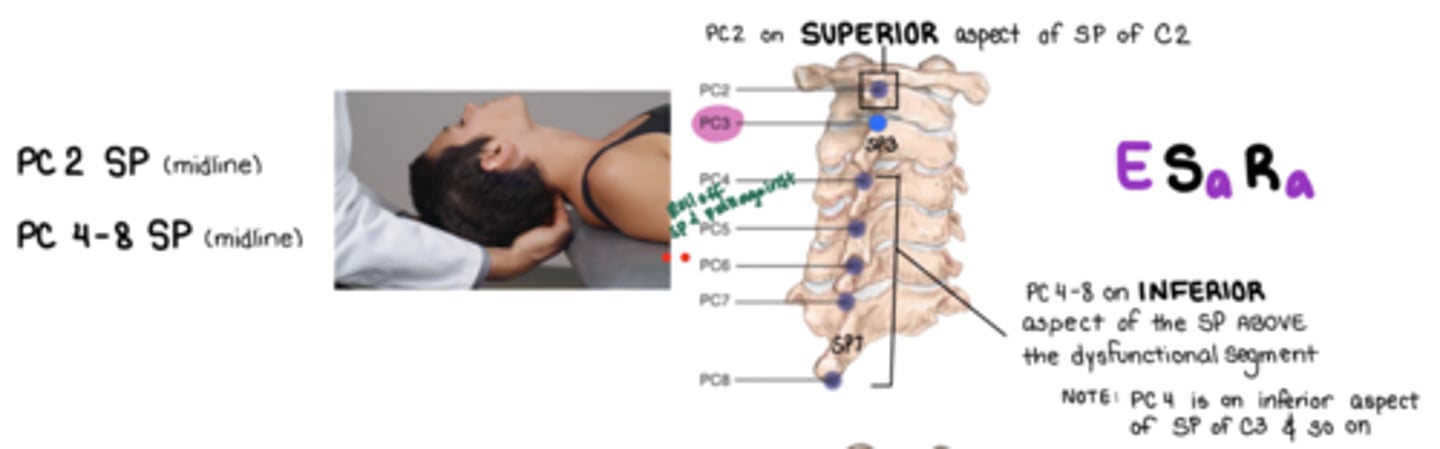
<p>E Sa Ra</p><p>**SUPERIOR aspect of SP C2</p><p>rectus capitis posterior minor/major and olbiquus capitis inferior</p>
10
New cards

Cervical CS PC4-8 SP

E Sa Ra

3- middle scalenes, longus capitis, longus colli

4-8 semispinalis capitis, multifidis, rotatores
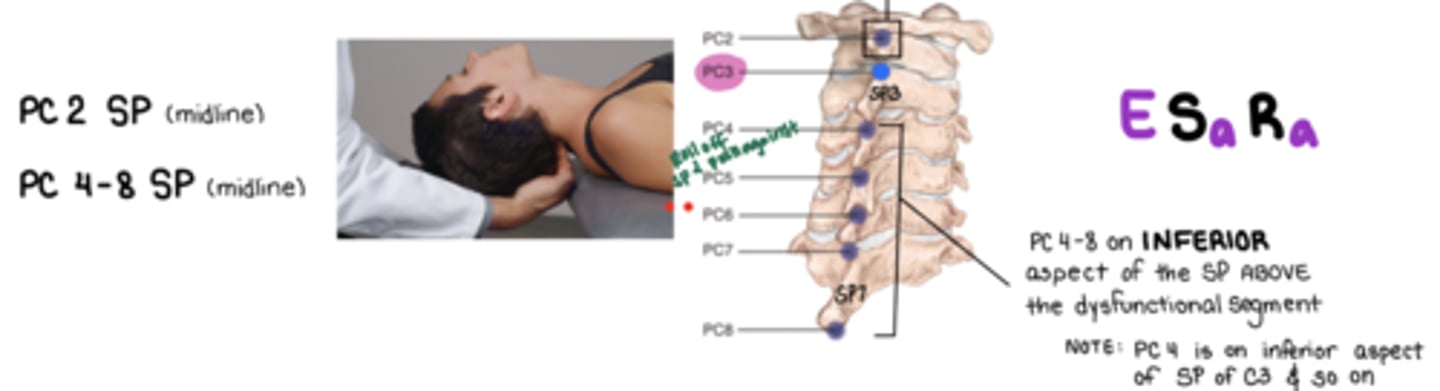
<p>E Sa Ra</p><p>3- middle scalenes, longus capitis, longus colli</p><p>4-8 semispinalis capitis, multifidis, rotatores</p>
11
New cards

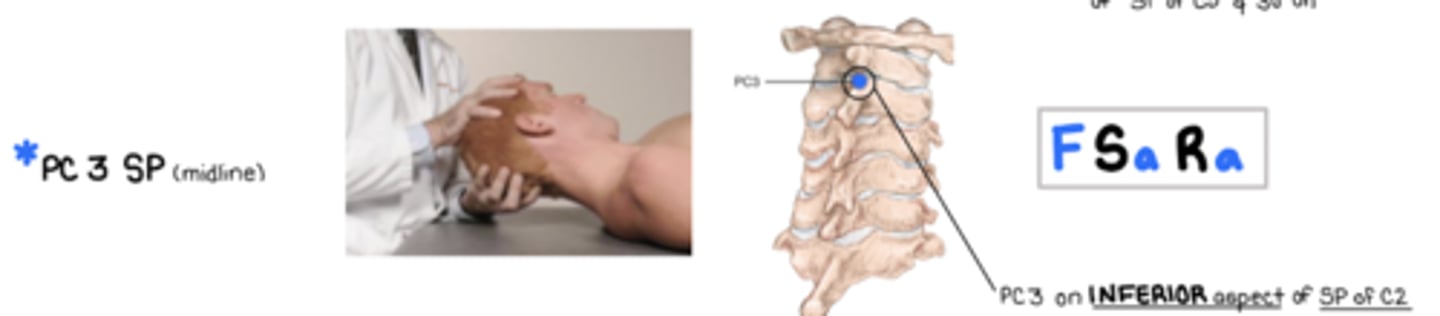
Cervical CS PC 3 SP

F Sa Ra

<p>F Sa Ra</p>
12
New cards

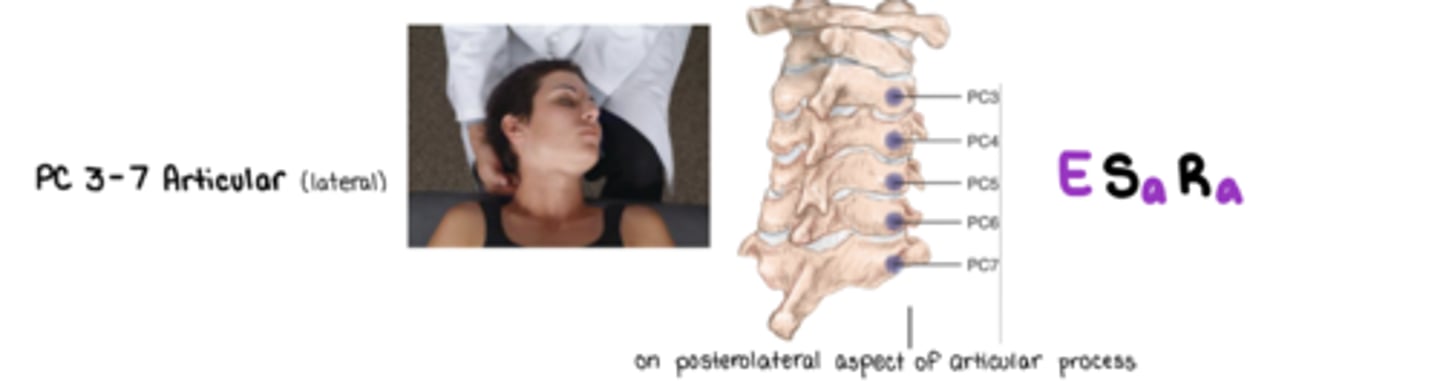
Cervical CS PC 3-7 Articular

E Sa Ra

<p>E Sa Ra</p>
13
New cards

Thoracic CS AT 1 Midline

F

located @ episternal notch
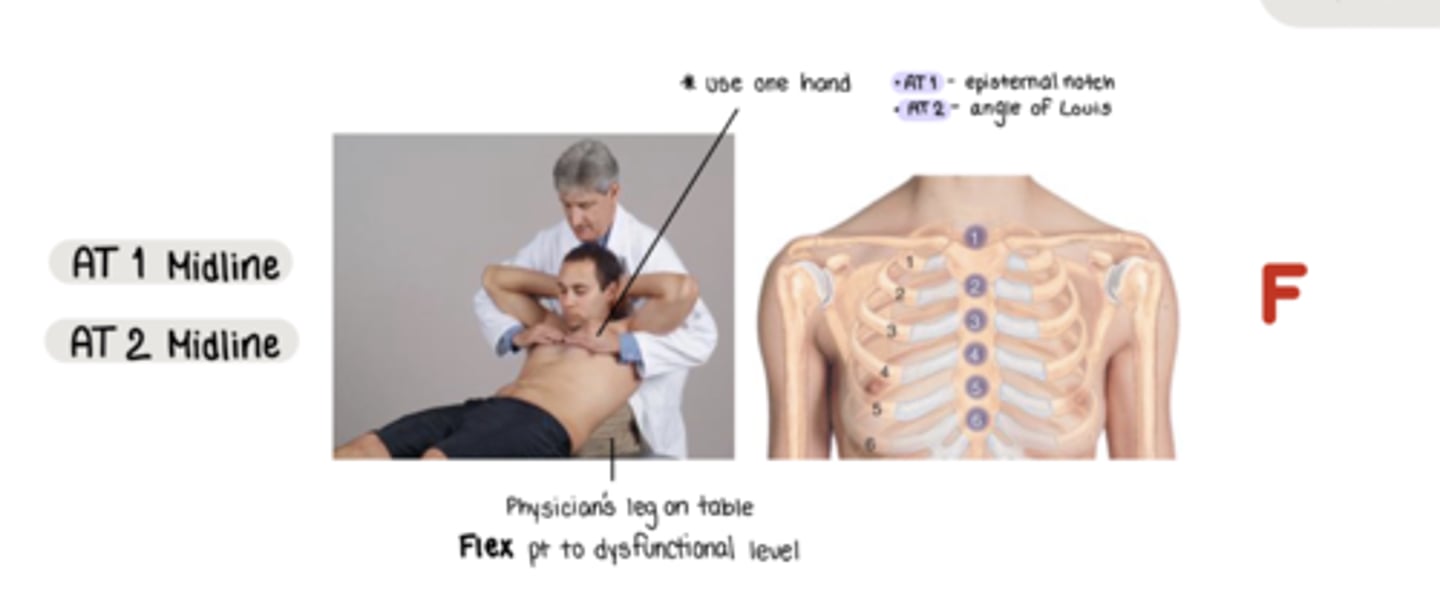
<p>F</p><p>located @ episternal notch</p>
14
New cards

Thoracis CS AT 2 Midline

located @ sternal angle
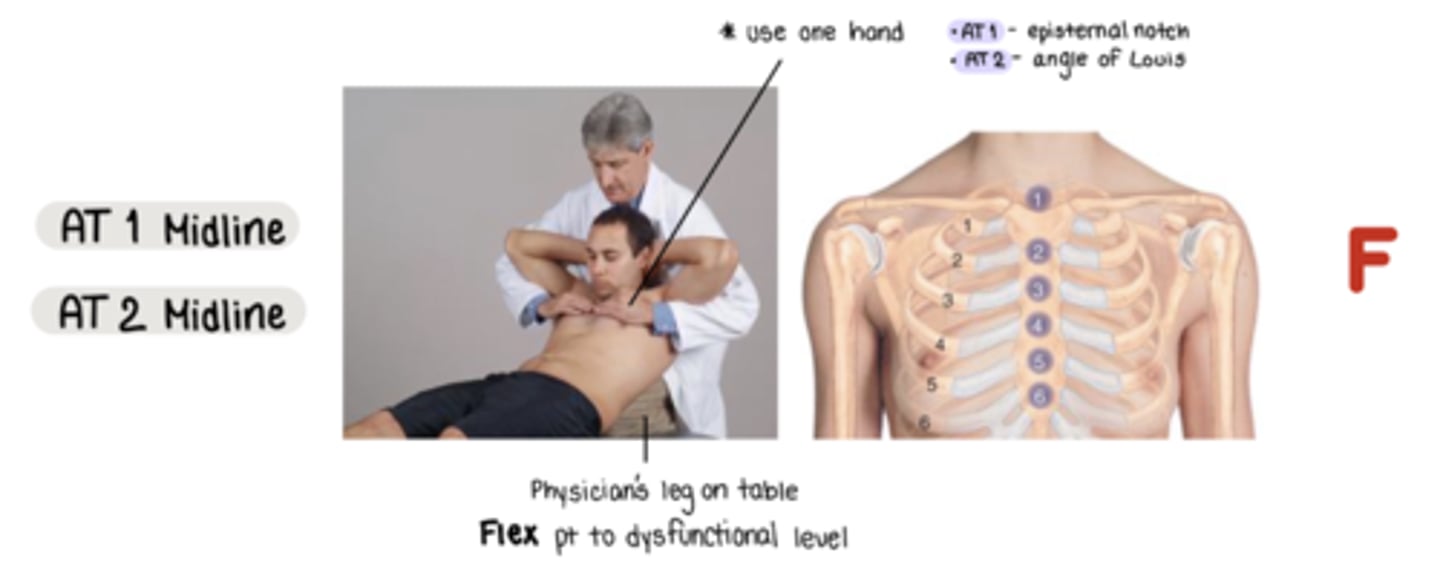
<p>located @ sternal angle</p>
15
New cards

Thoracic CS AT 3-6

F to dysfunctional level
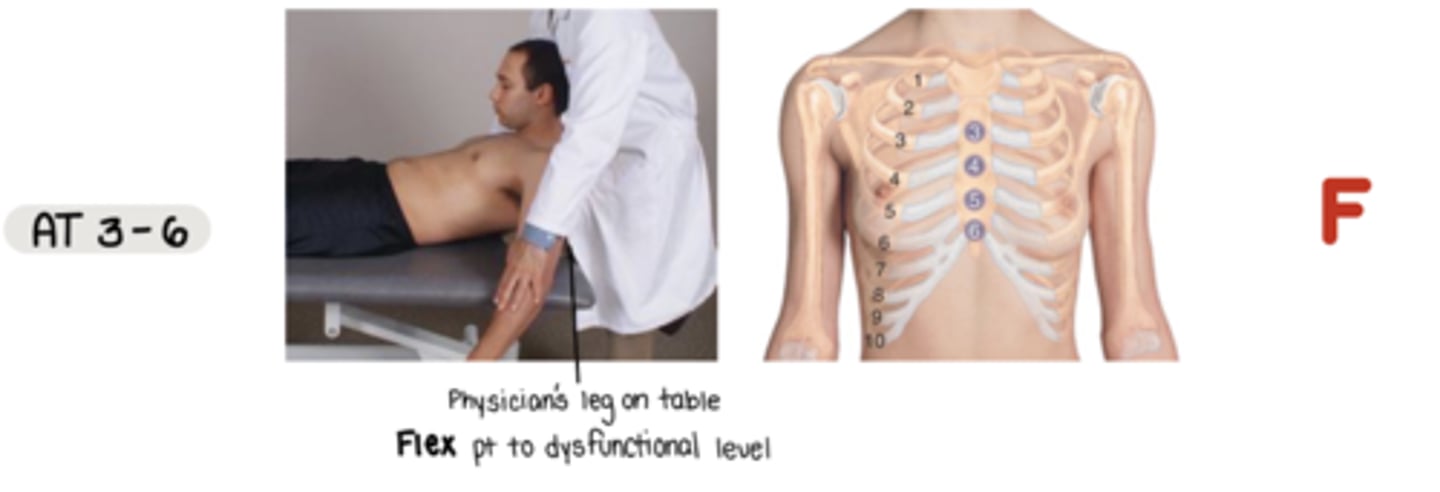
<p>F to dysfunctional level</p>
16
New cards

Thoracic CS AT 7

F Ra St

1/4 from xiphoid process

St = move leg out to induce pt side bending toward TP

Ra = pt wraps arm around physicians leg to induce Ra from TP
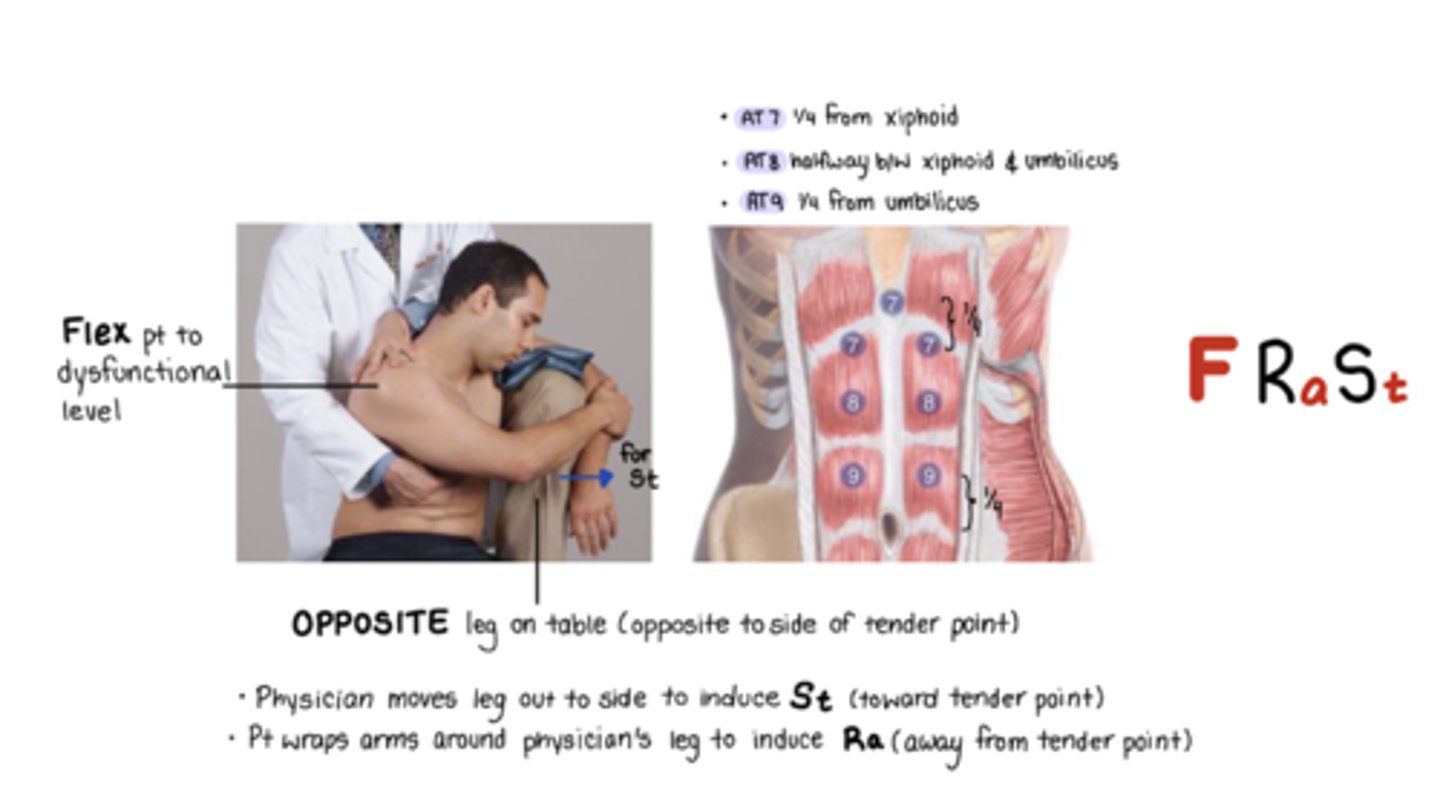
<p>F Ra St</p><p>1/4 from xiphoid process</p><p>St = move leg out to induce pt side bending toward TP</p><p>Ra = pt wraps arm around physicians leg to induce Ra from TP</p>
17
New cards

Thoracic CS AT 8

F Ra St

halfway xiphoid and umbilicus

St = move leg out to induce pt side bending toward TP

Ra = pt wraps arm around physicians leg to induce Ra from TP
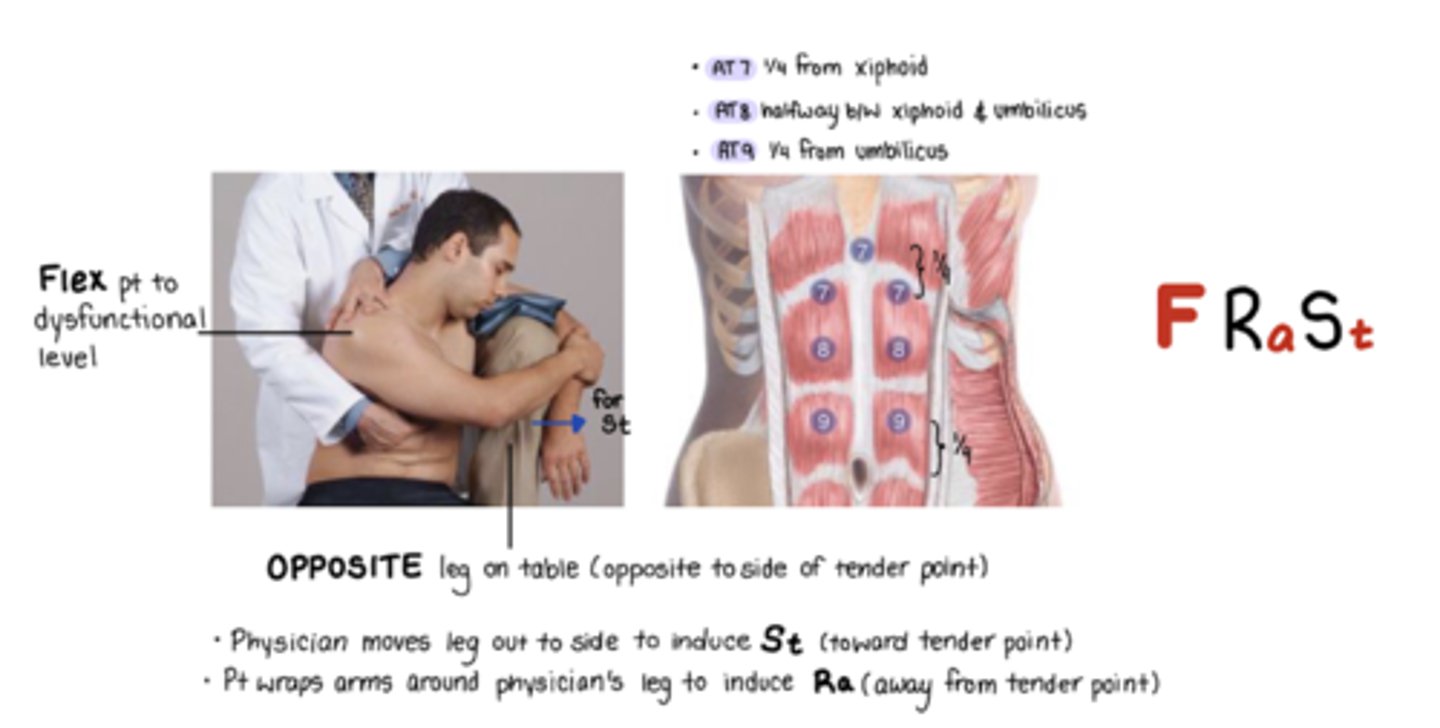
<p>F Ra St</p><p>halfway xiphoid and umbilicus</p><p>St = move leg out to induce pt side bending toward TP</p><p>Ra = pt wraps arm around physicians leg to induce Ra from TP</p>
18
New cards

Thoracic CS AT 9

F Ra St

1/4 from from umbillicus

St = move leg out to induce pt side bending toward TP

Ra = pt wraps arm around physicians leg to induce Ra from TP
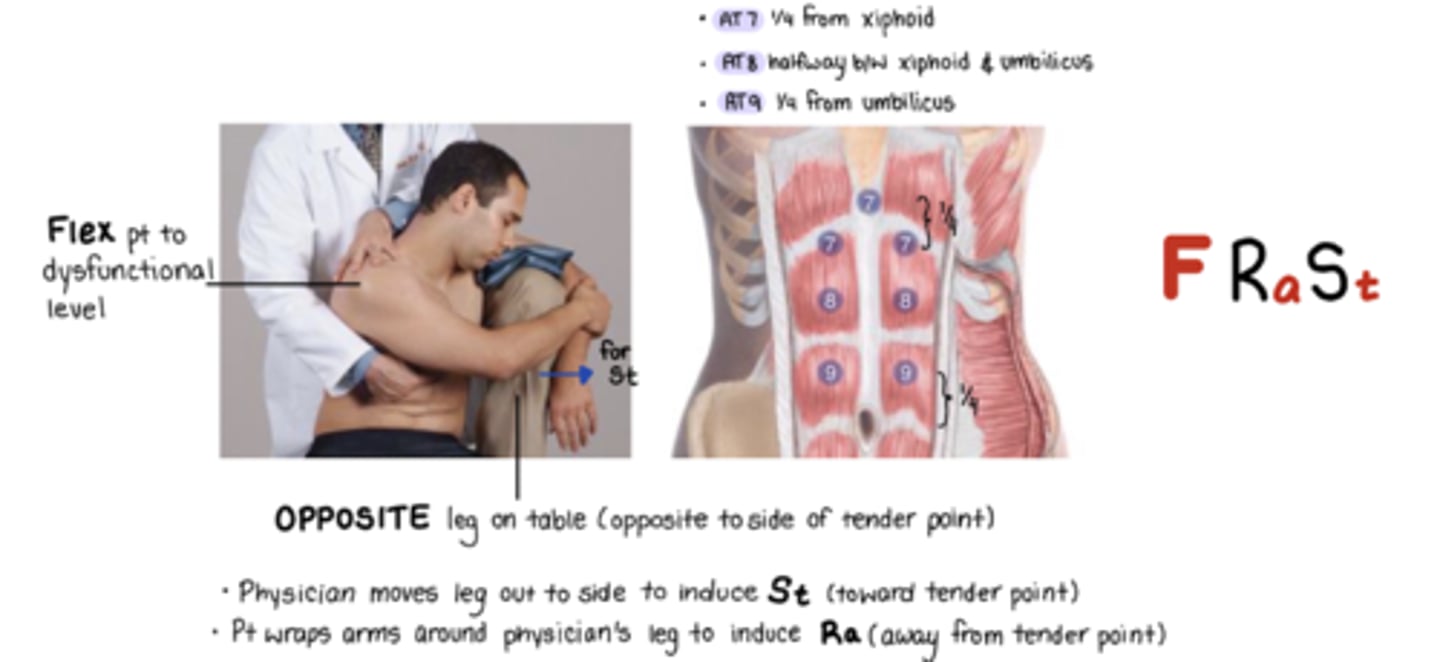
<p>F Ra St</p><p>1/4 from from umbillicus</p><p>St = move leg out to induce pt side bending toward TP</p><p>Ra = pt wraps arm around physicians leg to induce Ra from TP</p>
19
New cards

Thoracic CS AT 10

F Ra St

TP @ 1/4 from umbilicus to pubic symphysis

Physician on SAME side as TP

Pt crosses legs

Knees and ankles to me

Ra = bring knees toward physician

rotates pelvis toward so that torso rotates AWAY from TP

St = bring ankles toward physician
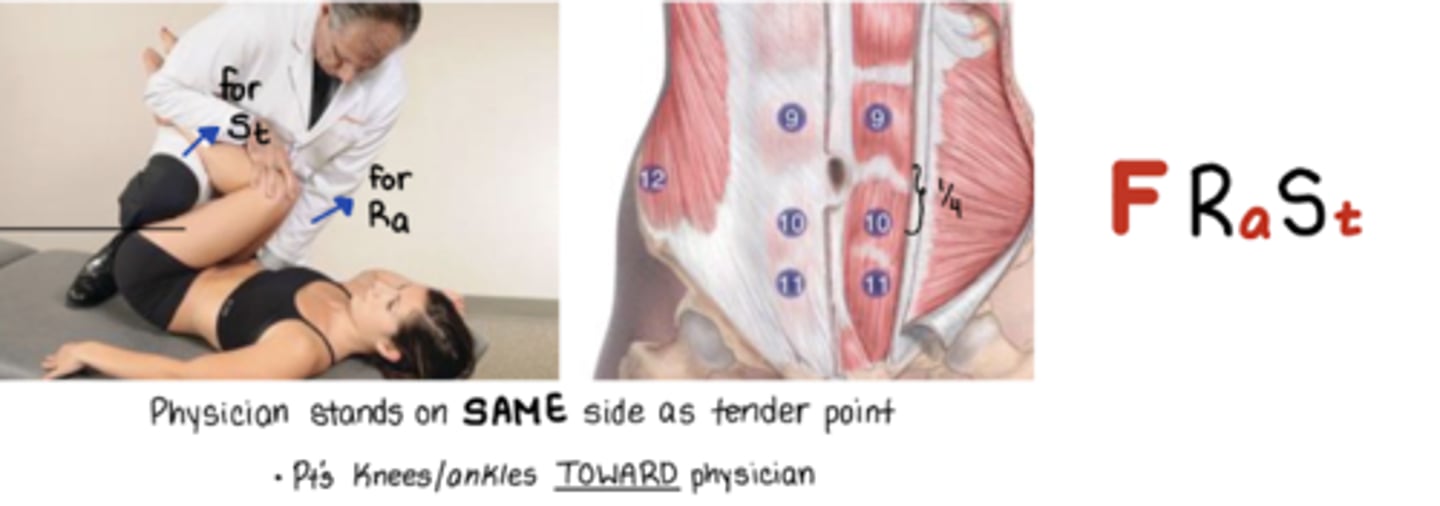
<p>F Ra St</p><p>TP @ 1/4 from umbilicus to pubic symphysis</p><p>Physician on SAME side as TP</p><p>Pt crosses legs</p><p>Knees and ankles to me</p><p>Ra = bring knees toward physician</p><p>rotates pelvis toward so that torso rotates AWAY from TP</p><p>St = bring ankles toward physician</p>
20
New cards

Thoracic CS AT 11

F Ra St

halfway b/w umbilicus and pubic symphysis

Physician on SAME side as TP

knees and ankles toward me

Ra = bring knees toward physician

rotates pelvis toward so that torso rotates AWAY from TP

St = bring ankles toward physician
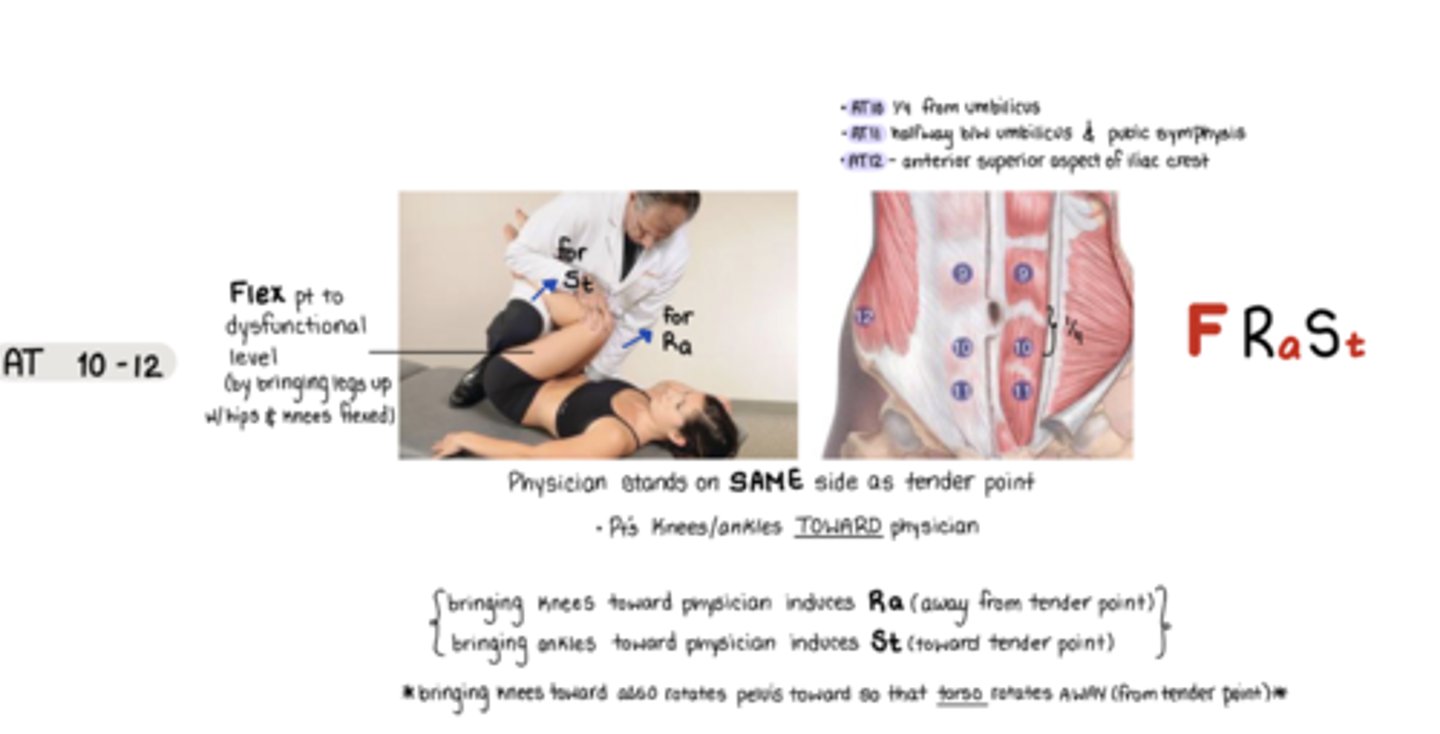
<p>F Ra St</p><p>halfway b/w umbilicus and pubic symphysis</p><p>Physician on SAME side as TP</p><p>knees and ankles toward me</p><p>Ra = bring knees toward physician</p><p>rotates pelvis toward so that torso rotates AWAY from TP</p><p>St = bring ankles toward physician</p>
21
New cards

Thoracic CS AT 12

F Ra St

located @ anterior super aspect of iliac crest

Physician on SAME side as TP

knees and ankles to me

Ra = bring knees toward physician

rotates pelvis toward so that torso rotates AWAY from TP

St = bring ankles toward physician
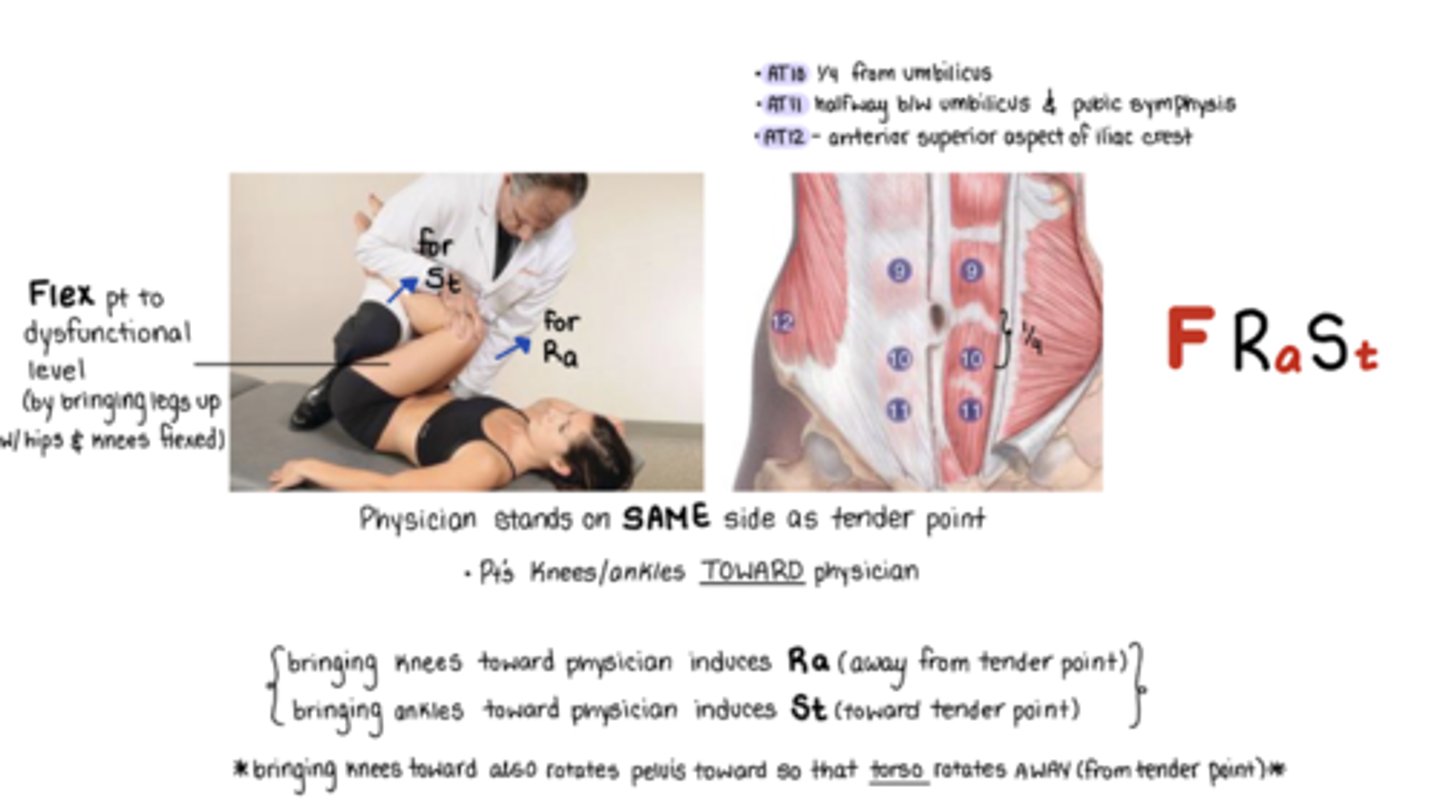
<p>F Ra St</p><p>located @ anterior super aspect of iliac crest</p><p>Physician on SAME side as TP</p><p>knees and ankles to me</p><p>Ra = bring knees toward physician</p><p>rotates pelvis toward so that torso rotates AWAY from TP</p><p>St = bring ankles toward physician</p>
22
New cards

Rib CS PR 1

PIE is OP

  • posterior

  • I = 1

  • E = E Sa Rt

  • OP = use opposite leg for stabilizing

E Sa Rt

*inhalation
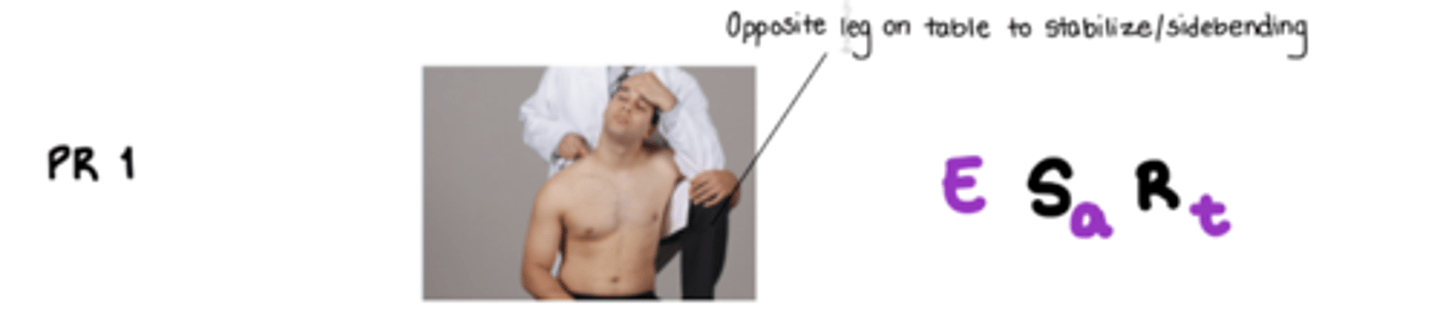
<p>PIE is OP</p><ul><li><p>posterior</p></li><li><p>I = 1</p></li><li><p>E = E Sa Rt</p></li><li><p>OP = use opposite leg for stabilizing</p></li></ul><p>E Sa Rt</p><p>*inhalation</p>
23
New cards

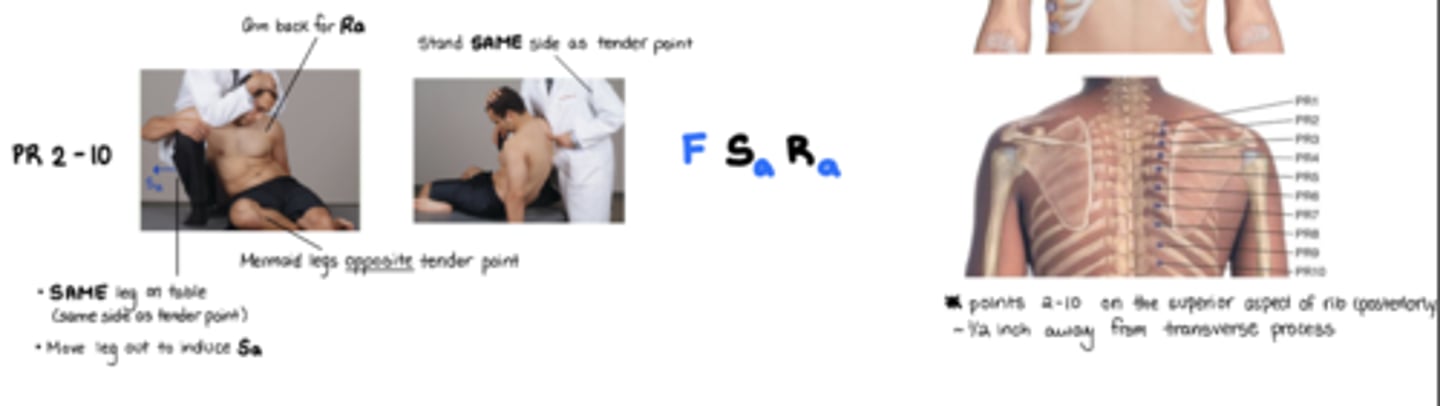
Rib CS PR 2-10

F Sa Ra

*inhalation

<p>F Sa Ra</p><p>*inhalation</p>
24
New cards

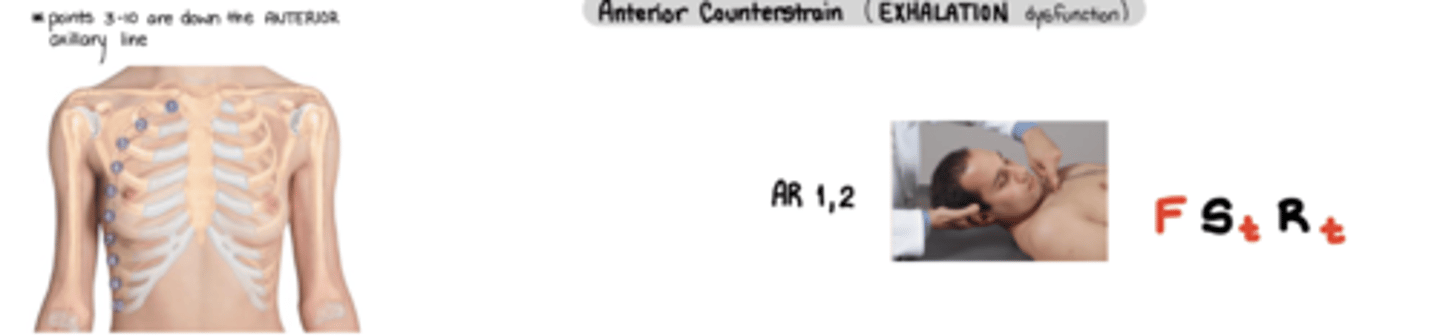
Rib CS AR 1,2

F St Rt

*exhalation

<p>F St Rt</p><p>*exhalation</p>
25
New cards

Rib CS AR 3-10

F St Rt

ASS! - anterior same side -> pt mermaid legs same side as TP

* exhalation

Arm back = Rt

Physician moves leg out = further into St
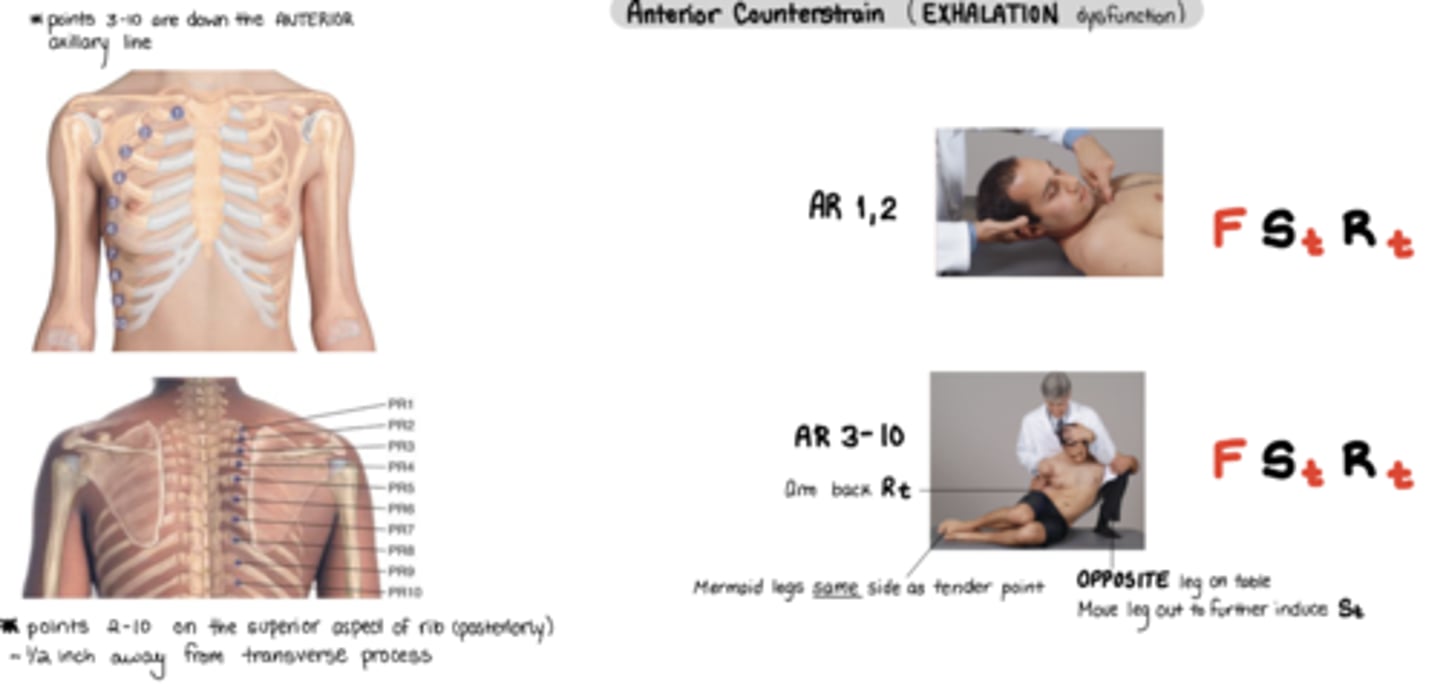
<p>F St Rt</p><p>ASS! - anterior same side -&gt; pt mermaid legs same side as TP</p><p>* exhalation</p><p>Arm back = Rt</p><p>Physician moves leg out = further into St</p>
26
New cards

Lumbar CS AL1

F Ra St

TP = medial to ASIS

ankles and knees to me
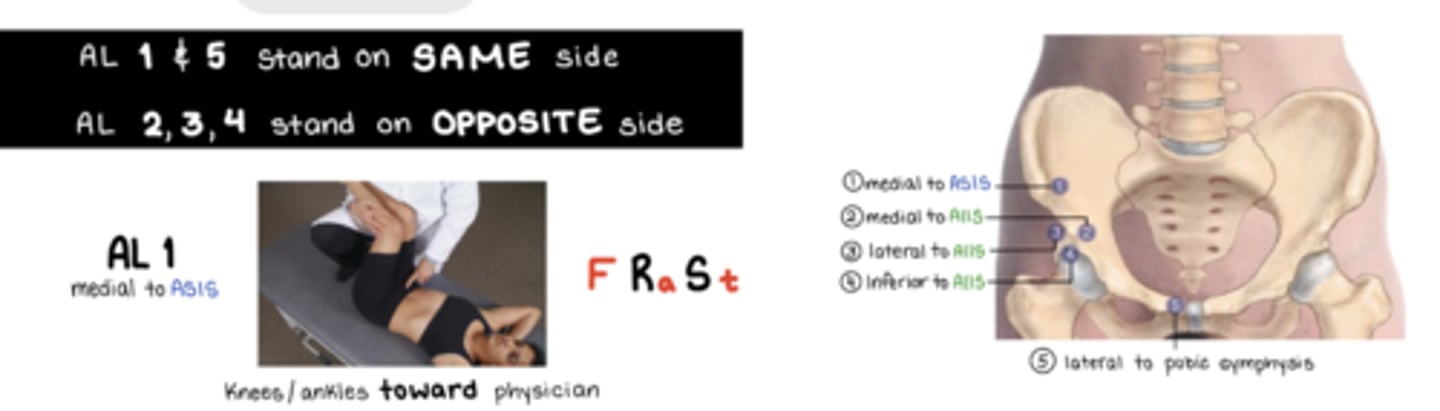
<p>F Ra St</p><p>TP = medial to ASIS</p><p>ankles and knees to me</p>
27
New cards

Lumbar CS AL 2

F Sa Rt

TP = medial to AIIS
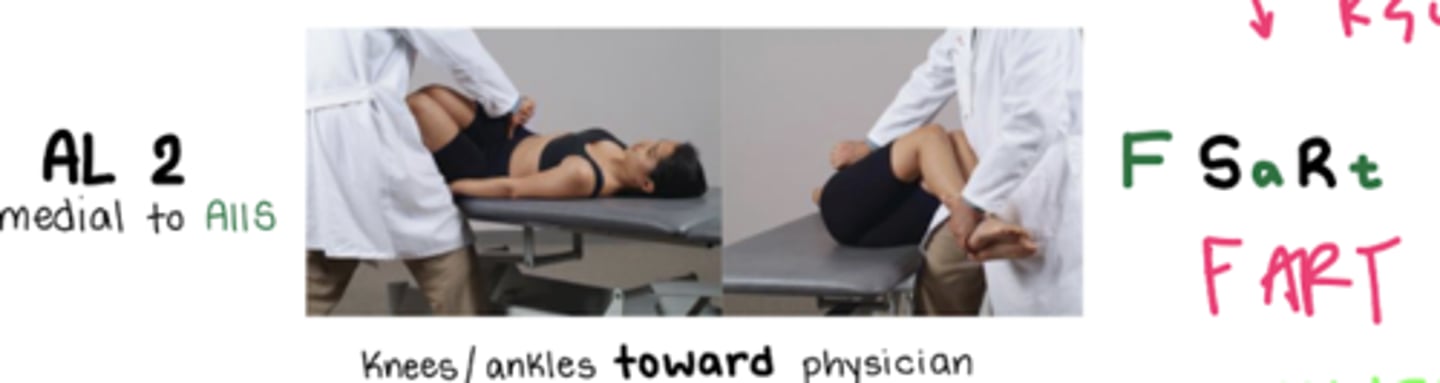
<p>F Sa Rt</p><p>TP = medial to AIIS</p>
28
New cards

Lumbar CS AL 3

F Sa Rt

TP = lateral to AIIS
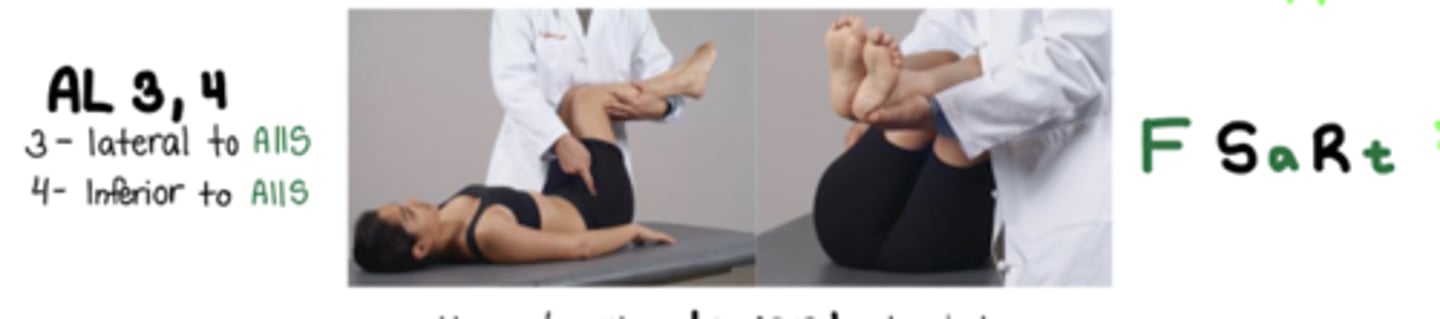
<p>F Sa Rt</p><p>TP = lateral to AIIS</p>
29
New cards

Lumbar CS AL 4

F Sa Rt

TP = inferior to AIIS
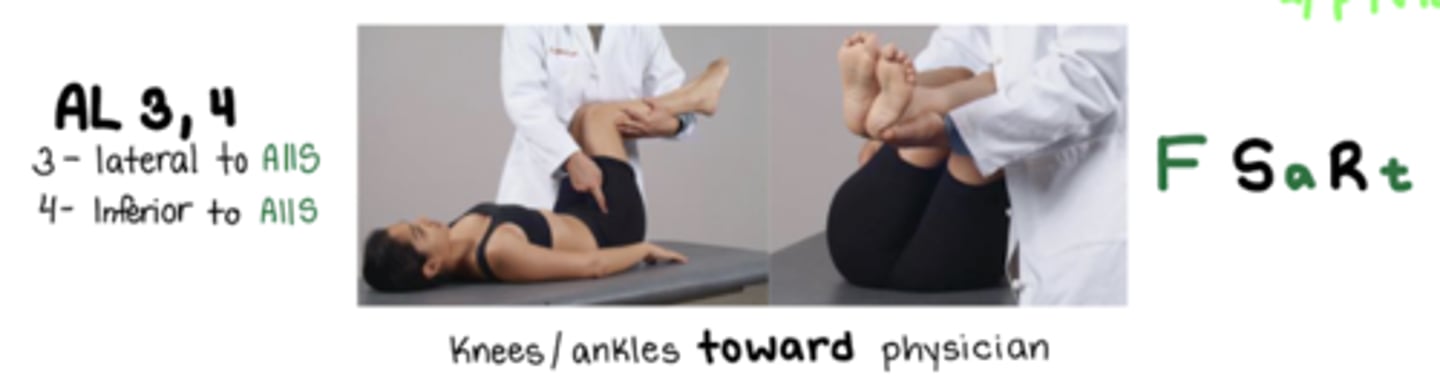
<p>F Sa Rt</p><p>TP = inferior to AIIS</p>
30
New cards

Lumbar CS AL 5

F Sa Ra

TP = lateral to pubic symphasis

ONLY lumbar anterior CS ankles are AWAY
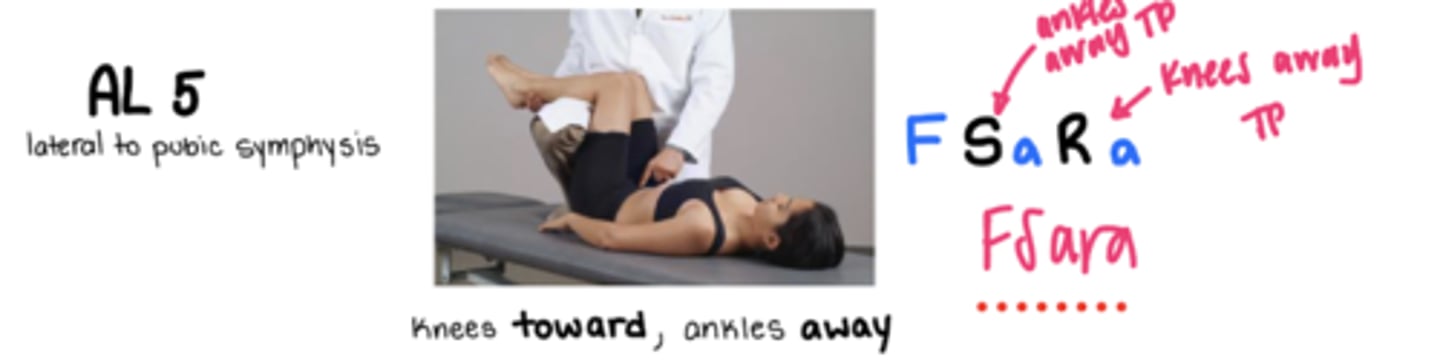
<p>F Sa Ra</p><p>TP = lateral to pubic symphasis</p><p>ONLY lumbar anterior CS ankles are AWAY</p>
31
New cards

AL 1 and 5 stand on

same side as TP

32
New cards

AL 2-4 stand on

opp side of TP

*across the floor

33
New cards

Lumbar CS PL 1-5 SP

E Sa Ra

EXTEND, ADDUCT, EXTERNALLY ROTATE

Stand OPPOSITE of TP

hold leg ABOVE knee

When standing on same side

  • Use your knee to lift leg closest to you to externally rotate, extend, and ADduct
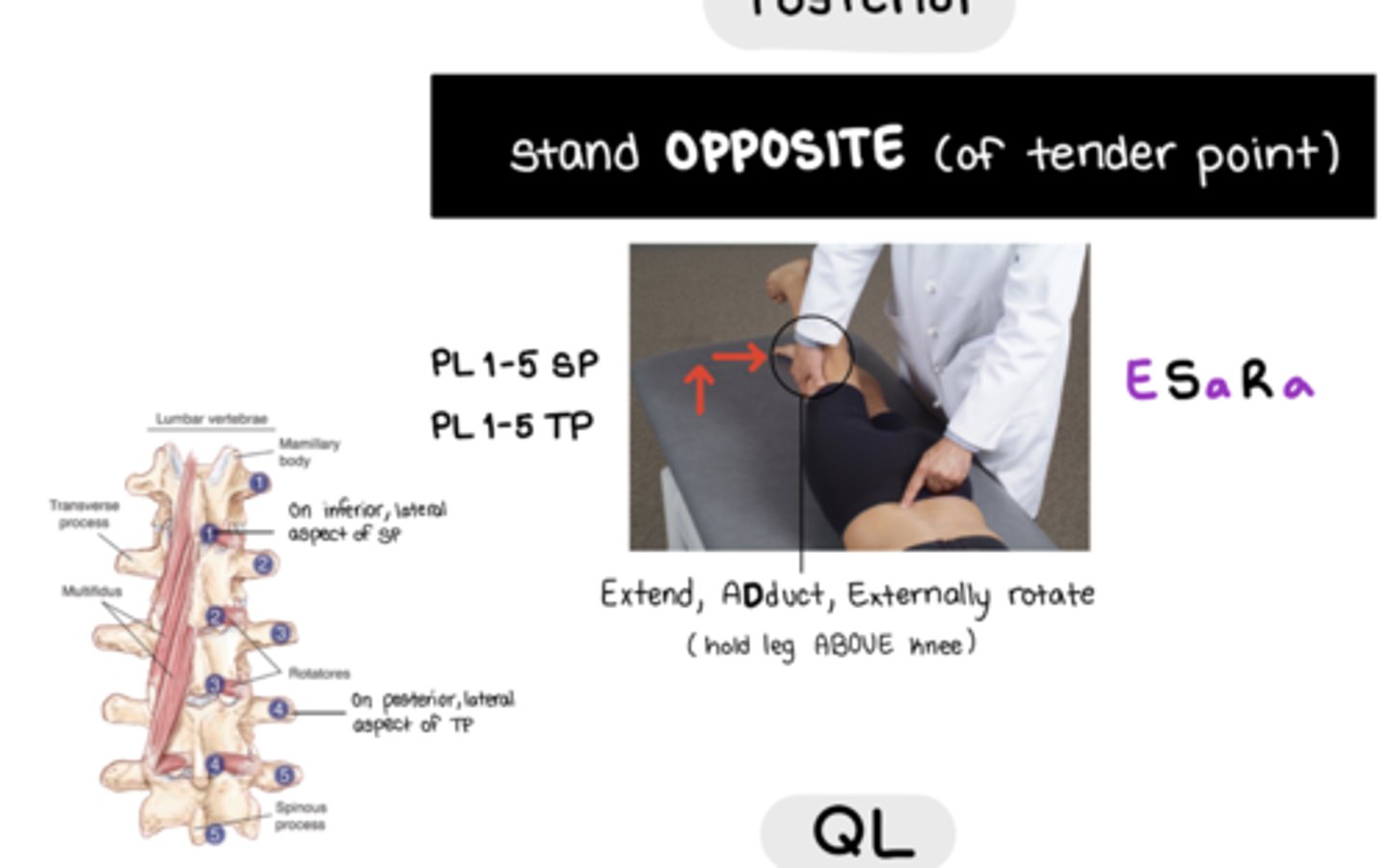
<p>E Sa Ra</p><p>EXTEND, ADDUCT, EXTERNALLY ROTATE</p><p>Stand OPPOSITE of TP</p><p>hold leg ABOVE knee</p><p><span style="background-color: transparent;"><strong><span>When standing on same side</span></strong></span></p><ul><li><p><span style="background-color: transparent;"><span>Use your knee to lift leg closest to you to externally rotate, extend, and ADduct</span></span></p></li></ul><p></p>
34
New cards

QL CS

EXTEND, ABDUCT, EXTERNALLY ROTATE HIP

Stand on SAME SIDE of TP

QL attachments: inferior aspect of 12th rib, lateral aspect of lumbar TPs, superior aspect of iliac crest
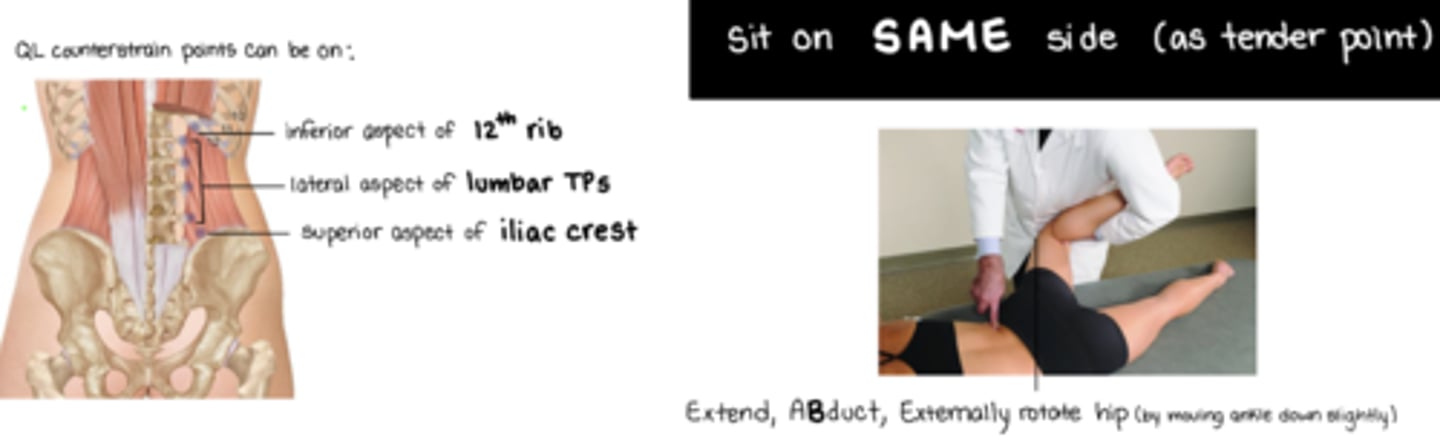
<p>EXTEND, ABDUCT, EXTERNALLY ROTATE HIP</p><p>Stand on SAME SIDE of TP</p><p>QL attachments: inferior aspect of 12th rib, lateral aspect of lumbar TPs, superior aspect of iliac crest</p>
35
New cards

OA MET flexed SD

v-hold: pads of thumb and index finger just under occiput

pt is moved further into barrier E Sa Ra
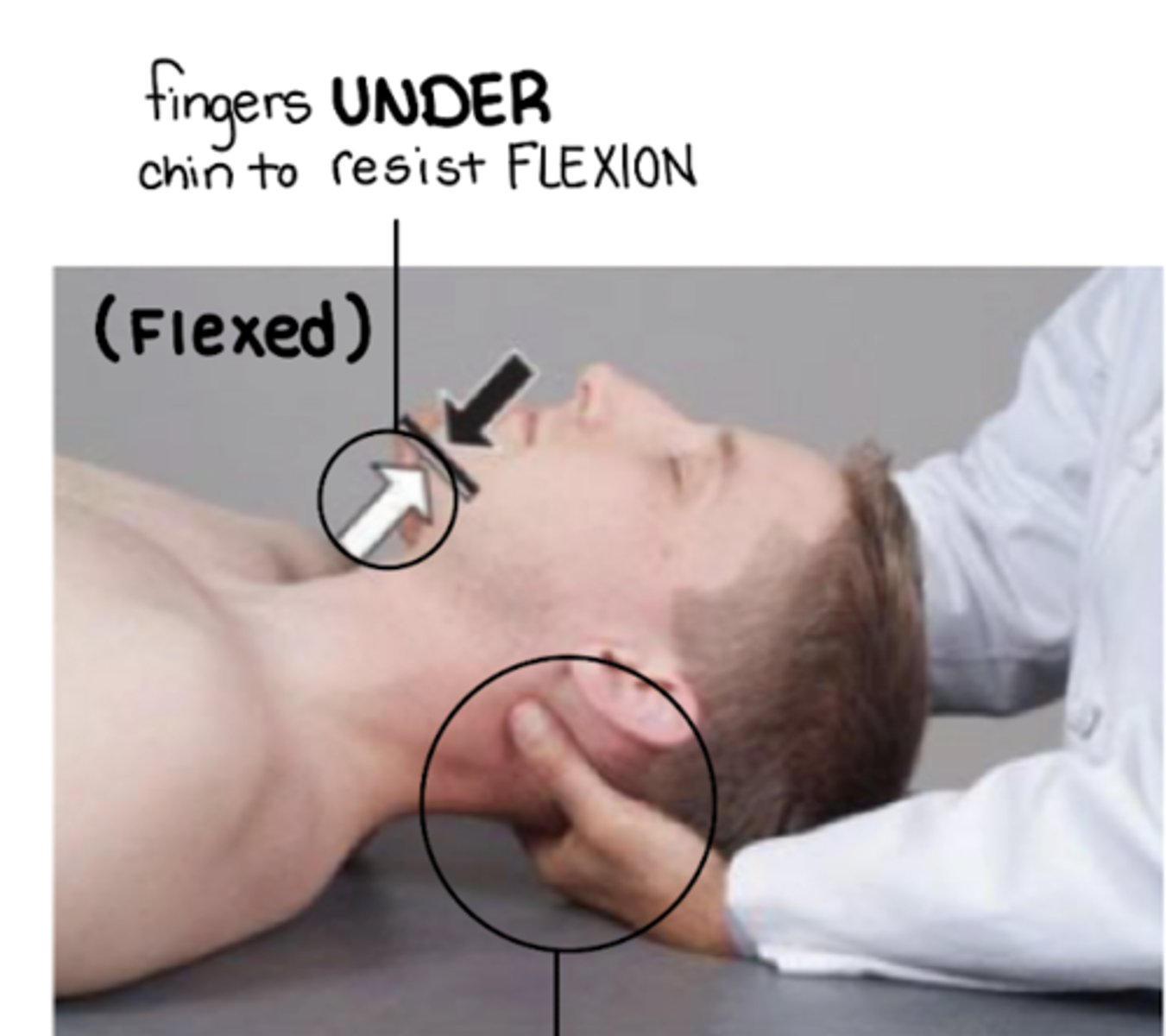
<p>v-hold: pads of thumb and index finger just under occiput</p><p>pt is moved further into barrier E Sa Ra</p>
36
New cards

OA MET extension SD

v-hold: under occiput, pads of fingers contact the suboccipital musculature

pt is moved further into barrier F Sa Ra
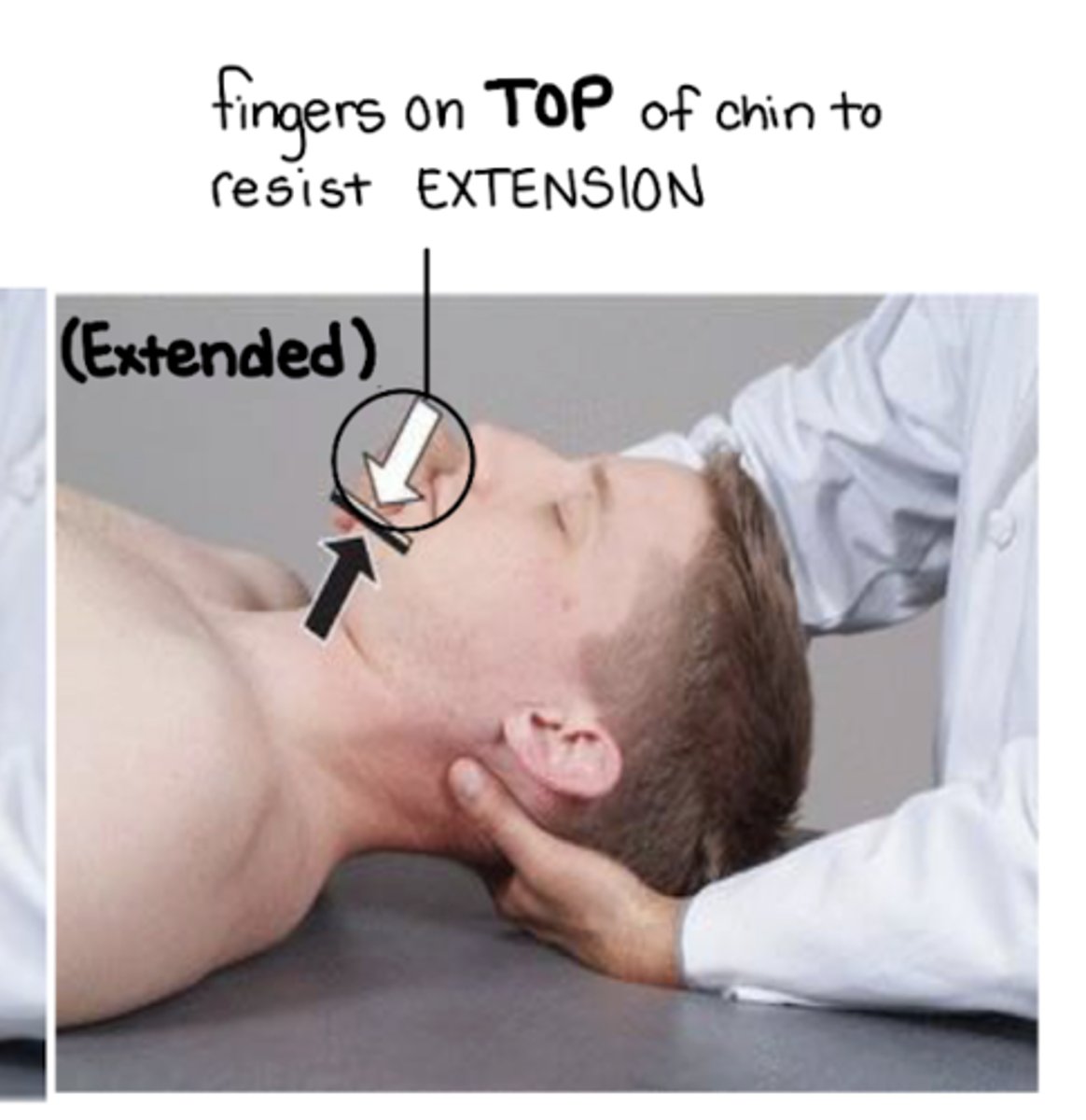
<p>v-hold: under occiput, pads of fingers contact the suboccipital musculature</p><p>pt is moved further into barrier F Sa Ra</p>
37
New cards

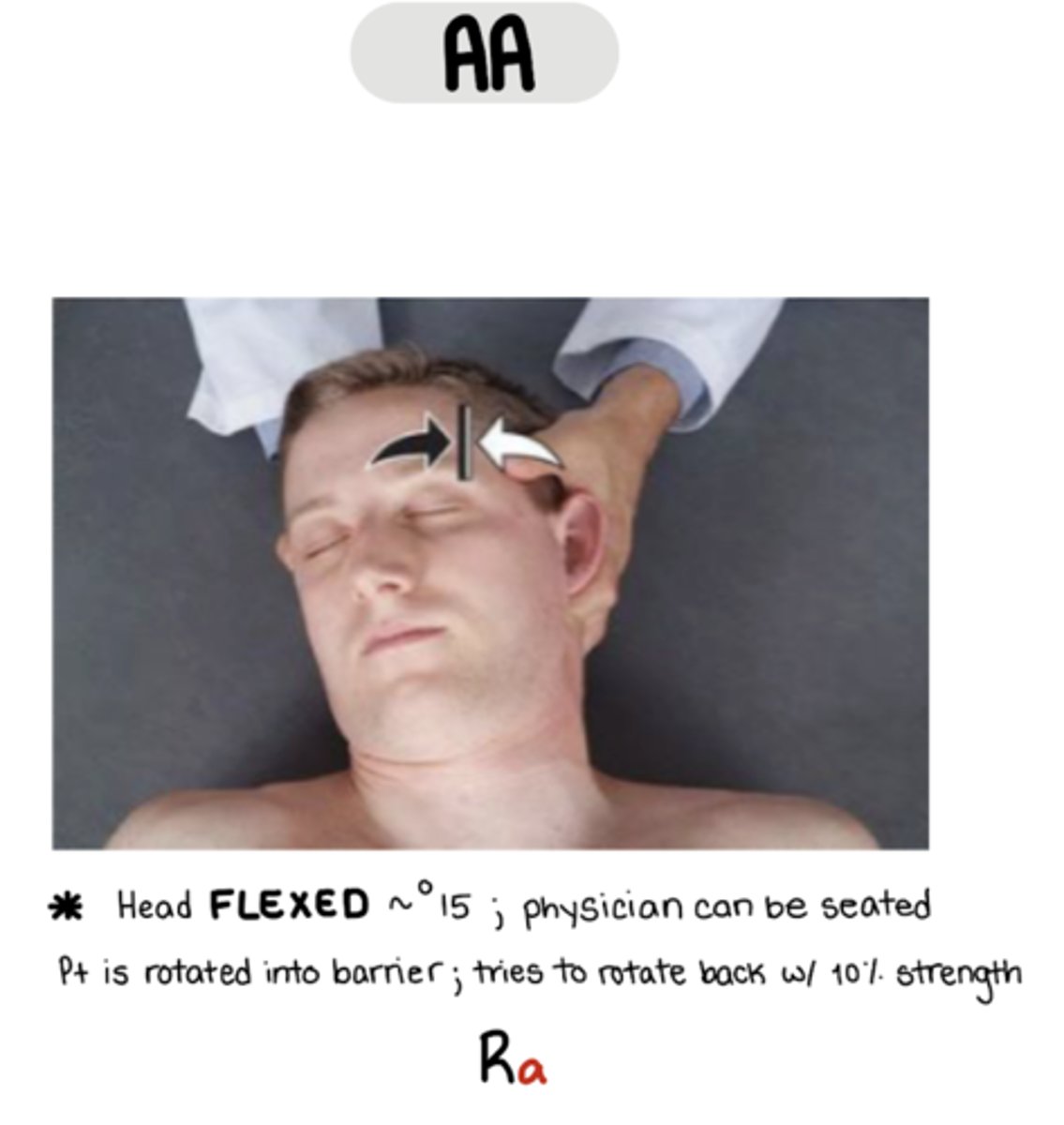
AA MET

Ra

<p>Ra</p>
38
New cards

C2-C7 MET

F/E Sa Ra

V-hold: thumb and index fingers to monitor articular pillae

pt is asked to rotate into freedom with 10% strength against counterforce
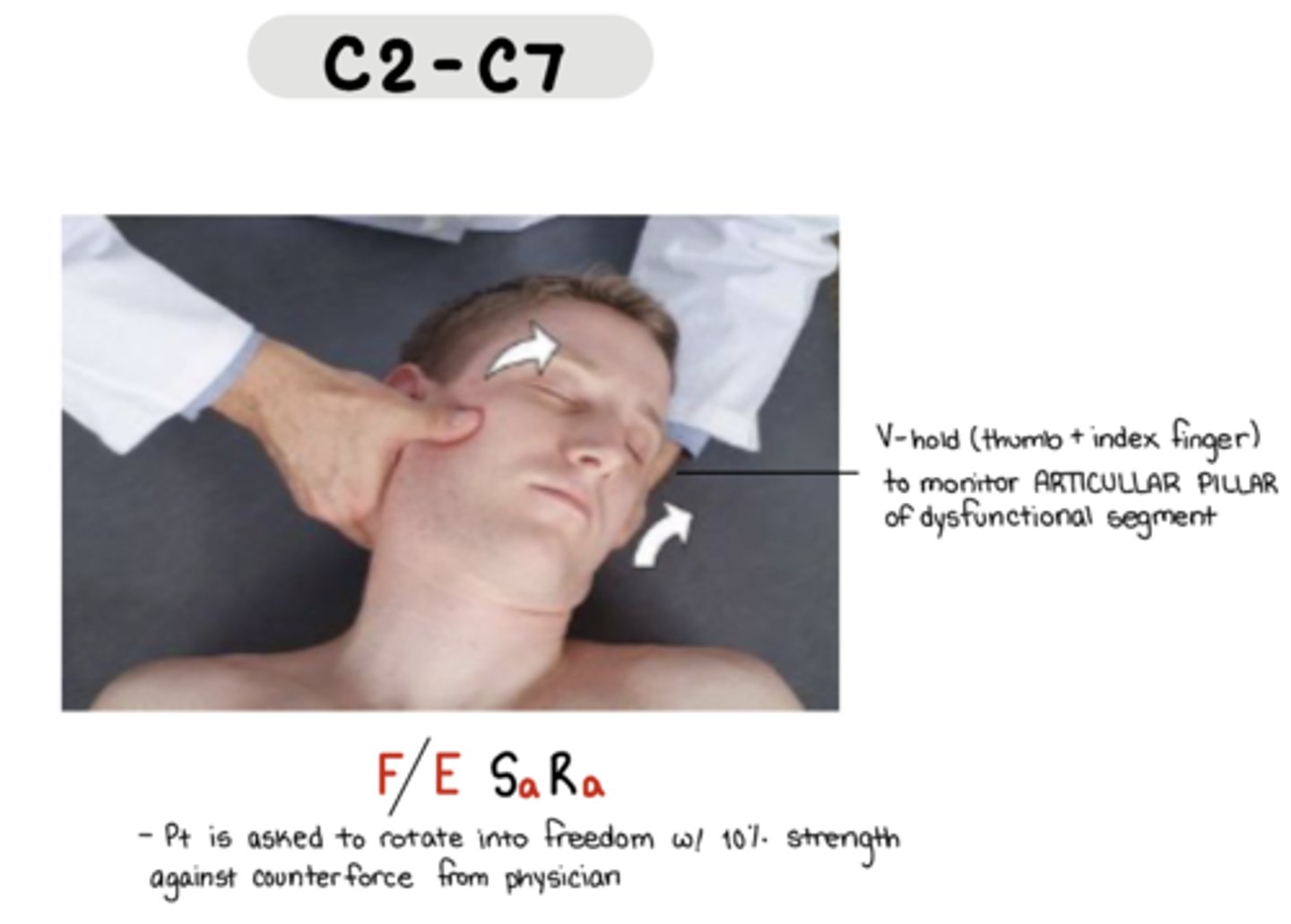
<p>F/E Sa Ra</p><p>V-hold: thumb and index fingers to monitor articular pillae</p><p>pt is asked to rotate into freedom with 10% strength against counterforce</p>
39
New cards

Thoracic MET Type 1 T1-T4

hands monitor transverse process

direct: moving pt INTO barrier in ALL PLANES

active: pt moves back toward direction of freedom in one plane
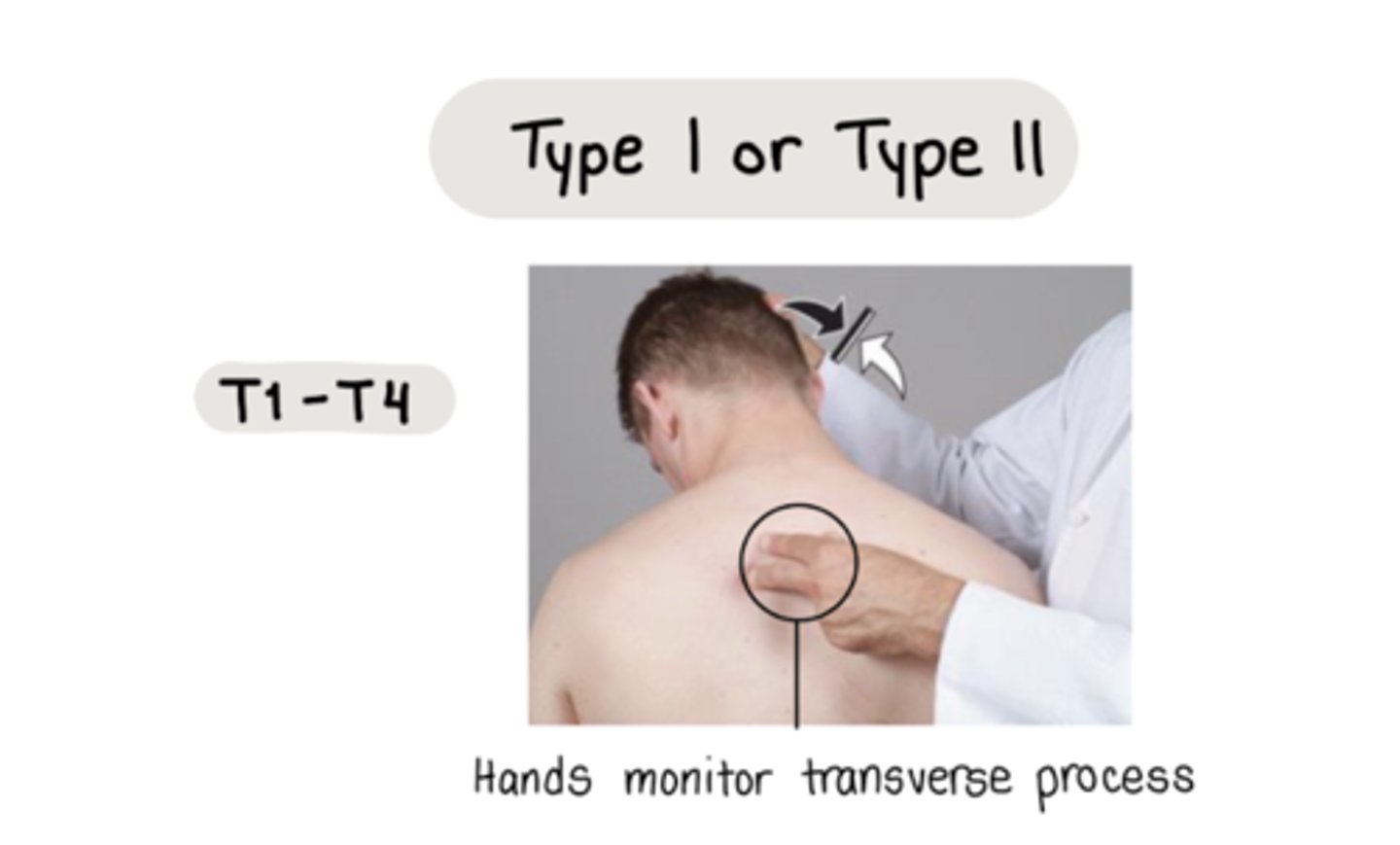
<p>hands monitor transverse process</p><p>direct: moving pt INTO barrier in ALL PLANES</p><p>active: pt moves back toward direction of freedom in one plane</p>
40
New cards

Thoracic MET Type 1 T5-T12

pt hand on neck on SAME side as rotational component

physician stand on OPPOSITE side of rotational component

hands monitor TP

direct: moving pt INTO barrier in ALL PLANES

active: pt moves back toward direction of freedom in one plane
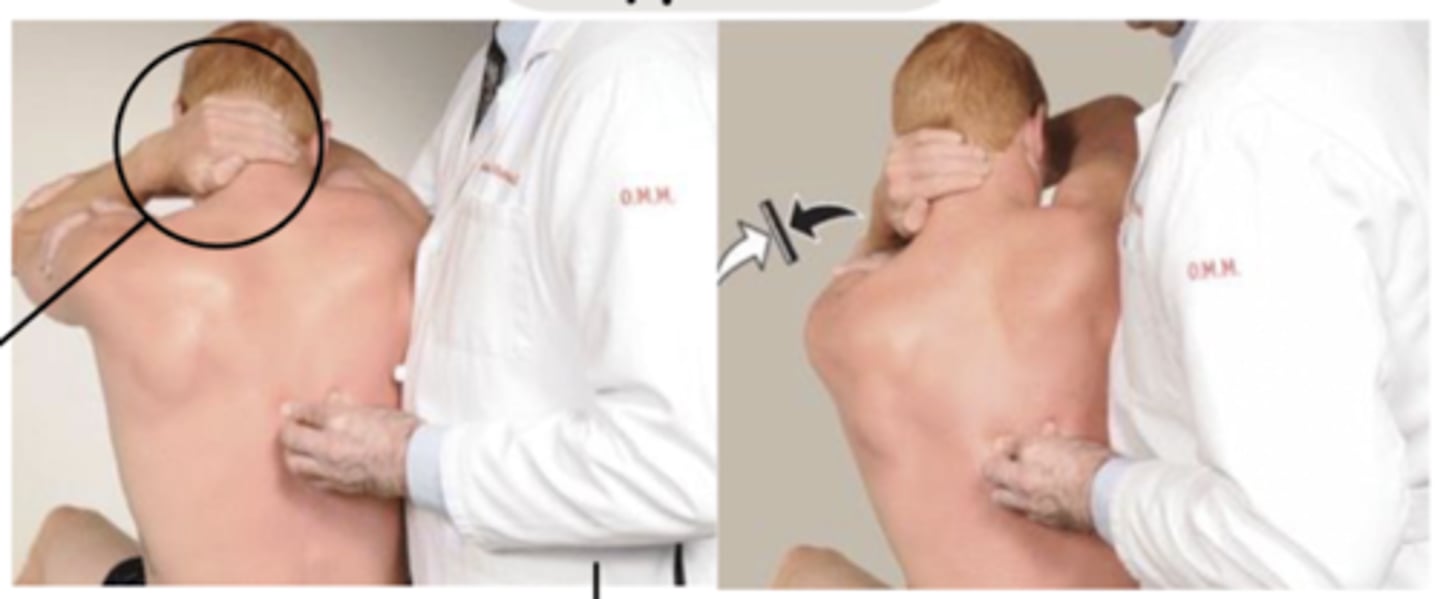
<p>pt hand on neck on SAME side as rotational component</p><p>physician stand on OPPOSITE side of rotational component</p><p>hands monitor TP</p><p>direct: moving pt INTO barrier in ALL PLANES</p><p>active: pt moves back toward direction of freedom in one plane</p>
41
New cards

Thoracic MET Type 2 T5-T12

osteopathic hug

physician stand on OPPOSITE side of rotational component

direct: moving pt INTO barrier in ALL PLANES (F/E R S)

active: pt moves back toward direction of freedom in one plane
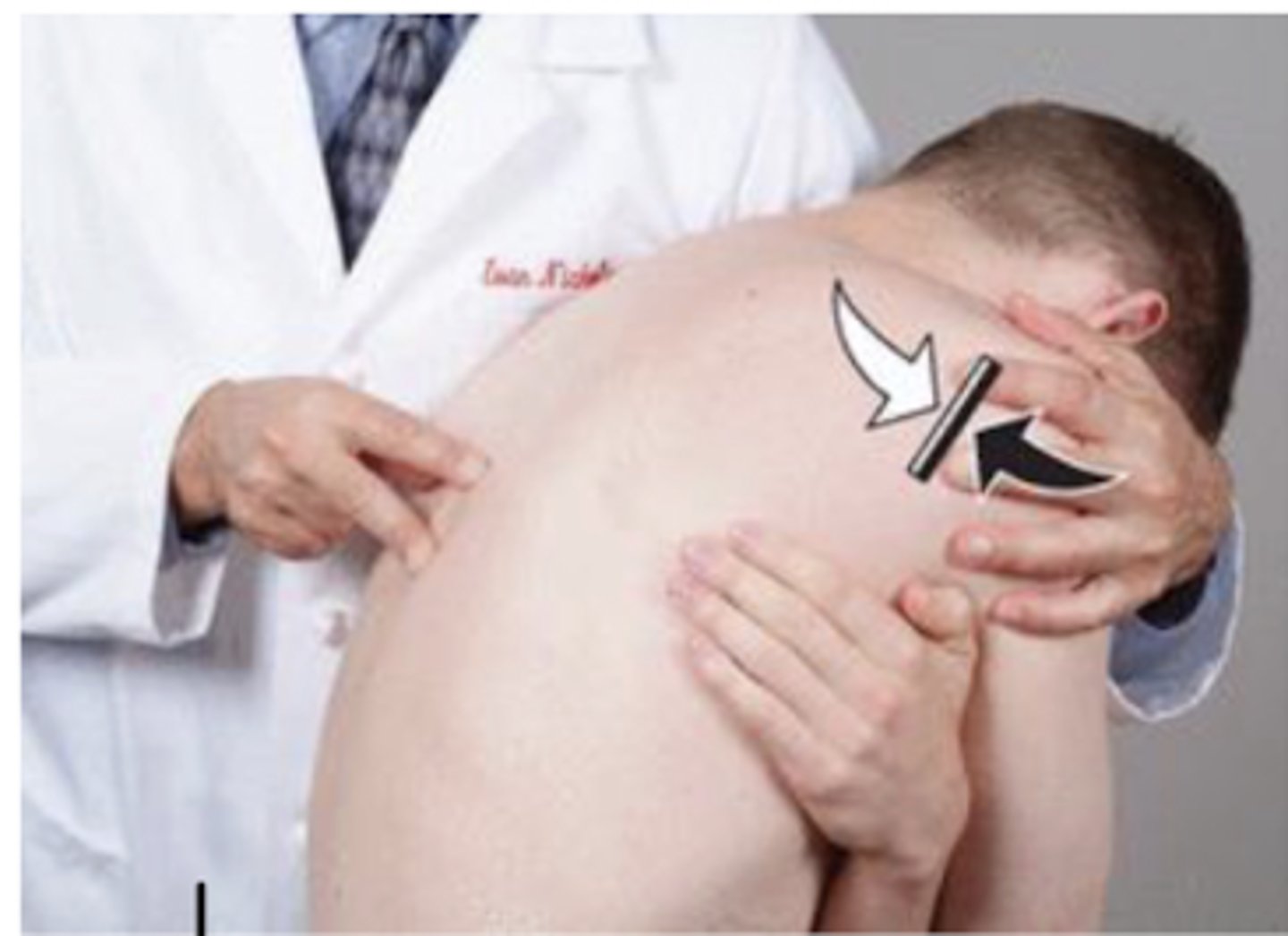
<p>osteopathic hug</p><p>physician stand on OPPOSITE side of rotational component</p><p>direct: moving pt INTO barrier in ALL PLANES (F/E R S)</p><p>active: pt moves back toward direction of freedom in one plane</p>
42
New cards

Rib 1 Inhalation MET

F Ra St

MCP of index finger or thumb on dysfunctional rib contacting anterior side of rib - resisting with INHALATION, following into EXHALATION
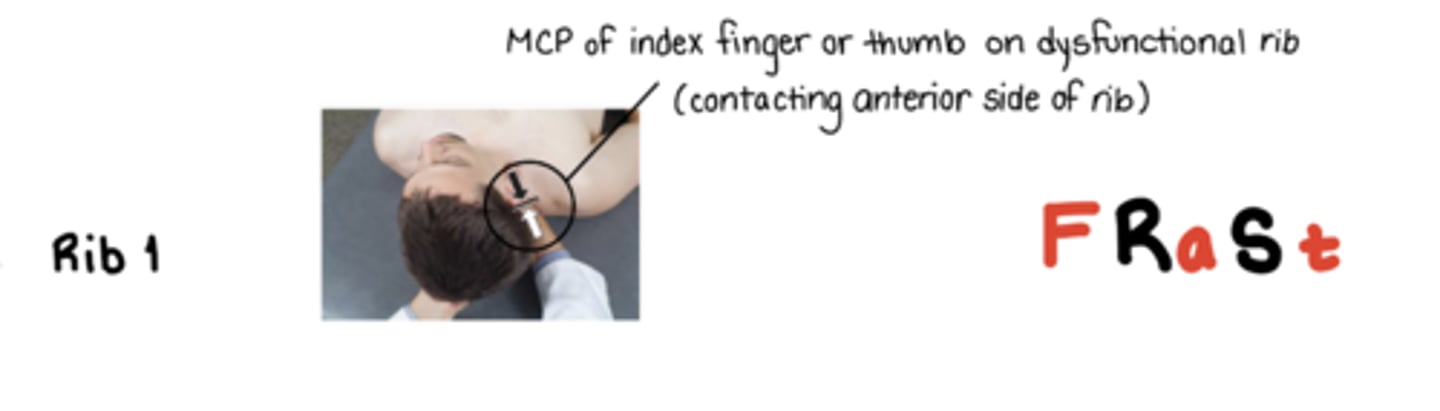
<p>F Ra St</p><p>MCP of index finger or thumb on dysfunctional rib contacting anterior side of rib - resisting with INHALATION, following into EXHALATION</p>
43
New cards

Rib 2-6 Inhalation MET

F St

MCP on superior aspect of rib - resisting with INHALATION, following into EXHALATION

Flex pt to level of dysfunctional rib
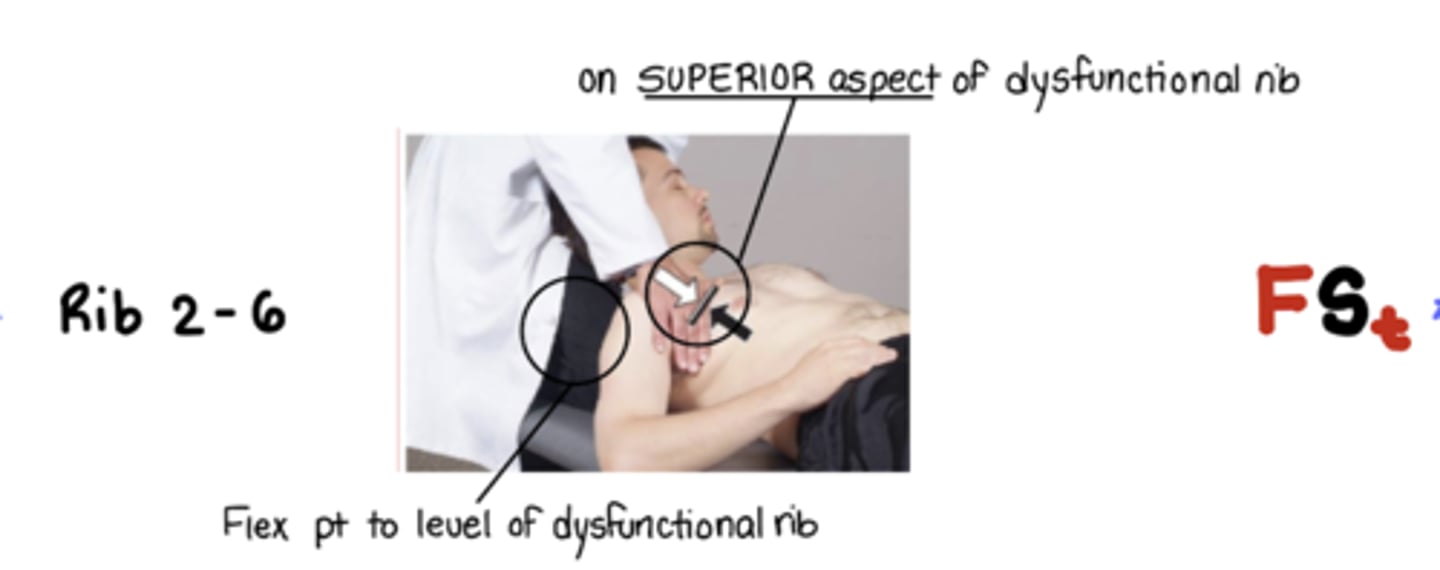
<p>F St</p><p>MCP on superior aspect of rib - resisting with INHALATION, following into EXHALATION</p><p>Flex pt to level of dysfunctional rib</p>
44
New cards

Rib 7-10 Inhalation MET

St

MCP on superior aspect of dysfunctional rib - resisting with INHALATION, following into EXHALATION

*use pt's arm to St
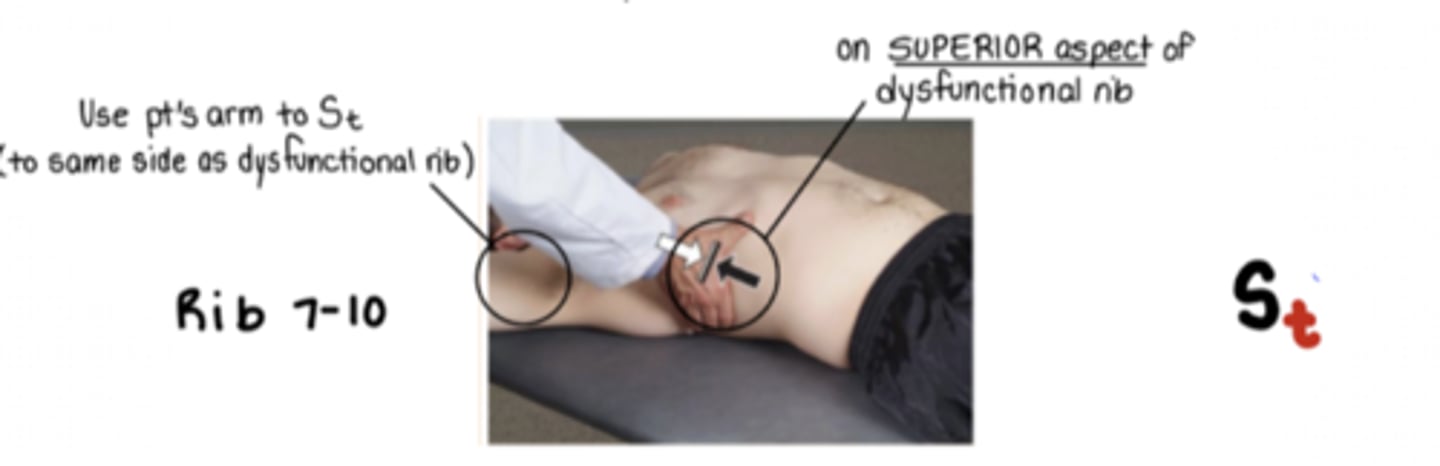
<p>St </p><p>MCP on superior aspect of dysfunctional rib - resisting with INHALATION, following into EXHALATION</p><p>*use pt's arm to St</p>
45
New cards

Ribs 11,12 Inhalation MET

St

active hand: HYPOTHENAR on the INFERIOR aspect of the dysfunctional rib resisting with INHALATION, following into EXHALATION

other hand stabilizing @ ASIS

HYPOTHENAR on the INFERIOR aspect of the dysfunctional rib

move legs away from me

(to take tension OFF QL)

ribs are stuck DOWN
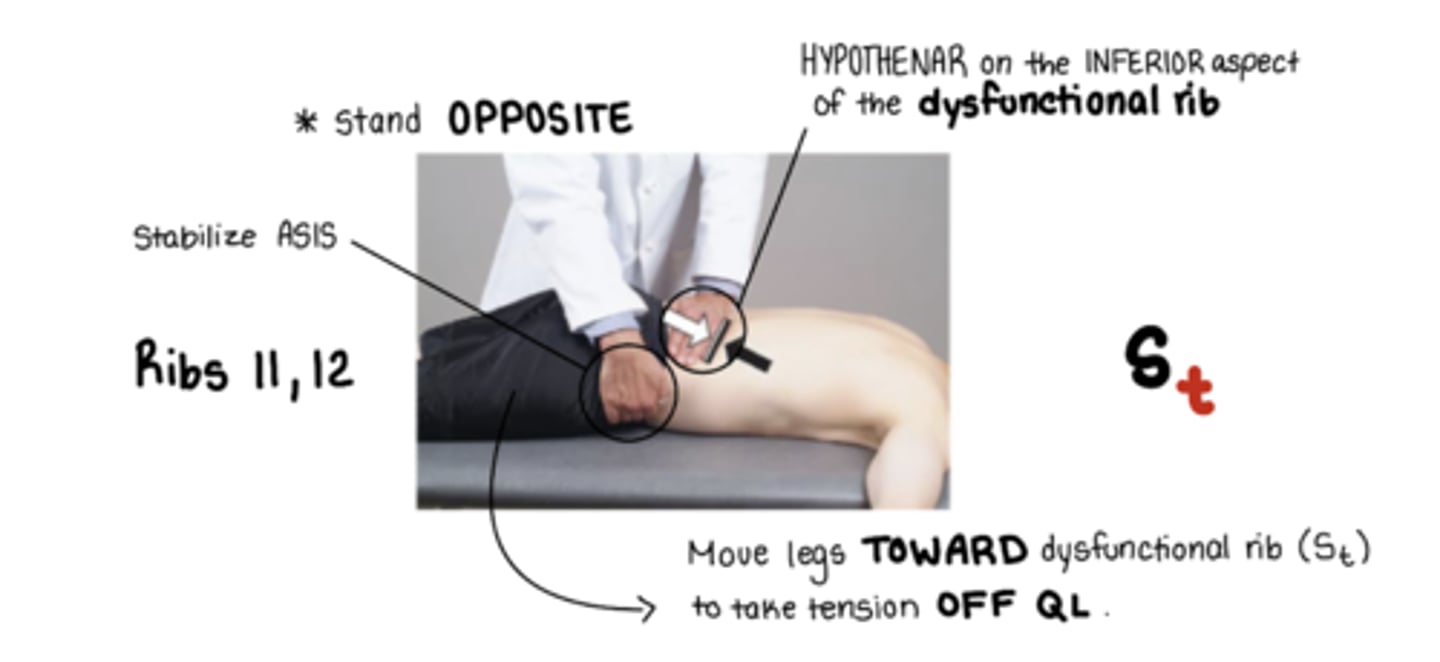
<p>St</p><p>active hand: HYPOTHENAR on the INFERIOR aspect of the dysfunctional rib resisting with INHALATION, following into EXHALATION</p><p>other hand stabilizing @ ASIS</p><p>HYPOTHENAR on the INFERIOR aspect of the dysfunctional rib</p><p>move legs away from me</p><p>(to take tension OFF QL)</p><p>ribs are stuck DOWN</p>
46
New cards

Ribs 1-2 Exhalation MET

"woe is me"

m: scalenes

stand on same side as SD

Pt head RA from dysfunctional rib

index and middle finger hook onto posterior and SUPERIOR aspect of the dysfunctional rib pulling rib inferolaterally at the rib angle

ribs are stuck DOWN
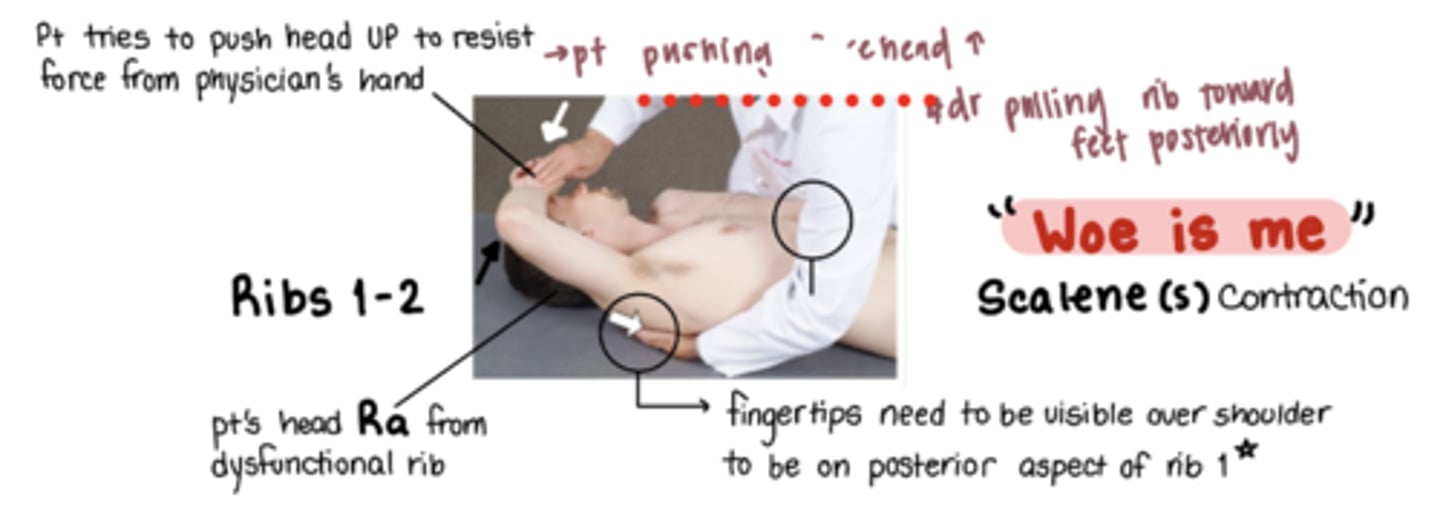
<p>"woe is me"</p><p>m: scalenes</p><p>stand on same side as SD</p><p>Pt head RA from dysfunctional rib</p><p>index and middle finger hook onto posterior and SUPERIOR aspect of the dysfunctional rib pulling rib inferolaterally at the rib angle</p><p>ribs are stuck DOWN</p>
47
New cards

Ribs 3-5 Exhalation MET

"hi"

m: pec minor

pt elbow ABOVE shoulder pt pushes elbow UP against physicians hand

stand on same side as SD

index and middle finger hook onto posterior and SUPERIOR aspect of the dysfunctional rib pulling rib inferolaterally at the rib angle

ribs are stuck DOWN
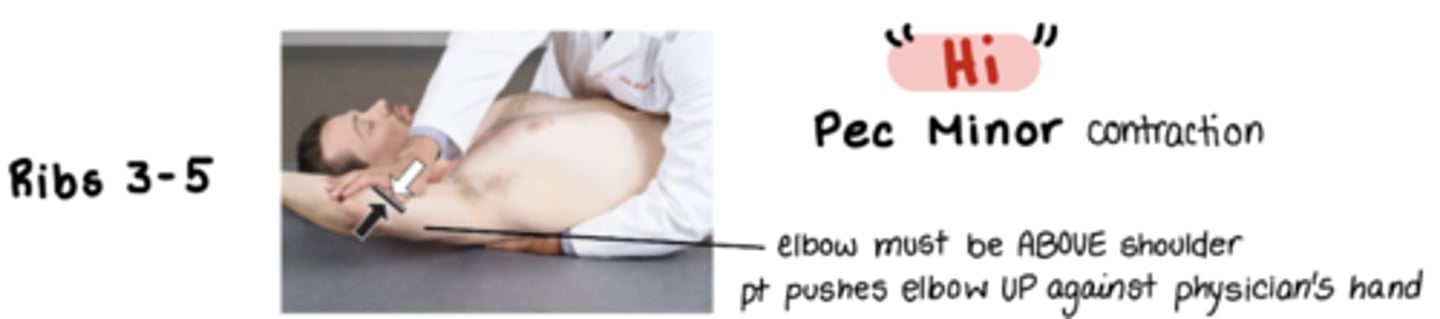
<p>"hi"</p><p>m: pec minor </p><p>pt elbow ABOVE shoulder pt pushes elbow UP against physicians hand</p><p>stand on same side as SD </p><p>index and middle finger hook onto posterior and SUPERIOR aspect of the dysfunctional rib pulling rib inferolaterally at the rib angle</p><p>ribs are stuck DOWN</p>
48
New cards

Ribs 6-8 Exhalation MET

"stop"

m: serratus anterior

pt pushes elbow UP against physicians hand

stand on same side as SD

index and middle finger hook onto posterior and SUPERIOR aspect of the dysfunctional rib pulling rib inferolaterally at the rib angle

ribs are stuck DOWN
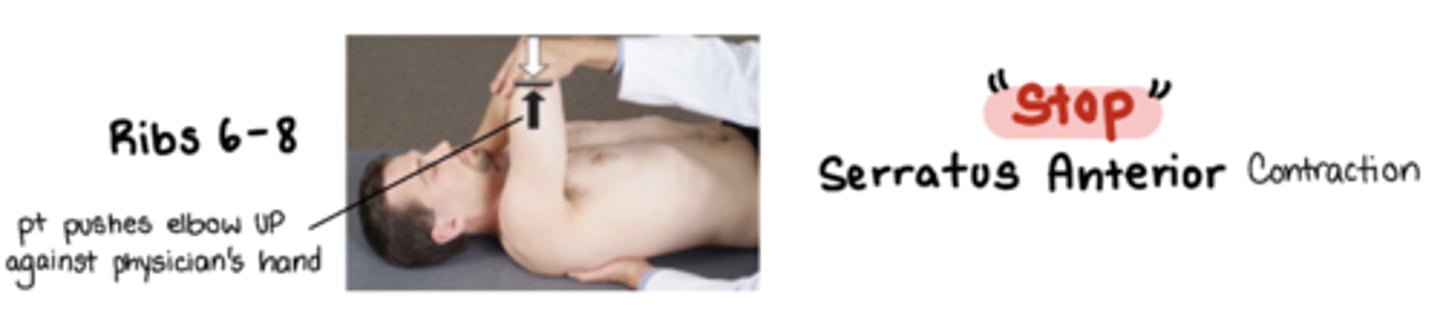
<p>"stop"</p><p>m: serratus anterior</p><p>pt pushes elbow UP against physicians hand</p><p>stand on same side as SD </p><p>index and middle finger hook onto posterior and SUPERIOR aspect of the dysfunctional rib pulling rib inferolaterally at the rib angle</p><p>ribs are stuck DOWN</p>
49
New cards

Rib 9 & 10 Exhalation MET

"Yes"

m: latissimus dorsi

stand on same side as SD

pt tries to push arm back DOWN against physician arm/leg

index and middle finger hook onto posterior and SUPERIOR aspect of the dysfunctional rib pulling rib inferolaterally at the rib angle

ribs are stuck DOWN
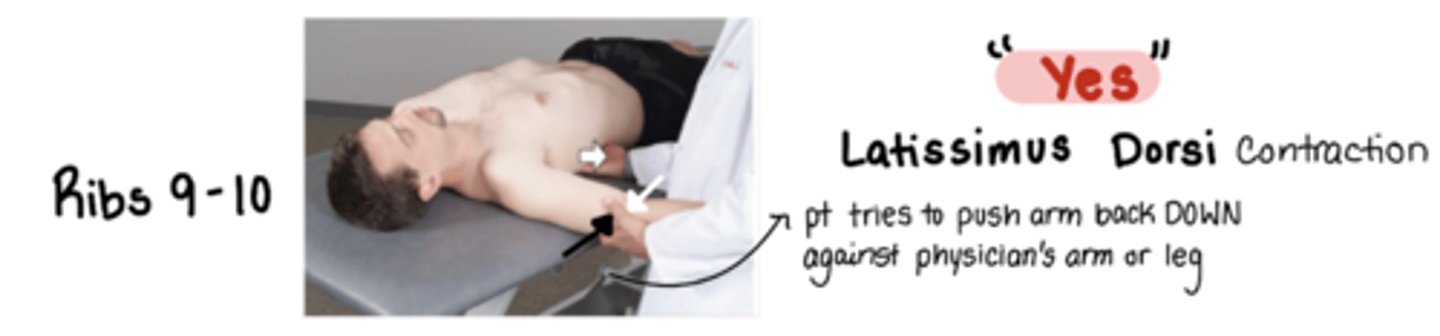
<p>"Yes"</p><p>m: latissimus dorsi </p><p>stand on same side as SD </p><p>pt tries to push arm back DOWN against physician arm/leg</p><p>index and middle finger hook onto posterior and SUPERIOR aspect of the dysfunctional rib pulling rib inferolaterally at the rib angle</p><p>ribs are stuck DOWN</p>
50
New cards

Ribs 11 & 12 Exhalation MET

Sa

*STAND OPPOSITE SIDE

active hand is the one on the ASIS - Pull ASIS caudad, pt resist by trying to pull their hip to shoulder

other hand stabiliizes rib:

hypothenar on INFERIOR aspect of the nondysfunctional rib (rib above the dysfunctional rib)

Sa = move legs to me

(ribs are stuck UP. QL does the work to push rib back down)
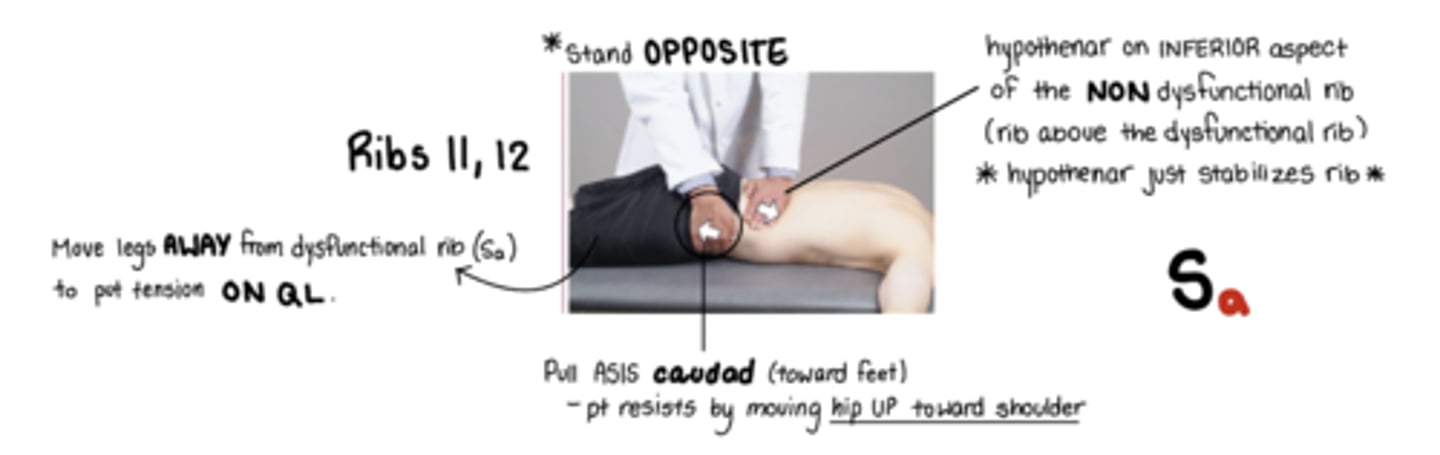
<p>Sa</p><p>*STAND OPPOSITE SIDE</p><p>active hand is the one on the ASIS - Pull ASIS caudad, pt resist by trying to pull their hip to shoulder</p><p>other hand stabiliizes rib:</p><p>hypothenar on INFERIOR aspect of the nondysfunctional rib (rib above the dysfunctional rib)</p><p>Sa = move legs to me</p><p>(ribs are stuck UP. QL does the work to push rib back down)</p>
51
New cards

Lumbar MET Type 1/2 (sitting)

osteopathic hug or pt arm on neck

monitor TP

(same as thoracic sitting MET)
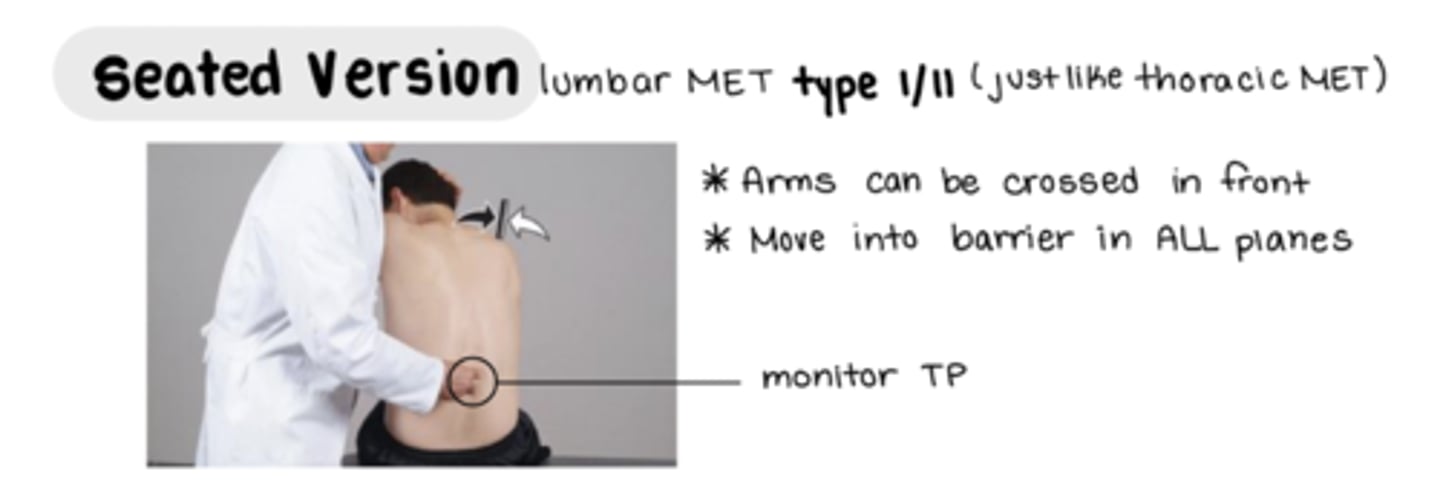
<p>osteopathic hug or pt arm on neck</p><p>monitor TP</p><p>(same as thoracic sitting MET)</p>
52
New cards

Cervical HVLA C2-C7

stand on SAME side of dysfunctional rotation component

MCP of index finger POSTERIOR to articular pillar of dysfunctional segment

**must lock out
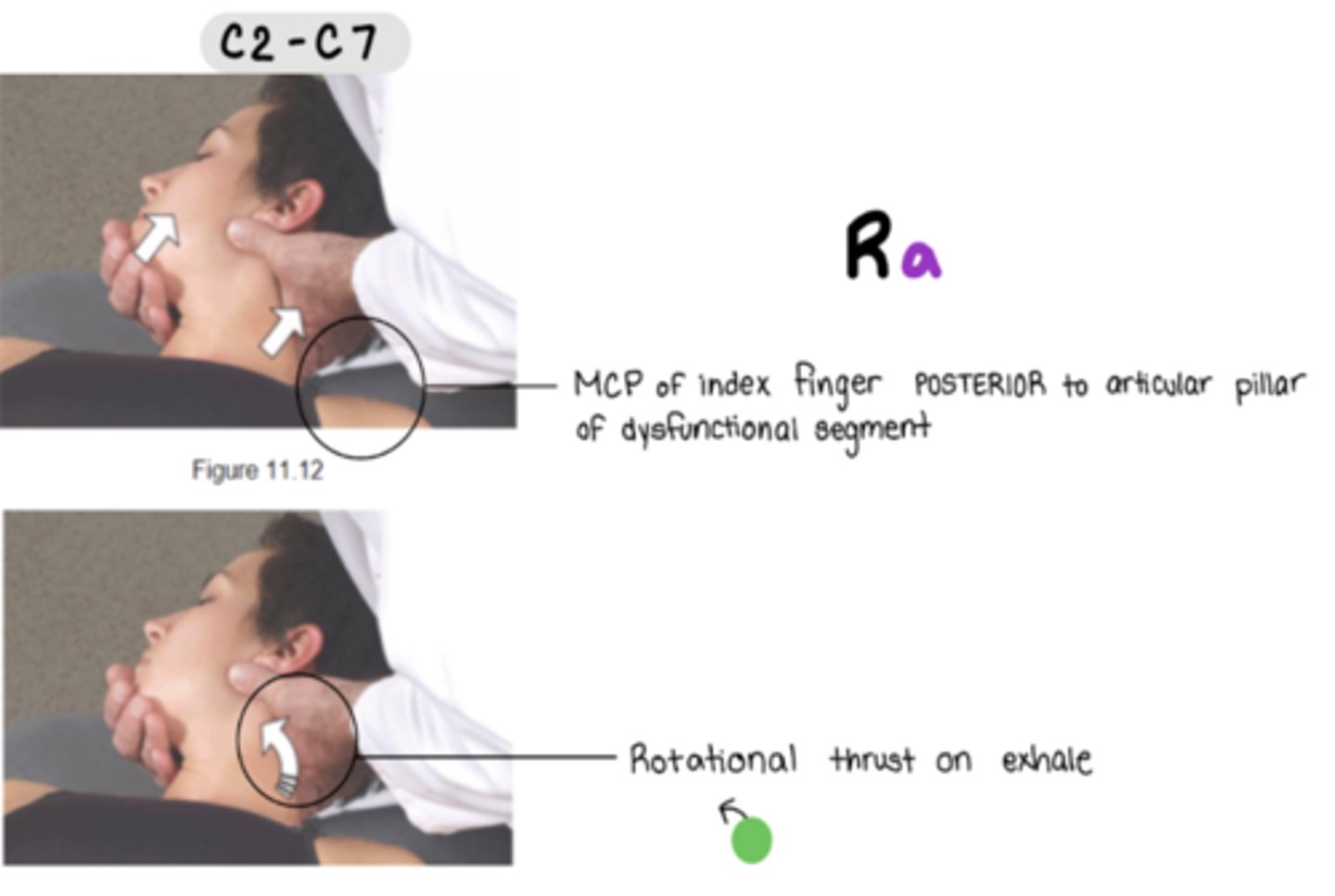
<p>stand on SAME side of dysfunctional rotation component</p><p>MCP of index finger POSTERIOR to articular pillar of dysfunctional segment</p><p>**must lock out</p>
53
New cards

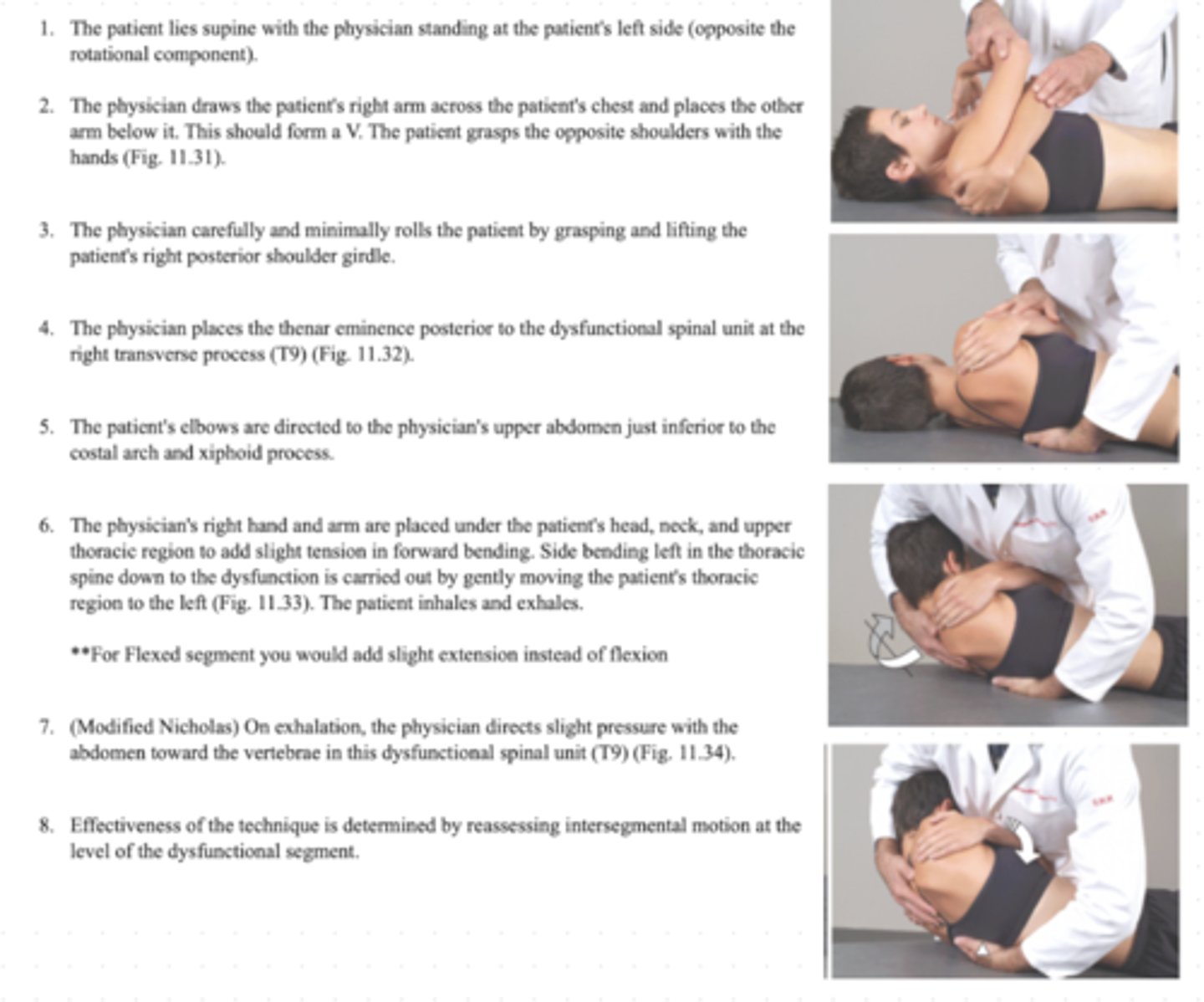
Thoracic HVLA Type 1 SD

pt supine, arms FAR/NEAR

physician stands on OPPOSITE side of the rotation component, pt faces toward you

place THENAR EMINENCE posterior to the rotated TP

Sidebend pt INTO barrier by moving elbow down

thrust @ end of pt exhale

*ensure thrust vector localizes to target spinal level
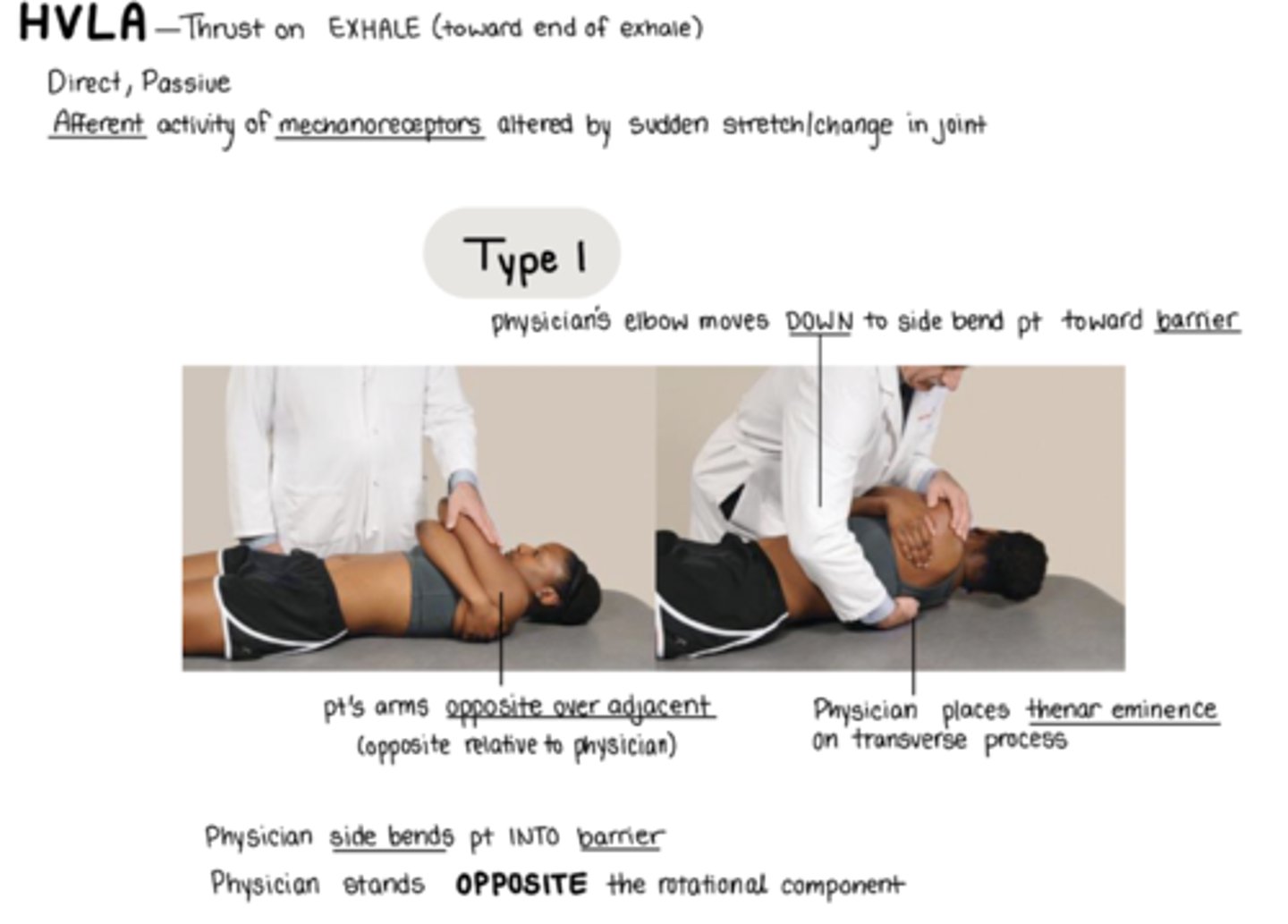
<p>pt supine, arms FAR/NEAR</p><p>physician stands on OPPOSITE side of the rotation component, pt faces toward you</p><p>place THENAR EMINENCE posterior to the rotated TP</p><p>Sidebend pt INTO barrier by moving elbow down</p><p>thrust @ end of pt exhale</p><p>*ensure thrust vector localizes to target spinal level</p>
54
New cards

Thoracic HVLA Type 2 SD

pt supine, arms FAR/NEAR

stand on OPPOSITE side of rotational component

place THENAR EMINENCE posterior to the rotated TP

Sidebend pt INTO barrier by moving elbow UP

slight F/E

thrust @ end of pt exhale

*ensure thrust vector localizes to target spinal level
<p>pt supine, arms FAR/NEAR</p><p>stand on OPPOSITE side of rotational component</p><p>place THENAR EMINENCE posterior to the rotated TP</p><p>Sidebend pt INTO barrier by moving elbow UP</p><p>slight F/E</p><p>thrust @ end of pt exhale</p><p>*ensure thrust vector localizes to target spinal level</p>
55
New cards

Rib 1,2 HVLA Exhalation SD

Ra St

Pt is SEATED

Physicians leg OPPOSITE of the SD on table to stabilize

one hand on pt head, forearm against head for stabilization

Thrust:

MCP of index finger on POSTERIOR aspect of dysfunctional rib - thrust @ end of exhalation
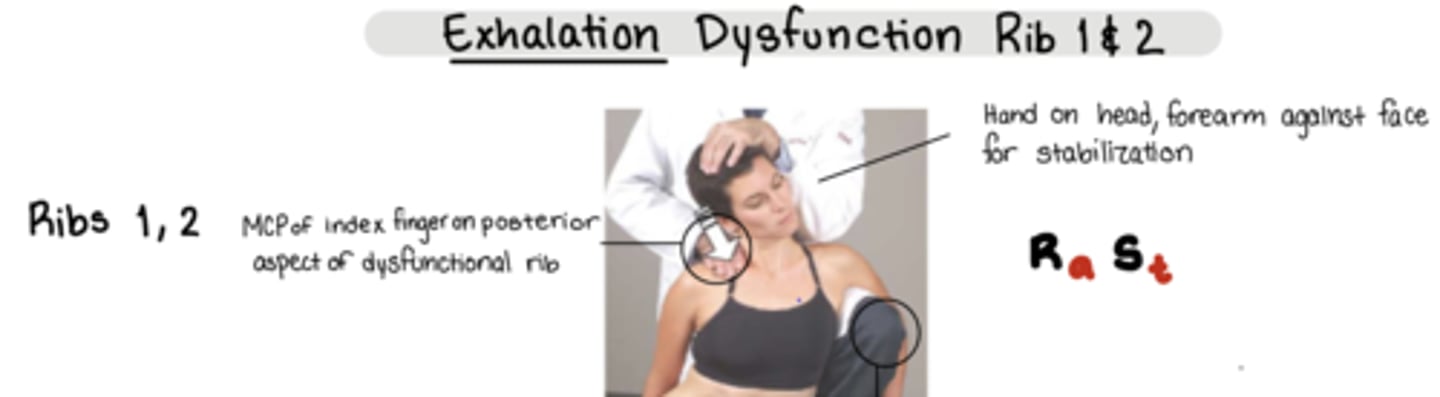
<p>Ra St</p><p>Pt is SEATED</p><p>Physicians leg OPPOSITE of the SD on table to stabilize</p><p>one hand on pt head, forearm against head for stabilization</p><p>Thrust:</p><p>MCP of index finger on POSTERIOR aspect of dysfunctional rib - thrust @ end of exhalation</p>
56
New cards

Ribs 3-10 HVLA Exhalation SD

pt supine, arms FAR/NEAR

stand on OPPOSITE side of dysfunctional rib

thenar eminence on inferior angle of rib angle to push rib back UP

ribs stuck DOWN

(basically thoracic HVLA other than hand placement)
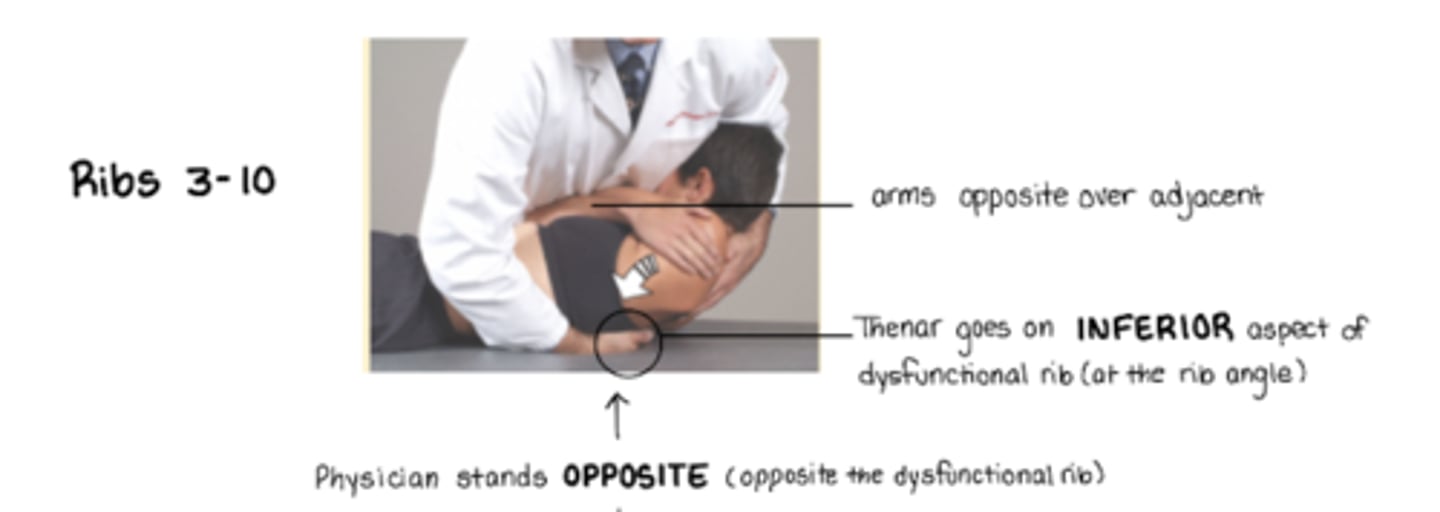
<p>pt supine, arms FAR/NEAR</p><p>stand on OPPOSITE side of dysfunctional rib</p><p>thenar eminence on inferior angle of rib angle to push rib back UP</p><p>ribs stuck DOWN</p><p>(basically thoracic HVLA other than hand placement)</p>
57
New cards

Ribs 11,12 HVLA Exhalation SD

Sa = legs away from dysfunctional rib

stand OPPOSITE of dysfunctional rib

active hand: hand pulls UP on ASIS to push rib back down

other hand: hypothenar eminence on inferior aspect of rib ABOVE dysfunctional rib to stabilize rib

ribs stuck UP
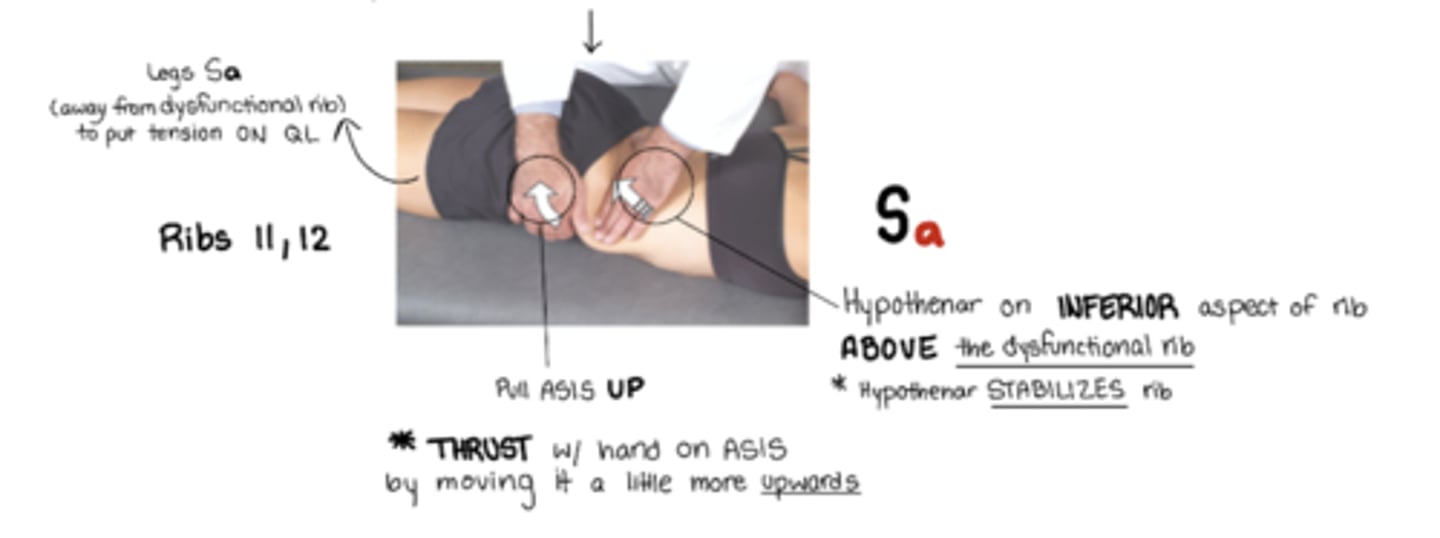
<p>Sa = legs away from dysfunctional rib</p><p>stand OPPOSITE of dysfunctional rib</p><p>active hand: hand pulls UP on ASIS to push rib back down</p><p>other hand: hypothenar eminence on inferior aspect of rib ABOVE dysfunctional rib to stabilize rib</p><p>ribs stuck UP</p>
58
New cards

Ribs 3-10 HVLA Inhalation SD

pt arms FAR/NEAR

stand on OPPOSITE side of dysfunctional rib

thenar eminence on superior angle of dysfunctional rib at the rib angle

ribs stuck UP

(basically thoracic HVLA other than hand placement)
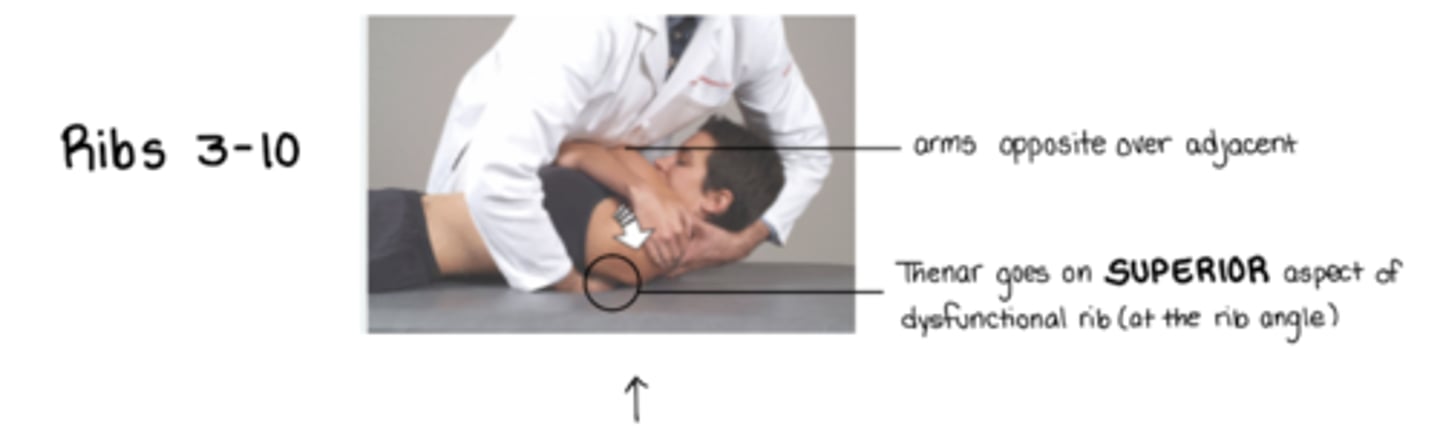
<p>pt arms FAR/NEAR</p><p>stand on OPPOSITE side of dysfunctional rib </p><p>thenar eminence on superior angle of dysfunctional rib at the rib angle</p><p>ribs stuck UP</p><p>(basically thoracic HVLA other than hand placement)</p>
59
New cards

Ribs 11,12 HVLA Inhalation SD

St = legs away from me

standing OPPOSITE side of dysfunctional rib

hypothenar eminence on inferior aspect of dysfunctional rib - to push rib back UP

(other hand stabilizes on ASIS)

ribs stuck DOWN
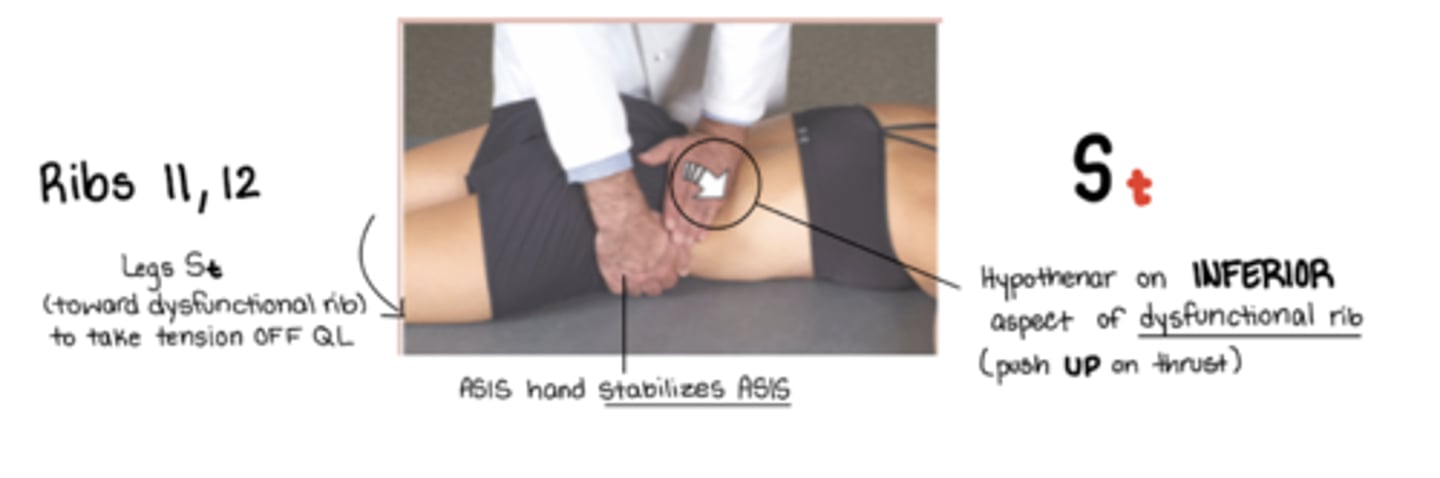
<p>St = legs away from me</p><p>standing OPPOSITE side of dysfunctional rib</p><p>hypothenar eminence on inferior aspect of dysfunctional rib - to push rib back UP</p><p>(other hand stabilizes on ASIS)</p><p>ribs stuck DOWN</p>
60
New cards

Lumbar HVLA Type 1 SD

Pt lays on SAME side as rotational component of dysfunction

pt lying facing physician

flex to localize to SP of dysfunctional segment AND level below it - monitor both levels throughout set up

*flex just enough so that the dysfunctional segment is in the neutral position

arm closest to table is pulled TOWARD physician to engage ROTATIONAL BARRIER (have pt hold your shoulder to pull them)

pt grabs their elbows, physician loops cephalad arm through (this is the arm monitoring @ SP), brace forearm against ribcage

caudad forearm placed over greater trochanter

top leg drops down off table, cepahald to the bottom leg now

THRUST: OUT and rotate

SB: arms come apart horizontally - caudad forearm moves DOWN, cephalad forearm moves UP to resist torso from moving down

ROTATION: arms come apart PERPENDICULARLY - moving pelvis toward physician with caudad arm, cephalad forearm moves torso slightly forward (AWAY)
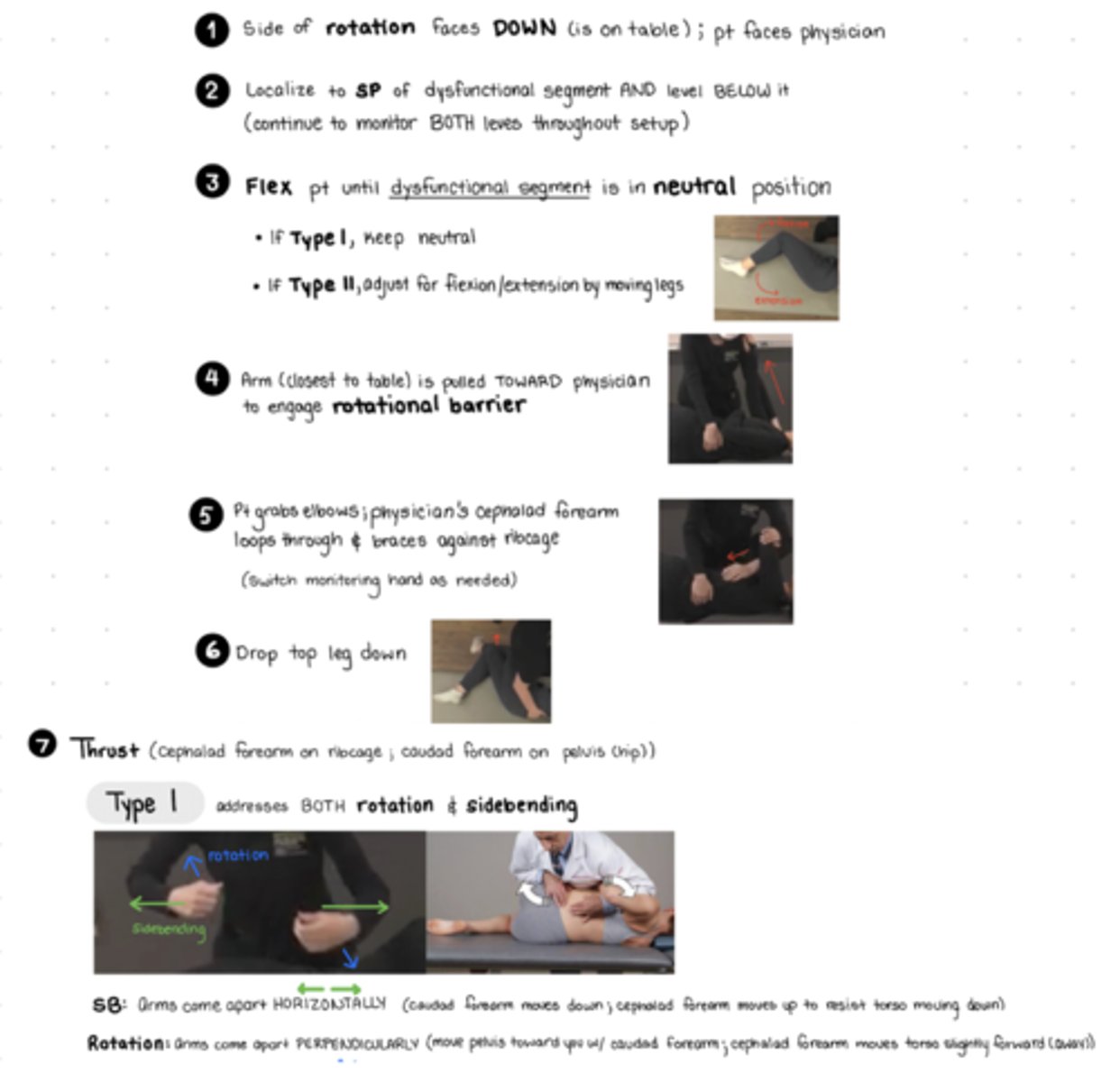
<p>Pt lays on SAME side as rotational component of dysfunction</p><p>pt lying facing physician</p><p>flex to localize to SP of dysfunctional segment AND level below it - monitor both levels throughout set up</p><p>*flex just enough so that the dysfunctional segment is in the neutral position</p><p>arm closest to table is pulled TOWARD physician to engage ROTATIONAL BARRIER (have pt hold your shoulder to pull them)</p><p>pt grabs their elbows, physician loops cephalad arm through (this is the arm monitoring @ SP), brace forearm against ribcage</p><p>caudad forearm placed over greater trochanter </p><p>top leg drops down off table, cepahald to the bottom leg now</p><p>THRUST: OUT and rotate</p><p>SB: arms come apart horizontally - caudad forearm moves DOWN, cephalad forearm moves UP to resist torso from moving down</p><p>ROTATION: arms come apart PERPENDICULARLY - moving pelvis toward physician with caudad arm, cephalad forearm moves torso slightly forward (AWAY)</p>
61
New cards

Lumbar HVLA Type 2 Flexion SD

Pt lays on SAME side as rotational component of dysfunction

pt lying facing physician

flex to localize to SP of dysfunctional segment AND level below it - monitor both levels throughout set up

*flex just enough so that the dysfunctional segment is in the neutral position -

arm closest to table is pulled TOWARD physician to engage ROTATIONAL BARRIER (have pt hold your shoulder to pull them

pt grabs their elbows, physician loops cephalad arm through (this is the arm monitoring @ SP), brace forearm against ribcage

caudad forearm placed over greater trochanter

have pt straighten bottom leg to induce EXTENSION, top leg drops down off table, cepahald to the bottom leg now

THRUST: IN and rotate

SB: arms come TOGETHER horizontally

Rotation: ROTATION: arms come apart PERPENDICULARLY - moving pelvis toward physician with caudad arm, cephalad forearm moves torso slightly forward (AWAY)
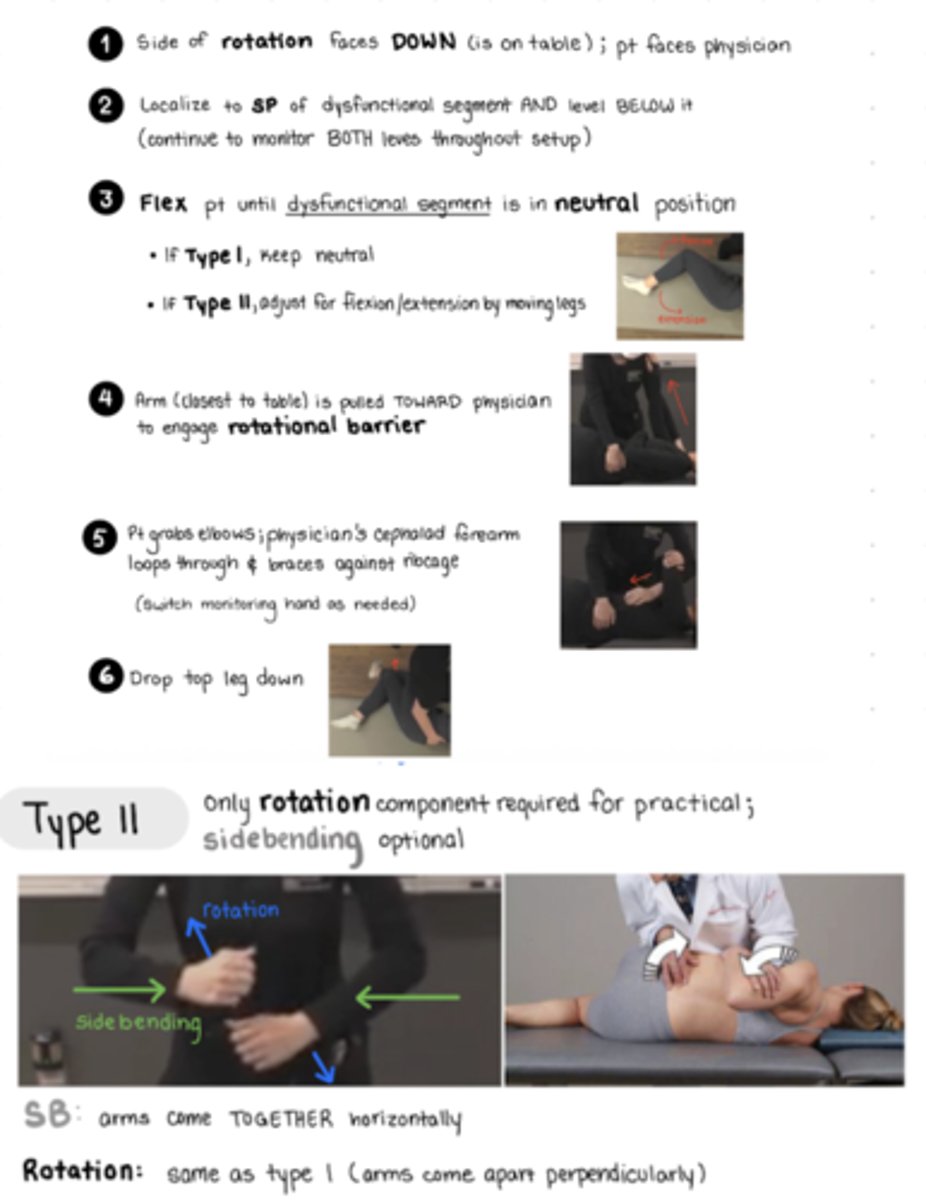
<p>Pt lays on SAME side as rotational component of dysfunction</p><p>pt lying facing physician</p><p>flex to localize to SP of dysfunctional segment AND level below it - monitor both levels throughout set up</p><p>*flex just enough so that the dysfunctional segment is in the neutral position - </p><p>arm closest to table is pulled TOWARD physician to engage ROTATIONAL BARRIER (have pt hold your shoulder to pull them</p><p>pt grabs their elbows, physician loops cephalad arm through (this is the arm monitoring @ SP), brace forearm against ribcage</p><p>caudad forearm placed over greater trochanter </p><p>have pt straighten bottom leg to induce EXTENSION, top leg drops down off table, cepahald to the bottom leg now</p><p>THRUST: IN and rotate</p><p>SB: arms come TOGETHER horizontally</p><p>Rotation: ROTATION: arms come apart PERPENDICULARLY - moving pelvis toward physician with caudad arm, cephalad forearm moves torso slightly forward (AWAY)</p>
62
New cards

Lumbar HVLA Type 2 Extension SD

Pt lays on SAME side as rotational component of dysfunction

pt lying facing physician

flex to localize to SP of dysfunctional segment AND level below it - monitor both levels throughout set up

*flex just enough so that the dysfunctional segment is in the neutral position -

arm closest to table is pulled TOWARD physician to engage ROTATIONAL BARRIER (have pt hold your shoulder to pull them

pt grabs their elbows, physician loops cephalad arm through (this is the arm monitoring @ SP), brace forearm against ribcage

caudad forearm placed over greater trochanter

flex by pulling legs in until flexion at the level of the dysfunction, bottom leg will stay flexed, top leg drops down off table, cepahald to the bottom leg now

THRUST: IN and rotate

SB: arms come TOGETHER horizontally

Rotation: ROTATION: arms come apart PERPENDICULARLY - moving pelvis toward physician with caudad arm, cephalad forearm moves torso slightly forward (AWAY)
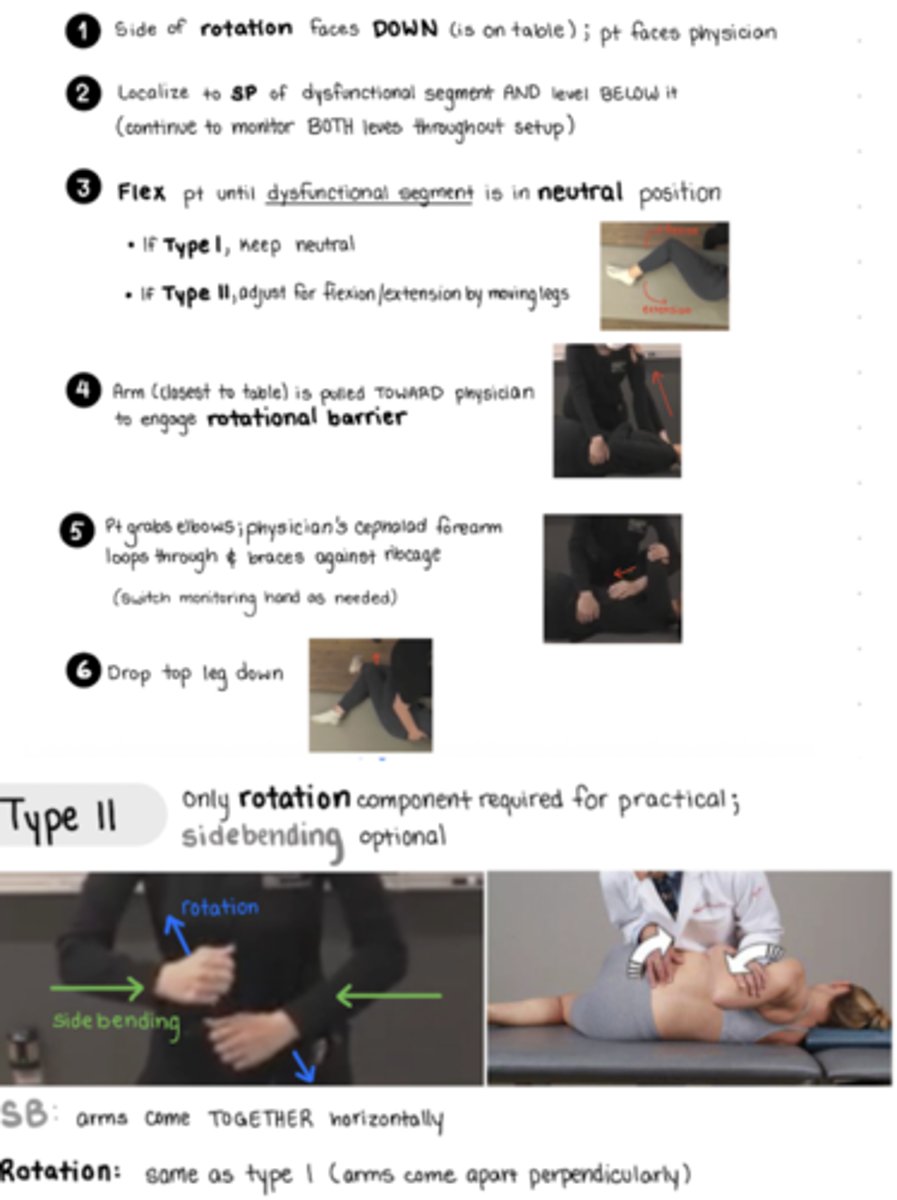
<p>Pt lays on SAME side as rotational component of dysfunction</p><p>pt lying facing physician</p><p>flex to localize to SP of dysfunctional segment AND level below it - monitor both levels throughout set up</p><p>*flex just enough so that the dysfunctional segment is in the neutral position - </p><p>arm closest to table is pulled TOWARD physician to engage ROTATIONAL BARRIER (have pt hold your shoulder to pull them</p><p>pt grabs their elbows, physician loops cephalad arm through (this is the arm monitoring @ SP), brace forearm against ribcage</p><p>caudad forearm placed over greater trochanter </p><p>flex by pulling legs in until flexion at the level of the dysfunction, bottom leg will stay flexed, top leg drops down off table, cepahald to the bottom leg now</p><p>THRUST: IN and rotate</p><p>SB: arms come TOGETHER horizontally</p><p>Rotation: ROTATION: arms come apart PERPENDICULARLY - moving pelvis toward physician with caudad arm, cephalad forearm moves torso slightly forward (AWAY)</p>
63
New cards

Diagnosis of the OA

OA = opposite always (type 1 mechanics) d/t position of the lateral AO ligament

for examination: translate head from left - right and right to left with head in neutral position

dx: determine translation (gives S/R) check with slight flexion/extension

ex: if motion is greater from L to R, freedom is side-bent L and rotated right (restriction in right side-bending), if restriction of lateral translation is MORE signficant in flexion, but goes away in extension, then the segment is extended

64
New cards

Diagnosis of AA

AA = rotation ONLY

you must be standing

1. ensure pt nods head forward to lock out OA joint

2. flex pt next to approx 45 degrees until locking occurs below the AA joint in the rest of the cervical spine

3. slowly rotate head from midline to left and then midline to right

if head rotates more freely to the right the diagnosis is AA Rr

65
New cards

Diagnosis of the typical cervical spine (C2-C7).

C2-C7 follow type 2 mechanics

1. palpate spinous process of segment being evaluated

2. move fingers laterally about 1/2 an inch and anteriorly to palpate articular pillars

3. feel which side appears more posterior to the table

OR push articular pillar gently from left to right and right to left - identify loss of translation

4. check segments in F/E

first branch of left and right subclavian artery enters @ C5-C6 level into the transverse foramen of vertebra

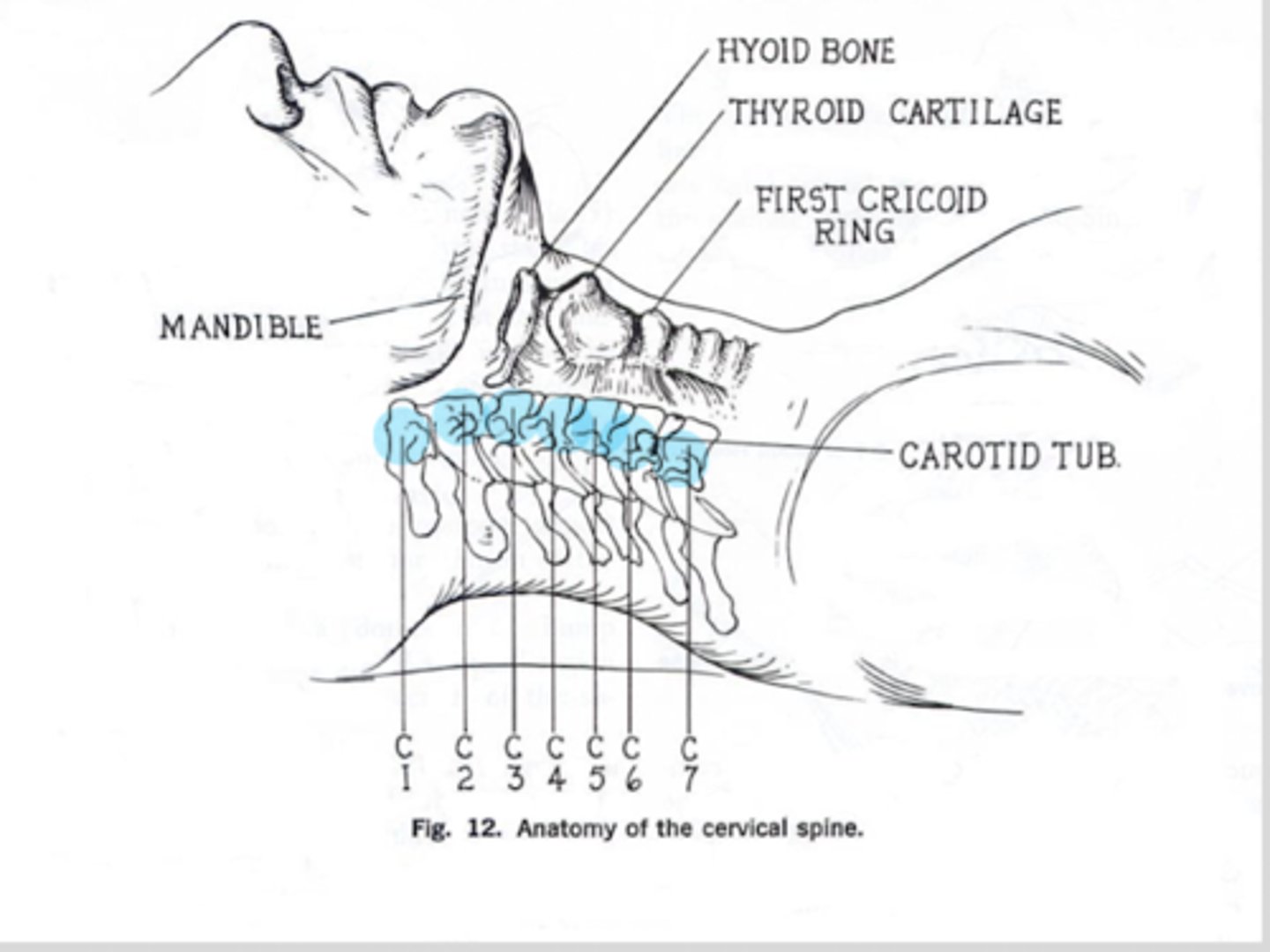
LANDMARKS:

C1: TP located behind ascending ramus of jaw

C2: level of the angle of the mandible

C3: level of hyoid bone

C4: @ superior aspect of thyroid cartilage

C5: @ thyroid cartilage body

C6: @ first cricoid ring or carotid tubercle

C7: vertebral prominens
<p>C2-C7 follow type 2 mechanics</p><p>1. palpate spinous process of segment being evaluated</p><p>2. move fingers laterally about 1/2 an inch and anteriorly to palpate articular pillars</p><p>3. feel which side appears more posterior to the table</p><p>OR push articular pillar gently from left to right and right to left - identify loss of translation</p><p>4. check segments in F/E</p><p>first branch of left and right subclavian artery enters @ C5-C6 level into the transverse foramen of vertebra</p><p>LANDMARKS:</p><p>C1: TP located behind ascending ramus of jaw</p><p>C2: level of the angle of the mandible</p><p>C3: level of hyoid bone</p><p>C4: @ superior aspect of thyroid cartilage</p><p>C5: @ thyroid cartilage body</p><p>C6: @ first cricoid ring or carotid tubercle</p><p>C7: vertebral prominens</p>
66
New cards

Cervical Soft Tissue

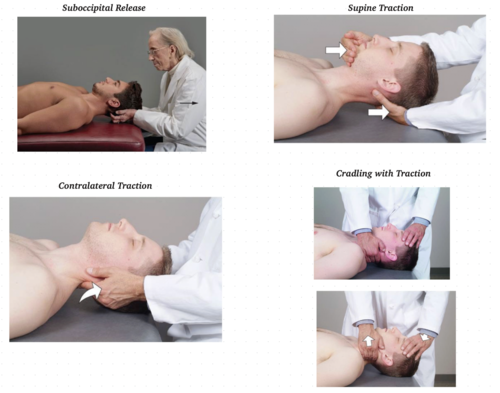
knowt flashcard image
67
New cards

Thoracic Soft Tissue

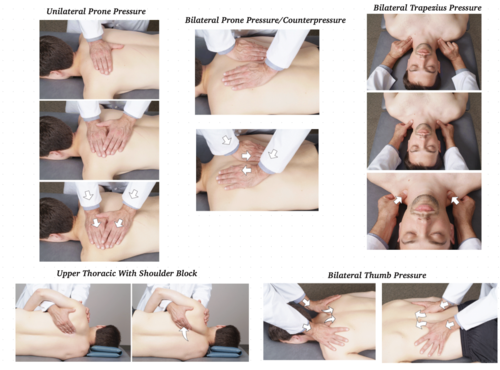
knowt flashcard image
68
New cards

Lumbar Soft Tissue

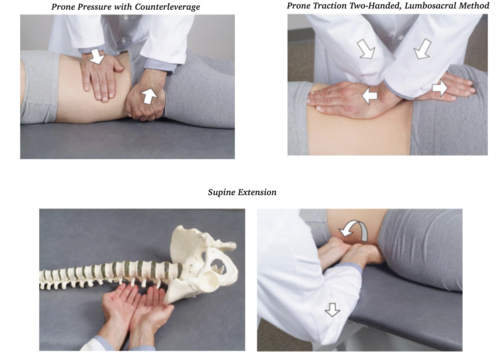
knowt flashcard image