Exam 4 Management
 Call Kai
 Learn
Learn Practice Test
 Spaced Repetition
 Match
Match Flashcards
 Knowt Play
1/79

Earn XP
Description and Tags
ch11 done, ch 12 done, ch 14
Name | Mastery | Learn | Test | Matching | Spaced | Call with Kai |
|---|
No analytics yet
Send a link to your students to track their progress
80 Terms
Leadership Function
Leadership Function - ability to influence others but first to understand them
Introduction to Leading
Leadership
Motivating, directing and otherwise influencing people to work hard to achieve the organizational goals
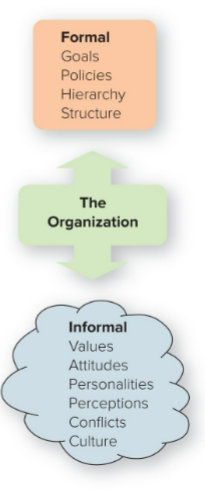
Covers the Informal Aspects of organizational behavior
Skills needed for supervising, motivating individuals and groups
How this changes from being a manager to a leader
Role of Communication in mastering exchange of information
Chapter 11
Managing individual differences and individual behavior
how people go from values to behavior
Why Organizational Behavior Matters
how people fit in org
Managers
Depend on human cooperation
Need to understand employee personality, traits and attitudes
Key to understanding organizational/job behavior
Want to develop and reinforce positive attitudes
Positive, happy people are healthier, more effective and more productive
Individual behavior influences group behavior which influences organizational behavior
Manager’s job to influence employees to do their best
Yet, individual differ when it comes to personality, values, attitudes and perception
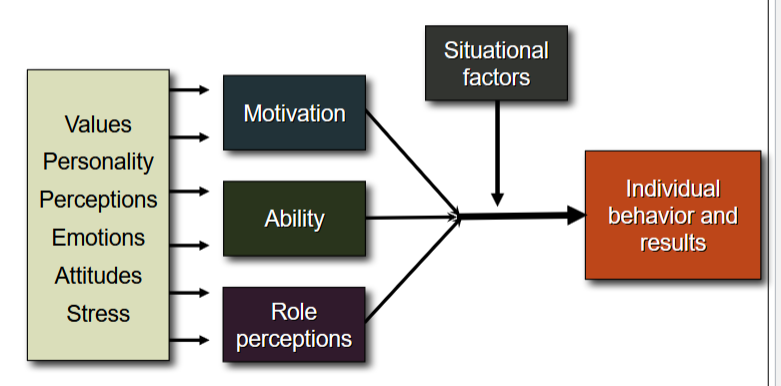
Model of Individual Behavior
the charcateristics have an impact on motivation, ability and role perceptions which come together to drive behavior
Personality and Individual Behavior
First, need to understand the role of personality in driving individual behavior
Influences how people perceive and act within the organization
Personality
Stable psychological traits and behavioral attributes that give a person his or her identity
Relatively enduring pattern of thoughts, emotions, and behaviors that characterize a person, along with the psychological processes behind those characteristics with how you process things
crytsallizes in early to mid 20s
the big 5 personality dimensions
core self-evaluations
emotional intelligence: understanding your emotions and emotions of others
Big 5 Personality DImensions (OCEAN) — scale
Extroversion - scale
how outgoing, talkative, sociable, and assertive a person is
Agreeableness
how trusting, good-natured, cooperative, and soft- hearted one is
Conscientiousness
how dependable, responsible, achievement-oriented, and persistent one is
Emotional stability
how relaxed, secure, and unworried one is
Openness to experience
how intellectual, imaginative, curious, and broad-minded one is
Charlie Brown Theory of Personality
Snoopy - socialable/extrovert, openness to experience
Charlie - low in emotional stability
kid with teddy - open to experience
girl - low agreeableness
kid with piano - high conscientiousness - persistent
5 Factor Personality and Organizational Behavior
Extroversion
Linked to sales and management performance
Related to social interaction and persuasion
Agreeableness
Effective in jobs requiring cooperation and helpfulness
Conscientiousness and emotional stability
Motivational components of personality
Strongest personality predictors of performance
Openness to experience
Linked to higher creativity and adaptability to change
Emotional Stability
Linked to ability to deal with stress
Core Self-Evaluation
*look at individual level to know what people need to influence or persuade to get work done
Self-efficacy
belief in one’s ability to do a task versus learned helplessness
Therefore, assign jobs to build/enhance people’s perceptions of their self-efficacy
Goal difficulty needs to match individuals perceived self-efficacy
generalized self-efficacy: represents belief in one’s general ability to perform across diff situations
want high self-efficacy
2. Self-esteem
the extent to which people like or dislike themselves, their overall self- evaluation
Therefore, Handle failure differently
low self –esteem sees failure as individual weakness
High self-esteem sees failure as either a learning experience or challenge
3. Locus of control
indicates how much people believe they control their fate through their own efforts
internal - believe you control your own fate
external - believe world drives your outcome
Therefore,
Expect different degrees of structure and compliance for each type
Employ different reward systems for each type
Emotional Stability
The extent to which people feel secure and unworried and to which they are likely to experience negative emotions under pressure
Low levels are prone to anxiety and tend to view the world negatively
High levels tend to show better job performance
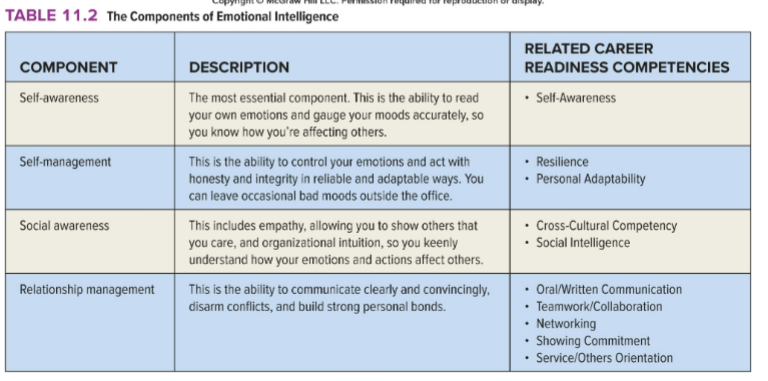
Emotional Intelligence (key personality trait)
ability to cope, empathize with others, and be self- motivated
Why is this key?
Improves social relations, better family and intimate relationships, perceived as being more positive, higher academic achievement and better psychological well-being
4 Components
Self-awareness
Self-Management
Social awareness
Relationship Management
ability to monitor your and other’s feelings and to use this info to guide thinking and actions
to help build EI:
develop awareness of EI level
learn about areas needing improvement
The Components of Emotional Intelligence
Emotional Intelligence - The ability to carry out accurate reasoning about emotions and the ability to use emotions and emotional knowledge to enhance thought.
Classifying Personality Traits
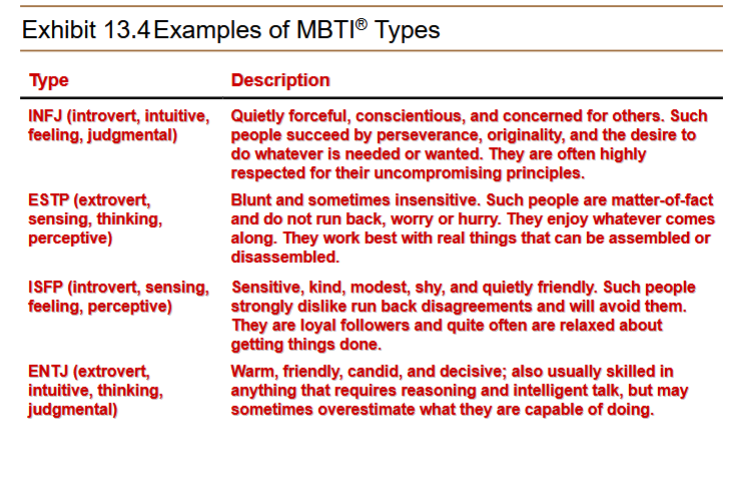
Myers Briggs Type Indicator (MBTI)
A general personality assessment tool that measures the personality of an individual using four categories:
Social interaction: Extrovert or Introvert (E or I)
Preference for gathering data: Sensing or Intuitive (S or N)
Preference for decision making: Feeling or Thinking (F or T)
Style of decision making: Perceptive or Judgmental (P or J)
Personality Types in Different Cultures
The Big Five model is used in cross-cultural studies
Differences are found in the emphasis of dimensions
No common personality types for a given country
A country’s culture influences the dominant personality characteristics of its people
Global managers need to understand personality trait differences from the perspective of each culture
Values, Attitudes, and Behavior
Organizational behavior (OB)
Dedicated to better understanding and managing people at work
Tries to help managers explain and predict work behavior, so they can better lead and motivate their employees to perform productively
focuses on individual and group behavior
Values
Abstract ideals that guide one’s thinking and behavior across all situations, how you perceive world, think about yourself
Attitude
A learned predisposition toward a given object
Directly influence our behavior
tend to mimic attitudes of role models when young
experiences may affect/change
Attitudes and Individual Behavior
Individual Values and Attitudes affect Individual’s behavior
Attitudes
Predisposition (feeling or belief) towards a given object (people, events, etc.)
As such, they are influenced by values and by personality
3 Components
Affective
I feel – feelings or emotions about a situation
Cognitive
I believe – beliefs and knowledge about a situation
Behavioral
I intend – intends or expects to behave towards a situatio
Components of Attitudes
how do you feel and think about job
job satisfaction - correlated with productivity and work
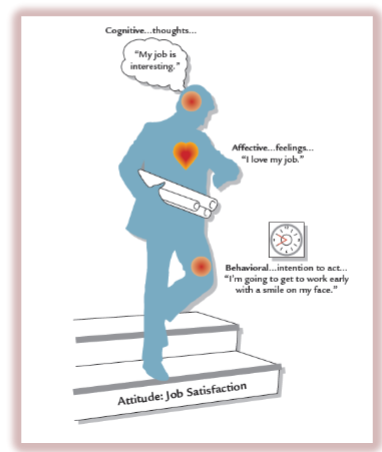
Behavior: how values and attitudes affect people’s actions and judgments
Values (global) and attitudes (specific) are generally in harmony, but not always.
A manager may put a positive value on helpful behavior (global) yet may have a negative attitude toward helping an unethical co-worker (specific).
Values and attitudes influence people’s workplace behavior— their actions and judgments.
Attitudes and Individual Behavior
Cognitive Dissonance
the psychological discomfort a person experiences between his or her cognitive attitude and incompatible behavior
ex. law abiding citizen jaywalk
How do people tend to deal with dissonance?
Depends on level of importance, control, rewards
Ways to reduce dissonance
Change attitude/behavior
Belittle importance of inconsistent behavior
Weight the consonant elements over the dissonant
Perception Challenges: What do you see
lady, knight on horse

Perception and Individual behavior
Perception
process of interpreting and understanding one’s environment
4 Steps in the Perceptual Process
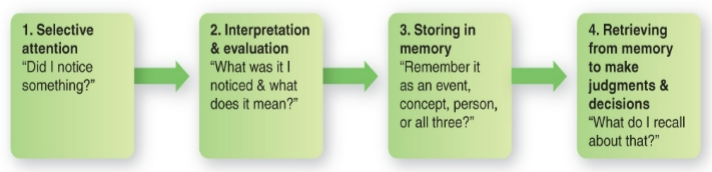
Common Distortions in Perception
Implicit Bias
attitudes or belief that affect our understanding, actions, and decisions in an unconscious manner —- not even aware of what biases are
Stereotyping
tendency to attribute to an individual the characteristics one believes are typical of the group to which that individual belongs
sex-role, age, race/ethnicity, height, religion
Halo effect
forming an impression of an individual based on a single trait (ex. blondes dumb)
Recency effect
tendency to remember recent info better than earlier info
Causal attributions
activity of inferring causes for observed beahviors
fundamnetal, self-serving bias
explicit bias: attitudes or beliefs that affect our understanding, actions, and decisions in a conscious manner
fundamental attribution bias: attribute others’ behaviors and outcomes to their personal characteristics rather than to environmental influences
self serving bias: tend to take more personal responsibility for our successes than for our failures
Stereotyping
A generalization we make about a person because they belong to one or more specific identity groups.
People may hold stereotypes about us because of our gender identity, race, religion, or age, or because of a combination of these or other identities.
Some statistics stereotypes in workplace.
Most U.S working believe that racial bias is a problem in hiring decisions and performance.
Survey respondents continue to rate men more qualified for leadership positions.
Nearly 40% of hiring managers admitted to age bias.
Implicit bias
The attitudes or beliefs that affect our understanding, actions, and decisions in an unconscious manner..
Consider the following research regarding implicit racial bias:
White applicants get around 50% more call-backs than Black applicants with the same résumé.
College professors are 26% more likely to respond to a student e-mail when signed by Brad (typical white name) rather than Lamar (typical African American name).
Physicians recommend less pain medications for Black patients than white patients when addressing the same injury.
Explicit bias
The attitudes or beliefs that affect our understanding, actions, and decisions in a conscious manner.
halo effect
we form an impression of an individual based on a single trait
halo (positive), horn (negative)
recency effect
The tendency to remember recent information better than earlier information,
perhaps because when you activate your recall, more recent events are still
present in your working memory.
Causal attribution
The activity of inferring causes for observed behavior. Rightly or wrongly, we constantly formulate cause-and-effect explanations for our own and others’ behavior.
Two attributional biases:
Fundamental attribution bias.
Self-serving bias.
Implications for Managers
Self-fulfilling prophecy
Also known as Pygmalion effect.
Is a phenomenon by which people’s expectations of themselves or others lead them to behave in ways that make those expectations come true.
Employees react to perceptions
Reaction will vary based on the Individual
Pay close attention to how employees perceive their jobs and management actions
Managerial expectations powerfully influence employee behavior and performance.
employees tend to rise to the level of managers expectations
Work related attitudes and individual behavior
Attitudes drive behavior
Manager’s need to concerned with 3 key areas
Engagement
an individual’s involvement, satisfaction, and enthusiasm for work
Mental state where a person is full immersed in the activity
Satisfaction
extent to which you feel positively or negatively about various aspects of your work, focus
Commitment
reflects the extent to which an employee identifies with an organization and is committed to its goals
Strong positive relationship between organizational commitment and job satisfaction
Employee engagement: how connected are you to your work?
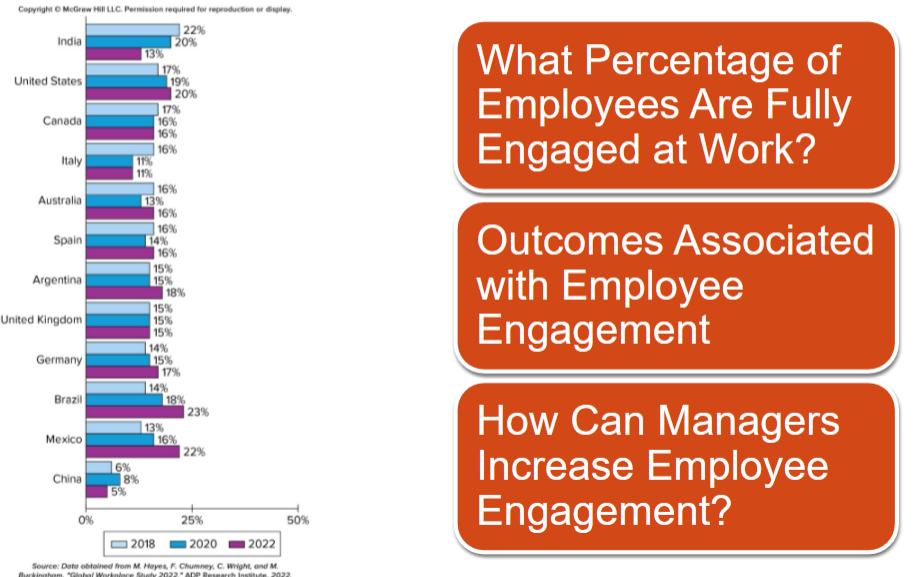
Outcomes associated with employee engagement
To increase employee engagement: design meaningful work, improve supervisor-employee relations, provide learning and development opportunitues, and reduce stressors
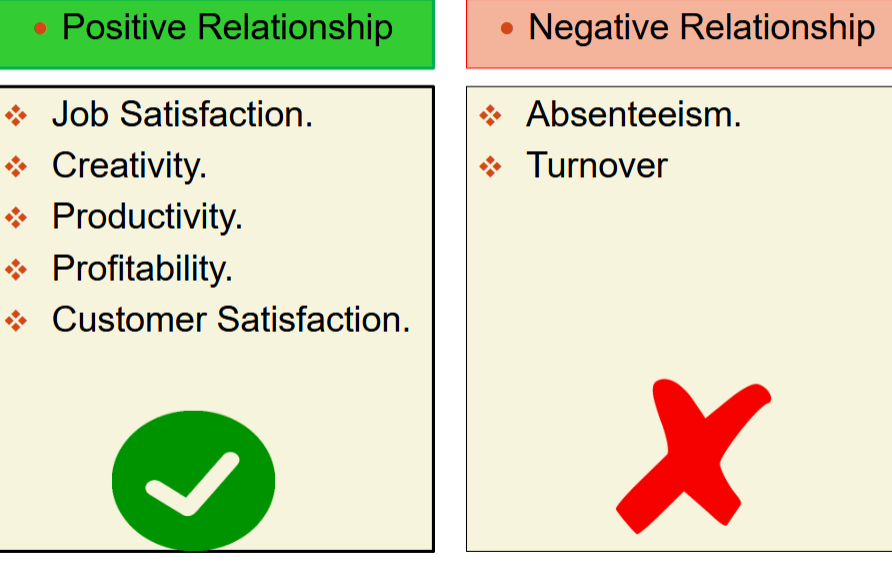
Key employee enaggement factors
what drives engagement varies across world
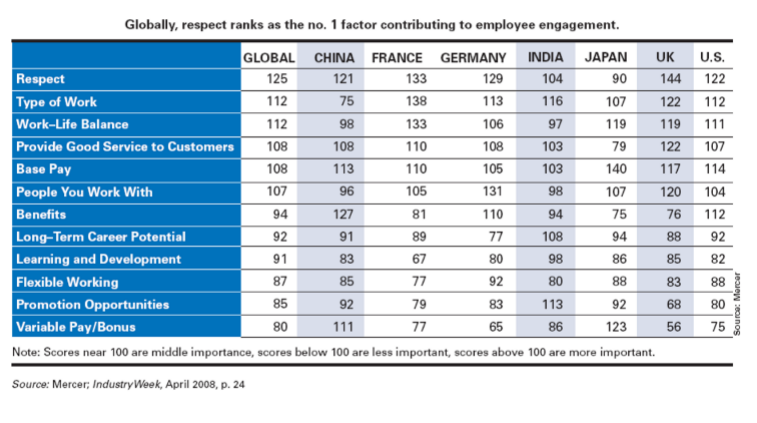
Job satisfaction: how much do you like or dislike your job
Job Satisfaction:
The extent to which you feel positive or negative about various aspects of your work.
Overall satisfaction depends on how they feel about work, pay, promotions, co-workers, and supervision.
Key correlates are stronger motivation, performance, job involvement, organizational commitment, and life satisfaction and less absenteeism, tardiness, turnover, and perceived stress.
Organizational Commitment: How much do you identify with your org?
Organizational Commitment:
The extent to which an employee identifies with an organization and is committed to its goals.
Research shows a significant positive relationship:
Job satisfaction.
Performance.
Turnover.
Organizational citizenship behavior — you go extra yard, outside of job role to enhance experience for those around you
pro social behavior - helpful to others
Important Workplace Behvaiors
Understanding individual differences is key to influencing employees to do their best
Managers are concerned with 3 types of behaviors
Working: Performance & Productivity
Not working: Absenteeism & Turnover
Exceeding work roles: Organizational Citizenship, Prosocial Behavior
Detrimental: Counterproductive behavior (types of behavior that harm employees and org as a whole — ex. absenteeish and tardiness, drug/alcohol abuse, disciplinary problems)
want to know what is causing it
organizational citizenship: employee behaviors that are not directly part of employees job description that exceed their work role requirements
The importance of attitudes
Implication for Managers
Attitudes warn of potential behavioral problems:
Managers should do things that generate the positive attitudes that reduce absenteeism and turnover.
Attitudes influence behaviors of employees:
Managers should focus on helping employees become more productive to increase job satisfaction.
Employees will try to reduce dissonance unless:
Managers identify the external sources of dissonance.
Managers provide rewards compensating for the dissonance.
5 ways to reduce excessive turnover: evaluate fit to org’s values, provide post hiring support, focus on enhancing employee engagement and social netowrks, incorporate reliable and valid selection devices, offer employee benefits
Stress and the Workplace
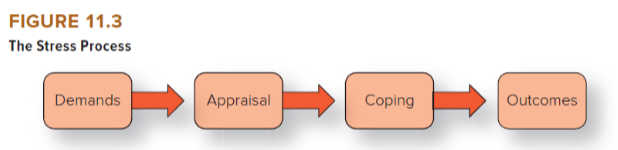
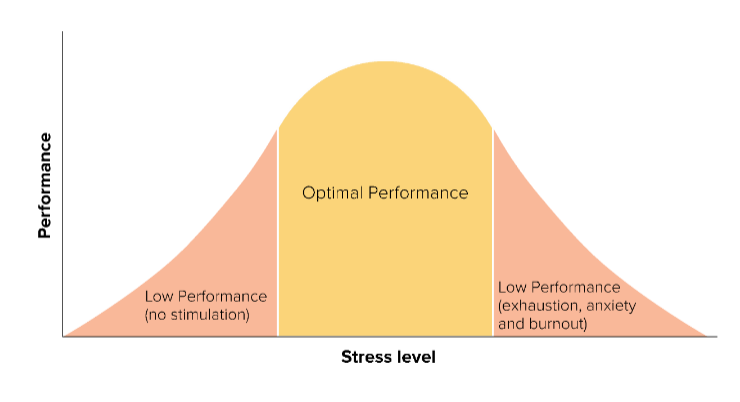
Stress
the tension people feel when they are facing or enduring extraordinary demands, constraints, or opportunities and are uncertain about their ability to handle them effectively
nonspecific response of body to any demand made upon it
Sources of job-related stress
Demands created by individual differences - type A
Individual task demands
Individual role demands - role overload, role conflict, role ambiguity
Group demands,
Organizational demands
Nonwork demands.
Work-family conflict
*demand is anything that you have to exert effort toward taking care of
Symptoms of Stress
Physiological
backaches, headaches, sweaty palms, nausea
Psychological
boredom, irritability, nervousness, anger, anxiety, depression
Behavioral
sleeplessness, changes in eating habits, increased smoking/alcohol/drug abuse
Consequences
Burnout
state of emotional, mental, and even physical exhaustion
exhaustion: lack of energy, feeling depleted, worn out, and debilitated
depersonalization: detaching from one’s job, negative attributes toward work
inefficacy: feeling unable to do job well
feeling “awalys on”
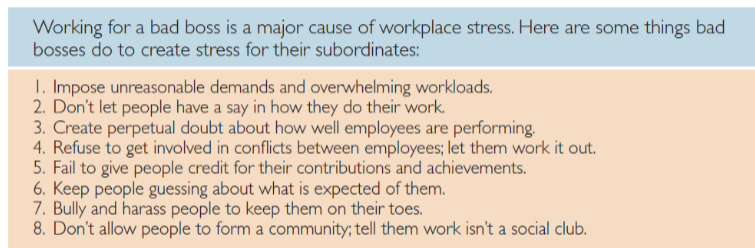
How managers create stress for employees
Reducing stressors in org
Roll out employee assistance programs
Recommend a holistic wellness approach
focus on self-responsibility, nurtritional awareness, relaxation techniques, physical fitness, environmental awareness
Create a supportive environment
Make jobs interesting
Make career counseling available
Build resilience
buffers: chnages that managers make to reduce stressors and improve employee well-being
Innovative responses to stress management
Quiet rooms
Wellness programs
Training programs
Manager intervention
Work/life balance initiatives
What is Motivation and why study it
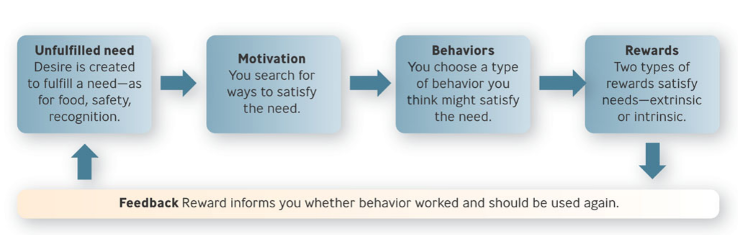
Motivation - the psychological processes of arousal, direction, and persistence of goal-directed behavior
result of multiple personal and contextual factors
force, either intrinsic or extrinsic, to a person that arouse enthusiasm and persistence
intrinsic - study bc value learning, satisfcatio, reward guven to youself
extrinsic - promotion, money, trophy (reward given by others)
you can’t see it or know it in another person but inferred from one’s behavior
Employee motivation affects productivity
a manager’s job is to channel motivation toward the accomplishment of goals
both intrinsic and extrinsic rewards can help tthe manager lead effectively thru motivation
Why is motivation important
You want to motivate people ti:
join ur org
stay with ur org
show up for work at ur org
be engaged while at ur org
do extra for ur org
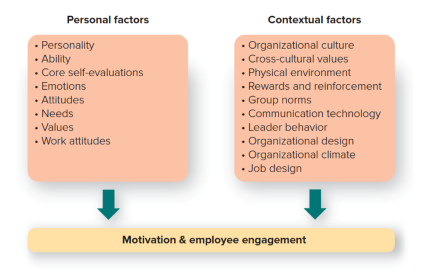
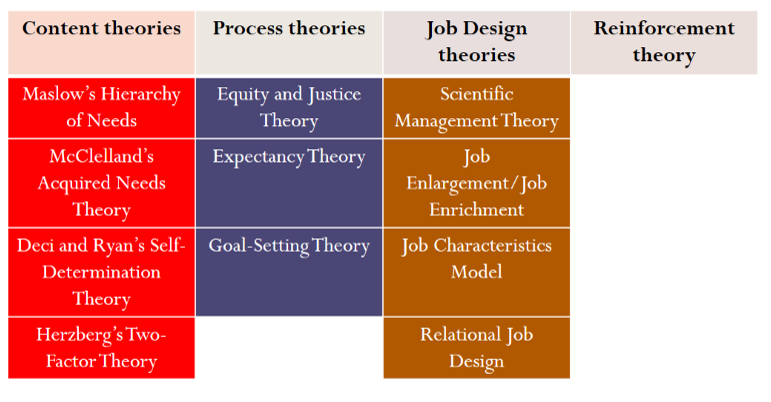
the 4 major perspectives on motivation: an overview
*no single theory that motivates everyone
contingency factor refers to degree to which individuals want personal and pyschological development
Content Perspectives of Motivation
If manager’s understand employee’s needs, they ccan design appropriate reward systems
emphasize needs as motivators
Needs, physiological or psychological, motivate people (Deficiencies that arouse behavior)
Needs translate into an internal drive that motivates behavior
People have a variety of needs
Models
Maslow’s Hierarchy of Needs
Alderfer’s ERG Theory
McClelland’s Acquired Needs Theory
Hertzberg’s Two-Factor Model
self determination theory (competencies, autonomy, relatedness)
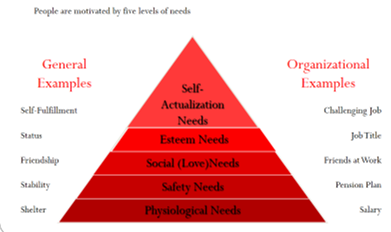
Maslow’s Hierearchy of Needs
basic needs: physiological and safety
psychological: social and esteem
self-fulfillment: self-actualization
Alderfer’s ERG Theory
Assumes 3 basic needs influence behavior
Existence needs – the needs for physical well-being
Relatedness needs – the needs for satisfactory relationships with others
Growth needs – the needs that focus on the development of human potential and the desire for personal growth
Note links to Maslow
Frustration-regression principle: failure to meet a high-order need may cause a regression to an already satisfied lower-order need
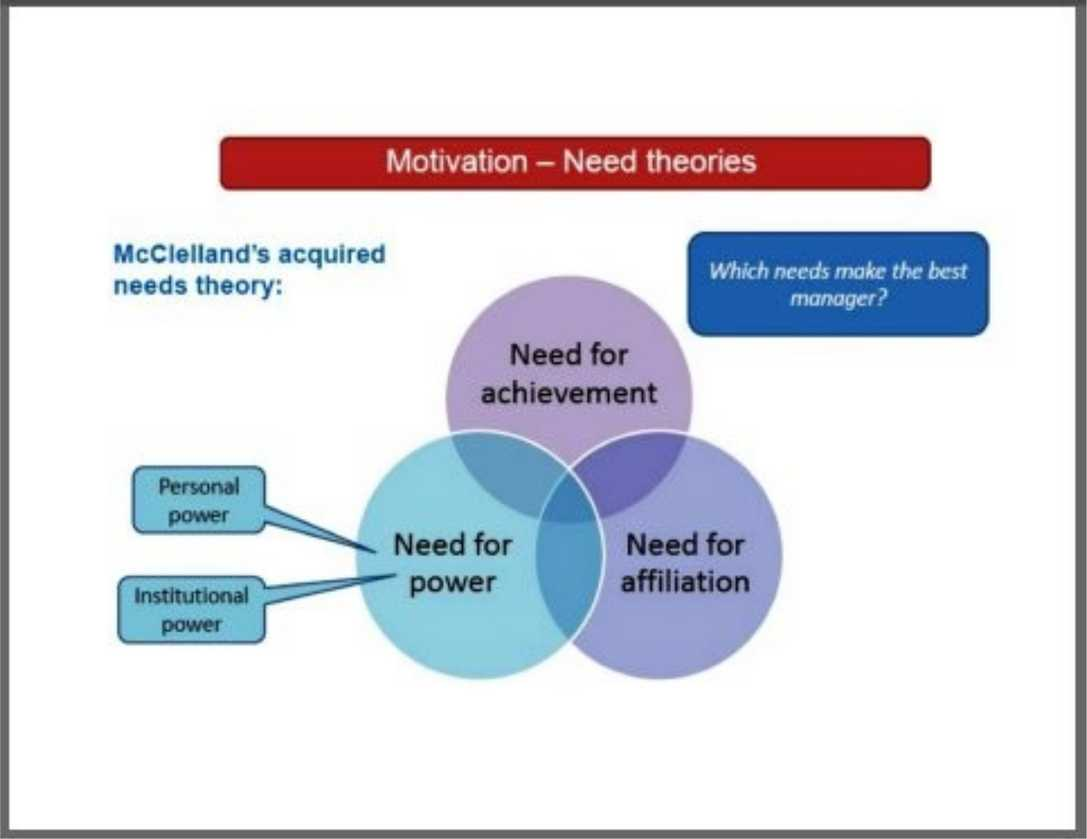
McClelland’s Acquired Needs Theory
Acquired Needs Theory
states that three needs - achievement (desire to excel), affiliation(desire for friendly relations), and power(desire to be responsible for other people) - are major motives determining people’s behavior in the workplace
2 assumptions:
needs are learned
one need often dominates
appeal to prefernces associated with each need
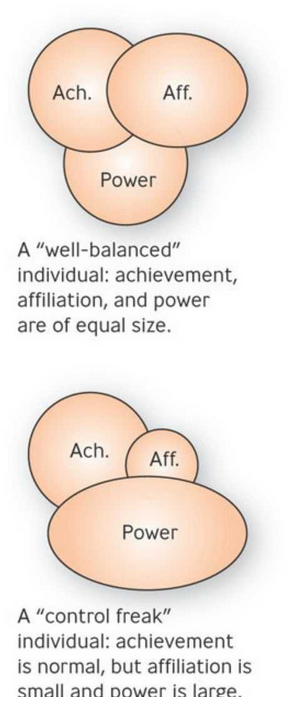
Implications for Managers
using power for institution
Hertzberg’s 2-Factor Theory
Two-Factor Theory
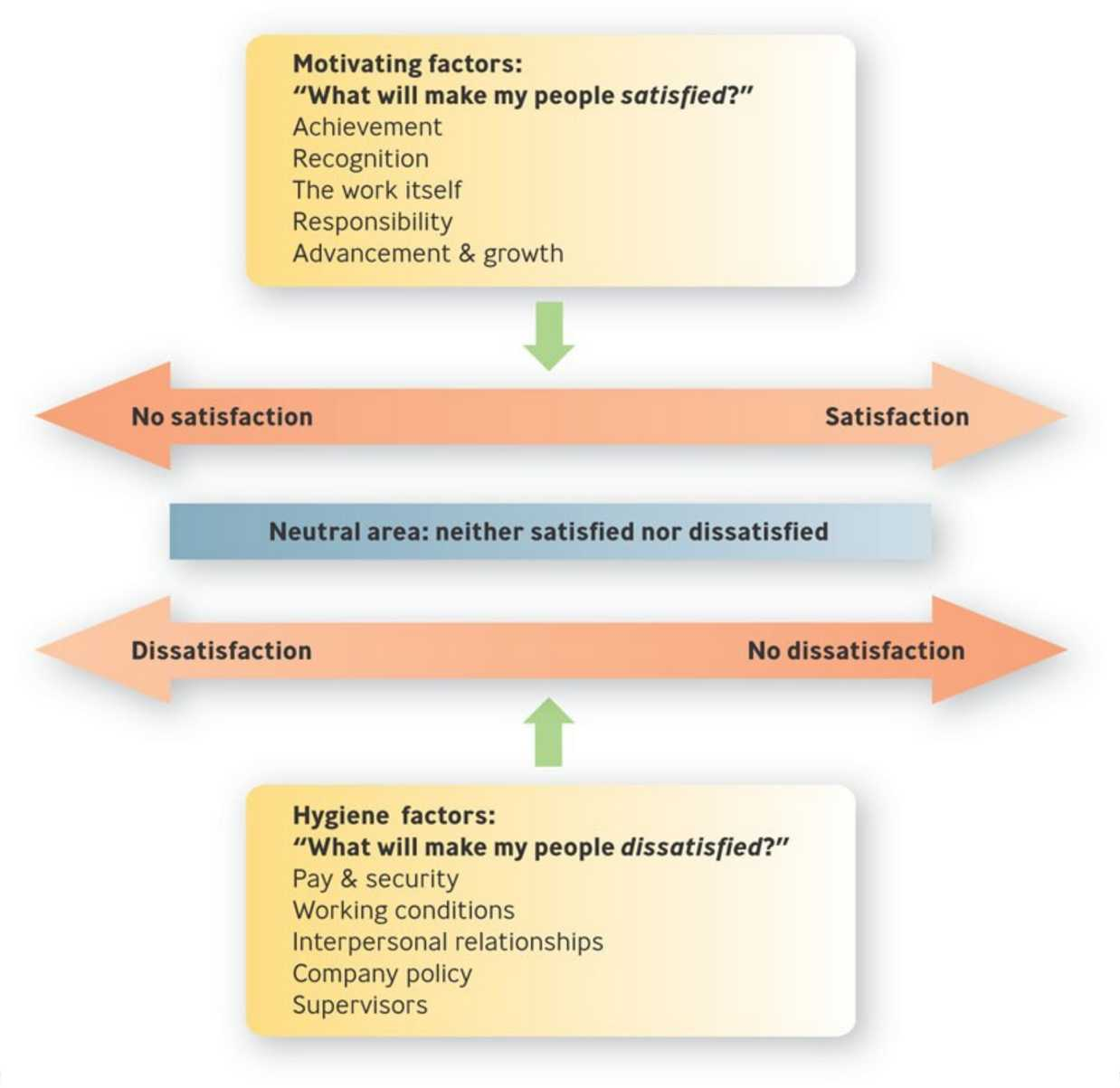
Proposed that work satisfaction and dissatisfaction arise from two different factors –
Motivating Factors
What drives satisfaction?
higher level needs
affect job content or rewards of work performance, job satisfcation
Hygiene factors
What drives dissatisfaction?
lower level needs
affect job context in which people work, job dissatisfaction
Fist eliminate dissatisfaction by making sure hygiene factors such as working conditions, pay levels, and company policies are reasonable
Concentrate on spurring motivation by providing desired opportunities for achievement, recognition, responsibility, and personal growth - motivating factors
Deci and Ryan’s Self Determination Theory
assumes people are driven to try to grow and attain fulfillment, with their behavior and well-being by 3 universal needs:
1. Competence - “I want to feel a sense of mastery”
2. Autonomy - “I want to feel independent and able to influence my environment”
3. Relatedness - “I want to feel connected to other popel”
how you work on these 3 things drive u forward
focus primarily on intrinsic motivation and rewards
longer lasting than extrinsic motivation
has a more positive impact on task performance than extrinsic
Process Perspectives on Motivation
Proposes that is not about NEEDS, it is about the THOUGHT PROCESS behind it by which people select behavioral actions
Equity Theory
Goal-Setting Theory
Expectancy Theory
focus on throughts and perceptions that motivate behavior
try to understand why people have different needs, wjay nehaviors they select to satisfy them and how they decide if their choices were successful
Equity Theory
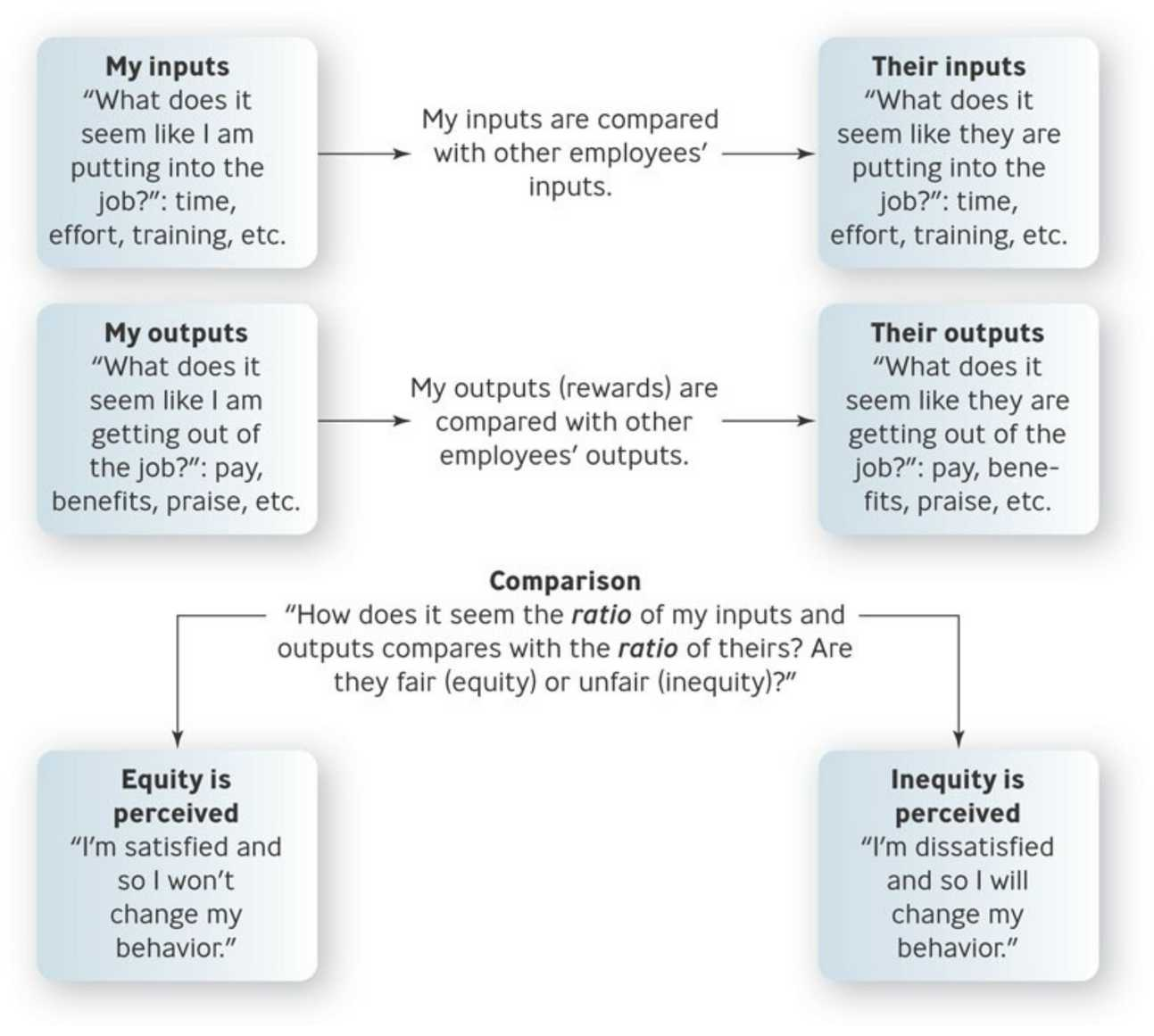
Employees evaluate their treatment relative to the treatment of others
People strive for fairness and justice
Inputs: Employee contributions to their jobs
Outputs: What employees receive in return
The perceived ratio of contribution to return determines perceived equity
based on cognitive dissonance — the psychological discomfort people expereince bvetween their cognitive attitudes and imccompatible behavior
Equity Theory and Motibvation
Individual perceptions of fairness
Perceived inequity can be reduced by:
Changing work effort
Changing outcomes
Changing perception
Leaving the job
Manager’s can affect perceptions
Employee Participation
Appeal Process
Elements of Justice Theory
1. Distributive justice
“How fairly are rewards being given out?”
Procedural justice
“How fair is the process for handing out rewards?”
Interactional justice
“How fairly am I being treated when rewards are given out?”
how you are told matters
org justice: extent to which people perceive they are treated fairly at work and these are the 3 component
Five Practical Lessons from Equity and Justice Theories
Employee perceptions are what count
Employee want a voice in decisions that affect them
Employees should be given an appeals process
Leader behavior matters
climate for justice makes a difference - shared sense of fairness felt by the entire workgroup
perceptions count
Expectancy Theory
Expectancy Theory suggests that people are motivated by two things: (1) how much they want something and (2) how likely they think they are to get it (deciding how much effort to exert in a specific task situation and you will do what you can do when you want ti)
Expectancy
belief that a particular level of effort will lead to a particular level of performance - effort to perofrmnace expectancy
Instrumentality
expectation that successful performance of the task will lead to the desired outcome
Valence
the value a worker assigns to an outcome
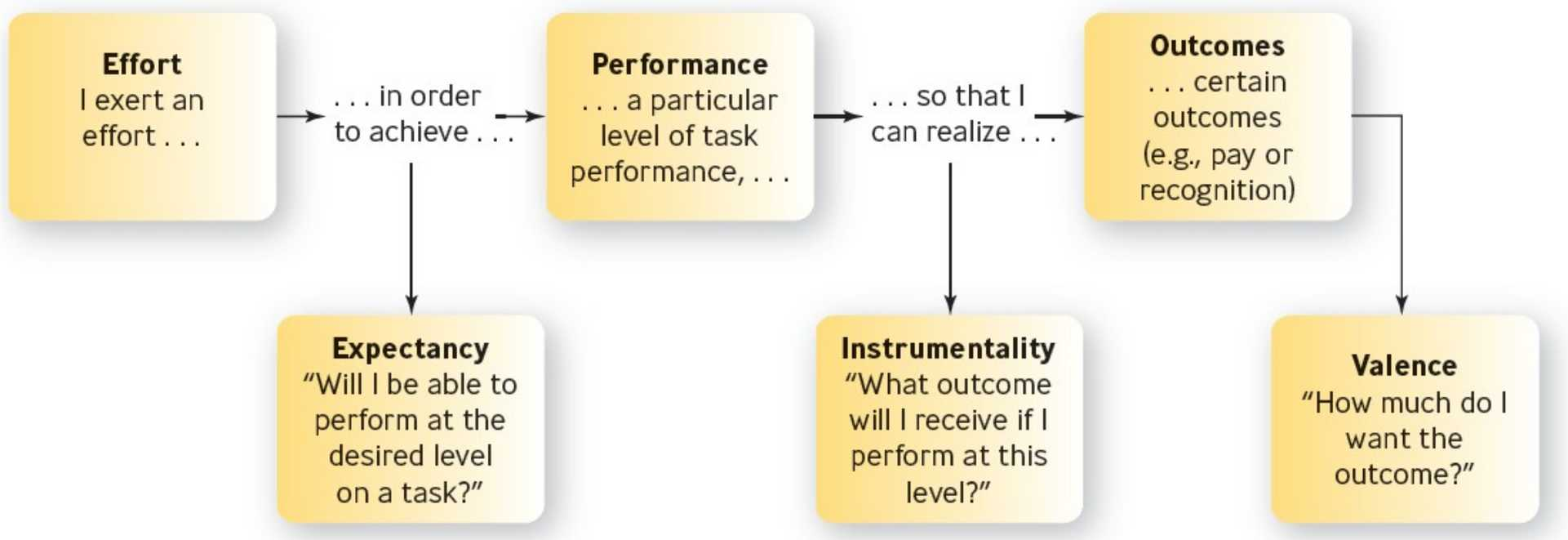
Expectancy Theory and Motivation
Role of Rewards
What do your employee’s value?
Individual and Cultural Differences
Job objectives and performance level
Clear link between the two
Right rewards for the right performance
Goal-Setting Theory
Goal-setting theory
Suggests that employees can be motivated by goals that are specific and challenging but achievable - useful only of people understand, accept and are committed to ones goals
Four motivational mechanisms
Directs your attention
Regulates the effort expended
Increases your persistence
Fosters use of strategic and action plans
Practical considerations of goal-setting theory
Goals should be specific
Certain conditions are necessary for goal-setting to work
Goals should be linked to action plans
Performance feedback and participation in deciding how to achieve goals are necessary but not sufficient for goal-setting to work
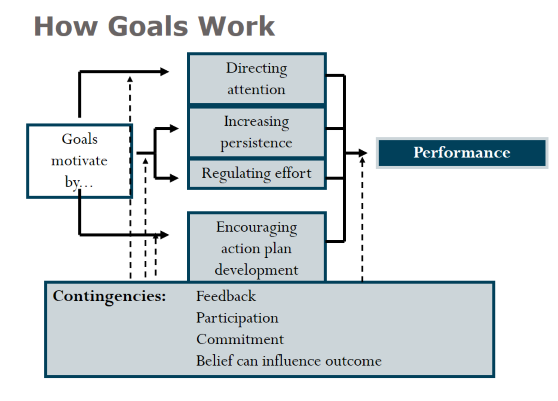
Goal Setting Theories
Goal setting is recognized explicitly or implicitly by virtually every major theory of work motivation
the existence of goals in and of themselves can motivate behavior
people assigned difficult goals tend to perform better than those with moderately difficult to easy goals
the idea behind goal setting theory is that goals motivate people to compare current performance to performance needed to meet goals
better to state a specific goal than to simply urge people to do their best
goal setting has been found to enhance performance about 90 percent of the time
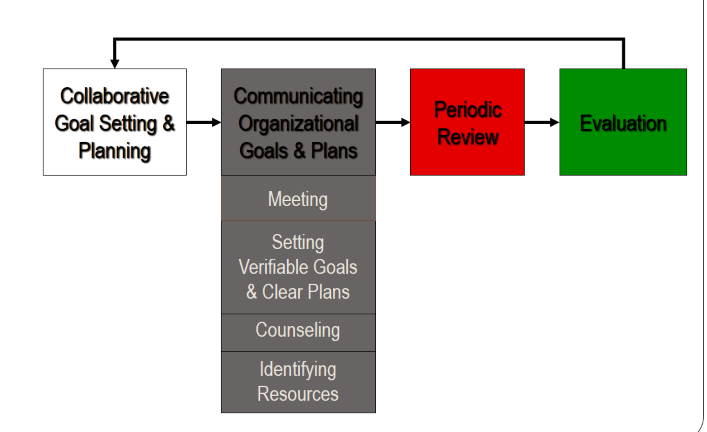
Management by Objectives - Collaborative Goal-setting
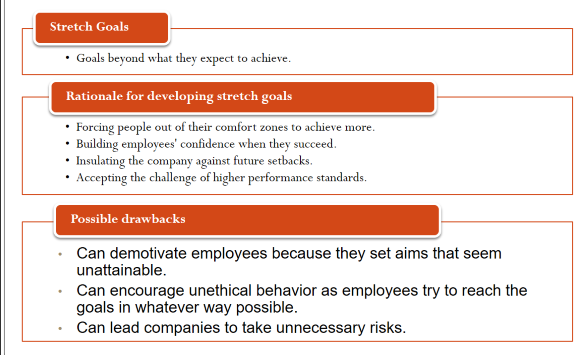
Stretch goals
Job Design Perspectives
Old perspective: adapt people to work
New perspective: adapt work to people
Note this perspective is built upon findings from other perspectives
Job design
Division of an organization’s work among its employees and the application of motivational theories to jobs to increase satisfaction and performance
Job simplification, job enlargement, job enrichment
focus on designing jobs that lead to employee satisfaction and performance
fit jobs to people because
employees are underutilized
employees wanyt more responsibility and challenges and variety
Scientific management is the process of reducing the number of tasks a worker performs, raise employee production, increase employee efficiency
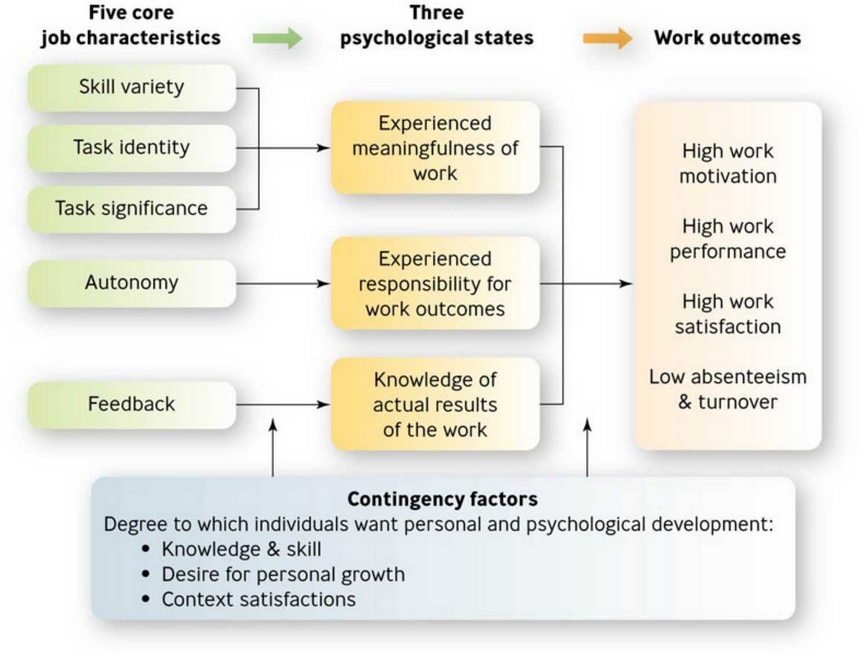
Job Characteristics Model
5 core job characteristics affect three psychological states which affect work outcomes
3 steps to apply model:
diagnose work environment to see whether a problem exists
determine whether job redesign appropriate
consider how to redesign job
task identity (are u in charge)
task significance (imporatnce/impact more than u)
RELATIONAL JOB DESIGN
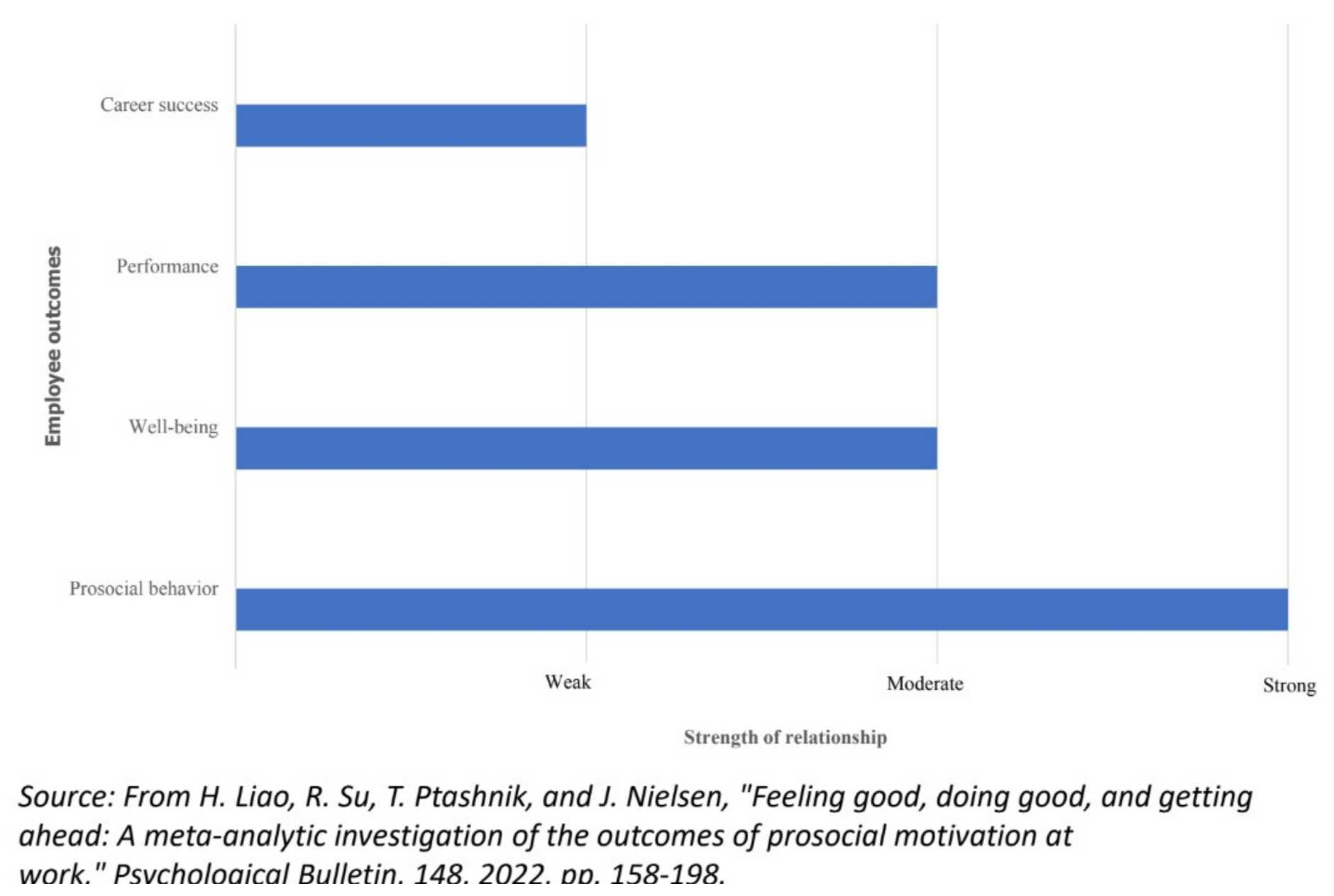
Relational job design focuses on designing the relational aspects of work to increase employees’ prosocial motivations, or the desire to benefit others.
Benefits of prosocial motivation:
Social capital.
Working harder.
Working smarter.
Working together.
Working safe.
focus on people
PROSOCIAL MOTIVATION’S IMPACT ON EMPLOYEE OUTCOMES
Job Design: Enrichment and Redesign and Motivation
Diagnose work environment to see if problem exists
does, consider:
Job Enrichment: Adding one or more motivating factors to job activities such as responsibility, achievement, recognition, stimulating work, and advancement
Job Redesign: Designing a better fit between workers and their jobs
Combining tasks
Forming natural work groups
Establishing client relationships
job enlargement consists of increasing number of tasks in a job to increase variety and motivation
Reinforcement Perspective on Motivation
based on notion that motivation is a function of behavioral consequences and not unmet needs
Reinforcement
anything that strengthens the likeliood that a given behavior will be repeated in the future
The administration of a consequence as a result of a behavior.
Proper management of reinforcement can change the direction, level, and persistence of an individual’s behavior.
Principles Governing Reinforcement
Law of effect.
Theoretical basis for manipulating consequences of behavior.
Behavior that results in a pleasant outcome is likely to be repeated while behavior that results in an unpleasant outcome is not likely to be repeated.
Law of contingent reinforcement.
The reward must be delivered only if the desired behavior is exhibited.
Law of immediate reinforcement.
The reward must be given as soon as possible after the desired behavior is exhibited.
2 ideas from foundation of this perspective:
skinner’s concept of operant conditioning: process of controlling behavior by manipulating its consequences
law of effect says behavior with favorable consequences tends to be repeated, while behavior with unfacorable consequcnes tend to disappear
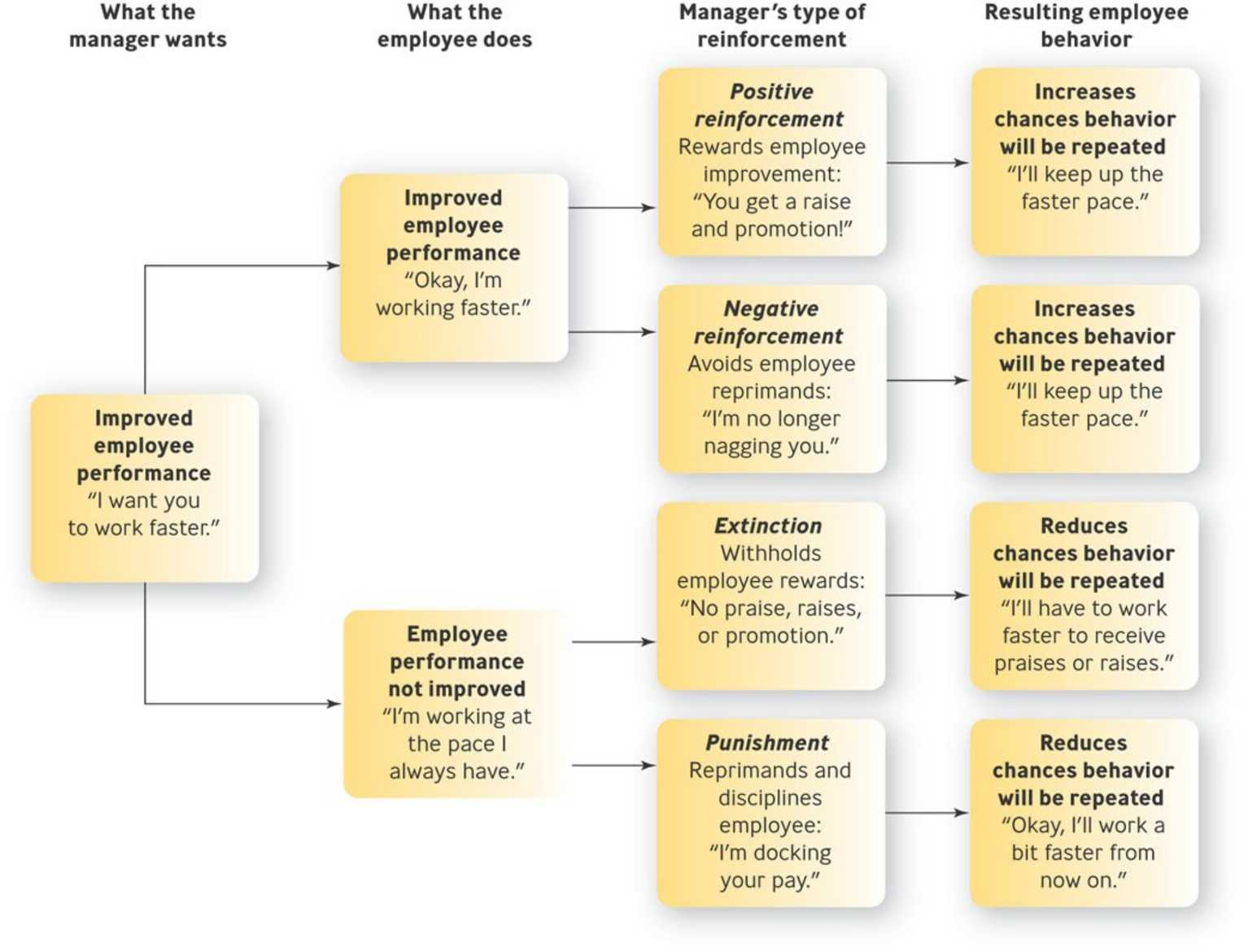
4 types of reinforcment
Positive reinforcement
use of positive consequences to encourage desirable behavior, be clear about what behavior is desired, give rewards as soon as possible
Negative reinforcement
process of strengthening a behavior by withdrawing something negative
Extinction
weakening of behavior by ignoring it or making sure it is not reinforced.
Punishment
process of weakening behavior by presenting something negative or withdrawing something positive
positive punishment: operant conditioning technique used to decrease an unwanted behavior by adding an unpleasant consequence immediately after
Using Reinforcement to Motivate Employees
Positive reinforcement
Reward only desirable behavior
Give rewards as soon as possible
clear about what behavior is desired
Have different rewards and recognize individual differences
Compensation and Other Rewards& Motivation
Organizations are using various types of incentive compensation to motivate employees to higher levels of performance
Variable compensation is a key motivational tool
Incentive plans can backfire
They should be combined with motivational ideas and intrinsic rewards
Incentives should reward the desired behavior
IS MONEY THE BEST MOTIVATOR?
Money still motivates, but it's not the only thing or even the most important thing.
Many workers rate having positive relationships at work, flexibility, and career growth opportunities as more important than salary.
A meta-analysis of 61 studies and over 18,000 respondents reveals pay is only minimally related with job satisfaction.
Examples of Popular Incentive Compensation Plans
Piece rate
employees are paid according to how mcuh output they produce, pay for performance aka profit pay
Sales commission
paid a % of earnings the company made from their sales
Bonuses
Profit-sharing
distribute to employees a % of companys profits
Gainsharing
dist of savings or gains to groups of employees who reduced costs and increase measurable productivity
Stock options
Pay for knowledge
Nonmonetary Ways to Motivate
Thoughtfulness: The Value of Being Nice
Work-Life Benefits
initiatives and programs that employee implemnet in an effort to help employees balance the often competing needs of their work and home lives
Positive Work Environment
Skill-Building/Educational Opportunities
Sabbaticals
extended periods of PTO that employees earn over several years
work life balance
3 types of learning opportunities: tuition reimbursement, learning and development, studying coworkers
How is Non monetary compensation motivating?
Intrinsic value
Show of accomplishment
Pride
Increase productivity of those around you
Difficulty of placing an actual monetary value on an accomplishment
Expectancy theory
Effort versus reward
The nature of leadership: the role of power and influence
What Is the Difference between Leading and Managing?
Managerial Leadership: Can You Be Both a Manager and a Leader?
Six Sources of Power
Common Influence Tactics
Outcomes of Influence Tactics
Managing and Leadership
Leadership and management must go hand in hand.
Leadership is the ability to influence employees to voluntarily pursue organizational goals
Leading and Managing
They are not the same thing.
They are necessarily linked and complementary
The manager’s job is to plan, organize and coordinate - get task done
The leader’s job is to inspire and motivate
need to create and communicate a company’s vision, strategies, and goals as well as to excute on these plans and goals
leadership coaching: process of enhancing a leader’s skills, abilities, and competencies in order to help the org achieve its goals
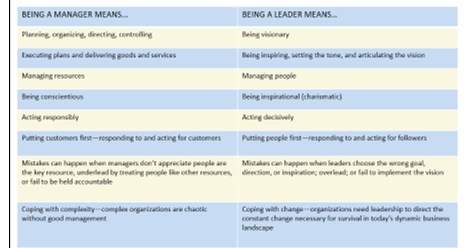
Managing versus Leading:Is there really a difference?
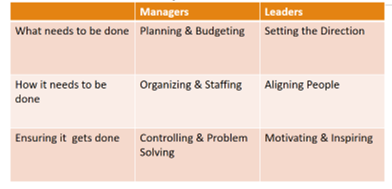
What is Managerial Leadership?
Workers need their managers not just to assign tasks but to define purpose
Managers must organize workers, not just to maximize efficiency, but to nurture skills, develop talent and inspire results
Managerial Leadership
The process of influencing others to understand and agree about what needs to be done
The process of facilitating individuals and collective efforts to accomplish shared objectives
Note the complementary nature of managing and leading
Understanding Leadership
What makes Managers different from Leaders?
Authority versus power
Authority
The right to perform or command - based on hierarchy of command
Power
the extent to which a person is able to influence others so they respond to orders
personalized power: power directed at helping oneself as a way of enhancing their own selfish ends may give the word power a bad name
socialized power: power directed at helping others
Understanding Leadership:6 Sources of Power
Legitimate power
results from managers’ formal positions within the organization
Reward power
results from managers’ authority to reward their subordinates
Coercive power
results from managers’ authority to punish their subordinates
Expert power
results from one’s specialized information or expertise (top gun)
Referent power
derived from one’s personal attraction, thru charisma
Informational Power
Derived from one’s access to information
Tactics for Influencing Others