Astronomy Exam One + Two
 Call Kai
 Learn
Learn Practice Test
 Spaced Repetition
 Match
Match Flashcards
 Knowt Play
1/99

Earn XP
Description and Tags
BGSU Astronomy 2010 Actual 2024 exams one and two questions for Finals preparations *DOES NOT INCLUDE QUESTIONS LEARNED AFTER EXAM TWO, JUST ONE AND TWO EXAM REVIEW*
100 Terms
Gravity pulls masses (and stars) together, yet it is almost a guarantee that no star will ever be pulled into the Sun, destroying our Solar System. Why?
Because stars are extremely small compared to their separation
Number comprehension can be a challenge in many human endeavors, including astronomy. Of the following, which is the largest number comprehensible to a normal adult human mind?
10,000
Modern radiometric dating of meteorites as proven that the Earth, Sun, and the entire Solar System is 4.57 X 10^9 years old. Another way to write this age is…
4.57 Gyr
The distance unit “astronomical unit” or “AU” was invented to measure the distance between planets and the Sun. The planet Earth is ______ AU from the Sun
1
Which of the following do we live in?
a solar system
a galaxy
the Universe
all of the above
all of the above
In our answer to “What is Science?” one of the things that is NOT a trait of science is _____.
once determined, a scientific theory can never change
Constellations are _____.
arbitrary patterns of stars as seen from the vantage point of Earth
The wavelength of a wave is the ____.
Distance from one peak to the next
A 500nm wavelength photon is seen as yellow light. What is the speed of this wave through space?
2.9979 X 10^8 m/s
Why is understanding light fundamental to understanding astronomy?
Because almost all information from beyond Earth comes to us from light
The number of an FM radio station is the number of its frequency measured in megahertz (millions of waves per second). If you listen to 97.9FM, what is the wavelength of the radio light radiated by the radio station’s tower?
3.06m
The electromagnetic spectrum is _____.
Light, of all types, arranged by wavelength
With our eyes we can see ______ of the electromagnetic spectrum.
very little
The energy of a visible light photon determines its _____.
frequency
color
wavelength
all of the above
all of the above
Electrons in an atom’s electron cloud _____.
can only exist at discrete distances from the nucleus of an atom
If an atom only has 5 possible electron orbits, how many different emission lines could this atom make?
10
“If an atom only has 5 possible electron orbits, how many different emission lines could this atom make?”
If this atom is fully ionized, how many different absorption lines could it make?
0
If we observe a set of emission lines from a gas cloud in space, we can deduce _____.
how excited the elements in the cloud making those lines are
what elements are present in the cloud and making those lines
how ionized the elements in the cloud making those lines are
all of the above
all of the above
Temperature is _____.
a measure of the average motion of the atoms in an object or substance
The Kelvin temperature scale is unfamiliar in our everyday lives, but its use has advantages over the more familiar Fahrenheit or Celsius scales. Which of these is one of the advantages?
0 K means zero energy. Material cannot have a negative Kelvin temperature
The heating elements on a typical household electric stove top will glow a red color once they fully heat up. If they produce the most light at a red wavelength of 700nm, what temperature is the element?
4,000 K
Considering that the metal that the heating element and the stove itself are made out of melts at temperatures near 1,600 K, what can we conclude about the heating element?
The element is not producing most of its light in the red. The peak emission must be in the infrared, and trails off into the red.
The Stefan-Boltzmann Law tells us that if the temperature of an object radiating light thermally is raised just a little bit, the amount of light it radiates _____.
increases a lot
If we observe two stars, and use Wien’s Law to deduce their temperatures as Tv1 = 8,000 K and Tv2 = 4,000 K, and we know via other observations that the stars are the same size, how much more light does the hotter star radiate?
16 times as much

What type of spectrum is this?
an absorption line spectrum

If you had a look-up table of all the emission/absorption line wavelength values of all the chemical elements, you could use this spectrum to ____.
deduce the elemental composition of the gas creating the dark lines

Using Kirchoff’s Laws we know this spectrum is _____.
caused by a continuous spectrum passing through a low density, cool gas
If we observe a pattern of emission lines in a laboratory and measure the red-most line to have a wavelength of 600 nm, and then we see the same pattern of lines in a star but the red-most line has a wavelength of 612 nm, this tells us that the star’s spectrum is ____.
red shifted, and that the star is moving away from us
“If we observe a pattern of emission lines in a laboratory and measure the red-most line to have a wavelength of 600 nm, and then we see the same pattern of lines in a star but the red-most line has a wavelength of 612 nm, this tells us that the star’s spectrum in ____.”
What is the line of sight velocity of the star in the question?
6,000 km/s
the Sun is not solid like the Earth, so what holds it up against its own gravity, i.e., why don’t all of the gas atoms simply fall to the center?
The Sun is held up by gas pressure
In visible light images it looks like the Sun has a surface, but we know this is false because the Sun is a gas and not a solid like the Earth. So, why does the Sun appear to have a surface?
As we look into the Sun, the photosphere is the first region in which the gas is opaque to visible light. Therefore the photosphere looks like a surface.
Which of the following is not caused by the Sun’s magnetic field?
granulation
Sunspots are ____.
cool regions in the photosphere
The solar wind and solar flares blast Earth with high energy charged particles. What protects the surface of the Earth from the full effects of these particles?
The Earth’s magnetic field and atmosphere
An example of parallax from every day life is _____.
Your thumb appearing to jump back and forth as you look at it with alternate eyes
If we measure the parallax angle of a nearby star to be 0.071 arc seconds, its distance is ____.
14 pc
The proper motion of a star is caused by ____.
its motion through space, perpendicular to the line of sight
The radial velocity of a star is measured via ____.
The Doppler Effect
The tangential velocity of a star is measured via ____.
an analysis of proper motion and distance
Why does the apparent brightness of a light source follow the so called inverse square law of brightness?
Because light spreads out as it travels.
Due to the inverse square law of brightness, if a light source is moved 10 times as far away its brightness will be _____ as much.
1/100th
If we observe a star with an apparent magnitude of m = 11 and another star with an apparent magnitude of m = 16 ______.
the m = 11 star is brighter
The luminosity of a star is _____.
how much energy a star radiates every second
If we measure how bright a star looks (apparent magnitude) and know how bright it really is (absolute magnitude) we can calculate its ____.
distance
Using the luminosity relationship for a star, if we know the luminosity of a star and its surface temperature we can calculate the star’s _____.
radius
For most stars, including the Sun, the absorption lines seen in the star’s spectrum are created _____.
as light from the photosphere passes through the chromosphere on its way out of the star
Main sequence stars are composed of _____.
about 70% H, 28% He, and 2% of everything else
Which absorption lines are visible in a star’s spectrum mostly depends on the star’s ____.
temperature
If we measure the spectral type of luminosity class of four stars as follows, which of the stars is a super giant?
B4 V
K6 IV
G9 I
M1 III
G9 I
If we measure the spectral type and luminosity class of four stars as follows, which of the stars has the hottest surface temperature?
B4 V
K6 IV
G9 I
M1 III
B4 V
Even though the teaching of Aristotle, which were believed true for almost 1700 years, said that massive objects fall faster than less massive objects, Galileo Galilei showed that ___.
This isn’t true. Object fall at the same rate without regard to their mass.
Why was Galileo able to correctly describe the motion of falling objects while Aristotle was unable to?
Galileo performed experiments while Aristotle believed that experiments were pointless
Of the four natural forces only the ____ force affects the motions of large objects on astronomical scales.
gravitational
With the precise physical definition of acceleration, how many devices does a bicycle have which are designed to allow the rider to cause it to accelerate?
1, the pedals
2, the pedals and the brakes
3, the pedals, the breaks, and the handlebars
4, the pedals, the brakes, the handlebars, and the bell or horn
3, the pedals, the brakes, and the handlebars
Isaac Newton proved that the force that we feel holding us down to the surface of the Earth is the same force that _____.
Holds the Moon in its orbit
Orbits only come in four possible shapes. Which of the following is NOT one?
hyperbola
ellipse
oval
circle
oval
What one physical parameter determines the shape of an object’s orbit around the Sun?
the velocity of the object relative to the Sun
If two spacecraft are on circular orbits around Earth, one on a very high orbit and the other on a much lower orbit, the one on the much higher orbit ____.
will have a slower velocity
Two satellites are launched into circular orbit. One orbits the Earth with on orbital radius of 7,000 km and the other orbits the Moon with an orbital radius of 7,000 km. What’s true about this?
The satellite orbiting the Moon must be moving slower in its orbit than the satellite orbiting the Earth is in its orbit
Binary stars provide the only direct way to measure the ____ of stars
masses
In a binary system, the two stars orbit around _____.
the center of mass of the system
To create a star a large amount of mass needs to be packed closely together. The conditions to do this are found ____.
in giant molecular clouds
What fundamental law of nature dictates that star formation will usually also result in planetary formation?
conservation of angular momentum
The energy in the light that comes from the surface of the Sun ____.
was created by nuclear fusion in the center of the Sun
In order for fusion to take place in a gas, the gas must be ____.
extremely hot and high density
The proton-proton chain is ____.
the set of three reactions that produce ^4vHe out of 4^1vH
What happens to the positrons (e+) generated in the proton-proton chain?
They almost immediately annihilate with electrons producing energy
The “solar neutrino problem” was solved when it was experimentally verified that ____.
an electron neutrino can spontaneously change into one of the other two types of neutrino
Since we can’t see to the center of the Sun, how have the nuclear reactions been verified?
The neutrinos produced in the reactions pass freely out of the Sun and have been detected here on Earth
What is a way that nature transports energy (energy flow) but is not an important process inside of stars?
conduction
There are two energy transport processes that are important inside of stars. What determines which one primarily transports the energy at any given point inside of a star?
The transparency of the gas
Hydrostatic equilibrium is an important concept for understanding the interior structure of a star. What does this concept mean?
At every point inside of a star the force of gravity pulling in must be balanced by pressure pushing out.
In the study of astronomy, a stellar model is ____.
a set of computations of the interior conditions of a star necessary to produce the observed parameters of the star
Using the relationship between lifetime on the main sequence and stellar mass, how long will a star with 7 times the mass of the sun, M=7.0Msun remain a main sequence star?
7.7 X 10^7 yr
Models predict that the main sequence lifetimes of the lowest mass main sequence stars (M V stars) are ___.
Extremely long, longer than the current age of the Universe
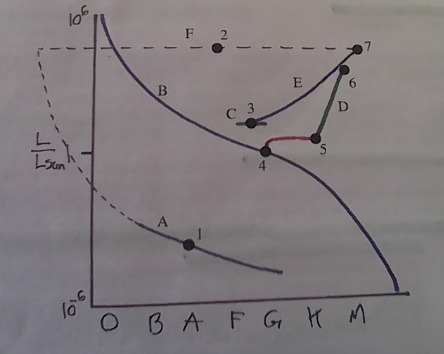
This diagram is known as a/an ___.
Hertzsprung-Russell diagram
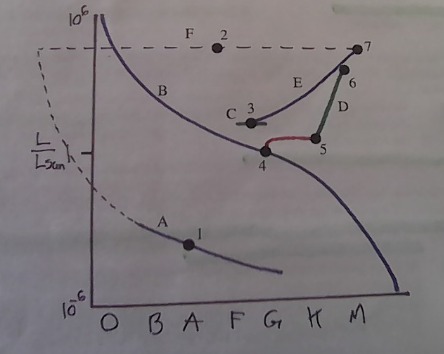
As drawn, spectral class is plotted on the horizontal axis. Another stellar parameter which can be plotted on the horizontal axis without changing the diagram is ____.
temperature
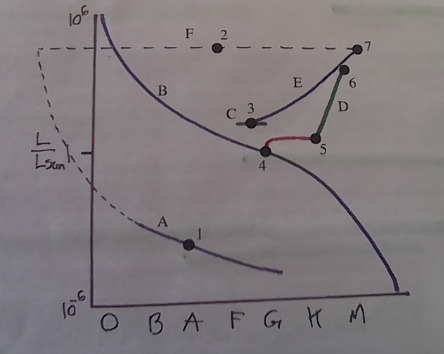
The letter ____ is representing the group of stars known as the main sequence.
B
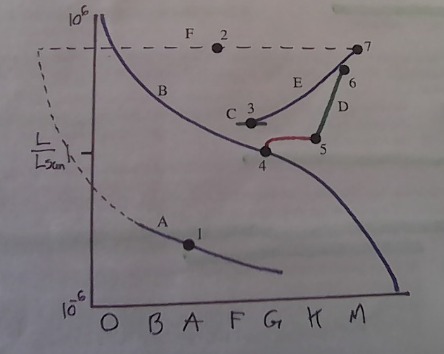
The letter ____ represents the group that most stars belong to.
B
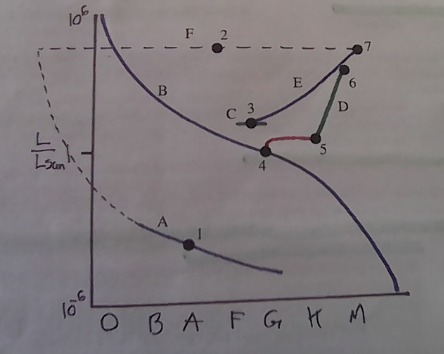
What is the name of the evolutionary stage indicated by the letter D?
giant branch
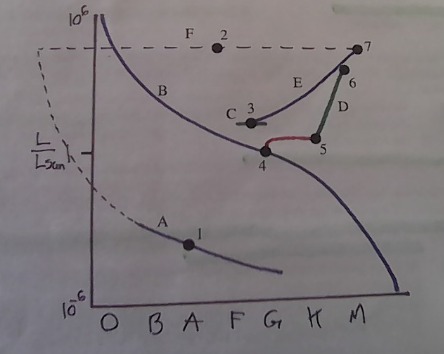
In the evolutionary stage indicated by the letter D, what is the energy source of the star and where in the star is the energy generated?
H —> He fusion in a shell around the inert core
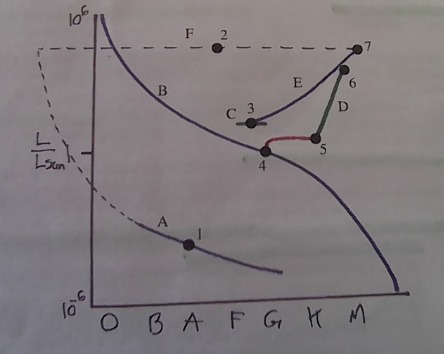
In the evolutionary stage indicated by the letter B, what is the energy source of the star and where in the star is the energy generated?
H —> He fusion in the core
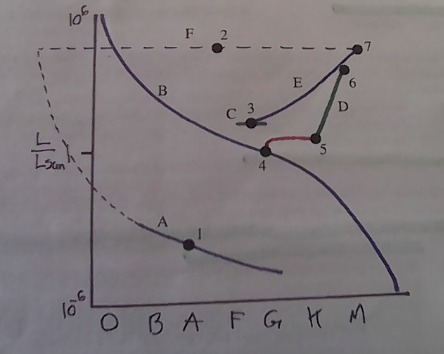
What is the name of the evolutionary stage indicated by the letter A?
white dwarfs
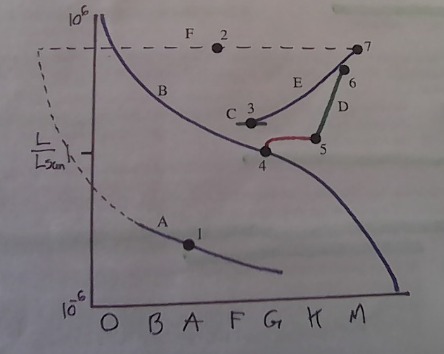
In the evolutionary stage indicated by the letter A, what is the energy source of the star and where in the star is the energy generated?
There is no energy source in the evolutionary stage; the star just cools
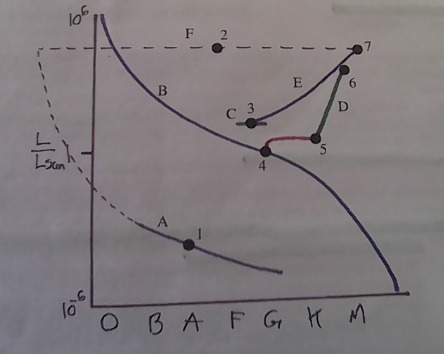
In what order does a star with a mass of one solar mass (M=1Msun) pass each of the numbered points during its lifetime?
4 5 6 3 7 2 1
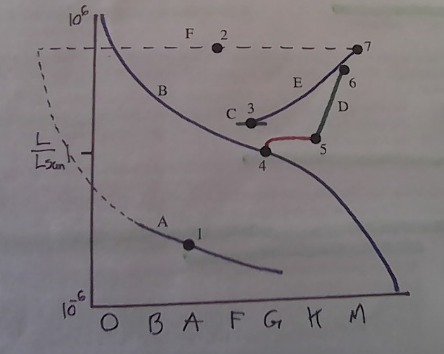
Between points 5 and 6 why does the luminosity of the star increase?
The compressed core gets hotter, causing shell fusion to go faster
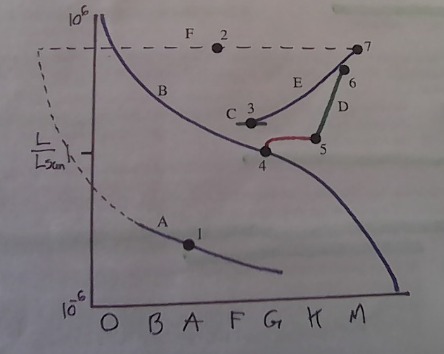
At point 7 the star _____.
pulsates and expands so much that its escape velocity is too low to hold the star together
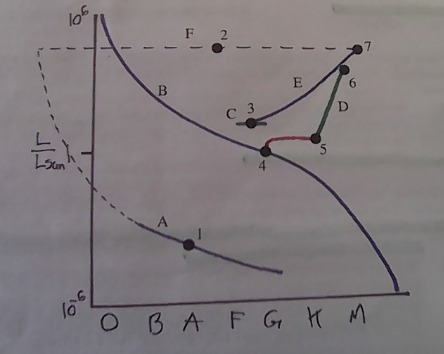
Near which numbered point does the star begin to fuse He in its core for the first time?
6
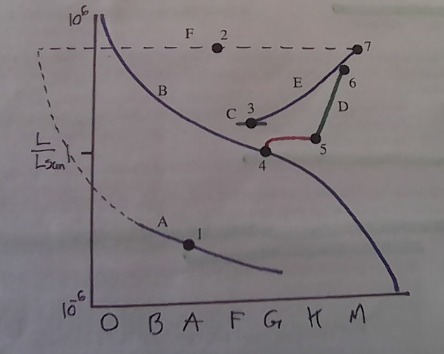
Near which numbered points is the star stable because it has ongoing core fusion?
4 and 3
Giant stars are ____.
stars with much larger radii than main sequence stars of the same temperature
The position of a star on the main sequence, that is to say its luminosity and temperature, is caused by which of its physical parameters?
its mass
A planetary nebula is ____.
the expanding outer layers of a dying star
White dwarf stars are produced ____.
when a planetary nebula is formed
A white dwarf star as no ongoing fusion, yet it is perfectly stable against its own gravity. Why?
It is composed of a degenerate gas, and its internal pressure depends only on density
A strange property of a white dwarf star is that if mass is added to the star, the star gets ___.
smaller, its radius shrinks
If enough mass is added to a white dwarf by a companion giant star that its mass exceeds 1.4Msun, the white dwarf _____.
collapses in on itself and then explodes as a type I supernova
What is the heaviest element (lowest on the periodic table) that can be produced by fusion in a super giant star and still generate energy?
C & O, carbon and oxygen
Early simulations of collapsing super giants predicted the stars would completely implode and form black holes. Observations show that they explode as type II supernovae. What was discovered to be missing from the early simulations, that is what actually “blows up” a type II supernovae?
neutrino pressure
At the end of their lives, the massive stars that produce type II supernovae are called “super giants”. Why?
they are much bigger in diameter than giant stars
Neutron stars are directly observable as
pulsars