APES CH 9, 10, 11 NOTES
 Call Kai
 Learn
Learn Practice Test
 Spaced Repetition
 Match
Match Flashcards
 Knowt Play
1/134

There's no tags or description
Looks like no tags are added yet.
Name | Mastery | Learn | Test | Matching | Spaced | Call with Kai |
|---|
No analytics yet
Send a link to your students to track their progress
135 Terms
Biophilia
E.O. Wilson’s term for the inherent human affinity and emotional connection to the natural world
Wild species importance
Wild species are important for economic, medical, scientific, ecological, aesthetic, recreational, and ethical reasons
Food crops from wild plants
90% of today’s food crops were domesticated from wild tropical plants
Plant-based medicine
80% of the world’s population relies on plants or plant extracts for medicine
Extinction
Extinction is a natural process where a species disappears completely from Earth
Percent of species extinct
99% of all species that have ever existed are now extinct due to background and mass extinctions
Background rate of extinction
The small number of species that become extinct naturally; also called the natural rate of extinction
Mass extinction
An abrupt rise in extinction rates above the background level, often followed by adaptive radiations
Adaptive radiation
Rapid increase in the diversity of life forms as species evolve to fill newly available ecological niches after a mass extinction
Natural background comparison
If there are about 100 million species, the natural background extinction rate would be about 30 species per year
Human-caused extinction crisis
The current extinction crisis is the first caused by a single species (humans) and is happening over decades instead of thousands to millions of years
Evolutionary centers
Biologically diverse environments that historically served as centers for the recovery of biodiversity after mass extinctions
Ecological extinction
Occurs when a species becomes so rare that it can no longer perform its ecological roles where it exists
Biological extinction
Occurs when a species is no longer found anywhere on Earth
Local extinction
Occurs when a species disappears from an area where it once lived but still exists elsewhere in the world
Endangered species
A species with so few individuals remaining that it could soon become extinct across all or most of its natural range
Threatened species
A species that is still abundant in its natural range but is declining in numbers and likely to become endangered
Ecosystem approach
A conservation strategy that aims to preserve balanced populations of species in their native habitats, establish protected areas, and reduce nonnative species
Species approach
Protecting endangered species by identifying them, giving them legal protection, preserving habitats, and propagating and reintroducing them
Maximum sustainable yield
The wildlife management goal of harvesting the largest number of individuals possible without reducing the population long-term
IUCN
The International Union for Conservation of Nature, the world’s leading authority on species conservation
IUCN Red List
The global database maintained by the IUCN that provides the most comprehensive assessment of species conservation status
CITES
The 1975 Convention on International Trade in Endangered Species that regulates international trade of threatened wildlife and wildlife products
Almost 38,700 species are listed and cannot be traded internationally as live specimens or wildlife products because they are endangered or threatened
Endangered Species Act
A major U.S. environmental law that protects endangered and threatened species and their habitats
The National Marine Fisheries Service and the U.S. Fish and Wildlife Service identify and list endangered and threatened species
Major amendments occurred in 1978, 1982, 1988, and 2004
The 2004 amendment reduced effectiveness by exempting the Department of Defense from some critical habitat designations
Enforcement and use of the Endangered Species Act can change significantly depending on U.S. policymakers
Bald Eagle example
Bald Eagle (Haliaeetus leucocephalus) recovered enough to be removed from the endangered species list in 2007
Whooping Crane example
Whooping Crane (Grus americana) population dropped to a low of 54 individuals
Red Wolf example
Red Wolf (Canis rufus) population dropped to a low of 17 individuals
California Condor example
California Condor (Gymnogyps californianus) is the most expensive species conservation project in U.S. history
Florida Manatee example
Florida Manatee (Trichechus manatus latirostris) was recently moved from the endangered list to the threatened list
Wildlife management definition
The manipulation of wildlife populations and their habitats for both their welfare and human benefit
Flyways
North–south migration routes along which migratory birds must be managed
Succession management
Wildlife managers can control ecological succession to encourage plant species that provide preferred food and cover for certain animals
Invasive species
Species introduced into ecosystems by humans that spread rapidly and often harm native species
also called alien
Introduced species
Species that humans deliberately or accidentally move into ecosystems where they did not previously exist
Nonnative species
Species that are not naturally found in a particular ecosystem
Traits of invasive species
Often generalist and r-selected species that reproduce quickly and outcompete native organisms
Examples of invasive species
Zebra mussel, kudzu vine, lionfish, and Burmese python

HIPPCO
Acronym describing the six main threats to biodiversity
Habitat loss/degradation
H in HIPPCO
Invasive species
I in HIPPCO
Human population growth
P in HIPPCO (first)
Pollution
P in HIPPCO (second)
Climate change
C in HIPPCO
Overexploitation
O in HIPPCO
Ecosystem services
Natural services that support life on Earth and are essential to human quality of life and the functioning of the world’s economies
Provisioning ecosystem services
Ecosystem services that provide food, water, medicine, and raw materials
Regulating ecosystem services
Ecosystem services that regulate natural processes such as pollination, water purification, and pest control
Supporting ecosystem services
Ecosystem services that provide species habitats and maintain genetic diversity
Cultural ecosystem services
Ecosystem services that provide recreation, intellectual development, and tourism
Public lands in the United States
42% of U.S. lands are set aside for public use, enjoyment, and wildlife
73% of U.S. public lands are located in Alaska
Multiple-use lands
Lands such as those in the National Forest System and National Resource Lands that are managed for a variety of uses simultaneously
Sustainable yield principle
Renewable resources should not be harvested faster than they are naturally replenished
Multiple-use principle
Land should be managed for a variety of uses at the same time such as recreation, logging, grazing, and wildlife habitat
Types of forests
Forests are generally classified into tropical, temperate, and polar forests based on climate
Old-growth forests
Uncut forests or regenerated forests that have not been seriously disturbed for several hundred years
Second-growth forests
Forests that regrow after being cut or disturbed through secondary ecological succession
Economic importance of forests
Forests provide lumber for housing, pulp for paper, biomass for fuel, medicines, and many other products
Heating use of timber
Worldwide, about 55% of the timber cut each year is used for heating and cooking
U.S. wood imports
The United States is the world’s largest per capita importer of wood products
China wood imports
China is the largest overall importer of wood products
Forest watersheds
Forests filter and regulate the flow of water from mountain areas to croplands and cities
Forest influence on climate
Forests influence climate because 50–80% of atmospheric water vapor comes from trees through transpiration and evaporation
Forests and carbon cycle
Forests play a critical role in the carbon cycle by absorbing about 90% of atmospheric carbon dioxide
Forest biodiversity
Forests provide more habitats for wildlife species than any other terrestrial biome
Tropical deforestation rate
About 46,000 square miles of tropical forest are lost or degraded each year
Primary causes of tropical deforestation
Population growth, poverty, and government policies
Secondary causes of tropical deforestation
Roads, logging, farming, ranching, flooding from dams, mining, and oil drilling
Forest management systems
The two main systems are even-aged management and uneven-aged management
Even-aged management
Trees are planted and grown at the same age and size, often using monocultures, and harvested at the same time
Uneven-aged management
A mix of tree species and ages are planted and maintained for multiple uses and greater biodiversity
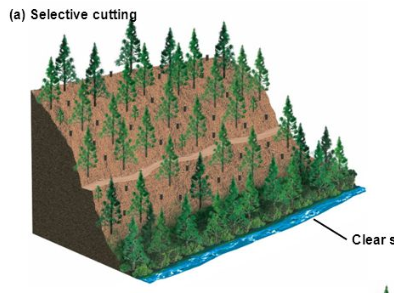
Selective cutting
Harvesting method where intermediate or mature trees are removed individually or in small groups
High grading
The selective cutting of the most valuable trees in a forest
Shelterwood cutting
Removing mature trees in two or three stages over about 10 years to allow new trees to grow
Seed-tree cutting
Harvesting nearly all trees in an area but leaving a few seed-producing trees to regenerate the forest
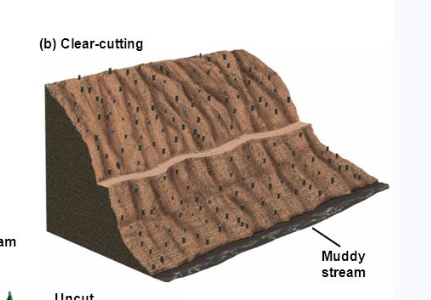
Clear-cutting
Removing all trees in an area in a single cutting for economic efficiency
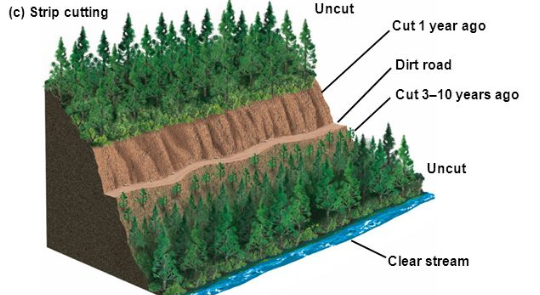
Strip cutting
A type of clear-cutting where trees are cut in narrow strips along the land contour to allow natural regeneration
Whole-tree harvesting
Cutting trees at ground level or uprooting entire trees to be chipped for pulpwood or fuelwood
Role of fire in forests
Natural fires are an important part of the ecological cycle in some forest ecosystems
Surface fires
Fires that burn undergrowth and leaf litter along the forest floor
Crown fires
Fires that burn entire trees and spread from treetop to treetop
Fire prevention
Actions taken to prevent forest fires before they start
Prescribed burning
Controlled ground fires set intentionally to reduce buildup of flammable materials
Presuppression
Early detection and control efforts to prevent small fires from spreading
Suppression
Fighting fires after they have started
Sustainable forestry
Forest management practices designed to maintain forest resources and ecosystem services long-term
Reduce harvest of pulpwood
Recycling more paper reduces the need to cut trees for pulpwood
Forest fragmentation
Breaking large forest areas into smaller pieces, which sustainable forestry aims to minimize
Grasslands
The ecosystem most widely used and altered by humans after forests
Soil formation in grasslands
Grasslands contribute to the formation of fertile soil
Erosion control in grasslands
Grasslands help reduce soil erosion
Nutrient cycling in grasslands
Grasslands help recycle nutrients through plant and soil processes
CO2 storage in grasslands
Grasslands store atmospheric carbon dioxide
Grassland biodiversity
Grasslands help maintain biodiversity
Rangelands
Unfenced grasslands used for grazing animals
Browsing animals
Animals that feed on shrubs and woody plants instead of grasses
Overgrazing
Occurs when too many animals graze too long and exceed the carrying capacity of the land
Soil compaction
A result of overgrazing where soil becomes packed down, reducing water infiltration and plant growth
Selective
Shelterwood
Seed tree
Strip
Clear
Whole tree
Tree harvesting methods best to worst
Ecosystem approach
Encourages the protection of habitats and ecosystem services through a four-point plan.
Map global ecosystems and create an inventory of the species within and ecosystem services provided
Protect the most endangered ecosystems and species
Restore degraded ecosystems
Encourage biodiversity-friendly development
Human impacts on marine species
Many marine species are disappearing due to overfishing, pollution, and habitat destruction and degradation