measurement of energy transfer - 8
 Call Kai
 Learn
Learn Practice Test
 Spaced Repetition
 Match
Match Flashcards
 Knowt Play
1/38

There's no tags or description
Looks like no tags are added yet.
Name | Mastery | Learn | Test | Matching | Spaced | Call with Kai |
|---|
No analytics yet
Send a link to your students to track their progress
39 Terms
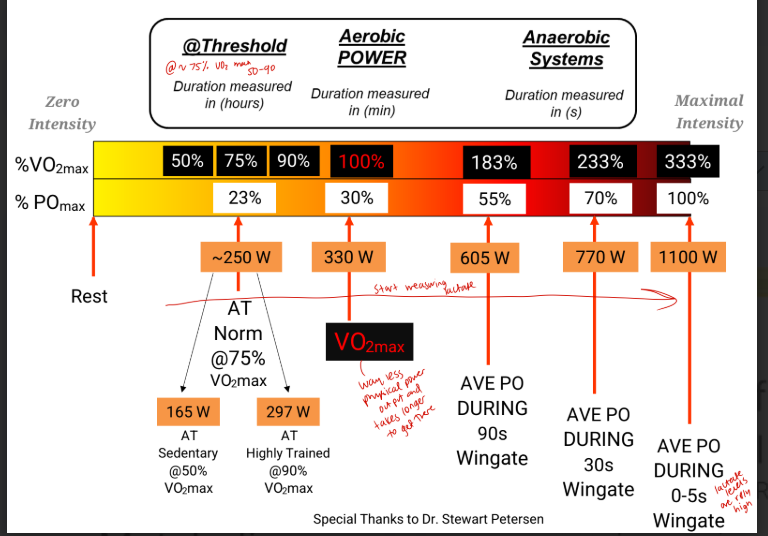
what do the different %VO2 max and %PO max look like
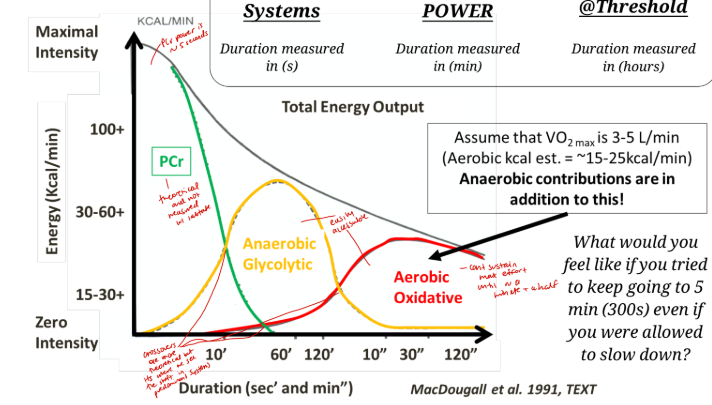
what are the different energy system contribution
PCR - power is around 5 seconds, theoretical and not measured with lactate
anaerobic glycolytic - easily accessible
aerobic oxidative - easily accessed, cant sustain max effort until around a minute and a half
crossovers are more theoretical but its where we set the shift in predominant systems
Why can’t the aerobic system contribute more to a 10s ALL OUT effort?
they dont turn on instantly
Why does Glycolysis contribute significantly to 10s, 30s, and 90s ALL OUT efforts?
• What is the role of Muscle Glycogen?
its fast and available so if depleted it affects everything
role of MG - rapid atp production, supports anaerobic and aerobic exercise, delays fatigue
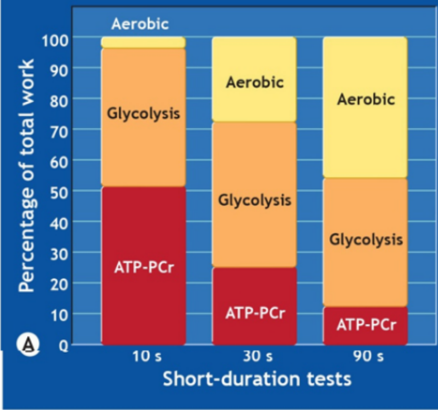
What would be the performance effect if you could start with more PCR?
more available for the first 15 seconds and it might extend it by a couple of seconds
what is performance fatigue
FATIGUE is: the inability to maintain a power output or the
force of a muscular contraction during sustained effort or
repeated stimulation.
what are two ways to think abt physiological fatigue
context dependent
depletion theory
fatigue results form decreases in certain metabolites specifically ATP, PCr and glycogen
accumulation theory
fatigue results from the accumulation of metabolites which impair force generation, specifically H+ **, ammonia, Pi (means youre breaking down a lot of ATP)- might inhibit enzymes
lactate accumulation is an indicator of fatigue not the cause
what are the important recovery times
ATP-PC store - 21-22 second half life and 3-5 minute full
muscle H+ - 5-8 min half time and 12 - 20 minute full (takes longer in the second half which is why its not 18 minutes)
blood H+ - 10-20 min half time and 30-60 full time
muscle La- - half life of 12-20 min and less than 60 min full life
blood La- - 25 min half life and 60+ min full life
muscle glycogen resynthesis (post exercise with adequate nutrition)
continuous 6 hours and 48 hours
intermittent 5 hours and 24 hours
anaerobic system - what are the physiologic indicators of short term energy systems
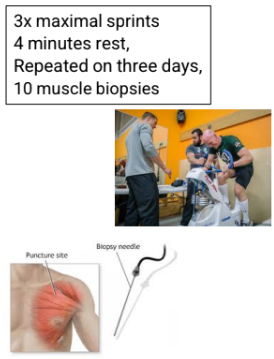
We often do not appreciate that energy systems need time to restore themselves. If we repeatedly engage maximal effort it is difficult to be precise about how ATP is resynthesized.
We can assume that the aerobic contribution will increase with repeated maximal efforts while performance is likely to decline, because the anaerobic systems are depleted and fatigue has accumulated.
This experiment is a superb illustration of the changing contributions from the major energy pathways while engaging in repeated sprint performance
anaerobic system - what does optimal recovery look like from non steady state exercise
• Aerobic exercise in recovery (30-50% VO2 max) accelerates blood lactate removal with increased perfusion and blood flow - active recovery
• Buffering capacity can be augmented with training to help maintain pH in the muscle, extending anaerobic power production or repeated anaerobic power production and reducing power drop off - buffering can help recover from high intensity
• Altered nutrition may increase the amount of extra cellular (bicarbonate) and intracellular buffer (carnosine, via beta alanine) buffer
lactate being high is a good thing
increased buffering capacity = increased capacity to resist change in pH
anaerobic system - what are the role of buffer in the nutritional prep of athletes
Extracellular bicarbonate concentration can be increased by about 20% following ingestion of sodium bicarbonate
~0.3 g per kg body mass 1-2 h before exercise
Sodium bicarbonate supplementation can produce gastrointestinal disturbances.
Muscle carnosine concentration can be increased by dietary supplementation with ß-alanine
~3–6 g of ß-alanine per day for 4–8 wk
ß-alanine supplementation in doses greater than 10 mg/kg BM can lead to a short period of paresthesia (prickling sensation on the skin)
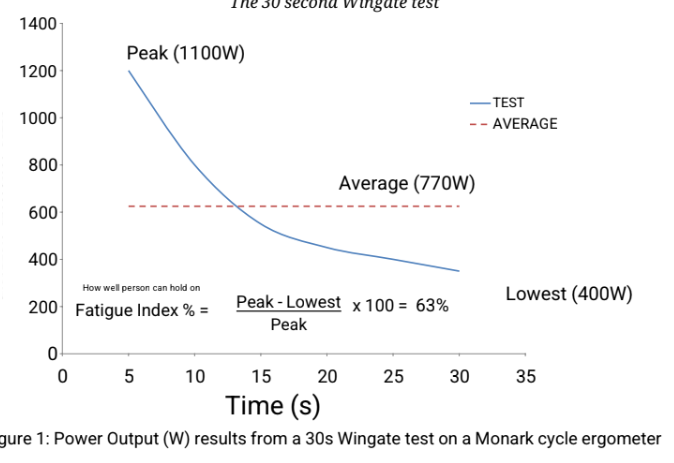
what is a anaerobic power and capacity test
30 sec wingate test
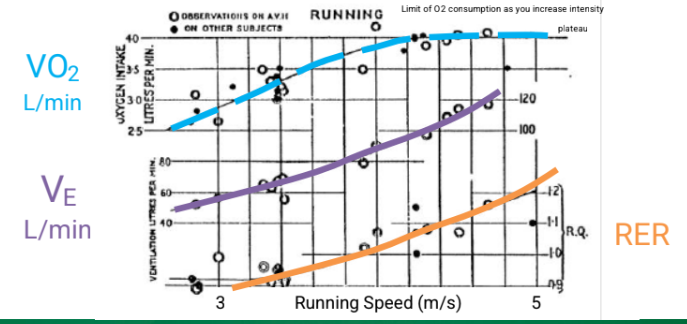
aerobic system - what was the history of measuring VO2 max with incremental graded exercise testing
DEFINITION: The maximal ability to intake,
circulate and utilize oxygen
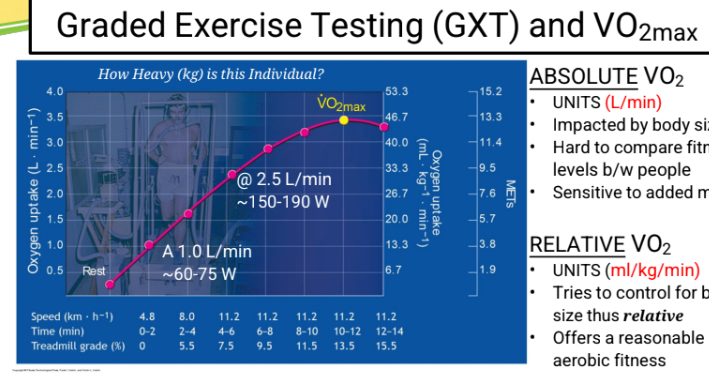
what is absolute and relative VO2
ABSOLUTE VO2
• UNITS (L/min)
• Impacted by body size
• Hard to compare fitness levels b/w people
• Sensitive to added mass
RELATIVE VO2
• UNITS (ml/kg/min)
• Tries to control for body size thus relative
• Offers a reasonable aerobic fitness comparison between people
how to convert absolute to relative VO2
ABSOLUTE to RELATIVE = [VO2 (L/min) x 1000 (ml/L)] / BM(kg)
can backtrack to find body weight
what is one MET in relative VO2
1 MET = 3.5 ml/kg/min or [RELATIVE VO2/3.5]
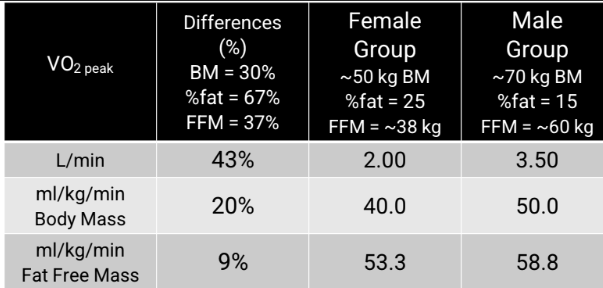
what does the comparison look like between male and female with the same relative VO2 max
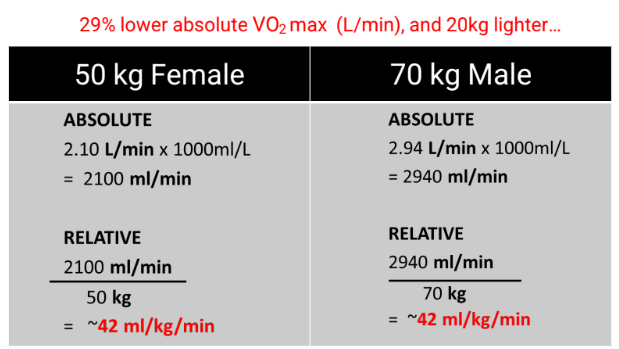
how much lower are female VO2 max values compared to males
As a group, Females have VO2max values that are 15% to 30% less than that of males
• Individual Females can have higher scores than individual males but not so for groups
• Leanness, muscle mass, and heart sizes are higher in males
• Fat mass is lower in males
• Hemoglobin mass is 10 to 14% higher in males
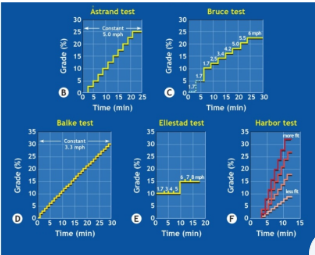
what are the different graded exercise testing protocols
• Duration should be more than 5 minutes and less than 15 minutes.
• Workloads (stages) can be short (30s) or longer (3-5 min) depending on the purpose of the test
• Subject motivation is important, they should reach exhaustion (10/10 effort)
• A “Repeat Supramaximal effort” after a brief rest can elicit a higher VO2max
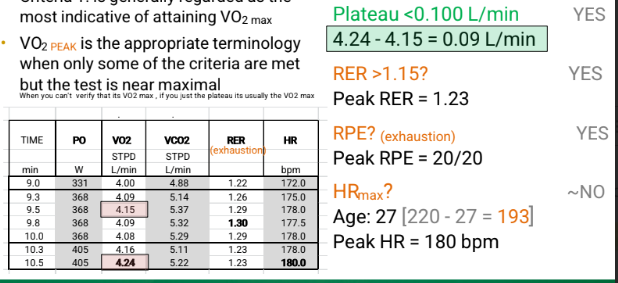
what are the 4 criteria to assess VO2 max
1. Peak or plateau in VO2 with an increase in intensity (∆ <100 ml/min OR ∆ < 0.100 L/min) - doesnt always happen
2. RER greater than 1.15 (sometimes 1.10) - their producing a lot of CO2 and approaching VO2 max
3. Volitional Exhaustion (RPE at maximal effort, 19-20 out of 20) - shows intensity scale or can they hang on for 30 more seconds
4. Known HRmax achieved - if they are at HR max their probs at VO2 max
• or within 10 bpm of predicted HRmax (est. 220-age)
• or plateau in HR with an increase in intensity (PO)
Blood lactate levels at least about 8 to 10 mmol but Bla is quite variable from test to test
Peak oxygen uptake is the correct term (VO2peak) when max criterion is not met or local muscle fatigue rather than central circulatory dynamics limits the test
how do you distinguish VO2 max and VO2 peak
• Criteria 1. is generally regarded as the most indicative of attaining VO2 max
• VO2 PEAK is the appropriate terminology when only some of the criteria are met but the test is near maximal - when you can’t verify that its VO2 max, if you just see the plateau its usually VO2 max
These results would be considered VO2MAX by most common criteria
what are the main assumptions of predicting VO2 max
1. There is a linear relationship between Power Output (PO), VO2 and Heart Rate (HR) during graded exercise - a lees fit person will hit HR max at a lower VO2, linear relationship between HR and PO
2. You can accurately predict HRmax
3. If you can accurately predict HRmax it will match VO2 max because of the cardiac limitations on oxygen delivery in the body
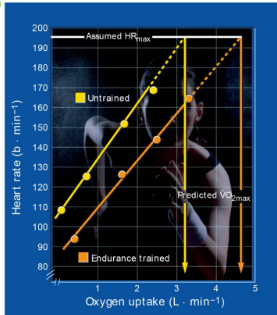
in theory how else can you predict VO2
• If you know HR, PO and VO2 at TWO submaximal intensities you can extrapolate the PO-VO2 slope and predict VO2 across the range of increasing intensities
• By plotting the VO2-HR slope you can predict what VO2 will be at assumed HRmax
what are the limitations in predicting VO2 max from HR
• Linearity of HR–VO2 relationship.
• Similar max HR for all subjects.
• Assumed constant exercise economy - if your efficiency changes it cn affect the slope of the line
• Day-to-day variation in exercise HR.
• Suitable for screening and classification of aerobic fitness but unacceptable for research purposes.
• At best falls within 10 to 20% of person’s actual VO2max - when you do predictive tests with a lot of people its good but its not good when you use one person so instead do a metabolic cart and do maximal test
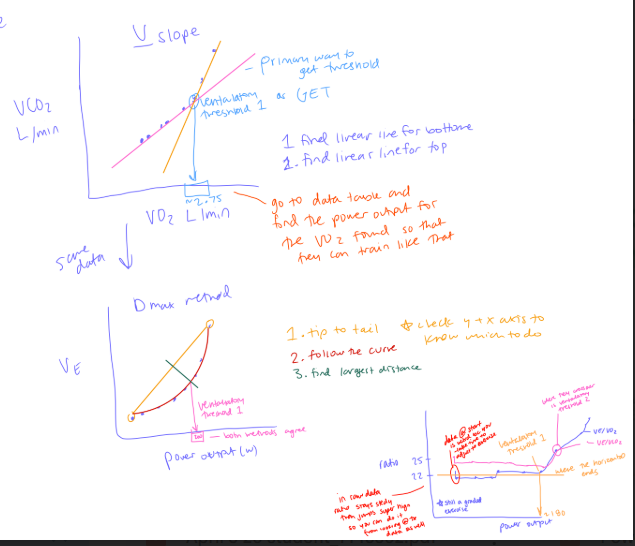
what are two ways to measure VO2
what are the oxygen uptake values for relative VO2 for different active levels
• Elite Endurance Athlete (Very Competitive)
- M 70-85+ ml/kg/min
-F 60-75 ml/kg/min
• Conditioned (End. amateur, team sports)
- M 50-65 ml/kg/min
- F 45-60 ml/kg/min
• Normally Active (wide range)
- M 40-50 ml/kg/min
- F 35-45 ml/kg/min
• Sedentary (wide range)
- M <40 ml/kg/min
- F <35 ml/kg/min
• Independent living Seniors (added)
- M & F > 15 ml/kg/min