Cellular Respiration & Fermentation 2.0
 Call Kai
 Learn
 Practice Test
 Spaced Repetition
 Match
 Flashcards
 Knowt Play
1/36

Name | Mastery | Learn | Test | Matching | Spaced | Call with Kai | Chat |
|---|
No analytics yet
Send a link to your students to track their progress
37 Terms
Fermentation
An anaerobic metabolic process that allows cells to generate energy in the absence of oxygen by breaking down glucose.
Primary biological purpose of fermentation
To regenerate NAD+ from NADH so that glycolysis can continue producing ATP without oxygen
Cellular location of fermentation
Cytoplasm
Net ATP yield per glucose molecule in fermentation
2 ATP
Lactic acid fermentation
A pathway occurring in overworked muscle cells and certain bacteria that reduces pyruvate to lactate to regenerate NAD+.
Alcoholic fermentation
A pathway occurring in yeast and some plant cells that converts pyruvate into ethanol and CO2 to regenerate NAD+
Lactic acid fermentation after glycolysis can be summaried as
Pyruvic acid + NADH —> Lactic acid + NAD+
A summary of alcoholic fermentation after glycolysis is
Pyruvic acid + NADH —> Alcohol + CO2 + NAD+

What’s 1a, 1b, 1c, and 1d?
Alcoholic Fermentation, NAD+, 2 Ethyl Alcohol, NADH
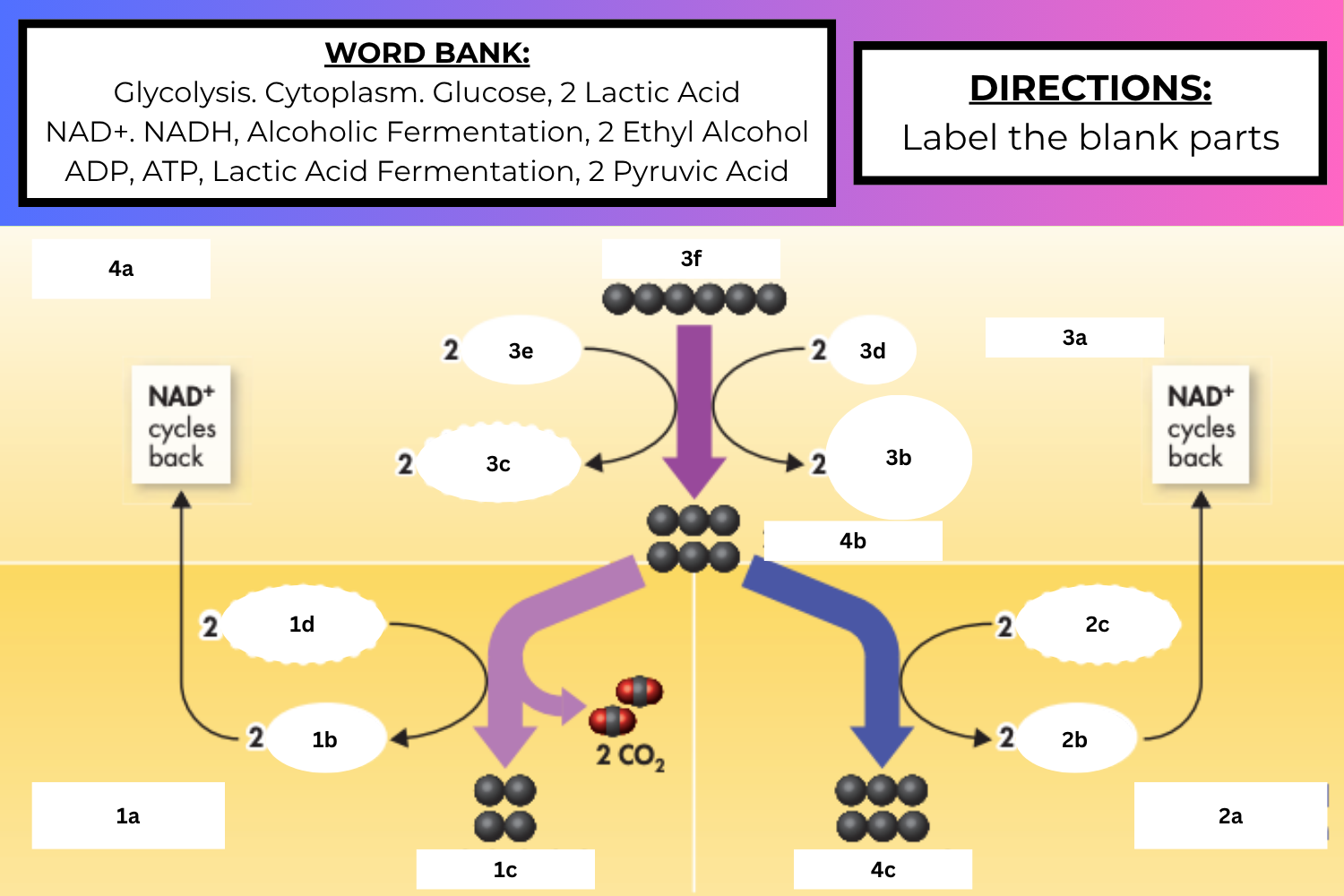
What’s 2a, 2b, and 2c?
Lactic Acid Fermentation, NAD+, NADH
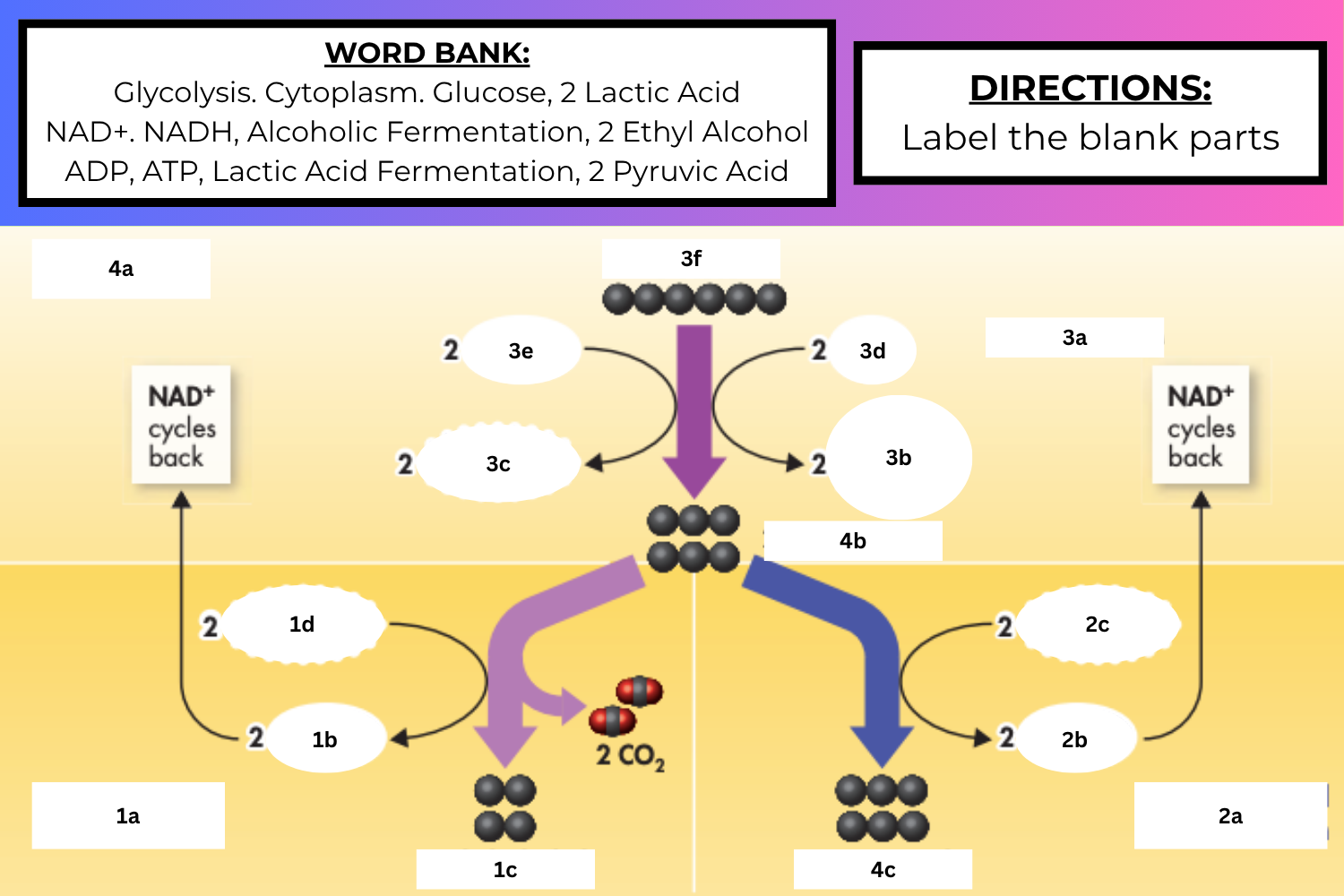
What’s 3a, 3b, 3c, 3d, 3e, and 3f?
Cytoplasm, ATP, NADH, ADP, NAD+, Glucose

What’s 4a, 4b, and 4c?
Glycolysis, 2 Pyruvic Acid, 2 Lactic Acid
Cellular respiration is
The process cells use to turn food, like glucose, into usable energy called ATP (adenosine triphosphate), while releasing waste.
Cellular Respiration Inputs
Glucose (sugar) and oxygen
Cellular Respiration Outputs
Carbon dioxide, water, and ATP
Step 1 of Cellular Respiration
Glycolysis
• Where it happens: Cytoplasm (the fluid inside the cell).
• What it does: Splits one glucose molecule into two pyruvate molecules.
• Energy yield: A small net gain of 2 ATP.
Step 2 of Cellular Respiration
Citric Acid Cycle (Krebs Cycle)
• Where it happens: Mitochondrial matrix (the inner space of the mitochondrion).
• What it does: Breaks down pyruvate derivatives, releasing carbon dioxide and loading up electron carrier molecules (NADH and FADH₂).
• Energy yield: 2 ATP.
Step 3 of Cellular Respiration
Electron Transport Chain (Oxidative Phosphorylation)
• Where it happens: Inner mitochondrial membrane.
• What it does: Uses electrons from NADH and FADH₂ to pump protons and create a gradient; oxygen acts as the final electron acceptor to form water.
• Energy yield: The vast majority of ATP (roughly 28 to 34 ATP).
Cellular Respiration: Why It Matters (Energy Currency)
Generates ATP, which powers everyday cell tasks like muscle movement, active transport, and growth.
Cellular Respiration: Why It Matters (No Oxygen Alt)
If oxygen is absent, cells switch to fermentation (producing lactic acid or alcohol), which yields far less energy.
What is the main goal of both cellular respiration and fermentation?
To break down nutrients (like glucose) and produce ATP (energy) for the cell.
What is Glycolysis?
The first step of both processes where glucose is broken down in the cytoplasm, producing 2 ATP.
What is Cellular Respiration?
An aerobic process (uses oxygen) that completely breaks down glucose in the mitochondria to make a lot of energy.
What are the three main stages of cellular respiration?
Glycolysis, Krebs Cycle (Citric Acid Cycle), Electron Transport Chain
What is the total ATP yield of cellular respiration?
Highly efficient; it produces about 36 to 38 ATP per glucose molecule
What is the chemical equation for cellular respiration?
Glucose + Oxygen ➔ Carbon Dioxide + Water + ATP
What is Fermentation?
An anaerobic process (no oxygen) that allows cells to make a small amount of energy in the cytoplasm.
Why does fermentation happen if it makes less energy?
It clears waste products and recycles NAD+ so glycolysis can keep running when oxygen is missing.
What is the total ATP yield of fermentation?
Low efficiency; it only yields the 2 ATP made during glycolysis.
What are the two main types of fermentation?
Alcohol (occurs in yeast) and Lactic acid fermentation (occurs in muscles and bacteria)
What are the products of Lactic Acid vs. Alcohol fermentation?
• Lactic Acid: Lactic acid + NAD+
• Alcohol: Ethanol + CO2 + NAD+

What’s 1a, 1b, 1c?
Mitochondria, electron transport, ATP

What’s 2a, 2b, 2c?
2 FADH2, Krebs cycle, 2 ATP

What’s 3a, 3b, 3c, 3d?
8 NADH, 4 CO2, 2 CO2, 2 NADH

What’s 4a, 4b, 4c?
2 NADH, 2 Pyruvate, 4 ATP

What’s 5a, 5b, 5c, and 6a?
Cytoplasm, 2 ATP, Glycolysis, and Glucose
During which stage of aerobic cellular respiration is the most ATP synthesized?
Electron transport chain is the step